


5,49 €
Mehr erfahren.
- Herausgeber: Editora Jaguatirica
- Kategorie: Fremdsprachen
- Sprache: Englisch
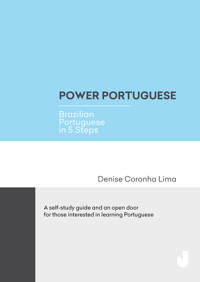
Power Portuguese, Brazilian Portuguese in 5 Steps is a self-study guide and an open door for those interested in learning Portuguese. It includes a strategic collection of words, everyday expressions and the fundamentals of grammar, carefully integrated for you to begin to communicate in basic and correct Brazilian Portuguese. Simple formulas and straightforward grammatical explanations mean that you will be able to select and put together combinations of words and phrases for real-life situations. These are matched up with exercises to test your knowledge revealing the essence of the language. Afterwards, you can assess how well you did by checking the answers at the end of the book. Power Portuguese consists of 5 Steps only. Besides the book, you also have a set of Power Charts. * A obra representa um auxílio ao estudo individual autodidata. Ela inclui uma coleção estratégica de palavras, expressões do cotidiano e os fundamentos da gramática, cuidadosamente integrados para que o aluno possa se comunicar de modo básico e correto do Português brasileiro. Esse estudo consiste em apenas 5 passos, criados por Denise Coronha Lima.
Sie lesen das E-Book in den Legimi-Apps auf:
Seitenzahl: 130
Veröffentlichungsjahr: 2015
Ähnliche






Folha de rosto
© 2015 Editora Jaguatirica
Todos os direitos reservados
Proibida a reprodução parcial ou total desta obra por qualquer processo sem autorização por escrito da editora.
edição e revisão Paula Cajaty
projeto gráfico M.F. Machado Lopes
Produção de ebook S2 Books
CIP-BRASIL. CATALOGAÇÃO NA PUBLICAÇÃO SINDICATO NACIONAL DOS EDITORES DE LIVROS, RJ
L698p
Lima, Denise Coronha
Power Portuguese : Brazilian Portuguese in 5 steps / Denise Coronha Lima. - 1.ed. - Rio de Janeiro : Jaguatirica, 2014.
149 p. : il. ; 24 cm.
eISBN 978-85-66605-42-6
1. Língua portuguesa - Gramática - Estudo e ensino. 2. Língua portuguesa - Estudo e ensino - Falantes estrangeiros. 3. Língua portuguesa - Compêndios para estrangeiros. I. Título.
14-17613
CDD: 469.824
CDU: 811.134.3(81)’36’243
08/11/2014 10/11/2014
Editora Jaguatirica
Rua da Quitanda, 86, 2º andar
Centro Rio de Janeiro RJ CEP 20.091-902
Tel. (21) 4141-5145 | 3747-1887
www.editorajaguatirica.com.br
ACKNOWLEDGMENT
Graham Jepson, a former student of Portuguese at the time he was a corporate expat in Rio, has contributed his time and unique talent in the making and editing of this volume. All his input and support have added a special energy to every stage of this book, from beginning to end.
FOREWORD
I always wanted my Portuguese lessons to be authentic get-togethers in which we could imitate real life and simply talk with one another, listening to stories from all corners of the world. With that in mind, I began to develop a method using grammar as a friend. As time passed, I discovered that each of the students created something unique to themselves: a comprehension and use of the language that reflected their own lives, so it stayed with them and they did not forget.
Writing this book, I was reminded of their questions and innumerable accents; of their anxiety and determination in facing the unforeseen challenges of the Tropics; and, also, of their fascination and wonder. The results of my experience in teaching Portuguese to them are synthesized here so that more people can overcome the language barrier and take full advantage of all that Brazil has to offer.
BIO
Heading up Rio Total Consultoria, Denise Coronha Lima is a carioca (native of Rio de Janeiro) teacher of Portuguese for foreigners and an intercultural facilitator. Through her work, she has helped clients of more than 50 different nationalities to gain insights and develop strategies for tackling the language and culture of Brazil, all easy to implement in day-to-day life as well as in business. Denise also provides orientation for Brazilians on the development of cross-cultural skills to facilitate positive interactions with people of other nationalities. She graduated with a BA in Languages and has post-graduate qualifications in Distance Education and in Applied Linguistics, and is also a certified Life & Professional Coach. Her first book, Ensinando Português no Mundo Corporativo, was targeted specifically for teachers of Portuguese for foreigners in the business arena.
INDEX
INTRODUCTION
PORTUGUESE AND THE WORLD
Portuguese is currently among the most spoken of languages[1], being in third place in the western world. It is the official language of Brazil[2], Portugal, Angola, Mozambique, Guinea-Bissau, Equatorial Guinea, São Tome and Príncipe, Cape Verde and East Timor, which form the Community of Portuguese Speaking Countries (CPLP) — one language belonging to more than 250 million native speakers spread across four continents.
In Brazil, the language brought by the Portuguese colonizers embraced the indigenous peoples´ culture along with the traditions brougth by slaves from different parts of Africa. As these groups began to integrate, the Brazilian version of the Portuguese language[3] evolved into something that has become especially colorful[4].
Just as happened with, for example, English and Spanish around the world, the Portuguese used in Europe, South America, Africa and Asia has its differences. However, they do not get in the way of our mutual understanding. In Brazil, many visitors want to learn enough of the language to get to know the country and its people, to do business or simply to enjoy our music. Actually, it seems that everything that has to do with Brazil today attracts attention, including Portuguese. For those with plans to live and work here, understanding the language helps untangle everyday life[5], adding spice to the Brazilian experience[6].
Nowadays, learning Portuguese has become a valuable “ace up the sleeve”[7] especially for those expatriates who take up positions in other Portuguese speaking countries after Brazil. Not surprisingly, they can read documents, take part in meetings and interact with their new co-workers as well as local authorities from day one. Sometimes they find their way back to Brazil with new projects and assignments or, when the time comes, to retire.
In Brazil, you may get lucky and meet people who can speak English and with whom you can chat and even make new friends. However, the overwhelming majority of Brazilians are not really able to interact fluently in other languages. Away from hotels[8], restaurants, up-market shops, and outside the multinational offices, you will see for yourself that any new word can be worth its weight in gold. Once in Brazil, you will be totally surrounded by Brazilian Portuguese[9].
POWER PORTUGUESE BLUEPRINT
Whenever I mention that I teach Portuguese to foreigners, I am countered with “but Portuguese is so difficult”. Not necessarily. Learning the language can be a quick and captivating challenge, depending on how it is done.
Knowing how well people are able to connect with Portuguese, integrating blocks of knowledge for themselves, I recently condensed the essence of the language into a 2-hour survival workshop. Students from different parts of the world had such a positive response to it that I expanded the material into this volume. If you also have the ambition to learn Portuguese, this book is for you[10].
— This material represents an original approach to self-study. It includes a strategic collection of words, everyday expressions and the fundamentals of grammar, carefully integrated for you to begin to communicate in basic and correct Brazilian Portuguese.
— Simple formulas and straightforward grammatical explanations mean that you will be able to select and put together combinations of words and phrases for real-life situations. These are matched up with more than 50 exercises to test your knowledge revealing the essence of the language. Afterwards, you can assess how well you did by checking the answers at the end of the book. I recommend that you take the time to do the exercises because they will give you feedback on how well you are actually doing. With that perspective, you can identify what you may need to revise.
— This self-study and self-paced framework consists of 5 Steps only. Feel free to start or jump to any step as you will.
STEP 1 : WORDS IN COMMON — A FREE PASS TO PORTUGUESE
If your next stop in life is Brazil, a wide open door into Portuguese is the large number of recognizable words of Latin (and also Greek) origin, with which speakers of for example Spanish, French and Italian, and even English are familiar. That is our first move in building a vocabulary. Start experimenting. Play around and discover how much you already know.
STEP 2 : IMPORTANT NEW WORDS
Nobody learns a language without acquiring new vocabulary. With this in mind, Power Chart 1: Important New Words gives you a selection of key words, arranged by topic. This section also includes Power Chart 2: Power Numbers that fits into your wallet to help you whenever you are buying and paying. Knowing how to handle numbers makes a difference and creates confidence.
STEP 3 : SMALL WORDS IN SEQUENCE
For those who say “it’s the small words that are difficult” or “I don’t know how to put words together”, this is your chance to discover what the language offers. Here you can make choices, via the easy-to-use Power Chart 3: Small Words in Sequence, trying out whatever new combinations come to mind.
STEP 4 : THE MAP OF VERBS
Students from all over the world have called this tool “The Map” because it reveals visually how verbs work in Portuguese.
With one single page, in simple graphical form, you will make friends with conjugations in Power Chart 4: The Map of Verbs and put full sentences together. In case you want to go further I have also designed Power Chart 6: Top Irregular Verbs, which is expanded upon in an Appendix to Step 4.
STEP 5 : RESPONDING WITH IMPACT
Every language has a set of everyday phrases that fit into almost all kinds of conversation. With Power Chart 5: Responding with Impact at hand you too can start modeling the natural way that only native speakers have to keep the conversation going.
— Besides the book, you also have a set of Power Charts[11] at the end of this volume. Easy to handle, this material can be carried in your car or in a bag. The charts have been used even by people in some large corporations in Rio de Janeiro who arrange them in view on the office desk, as well as on the dining table at home, where they serve as a friendly reminder of correct Portuguese grammar.
Roll up your sleeves. We are about to enter the world of Brazilian Portuguese.




