29,99 €
Mehr erfahren.
- Herausgeber: Elektor International Media
- Kategorie: Wissenschaft und neue Technologien
- Sprache: Englisch
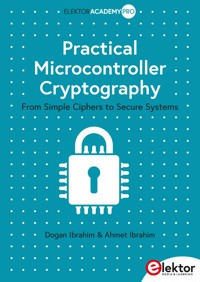
Understanding how to apply cryptography on modern microcontrollers is essential for building secure, reliable, and trustworthy systems. This book explains cryptography in the context of embedded hardware, from classical ciphers that illustrate core principles to modern techniques such as AES for practical high-security applications. By combining mathematical theory with real-world microcontroller implementations, readers learn not only how cryptography works, but also how to implement it effectively on systems with limited processing power and memory. The book is intended for students starting out in cryptography, hobbyists securing personal projects, and engineers looking for a structured guide to embedded security. The book covers these key topics in applied cryptography: - Classical ciphers on Arduino Uno and Raspberry Pi Pico, with full programs: Spartan Scytale, Hebrew Atbash, Caesar, ROT13, Alberti Disk, Vigenère, Affine, Polybius, Playfair, Beaufort, Ottoman Codebook, and One-Time Pad. - Hacking classical ciphers using microcontrollers, with examples. - Pseudo-random (PRNG) and true random number generation (TRNG) on microcontrollers. - Symmetric-key cryptography with full programs: DES and AES-128/256. - Memory and speed constraints of cryptography on microcontrollers. - Asymmetric cryptography: public/private keys, digital signatures, key distribution and derivation (KDF), RSA, and SHA-256 implementations. - A complete secure communication program using RSA and AES-256. - A glossary of commonly used cryptography terms.
Das E-Book können Sie in einer beliebigen App lesen, die das folgende Format unterstützt:
Veröffentlichungsjahr: 2026