


1,99 €
Mehr erfahren.
- Herausgeber: Quickie Classics
- Kategorie: Geisteswissenschaft
- Sprache: Englisch
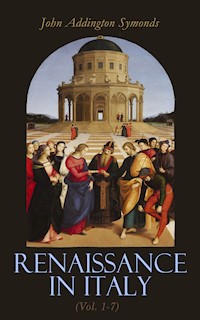
In seven volumes—The Age of the Despots; The Revival of Learning; The Fine Arts; Italian Literature I–II; The Catholic Reaction I–II—Symonds surveys the Italian Renaissance as a movement of bold statecraft, recovered letters, and new artistic vision. He blends biography with cultural analysis, quoting chronicles and treatises while linking city politics to philology, painting, and style. In elegant Victorian prose, he offers a panoramic yet precise narrative that culminates in a sober account of the Counter-Reformation. Symonds (1840–1893) was a Bristol-born classicist, poet, and translator of Cellini's Autobiography, whose long travels and archival work in Italy shaped these studies. His Hellenism, his biography of Michelangelo, and his private inquiries into sexuality and selfhood oriented him toward Renaissance individualism. Years of ill health and convalescence in Davos granted time for wide reading and synthesis, yielding a method that joins close citation to sweeping comparison across literature, art, theology, and civic life. Renaissance in Italy remains a lucid, durable guide and a bracing companion to Burckhardt. Read it for vivid portraits, command of sources, and fearless theses; consult it for orientation before newer monographs. Symonds's capacious vision makes this classic an essential gateway to the era's politics, learning, and arts. Quickie Classics summarizes timeless works with precision, preserving the author's voice and keeping the prose clear, fast, and readable—distilled, never diluted. Enriched Edition extras: Introduction · Synopsis · Historical Context · Brief Analysis · 4 Reflection Q&As · Editorial Footnotes.
Das E-Book können Sie in Legimi-Apps oder einer beliebigen App lesen, die das folgende Format unterstützen:
Veröffentlichungsjahr: 2026
Ähnliche





Renaissance in Italy (Summarized Edition)
Table of Contents
Introduction
At the heart of Renaissance in Italy lies the drama of how a society rediscovered the powers of mind, art, and individuality even as it wrestled with the constraints of tradition, religious authority, and uncompromising political realities, a restless interplay that unfolds in courts and communes, in studios and libraries, in festivals and battlefields, where new languages of beauty and thought contend with inherited loyalties, civic ambitions, and the unpredictable conduct of fortune, so that the emergence of modern sensibilities appears not as a serene revival but as a contested, luminous, and sometimes perilous negotiation between aspiration and order.
John Addington Symonds presents this work as a large-scale cultural history, written in the late nineteenth century by an English scholar attuned to literature, art, and ideas, and set amid the Italian city-states from the fourteenth to the sixteenth centuries and their immediate aftermath. Across seven volumes, he surveys political life, the revival of classical learning, the visual arts, vernacular literature, and the religious currents that reshaped the peninsula. The result is a genre-crossing synthesis—part narrative history, part criticism, part intellectual biography—constructed from wide reading and animated by a humanistic conviction that culture, personality, and institutions illuminate one another.
Symonds organizes his inquiry so that each volume isolates a major facet of the epoch while continually returning to the wider pattern. He begins with the political conditions of principalities and republics, turns to the recovery and dissemination of antiquity through scholarship and education, examines the evolution of architecture, sculpture, and painting, devotes sustained attention to Italian literature in its manifold genres, and concludes with the religious reaction that redirected energies and redefined boundaries. Readers encounter a sequence of carefully staged panoramas rather than a single linear story, each designed to show how ideas, practices, and patrons shape creative and civic life.
Stylistically, the series marries erudite argument with vivid scene-making and the steady cadence of the essay. Symonds writes as a critic as well as a historian, offering lucid syntheses, pointed evaluations, and close attention to the temper of cities, courts, workshops, and texts. His prose favors long, persuasive arcs that collect many threads into a single view, yet he regularly pauses over concrete examples to clarify terms, trace influences, and weigh competing interpretations. The tone remains reflective and humane, confident without pedantry, encouraging readers to move between particulars and generalities and to experience the Renaissance as a living field of inquiry.
In theme, Renaissance in Italy traces how humanist study, artistic experiment, and political innovation together cultivate a heightened sense of personality and public life. Symonds returns to the uses of antiquity, considering how classical models authorize new ambitions and styles while provoking debate about virtue, fame, and civic responsibility. He probes the arts as instruments of persuasion and self-fashioning within systems of patronage. He follows the tension between republican ideals and princely command, and the parallel friction between contemplative piety and worldly curiosity. Throughout, language, education, and institutions structure possibility, making culture a theater where competing values struggle and coexist.
For contemporary readers, the set matters both as a foundational interpretation of the Renaissance and as a document of Victorian historical imagination. Its panoramic method models how to connect art, politics, and learning across disciplines, while its attention to agency and institutions sheds light on perennial questions about creativity under pressure, the relationship between culture and power, and the social life of ideas. The work also invites critical engagement: its categories and emphases reflect the assumptions of its time, making it a useful companion for thinking about how narratives are built and how legacies are contested, reworked, and transmitted.
Approached as a whole or dipped into by interest, Renaissance in Italy rewards steady, reflective reading, with each volume offering an entry point into a different arena of Renaissance life. Symonds’s surveys provide orientation before sharpening into analyses that encourage independent judgment, making the series hospitable to newcomers and stimulating for seasoned readers. The cumulative effect is to render Renaissance Italy intelligible without flattening its strangeness, and to show how inquiry itself is a creative act. By charting continuities and breaks with unusual clarity, the work remains a durable companion to understanding modern Europe’s roots and the stakes of cultural memory.
Synopsis
John Addington Symonds’s Renaissance in Italy, a seven-volume study published in the late nineteenth century, surveys how Italy’s political structures, scholarship, arts, and letters collectively forged a new cultural epoch. Organized as The Age of the Despots, The Revival of Learning, The Fine Arts, two volumes on Italian Literature, and two on The Catholic Reaction, the sequence moves from civic upheaval to creative expansion and subsequent constraint. Drawing on chronicles, biographies, artistic monuments, and literary works, Symonds builds a composite portrait of a society experimenting with individuality and classical models. The series traces continuities and fractures from medieval legacies toward forms recognizably modern.
Dwelling first on the fractured map of communes and principalities, Symonds examines how dynastic ambition, mercenary warfare, and opportunistic diplomacy produced the so-called despotisms of the fourteenth and fifteenth centuries. Courts in cities such as Milan, Ferrara, Florence, and Naples pursued magnificence while managing endemic violence and shifting alliances. He considers municipal institutions, family strategies, and the assertion of personal rule, relating these to the emergence of civic spectacle and new conceptions of selfhood. The papacy’s temporal interests and competing city-states’ balance-of-power politics frame a milieu in which insecurity and cultural display advance together, setting the stage for humanist education, patronage, and artistic innovation.
In The Revival of Learning, Symonds follows the recovery of antiquity through humanist scholarship. He recounts the collection and collation of manuscripts, the study of Greek alongside Latin, and the formation of academies under princely and civic patrons. Philology, translation, and textual criticism reshape education and public discourse, culminating in the spread of print and the organization of libraries. Figures and institutions are treated as conduits for methods rather than as isolated curiosities, clarifying how eloquence, historical writing, and moral philosophy were refashioned to civic ends. Attention to tensions with ecclesiastical authority underscores the movement’s confidence and its vulnerabilities in a changing religious climate.
Turning to the arts, the series maps the technical and stylistic revolutions of architecture, sculpture, and painting. Symonds connects linear perspective, naturalistic anatomy, and revived classical ornament to workshops, guilds, and commissions from republics, courts, and the Church. He distinguishes regional schools—Tuscan design and draftsmanship, Roman grandeur, and Venetian color—while following careers that exemplify ambition and craft discipline. From cathedral domes and urban palaces to altarpieces and civic frescoes, he links artistic problems to patronal expectations and urban identity. The narrative stresses how competition, collaboration, and theoretical reflection elevated the status of the artist, creating exemplary works and a discourse of art that traveled beyond Italy.
The paired volumes on literature trace vernacular and Latin writing from fourteenth-century foundations into the Cinquecento. Symonds surveys lyric, the novella tradition, pastoral and burlesque verse, didactic and critical prose, and the emergence of theatre. He treats courtly dialogues, epic poetry, and political history as intertwined responses to social change, exploring how graceful style and moral debate coexist in a culture that prized performance and wit. Attention to patronage, academies, and censorship reveals the conditions under which authors worked. Across genres, he tracks the negotiation between classical imitation and inventive form, showing how Italian models set standards for European taste and rhetorical education.
The final two volumes assess the Catholic Reaction, charting how reform within the Church and the assertion of orthodoxy reconfigured Italian intellect and art. Against the backdrop of councils, religious orders, and tribunals, Symonds describes the codification of doctrine, the policing of books, and changes in pedagogy. He follows consequences for historical writing, philosophy, drama, and sacred art, noting both renewed devotional energy and narrower latitude for speculation. Political circumstances, including foreign dominion in parts of the peninsula, shape the tone of cultural life. The analysis balances loss and transformation, tracing adjustments in style and subject that redirected Renaissance inheritances into new, sanctioned channels.
Read as a whole, Renaissance in Italy offers a layered account of how political experiment, classical learning, artistic technique, and literary form interacted to produce a durable European legacy. Symonds’s synthesis emphasizes the emergence of the self-conscious individual, the circulation of ideas through institutions, and the contingencies that can hasten or inhibit creativity. Without reducing complexity to a single cause, the work links civic realities to aesthetic choices and intellectual methods. Its enduring resonance lies in giving readers a coherent map of the Italian movement’s breadth and limits, clarifying why its achievements remained influential even as later religious and political pressures altered their direction.
Historical Context
John Addington Symonds’s multivolume Renaissance in Italy (published 1875–1886) surveys the transformation of the Italian peninsula from the late fourteenth to the early seventeenth century. Its setting spans autonomous communes, princely courts, and the Papal States amid the overlapping claims of emperors and popes. City-states such as Florence, Venice, Milan, Naples, and Rome form the chief arenas for politics, commerce, and culture. Institutions central to the narrative include guilds, universities at Bologna and Padua, and ecclesiastical bureaucracies. Symonds situates artistic and intellectual change within this fragmented geography, tracing how civic competition, courtly patronage, and church power shaped the distinctive conditions that historians call the Italian Renaissance.
Politically, Symonds emphasizes the shift from medieval communal republics to signorie and despotisms led by dynasties such as the Visconti and Sforza in Milan, the Este in Ferrara, the Gonzaga in Mantua, and the Medici in Florence. He underscores professional warfare by condottieri and the emergence of resident diplomacy. The Peace of Lodi in 1454 and the subsequent Italian League sought equilibrium among regional powers. That balance unraveled with Charles VIII’s French invasion in 1494, drawing Italy into prolonged Habsburg–Valois wars. By mid-sixteenth century, Spanish Habsburg ascendancy constrained Italian autonomy, a political backdrop that frames Symonds’s analysis of patronage, censorship, and cultural resilience.
Urban wealth underwrote the Renaissance. Venice’s maritime empire linked Adriatic and Levantine trade; Florence’s bankers and merchants financed governments, churches, and courts. Houses like the Medici operated international branches, while textile guilds sustained skilled labor. The Black Death of 1348 reduced populations and altered labor markets, but recovery fueled urban building and artistic commissions. Italian presses, beginning at Subiaco in 1465 and flourishing in Venice by the 1470s, multiplied texts; the Aldine Press, founded by Aldus Manutius in 1494, standardized classics and portable editions. Courts and confraternities organized festivals, pageants, and civic ritual, creating audiences and institutional frameworks for art and learning.
Symonds situates humanism at the movement’s core. Petrarch and Boccaccio promoted classical Latin and recovery of texts, shaping civic chanceries under Coluccio Salutati. Manuscript hunters like Poggio Bracciolini expanded the canon, while Lorenzo Valla’s philology exposed the Donation of Constantine (c. 1440) as a forgery. The Council of Florence in 1439 facilitated Greek studies; émigré scholars such as Bessarion encouraged translations. Marsilio Ficino’s Platonic Theology and Pico della Mirandola’s syncretic theses epitomized intellectual ambition. Universities at Padua and Bologna fostered Aristotelian study and legal training. Symonds links grammar, rhetoric, and history to elite education, public life, and broadened secular interests.
Art and architecture illustrate how technique served new ideals of observation, anatomy, and proportion. Brunelleschi’s dome for Santa Maria del Fiore (consecrated 1436) and Alberti’s treatises advanced engineering and theory; linear perspective transformed pictorial space in the hands of Masaccio and Piero della Francesca. Donatello redefined sculpture; Botticelli, then Leonardo da Vinci, Michelangelo, and Raphael shaped the High Renaissance under patrons including Lorenzo de’ Medici, Julius II, and Leo X. In Venice, Bellini, Giorgione, and Titian developed colorito. Palladio’s villas and The Four Books of Architecture (1570) systematized classical forms. Symonds integrates patronage, workshop practice, and civic symbolism throughout.
Literature bridges Latin scholarship and the Italian vernacular. While Dante precedes Symonds’s main period, Petrarch and Boccaccio established Tuscan prestige. Quattrocento humanists wrote chiefly in Latin, yet vernacular poetics matured with Politian and Lorenzo de’ Medici. In the sixteenth century, Bembo’s Prose della volgar lingua (1525) codified language standards. Machiavelli and Guicciardini analyzed power and history; Castiglione’s Book of the Courtier (1528) defined courtly behavior; Ariosto’s Orlando Furioso (1516) and Tasso’s Jerusalem Delivered (1581) exemplified chivalric epic. Academies, later including the Accademia della Crusca (1583), fostered debate and lexicography. Symonds reads style alongside politics and patronage.
The disruptions of invasion and reform culminate in what Symonds terms the Catholic Reaction. The Sack of Rome in 1527 shattered papal prestige and dispersed artists and scholars. The Council of Trent (1545–1563) reaffirmed doctrine and disciplined clergy, while Paul III established the Roman Inquisition in 1542. The Index of Prohibited Books appeared in 1559; new orders, notably the Society of Jesus (1540), spearheaded education and missions. Artistic norms tightened, encouraging decorum; intellectual freedom narrowed. Figures such as Giordano Bruno, executed in 1600, mark the period’s boundaries. Symonds contrasts earlier experimentation with the stricter confessional culture that followed.
Symonds writes as a Victorian liberal humanist, indebted to Jacob Burckhardt yet more expansive in literature and art. He privileges the emancipation of the individual, praising civic energy, classical learning, and artistic genius while acknowledging political violence, faction, and moral hazard. Drawing on chronicles, state papers, and visual analysis, he synthesizes scholarship then emerging in Britain, Italy, and Germany. His Protestant, anglophone vantage sharpens critiques of papal policy and censorship but also celebrates Catholic patrons who fostered masterpieces. Across seven volumes, the work reads the Renaissance as both achievement and caution, reflecting nineteenth-century historicism and a belief in culture’s formative power.
Renaissance in Italy (Summarized Edition)
Volume 1
A table announces a preface and ten sections, from the spirit of the Renaissance through Italian history, republics, Machiavelli, morality, Savonarola, and the invasion of Charles VIII, followed by five appendices. The remarks declare this volume the first of a four-part exploration: learning will follow, then the fine arts, then literature in two books. Conscious of the ground, the volume concedes experts may find gaps, yet trusts the parts will illuminate one another; some matters await later treatment. He cites the difficulty of dating the epoch, names 1453 and 1527 as convenient peaks, lists authorities consulted, praises Burckhardt and Ferrari, notes revisions, and begs indulgence.
Renaissance now names the passage from dusk of the Middle Ages to dawn, a season impossible to confine to calendar days yet as distinct as spring from winter. Old and new mingle; forms wane and wax; the scene still shifts. No single field defines the surge. Artists point to antique models; scholars to recovered manuscripts and sharpened criticism; theologians to a freer conscience; scientists to Copernicus, Galileo, Vesalius, Harvey, and method; historians to the collapse of feudalism, rising monarchies, liberty; jurists to Roman law; inventors to printing, the compass, telescope, gunpowder, and voyages. None alone explains the awakening, an outburst of conscious freedom still unfolding.
Why, after fourteen centuries, did the Western mind stir? Complex conditions had to ripen. The Roman order fell; barbarian nations needed time to absorb civilization, accept the faith, frame new languages, shape emerging states, gather wealth, and secure partial peace. Only then could the free spirit rise. Once those seeds were ready, intellect woke as irresistibly as spring. Italy led, for it already enjoyed a supple tongue, mild skies, civic liberty, and thriving trade while northern peoples remained half-barbarous. Upon the very ruins where antiquity died, the revival began, the Papacy—called the ghost of Rome—standing crowned upon that ash, bridging old world and new.
Keeping the mind’s awakening in view, the scene opens with Europe bent beneath dogma, authority, and scholastic puzzles. Nations, still wrestling with poverty, cling to life while students dissect a mutilated phrase of Porphyry[1] and pilgrims foam against Palestine, seeking earth already stirring in their own hearts. Yet, in the murk, Italy, France, Spain, England, and Germany slowly harden; dialects become tongues, communes become realms. Feudal chains yield to crowns and principalities; kings declare, “L’État c’est moi,” popes echo, “L’Église c’est moi.” Thus political and spiritual weight settle under single sceptres, preparing the stage for Renaissance freedom, Reformation protest, and revolutionary thunder.
Before the great burst, sparks flare. Abelard exposes the sham of nominalist wrangling; Joachim cries, “The Gospel of the Father is past, the Son is passing, the Spirit is to be”; Roger Bacon proclaims that man, mastering nature, can do all things. Provence flowers with Aphrodite and Phoebus; wandering scholars sing the Carmina Burana[2]. Cathari[3], Paterini[4], Fraticelli[5], Albigenses[6], Hussites, and the wide-visioned Frederick II rise for tolerance, only to meet crusade, stake, or poison. Monastic hands scrape classics for litanies, relic merchants hawk parchment charms, the laity vacillate between saints and sorcery, and every glimmer of reason is smothered yet remembered.
At last Dante shapes a deliberate epic in the vernacular, Petrarch reaches across night for Rome and Athens, and Boccaccio lifts life itself as festival; their triple stroke restores conscious liberty. The fourteenth-century peninsula, eased by wealth and rest, welcomes a new age. Europe lies like fallow earth over antique seed, its people unwearied, sinewed, fearless. No decadent centuries have dulled appetite; pleasures glitter untried, energies boundless. Giants stride with stamina, craving splendor, sensing beauty, certain all is possible. Decay itself grows fragrance, and, as Browning sings of Sordello, “day by day new pollen on the lily-petal grows, and still more labyrinthine buds the rose.
Through the Middle Ages mankind trudged beneath a hood, shunning earth’s beauty as a snare. Like Saint Bernard riding beside Lake Leman, eyes fixed on rosary instead of azure water, men feared sin, death, judgment; ignorance proved faith, abstinence the only safety. The Renaissance ripped that veil, flooding mind and world with light. Classical learning, borne westward after Constantinople’s fall, met the restless modern spirit and forged belief in a single, continuous human story. Finding moral and intellectual ideals in Athens as in Jerusalem, the age felt its own strength rekindled, the old guesses of sages sparking new ambitions.
First the globe itself opened. Columbus steered west and found America in 1492; da Gama’s Portuguese rounded the Cape in 1497; Copernicus in 1507 set the sun at the center. A hemisphere entered civilization, while heaven’s architecture cracked: earth shrank to one planet among countless, no longer the apple of God’s eye. With a single demonstration the ladders of legend, the brazen throne, the cloud-caught paradise dissolved. The Church, scenting peril, hounded Galileo; still, science had been born and would not retreat. Freed from astrology, geomancy, alchemy, reason began its endless, practical conquest of nature, enriching every art of life.
Meanwhile the gaze turned inward. Pagan antiquity displayed man’s earthly stature, Scripture his immortal reach; art and scholarship probed both. Medieval painters, bound to stiff halos and almond eyes, feared to depart from holy formulae. Renaissance masters drew from the nude, studied posture and drapery, wove drama into altar pieces, till beauty itself eclipsed dogma. Michelangelo’s colossal prophets and Titian’s soaring mother exalted humanity, then sculpture and fresco plunged into full pagan vigor, a resurrection of the body. Texts followed: Greek and Latin treasures opened, the Bible regained original tongues, Oriental lore surfaced, and the "litterae humaniores" ennobled thought.
First, Renaissance learning burned with hunger. Petrarch bends over Homer he cannot decode, Boccaccio masters Greek to sip at the source, and their fever spreads across Italy. Next, libraries bloom. Nicholas V founds the Vatican treasury in 1453, Cosimo de Medici begins his own, Poggio Bracciolini[7] scours cities and cloisters, while Greek exiles flee Constantinople clutching priceless scrolls. Manuscripts are kissed like relics; good, bad, indifferent are adored. In 1485 workmen lift a marble coffin on the Appian Way inscribed "Julia, Daughter of Claudius[15]"; Rome files past the uncorrupted girl until Innocent VIII hides her at night, leaving only the empty sarcophagus.
The third stage calls for brains of steel and ink-stained hands. Ficino, Poliziano, Erasmus arrange the hoard, weigh every syllable, strike Greek type. Florence, Venice, Basle, Lyons, Paris thunder with presses; Aldus Manutius[8], the Stephani, and Froben labour by lamplight, fixing accents, choosing readings, locking pages safe from monks and time. Virgil rolls off in 1470, Homer 1488, Aristotle 1498, Plato 1513, joining humanity’s inalienable store. Such titans free the spirit, yet Italians, drunk on pagan wine, flout monasteries and ape antiquity; backlash rises—Puritan rigor in the north, Spanish-guided Counter-Reformation in the south—without quenching reason’s new fire.
Scholarship soon turns the same bright lantern on Scripture. Hebrew teachers set up new type, Reuchlin studies letters, Aleander lectures, Hutten fires pamphlets, Erasmus scatters Adagia, and the ferment births Luther. He tears the veil between soul and God, proclaims "judge for yourself", and plants the flag of conscience. Free inquiry begets rationalism; free belief allies with national power; Puritan England and resolute Dutchmen defend liberty; across the Atlantic equality of men is seeded; the French Revolution gives it thunder. The task that remains is to shape society so democracy and justice move in harmonious order.
Renaissance means the mind reborn to liberty, newly conscious, free to shape itself, delighting in nature and the body through art, releasing reason in science and conscience in religion, restoring culture and planting political freedom. Mediaeval Europe learned under the Church; the new age was civilized by culture. Present duty is education that opens knowledge to all, breaking the wall once raised between cleric and layman and now between enlightened and ignorant. Whether universal social, political, and intellectual equality arrives, the current of history has run that way. Distinctions nature casts cannot be erased, yet every civilised man may still become his best.
Long-known devices gained power only in the fifteenth century. Gioja’s compass of 1302[14] guided Columbus in 1492; the telescope, glimpsed by Arabs and described by Roger Bacon, let Copernicus and Galileo prove the moving earth; printing, perfected in 1438, joined cheap rag paper; gunpowder entered war about 1320. The Renaissance genius used each as a lever: cannon shattered castles, armor, and knightly pride, entrusting victory to the general’s brain; presses fixed all knowledge and scattered thought as common property. Still, intellect, not machinery, commands attention. Italy first breathed this freer air, shaping art, scholarship, and science, then handed the recovered humanities to Europe.
The path of Italian history appears chaotic. No single founding people marks the change from ancient to modern; Celts, Etruscans, Latins, Greeks fused under Rome, then Goths, Lombards, and Franks melted in. The Western Empire faded, the Roman Church rose and formed the Holy Roman Empire, yet neither forged unity. Byzantine, Gothic, Lombard, Frankish, Norman episodes altered but did not decide the story. When the Communes surfaced, they already differed wildly: Venice, Milan, Genoa, Florence, Siena, Perugia, Pisa—each a living persona. Governments ranged from Doges for life to rotating Priors; titles multiplied: Podestà[11], Captain of the People, Gonfaloniere, Consiglio del Popolo, Dieci, Nove, Cento.
Each city name is a fossil of struggle, showing how it carved itself from its neighbor. One bows to great houses, another brands nobility a crime and makes labor the badge; some kneel to priests, Venice shuns Rome. Amalfi, Pisa, Genoa, Venice rule by fleets; Romagna towns feed warlords; Florence and Lucca weave cloth; Milan coins money; Bologna, Padua, Vicenza thrive on students. France, Spain, Islam, Germany cast shadows, yet harden types like crystals. Proximity sparks hatred: Pisa defeats Amalfi, falls to Genoa, is chained by Florence; Siena and Perugia flare, fade; Milan swallows Lombards, Verona gulps Padua, Venice rolls over Friuli and the Veronese.
Inside the walls, people clash with nobles, burghers with castles, merchants with men of arms; Guelf and Ghibelline[12] drive one half of a city to exile, then suffer the same fate when the exiles return. Emperors thunder through with glittering knights, Papal legates drench church towns in blood, monks lead barefoot crowds crying 'Mercy'. Princes, kings, and sudden generals weave leagues that dissolve like clouds. Destruction follows construction in endless waves, yet from the hurricane a clear ideal soars: Italy, self-aware, crowns Europe with art, learning, statecraft, science. At that height, Spanish tyranny stamps the dazzling vision flat.
Peering over the gulf of history where ancient memories meet modern stirrings, we seek a guiding thread. The Papacy offers continuity yet soon drowns Italians in a cosmopolitan flood, sowing discord inside the peninsula. The Empire, potent until Frederick II, then fades into absentee insignificance until Charles V, too external to shape the nation. The Communes shine, yet ignore the Papal State and the Two Sicilies and must still explain their brilliant rise and sudden collapse. Despotisms, born of exhausted republics, fill only one episode. The People, Roman at heart, absorbing invaders and crushing Goths and Lombards, stays hidden until Otho I; charting its early tale is myth.
No single vantage suffices; Italy’s inner drama unfolds between the rival magnets of Papacy and Empire, and everywhere political unity is spurned. Rome’s theocracy, Naples’ monarchy, Venice’s aristocracy, Florence’s democracy, Milan’s tyranny—all serve the forging of a race without parallel. City versus city, faction versus faction, principle against principle: relentless conflict trains the people to vivid versatility. Each center gains a distinct face, instills freedom in its citizens, and together they unleash the Renaissance, gifting art, letters, and mental liberty to Europe. Yet the very diversity that feeds brilliance turns fatal when monarchic France and Spain arrive with disciplined armies.
Before turning to the splendor of that age, two linked questions demand brief notice: how the Communes rose, compelled, and conditioned the later despotisms; and why Italians, unlike other nations, never forged a kingdom or durable league. The free towns, born of civic energy, widened liberties and wealth until rivalry, exhaustion, and necessity surrendered them to single rulers, whose courts still nourished culture. Meanwhile, ingrained pride in local autonomy, distrust of neighbors, and scorn for subordination blocked every centripetal effort. Thus Renaissance civilization ripened in many independent centers, yet, lacking common purpose, faltered when confronted by stronger, unified, heavily armed foreigners.
With Honorius retreating to Ravenna in 476, Odoacer toppled the Western Empire and proclaimed Rome a republic. At Zeno’s bidding the Goths crossed the Alps; Theodoric seized Ravenna, upheld imperial institutions, revered the Eternal City, and ruled as Caesar’s deputy. His forbearance left Italy divided, Rome answering only to its own senate and bishop. Justinian reclaimed the peninsula, yet Narses’ intrigues unleashed the Lombards, who swept in stronger than the Goths and crowned Pavia. They never touched Rome, and could not master Venice, Ravenna, the Ligurian and Tuscan coasts, the southern sea-towns, or the islands.
The Lombard realm lasted two centuries. Military garrisons ringed Milan, Aquileia, Florence, Pisa, and Spoleto, while duchies and marches carved the interior. Coastal republics flourished beyond their reach, and Rome became the rallying point of anti-Lombard hopes. The princes, abandoning Arianism, embraced Latin orthodoxy to placate their Roman subjects, thereby strengthening the papal hand. Gregory the Great forged a disciplined hierarchy and amassed land. In 718 the city spurned Byzantine iconoclasm; when Lombards seized Ravenna, Pope Stephen crossed the Alps, named Pippin Patrician, and summoned Frankish swords. Charlemagne crushed the Lombards and in 800 received the imperial crown.
Charlemagne kept the conquered kingdom for the Franks, yielded Rome and scattered patrimonies to the Pope, and left Venice, Genoa, Pisa, and the southern ports outside any crown. Feudal grants split the Regno; counts of Ivrea, Verona, Tuscany, and Spoleto defied Pavia. Berengar’s last stand failed, and in 951 the magnates called Otho. Returned in 961, he wore both iron crown and imperial diadem, folded Italy into the German Empire, and showered new marches on Savoy, Montferrat, Verona, Este, and Canossa. Bishops gained civil power; cities ringed themselves with walls. Communes rose, reviving Italic energy beneath a distant emperor and an unarmed pontiff.
Luminous towns rise amid feudal gloom. Houses cluster round the cathedral, ring themselves with walls, and peer across a countryside of castles, serfs, and mailed nobles. Inside, Bishop and Count share power until some outrage sparks revolt; citizens arm, Bishop backs them, Count retreats to his contado stronghold. The victor forms a cabinet of wealthy clans, calling itself Popolo, an exclusive caste that inherits the Count’s authority. Each attempt to widen that franchise—second or third Popolo, fat or meager—meets stubborn resistance. Commune stands beside Popolo, representing the rest, and separate palaces, parlamento, gran consiglio, and secret credenza conduct debate beneath revived Roman titles.
In the north, great vassals—Canossa, Montferrat, Savoy, Este—encourage the communes; some even become liegemen of bishops, angering rival barons. Southward a parallel surge unfolds: Norman adventurers seize Apulia, Calabria, and Sicily, break Byzantium’s last hold, forge a kingdom, and place it under papal shelter, a future lever for curial ambition. Milan illustrates the cities’ new vigor. Reduced by Lombard kings, she revives after 1037 under Archbishop Heribert, champion of burghers. He fashions the Carroccio[10], an ox-drawn altar and banner around which pikemen rally, convenes a parliament of nobles, clergy, and crowd, and spreads his militant model across Lombardy and Tuscany.
Empowered communes soon demand their own bishops, rejecting imperial nominees. When emperors after Gregory VI try likewise to impose popes, successive Germans die suspiciously, and Hildebrand maneuvers Leo IX and Victor II into republican re-election. A Lateran council transfers papal choice to the cardinals, confirms civic elections of bishops, and in 1073 Hildebrand dons the tiara as Gregory VII, launching a forty-year duel with the Empire. The Concordat of 1122[9] leaves Church and Empire as rival limitless authorities yet exposes their impotence in Italy, where towns emerge stronger but poisoned by enduring Guelf and Ghibelline feuds and a politicized, Italianized papacy.
Bishops broke the feudal framework, humbled counts, and revived Roman towns. War sharpened both Popolo and Commune, and their Consuls seized power once held by prelates. Once mere scribes for merchants, these Consuls now led the city, merged civil with military command, opened the ruling circle to new burgher families, and replaced Lombard statutes with Roman law. Bologna outshone Pavia, jurists devoured Justinian’s Code, and, as the tale of Pisa’s Pandects boasted, the communities reached back toward their ancient institutions, eager for resurrection. This advance felt inevitable; the cities were armies housed in walls, and only their Consuls combined sword and seal.
Barely installed, the communes flung their new weapons against each other. Cramped domains, swelling populations, rival trades, and old Papal or Imperial grudges turned trifles into vendettas; survival demanded another city’s ruin. Alarmed, Frederick Barbarossa descended in 1152, building twin leagues around Pavia and Milan. When the two federations united, summoned Pope Alexander III, and triumphed at Legnano, the 1183 Peace of Constance[16] confirmed their autonomy and extended Milan’s gains to Tuscany, raising the towns as a third force beside Empire and Church. Before his Roman coronation the senate dared proclaim, "You were a stranger; I made you citizen… I made you prince.
Flushed with victory, each city next turned on the ring of castles encircling it. Noble lords, pressed by local enemies, bartered independence for distant alliances, freed their serfs, yet still lost; compelled to accept burgher status, they built lofty stone towers inside the walls and carried country feuds into the streets. Soon the struggle shifted from countryside to piazza, and civic authority faltered. To police both factions the communes elected a foreign Podestà, armed with summary justice, command of militia, and a single year’s mandate. Councils, Consuls, and newly formed Colleges of Priors retained the sovereignty, but real balance rested on that outsider.
Italy’s free communes had ripened to strength when Frederick II welded Empire and Sicilian crown. Commander of the South, he marched to reclaim imperial rights in Lombardy and Tuscany, a vision that might have bound the peninsula beneath one sceptre had the Papacy not loosed its hatred. Determined to crush a rival rooted on Italian soil, successive pontiffs armed the northern burghs, loosed crusaders against Ezzelino, and from the storm rose two irreconcilable hosts. Guelf banners gathered merchants, craftsmen, champions of civil liberty; Ghibelline standards summoned naturalised nobles, idle swords, feudal partisans. Cities split, half expelled, governments seized separate palaces, coffers filled by confiscation.
The fighting raged too hot for arbitration, thrusting the Podestà into shadow and bringing forth the Captain of the People. Chosen by each victorious side, he led proscriptions, stamped new laws, while old councils persisted: Popolo with its Captain, a vigilant Parte council, the Comune with its Podestà, Priors, Credenza, and Gran Consiglio. Party power yet rode ancient machinery. Amid the clash, craftsmen shut out from earlier revolutions stormed the gates; guilds flowered, the Arti redrew the social map. Feudal ranks crumbled, river and marketplace outshone castle and camp, and mingled citizens—contadini, nuovi uomini, merchant dynasts—rose unhampered toward command.
When arms paused, hatred smouldered. Dante thrust fence-sitters with the blank banners among Limbo’s refuse, proclaiming there was no ground between the camps. Tradition kept the wound raw: Guelf feathers tilted left, Ghibelline plumes right; one side slit fruit straight, the other crosswise; smooth cups versus chased, white roses against red. Garlic sliced the wrong way cost Calabrians their lives in Bergamo; Milanese Ghibellines later burned a crucifix that leaned to the Guelf shoulder. Romance embroidered the feud: Buondelmonte’s broken betrothal sparked Florence’s woes, Imelda fell upon Bonifazio’s corpse in Bologna, and star-crossed lovers of Verona bled beyond the Podestà’s reach.
So profound was civic strife that shattered communes bartered peace for tyranny. At the Papal summons Charles of Anjou crossed the Alps, matching Ezzelino’s Ghibelline savagery with Guelf ambition, and received the Two Sicilies for his dictatorship. Enlarged franchises and weary citizens let strongmen seize the Captaincy of the People, silence councils, hunt nobles, enrich trade, and muffle faction beneath one imperious will. The masses thanked them, great houses spat hate and begged for rescue. Boniface VIII brought Charles of Valois, Dante begged Henry VII; both champions failed, Boniface dying at Anagni, Henry at Buonconvento, while Italy groaned, “Chè le terre d’Italia tutte piene son di tiranni.
The hazards that felled earlier bosses schooled the next generation in icy craft. Patient, systematic rulers absorbed every branch of strained municipal machinery, welding it into a single mind and laying the groundwork for the Renaissance. To mourn the loss of old assemblies is unwise; with Papacy and Empire weak, no other cure existed. What Italians called freedom was simply local privilege guarded by oligarchs. Under enforced calm, workshops thrived, libraries multiplied, palaces rose. Princes shared popular passions, hired humanists, and poured treasure into marble, fresco, and porcelain. Casa Medici, the Pontiffs of Rome, and the dukes of Urbino turned patronage into policy.
After Henry’s death and the Avignon exile, Florence rallied municipal independence beneath the Guelf banner, while princes embraced Ghibellinism. Giovanni Villani warned, “The Guelf party forms the solid and unalterable basis of Italian liberty, so hostile to tyranny that a Guelf who turns tyrant becomes Ghibelline at once.” Milan, first guardian of burgher rights, now epitomized despotism, and the century revolved around its duel with Florence. Church legates, imperial raiders, and mercenary massacres raked the peninsula, yet the Visconti expanded, lesser dynasts dug deeper, and oligarchic Florence shackled Tuscan neighbors. Papacy and Empire lost all grip; exhausted republics slid inexorably toward Medicean monarchy.
The clash between Pope and Emperor under Benedict XII, Clement VI, and Louis let Lombard, Romagnol, and Marcher strongmen barter loyalties the great powers did not own. In battered communes they strode forth as guardians of order, champions of merchants and crowds, smotherers of faction, enlargers of borders. Arezzo herself sings of Bishop-lord Guido Tarlati: “He was a magnificent lord, full of grace and daring, beloved of Guelf and Ghibelline. By common consent his virtue made him master of my people. Peace and justice marked beginning, middle, and end of his rule; neighbors revered me, some by love, some by dread, to rest beneath his mantle.
Yet the same hand that soothed the craftsman kept gallows, rack, cage, and pit ready for whoever dared rebel. Power hinged on will, courage, and craft, a substitute for vanished Church and Empire, haunted by plots. When daggers struck a tyrant, the victor became tyrant in turn: “Cities that are once corrupt and used to princes can never regain freedom, even if the dynasty is wiped out; one prince must destroy another, and only one burgher may guard brief independence.” To curb revolt they disarmed citizens, swapped service for taxes on salt and silver, and hired swords gathered under paid captains, the Condottieri[13].
Condottieri ravaged the land—Urslingen, Lando, Fra Moriale first, then Braccio and Sforza carving duchies while cities bled money. Extortion bankrupted communes; hunger stirred artisans and peasants to topple fat burghers and raise Bentivogli in Bologna, Medici in Florence, Baglioni in Perugia, Petrucci in Siena. After Francesco Sforza rode into Milan in 1450 the sword grew lighter; princes preferred small guards, careful diplomacy, and bribes. Cosimo de’ Medici mastered Florence by calculated demoralization; gold, not steel, ruled. Milan, Venice, Florence, Rome, and Naples formed a balanced constellation; Nicholas V and, later, Lorenzo de’ Medici upheld peace until Lodovico Sforza summoned the French in 1494, shattering fragile harmony.
Masking frailty with ceremony, the Italian tyrannies stood on hollow ground. Bereft of the deep moral sympathy that steadies a true prince, they flared like splendid cancers bred by civil fever; every ruler sat uneasy while the peninsula, earthquake country, sensed a gathering cataclysm. A seemingly slight spark set it off: Sforza beckoned France, Charles VIII thundered across the Alps, and the balance collapsed. Instead of home-made checks, successive invasions imposed foreign chains. Municipal liberty, once a proud watchword, had already shrunk into tight oligarchies; conquering republics silenced villages they absorbed, turning countless local voices into subjects without a vote.
Had any single republic prevailed, the 3,200 Florentine burghers or the nobles of Venice’s Golden Book would have ruled from Alps to Ionian, a vision so dreaded that Cosimo de’ Medici armed Francesco Sforza against Venetian power. Yet municipal autonomy itself blocked national union; no broad representation existed and each town guarded its own gain. A crown enticed no one: clinging to Rome’s memory, Italians chose an idea over a king, fearing feudal barbarism. Greek Constantinople, militant Papal Rome, and Charlemagne’s partition stifled every budding dynasty, while ever multiplying free cities further deepened the peninsula’s stubborn patchwork
After 1200 the Italian communes, fresh from victory over Frederick Barbarossa and buoyed by vigorous militias, stop at municipal freedom instead of forging a national league like the Swiss. Each city guards its own growth, commerce, and beloved walls, mistrusting neighbors and fighting the surrounding contado. Naples, locked in Norman monarchy, blocks the south; the Popes, who once backed the burghs against the Emperor, now dread a federation that would leave the Church unarmed among Lombard and Tuscan powers. Imperial prestige still dazzles: Cæsar’s throne and Christ’s altar seem twin lights, so raising a bulwark against the Holy Roman Empire feels profane.
Antagonism between tiara and crown, born of the Investiture Wars, deepens rivalries and turns town against town; exhaustion and chaos open gates to the Despots. After 1400 only iron rule promises unity. Gian Galeazzo Visconti races toward a peninsular throne until plague halts him; Cesare Borgia stakes everything; Leo X secretly schemes for his kin; at tragedy’s brink Machiavelli cries for a savior. Yet the moment is gone. France and Spain march, their armies deciding Italy’s fate. Charles V conquers, freezes the patchwork for dynastic convenience, while the Papacy, author and guardian of division, stands unchanged through humiliation, schism, and storm.
Fourteenth- and fifteenth-century Italy lives without a center: emperors pay vain visits, selling titles for gold; popes who shattered Hohenstaufen strength wield enough power to block Milan, Venice, or Naples from forging a kingdom, yet never enough to rule themselves. Feudal bonds fade; Guelf and Ghibelline badges, drained of meaning, still sharpen every quarrel. Only the Two Sicilies keeps a continuous crown. Venice holds aloof; Genoa languishes beneath Milanese shadow; Florence, after long resistance, bows to a family tyrant. Elsewhere ambitious captains seize towns on pretexts, battling, merging, re-splitting. Folengo sighs, “Chè se non fusser le gran parti in quella, Dominerebbe il mondo Italia bella.
Succession in tyrannies stayed shaky: La Scalas, Aragonese Naples, Visconti, Medici, Urbino, Este, Malatesta, even Bentivogli, all thrived on bastardy, and papal sons mingled with nobles. Ability outweighed lineage; power, once seized, clung to force, family records reading like crime ledgers. Yet streets were orderly, police strict, learning diffused, colossal buildings rising; citizens, honed by rivalry, grew self-aware. Lacking northern feudal ties, courtiers paid taxes, not service; anyone might climb like Sforza or stroll beside princes like Petrarch. Equality in servitude forged hatred, wit, and a realm where, might replacing right, Cellini and Cesare Borgia provoke no wonder. Italy's misfortune: despotism ended in foreign chains.
Frederick II, last emperor to govern Italy in person, set the pattern later despots copied. He planted a Saracen garrison at Nocera, proof that rulers should disarm subjects and fight with German, Swiss, Gascon, or Hungarian hirelings. He squeezed wealth by ruthless taxes and a Catasto of every estate, destroyed civic autonomy by appointing all officials, centralized courts, and grew rich on monopolies— a path Sixtus IV and Alfonso II followed. His court, shaped like an Oriental sultan's, let chamberlains turn ministers, spread luxury, polished manners, and sparked Italian letters; through him Saracenic statecraft flowed from Palermo to Lombardy. He displayed the cultivated despotism that mastered the Renaissance.
Ezzelino da Romano, Frederick's northern vicar, revealed the abyss such rule could reach. Small, pale, austere, devoted to power and blood, he dubbed himself Heaven's scourge. As captain of Verona, Vicenza, Padua, Feltre, and Belluno, he packed eight Padua prisons, blinded and maimed Friola's folk, walled princes to starve, broke oaths to snare victims, and trapped eleven thousand Paduan soldiers; barely two hundred crawled from his cells. Alexander IV preached a crusade; cornered, Ezzelino tore away his bandages and died mute like a boar. The monks' penitent crowds could not erase his legacy, soon copied by Visconti, Sforza, Malatesta, Borgia, staining 'the kindly race of men'.
Ezzelino’s savagery never flared and faded like berserker rage; it burned steady, a calculated tool for tyranny. His appetite for blood grew beyond all bounds until it mastered him, yet its roots lay in ordinary passions—lust, violence, cruelty—swollen by power beyond law. Perched above scrutiny, the tyrant lets pleasure or slaughter swell into monomania, chasing a mirage that leaves the soul thirstier each time. Frederick, the modern autocrat, and Ezzelino, the legendary butcher, stand as Italy’s earliest models of despotism; their memories haunted popular fancy, seeped into literature, and planted the notion of absolute rule in later minds.
Later centuries displayed six broad breeds of Italian despot. First came old dynasts—Montferrat, Savoy, Este, Urbino—whose long seignories blurred with elective captaincies like Malatesta or Polentani, all glad to add imperial or papal patents to their names. Second, imperial vicars such as the Scala and Visconti stretched offices into outright thrones. Third, captains and podestàs raised by republics—Carraresi, Gonzaga, Rossi, Torriani, Scotti—overran limits voters set, ruling by confessed illegality and fear. Fourth, condottieri seized what armies won: Uguccione, Castruccio, then Francesco Sforza at Milan. Fifth, papal kin—Riario, Rovere, Borgia, Farnese—carved fiefs, yet succession kept footing weak until reform curbed nepotism.
Sixth stand powerful citizens whose money or lineage outgrew republican checks: Medici of Florence, Bentivoglio of Bologna, Baglioni of Perugia, Vitelli of Città di Castello, Gambacorti of Pisa, Petrucci in Siena, Pepoli the usurer, Alticlinio, Agolanti, Vignate the millionaire. Cities themselves went on sale—Parma cost 35,000 florins, Bologna 200,000, Lucca 30,000—while valor or bloodline sealed other bargains. As such houses advanced, Italy drifted irresistibly from communes to princes. Sismondi absolves the peninsula, yet facts disagree. “No accident, however weighty and violent, could ever restore Milan or Naples to liberty,” sighs Machiavelli; “Cities, once corrupt… need one prince to extinguish another.
Bastards of popes, merchant princes, peasant sons, and usurers pushed forward beside Este or Visconti lords; everything rested on force. Town crowds first lifted them, then obeyed their violence, greeting the return of a Bentivoglio or Malatesta simply because the banners felt familiar, not from loyalty. Despotism, like in old Greece, was democratic; thrones stood on the very masses they crushed. Audacity could raise a monk to Saint Peter’s chair or a foot soldier to Milan. Cesare Borgia rode to Chinon in 1498, and “the king, being at the window, saw him arrive” and mocked such pomp “unbecoming the petty Duke of Valentinois.
Perched in cliff-top castles or the murk of the Milanese Castello, the prince dined behind tested tasters, slept behind rings of blades, and trusted only artists, astrologers, jesters, and exiles. Against wife, son, and brother he kept a poison phial ready; unease hardened into mania. Ghosts wailed for Alfonso of Naples, stars ruled Ezzelino, thunder made Filippo Maria Visconti tremble, one guard spied upon another. “O thou soft natural Death, thou art joint-twin to sweetest Slumber…” groaned the Duke of Bracciano, knowing rulers rarely die in bed. Of thirteen Carraras, four were executed; brothers slew brothers among La Scala, Gonzaga, Sforza, Da Polenta, Varano, Manfredi.
Girolamo Riario fell in Forlì, 1488; Francesco Vico dei Prefetti was cut down in S. Sisto, Viterbo. At Lodi, 1402, Antonio Fisiraga burned the Vistarini chiefs and soon took poison, while his heir Giovanni Vignate raved in a wooden cage at Pavia until he dashed out his brains. Gabrino Fondulo lured seventy Cavalcabò into Macastormo, butchered them for Cremona, and lost his head at Milan, 1425. Ottobon Terzi died by ambush at Parma, Nicola Borghese by his son-in-law at Siena, Altobello Dattiri was torn piecemeal at Todi; nephews slew Raimondo and Pandolfo Malatesta, and Oddo Antonio di Montefeltro at Urbino.
The Varani, Trinci, and Chiavelli were wiped out in churches of Camerino, Foligno, and Fabriano between 1434-35. From the Camerino carnage a two-year-old, Giulio Cesare Varani, was smuggled away in hay by his aunt Tora; three times she fled massacres, hid him in a convent, and a soldier finally carried him off. At twelve he ruled Camerino, became a captain, yet Cesare Borgia slew him and three sons at sixty. Foligno’s Corrado Trinci, escaping the murder of his brothers, stormed Nocera with Braccio da Montone, slaughtered three hundred Rasiglia, paraded thirty-six asses laden with limbs, and was himself and five sons destroyed by Cardinal Vitelleschi.
Perugia’s Baglioni rose 1389, yet Pandolfo and sixty kin soon lay butchered; successor Biordo Michelotti poisoned by an abbot; Braccio da Montone ruled, Baglioni returned 1466, Grifonetto slew his kin 1500. Bologna’s Bentivogli fared alike: Giovanni crushed in a vat, Antonio beheaded, Annibale saved by Marescotti then slain at a christening, Canetoli hearts nailed to palace doors, weaver Santi thrust on the throne, line expelled 1536. Such bloody cycles darkened even the proud Estensi with executions and poison. Some princes fostered art, yet many reveled in lust, torture, and feeding men to dogs; tyranny’s legacy bred monsters.
The essay commends Macaulay's vivid sketch of the Renaissance despot but argues he paints too rosy a picture, citing only refined rulers like Galeazzo Visconti, the Sforzas, Frederick of Urbino, Lorenzo. While proving that Italian guile matched Northern brutality, he ignores monsters such as Gian Maria Visconti, Malatesta, Cesare Borgia, della Rovere, Pier Luigi Farnese, Alexander VI. He calls the tyrant gentle when politics slept—“Wanton cruelty was not in his nature”—and disciplined in rage—“His passions… never forget the discipline to which they have been accustomed”—yet revolts refute this ideal. By the sixteenth century oppression wore a paternal mask; Lorenzo exemplifies rule by enervation, not terror.
Chronicles confirm the charge: Milan, Lombardy, Romagna, and the Marches teem with tragedies stranger than fiction. Savonarola thundered, and Matteo Villani warned, “The crimes of despots swallow riches, outrage virtue, and breed their own downfall.” Even Baglioni-friendly Matarazzo repeats the complaint—lust, violence, extortion, shelter for criminals, the blighting of genius. Ariosto sighs, “Happy the kingdoms ruled by a blameless man… wretched those burdened by tyrants,” while Guicciardini adds, “Their states are cemented with citizens’ blood.” Two facts stand out: fourteenth-century giants absorbed lesser lords, fifteenth-century Condottieri fused with princes; Milan’s Visconti–Sforza house embodies military roots, ambition, glittering culture, and entanglements that doomed Italy’s liberty.
Archbishop Otho Visconti launched his clan in 1277 by caging Napoleone Della Torre and kin, then securing the imperial vicariate for nephew Matteo. From 1311-22 Matteo, shrewd Ghibelline, won cities with coin more than steel; fear of excommunication made him abdicate, and his wolfish sons buried him secretly. Galeazzo the Great, jailed by Emperor Louis in 1327 and freed through Castruccio, wed Beatrice d’Este and sired Azzo. Azzo bought the vicariate in 1328, added ten towns, murdered his uncle Marco, and died gout-ridden in 1339. Cruel Lucchino inherited, seized Parma and Pisa, but Isabella Fieschi poisoned him in 1349, leaving no lawful heirs.
Archbishop Giovanni, Matteo’s son, now rose. Ruling sixteen cities, he annexed Bologna in 1350 and enraged Pope Clement VI. Summoned to Avignon, he retorted that he would arrive with 12,000 horse and 6,000 foot; after mass he mounted the Duomo throne, cross in one hand, flashing sword in the other, declaring, “This is my spiritual scepter, and I will wield the sword as my temporal, in defense of all my empire.” Couriers booked lodgings, the Pope backed down, and Giovanni took Genoa in 1353. He died in 1354. His realms passed to Stefano’s sons—Matteo, Bernabò, Galeazzo—who partitioned them; the two latter murdered Matteo in 1355.
Handsome Galeazzo, tall, golden-haired and flower-crowned, governed with his brother Bernabò but reveled in personal magnificence. He poured his hoarded treasure into palaces, churches, pageants, and exotic beasts, and, yearning for royal bonds, offered his daughter Violante to Lionel, Duke of Clarence, son of Edward III. The bride’s dowry reached 200,000 florins and five Piedmontese cities. At the wedding feast Gian Galeazzo and glittering youths served each course with new gifts: steeds draped in silk, jewelry, armor, hawks, hounds, cloth of gold enough for armies; Petrarch sat among the princes. Soon after, Galeazzo joined his son Gian Galeazzo to Isabella of France for similar sums.
At Pavia, Galeazzo kept court, while his brother Bernabo ruled Milan and indulged every Visconti vice. Crushing taxes filled his coffers so richly that he could marry nine daughters for two million gold pieces. He quartered five thousand boar-hounds on peasants, forbade any other dog, and twice monthly inspectors decided whether the beasts were too thin or too fat; fines, blinding, burning, even death by the pack punished the slightest fault or poaching dream. An edict proclaimed that state offenders would endure forty days of graduated tortures, each respite timed to stretch their agony until little flesh remained.
Galeazzo died in 1378; his son Gian Galeazzo inherited Pavia and braced for a feud with Bernabo and cousins plotting to seize the estate. Retreating behind Pavia’s walls, the young prince flaunted real physical cowardice and feigned meeker piety, chanting prayers and counting beads until his enemies judged him harmless. In 1385 he announced a pilgrimage to Our Lady of Varese, rode out with German guards, and halted near Milan. Bernabo and his sons hurried to greet him; at Gian’s sharp German watchword the escort closed ranks, arrested them, and escorted their captive master into Milan, where Bernabo met poison and Gian proclaimed sole dominion.
Serious from childhood, Gian Galeazzo shunned hunting and dalliance, taking mild exercise, reading deeply, and conferring with scholars while plotting like a banker. He raised the Certosa of Pavia, laid Milan’s Duomo, finished Pavia’s palace, revived its university, and even sought to turn the Mincio and Brenta to parch Venice’s lagoons. Clerks booked every florin, soldier, and letter, pushing yearly income to 1.2 million plus 800,000 in special calls. Too timid for battle, he hired every famed condottiere, surrounding himself with guards yet jumping at sudden sounds. 'False and pitiless,' says Sismondi, praising his finances and ambition to rule Italy, checked by Florence and death.
At Gian Galeazzo’s accession, the great serpent of Milan had already swallowed the Correggi, Rossi, Scotti, Pelavicini, Tornielli, Ponzoni, Cavalcabò, Beccaria, Languschi, Fisiraghi and Brusati. Only Carrara at Padua, Gonzaga at Mantua, Este at Ferrara, and the Scaliger lords of Verona still stood. He first struck Verona, employing the Carrara—despite their marriage ties—to topple the dissolute Antonio della Scala in 1387. Next he seized Padua, luring Venice into the assault; by 1388 his captains held the city and the Trevisan Marches. Master of almost all Lombardy, he attacked Mantua and Ferrara, goading Alberto d’Este and Francesco Gonzaga into notorious family murders.
With their reputations ruined, Mantua and Ferrara lay helpless, and Lombardy knelt. Turning south, the duke coveted Tuscany. He bribed Jacopo Appiano to butcher his patron Pietro Gambacorta and children; Pisa fell in 1392 and was bought outright for 200,000 florins in 1399. He pushed into Umbria: after Pandolfo Baglioni’s elevation and murder, Perugia became his in 1400. Emperor Wenceslaus, inert, accepted 100,000 florins and in 1395 crowned him Duke of Milan. Siena followed; plague smoothed the path to Lucca and Bologna. Only Florence and the exiled Francesco da Carrara still barred him when another plague swept Lombardy in 1402.
In flight from infection he retired to the fortress of Marignano. A comet blazed; he pointed and murmured, “God could not but signalize the end of so supreme a ruler.” Fever struck, and at fifty-five he died; Italy exhaled in relief. The web he had spun unraveled overnight. His heirs, Giovanni Maria and Filippo Maria, were still boys, left with their mother Catherine and her lover Barbavara. Refusing obedience, the captains he had disciplined—Barbiano, Facino Cane, Malatesta, Dal Verme, Fondulo, Terzo—snatched provinces: Alessandria, Brescia, Parma. Old houses reappeared at Piacenza, Parma, Como, Bergamo, Cremona. The once-vast duchy burst into fragments.
Italy’s tyrant clans slipped into hereditary madness, bred by long force, pleasure, and dread. In the inbred Visconti, Duke Giovanni Maria turned ferocity into monomania, hunting men with hounds trained by Squarcia Giramo on human meat; he watched the tearing with lunatic glee until nobles killed him in 1412 and a courtesan scattered roses on the corpse. Brother Filippo Maria, timid and deformed, married Facino Cane’s rich widow Beatrice di Tenda, gaining half a million florins, troops, and cities; Piacenza, retaken amid slaughter, kept only three inhabitants for a year. In 1418 he rewarded Beatrice by forging adultery and beheading her.
Though clever at judging others, Filippo Maria skulked through secret rooms, shivered at thunder, checked his captains with spies, and stalled his own advantage. He chose the brilliant mercenary Francesco Sforza against Venice in 1431 yet failed to bind him. Sforza later joined Florence, forced a crippling peace, and married Filippo’s illegitimate daughter Bianca in 1441. With no son, the Visconti line withered; on the duke’s death in 1447 Milan proclaimed a republic. Needing arms, the burghers rehired Sforza. He drove Venice over the Adda, burned its fleet, routed it at Caravaggio, surrounded Milan, and in 1450 entered as duke.
Louis of Orléans claimed Milan through his wife Valentina, yet her female line, like Bianca’s, was barred by the imperial grant, leaving the duchy to brute strength. Freedom might have survived had Florence, Venice, and Genoa backed Milan, but Cosimo de’ Medici wanted a duke and Doge Foscari territory. The fiasco showed that cities sapped by despots could no longer govern themselves and drifted toward inevitable tyranny. Meanwhile soldier-adventurers multiplied. Princes, republics, Venice, and the Popes preferred foreign swords that spared their own taxpayers; infantry faded, armored horse ruled. Rich pay, mild risk, and easy plunder drew nobles, burghers, and peasants to the Condottiere life.
Lively picture of Perugia condottieri: foreign guards became free captains. The Great Company, 1343, rode under the German Duke Werner, his corselet announcing, 'Enemy of God, of Pity and of Mercy.' Hired in 1348 by a Montferrat league against the Visconti. By mid-century Alberico da Barbiano Italianized the trade with his all-native Company of Saint George. His pupils—Braccio da Montone, master of horse, and Sforza Attendolo, faithful to the solid phalanx. Hurling a pickax into an oak he cried, 'If it stays, I shall make my fortune.' After 1409 they formed rival bands, conducting chess-like wars; Malatesta, Urbino, Orsini, Vitelli, Varani, Baglioni, Gonzaghi copied them.
Braccio and Sforza fell in 1424; Niccolò Piccinino and Francesco Sforza took their places, while new houses fielded troops. The brightest story belonged to Francesco Carmagnuola, a Piedmontese who dazzled Filippo Maria Visconti at Monza, earned command, then, unjustly mistrusted, crossed to Venice. In 1427 at Macalo he captured Piccinino, Sforza, and other foes, released them, then tasted defeat at Soncino. Honors greeted his return to the lagoon, yet the velvet salute hid iron claws: imprisoned, tried in secret, gagged, he walked the piazza on 5 May 1432 and lost his head, the silent execution chilling every servant of the Republic.
Condottieri spared each other yet not the towns: in 1447 Sforza’s troops sacked Piacenza forty days, selling inhabitants. In 1450 he entered Milan as conqueror and, lacking imperial patent, governed firmly, encouraging wealth and order. He died 1466, leaving Galeazzo, Ascanio, and Lodovico il Moro. The saying ran, 'Francesco's crown will pass through many hands.' Galeazzo fell stabbed at the altar; Giovanni Galeazzo was poisoned by his uncle; Lodovico pined in a French cell inscribed Voilà un qui n'est pas content; one son died likewise, the other briefly recovered a tottering throne, then died childless while France, Germany, and Spain pressed on Italy.
We stand at the doorway of the true Renaissance as Italian power prepares to clash with the northern kingdoms. Among the Milanese despots looms Galeazzo Maria Sforza, Bona of Savoy’s husband, whose gaudy vanity echoed Gian Maria Visconti’s passions. In 1471 he swaggered into sober Florence: fifty palfreys for the Duchess, fifty gold-caparisoned chargers for himself, six hundred guards, five hundred couples of hounds, hawks in droves, and two thousand mounted courtiers, a spectacle costing 200,000 florins and, as Machiavelli noted, loosening Florentine manners. Daily he indulged in rapes, in feeding captives filth, in burial of victims alive, and in petty, vicious torments.
His outrages bred vengeance. Three young nobles—Carlo Visconti, Girolamo Olgiati, Giannandrea Lampugnani—fired by classical zeal, saw a sister defiled and patronage stolen; they vowed to strike the tyrant. In Saint Ambrose garden they plotted, laid knives before the saint, drilled dummies, received sacrament in San Stefano. December 26 1476, the Duke entered; Olgiati stabbed his breast, Visconti his back, Lampugnani his belly. He gasped "Ah, Dio!" and fell. Guards slew Lampugnani and Visconti; Olgiati, racked and pincered, declared, "As for the noble action… I would die ten times for so sublime a cause," then cried, "Mors acerba, fama perpetua, stabit vetus memora facti." He was twenty-two.
Similar shocks rocked the peninsula. That year Girolamo Gentile tried to kill Galeazzo at Genoa; Niccolò d’Este plotted against his uncle Ercole, who answered by beheading Niccolò, cousin Azzo, and twenty-five followers; in 1478 the Pazzi, backed by Pope Sixtus IV, struck at the Medici. Such clustered plots show Italy’s late-fifteenth-century climate: cruelty answered with conspiracy, tyrannicide hailed as honorable. Donatello’s Judith stood at Florence’s palace gate as exemplum salutis publicae; theorists praised the deed while debating its utility; popes sold indulgences; palaces teemed with bravi; lives were cheaper than horses; success alone defined virtù, giving ruthless individual genius free rein.
While Boiardo sings, Ficino unpacks Plato, Poliziano pours honeyed speech, Filelfo pockets Visconti gold, Guarino and Vittorino drill princely heirs, Lionardo dazzles Milan, and Pico dreams of reconciling Hebrew, Pagan, and Christian wisdom, the glare of art falls on murderous thrones. Even the most perfidious tyrants hunger for knowledge, none more than Sigismondo Pandolfo Malatesta of Rimini. Narrow brow, hooked nose, tight lips—his coins promise fury. He slew three wives, violated his daughter, challenged his son’s chastity, yet built Alberti’s S. Francesco, carved “Divæ Isottæ Sacrum,” and set Plethon’s sarcophagus beneath the words, “These remains…love for learning…1466.” Reader and condottiere, he matched devotion with treason.




