


0,49 €
Mehr erfahren.
- Herausgeber: Booksell-Verlag
- Kategorie: Gesellschafts- und Liebesromane
- Sprache: Englisch
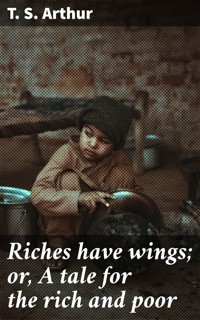
In "Riches Have Wings; or, A Tale for the Rich and Poor," T. S. Arthur delves into the moral landscape of wealth and its transient nature through a compelling narrative that intertwines the lives of both affluent and destitute characters. Arthur employs a clear, straightforward prose style that allows for deep emotional resonance, reflecting the mid-19th century's social realism. This novel stands as a critique of materialism and a reminder of the ethical responsibilities that accompany financial success, echoing prevalent themes in Victorian literature regarding social class and personal integrity. T. S. Arthur, an influential figure in America'Äôs literary scene, was known for his didactic storytelling aimed at moral upliftment. Having witnessed the societal disparities of his time, Arthur's experiences and observations profoundly shaped his writing. His background in working-class culture and commitment to social reform inspired this tale, showcasing his belief in the importance of empathy and understanding across economic divides. I highly recommend "Riches Have Wings" to readers interested in classic literature that explores the complexities of wealth and morality. This thought-provoking narrative not only entertains but also challenges us to reflect on our own values in relation to wealth, making it a relevant read for contemporary audiences.
Das E-Book können Sie in Legimi-Apps oder einer beliebigen App lesen, die das folgende Format unterstützen:
Veröffentlichungsjahr: 2023
Ähnliche















Riches have wings; or, A tale for the rich and poor
Table of Contents
CHAPTER I.INTRODUCTION.
Riches have wings. In no country is this more strikingly true than in our own. The social history of the world presents no era, nor any people, in which, and among whom, such sudden and remarkable changes in the possession of property have taken place. The man who is worth a million to-day, has no surety that he will be worth a thousand to-morrow. Children who are raised amid all the luxuries that money can procure, too often, when they become men and women, are doomed to hopeless poverty; while the offspring of the poor man, who grew up, perhaps, in the hovel beside their princely mansion, is the money lordling of their darker day.
The causes for this are various: mainly it depends upon our negation, in the beginning of our national existence, of the law of primogeniture and entailment of property. A man cannot be rich here in spite of himself. He may be born to great possessions, but has the full liberty to part with them upon almost any terms that please him; and such alienations are things of every-day occurrence. One result of this is, that property and possessions of all kinds are continually changing hands, and thus placed within the reach of nearly all who have the ability, as well as the desire, to struggle for their attainment. To superior judgment, skill, and industry, when applied to the various pursuits in life, comes the reward of wealth; while the supine and self-indulgent, or those who lack a sound judgment and business acumen, remain in moderate circumstances, or lose the property that came into their hands at majority.
There are no privileged classes here, made such by arbitrary national preferences of one over another. In the eye of the nation, every man is born free and equal. The son of the humble artisan or day-laborer can enter the same course, and start for the same goal, with the son of the wealthiest and most distinguished in the land—and beat him in the race if he be swifter of foot, and possess greater endurance.
The consequence of all this is, that wealth becomes a less and less stable thing every day; for, in the fierce struggle that is ever going on for its possession, as an end, and not as a means to a higher end, men become more and more absorbed in the desire for its attainment, and, as a natural result, more and more acute in their perception of the means of attaining it. And the most eager and acute are not always the most conscientious in regard to the use of means, nor the most careful lest others sustain an injury when they secure a benefit.
Great instability in the tenure of wealth must flow from the operation of these causes; for the balance of trade must ever be suffering disturbance by the inordinate action, at some point, of those engaged in commercial and business pursuits. This disturbance we see almost every day, in the dishonest spirit of speculation and overreaching that prevails to a melancholy extent. Business is not conducted, in this country, on the permanent, healthy, honest, and only true basis of demand and supply; but is rendered ever fluctuant and unsafe, from the reasons just given.
The apparent causes of the instability alleged, are mainly those that we have stated. But, as every thing that meets the eye is an effect of something interior to it and invisible, so, in this case, the things we have set forth are merely the effects of a spiritual cause, or, in other words, of a perverted state of the mind of the whole nation viewed as one man; for the truth that a nation is only a man in a larger form is undeniable. This perversion lies in the almost universal estimation of wealth as a means of selfish gratification, and not as a means of promoting and securing the general good; and from this it arises, that nearly every man seeks to secure wealth to himself, utterly regardless of his neighbor; and far too many not only covet their neighbors’ goods, but actually seek to defraud them of their possessions.
Every man is regenerated through temptations to evil, by means of which he comes into a knowledge of his hereditary perversions; and it often happens, that he is not only tempted of his evil lusts, but yields to the temptation, and thus, in suffering the consequences that follow, is made more clearly to see the nature and ultimate tendencies of the false principles from which he had acted. And this is just as true of a body of individuals (as a nation) as it is of an individual himself. The law of primogeniture and entailment of property, which is not a just law, lays, with its disabilities, upon the mind and ultimate energies of the nation farthest advanced in civilization, because to have abolished it would have resulted in a worse evil, even the utter destruction of that nation by the fierce intestine struggle that would have resulted therefrom, while there was no conservative spirit strong enough to sustain it. But, in the fullness of time, this American Republic sprang into independent existence, an outbirth of Anglo-Saxon civilization, and prepared to take an advancing step. The law that held in iron-bound consistency the English nation, was abolished, and all the strong energies, eager impulses, and natural lust of wealth and power, that distinguished the people of that nation, were allowed full scope here.
In the history of the world’s regeneration, the time had come for this, and there was virtue enough in the people to meet the consequences that have flowed therefrom. These consequences, externally disastrous to individuals as they have proved, have not been severe enough to check the onward advancement of the nation. They are, in fact, a reaction, upon individuals, of consequences flowing from their own acts, and showing them that their acts were evil. The love of wealth, for its own sake, needed to be regenerated. It was a great evil, fraught with unhappiness. Its regeneration could only be effected in rational light and mental freedom. That is, men must see it to be an evil, and freely put it away. But, so long as a man secures the gratification of every lust, just so long he sees it to be good instead of evil. It is only when he is deprived of its gratification, through consequences growing out of its indulgence, that he is enabled to perceive its true quality. And this is just the effect produced upon the general mind by the instability that attends the possession of wealth in this country. A man who loves money for its own sake, and looks upon it as the greatest good, is not at all likely to have his false view corrected, while all is sunshine and prosperity; but, in reverses, he sees with a more purified vision.
In a word, then, we believe that the cause why wealth is so unstable a thing in this country, lies in the free scope that every man’s selfish impulses find, and instability is only a salutary reaction. And, in this seeming evil, we recognize a Divine Providence, still educing good.
A change in our form of government, as some have thought, cannot, therefore, effect a remedy for the evil which so many lament. Nor is it to be found in penal statutes. It will come only when the whole nation, as one man, shall be guided in every transaction, small and great, by justice and judgment, and not till then. In the mean time, it is every man’s duty, who sees and acknowledges this truth, to do all in his power to give it vitality in the minds of the people.
CHAPTER II.HUMAN PRUDENCE.
“It’s my opinion, Mr. Carlton, that every man who remains poor through life, or who, once possessing wealth, loses it, has only himself to blame. I am out of all patience with these constant failures that occur in the mercantile community, and set them all down to sad mismanagement, or utter incapacity for business; and I am equally out of patience with the unceasing murmurs of those who have not the means of supplying their wants. The fault, in both cases, is with the individual, and no where else.”
“The fault may be, and doubtless is, to some extent, in the individual, but I am satisfied that you are in error in the broad ground you take, Mr. Townsend. Above and beyond man’s will and action, is a Power that rules events. Human prudence is not every thing in fact, it is nothing, when it comes in opposition to the designs of Providence.”
“Your profession, as a minister, naturally leads you to such conclusions,” replied the merchant. “But, as a man of business and close observation of men and things, I am satisfied that, in the ordinary pursuits of life, Providence interferes but little; and that all, or nearly all, of success or failure is chargeable to man’s own efficient or inefficient action.”
“I will grant that it is chargeable to his ends, and to his actions, so far as they are influenced by his ends. But that the mere possession of mercantile ability, and the means of engaging in trade, will give a man wealth and its permanent enjoyments, I seriously doubt.”
“I am not sure, Mr. Carlton, that I understand what you mean by the first sentence of your last remark.”
“About a man’s ends influencing his external condition?”
“Yes.”
“I mean, that a man’s end in seeking wealth may be of such a nature, that, after attaining what he has sought, the loss thereof may be necessary as a reaction upon that end, in order that it may be changed into one less useful and soul-destroying. The Divine Providence, which, I believe, governs in the most intimate things of every man’s life, has sole reference to what is spiritual and eternal, and so disposes of things, external and worldly, as to make them subserve man’s highest and best interests. I believe, therefore, that if it is best for man’s eternal state that he should be poor, and have to struggle hard to obtain mere food and clothing, that he will remain poor in spite of a lifelong effort to get rich. And I also believe, that with one tenth of his effort, another may accumulate a large fortune, who is no better, perhaps not so good a man, but whose hereditary evils are of a nature to be best reacted upon in a state of prosperity.”
“Very much like fatalism, all that,” said the merchant. “What use is there in a man’s striving at all?”
“It is any thing but fatalism, Mr. Townsend. And as no man can know the true quality of his internal life, nor what external condition will best react upon it, he is not left to the choice of that condition. Necessity, or a love of gain, causes him to enter into some business or profession, and according to the pressing nature of his necessities, or his desire for wealth, is the earnestness with which he struggles for success. As is best for him, so is the result. To him who needs the disappointments, anxieties, and sad discouragements that attend poverty and reverses of fortune, these come; and to him whose external interests will be best promoted by success, success is given. In all this, human prudence is actually nothing, though human prudence is the natural agent by which the Divine Providence works.”
“All that sounds very well, Mr. Carlton, but I don’t believe it. My doctrine is, and always has been, that every man who will use the right means, can get rich; and if he will manage his affairs, afterwards, with common prudence, may retain what he has acquired. I certainly, am not afraid of the loss of property. But, may be, I am one of your favored ones, whose spiritual interests are best promoted by a state of prosperity.”
“That, of course, is not for you nor I to know, at present,” returned the minister, speaking seriously. “The time may come when you will see the whole subject in a different light, and think, perhaps, as I do now.”
“Then you prophesy that I will become a broken merchant?”
“No, I prophesy no such thing. Judging from appearances, I should say that few men were less likely to become poor. Still, Riches have Wings, and your possessions may take flight one day, as well as another man’s. Mr. Barker, a few years ago, stood as far above the dangers of a reverse as you now do.”
“And would have stood there until to-day, but for his own folly. Look what a mistake he made! How any man, of his age and experience, could suffer himself to be tempted into such a mad investment of property, is to me inconceivable. He deserved to fail.”
“Heretofore he had always been prudent and far-seeing in all his operations?”
“No man more so.”
“But, when it became necessary for his higher and better interests that he should sustain reverses, he lost his prudence, and his mind was no longer far-seeing. Depend upon it. Mr. Townsend, the hand of Providence is in all this! I have seen Mr. Barker frequently since the great change that has taken place in his circumstances. He is not the man that he was. His whole character has softened.”
“He must be very miserable.”
“To me he seems quite as happy, as before.”
“Impossible!”
“No. The wind is tempered to the shorn lamb. He who sends reverses and afflictions for our good, gives strength and patience to bear them. I have seen many families reduced from affluence to poverty, Mr. Townsend, and in but few instances have I seen individuals made more wretched thereby.”
“That to me is inconceivable,” said the merchant. “I cannot credit it.”
“At first, there was great anguish of mind. The very life seemed about to be extinguished. But, when all the wild elements that had come into strife and confusion, had subsided, there came a great calm. The natural life was yet sustained. Its bread and its water were still sure. There was a feeling of confidence that all things necessary for health, comfort, and usefulness, would still be given, if sought for in a right spirit. Poverty, Mr. Townsend, is no curse, nor is wealth a blessing, abstractly considered. They bless or curse according to the effect they produce upon our minds. The happiest man I ever saw, was a poor man, so far as this world’s goods were concerned. He was a good man.”
There was something in the words of the minister that impressed itself upon the mind of Mr. Townsend, notwithstanding his efforts to put no value upon what he said. Frequently, afterwards, certain expressions and positions assumed, would arise in his thought and produce a feeling of uneasiness. His confidence in human prudence, though still strong, had been slightly impaired.
Mr. Carlton was the minister of a wealthy and fashionable congregation, to whom his talents made him acceptable. Not infrequently did he give offence by his plainness of speech and conscientious discharge of the duties of his office; but his talents kept him in his position. Mr. Townsend was a wealthy merchant, and a member, for appearance sake, of his church. As to religion, he did not possess a very large share. His god was Mammon.
The occasion of the conversation just given, was the failure of a substantial member of the church, for whose misfortunes Mr. Townsend, as might be inferred, felt little sympathy; and less, perhaps, from the fact that he was to be the loser of a few thousands of dollars by the disaster. The minister was on a visit to the house of Mr. Townsend, in the presence of whose family the conversation took place.
“How I do despise this cant—I can call it by no better name,” said the merchant, after the minister had left. “I am surprised to hear it from a man of Mr. Carlton’s talents. He might talk such stuff as this to me until doomsday, and I would not believe it.”
Mr. Townsend had a son and two daughters. The latter, Eveline and Eunice, were present during the conversation with the minister, and noticed the remarks of their father, after Mr. Carlton left. Some time afterward, when they were alone, Eunice, the younger of the two daughters, said, with unusual sobriety of manner, “Father treated what Mr. Carlton said very lightly; don’t you think so?”
“Indeed, I don’t know,” was the thoughtless reply of Eveline, who was noticing the effect of a costly diamond breast-pin with which her brother had, a day or two before, presented her. “Mr. Carlton has a strange way of talking, sometimes. I suppose he would—there! isn’t that brilliant, Eunie? If brother John could only see the effect! I’m a thousand times obliged to him. Isn’t it splendid, Eunie?”
“It is, indeed, Evie. But what were you going to say about Mr. Carlton?”
“Dear knows! I forget now. John must have given at least five hundred dollars for this pin, don’t you think he did?”
“I am sure I don’t know. I never think about how much a thing costs.”
“Jane Loming’s is admired by every body; but the diamonds in this are twice the size of those in hers, and it contains two to one. Just look how purely the light is sent back from the very bosom of each lucid gem. Could any thing be more brilliant! How I love gold and diamonds! They are nature’s highest and loveliest achievements.”
“In the mineral kingdom,” said Eunice, in her gentle way. “But gold and diamonds I love not half so well as I do flowers, nor are they half so beautiful. There is your glittering diamond. There is a flower not only far more beautiful, but with a spirit of perfume in its heart. And when I look into your eyes, sister, how dim and cold appear the inanimate gems that sparkle on your bosom. There are lovelier things in nature, Evie, than gold and diamonds.”
“You are a strange girl, Eunie,” returned Eveline, playfully. “I don’t know what to make of you, sometimes.”
“I don’t know what there is strange about me, sister,” said Eunice. “Have I not said the truth? Is not a flower a lovelier and more excellent thing than a brilliant stone, which, because it is the purest and rarest substance in the mineral kingdom, is prized the highest, but is still only a stone?”
“Would you give a diamond for a flower, Eunie? Tell me that, dear.”




