



8,63 €
Mehr erfahren.
- Herausgeber: Seren
- Kategorie: Abenteuer, Thriller, Horror
- Sprache: Englisch
A disquieting everyday world of make-believe as roles and performances are explored in Jo Mazelis' darkly gothic new collection, Ritual, 1969. What might a little girl be made of? Sugar and spice? And when she grows up? A dressmaker, teacher, flower-maker, actress? Or should she run away to the circus? From the playground to adulthood the path is beset with misunderstandings and missed dates, traps for the unwary and disingenuous dissembling. Not all is what it seems in a world where first impressions may only uncover disguises and false trails - but there's no going back! A thrilling third collection from the author of Jerwood-award-winning novel Significance and Commonwealth Best First Book Award shortlisted Diving Girls.
Das E-Book können Sie in Legimi-Apps oder einer beliebigen App lesen, die das folgende Format unterstützen:
Seitenzahl: 275
Veröffentlichungsjahr: 2016
Ähnliche

















Contents
PraiseDedicationTitle PageQuotesLevitation, 1969CaretakersMechanicsThe Murder StoneA Bird Becomes a StonePrayer, 1969Word Made FleshWhose Story is this Anyway?VelvetThe Green HourStorm DogsMrs DundridgeRitual, 1969Fallen ApplesBiology, 1969The Twice Pricked HeartThe Flower MakerThe Moon and the BroomstickUndone, 1969About the AuthorAcknowledgementsAdvertCopyright
Praise for Jo Mazelis
Ritual, 1969
In this fine collection, Jo Mazelis proves herself mistress of the short-story form. A selection of unflinching stories move across time and landscape, linked by the revealing details of human behaviour, the voices of the unloved and an unsettling imagination. Haunting, beautifully crafted fictions.
Cathy Galvin, director, www.thewordfactory.tv
With prose that is as beautiful and harsh as her stories, Jo Mazelis has produced a string of tales full of yearning and loss. Her characters, mainly women, young and old, are linked through passions misplaced and longings unmet – or else traduced. But there’s nothing wistful aboutRitual 1969: the writing is precision-modulated, witty, barbed. It’s as refreshing as a cold shower, and uplifting as a levitation.
Marina Benjamin,The Middlepause
Mazelis writes about the repressed desires and casual cruelties of suburban life with an acute sensitivity that lends these stories an almost dreamlike, even Gothic quality. Imagine ifCarriehad been set in 1970s Swansea and filmed by Mike Leigh rather than Brian de Palma and you’re getting close to describing the atmosphere of a collection that is marked by a particularly British sense of melancholia and surrealism.
Ritual, 1969is an unapologetically feminist work that relays the pitfalls of a troubled journey from school to womanhood with considerable depth and artistry. Mazelis writes in the tradition of Woolf, Plath and Carter, and does not feel out of place in their company. Like those writers she takes apparently mundane, everyday dramas and reveals them to be extraordinary and defining moments in an individual’s lifetime.
John Lavin,The Lonely Crowd, Wales Arts Review
As in her previous short-story collections, Jo Mazelis in this new book proves herself to be a virtuoso of the genre. As usual, she sees with the eyes of those marginalised by power – children, servants, women. But there’s nothing worthy or sentimentally victimised about her writing, which is always alert to the oddly resonant detail, even the grotesque, in every existence.
Indeed, many of these tales have a gothic or supernatural cast… They refuse cheap consolation – the style is bare, if beautifully crafted, and several stories, such as ‘The Murder Stone’, concern the terrible minor-seeming errors and misunderstandings that can blight the rest of a life. But they are at the same time the opposite of downbeat or heartless, are charged with ironic empathy, reminding us again and again of the poetry and sheer strangeness of human existence.
John Goodby
Georgina and Charlotte are Siamese twins…Ritual, 1969broods on the strange conjunctions and fateful symmetries that shape the lives of women who seem fated never to be in control of their own individual stories. Only gradually do we realize that those stories themselves are silently interconnected, their characters recurrent… The result is a powerful double-take on female experience.’
M. Wynn Thomas
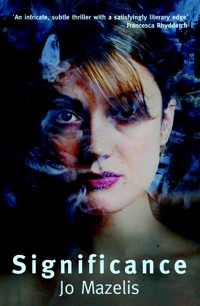
Significance;winner of the Jerwood Fiction Uncovered Award 2015
‘Quite unlike any literary crime novel that I have read before, seriously… It is rather like Mazelis has taken a box filled with all the crime novel/thriller tropes and really shaken it up to see what can be done outside the box…
There is also a much deeper level to the novel than just an enthralling and entertaining, and it should be said beautifully written (you can tell Mazelis is a poet, the writing is lyrical yet has real pace) and crafted, read. From the title you would imagine that the novel is about the significance of a murder and of course it is, yet it is also about many other significances; the significance we give ourselves and others, the significance we are given, the significance of tiny details or moments and how they can change everything. It is also a book that is very much about perception, the things we notice and the things that we don’t.’
Simon Savidge, Jerwood Fiction Uncovered judge
Significanceis a novel that toys with and interrogates the mystery fiction genre itself, often reproaching the stereotypes created there … the introduction of new characters continues way past the point any creative writing tutor or manual would advise an aspiring writer to stop. Yet Mazelis makes each and every one of them seem vital and engaging… WithSignificance, Mazelis has set her novel-writing bar at a breathtaking height.
Rachel Trezise,Agenda
With its intricate plotting and many-layered narrativeSignificanceturns out to be completely engrossing. There’s a crime but this isn’t a crime novel: it’s a study in human nature and the way we interact and observe each other… It’s all beautifully done.
A gripping first novel, thoroughly deserving of its prize.
A Life in Books
Jo Mazelishas a wonderful elliptical approach to her writing – nothing is as it seems. What sets out to be a straightforward thriller succeeds in becoming a seductive narrative, transforming itself into a delicate maze of events, interspersed by arresting characters brushed in with the touch of a seasoned writer… It is a cool and sophisticated look at human interaction, loving, violent and inexplicable simultaneously. There are no neat answers, no predictable plot structures.Mazelisevades the stereotypical – yet her characters are recognisable as they cope with the bewildering situations they find themselves in. Quite a tour de force for a debut novelist.
Sarla LangdonThe Bay
A literary crime novel in which the ‘whodunnit’ and even the ‘whydunnit’ is less significant than the mystery of who the victim is (or who any of us are)…Significanceis written with admirable storytelling skill that weaves captivating narrative tension, poetic density and exploration of ideas. Further enjoyment is provided by an acute sense of place … and by the precision and awareness of the power of language…
Valerie Sirr, Wales Arts Review
I was gripped from the first chapter to the unexpected ending and cannot recommend this book highly enough.
Leslie Williams The Bay
Circle Games(2005)
Mazelis’ latest collection of short stories is permeated with an undercurrent of barely suppressed unease in which the ordinary is transformed into something altogether more disturbing. Capturing the frequently shaky basis on which her characters interrelate, Mazelis explores love in its various manifestations, together with the complicated games it causes people to play, both with themselves and with one another…
Mazelis has produced an imaginatively written collection which draws strength from the all-too-human flaws and weaknesses of its characters.
Anna Scott,New Welsh Review
Circle Games leaves you disturbed and dislocated – with a feeling that all is not quite right, that there’s an itch you can’t locate. Which is quite as it should be. Jo Mazelis’ short stories are, on the surface, concerned with the everyday – for the most part small slices of life that one is quick to identify with, where something is always familiar. But there is no sense of ease, everything falls just short of closure, and her images return to you again and again – the literary equivalent of looking at a Paula Rego painting. Highly recommended.
Amazon review
Diving Girls(2002)
Misunderstandings and miscommunications, and the danger of superficial masks… This theme of penetrating surface exteriors in relationships among both family members and society’s outsiders is constant throughout this collection, where initial appearances belie a contradictory reality. The insignificance of images and slogans is constantly revealed. The intricacies of relationships within families are laid bare in a number of the stories, and especially the tensions between parents and children.
Liz Saville, Gwales.com
For Ben, Nico and Megan
Ritual, 1969
Jo Mazelis
O Rose thou art sick.
The invisible worm,
That flies in the night
In the howling storm:
Has found out thy bed
Of crimson joy:
And his dark secret love
Does thy life destroy.
William Blake ‘The Sick Rose’
‘Children are taught revenge and lies in their very cradles.’
Mary Wollstonecraft,Thoughts on the Education of Daughters
LEVITATION, 1969
Rising up in the air, the dead girl feels … dead. Her eyes are closed; for a moment she has forgotten everything. She is dead.
Then alive again. They have set her down on the concrete wall and the ceremony is over. They do not misuse the levitation game – weeks and even months go by and they don’t do it or even think of doing it – as if it’s a dream that occasionally recurs, but is forgotten when the sleeper wakes. Then at some point in time it stops. They never perform the act of levitation again.
The game arrived in their lives after the circle games of ‘The Farmer’s in His Den’ and ‘Oranges and Lemons’ had fallen away, but before the long passage of no-games-at-all enveloped them forever.
The reign of levitation is also that of puberty. Is it not said that pubescent girls and boys, those on the cusp of change are the most vulnerable and attractive to the spirit world? That in homes where poltergeists are active there is usually in residence a child in their early teens?
The dead girl (who is not really dead) lives in a home with such a poltergeist. Objects are broken; china smashed into many pieces, the old black Bakelite telephone – the one whose weight and heft suggested unalienable permanence – is suddenly and mysteriously transformed. It catches her eye when she comes home from school. It is in its usual place by the front door, but something is different. She looks closely, sees an intricate pattern of lines and cracks all over it and, in places, evidence of glue. The phone has somehow been broken into a hundred jagged shards and then someone (she knows who) has painstakingly, with his Araldite and magnifier, tweezers and spent matches, put it back together again.
Such an event should come up in conversation in a small family like theirs but no one says a word. The destruction was the work of an angry spirit; the reconstruction was performed by her father, who is often to be found with a soldering iron in his hand, or a pair of needle-nose pliers, an axe or hammer.
One autumn day years before, she came across him in the garden, tending a fire of fallen leaves. Such a fire is always an event for a child of eight or nine so she stands at a safe distance to watch how he rakes and prods it, how the flames change colour from red to blue to white to yellow.
He stirs his pyre of smoking leaves; the centre gives way and something hidden is revealed: first, brown paper that flares away to black tissuey fragments, then white fabric pads, some folded in upon themselves, others that boldly show their faces with their Rorschach test ink blots of red and rust-coloured blood. Her mother’s blood, her mother’s sanitary towels – which belong to the secret places of locked bathrooms – are out here being burned by her father in the front garden of their home where any neighbour or passerby might see.
Behind her father is the oak tree and behind that the ivy-covered low stone wall and in the earth just in front is a bamboo pole that she has topped with a bird’s skull – a totem she had made to ward off danger.
This was long ago, before the poltergeist and the angry words that echo through the house late at night to infiltrate her dreams, turning them into nightmares.
One day her mother came home from the shops and announced she had found a lucky charm. She reached into her coat pocket and pulled out a tiny little hand made from cheap nickel-plated metal. The thumb was tucked into the palm and so were the two middle fingers, leaving just the index and little finger standing proudly erect.
‘Aren’t those meant to represent the Devil’s horns?’ the girl said, not knowing where such knowledge came from.
Her mother’s eyes widened in horror and she threw the charm from her hand into the empty sink. Later she took it into the garden and was gone for some time. When she came back into the house she looked tired and frightened.
‘I tried to smash it,’ she told her daughter. ‘Then I tried to burn it. It’s indestructible; it must have been made by the Devil.’
Now the girl is eleven years old and goes to big school where as the littlest, lightest one among her friends she always plays the dead girl.
‘This is the law of levitation…’
There is no greater pleasure than the moment when the other girls lift her high into the air. Her body remains absolutely straight; at no place, either at one leg or at her head, does a weaker girl fail to do the magic and she seems to almost float upward. No one laughs and the dead girl’s eyes remain closed. She believes. All of them believe.
Her body is still that of a child while all around her the other girls are changing or have already changed into women. After sports they are meant to strip and go into the communal shower, all of them naked together, sixteen or seventeen girls, most of whom have never done such a thing before. None of them are muddy or even sweaty; a half-hour of netball is hardly an exertion, especially after the enforced stillness of sitting at a desk listening to an array of voices droning on about Pythagoras and the tributaries of the Nile and flying buttresses and Beowulf and blanket stitch and the creaming method for making cakes. She and a few other girls run to the showers with their towels wrapped carefully around themselves, then after splashing a little water over their heads and feet they run back to the changing area again.
The poltergeist at home is getting worse. Last night after she had gone to bed he tore the television set from the stand and jumped on it. She doesn’t know if he was careful to switch it off and take out the plug first. Probably, as he’s always telling them all to do just that.
She has dark circles under her eyes. She is thin and (though no one knows this) anaemic. She does not do her homework. Every time her parents ask if she has any she says ‘no’ or claims that she did it on the bus.
She is like a fallen leaf caught up in a strong gust of wind. She has no locomotion. In biology Mr Thomas had taught them that as seeds have no locomotion they must find other means of dispersal, hence the helicopter wings of sycamore seeds.
In the playground, from behind her, something hard and knobbly is laid upon her head. This may be the start of another interesting game, but when she turns, she sees that the hand belongs to a girl she does not really know, a girl who gives her a smile that is glittering with malice. She has only just understood that the object on the top of her head is a curled fist when its partner arrives to smash it down. It is meant to be like a raw egg breaking on her head, but it is far more painful than that. It hurts as much as if the girl had just straightforwardly punched her. It is instead a complex violence that is nearly impossible to react to. It is delivered in the guise of a joke, but the message is menace.
She grimaces with pain and her eyes water.
Don’t cry, whatever you do, don’t cry.
Weakly she smiles, then grimaces again, this time comically, exaggerating her expression in the hope they will appreciate her humour. This is a tactic that usually works, but not now, not with this girl and her silent, sneering sidekick.
Instead they point right at her, index fingers dangerously close to poking out an eye, and laugh jeeringly, artificially. WHA HA HA!
Then as quickly as they had arrived they are gone and whateverthatwas is over.
At around two in the afternoon it grows unnaturally dark, nearly as black as night. The teacher has switched on the overhead lights, and attempts to keep their attention on the lesson, but beyond the big plate-glass window the distant hills and far-off steelworks are the dramatic backdrop to a spectacular performance given by the weather. Grey-black clouds fill the sky and the air is charged with electricity. The children can barely keep their eyes from the window; the teacher raps the wooden board-duster sharply on her desk creating a cloud of chalk dust, but their attention is snagged by a greater primordial force.
‘Never mind the storm, we have work to do. Now, look at your books, what is the meaning of…’
A flash of lightning draws a collective gasp from the children, loud enough to cut the teacher off in mid-sentence. Seconds later, distantly, there is the rumble of thunder.
‘Woah!’ one boy cries and abandons his chair to run to the window, and then nearly all of the children are by the window staring outside, their eyes wide with wonder. Lightning zigzags down again and again on the black shrouded hills; magnesium-white veins that burn onto the retina, while the tin-tray thunderclaps grow louder and more insistent.
Unlike the others, the dead girl stays in her seat. She can see just as well from there as from the scrum of elbows and sharp knees and bony heads that are ducking and dancing and roaring by the window. She is no less moved than the others, no more obedient than they, but she has withdrawn into herself. She is a pair of green eyes looking out at the turning world as the leaf of her body is taken there, or battered by that, or torn by this.
Seconds pass and finally she no longer wants to remain in her seat; she wants to belong, to be like the other children, to break the rules like them, to press her face against the cold glass by the window and feel the thrum in her cheekbones as the sound waves batter and shake it.
‘Children!’ the teacher is saying. ‘Calm down at once!’
The dead girl pushes back her chair. She wears a beatific smile as she stands and begins to take the few steps which will bring her to the window. She seems to glide forward, focusing her gaze on the distant hills. She does not see the teacher bearing down on her. She hears the tirade of words coming from the teacher’s mouth, but they are as generalised as the thunder.
‘I will not have this! I will not tolerate such insubordination in my classroom. Sit down! Sit down at once! YOU!’
The teacher catches her arm, wrenching it sideways, forcing her to turn. The older woman’s face up close is terrifying, her expression almost insane with fury.
‘How dare you!’ she roars, then slaps the dead girl’s left cheek. ‘Stop grinning, child!’ she adds, but the girl’s smile has already gone and her face is blank once more.
She closes her eyes.
‘Sheisdead,’ the girl standing at her head says, and the voices travel around her prone body, echoes of what has been, of what is to come. Then they are lifting her, higher and higher, to waist level, then shoulder level, then above their heads, to the furthest reach of their upstretched arms and fingers. Then higher still and higher again until she is floating far overhead. Then finally, although the other girls shade their eyes and search the sky they can no longer see her. She’s free.
CARETAKERS
‘Human beings are 70 per cent water. The brain is roughly 85 per cent water…’
She is gazing at the lecturer trying to fight back a yawn. She is so tired her eyes are tearing up. She searches her bag, but no pen. Just a dried-up, electric-lime highlighter. She looks around at the students near her, mouths the word ‘pen’, makes a squiggle in the air to signify her want. Cold eyes study her, frown, then dismiss her as if she is merely a clown, a puppeteer whose hand is suddenly naked and meaningless.
She leans forward in her chair and stretches out to tap Lolly’s shoulder. As he turns, she catches, from beneath her armpit, the strong scent of sweat. Lowers her arm quickly.
‘Pen,’ she whispers urgently.
Lolly raises his eyebrows, turns back, riffles in his bag then produces a biro. She has to lean over to take it. Her sweat is greasy smelling, like pork and onions.
When the lecture finishes just before lunch, she does not follow the other students to the refectory, but goes home to shower.
Last night she couldn’t sleep. All because of the wet footprints she saw; running in a line from the bathroom to the fireplace in her bedroom. The footprints were far smaller than her own. Child-sized naked heel and toe marks, damp on the floorboards and carpet, quickly evaporating to nothing.
The other houses on her street are a mixture of 1930s mock Tudor semis, new apartment blocks and terraced cottages. Hers is the oldest, a Georgian landowner’s pile, double-fronted, whitewashed, tall sash windows and six bedrooms. She lives here alone, half ashamed of her good luck in possessing such a house, half afraid that it will somehow be taken from her, invaded, despoiled. She has lived there for over four months. Since September, when she moved in, disbelieving, everything she owned in an old suitcase and a black bin bag. Everything she owned – not forgetting the house and all its contents: the antique furniture, the mahogany and horsehair, the ivory and silks and ormolu, the oil paintings and watercolours, the butler’s pantry with its silverware, its cut glass and Clarice Cliff tea sets.
The house was left to her by her great uncle. It was a slap in the face to his children and five grandsons, her own parents and his housekeeper (who may or may not have been his mistress for the preceding fifty years).
‘Don’t go and live in that awful house,’ her mother said. ‘Just sell it.’ But it was near the college and she felt compelled somehow, duty-bound.
She puts her bag on the rosewood table in the hall and hangs her jacket on the coat-stand with its carved menagerie of real and mythical creatures, a stag, a unicorn, frogs and lizards with inlaid eyes of ebony, amber and jet. Kicks off her shoes at the base of the stairs and goes up, two steps at a time.
On the landing she stops and searches the floor for signs of footprints. Nothing. She draws closer and kneels to inspect the area for the barest trace of a dark or water-beaded mark.
She glances into her bedroom. Nothing there. Then goes into the bathroom and locks it before disrobing. Turns on the ancient shower and steps under its spluttering, thundering water. Washes herself, then stands, turning this way and that, luxuriating in the liquid heat. She feels at peace. Cleansed and transcendent. Not reborn, but returned to the womb, to the state of being where there are no edges or boundaries. She lingers, eyes closed, hair plastered flat against her skull, down her back.
She does not go back to college that day. Or the day after that, a Friday. Spends hours curled up on the sofa, the TV on. Thinks that she could go on like this. Forever and forever. If she wasn’t so lonely.
On Monday she goes back to college. No one has noticed her absence. They ignore her as before.
After the seminar, she goes to the refectory and does not, as she has in the past, attempt to sit at a table with her fellow students. But they, as bad luck would have it, occupy the table behind her. She can hear every tedious word of their conversation. None of which she wants to hear. Until…
‘Did you hear about Lolly?’
‘No. What?’
‘He’s just like, totally broke.’
‘Really?’
‘Yeah. His father’s supposed to pay his rent. But he hasn’t, so Lolly’s being chucked out.’
‘Oh my God!’
‘So he owes like nearly a thousand, but his father won’t help him and he can’t go home.’
‘What’s he going to do?’
There is no audible answer to this, perhaps the speaker merely shrugged.
They change the subject. She stops listening. Finishes her food, gets up and walks away, very deliberately not looking at them. Someone laughs, perhaps at her.
She sees Lolly crossing the big hall, weaving between tables packed with students. He has a plate of chips and a white plastic cup of water. Nothing else. Lolly is a big guy, tall, broad-shouldered, but also overweight. His lumberjack shirt is crumpled and he looks like he needs a shave. Tucked away, near the fire exit is a narrow corridor with three small tables, he heads there and she follows. At one of the tables, sitting on a chair as if waiting for a companion is a large nylon rucksack, on the floor beside it are two carrier bags, and a sleeping bag. Lolly slumps into the seat opposite.
She pulls over a chair and sits.
‘Lolly,’ she says.
‘Don’t call me that.’
‘But everyone…’
‘My name is Lawrence.’
He averts his gaze and begins eating.
‘So … someone said you were looking for a place…’
‘Oh yeah? Well someone is talking out of their ass. OK?’
‘Oh. I’m sorry. I heard that … and then here you are with your rucksack and this bag and…’
He looks her in the eye; his expression is flat, guarded. She waits. He says nothing.
‘I was going to say. You know, if you’re stuck. Between places? Then you could stay at mine. For a while. If you want…’
‘For real? Are you for real?’ A grin is starting to break out all over his face. He’s handsome when he smiles.
‘Yeah, for real.’
When their last lecture finished at three she and Lolly lingered until the rest of the class drifted away, before setting off together – him almost a giant, made even larger by his huge rucksack. She, at least a head and a half shorter, had to run every few paces to keep up with him.
They didn’t talk. There was no conversational opening which wouldn’t have been painful for either; he didn’t want to talk about his father, she was ashamed of owning a big Georgian house set in an acre of land, he did consistently well at college, she was scraping along most of the time. Everybody at college liked him, though he seemed to make no effort to be liked, while she tried desperately to charm and ingratiate herself, but got nowhere.
The Lolly/Lawrence thing was interesting, she thought as they turned into her street, he hated being called Lolly but said nothing. The man they all liked, Lolly, Big Loll, Lolls who was tall and a tad overweight, but handsome and affable, was their own invention. The jolly giant, he was safe, good at walking home girls too drunk to look after themselves.
In a similar fashion they must have created a version of her that bore little resemblance to reality. This person was spiky and mean, jealous of the other girls.
Maybe as she and Lawrence got to know one another better they would have a conversation about this, and then understanding everything about her, he would become her envoy, making others see her in a whole new light.
As they began down the drive to the house, he gave no sign of surprise at its majesty. But then he had no idea of her relationship to the house, she might have been a live-in skivvy for all he knew and lived in a caravan around the back.
‘Here it is.’
He stepped in and looked around.
She had almost stopped seeing how grand the hall was, but now she could see its magnificence reflected in his gaze.
‘How many people live here?’
‘Just me.’
‘Just … you?’
‘I’m the caretaker.’
He seemed relieved to hear that. She smiled. How easily the lie had come to her.
‘Well…’ she began, but then she sensed a presence near her, very close by, and a fleeting touch of something cool and very slightly moist on the back of her hand. A quick glimpse and there they were, fading and drying already, two bare footprints that seemed to be waiting, hungry for attention.
‘You okay?’ he said.
‘Yes, just tired. Let’s find you a room, eh?’
When they were halfway up the stairs, he said, ‘You won’t get in trouble will you?’
‘It’s fine,’ she said. ‘As long as nothing is damaged or whatever… We’re not going to have wild parties are we?’
‘God, no.’
‘Okay, that’s my room,’ she indicated the closed door opposite the bathroom. ‘How about you have this room, next to it?’ She led him into the master bedroom. It was a big room, high-ceilinged, twenty-two feet by eighteen, with three tall sash windows, each with the original wooden shutters. There were long yellow brocade curtains that pooled on the floor and were faded in places. The bed with its walnut headboard stood in the centre of the room, the bare mattress was indecently pink and shiny.
Lawrence put his bags on the floor, then unrolled the sleeping bag and laid it out along one half of the bed. It was one of those high-altitude sleeping bags, a black cocoon that was narrower at the feet than the upper body, like a sarcophagus.
‘There’s plenty of bedding; pillows, blankets, sheets, eiderdowns,’ she said.
‘This will be fine’ he said.
‘But…’
It looked so temporary and so out of place, that sleeping bag on the luxurious satin of the mattress. He does not mean to stay, she thought, he can’t wait to escape.
He busied himself with his stuff, going through the bags, not unpacking but searching for something. Eventually he came to a limp-looking roll of faded purple towel and a striped nylon wash bag.
‘Would it be OK if I had a wash? Need to shave,’ he said, rubbing a hand over his bristly chin, so that a faint rasping sound could be heard.
‘Yes. Yes, of course. The bathroom’s just here. Have a shower.’
He went in and she hovered at the open door.
‘We’ll have to sort out some money for bills,’ he said, as if in answer to her watching him.
‘Plenty of time,’ she said.
He turned on the shower and held a hand under, testing it, then steam began to gather and rise and he withdrew his hand. Smiling awkwardly, he crossed the room and closed the door in her face.
At college, as the days went by, he behaved towards her exactly as he had always done. He did not sit beside her in lectures, nor share a table in the refectory. They did not walk to college together and after the last lecture of the day he always seemed to be caught up in a laughing conversation with one group of students or another.
To punish him she had not yet given him his own set of keys.
Yet each evening they ate together. She had an allowance, she explained, for expenses, and this covered all the bills, even food. She bought ready meals from Marks and Spencer and heated them in the oven, decanting them onto the best plates and adding flourishes like side salads and steam-in-the-bag vegetables. There was always wine too, though he professed at first not to like it. She put fresh flowers on the table and lit the candles in the silver candelabra.
They started, from desultory beginnings, to have real conversations, though the focus was always weighted towards him, she, having much to hide, used a subtle sleight of hand to keep herself in the shadows.
Only two years before he had been an outstanding athlete; excelling at cricket, rugby, long-distance running, swimming and basketball. Then he’d had his accident while rock climbing.
‘But I was lucky,’ he said, and she thought it would be luckier not to fall at all, though did not say this. ‘I could have been paralysed. I could have been dead. Instead, a year and a half in hospital and I’m as right as rain. Just out of shape. Look!’ He pulled his wallet from his back pocket, took out a newspaper clipping. There he was, a god of a man in Speedo swimming trunks, every muscle toned and lean; pecs, biceps, abs, quads. His face, stripped of the plump cheeks and double chin, was that of a Hollywood film star, a young dimpleless Robert Mitchum crossed with Jake Gyllenhaal.
She passed it back to him quickly, afraid to linger over this image.




