


1,99 €
Mehr erfahren.
"Roget's Thesaurus" stands as a monumental achievement in the realm of linguistics and reference literature, meticulously cataloging the vast spectrum of the English language. Published first in 1852, Roget's innovative approach organizes words by concept rather than mere synonyms, providing users with a comprehensive understanding of language and thought. Its literary style is both accessible and authoritative, encouraging writers and speakers to explore nuances in expression. Embedded within the context of a rapidly industrializing society, Roget's work reflects a burgeoning interest in systematic classifications that echoed the era's scientific advancements, thus establishing a modern lexicon of ideas. Peter Mark Roget, a polymath, physician, and lexicographer, drew upon his medical training and personal interests in natural philosophy to create this thesaurus. His deep understanding of linguistic structures and cognitive patterns propelled him to compile a tool that goes beyond mere vocabulary—a framework for structured thinking and expression. Roget's passion for cataloging and organizing knowledge stemmed in part from his experience with the disconnect between language and thought, which he sought to bridge through this seminal work. "Roget's Thesaurus" is an indispensable tool for anyone looking to enhance their linguistic precision and creativity. Whether you are a student, professional writer, or casual communicator, Roget's masterful compilation not only enriches your vocabulary but also deepens your appreciation for the subtleties of language. This enduring classic invites readers to engage with words in a transformative manner, making it a must-have resource in the study and enjoyment of language. In this enriched edition, we have carefully created added value for your reading experience: - A succinct Introduction situates the work's timeless appeal and themes. - The Synopsis outlines the central plot, highlighting key developments without spoiling critical twists. - A detailed Historical Context immerses you in the era's events and influences that shaped the writing. - An Author Biography reveals milestones in the author's life, illuminating the personal insights behind the text. - A thorough Analysis dissects symbols, motifs, and character arcs to unearth underlying meanings. - Reflection questions prompt you to engage personally with the work's messages, connecting them to modern life. - Hand‐picked Memorable Quotes shine a spotlight on moments of literary brilliance. - Interactive footnotes clarify unusual references, historical allusions, and archaic phrases for an effortless, more informed read.
Das E-Book können Sie in Legimi-Apps oder einer beliebigen App lesen, die das folgende Format unterstützen:
Veröffentlichungsjahr: 2022
Ähnliche






Roget's Thesaurus
Table of Contents
Introduction
Like a meticulously drawn atlas of thought in which pathways, landmarks, and hidden byways are rendered in living words, Roget’s Thesaurus invites readers to navigate from intention to expression with the assurance that language, once scattered and elusive, can be ordered, traversed, and made to bear the weight of the idea it carries—a map that does not merely list destinations but reveals relationships, gradients of meaning, and the surprising proximities that turn vocabulary into a living network of sense and sound. In a single volume, complexity is coaxed into shape so that clarity can emerge without sacrificing nuance.
Roget’s Thesaurus holds classic status because it transformed a practical problem—finding the right word—into a lasting intellectual framework for understanding how words relate. More than a storehouse of interchangeable terms, it advances a disciplined inquiry into meaning: how ideas cluster, contrast, and expand. Its prestige stems from this dual character. It is immediately useful to anyone drafting a sentence, yet it stands as a landmark of humane scholarship. By uniting utility with vision, the book established a model for reference works that are not merely consulted but continually reread, explored, and used to refine the habits of thought itself.
The author, Peter Mark Roget, was a nineteenth-century British physician and scholar whose scientific training shaped his approach to language. First published in 1852 after years of preparation, Roget’s Thesaurus emerged during the Victorian era’s energetic pursuit of classification and system. The volume’s initial appearance reflects a moment when ordering knowledge promised broader access to it. Roget’s professional commitment to method is evident throughout: he sought not only to gather words but to organize them according to the underlying ideas they serve. That historical context, and the rigor it encouraged, gave the work its distinctive texture and its durable intellectual authority.
The book’s central premise is elegantly simple: arrange words and phrases by ideas rather than alphabet alone, so that the user can move from concept to expression. Its organizing principle places meaning first, surrounding each idea with a constellation of related terms that vary by shade, strength, and association. An extensive index guides the reader to the appropriate conceptual “head,” where families of words are grouped, contrasted, and cross-referenced. The result is a system that both accelerates composition and stimulates discovery, allowing writers to locate a precise term while also encountering unexpected possibilities that reframe what they intend to say.
This design profoundly influenced the habits of writers across generations. Novelists, poets, dramatists, journalists, and students have turned to Roget not merely to replace a word but to test an idea, to measure tone, and to calibrate nuance. The thesaurus encourages craft by making the writer think in terms of relationships, gradations, and context. It invites a richer, more deliberate engagement with diction, helping to avoid vagueness without tipping into monotony. Its presence on desks and in classrooms has spread an ethic of precision: the conviction that choosing the right word is an act of thought, not merely of style.
Enduring themes run through the book’s method. It affirms the possibility of clarity without denying complexity: words are not pinned specimens but living links in a network. It recognizes that meaning is relational, that difference and likeness animate expression, and that contrasts are as revealing as proximities. It also embodies a generous, democratic impulse. By systematizing access to vocabulary, Roget’s Thesaurus widens participation in articulate thought. The work teaches that eloquence does not arise solely from innate gift; it is nurtured by attention, comparison, and a willingness to test alternatives until the language matches the intention.
The structure of the book reinforces these themes. Instead of a single alphabetical stream, Roget presents a hierarchy of conceptual divisions, moving from general categories into more specific “heads,” each housing clusters of related terms. Within those groupings, the reader finds words that share a core idea yet differ in register, intensity, or angle. Cross-references point laterally across the system, encouraging the user to roam between neighboring concepts and their contrasts. The index then reunites this network with the convenience of alphabetical search, ensuring that purposeful browsing and directed lookup complement each other rather than compete.
The historical moment of its creation matters. Mid-nineteenth-century scholarship pursued classification in fields from natural history to library science, aiming to make knowledge navigable. Roget’s Thesaurus belongs to that tradition, but it applies the spirit of system to the restless medium of everyday language. In doing so, it bridges disciplines: the exactitude of science and the flexibility of letters. The book’s taxonomy acknowledges order without arresting change; it lets language evolve while keeping the scaffolding of meaning in view. That balance between stable structure and living speech accounts for much of its longevity.
Roget’s method has a quietly radical implication: thinking can proceed by association as fruitfully as by linear sequence. When a writer enters the thesaurus through the index and arrives at a conceptual head, adjacent terms, near-opposites, and cross-references open paths that might not have been considered. The system becomes a workshop for imagination, enabling lateral moves—reframing a scene, shifting tone, or enlarging an argument. In this way, the book is both a compass and a set of tools. It orients the user while supplying the means to build sentences that reflect intention with deliberateness.
From its first appearance, the work found an audience that extended far beyond specialists, and subsequent editions have preserved its underlying framework while revising content for contemporary usage. The continuity of the system speaks to its resilience; the adaptability of the entries speaks to language’s change. Editors have maintained the concept-centered design even as vocabulary, idiom, and usage evolve. The result is a reference that feels at once historical and current, a tradition kept alive by careful stewardship. That shared maintenance across generations signals the book’s status as a cultural institution rather than merely a convenient tool.
To read Roget well is to browse with purpose. One may arrive seeking a single term and discover, in the surrounding field, the tone or approach a passage truly requires. The thesaurus encourages sensitivity to register, connotation, and context, urging the writer to select not only what is accurate but what is apt. It also rewards patience. The most fruitful encounters often come when one follows a cross-reference, tests an alternative, and returns with a clearer sense of the idea at stake. Used in this spirit, the book becomes a companion to thinking as much as to writing.
In an era shaped by search engines and digital corpora, Roget’s Thesaurus retains a distinctive relevance. Its concept-first organization models the structures that underlie modern knowledge systems while also resisting the flattening effects of mere frequency and convenience. It reminds us that expression is not only about retrieval but about judgment, relation, and purpose. Whether consulted by students seeking precision, professionals shaping arguments, or artists exploring tone, it continues to offer a disciplined freedom: the chance to find words that fit, and in fitting, illuminate. That is why its appeal endures and why its guidance remains contemporary.
Synopsis
Roget’s Thesaurus by Peter Mark Roget is a systematic catalog of English words and phrases organized by ideas rather than alphabet. First published in 1852, it proposes a practical route from a user’s intended meaning to appropriate expressions. The work positions itself as a companion to dictionaries, which list words alphabetically, by offering conceptually arranged groupings that bring related terms into one place. Its scope is general English usage, and its purpose is to support clear, varied, and precise composition. The opening material frames the project as a method for navigating thought through language, inviting readers to browse clusters of meaning to refine what they wish to say.
The introductory sections explain why a verbal classification is necessary and how it differs from ordinary lexicography. Roget sets out a plan that begins with broad conceptual categories and narrows toward specific notions, providing a framework users can learn and apply consistently. He emphasizes that arrangement by meaning exposes relationships among terms that alphabetical order conceals. The method is descriptive, not prescriptive: the book gathers words and phrases actually in circulation and places them according to the ideas they convey. These preliminaries orient readers to a tool that favors association, contrast, and gradation over spelling or etymology.
At the core of the book is a hierarchical architecture divided into six overarching classes: abstract relations, space, matter, intellect, volition, and affections. Each class breaks into sections, and sections into numbered heads that represent particular ideas. The sequence moves from the most general conceptual relations to those that govern physical reality and human thought and action. Heads placed in proximity often illuminate each other by similarity or opposition, making contrasts readily discoverable. This design creates a navigable map of meaning, where terms near one head may lead naturally to adjacent concepts, and the numbering system supplies a stable reference for cross-linking throughout the work.
Within each head, words and phrases are grouped by part of speech, allowing nouns, verbs, adjectives, and adverbs associated with the same idea to be consulted together. The entries typically range across registers and domains, reflecting both everyday and technical usage where relevant. Cross-references connect related heads, enabling users to move laterally when a given cluster suggests neighboring notions. Contrasted ideas are signposted so that a search for one concept can quickly reveal its opposite. The arrangement presumes that perfect synonyms are rare; instead, it offers gradations of sense so readers can select expressions that match intention, tone, and context.
An extensive alphabetical index serves as the principal entry point. Users begin with a familiar word, locate it in the index, and note the head numbers to which it points. Turning to those heads, they examine semantically related options, compare nuances across parts of speech, and follow cross-references where needed. Directions in the front matter explain this procedure and encourage consultation of more than one head when a concept spans multiple areas. The index thus multiplies access points to the conceptual scheme, while the body of the work invites exploration beyond the initial query, often revealing alternatives a reader might not have anticipated.
The classification reflects a belief that language mirrors the structures of thought and experience. By placing time, space, causation, quantity, and other fundamental relations near the beginning, the scheme foregrounds concepts that organize perception and reasoning. Subsequent classes address the material world and then the faculties of mind, the operations of will, and the sentiments and social bonds that shape conduct. This progression exemplifies a nineteenth-century ambition to systematize knowledge, yet it remains practical, anchoring abstraction in clusters of usable expressions. The thesaurus thereby treats words as nodes in a web of ideas, traceable through similarity, difference, sequence, and dependence.
As a working instrument, the thesaurus supports composition, revision, and study. A writer can move from a tentative term to a more precise one, adjust register from formal to colloquial, or vary phrasing to avoid repetition. Because meanings are shown in relation, the user can test alternatives for connotation and strength, substituting a more exact or more restrained choice as context requires. The design also aids memory by organizing vocabulary under memorable conceptual headings. In this way, the book functions not only as a wordfinder but also as a guide to articulating distinctions that everyday usage may blur.
Over time, the work has been issued in numerous revised editions that expand and update its vocabulary while retaining the original conceptual framework. Editors have refined the index, adjusted classifications where usage has shifted, and incorporated terms reflecting developments in science, society, and culture. Despite these changes, the central architecture of classes, sections, and heads endures, preserving its method of access by idea. The continuity of structure allows the thesaurus to adapt to evolving English without abandoning its founding principle that expressions are most usefully retrieved through their meanings and relations.
The broader significance of Roget’s Thesaurus lies in its demonstration that a map of ideas can organize a living language for practical use. By foregrounding semantic neighborhoods, it invites readers to consider precision, appropriateness, and variety as inseparable aims in communication. The book’s enduring appeal reflects the simplicity of its procedure and the richness that emerges from systematic browsing. Across many editions, it continues to offer a disciplined path from intention to expression. Its lasting message is that clarity and invention are fostered when words are sought through the concepts they serve, rather than merely through their spellings.
Historical Context
Peter Mark Roget’s Thesaurus emerged in mid‑Victorian Britain, a global imperial center defined by Parliament, the Church of England, expanding universities, powerful scientific societies, and a rapidly mechanizing economy. London’s publishing houses linked this capital to an increasingly literate population, while law, medicine, and civil administration forged professional standards of language. The British state, strengthened by naval supremacy and commercial networks, relied on a bureaucratic style of clear, standardized prose. Within this institutional frame, a work that promised systematic access to words and ideas could flourish. Roget’s 1852 Thesaurus of English Words and Phrases answered a practical and cultural need: disciplined expression in an age devoted to order and utility.
Roget was born in London in 1779 to Genevan parents and educated in Scotland, training in medicine at the University of Edinburgh in the late 1790s. The Scottish Enlightenment shaped his habits of classification and empiricism, emphasizing observation, clarity, and the organization of knowledge. Edinburgh’s medical school was at the forefront of scientific pedagogy, aligning medicine with natural philosophy and statistical thinking. Amid this intellectual climate, Roget began long‑term habits of note‑keeping and arrangement that later fed his lexical project. The environment connected philosophical analysis of ideas with practical investigation, preparing a physician who would also become a systematic cataloger of the relations among words.
Roget’s early career unfolded against the social pressures of post‑Napoleonic Britain. Industrial towns grew, poverty and disease demanded reform, and medicine sought professional status. The Apothecaries Act of 1815 began regulating practice and education, while voluntary hospitals and dispensaries multiplied. Roget practiced in such contexts, treating patients and observing the everyday language of ailments, symptoms, and remedies. The demand for precise terms in diagnosis and public health mirrored a broader desire to standardize communication. His medical background trained him to arrange complex phenomena into comprehensible categories. That same impulse—to order varied particulars under intelligible heads—would later govern his approach to the architecture of a thesaurus.
Scientific institutions gave Roget both authority and tools for systematization. Elected a Fellow of the Royal Society in the early nineteenth century, he later served as its Secretary for roughly two decades, administering correspondence, publications, and meetings. The Royal Institution, the British Association for the Advancement of Science (founded 1831), and learned clubs promoted the public circulation of knowledge. Within these networks, classification and clear exposition were valued skills. Roget contributed papers on physiology and optics, including an 1824 account of the persistence of vision, and in 1814 devised a logarithmic slide rule. Such work reflects a disciplined mind attuned to measurement, abstraction, and the careful naming of phenomena.
Victorian science frequently intersected with theology, particularly through “natural theology,” which sought evidence of design in nature. Between 1833 and 1836, the Bridgewater Treatises presented leading scholars’ syntheses of science and belief. Roget authored Animal and Vegetable Physiology Considered with Reference to Natural Theology (1834), summarizing contemporary life sciences while arguing for order in creation. The Treatises modelled a Victorian mode of writing: rigorous, comprehensive, and moral in tone. Roget’s Thesaurus later applied a similar ideal—system and intelligibility—to language itself. Both projects presupposed that complex domains could be mapped, indexed, and made accessible to diligent readers seeking improvement.
The early nineteenth‑century print revolution made such mapping practicable. Steam‑driven presses, stereotyping, better distribution by canals and railways, and expanding bookseller networks lowered costs and broadened reach. The 1842 Copyright Act stabilized publishing economics, encouraging investment in reference works. London houses such as Longman produced encyclopedias, manuals, and compendia for a swelling middle‑class reading public. Catalogs, indexes, and tables proliferated across genres. The format of Roget’s Thesaurus—compact, navigable, methodically cross‑referenced—matched the new conditions of production and the expectations of readers trained to consult, compare, and retrieve information quickly in the midst of busy professional lives.
Language study itself was being refashioned. Samuel Johnson’s Dictionary (1755) remained influential, but by the early nineteenth century comparative philology was ascendant, with figures such as Rask, Bopp, and Grimm outlining historical laws of sound change. In Britain, the Philological Society (1842) coordinated scholars who, by 1857, initiated plans for a comprehensive historical dictionary that would become the Oxford English Dictionary. Alongside these historical and etymological projects, practical guides to usage and synonymy, such as George Crabb’s English Synonyms (1816), circulated widely. Roget’s Thesaurus differed in method: it grouped words conceptually rather than alphabetically, to capture relations among ideas rather than merely define them.
Roget had compiled word lists privately for decades before publication. He conceived an arrangement by “ideas” early in the century and refined it during years of administrative and scientific work. In 1852, Longman published the first edition of his Thesaurus of English Words and Phrases, systematically classified and arranged. The work was organized under six main classes—Abstract Relations, Space, Matter, Intellect, Volition, and Affections—subdivided into heads that clustered synonyms and related expressions. An extensive alphabetical index guided users to the appropriate conceptual category. The structure balanced philosophical taxonomy with everyday practicality, enabling readers to move from a term to a family of related notions.
The Thesaurus also reflects a wider nineteenth‑century passion for taxonomy. Linnaean classification had reordered natural history; Lavoisier and colleagues had systematized chemical nomenclature; museum and library catalogues multiplied as collections expanded. The Great Exhibition of 1851, staged in London’s Crystal Palace, presented a grandly classified display of global manufactures and scientific instruments, signaling confidence that human industry could be surveyed and arranged. Roget’s project translated that classificatory ethos into the realm of language, offering a portable “museum” of ideas. Its tables and cross‑references echoed the era’s belief that knowledge could be grasped through well‑designed schemes and navigated by indexes.
Industrialization altered how Britons worked and communicated. Expanding professions—law, engineering, medicine, civil service—valued precise, consistent terminology. Parliamentary blue books, technical manuals, and scientific journals demanded clarity and nuance. Standardized examinations and credentialing reinforced shared vocabularies. Roget’s Thesaurus functioned as a tool for exactness and variation: it helped writers avoid ambiguity while selecting among near‑synonyms for tone and register. This was not mere ornament. In commerce, engineering reports, and medical case histories, lexical choice could shape interpretation. The Thesaurus thus served practical needs created by bureaucratic growth and the specialization of knowledge.
The period also witnessed significant advances in popular education. Sunday schools had raised basic literacy since the late eighteenth century; Mechanics’ Institutes, from the 1820s onward, offered adult instruction in scientific and technical subjects; and the Society for the Diffusion of Useful Knowledge (founded 1826) promoted inexpensive publications. Government grants for schooling began in the 1830s, and the Ragged Schools Union formed in 1844 to reach impoverished children. Within this expanding learning culture, reference books became instruments of self‑improvement. Roget’s Thesaurus, compact and methodical, fit the ethos of incremental study, allowing readers to enrich vocabulary and sharpen thought outside formal classrooms.
Transportation and communications revolutions reshaped everyday reading and writing. The penny post (1840) broadened correspondence; railways standardized time and spread newspapers; electric telegraph networks expanded in the 1840s, and an English‑French submarine cable was completed in 1851. These systems accelerated information flow and foregrounded concision and exact meaning. Journalists, clerks, and businesspeople needed to draft quickly yet precisely for diverse audiences. While the Thesaurus did not legislate usage, it enabled choice by grouping alternatives according to sense and register. The alphabetical index closed the gap between speed and deliberation, letting users move from a familiar term to a calibrated expression.
Political reform and public debate formed another backdrop. The 1832 Reform Act rebalanced parliamentary representation; Chartism (circa 1838–1848) mobilized mass petitions for expanded suffrage and political rights; controversies over free trade, the Corn Laws, and factory regulation saturated print culture. Pamphlets, speeches, and editorials relied on rhetorical finesse to persuade an enlarged reading public. Roget’s classification of moral, intellectual, and affective terms offered a resource for selecting language suited to argument, sentiment, and policy. By systematizing the relations among ideas such as liberty, duty, and authority, the Thesaurus echoed the period’s argumentative energies while providing a neutral instrument for expression.
Roget’s personal and professional connections also mattered. His maternal uncle, the legal reformer Sir Samuel Romilly, exemplified the era’s commitment to rational improvement; Roget later edited and managed papers and correspondences within London’s intellectual world. He wrote for encyclopedic projects and served long in scientific administration, building a reputation for diligence and order. These networks lent credibility to a novel reference form. The Thesaurus appeared not as eccentric curiosity but as the product of a known figure in learned society, presented by an established publisher. Its method—philosophical in plan, practical in use—matched the expectations cultivated in clubs, societies, and editorial offices.
The language of empire gave additional context. English expanded as an administrative and educational medium across the British Empire, notably after Thomas Babington Macaulay’s 1835 minute advocating English education in India. As colonial officials, missionaries, and merchants circulated texts, the pressure to stabilize and codify English usage grew. Roget did not pursue historical lexicography or prescribe colonial standards, but his Thesaurus assumed a common core of educated English. Its entries favored metropolitan written registers, implicitly reflecting the hierarchy of forms that accompanied imperial governance. In doing so, it aided readers operating within institutions projecting British norms at home and abroad.
Reception was steady and enduring. The 1852 edition was followed by subsequent printings and revisions during Roget’s lifetime. After his death in 1869, editorial stewardship passed to his son, John Lewis Roget, and later to other revisers, ensuring continuity while expanding coverage. The book’s persistence owed to its duality: a philosophical scheme of classes and heads, and a practical alphabetical index. Teachers, students, clerks, journalists, and authors integrated it into daily work. By the late nineteenth century, “Roget’s” had become a byword for organized synonymy, a fixture of desks and libraries amid the broader consolidation of reference culture.
The Thesaurus also reveals tensions in Victorian language ideology. Standardization advanced access and mutual intelligibility but could downplay dialects, technical jargons, and non‑metropolitan varieties of English. Roget’s categories privilege abstract, literate registers aligned with professional and academic writing. Yet his inclusion of phrases and cross‑references acknowledges the fluidity of sense and context. The work balances an Enlightenment faith in order with a pragmatic acceptance of usage diversity, mediating between prescriptive ambitions and lived language. Its structure invited users to exercise judgment, selecting among alternatives rather than submitting to a single authoritative choice. That negotiation typified Victorian compromises between principle and practice.
Author Biography
Peter Mark Roget (1779–1869) was a British physician, natural philosopher, and lexicographer best known as the creator of Roget’s Thesaurus. Working across the late Georgian and Victorian eras, he combined medical practice, public lecturing, and scientific research with an extraordinary project in verbal classification. His thesaurus, first issued in the mid-nineteenth century, reshaped how English speakers think about relationships among words and ideas. Yet Roget’s reputation also rests on his contributions to physiology, optics, and the organization of scientific life. He exemplified a culture that prized order, inquiry, and public instruction, bringing the sensibilities of a clinician and experimenter to the realm of language.
Roget received his medical education at the University of Edinburgh, a leading center of the Scottish Enlightenment. Completing his training in the late 1790s, he absorbed an empirical approach that emphasized observation, classification, and the careful use of terminology. Edinburgh’s lectures in anatomy, chemistry, and natural philosophy, along with its vibrant learned societies, shaped his habits of systematic note‑keeping and conceptual analysis. These formative experiences encouraged a view of knowledge as an interconnected web rather than isolated facts. They also oriented him toward teaching and public communication, preparing him for a career that would bridge clinical work, scientific investigation, and the popular exposition of ideas.
After qualifying, Roget practiced medicine in industrial northern England and later in London, gaining experience in hospital and dispensary settings while building a reputation as a clear and engaging lecturer. He participated in medical societies and published on topics in physiology and public health. His administrative abilities led to sustained service within the scientific establishment, most notably as secretary of the Royal Society from 1827 to 1848. In that role he helped manage publications, meetings, and correspondence during a period of expanding professional science. The position also kept him at the center of intellectual exchange, reinforcing his interest in methods that could order and retrieve knowledge efficiently.
Roget’s scientific output ranged widely. In optics, his 1824 paper explaining an illusion seen in rotating wheel spokes—now often called Roget’s illusion—analyzed how intermittent views create apparent motion, a theme later important to visual technologies. In instrument design, he proposed improvements to calculating devices, including an innovation in the early 1810s that enabled slide rules to handle exponential functions more readily. He also wrote substantial surveys of physiology, distilling experimental results for broad audiences. Throughout, he favored lucid exposition and careful taxonomy, aiming to make complex phenomena intelligible by relating parts to wholes, processes to structures, and terms to the conceptual systems that warranted them.
The project that defined Roget’s fame matured over decades of private notebooks in which he grouped words by ideas rather than alphabetic order. Published in 1852 as Roget’s Thesaurus of English Words and Phrases, it offered a hierarchical classification of concepts, each category listing words and phrases related by sense, opposition, and association, with an index to aid retrieval. The work was immediately useful to writers, students, and professionals seeking precision or variety of expression. It also embodied a philosophy of language as a map of thought. Critics praised its practicality, while scholars noted its underlying logic, which drew on traditions of rhetoric and classification.
Roget’s commitments included a conviction that studying nature revealed intelligible order. His two‑volume Animal and Vegetable Physiology Considered with Reference to Natural Theology (1834), one of the Bridgewater Treatises, surveyed life processes as evidence of design, synthesizing contemporary physiology for general readers. He supported efforts to broaden access to knowledge through lectures, compendia, and institutional work, convinced that clear organization could make learning more democratic. The same outlook shaped his thesaurus: it was not merely a list of synonyms, but a pedagogical instrument for navigating conceptual relations. Across genres, he sought to connect specialist inquiry with public understanding without sacrificing rigor.
In later years Roget continued to revise and expand his classifications, seeing the thesaurus through multiple editions while remaining a respected elder of Britain’s scientific and literary culture. He lived to the age of ninety, long enough to witness the work’s widespread adoption. After his death in 1869, the thesaurus remained in continuous print, maintained and adapted by successive editors and publishers. Its influence extends from creative writing and education to information retrieval and computational linguistics, where concept‑based organization remains vital. Roget’s legacy endures as a model of intellectual synthesis: the disciplined habits of a scientist applied to the expressive resources of language.
Roget's Thesaurus
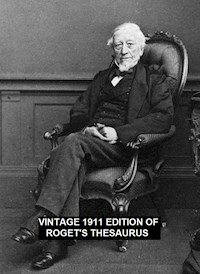
<— An electronic thesaurus derived from the version of Roget's Thesaurus published in 1911.
This thesaurus has been prepared by MICRA, Inc[1]. (May 1991).
=-=-=-=-=-=-=-=-=-=-=-=-=-=-=-=-=-=-=-=-=-=-=-=-=-=-=-=-=-=-=-=-=-=-=-=-=-=
MICRA, Inc. makes no representation that the original 1911 printed work on which this is based is now in the public domain in any particular country. However, MICRA, Inc. makes no proprietary claims regarding this electronic version of the 1911 thesaurus. If the 1911 work is currently public domain, this electronic version can also be treated as public domain.
If any commercial use is made of this work prior to January 1, 1993, it is suggested that an appropriate donation be made to MICRA, Inc. to assist in preparing other such texts which may be useful.
=-=-=-=-=-=-=-=-=-=-=-=-=-=-=-=-=-=-=-=-=-=-=-=-=-=-=-=-=-=-=-=-=-=-=-=-=-=
Note that this version of Thesaurus-1911 has been supplemented with over 1,000 words not present in the original 1911 edition, but many modern words are still missing. About 1500 verbs (out of 6500) which can be found in an 80,000-word spell-checker are absent from this work. The deficiency of nouns is probably much worse, especially on technical topics. Of 40,000 unique words contained in the original text, 12,000 are not recognized by a spell-checker. Most of these are foreign words (primarily Latin), and many are obsolete. In this version, these words are marked as such by comments in square brackets. Although this version has been proof-read, there are doubtless numerous residual transcription errors, some of which may be obvious even without reference to the original text. We will be grateful if any of these are brought to our attention; the corrections will appear in subsequent versions.
The original arrangement has also been modified slightly in several places, in particular by splitting one entry into two. A version of the 1911 thesaurus which is almost identical to the original (only a small number of additions to the original work) has also been prepared by MICRA, Inc., and also carries no restrictions from MICRA. Copies of that version or this one may be purchased for $40.00 from MICRA, Inc., or from the Austin Code Works, Austin Texas.
In this file, comments which are not a proper part of the thesaurus itself are contained within arrow brackets thus: <— comment —>.
Section headings, which are not an actual part of the thesaurus proper, are included between percent (%) markers.
Occasional references to numbers starting with "@" are the embryonic beginnings of a reorganized version, mentioned below. A few comments are also included within curly brackets {}.
Last edit 12-20-91.
The following additional differences will be noted between this version and the original edition of the printed 1911 thesaurus:
(1) the space-saving abbreviations in the original, using hyphens to represent common words, prefixes or suffixes, have been expanded into the full words or phrases.
(2) the side-by-side format for words and their opposites has been abandoned. Words are listed in order of their entry number.
(3) each main entry (1035 entries) has a pound sign "#" in front of the number to facilitate computerized search.
(4) Greek words and phrases are transliterated and included between brackets in the format <gr/greek word/gr>.
(5) where italics occurred in the original, italics are used in the Microsoft Word format file. In the plain ASCII file, this formatting is lost.
(6) in the original book, words which were obsolete (in 1911) were marked with a dagger. In this version, those words are marked with a vertical bar ("|").
Some of the words which were still current in 1911, but are no longer found in a current college-size dictionary (presently obsolete words), or which are no longer used in the specific indicated sense, have been marked with a bar followed by an exclamation point "|!". However, this marking process has just commenced, and only a small portion of the words which are now obsolete have been thus marked. Most though not all of the foreign-language phrases are now obsolete. The "obsolete" notation [obs3] indicates that the previous word (or some word in the previous phrase) is not recognized by the word processor's spelling checker, and also is either NOT in a modern college-sized dictionary, or is noted there as being "ARCHAIC".
(7) the approximate location of the bottom of each page in the original 1911 printed book is indicated by a comment of the form: <— p. 23 —>. To search for a page, note that there are two spaces between the "p." and the page number.
(8) This file contains only the main body of the thesaurus. Neither outline nor index are contained here. The outline with an overview of the organization of the concepts is contained in a separate file, "outline.doc", on the distribution disk.
This first edition of this supplemented 1911 thesaurus (June 1991) is very much less complete than the latest editions of commercial thesauri, and is probably not suitable for use as an adjunct to word-processing programs, but it has no proprietary claims attached to it by MICRA, Inc., and does not contain any material published commercially after 1911.
Future (copyrighted) versions of this thesaurus are planned, which will be reorganized in a hierarchical fashion to maximize the ability to take advantage of inheritance of semantic characteristics from higher categories. The objective is to create a database of words organized by semantic categories, suitable for use in natural-language understanding programs. This is a very small-scale project, which will not be competitive with large academic or commercial efforts such as the CYC project[2], but is intended to provide a convenient resource for experimentation in natural-language processing for individuals or small groups. Anyone who is currently engaged in or contemplating a similar thesaurus or dictionary project, who would be willing to collaborate on this project, is encouraged to contact us, so that unnecessary duplication of effort can be avoided. We would also appreciate being notified of typos, errors, or omissions in any version. Send inquiries or comments to:
Patrick Cassidy MICRA Inc. 735 Belvidere Ave. Plainfield, NJ 07062-2054
voice: (908) 668-5252 fax: (908) 668-5904
(If no one answers, please leave a message.) ==========================================================================
—> % THESAURUS OF ENGLISH WORDS AND PHRASES
CLASS I WORDS EXPRESSING ABSTRACT RELATIONS
SECTION I. EXISTENCE
1. BEING, IN THE ABSTRACT %
#1. Existence.— N. existence, being, entity, ens[Lat], esse[Lat], subsistence. reality, actuality; positiveness &c. adj.; fact, matter of fact, sober reality; truth &c. 494; actual existence. presence &c. (existence in space) 186; coexistence &c. 120. stubborn fact, hard fact; not a dream &c. 515; no joke. center of life, essence, inmost nature, inner reality, vital principle. [Science of existence], ontology. V. exist, be; have being &c. n.; subsist, live, breathe, stand, obtain, be the case; occur &c. (event) 151; have place, prevail; find oneself, pass the time, vegetate. consist in, lie in; be comprised in, be contained in, be constituted by. come into existence &c. n.; arise &c. (begin) 66; come forth &c. (appear) 446. become &c. (be converted) 144; bring into existence &c. 161. abide, continue, endure, last, remain, stay. Adj. existing &c. v.; existent, under the sun; in existence &c. n.; extant; afloat, afoot, on foot, current, prevalent; undestroyed. real, actual, positive, absolute; true &c. 494; substantial, substantive; self-existing, self-existent; essential. well-founded, well-grounded; unideal[obs3], unimagined; not potential &c. 2; authentic. Adv. actually &c. adj.; in fact, in point of fact, in reality; indeed; de facto, ipso facto. Phr. ens rationis[Lat]; ergo sum cogito: "thinkest thou existence doth depend on time?" [Lat][Byron].
#2. Inexistence.— N. inexistence[obs3]; nonexistence, nonsubsistence; nonentity, nil; negativeness &c. adj.; nullity; nihility[obs3], nihilism; tabula rasa[Lat[3]], blank; abeyance; absence &c. 187; no such thing &c. 4; nonbeing, nothingness, oblivion. annihilation; extinction &c. (destruction) 162; extinguishment, extirpation, Nirvana, obliteration. V. not exist &c. 1; have no existence &c. 1; be null and void; cease to exist &c. 1; pass away, perish; be extinct, become extinct &c. adj.; die out; disappear &c. 449; melt away, dissolve, leave not a rack behind; go, be no more; die &c. 360. annihilate, render null, nullify; abrogate &c. 756; destroy &c. 162; take away; remove &c. (displace) 185; obliterate, extirpate. Adj. inexistent[obs3], nonexistent &c. 1; negative, blank; missing, omitted; absent &c. 187; insubstantial, shadowy, spectral, visionary. unreal, potential, virtual; baseless, in nubibus[Lat]; unsubstantial &c. 4; vain. unborn, uncreated[obs3], unbegotten, unconceived, unproduced, unmade. perished, annihilated, &c. v.; extinct, exhausted, gone, lost, vanished, departed, gone with the wind; defunct &c. (dead) 360. fabulous, ideal &c. (imaginary) 515, supposititious &c. 514. Adv. negatively, virtually &c. adj. Phr. non ens[Lat].
<— p. 1 —>
% 2. BEING, IN THE CONCRETE %
#3. Substantiality. — N. substantiality, hypostasis; person, being, thing, object, article, item; something, a being, an existence; creature, body, substance, flesh and blood, stuff, substratum; matter &c. 316; corporeity[obs3], element, essential nature, groundwork, materiality, substantialness, vital part. [Totality of existences], world &c. 318; plenum. Adj. substantive, substantial; hypostatic; personal, bodily, tangible &c. (material) 316; corporeal. Adv. substantially &c. adj.; bodily, essentially.
#4. Unsubstantiality. — N. unsubstantiality[obs3], insubstantiality; nothingness, nihility[obs3]; no degree, no part, no quantity, no thing. nothing, naught, nil, nullity, zero, cipher, no one, nobody; never a one, ne'er a one[contr]; no such thing, none in the world; nothing whatever, nothing at all, nothing on earth; not a particle &c. (smallness) 32; all talk, moonshine, stuff and nonsense; matter of no importance, matter of no consequence, thing of naught, man of straw, John Doe and Richard Roe[4], faggot voter; nominis umbra[Lat], nonentity; flash in the pan, vox et praeterea nihil[Lat]. shadow; phantom &c.(fallacy of vision) 443; dream &c. (imagination) 515; ignis fatuus &c. (luminary) 423[Lat]; "such stuff as dreams are made of" [Tempest]; air, thin air, vapor; bubble &c. 353; "baseless fabric of a vision" [Tempest]; mockery. hollowness, blank; void &c. (absence) 187. inanity, fool's paradise. V. vanish, evaporate, fade, dissolve, melt away; disappear &c. 449. Adj. unsubstantial; baseless, groundless; ungrounded; without foundation, having no foundation. visionary &c. (imaginary) 515; immaterial &c. 137; spectral &c. 980; dreamy; shadowy; ethereal, airy; cloud built, cloud formed; gossamery, illusory, insubstantial, unreal. vacant, vacuous; empty &c. 187; eviscerated; blank, hollow; nominal; null; inane. Phr. there's nothing in it; "an ocean of dreams without a sound" [Shelley].
% 3. FORMAL EXISTENCE
Internal conditions %
#5. Intrinsicality.— N. intrinsicality[obs3], inbeing[obs3], inherence, inhesion[obs3]; subjectiveness; ego; egohood[obs3]; essence, noumenon; essentialness[obs3] &c. adj.; essential part, quintessence, incarnation, quiddity, gist, pith, marrow, core, sap, lifeblood, backbone, heart, soul; important part &c. (importance) 642. principle, nature, constitution, character, type, quality, crasis[obs3], diathesis[obs3]. habit; temper, temperament; spirit, humor, grain; disposition. endowment, capacity; capability &c. (power) 157. moods, declensions, features, aspects; peculiarities &c. (speciality) 79; idiosyncrasy, oddity; idiocrasy &c. (tendency) 176[obs3]; diagnostics. V. be in the blood, run in the blood; be born so; be intrinsic &c. adj. Adj. derived from within, subjective; intrinsic, intrinsical[obs3]; fundamental, normal; implanted, inherent, essential, natural; innate, inborn, inbred, ingrained, inwrought; coeval with birth, genetous[obs3], haematobious[obs3], syngenic[obs3]; radical, incarnate, thoroughbred, hereditary, inherited, immanent; congenital, congenite|; connate, running in the blood; ingenerate[obs3], ingenite|; indigenous; in the grain &c. n.; bred in the bone, instinctive; inward, internal &c. 221; to the manner born; virtual. characteristic &c. (special) 79, (indicative) 550; invariable, incurable, incorrigible, ineradicable, fixed. Adv. intrinsically &c. adj.; at bottom, in the main, in effect, practically, virtually, substantially, au fond; fairly. Phr. "character is higher than intellect" [Emerson]; "come give us a taste of your quality" magnos homines virtute metimur non fortuna [Lat][ Hamlet][Nepos]; non numero haec judicantur sed pondere [Lat][Cicero]; "vital spark of heavenly flame" [Pope].
% External conditions %
#6. Extrinsicality.— N. extrinsicality[obs3], objectiveness, non ego; extraneousness &c. 57; accident; appearance, phenomenon &c. 448. Adj. derived from without; objective; extrinsic, extrinsical[obs3]; extraneous &c. (foreign) 57; modal, adventitious; ascititious[obs3], adscititious[obs3]; incidental, accidental, nonessential; contingent, fortuitous. implanted, ingrafted[obs3]; inculcated, infused. outward, apparent &c. (external) 220. Adv. extrinsically &c. adj.
<— p. 2 —>
% 4. MODAL EXISTENCE
Absolute %
#7. State. — N. state, condition, category, estate, lot, ease, trim, mood, pickle, plight, temper; aspect &c. (appearance) 448, dilemma, pass, predicament. constitution, habitude, diathesis[obs3]; frame, fabric &c. 329; stamp, set, fit, mold, mould. mode, modality, schesis[obs3]; form &c. (shape) 240. tone, tenor, turn; trim, guise, fashion, light, complexion, style, character. V. be in a state, possess a state, enjoy a state, labor under a state &c. n.; be on a footing, do, fare; come to pass. Adj. conditional, modal, formal; structural, organic. Adv. conditionally &c. adj.; as the matter stands, as things are; such being the case &c. 8.
% Relative %
#8. Circumstance. — N. circumstance, situation, phase, position, posture, attitude, place, point; terms; regime; footing, standing, status. occasion, juncture, conjunctive; contingency &c. (event) 151. predicament; emergence, emergency; exigency, crisis, pinch, pass, push; occurrence; turning point. bearings, how the land lies. surroundings, context, environment 229a[TE 232]; location 184. contingency, dependence (uncertainty) 475; causation 153, attribution 155. Adj. circumstantial; given, conditional, provisional; critical; modal; contingent, incidental; adventitious &c. (extrinsic) 6; limitative[obs3]. Adv. in the circumstances, under the circumstances &c. n., the circumstances, conditions &c. 7; thus, in such wise. accordingly; that being the case, such being the case, in view of the circumstances; that being so, sith[obs3], since, seeing that. as matters stand; as things go, as times go. conditionally, provided, if, in case; if so, if so be, if it be so; depending on circumstances, in certain circumstances, under certain conditions; if it so happen, if it so turn out; in the event of; in such a contingency, in such a case, in such an event; provisionally, unless, without. according to circumstances, according to the occasion; as it may happen, as it may turn out, as it may be; as the case may be, as the wind blows; pro re nata[Lat]. Phr. "yet are my sins not those of circumstance" [Lytton].
<— p. 3 —>
% SECTION II. RELATION
1. ABSOLUTE RELATION %
#9. Relation. — N. relation, bearing, reference, connection, concern, cognation; correlation &c. 12; analogy; similarity &c. 17; affinity, homology, alliance, homogeneity, association; approximation &c. (nearness) 197; filiation &c. (consanguinity) 11[obs3]; interest; relevancy &c. 23; dependency, relationship, relative position. comparison &c. 464; ratio, proportion. link, tie, bond of union. V. be related &c. adj.; have a relation &c. n.; relate to, refer to; bear upon, regard, concern, touch, affect, have to do with; pertain to, belong to, appertain to; answer to; interest. bring into relation with, bring to bear upon; connect, associate, draw a parallel; link &c. 43. Adj. relative; correlative &c. 12; cognate; relating to &c. v.; relative to, in relation with, referable or referrible to[obs3]; belonging to &c. v.; appurtenant to, in common with. related, connected; implicated, associated, affiliated, allied to; en rapport, in touch with. approximative[obs3], approximating; proportional, proportionate, proportionable; allusive, comparable. in the same category &c. 75; like &c. 17; relevant &c. (apt) 23; applicable, equiparant[obs3]. Adv. relatively &c. adj.; pertinently &c. 23. thereof; as to, as for, as respects, as regards; about; concerning &c. v.; anent; relating to, as relates to; with relation, with reference to, with respect to, with regard to; in respect of; while speaking of, a propos of[Fr]; in connection with; by the way, by the by; whereas; for as much as, in as much as; in point of, as far as; on the part of, on the score of; quoad hoc[Lat]; pro re nata[Lat]; under the head of &c. (class) 75 of; in the matter of, in re. Phr. "thereby hangs a tale" [Taming of the Shrew].
#10. [Want, or absence of relation.] Irrelation. — N. irrelation[obs3], dissociation; misrelation[obs3]; inapplicability; inconnection[obs3]; multifariousness; disconnection &c. (disjunction) 44; inconsequence, independence; incommensurability; irreconcilableness &c. (disagreement) 24; heterogeneity; unconformity &c. 83; irrelevancy, impertinence, nihil ad rem[Lat]; intrusion &c. 24; non-pertinence. V. have no relation to &c. 9; have no bearing upon, have no concern with &c. 9, have no business with; not concern &c. 9; have no business there, have nothing to do with, intrude &c. 24. bring in head and shoulders, drag in head and shoulders, lug in head and shoulders. Adj. irrelative[obs3], irrespective, unrelated; arbitrary; independent, unallied; unconnected, disconnected; adrift, isolated, insular; extraneous, strange, alien, foreign, outlandish, exotic. not comparable, incommensurable, heterogeneous; unconformable &c. 83. irrelevant, inapplicable; not pertinent, not to the, purpose; impertinent, inapposite, beside the mark, a propos de bottes[Fr]; aside from the purpose,, away from the purpose,, foreign to the purpose, beside the purpose, beside the question, beside the transaction, beside the point; misplaced &c. (intrusive) 24; traveling out of the record. remote, far-fetched, out of the way, forced, neither here nor there, quite another thing; detached, segregate; disquiparant[obs3]. multifarious; discordant &c. 24. incidental, parenthetical, obiter dicta, episodic. Adv. parenthetically &c. adj.; by the way, by the by; en passant[Fr], incidentally; irrespectively &c. adj.; without reference to, without regard to; in the abstract &c. 87; a se.
#11. [Relations of kindred.] Consanguinity. — N. consanguinity, relationship, kindred, blood; parentage &c. (paternity) 166; filiation[obs3], affiliation; lineage, agnation[obs3], connection, alliance; family connection, family tie; ties of blood; nepotism. kinsman, kinfolk; kith and kin; relation, relative; connection; sibling, sib; next of kin; uncle, aunt, nephew, niece; cousin, cousin- german[obs3]; first cousin, second cousin; cousin once removed, cousin twice &c. removed; near relation, distant relation; brother, sister, one's own flesh and blood. family, fraternity; brotherhood, sisterhood, cousinhood[obs3]. race, stock, generation; sept &c. 166; stirps, side; strain; breed, clan, tribe, nation. V. be related to &c. adj. claim relationship with &c. n. with. Adj. related, akin, consanguineous, of the blood, family, allied, collateral; cognate, agnate, connate; kindred; affiliated; fraternal.
<— p. 4 —>
intimately related, nearly related, closely related, remotely related, distantly related, allied; german.
#12. [Double or reciprocal relation.] Correlation. — N. reciprocalness &c. adj[obs3].; reciprocity, reciprocation; mutuality, correlation, interdependence, interrelation, connection, link, association; interchange &c. 148; exchange, barter. reciprocator, reprocitist. V. reciprocate, alternate; interchange &c. 148; exchange; counterchange[obs3]. Adj. reciprocal, mutual, commutual[obs3], correlative, reciprocative, interrelated, closely related; alternate; interchangeable; interdependent; international; complemental, complementary. Adv. mutually, mutatis mutandis[Lat]; vice versa; each other, one another; by turns &c. 148; reciprocally &c. adj. Phr. "happy in our mutual help" [Milton].
#13. Identity. — N. identity, sameness; coincidence, coalescence; convertibility; equality &c. 27; selfness[obs3], self, oneself; identification. monotony, tautology &c. (repetition) 104. facsimile &c. (copy) 21; homoousia; alter ego &c. (similar) 17[obs3]; ipsissima verba &c. (exactness) 494[Lat]; same; self, very, one and the same; very thing, actual thing; real McCoy[5]; no other; one and only; in the flesh. V. be identical &c. adj.; coincide, coalesce, merge. treat as the same, render the same, identical; identify; recognize the identity of. Adj. identical; self, ilk; the same &c. n. selfsame, one and the same, homoousian[obs3]. coincide, coalescent, coalescing; indistinguishable; one; equivalent &c. (equal) 27; tweedle dee and tweedle dum[Lat]; much the same, of a muchness[obs3]; unaltered. Adv. identically &c. adj.; on all fours.
#14. [Noncoincidence.] Contrariety.— N. contrariety, contrast, foil, antithesis, oppositeness; contradiction; antagonism &c. (opposition) 708; clashing, repugnance. inversion &c. 218; the opposite, the reverse, the inverse, the converse, the antipodes, the antithesis, the other extreme. V. be contrary &c. adj.; contrast with, oppose; diller toto coelo[Lat]. invert, reverse, turn the tables; turn topsy-turvy, turn end for end, turn upside down, turn inside out. contradict, contravene; antagonize &c. 708. Adj. contrary, contrarious[obs3], contrariant[obs3]; opposite, counter, dead against; converse, reverse; opposed, antithetical, contrasted, antipodean, antagonistic, opposing; conflicting, inconsistent, contradictory, at cross purposes; negative; hostile &c. 703. differing toto coelo[Lat]; diametrically opposite; diametrically opposed; as opposite as black and white, as opposite as light and darkness, as opposite as fire and water, as opposite as the poles; as different as night and day; "Hyperion to a satyr"[ Hamlet]; quite the contrary, quite the reverse; no such thing, just the other way, tout au contraire[Fr]. Adv. contrarily &c. adj.; contra, contrariwise, per contra, on the contrary, nay rather; vice versa; on the other hand &c. (in compensation) 30. Phr. "all concord's born of contraries" [B. Jonson]. Thesis, antithesis, synthesis [Marx].
#15. Difference. — N. difference; variance, variation, variety; diversity, dissimilarity &c. 18; disagreement &c. 24; disparity &c. (inequality) 28; distinction, contradistinction; alteration. modification, permutation, moods and tenses. nice distinction, fine distinction, delicate distinction, subtle distinction; shade of difference, nuance; discrimination &c. 465; differentia. different thing, something else, apple off another tree, another pair of shoes; horse of a different color; this that or the other. V. be different &c. adj.; differ, vary, ablude|, mismatch, contrast; divaricate; differ toto coelo[Lat], differ longo intervallo[It]. vary, modify &c. (change) 140. discriminate &c. 465. Adj. differing &c. v.; different, diverse, heterogeneous, multifarious, polyglot; distinguishable, dissimilar; varied, modified; diversified, various, divers, all manner of, all kinds of; variform &c. 81[obs3]; daedal[obs3]. other, another, not the same; unequal &c. 28. unmatched; widely apart, poles apart, distinctive, characteristic; discriminative; distinguishing. incommensurable, incommensurate. Adv. differently &c. adj. Phr. il y a fagots et fagots.
<— p. 5 —>
% 2. CONTINUOUS RELATION %
#16. Uniformity. — N. uniformity; homogeneity, homogeneousness; consistency; connaturality[obs3], connaturalness[obs3]; homology; accordance; conformity &c. 82; agreement &c. 23; consonance, uniformness. regularity, constancy, even tenor, routine; monotony. V. be uniform &c. adj.; accord with &c. 23; run through. become uniform &c. adj.; conform to &c. 82. render uniform, homogenize &c. adj.; assimilate, level, smooth, dress. Adj. uniform; homogeneous, homologous; of a piece[Fr], consistent, connatural[obs3]; monotonous, even, invariable; regular, unchanged, undeviating, unvaried, unvarying. unsegmented. Adv. uniformly &c. adj.; uniformly with &c. (conformably) 82; in harmony with &c. (agreeing) 23. always, invariably, without exception, without fail, unfailingly, never otherwise; by clockwork. Phr. ab uno disce omnes[Lat].
#16a. [Absence or want of uniformity.] Nonuniformity. — N. diversity, irregularity, unevenness; multiformity &c. 81; unconformity &c. 83; roughness &c. 256; dissimilarity, dissimilitude, divarication, divergence. Adj. diversified varied, irregular, uneven, rough &c. 256; multifarious; multiform &c. 81; of various kinds; all manner of, all sorts of, all kinds of. Adv. variously, in all manner of ways, here there and everywhere.
% 3. PARTIAL RELATION %
#17. Similarity. — N. similarity, resemblance, likeness, similitude, semblance; affinity, approximation, parallelism; agreement &c. 23; analogy, analogicalness[obs3]; correspondence, homoiousia[obs3], parity. connaturalness[obs3], connaturality[obs3]; brotherhood, family likeness. alliteration, rhyme, pun. repetition &c. 104; sameness &c. (identity) 13; uniformity &c. 16; isogamy[obs3]. analogue; the like; match, pendant, fellow companion, pair, mate, twin, double, counterpart, brother, sister; one's second self, alter ego, chip of the old block, par nobile fratrum[Lat], Arcades ambo[obs3], birds of a feather, et hoc genus omne[Lat]; gens de meme famille[Fr]. parallel; simile; type &c. (metaphor) 521; image &c. (representation) 554; photograph; close resemblance, striking resemblance, speaking resemblance, faithful likeness, faithful resemblance. V. be similar &c. adj.; look like, resemble, bear resemblance; smack of, savor of; approximate; parallel, match, rhyme with; take after; imitate &c. 19; favor, span [U. S.]. render similar &c. adj.; assimilate, approximate, bring near; connaturalize[obs3], make alike; rhyme, pun. Adj. similar; resembling &c. v.; like, alike; twin. analogous, analogical; parallel, of a piece[Fr]; such as, so; homoiousian[obs3]. connatural[obs3], congener, allied to; akin to &c. (consanguineous) 1 1. approximate, much the same, near, close, something like, sort of, in the ballpark, such like; a show of; mock, pseudo, simulating, representing. exact &c. (true) 494; lifelike, faithful; true to nature, true to life, the very image, the very picture of; for all the world like, comme deux gouttes d'eau[Fr]; as like as two peas in a pod, as like as it can stare; instar omnium[Lat], cast in the same mold, ridiculously like. Adv. as if, so to speak; as it were, as if it were; quasi, just as, veluti in speculum[Lat]. Phr. et sic de similibus[Lat]; tel maitre tel valet[Fr]; tel pere tel fils[Fr]; like master, like servant; like father, like son; the fruit doesn't fall far from the tree; a chip off the old block
<— p. 6 —>
#18. Dissimilarity. — N. dissimilarity, dissimilaritude[obs3]; unlikeness, diversity, disparity, dissemblance[obs3]; divergence, variation.; difference &c. 15; novelty, originality; creativeness; oogamy[obs3]. V. be unlike &c. adj.; vary &c. (differ) 15; bear no resemblance to, differ toto coelo[Lat]. render unlike &c. adj.; vary &c. (diversify) 140. Adj. dissimilar, unlike, disparate; divergent; of a different kind &c. (class) 75 unmatched, unique; new, novel; unprecedented &c. 83; original. nothing of the kind; no such thing, quite another thing; far from it, cast in a different mold, tertium quid[Lat], as like a dock as a daisy, "very like a whale" [Hamlet]; as different as chalk from cheese, as different as Macedon and Monmouth; lucus a non lucendo[Lat]. diversified &c. 16a. Adv. otherwise. Phr. diis aliter visum[Lat]; "no more like my father than I to Hercules" [Hamlet].
#19. Imitation. — N. imitation; copying &c. v.; transcription; repetition, duplication, reduplication; quotation; reproduction; mimeograph, xerox, facsimile; reprint, offprint. mockery, mimicry; simulation, impersonation, personation; representation &c. 554; semblance; copy &c. 21; assimilation. paraphrase, parody, take-off, lampoon, caricature &c. 21. plagiarism; forgery, counterfeit &c. (falsehood) 544; celluloid. imitator, echo, cuckoo|, parrot, ape, monkey, mocking bird, mime; copyist, copycat; plagiarist, pirate. V. imitate, copy, mirror, reflect, reproduce, repeat; do like, echo, reecho, catch; transcribe; match, parallel. mock, take off, mimic, ape, simulate, impersonate, personate; act &c. (drama) 599; represent &c. 554; counterfeit, parody, travesty, caricature, lampoon, burlesque. follow in the steps of, tread in the steps, follow in the footsteps of, follow in the wake of; take pattern by; follow suit, follow the example of; walk in the shoes of, take a leaf out of another's book, strike in with, follow suit; take after, model after; emulate. Adj. imitated &c. v.; mock, mimic; modelled after, molded on. paraphrastic; literal; imitative; secondhand; imitable; aping, apish, mimicking.
Adv. literally, to the letter, verbatim, literatim[Lat], sic, totidem verbis[Lat], word for word, mot a mot[Fr]; exactly, precisely.
Phr. like master like man; "like - but oh! how different!" [Wordsworth]; "genius borrows nobly" [Emerson]; "pursuing echoes calling 'mong the rocks" [A. Coles]; "quotation confesses inferiority" [Emerson]; "Imitation is the sincerest form of flattery".
#20. Nonimitation. — N. no imitation; originality; creativeness. invention, creation. Adj. unimitated[obs3], uncopied[obs3]; unmatched, unparalleled; inimitable &c. 13; unique, original; creative, inventive, untranslated; exceptional, rare, sui generis uncommon[Lat], unexampled.
#20a. Variation. — N. variation; alteration &c. (change) 140. modification, moods and tenses; discrepance[obs3], discrepancy. divergency &c. 291[obs3]; deviation &c. 279; aberration; innovation. V. vary &c. (change) 140; deviate &c. 279; diverge &c. 291; alternate, swerve. Adj. varied &c. v.; modified; diversified &c. 16a.
#21. [Result of imitation.] Copy. — N. copy, facsimile, counterpart, effigies, effigy, form, likeness. image, picture, photo, xerox, similitude, semblance, ectype[obs3], photo offset, electrotype; imitation &c. 19; model, representation, adumbration, study; portrait &c. (representation) 554; resemblance. duplicate, reproduction; cast, tracing; reflex, reflexion[Brit], reflection; shadow, echo. transcript[copy into a non-visual form], transcription; recording, scan. chip off the old block; reprint, new printing; rechauffe[Fr]; apograph[obs3], fair copy. parody, caricature, burlesque, travesty, travestie[obs3], paraphrase. [copy with some differences] derivative, derivation, modification, expansion, extension, revision; second edition &c. (repetition) 104. servile copy, servile imitation; plagiarism, counterfeit, fake &c.(deception) 545; pasticcio[obs3]. Adj. faithful; lifelike &c. (similar) 17; close, conscientious. unoriginal, imitative, derivative.
#22. [Thing copied.] Prototype. — N. prototype, original, model, pattern, precedent, standard, ideal, reference, scantling, type; archetype, antitype[obs3]; protoplast, module, exemplar, example, ensample[obs3], paradigm; lay-figure. text, copy, design; fugleman[obs3], keynote; die, mold; matrix, last, plasm[obs3]; proplasm[obs3], protoplasm; mint; seal, punch, intaglio, negative; stamp. V. be an example, be a role model, set an example; set a copy. Phr. a precedent embalms a principle [Disraeli]; exempla sunt odiosa[Lat].
<— p. 7 —>
% 4. GENERAL RELATION %
#23. Agreement. — N. agreement; accord, accordance; unison, harmony; concord &c. 714; concordance, concert; understanding, mutual understanding. conformity &c. 82; conformance; uniformity &c. 16; consonance, consentaneousness[obs3], consistency; congruity, congruence; keeping; congeniality; correspondence, parallelism, apposition, union. fitness, aptness &c. adj.; relevancy; pertinence, pertinencey[obs3]; sortance|; case in point; aptitude, coaptation[obs3], propriety, applicability, admissibility, commensurability, compatibility; cognation &c. (relation) 9. adaption[obs3], adjustment, graduation, accommodation; reconciliation, reconcilement; assimilation. consent &c. (assent) 488; concurrence &c. 178; cooperation &c. 709. right man in the right place, very thing; quite the thing, just the thing. V. be accordant &c. adj.; agree, accord, harmonize; correspond, tally, respond; meet, suit, fit, befit, do, adapt itself to; fall in with, chime in with, square with, quadrate with, consort with, comport with; dovetail, assimilate; fit like a glove, fit to a tittle, fit to a T; match &c. 17; become one; homologate[obs3]. consent &c. (assent) 488. render accordant &c. adj.; fit, suit, adapt, accommodate; graduate; adjust &c. (render, equal) 27; dress, regulate, readjust; accord, harmonize,. reconcile; fadge[obs3], dovetail, square. Adj. agreeing, suiting &c. v.; in accord, accordant, concordant, consonant, congruous, consentaneous[obs3], correspondent, congenial; coherent; becoming; harmonious reconcilable, conformable; in accordance with, in harmony with, in keeping with, in unison with, &c. n.; at one with, of one mind, of a piece[Fr]; consistent, compatible, proportionate; commensurate; on all fours. apt, apposite, pertinent, pat; to the point, to the purpose; happy, felicitous, germane, ad rem[Lat], in point, on point, directly on point, bearing upon, applicable, relevant, admissible. fit adapted, in loco, a propos[Fr], appropriate, seasonable, sortable, suitable, idoneous[obs3], deft; meet &c. (expedient) 646.
at home, in one's proper element. Adv. a propos of[Fr]; pertinently &c. adj. Phr. rem acu tetigisti[Lat][obs3]; if the shoe fits, wear it; the cap fits; auxilia humilia firma consensus facit [Lat][Syrus]; discers concordia [Lat][Ovid].
<— p. 8 —>
#24. Disagreement. — N. disagreement; discord, discordance; dissonance, dissidence, discrepancy; unconformity &c. 83; incongruity, incongruence[obs3]; discongruity[obs3], mesalliance; jarring &c. v.; dissension &c. 713; conflict &c. (opposition) 708; bickering, clashing, misunderstanding, wrangle. disparity, mismatch, disproportion; dissimilitude, inequality; disproportionateness &c. adj[obs3].; variance, divergence, repugnance. unfitness &c. adj.; inaptitude, impropriety; inapplicability &c. adj.; inconsistency, inconcinnity[obs3]; irrelevancy &c. (irrelation) 10[obs3]. misjoining[obs3], misjoinder[obs3]; syncretism[obs3], intrusion, interference; concordia discors[Lat]. fish out of water. V. disagree; clash, jar &c. (discord) 713; interfere, intrude, come amiss; not concern &c. 10; mismatch; humano capiti cervicem jungere equinam[Lat]. Adj. disagreeing &c. v.; discordant, discrepant; at variance, at war; hostile, antagonistic, repugnant, incompatible, irreconcilable, inconsistent with; unconformable, exceptional &c. 83; intrusive, incongruous; disproportionate, disproportionated[obs3]; inharmonious, unharmonious[obs3]; inconsonant, unconsonant[obs3]; divergent, repugnant to. inapt, unapt, inappropriate, improper; unsuited, unsuitable; inapplicable, not to the point; unfit, unfitting, unbefitting; unbecoming; ill-timed, unseasonable, mal a propos[Fr], inadmissible; inapposite &c. (irrelevant) 10. uncongenial; ill-assorted, ill-sorted; mismatched, misjoined[obs3], misplaced, misclassified; unaccommodating, irreducible, incommensurable, uncommensurable[obs3]; unsympathetic. out of character, out of keeping, out of proportion, out of joint, out of tune, out of place, out of season, out of its element; at odds with, at variance with. Adv. in defiance, in contempt, in spite of; discordantly &c. adj.; a tort et a travers[obs3]. Phr. asinus ad lyram[Lat].
% SECTION III. QUANTITY
1. SIMPLE QUANTITY %
#25. [Absolute quantity.] Quantity. — N. quantity, magnitude; size &c. (dimensions) 192; amplitude, magnitude, mass, amount, sum, quantum, measure, substance, strength, force. [Science of quantity.] mathematics, mathesis[obs3]. [Logic.] category, general conception, universal predicament. [Definite or finite quantity.] armful, handful, mouthful, spoonful, capful; stock, batch, lot, dose; yaffle[obs3]. V. quantify, measure, fix, estimate, determine, quantitate, enumerate. Adj. quantitative, some, any, aught, more or less, a few. Adv. to the tune of, all of, a full, the sum of, fully, exactly, precisely.
#26. [Relative quantity.] Degree. — N. degree, grade, extent, measure, amount, ratio, stint, standard, height, pitch; reach, amplitude, range, scope, caliber; gradation, shade; tenor, compass; sphere, station, rank, standing; rate, way, sort. point, mark, stage &c. (term) 71; intensity, strength &c. (greatness) 31. Adj. comparative; gradual, shading off; within the bounds &c. (limit) 233. Adv. by degrees, gradually, inasmuch, pro tanto[It]; however, howsoever; step by step, bit by bit, little by little, inch by inch, drop by drop; a little at a time, by inches, by slow degrees, by degrees, by little and little; in some degree, in some measure; to some extent; di grado in grado[Lat].
% 2. COMPARATIVE QUANTITY %
#27. [Sameness of quantity or degree.] Equality. — N. equality, parity, coextension[obs3], symmetry, balance, poise; evenness, monotony, level. equivalence; equipollence[obs3], equipoise, equilibrium, equiponderance[obs3]; par, quits, a wash; not a pin to choose; distinction without a difference, six of one and half a dozen of the other; tweedle dee and tweedle dum[Lat]; identity &c. 13; similarity &c. 17. equalization, equation; equilibration, co*ordination, adjustment, readjustment; drawn game, drawn battle; neck and neck race; tie, draw, standoff, dead heat. match, peer, compeer, equal, mate, fellow, brother; equivalent. V. be equal &c. adj.; equal, match, reach, keep pace with, run abreast; come to, amount to, come up to; be on a level with, lie on a level with; balance; cope with; come to the same thing. render equal &c. adj.; equalize level, dress, balance, equate, handicap, give points, spot points, handicap, trim, adjust, poise; fit, accommodate; adapt &c. (render accordant) 23; strike a balance; establish equality, restore equality, restore equilibrium; readjust; stretch on the bed of Procrustes. Adj. equal, even, level, monotonous, coequal, symmetrical, coordinate; on a par with, on a level with, on a footing with; up to the mark; equiparant[obs3]. equivalent, tantamount; indistinguishable; quits; homologous; synonymous &c. 522; resolvable into, convertible, much at one, as broad as long, neither more nor less.; much the same as, the same thing as, as good as; all one, all the same; equipollent, equiponderant[obs3], equiponderous[obs3], equibalanced[obs3]; equalized &c. v.; drawn; half and half; isochronal, isochronous isoperimetric[obs3], isoperimetrical[obs3]; isobath[Oceanography], isobathic[Oceanography]. Adv. equally &c. adj.; pari passu[Lat], ad eundum[Lat], caeteris paribus[Lat]; in equilibrio[Lat]; to all intents and purposes.
Phr. it comes to the same thing, it amounts to the same thing; what is sauce for the goose is sauce for the gander.
#28. [Difference of quantity or degree.] Inequality. — N. inequality; disparity, imparity; odds; difference &c. 15; unevenness; inclination of the balance, partiality, bias, weight; shortcoming; casting weight, make- weight; superiority &c. 33; inferiority &c. 34; inequation[obs3]. V. be unequal &c. adj.; countervail; have the advantage, give the advantage; turn the scale; kick the beam; topple, topple over; overmatch &c. 33; not come up to &c. 34. Adj. unequal, uneven, disparate, partial; unbalanced, overbalanced; top-heavy, lopsided, biased, skewed; disquiparant[obs3]. Adv. haud passibus aequis [Latin][Vergil].
<— p. 9 —>
#29. Mean. — N. mean, average; median, mode; balance, medium, mediocrity, generality; golden mean &c. (mid-course) 628; middle &c. 68; compromise &c. 774; middle course, middle state; neutrality. mediocrity, least common denominator. V. split the difference; take the average &c. n.; reduce to a mean &c. n.; strike a balance, pair off. Adj. mean, intermediate; middle &c. 68; average; neutral. mediocre, middle-class; commonplace &c. (unimportant) 643. Adv. on an average, in the long run; taking one with another, taking all things together, taking it for all in all; communibus annis[Lat], in round numbers. Phr. medium tenuere beati[Lat].
#30. Compensation. — N. compensation, equation; commutation; indemnification; compromise &c. 774 neutralization, nullification; counteraction &c. 179; reaction; measure for measure, retaliation &c. 718 equalization &c. 27; robbing Peter to pay Paul. set-off, offset; make-weight, casting-weight; counterpoise, ballast; indemnity, equivalent, quid pro quo; bribe, hush money; amends &c. (atonement) 952; counterbalance, counterclaim; cross-debt, cross-demand. V. make compensation; compensate, compense[obs3]; indemnify; counteract, countervail, counterpoise; balance; outbalance[obs3], overbalance, counterbalance; set off; hedge, square, give and take; make up for, lee way; cover, fill up, neutralize, nullify; equalize &c. 27; make good; redeem &c. (atone) 952. Adj. compensating, compensatory; countervailing &c. v.; in the opposite scale; equivalent &c. (equal) 27. Adv. in return, in consideration; but, however, yet, still, notwithstanding; nevertheless, nathless[obs3], none the less; although, though; albeit, howbeit; mauger[obs3]; at all events, at any rate; be that as it may, for all that, even so, on the other, hand, at the same time, quoad minus[Lat], quand meme[Fr], however that may be; after all is said and done; taking one thing with another &c. (average) 29. Phr. "light is mingled with the gloom" [Whittier]; every dark cloud has a silver lining; primo avulso non deficit alter [Lat][obs3][Vergil]; saepe creat molles aspera spina rosas [Lat][Ovid].
% QUANTITY BY COMPARISON WITH A STANDARD %




