


0,49 €
Niedrigster Preis in 30 Tagen: 0,00 €
Niedrigster Preis in 30 Tagen: 0,00 €
Mehr erfahren.
- Herausgeber: DigiCat
- Kategorie: Religion und Spiritualität
- Sprache: Englisch
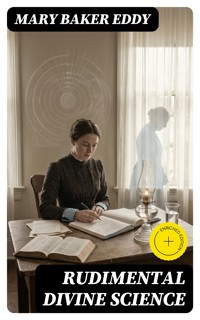
In "Rudimental Divine Science," Mary Baker Eddy presents a profound exploration of metaphysical principles and spiritual healing, framed within the context of her groundbreaking Christian Science movement. Written in a concise and accessible style, the book articulates the foundational aspects of her theology, emphasizing the relationship between the divine, the spiritual, and the material world. Eddy employs a rational and systematic approach, intertwining scripture with her insights to elucidate the power of thought and the importance of spiritual understanding in human healing, thus positioning the work as a crucial text in 19th-century religious literature. As the founder of Christian Science, Mary Baker Eddy was deeply influenced by her own experiences with pain and recovery through spiritual means, ultimately culminating in the establishment of her faith. Her extensive background in metaphysical inquiry and early religious influences shaped her perspective, enabling her to challenge conventional views on illness and wellness. "Rudimental Divine Science" serves as both a personal manifesto and a universal guide to achieving practical spirituality. This book is highly recommended for readers interested in spirituality, theology, and alternative healing practices. Its insights into the connection between faith and wellness offer valuable perspectives for anyone seeking holistic approaches to health and a deeper understanding of the divine. Eddy's work continues to resonate, inviting contemporary audiences to explore its rich spiritual dimensions. In this enriched edition, we have carefully created added value for your reading experience: - A comprehensive Introduction outlines these selected works' unifying features, themes, or stylistic evolutions. - The Author Biography highlights personal milestones and literary influences that shape the entire body of writing. - A Historical Context section situates the works in their broader era—social currents, cultural trends, and key events that underpin their creation. - A concise Synopsis (Selection) offers an accessible overview of the included texts, helping readers navigate plotlines and main ideas without revealing critical twists. - A unified Analysis examines recurring motifs and stylistic hallmarks across the collection, tying the stories together while spotlighting the different work's strengths. - Reflection questions inspire deeper contemplation of the author's overarching message, inviting readers to draw connections among different texts and relate them to modern contexts. - Lastly, our hand‐picked Memorable Quotes distill pivotal lines and turning points, serving as touchstones for the collection's central themes.
Das E-Book können Sie in Legimi-Apps oder einer beliebigen App lesen, die das folgende Format unterstützen:
Veröffentlichungsjahr: 2022
Ähnliche













Rudimental Divine Science
Table of Contents
Introduction
This single-author collection, gathered under the title Rudimental Divine Science, presents a focused view of Mary Baker Eddy’s thought across doctrinal exposition, collected writings, and devotional song. It brings together Rudimental Divine Science, Works on Christian Science, and Solos: Poems by Mary Baker Eddy set to music. The purpose is to offer readers an integrated approach to a body of work that founded and shaped Christian Science. Each component plays a distinct role: concise instruction, broader elaboration, and lyrical devotion. Read together, these texts illuminate how Eddy articulates Christian discipleship, spiritual healing, and scriptural engagement, while also showing the practical and worshipful dimensions of her teaching.
Rudimental Divine Science is a brief, methodical presentation of Christian Science in a question-and-answer format. It addresses basic terms and premises, clarifying how prayer, spiritual understanding, and adherence to biblical revelation relate to healing and moral transformation. Its economy of expression and pedagogical structure make it a compact gateway to Eddy’s system, designed for readers seeking orientation before engaging more expansive texts. The work’s instructional tone, steady definitions, and orderly progression help establish a shared vocabulary, preparing the reader to recognize key concepts that reappear throughout her writings and to consider how those concepts are applied in life and practice.
Works on Christian Science gathers a range of shorter texts by Mary Baker Eddy that elaborate doctrinal points, comment on church practice, and address questions of spiritual discipline. The volume presents essays, addresses, and expository pieces that expand themes introduced in her introductory writings. It offers context for the practical conduct of Christian Science, including instruction for study, guidance for collective worship and church life, and reflections on the Christian character. Read as a companion to the concise primer, it provides a fuller picture of Eddy’s approach to theology, healing, and community, allowing readers to see how foundational ideas are developed in varied settings.
Solos: Poems by Mary Baker Eddy set to music introduces the lyrical strand of her authorship. These poems, long familiar to Christian Scientists, have been set to music for solo voice and are often used in worship. The texts reflect devotional trust, spiritual aspiration, and reliance on God, translated into sung prayer. Their musical life underscores the close connection in Eddy’s work between doctrine and lived devotion, showing how theological insight may be reinforced by art. In presenting words intended to be sung, this volume complements the expository books with an aural, affective register suitable for private meditation and congregational inspiration.
The collection spans several genres and text types: a compact catechetical tract, a compendium of essays and addresses, and poetry set for performance. Taken together, these modes display how Eddy communicated in different registers to meet different needs—definition and instruction, extended reflection, and praise. The diversity of form is purposeful. It allows the reader to encounter Christian Science as both studied discipline and heartfelt devotion. The intellectual and affective dimensions of faith are brought side by side, encouraging readers to move from grasping principles to embodying them in prayer, worship, ethical action, and compassionate engagement.
Unifying themes recur across all three books. Chief among them is the conviction that spiritual understanding, grounded in the Bible, has practical consequences for health, character, and community. Eddy consistently presents Christian discipleship as a path of regeneration through prayer and moral growth. She emphasizes the necessity of aligning thought with divine law and of testing faith by its fruits. Another persistent theme is the active role of Scripture in daily life. Whether in definition, exposition, or song, the texts invite readers to approach the Bible as the guide and measure for Christian progress and healing.
Eddy’s stylistic hallmarks are equally consistent. In doctrinal passages she prefers precision, concise definitions, and cumulative argumentation anchored by biblical citation. She uses clear contrasts to sharpen spiritual distinctions and poses direct questions to frame key issues. Her essays balance analysis with exhortation, cultivating both understanding and commitment. The poems, by contrast, favor hymnlike clarity and steady cadence, supporting memorization and communal use. Across genres, she writes with an instructive and pastoral voice aimed at reforming thought and life. The result is a distinctive idiom—didactic yet devotional, rigorous yet accessible to careful, prayerful reading.
The lasting significance of these works lies in their role in establishing and sustaining the movement Mary Baker Eddy founded. They continue to inform the study and practice of Christian Science worldwide, shaping personal devotion, public worship, and church organization. Readers encounter not only a statement of belief but also a method that connects biblical interpretation with spiritual healing and moral purpose. The poems, frequently sung in services, help embed that teaching in the memory and affections of congregations. As a combined resource, the volumes support both newcomers seeking orientation and experienced students pursuing consistent spiritual discipline.
The rationale for assembling these specific books is to trace a coherent arc from rudiments to reflections to song. Rudimental Divine Science offers the essential framework. Works on Christian Science elaborates doctrine and practice in varied contexts. The musical settings of the poems express the same convictions in a form suited to worship. Placed together, these texts show how foundational principles inform conduct and how conduct is sustained by devotion. Readers may observe the continuity of ideas across form and function, gaining a comprehensive overview without losing the clarity that comes from discrete, well-defined pieces.
Readers may choose multiple pathways through the material. One approach begins with Rudimental Divine Science to establish key terms, proceeds to Works on Christian Science for breadth and application, and then turns to Solos for devotional reinforcement. Others may start with the poems to cultivate receptivity before moving to exposition. However arranged, the collection invites patient, repeated reading in conversation with the Bible. Its coherence allows for study in individual or group settings, in church or at home, producing a cumulative understanding that grows from succinct definition to considered practice and finally to sung prayer.
This collection also situates these volumes in relation to Mary Baker Eddy’s broader authorship, in which Science and Health with Key to the Scriptures is central. The present books complement that larger work by condensing, elucidating, and devotionalizing themes central to Christian Science. Rudimental Divine Science distills basic concepts; Works on Christian Science extends them to church life and practical guidance; the poems set to music nurture remembrance and spiritual encouragement. Together they provide an accessible entry point and a durable companion to ongoing study, illuminating the consistency of Eddy’s thought across modes and purposes.
In offering these texts together, the collection aims to honor original forms while enabling a panoramic view of Mary Baker Eddy’s teaching. It preserves the pedagogical clarity of concise instruction, the reach of extended exposition, and the warmth of devotional song. Readers are invited to engage each work on its own terms and to notice how the same spiritual convictions animate different expressions. The result is a resource for learning, practice, and worship—an integrated presentation that reflects the breadth of an author whose writings continue to influence lives through their call to prayer, understanding, healing, and Christian service.
Author Biography
Mary Baker Eddy (1821–1910) was an American religious leader whose writings and organizational work shaped the new religious movement known as Christian Science. Emerging in the later nineteenth century, she presented a biblical and metaphysical approach to healing and worship that attracted adherents across the United States and beyond. Best known for authoring Science and Health with Key to the Scriptures, she also produced shorter instructional texts and poetry that served teaching and devotional purposes. Her ideas emphasized the primacy of God, the spiritual identity of humanity, and prayer-based healing, establishing a distinctive theology, practice, and ecclesiastical culture that continues to inform her readers.
Her early intellectual formation relied heavily on intensive Bible study and the currents of Protestant thought circulating in nineteenth-century New England. She engaged with broader reform and religious conversations of her era, including metaphysical and mind-healing discussions then gaining attention. Rather than pursuing a formal academic path, she developed her theology through study, practice, and public discourse, refining a scripturally grounded metaphysics that addressed suffering, health, and moral regeneration. The Bible became both source and standard for her system, and she urged systematic, prayerful interpretation, encouraging students to test spiritual propositions in practical living and to measure claims against Christian discipleship.
From the 1870s onward, Eddy taught, lectured, and wrote to articulate Christian Science, organizing classes and establishing publications to support instruction. Science and Health with Key to the Scriptures served as her principal exposition, but she also prepared concise statements to clarify doctrine for students and readers. She established a church structure (the Church of Christ, Scientist) and encouraged the training of practitioners who would unite study, prayer, and ethical practice. Periodicals and publishing initiatives amplified her message, creating a network through which testimonies of healing, sermons, and lessons circulated, and offered a platform for continuing clarification of her theology.
Rudimental Divine Science distills her teaching into a brief catechetical format, using questions and answers to define foundational terms, outline the nature of God and man, and explain healing as the practical outcome of spiritual understanding. Its compact design made it a study aid for newcomers and a reference point for experienced students. In addition, a collected volume often titled Works on Christian Science gathers several of her shorter doctrinal pieces and messages, providing a convenient compendium for classroom and devotional use. Together, these texts complement her larger treatises by presenting core concepts in accessible, repeatable, and teachable form.
Eddy also wrote poetry that lent itself to congregational and solo singing. The collection SOLOS: Poems by Mary Baker Eddy set to music demonstrates how her devotional verse—focused on divine guidance, comfort, and healing—was adapted for performance in worship services and other sacred settings. These musical settings emphasize simplicity of expression and spiritual aspiration, encouraging reflection as well as communal participation. The poems’ recurring imagery—shepherding, light, prayer, and faith—aligns with themes central to her prose, creating continuity between doctrine and devotion. As hymn texts or solos, they helped embed Christian Science ideas in daily practice through memorization and song.
Her writings and organizational leadership drew both enthusiastic support and vigorous criticism. Admirers valued the call to rely on God, the insistence on moral regeneration, and reports of healing associated with prayer. Critics challenged aspects of her theology and expressed concern about the movement’s stance toward conventional medicine. Eddy addressed disputes through continued publication, curricular refinement, and church governance, asserting that Christian Science demanded disciplined study and ethical living rather than credulity. The movement’s rapid spread reflected broader American openness to religious innovation and alternative approaches to health, while public controversies kept her work at the center of cultural debate.
In her later years, Eddy consolidated the church’s institutions and extended its publishing mission, notably establishing a daily newspaper, The Christian Science Monitor, in the early twentieth century. She continued to issue messages to her church, oversee revision and republication of key texts, and emphasize practical Christianity expressed in healing and service. After her death in 1910, her writings remained central to church study and worship. Titles such as Rudimental Divine Science and collected Works on Christian Science still serve as concise gateways to her system, while the solos preserve her poetic voice, ensuring ongoing engagement with her spiritual legacy.
Historical Context
Mary Baker Eddy’s authorship unfolded across the dense religious, social, and technological transformations of nineteenth- and early twentieth-century America. Born in 1821 and active into the Progressive Era, she wrote and organized during decades marked by revivalism, reform, and the consolidation of modern professions. The collection centered on Rudimental Divine Science, together with a group of Works on Christian Science and solo musical settings of her poems, samples that long arc. It situates concise doctrinal instruction beside institutional writings and devotional verse adapted to worship, reflecting how an emergent religious movement addressed the public square, the congregation, and the individual seeker simultaneously.
Antecedents included the Second Great Awakening’s democratization of religious authority, the rise of Transcendentalism, spiritualism, and various “mind-cure” currents that explored mental causation and healing. Eddy briefly consulted the mesmerist Phineas P. Quimby in the early 1860s, a biographical fact often contextualized within broader debates about mental therapeutics. Yet her mature work framed healing as a biblical and theological matter rather than a mesmeric technique. Rudimental Divine Science, by presenting definitions and answers, engages those currents as it delineates Christian Science from spiritualism, hypnotism, and materialist medicine, positioning the movement within a contested field of nineteenth-century religious and scientific claims.
A formative year for Eddy was 1866, after an injury and recovery she later identified as pivotal in discerning the spiritual basis of Christian healing. The publication of Science and Health with Key to the Scriptures in 1875 and the founding of the Church of Christ, Scientist in 1879 gave institutional shape to that insight. Through the 1880s she taught, organized, and revised her writings, notably via the Massachusetts Metaphysical College (chartered 1881, closed 1889). Within this trajectory, Rudimental Divine Science operates as a late-century condensation, clarifying points that students and readers repeatedly asked amid expanding public engagement.
Rudimental Divine Science appeared in the late 1890s as a catechetical text in question-and-answer form, a familiar nineteenth-century pedagogical genre. It addressed topics resonating in a period of scientific ascendancy: the status of matter and mind, the nature of God, and the logic of healing. The professionalization of medicine, advances in germ theory, and the growth of public health campaigns shaped audience expectations and objections. Eddy framed Christian Science as a system of spiritual law grounded in Scripture, distinguishing it from both conventional therapeutics and occult practices. The booklet’s brevity suited reading rooms, classes, and congregational instruction.
The label Works on Christian Science signals the breadth of Eddy’s late-nineteenth- and early-twentieth-century authorship beyond Rudimental Divine Science. These writings include doctrinal essays, sermons, reminiscences, organizational by-laws, and replies to critics, published from the late 1880s through the early 1900s. Texts such as Miscellaneous Writings 1883–1896, Unity of Good, Pulpit and Press, Retrospection and Introspection, the Manual of The Mother Church, and later messages to the denomination collectively addressed theology, church governance, and public controversies. Their publication record shows a leader consciously shaping both teaching and institutional durability amid rapid cultural change.
Industrialization, urbanization, and mass print culture fostered an audience for new religious ideas. Eddy leveraged periodicals and publishing infrastructure to stabilize doctrine and distribute testimony. The Christian Science Journal began in 1883; the Christian Science Publishing Society was established in 1898; the Christian Science Sentinel followed that year; and in 1908 the Christian Science Monitor joined the portfolio. Rudimental Divine Science and related works moved through these channels, aided by railroads, the telegraph, and typesetting innovations like linotype. Reading Rooms, opened by the late nineteenth century, made texts accessible to urban and small-town readers alike, multiplying points of contact with the movement.
The building of The Mother Church, The First Church of Christ, Scientist, in Boston, completed in 1894 with a large Extension opened in 1906, anchored the movement in a visible urban landmark. Organizationally, the Manual of The Mother Church (first issued in the mid-1890s) codified governance and worship practices, including the use of Readers rather than ordained clergy. Such measures sought consistency across a quickly expanding field of congregations in the United States and abroad. Rudimental Divine Science’s succinct definitions complemented this consolidation by supplying a portable doctrinal standard that teachers and congregations could cite and circulate.
From the 1890s into the 1900s, Christian Science faced intense media scrutiny and legal debates about medical practice and parental duties. A series of critical articles in McClure’s Magazine in 1907 and the widely reported “Next Friends” suit that year tested Eddy’s leadership and the movement’s public reputation; the court found her competent. Works on Christian Science often functioned as measured responses to such controversies, emphasizing scriptural foundations, healing testimonies, and the distinction between Christian Science and hypnotism. The collection’s writings thus intersect with the era’s expanding investigative journalism and the negotiation of religious liberty in a modern regulatory state.
Women’s activism, education, and organizational leadership advanced markedly from the mid-nineteenth century through the suffrage achievement of 1920. Eddy’s founding of a denomination and a publishing enterprise placed a woman at the helm of a national—and increasingly international—religious movement. Her Works on Christian Science helped structure roles for women and men as Readers and workers in church governance, while Rudimental Divine Science offered concise instruction accessible to laypeople. The collection’s third component—poems set for solo voice—also reflects a gendered musical culture in which women, especially, participated as church and parlor performers, shaping devotional practice.
Late Victorian and early twentieth-century musical life in Boston and other American cities favored hymnody, choral societies, and parlor song. Eddy’s religious poems, including texts later familiar to congregants as hymns and solos, were set by American composers and issued by church and commercial publishers in the late 1890s and early 1900s. Such “solos” were performed in Christian Science services, where a vocal solo customarily complements readings from the Bible and Science and Health. The dissemination of these pieces as sheet music parallels the circulation of doctrinal booklets, embedding the movement’s theology within the era’s domestic and ecclesial soundscapes.
Rudimental Divine Science belongs to a broader nineteenth-century pattern of doctrinal compendia that sought precision in an age of expanding scientific authority. While debates over evolution, higher criticism of the Bible, and laboratory science reshaped American thought, Eddy articulated “divine Science” as an epistemology rooted in divine Principle rather than material causation. That framing positioned Christian Science both alongside and against modern science, inviting readers to test propositions through healing and moral transformation. The booklet’s clarity—short definitions, direct answers—was a strategic response to questions posed by students, skeptics, and a press attuned to controversy.
The long arc from the Civil War generation through the Progressive Era saw recurring national shocks—financial panics in 1873 and 1893, epidemics such as tuberculosis, and the Spanish–American War in 1898—that heightened public interest in health, mortality, and moral certainty. Christian Science congregants published testimonies of healing in denominational periodicals, and Works on Christian Science supplied theological explanations distinguishing Christian Science from faith cure and mesmerism. Rudimental Divine Science, by sketching first principles, sat at the entry point of this explanatory chain, giving readers a compact map of terms and claims amid widespread anxiety about sickness and the limits of material remedies.
Eddy’s teaching methods, first formalized during the Massachusetts Metaphysical College years, continued afterward through annual association meetings and private instruction. The Manual regulated these activities while preserving the primacy of the Bible and Science and Health in worship. Rudimental Divine Science served as a pedagogical aid within this network, its portability making it apt for classwork, church reading rooms, and missionary efforts. By the early twentieth century, selected Christian Science texts appeared in translation, and churches were established in Europe and elsewhere, demonstrating how concise statements like those in Rudimental Divine Science helped standardize teaching across cultural boundaries.
The poetry underpinning the solos belongs to a transatlantic tradition of devotional verse that favored biblical allusion, moral exhortation, and intimate petition. Eddy’s poems, some later included in the Christian Science Hymnal, adopt a diction consistent with Victorian religious lyricism while articulating themes central to her theology—divine Love, guidance, protection, and healing. When set for solo voice, these texts gained performative immediacy within services. The musical settings thus mediated doctrine affectively, enabling congregants to internalize theological ideas through melody and meter in an era when home music-making and church performance were culturally prominent.
Print culture shaped both controversy and consolidation. Investigative periodicals tested new norms of journalistic authority, to which Eddy responded by strengthening the church’s publishing apparatus and, in 1908, founding The Christian Science Monitor to model ethical reporting. Works on Christian Science often address questions of authorship, revision, and copyright—live issues in a market of reprints and unauthorized pamphlets. The Christian Science Publishing Society centralized distribution, ensuring textual fidelity. Rudimental Divine Science’s compactness made it a stable reference amid revisions and debates, a quality prized by a movement concerned with doctrinal exactness.
The collection also reflects the distinctive polity of Christian Science, which emphasizes lay governance and the reading of two texts—the Bible and Science and Health—by lay Readers in services. Works on Christian Science, especially the Manual, codified these practices and set parameters for teaching and healing within legal and ethical bounds contested in the period. Rudimental Divine Science functions within that polity as a doctrinal précis, while the solo settings of poems provide a sanctioned musical repertoire. Together, they show how text and practice were harmonized to sustain a community under the pressures of modern professionalism and public scrutiny.
Later readers have revisited these writings through multiple lenses. Historians of American religion place Rudimental Divine Science and the broader Works on Christian Science within the landscape of New Thought and metaphysical traditions, while noting the movement’s insistence on its biblical distinctiveness. Scholars of gender and leadership examine Eddy’s role as a woman founder who shaped national institutions. Historians of science and medicine study the movement’s engagement with professional medicine, psychology, and public health. Musicologists consider the solo settings as documents of American sacred music. Each angle reframes the collection as a product of, and commentary on, its time and its reception afterward.
Synopsis (Selection)
RUDIMENTAL DIVINE SCIENCE
A concise primer that articulates the fundamental ideas of Christian Science, presenting reality as spiritually grounded and healing as the practical outcome of understanding divine law. It progresses from core definitions to brief indications of practice, linking right thinking and prayer with moral self-discipline and well-being. The tone is didactic and clarifying, favoring distilled statements and orderly reasoning to establish a foundation for later study.
WORKS ON CHRISTIAN SCIENCE
A broader exposition that expands and systematizes these doctrines, exploring how spiritual premises inform conduct, health, and everyday decision-making. It consolidates principles into practical counsel, revisiting essential claims from multiple angles to show their application and coherence. The tone is expository and pastoral, balancing firm metaphysical argument with guidance aimed at lived demonstration.
SOLOS Poems by Mary Baker Eddy set to music
Devotional poems arranged for musical performance that translate the author’s metaphysical themes into lyrical prayer. The pieces meditate on praise, comfort, and spiritual courage, inviting reflection on divine care and the possibility of healing. Reverent and uplifting in tone, they show how convictions stated in prose also animate a more intimate, artistic mode.




