


7,49 €
Mehr erfahren.
- Herausgeber: Anthony Chris Smithson
- Kategorie: Für Kinder und Jugendliche
- Sprache: Englisch
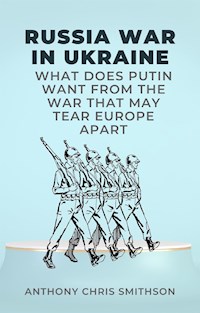
The Russia-Ukraine conflict has worsened as a result of three underlying factors: the security dilemma, the impact of democratization on geopolitics, and the clashing goals of a post-Cold War Europe.
This book investigates Ukraine's ongoing war, examining its roots and assessing the factors that have led to it. It has previously been mentioned how the two sides have engaged in political posturing, accusations, increasing sanctions, and increased threats.
The book also shows how this battle fits into larger patterns of modern international warfare and should be of interest to anybody interested in the root causes of the conflict, Russia's ties with the West, and geopolitics in general.
This is the book to read if you want to understand the present Russia-Ukraine crisis.
Das E-Book können Sie in Legimi-Apps oder einer beliebigen App lesen, die das folgende Format unterstützen:
Veröffentlichungsjahr: 2022
Ähnliche









![Tintenherz [Tintenwelt-Reihe, Band 1 (Ungekürzt)] - Cornelia Funke - Hörbuch](https://legimifiles.blob.core.windows.net/images/2830629ec0fd3fd8c1f122134ba4a884/w200_u90.jpg)



Russia War in Ukraine ––––––––What Does Putin Want from the War That May Tear Europe Apart
––––––––
BY
ANTHONY CHRIS SMITHSON
COPYRIGHT ©
Written By ANTHONY CHRIS SMITHSON
© 2022 CANADA
All rights reserved. No part of this book may be reproduced or modified in any form, including photocopying, recording, or by any information storage and retrieval system, without permission in writing from the publisher.
Table of Contents
Title Page
Copyright Page
DISCLAIMER:
WHY RUSSIA AND UKRAINE ARE AT WAR
WHY RUSSIA INVADES UKRAINE
THE ROLE OF NATO IN THE CONFLICT
HOW THE SANCTIONS AGAINST RUSSIA WILL IMPACT ITS ECONOMY
HOW WORLD LEADERS ARE REACTING TO THE CONFLICT
DISCLAIMER:
No part of this book should be considered legal or professional advice. Take everything I say in this book as my opinion and regard it as entertainment. You are responsible for your action by acting on the thoughts and views shared in this book.
WHY RUSSIA AND UKRAINE ARE AT WAR
The military confrontation in Ukraine began in early 2014 and swiftly devolved into a protracted standoff, with frequent shelling and skirmishes taking place along the front line that separates Russian- and Ukrainian-controlled border territories in the east. Since Russia started a full-scale military invasion of Ukraine on February 24, 2022, combat has resulted in over a hundred civilian fatalities and tens of thousands of Ukrainians fleeing to neighboring nations, including Poland, a NATO member where US soldiers are poised to aid.
Russia began mobilizing troops and military equipment near the border with Ukraine in October 2021, reigniting fears of an attack. Commercial satellite photos, social media posts, and publicly available intelligence from November and December 2021 revealed the movement of armor, missiles, and other heavy equipment toward Ukraine with no official justification. By December, over 100,000 Russian troops were stationed along the Russia-Ukraine border, and US intelligence sources warned that Russia may be plotting an assault in early 2022. Russia's foreign ministry issued a set of demands in mid-December 2021, requesting that the United States and the North Atlantic Treaty Organization (NATO) cease all military activity in Eastern Europe and Central Asia, commit to opposing further NATO expansion toward Russia, and prevent Ukraine from joining NATO in the future. The US and other NATO partners rejected these requests and warned Russia that if it attacked Ukraine, it would face harsh economic consequences. The US supplied further military aid to Ukraine, including ammunition, small guns, and other defensive weapons.
In early February 2022, US President Joe Biden directed the deployment of around 3,000 US troops to Poland and Romania (NATO nations bordering Ukraine) to confront Russian forces stationed near its border with Ukraine and reassure NATO allies. Satellite images revealed Russia's greatest force deployment to its border with Belarus since the Cold War's conclusion. Negotiations between the US, Russia, and European nations, particularly France and Germany, failed to provide a settlement. While Russia issued a statement claiming to be drawing down a set number of troops, rumors arose of an increased Russian force presence on Ukraine's border.




