


1,99 €
Niedrigster Preis in 30 Tagen: 1,99 €
Niedrigster Preis in 30 Tagen: 1,99 €
Mehr erfahren.
- Herausgeber: DigiCat
- Kategorie: Gesellschafts- und Liebesromane
- Sprache: Englisch
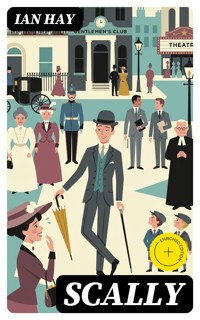
In "Scally," Ian Hay presents a vivid, light-hearted narrative that weaves together humor and poignant social commentary. Set against the backdrop of early 20th-century British society, the novel captures the escapades of its protagonist, a charming rogue known as Scally. Hay's intricate prose, characterized by its wit and lively dialogue, immerses readers in a world of youthful adventure, often reflecting the societal norms and moral expectations of his time. The book stands out as a testament to the evolving nature of the British novel, blending traditional storytelling with innovative character development and situational comedy. Ian Hay, a celebrated Scottish author and playwright, drew on his own experiences and the cultural milieu of his era to pen this delightful tale. His keen observations of human behavior and society are underscored by a rich tapestry of personal anecdotes and astute reflections, which undoubtedly influenced his writing style. Hay's background in theatre and involvement in the literary scene of his time imbued his works with a theatricality that engages and entertains, making "Scally" a remarkable addition to his oeuvre. Readers seeking a blend of humor, character-driven storytelling, and incisive social commentary will find "Scally" to be a compelling and enjoyable read. It offers not just escapism but also a window into the complexities of human nature and societal roles, making it an essential read for lovers of classic British literature. In this enriched edition, we have carefully created added value for your reading experience: - A succinct Introduction situates the work's timeless appeal and themes. - The Synopsis outlines the central plot, highlighting key developments without spoiling critical twists. - A detailed Historical Context immerses you in the era's events and influences that shaped the writing. - A thorough Analysis dissects symbols, motifs, and character arcs to unearth underlying meanings. - Reflection questions prompt you to engage personally with the work's messages, connecting them to modern life. - Hand‐picked Memorable Quotes shine a spotlight on moments of literary brilliance. - Interactive footnotes clarify unusual references, historical allusions, and archaic phrases for an effortless, more informed read.
Das E-Book können Sie in Legimi-Apps oder einer beliebigen App lesen, die das folgende Format unterstützen:
Veröffentlichungsjahr: 2022
Ähnliche














Scally
Table of Contents
Introduction
At the heart of Scally lies a quietly insistent question—whether the making of a gentleman resides in pedigree and polish or in the unadvertised choices a person makes when ease, advantage, and reputation tug one way while loyalty, courage, and kindness tug another—and Ian Hay frames that contest with a light touch that brightens rather than blurs the stakes, letting charm spar with conscience, style brush against substance, and the brisk pleasures of social comedy carry readers toward the deeper satisfaction of watching character, under pressure and in public view, reveal its grain as surely as wood shows truth beneath varnish, and to test whether decency can thrive without applause.
Scally is a comic novel of manners by the British writer Ian Hay, the pen name of John Hay Beith, published in the early twentieth century. It moves through the recognizable textures of British society of that period, where clubs, offices, and drawing rooms serve as informal courts of reputation and arenas for quick wits. Rather than lean on melodrama, the book uses nimble incident and amiable irony to trace how reputations are made and unmade. The result sits comfortably within light social fiction while preserving a moral core, a combination that helped define Hay’s popularity with general readers of his time.
Without disclosing its turns, the premise is straightforward: a figure known as Scally steps across the thresholds of several social worlds and, by force of temperament and timing, finds opportunities to prove what sort of man he wishes to be. The narration favors brisk scenes and direct, companionable commentary, inviting readers to enjoy the surface play even as stakes quietly accumulate. Dialogue is crisp and light, the pacing fleet, and the tone genial, yet never vacant. Set pieces of misunderstanding, tact, and quick thinking give the book its comic sparkle, while a steady undercurrent of ethical inquiry provides balance and ballast.
Among the themes that emerge are class and character, the friction between appearances and actions, and the uses and misuses of influence. The book treats manners as both lubricant and mask, showing how politeness can open doors or conceal indifference, and how true courtesy often looks surprisingly like courage. It also considers mentorship and friendship across status lines, and the unshowy labor of keeping promises. Hay’s humor does not mock feeling; instead, it makes room for it. By teasing out small choices—when to speak, when to yield, when to stand firm—the narrative suggests how private virtues become public goods.
The setting’s institutions—professional offices, social clubs, charitable committees, and informal networks—are not presented as monoliths but as stages where character is revealed by use rather than possession of power. In this sense, Scally belongs to a strand of early twentieth-century British fiction that is skeptical of mere entitlement yet sympathetic to tradition when it serves fairness and mutual obligation. The book registers how economic and social uncertainties press on ambition and kindness alike, without turning anxious or dour. It grants the everyday its due: competence, tact, humor, and reliability accrue meaning through repetition, until what looks like luck reads as earned trust.
For contemporary readers, the novel’s insistence that decency is measurable in small, repeated acts has sharp relevance in an age that often rewards performance over substance. Its comedy, far from trivial, models how levity can keep conversation open while principles are tested, and how charm, when allied to conscience, can accomplish more than bluster. The book also offers a counterexample to cynicism: it affirms that institutions can be improved from within by people who refuse to confuse cleverness with wisdom. Without preaching, it invites readers to consider how influence is acquired, and to what ends it should be spent.
Scally endures because it offers pleasure without cruelty and moral clarity without heaviness, marrying the pace of a well-made entertainment to a humane understanding of frailty and resolve. Readers new to Ian Hay will find an accessible entry point to his blend of wit and warmth; readers returning to him will recognize the ease with which he orchestrates sympathy for flawed, striving people. As an introduction to a world where the social veneer gleams yet is never the whole story, the novel still sparkles. It is, finally, a reminder that character can be cheerful and serious at the same time.
Synopsis
Scally by Ian Hay is a brisk, character-driven novel in the author’s light-comic, humane vein, tracking the rise of its titular figure through a series of tests that prize tact, courage, and decency. Hay frames the story around everyday predicaments that slowly accrete weight, letting small decisions reveal large traits. The title signals both mischief and aspiration, inviting readers to watch how charm, quick judgment, and loyal instinct fare when confronted by custom and consequence. Without grandiosity, the book builds a portrait of character under pressure, attentive to the ways social expectations are negotiated, bent, or fulfilled by one determined protagonist.
The opening movement situates Scally in modest circumstances and a close-knit environment where reputation is built face to face. Early episodes show him improvising solutions to practical problems, not from bravado but from a nimble sense of what people need to hear and have done. His actions kindle goodwill while also attracting skepticism from those who distrust unconventional methods. Hay sketches the surrounding network—friends, neighbors, and watchful authorities—so that each favor, shortcut, or kindness reverberates. The question set in motion is whether charm married to conscience can withstand formal tests of responsibility, or whether rules will finally circumscribe native enterprise.
As opportunities widen, Scally is entrusted—reluctantly at first, then with a wary confidence—with tasks that carry real consequences. Hay threads comic scrapes through these trials, setting up encounters where repartee, tact, and practical know-how must deliver under time pressure. Minor victories accrue, but so do expectations, and a pattern emerges: Scally’s solutions work because they serve others, even when they risk censure. Allies form around this usefulness, while adversaries gather around his irregular methods. The narrative’s momentum comes from the tension between recognition and reprimand, and from the steady growth of responsibilities that test whether instinct can mature into principle.
A pivotal sequence revolves around a misunderstanding that threatens to collapse the credibility Scally has built. The stakes are public enough to sting, private enough to complicate simple defense, and entangled with the interests of people he does not wish to harm. Hay uses this pressure to sharpen the book’s central inquiry: what constitutes sound conduct when rules and outcomes diverge? Scally’s response—measured rather than flashy—deepens the portrait of a person learning when to speak, when to step back, and when to act without fanfare. It also reframes earlier episodes in a sterner light, converting charm into character under scrutiny.
The middle stretch opens the world of the story, moving beyond the familiar cluster of faces into circles where manners, money, and merit measure differently. Scally’s adaptability becomes a bridge across these divides, as he mediates small conflicts and navigates unspoken hierarchies. A personal attachment lends warmth and ambiguity, clarifying what he values while complicating what he must risk. Hay keeps the tone buoyant, yet the errands and coincidences that once amused now carry ethical freight. The question shifts from whether Scally can manage a situation to whether he can accept the costs of managing it rightly.
In the approach to the climax, accumulated obligations converge, forcing a choice between expedience and a standard he has tacitly lived by. Practicalities argue one way; loyalty and fairness argue another. Hay orchestrates this without melodrama, letting the weight of prior scenes supply urgency. The resolution remains poised on discretion and consequence rather than spectacle, consistent with the book’s preference for earned outcomes. What matters is less a single coup than the alignment of manner and motive, and the quiet recognition of those who see it. The ending satisfies the narrative’s logic while keeping its most delicate turns unspoiled.
Scally endures as a study in everyday heroism pitched at human scale, distilling Ian Hay’s gift for comedy that clarifies character. It asks what makes a “perfect gentleman” in practice: birth, polish, or the persistent habit of considering others before oneself. By tracing how small choices compound into identity, the book offers a gentle, persuasive argument for integrity that is neither pious nor naïve. Its social observation remains lively, its situations recognizably tangled, and its conclusions earned rather than proclaimed. The result is a work that rewards readers seeking warmth without sentimentality and ideals tested in the grain of ordinary life.
Historical Context
Ian Hay was the pen name of John Hay Beith (1876-1952), a Scottish-born novelist, playwright, and former schoolmaster who served as a British Army officer in the First World War. Scally belongs to the interwar climate in Britain, when London-centered publishing and West End theatre rewarded brisk, good-humoured narratives about class, character, and public life. Hay's background - Fettes College, Cambridge, teaching at Charterhouse, and commissioned service in the Argyll and Sutherland Highlanders - gave him first-hand familiarity with elite schools, regiments, and gentlemanly codes. These institutions, and the networks of clubs, offices, and drawing rooms they fed, form the social matrix that frames the book's outlook.
Late-Victorian and Edwardian public school culture prized 'character' formed through team games, house loyalties, and prefect authority, often summarized as the games ethic and Muscular Christianity. The ideal gentleman was expected to be brave, self-effacing, humorous under pressure, and fair to inferiors - qualities long associated with leadership in school, regiment, or service. In the early twentieth century this ethos still shaped recruitment into the officer corps, civil service, and colonial administration. Hay repeatedly treats the gentleman less as a title of birth than a code of conduct. Scally draws upon that tradition to test manners, merit, and status within recognizably British institutions.
The Great War (1914-1918) profoundly altered the social landscape that Hay knew. Kitchener's volunteer 'New Army' drew heavily from clerks, students, and public-school men; junior officers suffered especially high casualties. Hay served on the Western Front and chronicled training and trench life in his bestselling The First Hundred Thousand (1915), establishing a tone of stoic comedy amid hardship. Demobilization after 1918 returned millions to civilian life, while bereavement and injury reshaped families and workplaces. Interwar readers carried that memory into peacetime fiction, where levity coexisted with frustration at bureaucracy, respect for practical competence, and suspicion of empty swagger, all themes Hay understood intimately.




