


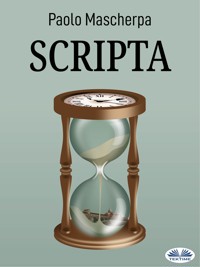
4,99 €
Mehr erfahren.
Pavia, 1890
Enrico Vismara è un giovane operaio analfabeta arrestato per degli strani comportamenti.
Pavia, 1890
Enrico Vismara is a young illiterate factory worker arrested for strange behavior.
Pavia, today
Chiara Fiori is a brilliant journalist exploited by the deputy editor of the newspaper.
Enrico’s troubled existence hides a mystery that, in the present day, triggers opposing investigations by an art-loving real estate developer and the brilliant journalist.
A gripping adventure unfolding across different eras, involving a rediscovered Caravaggio and a State secret.
Scripta is a historical thriller novel with a fantastical twist, built on an investigative narrative structure.
Das E-Book können Sie in Legimi-Apps oder einer beliebigen App lesen, die das folgende Format unterstützen:
Seitenzahl: 337
Veröffentlichungsjahr: 2026
Ähnliche
















Paolo Mascherpa
SCRIPTA
Title | Scripta
Author | Paolo Mascherpa
Cover illustration | Cecilia Di Giulio
Translated by Chiara De Giorgi
© 2026 - All rights reserved
This is a work of fiction. Names, characters, institutions, places, and events are the product of the author's imagination and are not to be considered real. Any resemblance to actual persons, living or dead, or actual events, is purely coincidental.
To my mom
“[...] there be three times; a present of things past, a present of things present, and a present of things future.” For these three do exist in some sort, in the soul [...] present of things past, memory; present of things present, sight; present of things future, expectation.
[Saint Augustine, Confessions, Chapter XX]
1 – ENRICO
PAVIA, 1890
The steady drumming of the rain rocked him to sleep. A few hours later, the cold wind whistling through the window frames woke him again. He left the candle unlit and looked outside, just able to make out the swaying treetops. Watching the two forces of nature at work, the cutting wind and the trees standing firm, he wished that even a trace of either strength might seep into him, stir him, make him different. With a sigh, he pulled the thin blanket over his head and curled up, trying to trap what little warmth he had. Sleep wouldn’t return. Present worries and old memories drifted in and out until he heard the first sounds from his landlady’s rooms. At last, it was time to get up. The routine of the day might, with luck, distract him.
He filled the chipped basin and set the white jug back in its place. Off went the wool undershirt. He washed his face, armpits, and chest, then ran his damp hands through his black, messy hair, scrubbing quickly as the room was freezing. Working up a faint lather from the unscented soap, he dunked his hands again and rinsed the thin film from his lean body. Then came his daytime wool shirt, the long johns, the corduroy trousers, a dark turtleneck sweater, and the suspenders. Grabbing his coat and two two-lira coins, he left the ten-lira note in the drawer of the bedside table.
“Morning, Enrico,” his landlady said, stirring the milk.
He muttered a good morning, breathed in the warm smell from the hearth, and sat in his usual place. Cutting a modest slice of dark bread, small enough to avoid a scolding from Signora Maria, he waited while she set down a steaming, almost-full mug. Despite his hunger, he took his time with breakfast, then said goodbye and stepped outside. The rain had stopped, but the cold hadn’t. It was 5.30 am on 22 October. He headed down the slight slope towards the river. Others were already on their way to work, and a few carts rattled in the direction of the square to set up the market. Enrico noticed none of it, neither the people nor the carts nor the horses, and didn’t bother looking up to guess where the sun might pierce the clouds. He walked hunched over, hoping nothing around him would change without warning.
A passerby shouted a greeting to a cart driver. The sudden cry made him jump, and he quickened his pace on instinct.
In a few minutes he reached the Ponte Coperto, the city’s covered bridge; the tannery wasn’t far now. The gendarmes let him through without a word. He allowed himself a glance at the river, its water sliding calmly along the wide bed. The rains of the past weeks, falling even farther upstream, had raised the level by nearly a metre. They might have to prepare for a flood.
The tannery sat at the end of the road, visible as soon as he turned left after the bridge. A low stone building stretching from the riverbank into the Borgo Basso neighbourhood, it mixed roofed sections with open-air areas where the vats were.
A few workers ahead of him trudged towards the entrance, bundled up against the cold. At the iron gate the owner, Mr Farini, waited for everyone to arrive. From time to time, he shifted his frock coat aside, pulled a gold watch from his waistcoat pocket, checked it, put it back, then paced with a dark, muttering scowl. He would wait until ten minutes past 6, then he would shut the gate and the day’s work would begin.
Mr Farini was a stout man past fifty; more grey than black showed in his hair and beard, and his hands still carried the marks of the work he’d done in his youth. After years spent gaining experience in Magenta, he’d moved to Pavia and set up his own business. Age and wealth hadn’t softened him. If anything, he was stricter and more abrasive with his workers: he tolerated no lateness, no mistakes that caused damage, and he was known to make, quite often, ‘small errors’ in the wage calculations to the disadvantage of those who couldn’t read.
Enrico greeted him with deference and headed to the back of the building, where the storeroom and cart yard were. Today, he was assigned to unloading the hides and hauling them to the first vats. Hard work, but at least it kept him away from the chrome salts. He heard Mr Farini lock the gate facing the Ticino River and then, immediately after, a sharp whistle blast signalled the start of the shift. The starting whistle always seemed louder, harsher, more insistent than the one marking the end of the workday.
The first cart was already waiting, so Enrico let it in, closed the wooden rear gate, and went back inside. He shed his coat and pulled on a long, heavy, dark leather apron. He hauled the hides down from the cart, laid them on a trolley, and took them into the adjacent room, where someone else would wash them. When there were no carts to unload, he collected the finished leather and shelved it in the proper racks. He also handled the day’s shipments—a task the owner always checked personally.
Enrico liked working in the storeroom, despite the stench of raw hides, thick with the reek of rotting flesh. Not just because it kept him far from the salts, but because it kept him far from the others. When Mr Farini came by, Enrico simply did whatever was asked without speaking.
“Put those over there.” “Load this.” “Move that basket.”
Enrico kept moving as quickly as he could without looking at the owner. Focused on his work. Always on edge, hoping nothing out of the ordinary would happen.
The day went by quickly. Enrico, exhausted, finally headed home. His stomach was already growling, despite the small piece of bread, the onion, and the apple that made up his lunch. He walked more slowly than he had in the morning, following the river for a while, even passing on the far side of the bridge, though it wasn’t the shortest way back. His boots pressed through drifts of coloured leaves as the sun, out for most of the day, now began to set. He stopped and leaned on the parapet to watch the boats and the sand-loaded barges glide by in silence. These moments, like those he spent in an empty church, offered him a rare sense of peace. No voices, no flashes of light, no images or crashes would burst in on him, as they had far too often in his life. He let himself rest in that quiet for a few more minutes, then hunger pushed him onward.
They ate dinner—polenta, salad, and dark bread—without speaking. After tidying the kitchen, Signora Maria went downstairs to visit the neighbours. Enrico returned to his room and sat by the window with a blanket around his shoulders. Though the darkness outside was nearly complete, he watched what little was visible near the vegetable patch, beneath the trees, or in the courtyard of the house opposite. When he grew bored, he picked up one of the four magazines belonging to his landlady and studied the illustrations by candlelight. He couldn’t read. Even so, and even knowing every detail by heart, he admired those images and daydreamed, wishing that one day he might decipher the dense blocks of text around them. Sometimes his mood grew so hopeful that he even imagined learning to write.
The creak of the steps under Signora Maria’s weight told him it was time to sleep. He set the magazine aside, got ready for the night, and slipped into bed, piling his daytime clothes and the coat on top of the blanket and sheet. He heard her pause outside his door and whisper: “Good night, Enrico.”
“Good night,” he answered, wishing the blessing might somehow come true.
He slept, but a strange dream left him uneasy for the first few minutes after waking. He went through his usual morning gestures, though this time he paused at his reflection in the mirror. His black hair fell over his ears, and the hollowed face only made his large dark eyes look larger. His greyish skin and deep dark shadows under his eyes added at least ten years to his nineteen. He shook his head with a sigh and, once dressed, stepped into the other room. Signora Maria was in the mood to talk—and worse: in the mood to talk about him. To prod him.
“Enrico, how are you? How’s work?”
“Same as always.”
“But why do you talk so little?”
Enrico lifted his eyes from the cup of milk without speaking, hoping the questions would stop.
“Don’t you have a friend to grab a drink with after work?”
He shook his head and dipped the bread in the milk.
“You’ll never meet a young woman. You’re twenty, it’s time to marry.”
“Nineteen.”
“Yes, yes, close enough. Point is, you can’t go on like this.”
“Mm.”
“I know you’ve had a hard life, but do you think others have it easy? Look at me: I’m three times your age and still working the fields and the house, but I manage. I face what I have to face. I had a husband, and we were happy for many years, even if we were never blessed with children. Come on now, Enrico. Be brave.”
He finished what was left of his breakfast and forced himself to say, as he stood up, “I’ll try, Signora Maria.”
As much as talking about himself irritated him, he knew she meant well and told him what she thought he needed to hear. She was kind; she had taken him in knowing he wouldn’t be able to pay rent at first. He had just lost his job and been thrown out of his previous lodging, yet she tried to encourage him. But he simply couldn’t manage. Something in him wasn’t right.
He walked to work more hunched than usual, unable to enjoy the soft rising light. He replayed her words in his head without looking around, bundled up to his eyes in the worn clothes she’d provided, perhaps left by her late husband.
On the opposite side of the street, a shopkeeper stepped out and dumped a bucket of water onto the pavement at the shop’s entrance. The splash hit the stone like a blow. He froze. The signs were unmistakable. A sudden weight pressed down. His body locked and he fell. Water surged around him, as if he were sinking into the Ticino rather than standing on the street. He thrashed, arms and legs flailing, his mouth filling with water.
The shopkeeper saw him convulse and ran over. One hand pressed to Enrico’s chest, he slapped him with the other. Enrico grabbed the arm that had just plunged into his inner river and pulled himself up, toppling the man in the process. Suddenly he was upright, head above water, the illusion draining rapidly until nothing remained. He drew a long breath and watched a carriage roll past. Only then did he realize where he truly was. The shopkeeper stared at him, both startled and relieved. Enrico got to his feet and ran towards the tannery without a word, without thanks.
He sprinted down Strada Nuova, feeling he was running too fast to ever stop. He ran, wanting only to keep running. Not from the shopkeeper, but from himself. Narrowly dodging the rare passersby and skidding on the steep descent, he kept moving. When the bridge came into view, he remembered the two gendarmes always stationed there and slowed as much as he could. But they had seen him and stepped forward to block his way.
“Halt!”
Enrico managed to stop before crashing into them.
“Where are you going in such a rush, young man?” one asked.
“To work,” he replied, breathless, sweating despite the cold.
“Not running because of something you did, are you?” the gendarme pressed, glancing past Enrico for anyone in pursuit.
“No, no... I’m just late,” he lied.
The other gendarme, though well aware it was still early, said, “Works at the tannery, he passes by every morning. Let him go.”
“All right, but he must stop running. It’s far too early for that.” the first grumbled.
Enrico walked the rest of the way. His fists clenched in his pockets, his jaw tight, furious at himself and his cursed nature. Mr Farini had only just opened the gate when he saw him. The expression on Enrico’s face nearly intimidated him, but he forced a look of concern, hiding what he really felt. “Vismara, are you all right? Did something happen?”
Enrico didn’t answer. He gave the usual deferential nod and went inside.
Mr Farini stared after him, puzzled, then pulled out his watch and muttered something under his breath.
Enrico went to work at the vats with Gaetano.
“Move! Get that hide in the water! Faster!”
Enrico didn’t reply and kept working.
“My back hurts today. You’ll have to do my share too,” Gaetano reminded him now and then, dropping the mocking grin for a moment.
Enrico didn’t even look at him. Gaetano was a brute from San Martino Siccomario who had been hired just a couple of weeks earlier. Enrico sometimes imagined hurling the bucket of salts in his face, but he feared the man’s strength, and he didn’t want to lose his job. So he chose to endure, just as he had learned to bear the stench that clung to every worker who left the tannery.
2 - CHIARA
PAVIA, PRESENT DAY
“I may be able to get in.”
“We need that data!”
“I’ll update you tomorrow.”
“OK.” Chiara typed impatiently, hoping to put an end to the deputy editor’s texts.
She put the phone away and hunted for her keys. Once inside her flat, she twisted the little knob twice and the deadbolt four times. Sealed. That was her signal: the day was over. The hours she’d spent waiting in that suffocating corridor at San Matteo Hospital were now firmly shut out of her mind. Three hours and a half sitting on a wooden bench, in front of an old window flung wide open onto the hottest summer in years. She’d read the paper, played on her phone, stared at the wall, checked the shoes of passersby, mentally rehearsed her plan again and again… and still had too much time left to think about her life.
It wasn’t exactly going the way she had hoped, was it? Well, that’s an understatement, she’d thought suppressing a smile.
Love wasn’t love. Not really. She wasn’t even sure she could call it that. Who was he, anyway? She wished he’d be more present, more supportive; more part of their ‘us’. He didn’t just flicker on and off like a Christmas light; he buzzed and sputtered like a failing neon tube.
She hated her deputy editor. Or maybe she hated her job. Both. Him, for who he was: ambitious, petty, obsequious around the editor-in-chief, authoritarian with his team, ready to throw anyone under the bus at the slightest hint of trouble. And for how he used her. Not for her skills—her degree in literature, her master’s in investigative journalism, her clean, sensitive writing, her problem-solving skills, her English and Spanish—but for her looks. Her face, her long chestnut hair, her body. Men listened to her, helped her, did what she asked… because of that? Everything else she had achieved counted for nothing. He exploited her beauty to gain the advantage in investigations. She had never encouraged it. She hated him.
Did she also hate the job? Yes, if this was the job. No, if it were the job she had been working toward since middle school.
An elegant woman walked down the corridor in brand-new red shoes. Chiara noticed every detail, letting it pull her out of the spiral of thoughts that was dragging her down. If she let herself go any further, she’d start thinking about home, her parents, her sister, and money…
She ran through the answers she’d prepared with the deputy editor, just in case the clerk questioned her, and hoped to be called in soon. She desperately needed the bathroom but dared not move, fearing her name would be called the moment she stepped away. She waited, watching the corridor stretch on.
Finally, the bored voice of the clerk drifted out: “Ms Fiori.”
She fastened a button on her blouse. The exact opposite of what the man she hated had suggested. She walked in smiling, thinking that finally, in a moment, she’d be free to leave.
“I’ve received your request to... consult the outpatient performance documents for your newspaper’s investigation on reducing waiting list times. Correct?”
“Yes.”
“Well then…” The clerk looked her up and down, wiping the smile off her face. “Well then, the colleague who handles the archive will be here tomorrow, and he can certainly grant you access.”
“Perfect,” she said in a professional tone.
“Come tomorrow morning at 9.30 and we’ll let you in right away.”
“Thanks, see you tomorrow.”
She turned and left, fully aware he would watch her until she disappeared down the corridor.
Now she was finally home. She would take off her shoes and everything else, run a bath, put on relaxing music, the only question left being which bath salts to pour into the water.
The radio clicked on to her favourite station, and the cheerful hosts tried to drag her into a brand-new day, without success. Remembering her appointment at 9.30 am (late morning, by her standards), she decided to stay in bed a bit longer. She pushed the sheet aside; the day was already warm, and she didn’t want to turn on the AC yet. Eyes closed, she listened to a few songs without drifting back to sleep, followed by some news related to the day’s topic. Then she got up, showered in almost-cold water, and put on jeans, a not-too-new T-shirt, and trainers. She grabbed the backpack she’d prepared with the deputy editor for this mission a few days ago, added a couple of personal items, and went out for breakfast at the coffee shop.
At 9.20 she was sitting on yesterday’s bench. A moment later, a stranger approached and stopped.
“You must be the journalist. I’m Mr Baffi, the archivist. Nice to meet you.”
“Nice to meet you. I’m Ms Fiori.”
“Give me a moment. I’ll get the keys and we’ll go downstairs.”
They walked along the corridor to the elevator, which took them to the basement. They stepped out into a service hallway with bare walls.
“Watch out for forklifts and bikes when you’re here. These tunnels connect all the wings, and traffic can be heavy. The problem is there’s no warning signs. Accidents happen now and then.”
“Thanks.”
“We’ll go down one more floor with the freight elevator. There’s the stairwell, in case of an emergency.”
The man—she guessed he was around forty—seemed kind. Diligent, too. That might complicate things. For their plan, a slacker would have been better.
The elevator doors opened, and as soon as they stepped into the cone of light, a wave of mildew hit them. Mr Baffi didn’t even notice. He turned to the control panel and flipped four of the ten switches.
The huge room lit up as the neon lights crackled to life. Chiara felt herself shrink before the endless rows of shelves rising to the ceiling and packed with boxes, binders, and folders covered in dust.
“Come on.”
They walked in until they reached a desk with a computer, two monitors, and two chairs.
“Have a seat.”
“Thanks.”
“So… you need the documents from the last ten years relating to waiting times in seven outpatient clinics. Quite a task,” he said, typing.
Chiara nodded.
“The data from the last three years are already digitized and available on the server we have upstairs. The rest you’ll have to reconstruct here. It may take several days, but I’ll help you, don’t worry.”
“Good, thank you. I was hoping you’d say that.”
There it is, the first lie of the day, she thought, smiling as naturally as she could. He isn’t going to ever leave me here alone. That was her second thought.
Mr Baffi used the search function to locate the boxes she needed. Every shelving unit had a number, every shelf a letter. Chiara examined the documents and scanned anything useful, sending the images directly to the paper’s email account.
At one point the archivist had an idea.
“Would you email the documents to us as well? It will save us a lot of work later on. We’re going to digitize everything you see here, you know,” he said, sounding almost defeated.
“That’s a huge job,” she said, trying to sound sympathetic.
Over the next few hours, Mr Baffi talked her through the many facets of his job, and Chiara quickly realised how genuinely passionate he was about it. There was plenty he was proud of about his role, and the fact that a journalist needed the documents he was in charge of for her research made him glow. He wasn’t trying to impress her; he simply wanted to share the craft, along with its historical and statistical worth. With every lie she’d told and every lie still to come, her guilt grew.
“This place used to be the maintenance workshop for the hospital. Eight years ago they consolidated the filing systems from all departments down here,” Mr Baffi said, brushing dust off the box he was opening.
“How big is this place?”
“About two thousand square meters.”
“It’s huge,” she commented.
“One of these days I’ll give you a tour,” he said.
At 11.55, she got a text: “How’s it going?”
Why text me? Why interrupt my work? Chiara thought. She didn’t reply.
Finally, the archivist told her they had to leave for lunch break.
“Ah… do we really have to go now? I have another appointment at 2.30 pm,” she lied. “I was hoping to work here at least until 2.00.”
“I’m sorry. I can’t leave you alone down here.”
She smiled. “I’m not afraid, Mr Baffi.”
“It’s not that... There are classified documents.”
“I think I’d be quite conspicuous if I tried to leave with a couple of boxes balanced on my head,” she joked.
“You might scan or photograph something important.”
“I don’t even know where the classified documents are. Why don’t we do like this: you keep the scanner and my phone, and I’ll stay here and check the files, selecting the ones I need. I’ll do the scanning tomorrow. This will save me some time.”
Puzzled, Mr Baffi looked at her, but he eventually agreed. He locked scanner and phone in a cabinet, but before leaving for lunch he asked her: “May I look inside your backpack?”
“Of course.”
When the inspection was over, he said goodbye and promised to be back in one hour.
As soon as the freight elevator’s door closed, Chiara moved quickly. She reached into the front pocket of her backpack and opened a thin, hidden compartment sealed with Velcro, pulling out a powered-off phone. She turned it on and placed it on the desk. For the next ten minutes, she gathered as many documents as she could, planning to scan them the following day. It was part of her cover investigation, and a way to show Mr Baffi that she had done exactly what she’d promised. Afterwards, she located the staff attendance records using the search function on the computer and memorised the shelf numbers. Everything she needed was nearby, albeit in an unlit area. She ran to the electrical panel and switched everything on after memorizing the setting of the switches as Mr Baffi had left it, so she could put everything back as it was. She set the phone to camera mode and took the box she needed: from the surgery department, shelf 281.
Sitting on the floor, she spent the next forty minutes taking photos, then returned everything to its place and retraced her steps to make sure nothing would arouse suspicion, including deleting every trace of her computer search. She resumed her previous work, and a few minutes later, the archivist reappeared. He gave her back her phone and the scanner and helped her further, none the wiser.
Once outside San Matteo, she headed towards the newsroom, happy to be in the open air despite the sweltering heat.
For this investigation, Rizzo—the one she hated—had paired her with a capable intern. Grazia Perego was a very young blonde with wavy hair, blue eyes, a slightly aquiline nose, tall and shapely, chatty and sharp.
As soon as she arrived at the newsroom, Chiara handed her the phone and asked her to download all the photos. She grabbed a diet snack, a small bottle of water, and a coffee from the vending machine, then sat at her desk to eat.
The deputy editor had seen her from his office and didn’t wait for her to finish her minimal meal. He called her in immediately. Chiara approached his huge ergonomic desk cluttered with books, neatly stacked newspapers, and scattered documents. On the light wood wall hung portraits of four journalists who had made the country’s history, along with a few certificates. On a side table were more books, family photos, and three amateur golf trophies.
Rizzo continued tapping keys relentlessly, bent forward, his hooked nose giving the impression that he was sniffing the words on the monitor. After a few minutes, he finally said: “Have a seat… So?”
“I could photograph several documents; Grazia is downloading the photos right now, then we’ll go over them.”
“Give me some news by tonight,” he pressed.
Chiara nodded and left the room.
La Provincia di Pavia was a local newspaper belonging to a national publishing group, with a small circulation. Two deputy editors reported to the editor-in-chief: Rizzo for the news section, and Maestri for the miscellaneous one. Historically, the news had covered traffic accidents, petty thefts, and minor stories, but since Rizzo’s promotion he had begun pursuing uncomfortable investigations into local politicians and institutions. Driven by his ambition to one day work at a national daily, he had run out of leads: Pavia was a small town, and the province offered little to advance his career. So when he received an anonymous letter about San Matteo, he saw it as his one-way ticket to the Milan office he aspired to join.
The letter contained detailed accusations: names, dates, and events. The style was plain and awkward, yet the anger behind it gave the words unexpected force. The sender was possibly one of the thirteen San Matteo employees dismissed the previous year for absenteeism. The letter’s aim was clear: to bring down the two colleagues who had been spared, likely thanks to a department head’s intervention. The reason for that intervention could not be traced to anything as simple as family ties, which triggered Rizzo’s investigative instinct.
He left the letter in the drawer for a couple of days, letting it settle in his mind. Finally, he prepared a plan. The first step was to gather documentary evidence to support the claims made in the letter.
3 - THE ESTATE AGENT
MILAN, PRESENT DAY
The line of cars was moving far too slowly. He wasn’t going to make it to the meeting on time; the satnav still showed twenty-two minutes. He thought Mr Spiga wouldn’t wait more than fifteen. He knew why he wanted to see him: to renegotiate the contract. Still, he wasn’t worried. Months earlier he’d already contacted another moving company and given them a few test jobs. They’d delivered: decent service at a lower cost. And he had no intention of wasting too much time on something that, for him, was only a side business anyway.
Massimo Zecchi took pride in dealing with luxury properties. Sometimes he worked purely as an agent; other times he bought, renovated, and resold. He had started out thirty years earlier as a simple estate agent, then started his own business and gradually expanded until he covered the whole Lombardy region. When the market crashed for the second time, he realised he needed to diversify his income, so he launched a moving company and opened a shop selling second-hand furniture and household items.
He parked his black X7 on the patch of concrete in front of the warehouse on Milan’s southern outskirts and swung the door open wide so he could squeeze himself out. He shut it and headed toward the large orange metal door, the click of the car lock and the chirp of the alarm fading behind him.
A sharp stench from a nearby farm hit him, and he pulled a tissue from his pocket to cover his nose. He kept his eyes on the ground: he didn’t want his polished shoes to get any dirtier. The sudden heat after the cool air of the car only annoyed him, and by the time he stepped inside the building, he was quite irritated.
Why am I even here? he wondered. I should’ve had him come to my office.
Then again—he’d wanted to see the warehouse with his own eyes. Maybe something valuable had come in with the last two loads.
“Good morning, Mr Zecchi,” Mario Spiga greeted him. He’d waited for him, at least.
“Good morning.”
“Let’s step into the back office, it’s cooler in there. This heat is unbearable.”
“As it was yesterday, and the day before, and I’m sure it will be tomorrow.”
Mr Spiga looked at the man and wondered, as he always did, why he didn’t try to lose weight. He found no answer other than yet more unconfirmed theories. He picked up the AC remote and lowered the temperature, hoping that his counterpart’s mood, which seemed truly awful, would improve a little with the cooler air.
Zecchi filled the armchair, almost spilling over. He wiped his forehead and bald head with a cotton handkerchief as he listened to Spiga, his dark eyes fixed first on the man, then on the papers he had been handed. His eyes appeared small, not because they were, but because of his disproportionately large face and square jaw.
They discussed the matter at length. Against all expectations, Spiga managed to secure a small raise in his company’s fees. Zecchi had his reasons: he’d decided to keep two suppliers, and the sum he’d paid Spiga so far was almost negligible. A slight increase was something he could easily afford.
They left the small office in the corner of the warehouse and made their way along the aisles, passing chairs, tables, old chandeliers, mouldy books, worn carpets, wardrobes, mirrors of all shapes, floor lamps, sofas, armchairs, TVs, and every kind of object one might find in a house, an attic, a basement, or a garage. They finally reached a cordoned-off area where he had instructed that any paintings and sculptures be carefully placed. He always hoped to bump into something precious to resell or keep for himself.
Over the years, he had grown passionate about art and had invested a portion of his substantial profits; he now owned a respectable collection in his penthouse in the Brera district in Milan. But there was nothing new since his last visit. Disappointed, he gave Spiga a few instructions.
“A new worker is coming tomorrow to arrange the furniture. Keep an eye on him for the first few days; I’ve already explained the rules to him. Also, we should be getting a couple of new dealers in addition to the regulars. With a few more stalls, we’ll finally clear out some of this junk,” Zecchi concluded, speaking the last part aloud even though it was meant for himself.
“Oh, and Spiga,” he added, “we should be able to secure the clearance of some sizable offices in the city. My assistant will let you know the details. I want this done properly, understood?”
“Yes, of course, Mr Zecchi.”
“Goodbye.”
“Goodbye, and thank you.”
Zecchi, moving slowly, headed for the exit, eager to retreat into his own SUV.
He headed back to the city centre, driving at full speed along the roads, almost deserted at that time. He stopped by the office to handle some urgent paperwork, had lunch at his usual Michelin-starred restaurant, and finally headed home with a growing sense of excitement. He spent a few hours reading one emerging artist’s profile and admiring some of their works. Then, he carefully checked the photographs the auction house had sent him. He sank into his study’s armchair clutching a close-up image of a painting’s detail in his right hand. Every rational thought slipped away, and emotions flooded in. He felt a faint shiver.
He logged into the secure website of the English auction house and started the video conference. He waited. It wouldn’t be the same as being there in person, though. Through the screen, he wouldn’t be able to breathe in the smell of London’s streets, tread on the prized entrance hall carpet, or even catch his own distorted reflection in the veined marble. He wouldn’t be able to feel the leather of the chairs or gauge the strength of his competitors by studying every detail of their appearance. But he would still be able to experience the challenge. A slow battle fought with virtual paddles.
The moment arrived. The lot was presented, and the bidding began. It didn’t last long, and he didn’t spend much. Yet, the thrill that ran through him when he made the winning bid was so much more intense than what he had felt while admiring the detail of the artwork in the photos.
4 - FRIGHT
PAVIA, 1890
The hours passed steadily, the sun climbing and the moon following in turn, while Enrico walked the same straight streets, trapped by fear of himself and of others. One evening, he stood before the panes of his closed window, watching the usual peasant landscape at dusk. His thoughts yearned for a still and mute darkness. A state where his eyes could not deceive him, and his hearing could not distract him.
When the light vanished completely, both outside and within the room, he leaned against the rough wooden frame. He felt a sense of emptiness, followed by a weary sadness that seemed to lay itself out over all the days to come.
“Enrico.”
“Yes,” he whispered absent-mindedly, thinking Signora Maria was calling him.
“Enrico,” the voice repeated.
He suddenly realized it was a male voice. No one could be in the house, apart from himself and Signora Maria... The voice must come from nowhere else than his own head. He let out a strangled cry and stumbled back from the window.
“No, no!” he yelled. He threw himself onto the bed and buried his head in the blankets. Clutching the pillow, he pressed his hands over his ears as if they were guilty of yielding to the siege.
“Enrico, listen to me.”
“Uh, no, no! I won’t hear, I won’t see. I must talk; I’ll talk. The pitcher is chipped, the water is cold, the sweater is itchy. The gendarmes are at the bridge. The bucket is full of salts… the cart is behind the closed gate.”
He kept talking until the insistent knocking at the door pierced through the blankets and pillow, and he realized Signora Maria was calling for him, alarmed.
“Is everything all right, Enrico?”
“Ye… yes, Signora Maria.”
“Is someone with you? It wouldn’t be a problem, but tell me, are you sure you’re all right?”
“No one is here. I was thinking out loud. Yes, I’m fine,” he replied with all the calm he could muster, knowing how important it was to reassure his landlady.
“All right then. Goodnight.”
“Goodnight.”
As soon as he heard the woman stepping away, he flung himself back onto the bed and lay there in silence. Tense, clinging to what he could grasp, he prayed nothing would happen and, without moving, waited for sleep to carry him into an empty world.
But he was too frightened, and he could not fall asleep the whole night, despite his eyes being shut tight. The same questions tormented him for hours. What did that voice want? Whom did it belong to? Was it he, calling himself? At times he tried to calm down, thinking there must have been someone downstairs looking for him, or maybe he had dreamed it all. But the tormenting questions always came back.
It wasn’t the first time he had heard voices, but never like this. Never his name, uttered and repeated in that odd voice: hoarse, perhaps old, so different from his own and from the one that roamed his head when he thought. What terrified him most was the order: “Listen to me”. He wondered what the voice’s owner—or he himself?—might want. Perhaps ask questions, search for an answer…
Later, he mustered enough courage to get under the covers. Sleep kept evading him, but at least his stiff body could feel a little warmth.
As the first noises from the house began, he left his room and arranged three logs in the fireplace over some pinecones and dry twigs, then lit a cork and placed it amidst the kindling. When Signora Maria entered the kitchen, the fire was blazing; she looked at Enrico, seated with his hands clasped and elbows on the table, waiting for breakfast as if in prayer.
The elderly woman, without a word, moved her hands and began the usual morning routine. Shortly after, Enrico went out, bidding her goodbye without looking at her.
He wandered the narrow lanes of the district, treading on the damp cobblestones until he reached the square of Santa Maria del Carmine. He looked at the church façade. Unfortunately, it was too early, and the friars had not opened the heavy wooden door yet. And he had no time to wait; he had to go to work. He headed towards the river, passing through Piazza del Duomo and Piazza Cavagneria. In front of the bakery on Strada Nuova, he stopped to breathe in the scent of warm bread.
He spent the day thinking of the church, wanting to go there. Every time he pictured himself sitting in the back of the empty church, he instantly felt better.
At the end of the working day, he retraced the same path he had taken in the morning. Now there were even more people to avoid, more noises to block out, more energy demanded to focus on innocuous things: windows, chimneys, bricks, any material object he could fix his mind on. Words slipped from his lips, muttered over and over, a fragile barrier against being overwhelmed by anything or anyone. Those who passed him noticed the strange man talking to himself; they stopped, stared for a moment, then moved on, shaking their heads.




