Contents
Preface
1.
Introduction
.....................................................................................................................................
IV
2.
The music
........................................................................................................................................
IV
3.
Possibilities within constraints
...........................................................................................................
VI
4.
Special considerations for performance
..............................................................................................
VII
Vorwort
1.
Einführung
...................................................................................................................................
VIII
2.
Die Musik
.....................................................................................................................................
VIII
3.
Möglichkeiten im Rahmen der Beschränkungen
.................................................................................
X
4.
Besonderheiten der Ausführung
........................................................................................................
XI
Suite No. 1
: Prelude, Courante, Sarabande, Minuets I and II, BWV 1007
.........................................................
2
Suite No. 5
: Courante, Gigue, BWV 1011
......................................................................................................
8
Suite No. 3
: Courante, Bourrées I and II, BWV 1009
....................................................................................
10
Suite No. 2
: Sarabande, BWV 1008
..............................................................................................................
12
Suite No. 6
: Sarabande, Gavottes I and II, BWV 1012
..................................................................................
13
Suite No. 4
: Gigue, BWV 1010
....................................................................................................................
16
Critical Commentary
..................................................................................................................................
18
Further Reading
.........................................................................................................................................
20
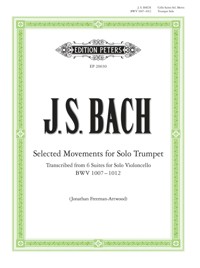
Edition Peters 20030
IV
1. Introduction
Over the last few decades, Bach’s Cello Suites – in part or in toto
– have been transcribed for numerous instruments, including
the trumpet. The prevailing ambition in the majority of cases
is to make the suites technically playable in each context. The
most sophisticated of these editions have also helped musicians
– violinists, violists, saxophonists and so on – move beyond the
mechanical execution of each work, towards forging compelling
artistic interpretations. The trumpet is an instrument that offers
many possibilities, and yet its cultural heritage has not always
allowed players to pursue their creative ideas with the same
confidence as string players, whose training usually takes on the
language and idiom of these pieces from the outset. My aim in
this edition has been to open up new ways for trumpet players to
meet this exceptional and distinctive repertoire.
At the heart of this edition is the adaptation of Bach’s music to
suit the particular characteristics of the trumpet. Many decisions
derive from trying to identify the compositional priorities and
broader stylistic proclivities in each movement of the suites.
I have provided editorial suggestions in matters of articulation,
tempi and so on, but no prescriptive phrase or dynamic markings.
The primary goal is to give performers the means to make their
own discoveries.
To achieve this, I have examined the five main sources dating
from c. 1730 to the 1820s. Much of this work may seem surplus
to requirements, but by exploring the alternative possibilities
present in these sources – from copies by Johann Peter Kellner
and Anna Magdalena Bach to the first edition published in Paris
in 1824 – we can bring instrument and music closer together.
Only when this process had been exhausted did I put forward
my own editorial ideas to create the most idiomatic text for the
trumpet.
For this volume, I have selected twelve movements from the
Six Suites that can be negotiated with relative ease by players
moving towards ever-greater technical proficiency and musical
confidence. The complete Trumpet Suites are available in Edition
Peters 20029 and players can graduate to the more demanding
movements found there – especially preludes and allemandes
where the challenges generally require greater technical command
and stamina than the other movements.
This collection includes three of the most familiar dance pairs (in
major keys), and three sarabandes and courantes which present
variations in style and mood, and therefore different musical
possibilities for the performer. A pair of energetic gigues are
chosen to capture the vitality of articulation which can sound so
effective on the trumpet. No collection could deny the famous
Prelude from Suite No. 1 as an ideal opener. On first inspection,
it looks forbidding but with judicious breathing and shaping,
the player soon discovers strategies to make viable this seminal
movement.
Given that the most formative trumpet learning is done almost
exclusively on the B
b
trumpet, it was considered that the
additional C-trumpet part offered in the complete edition would
be largely redundant in this volume.
On both the complete adaption of the cello suites and this selection
of movements, I have been fortunate to draw on the friendship
and guidance of Professor Timothy Jones and Professor Laurence
Preface
Dreyfus, as well as significant encouragement from Rachel
Podger, John Wallace and Mats Lidström. Having found that
vacillation lies at the heart of the process, I am deeply grateful
to Stuart Garden for his endless patience and skill in setting my
textual wishes, re-spelling transpositions, altering figuration and
articulation markings, and uncomplainingly unscrambling these
when needed. A number of eminent artists have played through
my edition – Mark David, Jeroen Berwaerts, Jasmin Ghera and
Alison Balsom – and their comments and suggestions have been
invaluable.
Near the end of the project, I corresponded with the distinguished
lutenist, Hopkinson Smith, whose inspiring transcriptions and
performances allowed me to think freely about interpretative
options – both on the page and in the studio. Alongside my
gratitude to him for his guidance, he also sent general observation
on Bach which rings as true as any I know: ‘He so often seems to
think beyond the instrument. Since his music is so often conceived
on an abstract plane, I often say to myself, “What would Bach
have done with this or that instrument?” Or, to put it in another
way, “How can one best bring the music to life with the means
that your instrument has?” This is, for me, the challenge.’
I owe an enormous debt to Lucía Camacho Acevedo for her
perceptive and expert critical observations during the editing of
the Preface and Critical Commentary. My wife, Henrietta, has
lovingly suffered the various stages of my own experimental
playing through the score as the music gradually found a new
home on an unfamiliar instrument.
2. The music
His melodies were strange, but always varied, rich in invention,
and resembling those of no other composer.
1
Throughout his life, Bach assembled collections of what Christoph
Wolff describes as ‘methodically organised works of exemplary
status […] as paradigms of his musical art’.
2
These anthologies
are often distinctive for their scrupulous presentation, and
include the
Orgelbüchlein
, the two ground-breaking volumes of
The Well-Tempered Clavier
, his chorale cantata cycle, sets of masses,
passions, oratorios, instrumental suites, sonatas, partitas and
concertos, and
The Art of Fugue
. Bach’s clear motivation was to
signpost what he considered his best work. With half a glance to
posterity, it was the gathering of a substantial corpus of his finest
compositional achievements that most preoccupied him. For all
his celebrated virtuosity as a keyboard player and brilliance as a