


0,49 €
Niedrigster Preis in 30 Tagen: 1,99 €
Niedrigster Preis in 30 Tagen: 1,99 €
Mehr erfahren.
- Herausgeber: Booksell-Verlag
- Kategorie: Religion und Spiritualität
- Sprache: Englisch
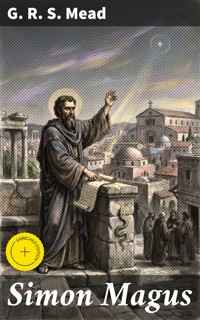
In "Simon Magus," G. R. S. Mead delves into the rich tapestry of early Christian thought, exploring the figure of Simon Magus'Äîa complex character often vilified in ecclesiastical history. Mead adopts a sophisticated literary style that seamlessly blends historical narrative with philosophical inquiry, presenting Simon not merely as a heretic but as a pivotal figure whose Gnostic beliefs influenced the nascent Christian tradition. His analysis contextualizes Simon within the broader currents of late antiquity, weaving together myth, theology, and socio-political dynamics in an engaging manner that appeals to both scholars and general readers alike. G. R. S. Mead, a prominent scholar of Gnosticism and early Christianity, was deeply influenced by his academic background, particularly his interest in mysticism and esoteric traditions. His studies at such institutions as the University of Oxford under eminent thinkers of the time inspired him to seek a deeper understanding of spiritual philosophies. Mead'Äôs scholarly journey, marked by critical engagement with both religious texts and historical contexts, culminated in this astute study of Simon Magus, reflecting his commitment to uncovering the often overlooked figures of antiquity. "Simon Magus" is highly recommended for those interested in early Christianity, Gnosticism, and the complexities of spiritual identity. Mead'Äôs meticulous research and eloquent prose invite readers to rethink the narratives surrounding religious figures perceived as antagonists. This work serves not only as an academic resource but as a profound exploration of the mystical dimensions of faith, offering insights that remain relevant in contemporary theological discussions. In this enriched edition, we have carefully created added value for your reading experience: - A succinct Introduction situates the work's timeless appeal and themes. - The Synopsis outlines the central plot, highlighting key developments without spoiling critical twists. - A detailed Historical Context immerses you in the era's events and influences that shaped the writing. - A thorough Analysis dissects symbols, motifs, and character arcs to unearth underlying meanings. - Reflection questions prompt you to engage personally with the work's messages, connecting them to modern life. - Hand‐picked Memorable Quotes shine a spotlight on moments of literary brilliance. - Interactive footnotes clarify unusual references, historical allusions, and archaic phrases for an effortless, more informed read.
Das E-Book können Sie in Legimi-Apps oder einer beliebigen App lesen, die das folgende Format unterstützen:
Veröffentlichungsjahr: 2019
Ähnliche

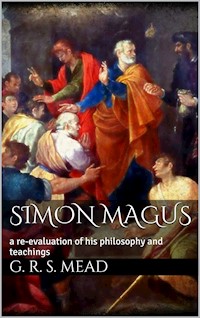


Simon Magus
Table of Contents
Introduction
Legends become battlegrounds when the search for spiritual authority collides with the urge to brand dissent as fraud.
G. R. S. Mead’s Simon Magus is an early twentieth-century work of scholarly reconstruction and esoteric history, written in the form of a study rather than a conventional novel. It takes its subject from late antique religious controversy, focusing on the figure of Simon, remembered in Christian tradition as a rival wonder-worker and a byword for deceptive spiritual power. Mead approaches this contested terrain as a historian of religions and translator of ancient materials, assembling testimony, parallels, and interpretive arguments to re-examine what later polemic may have obscured.
The book’s premise is straightforward but ambitious: to revisit the sources that mention Simon and to ask what kind of religious teacher or movement might stand behind the hostile caricatures. Rather than offering a single definitive biography, Mead guides the reader through fragments, references, and later retellings, treating them as clues to a wider spiritual milieu. The experience is that of a learned inquiry, moving between close reading and synthesis, inviting readers to weigh evidence and to notice how narratives harden into reputations across centuries.
Mead writes with the measured confidence of a comparative scholar, combining philological attentiveness with a pronounced interest in the history of ideas. The tone is serious and investigative, and the style favors careful exposition over dramatic flourish. Readers should expect argument, contextualization, and an emphasis on how texts speak to one another, including the ways later writers reshape earlier memories. At the same time, the book retains a speculative energy characteristic of the period’s revived attention to Gnosticism, mystery traditions, and the contested boundaries of early Christianity.
A central tension in Simon Magus lies between heresiological portraiture and historical reconstruction: what do we do with sources designed to warn, ridicule, or discredit? Mead repeatedly returns to the problem of mediation, showing how polemic can serve as both a record and a distortion. The book also explores the porous frontier between magic and religion, and how claims to healing, prophecy, or spiritual insight become markers of legitimacy or scandal depending on the community that reports them. Underneath the case study runs a broader reflection on how religious identities form through conflict.
Thematic threads include the manufacture of orthodoxy, the persistence of alternative spiritualities, and the interpretive ethics of reading hostile evidence. Mead’s method encourages attention to context: not only what a source says, but why it says it and what it needs its audience to believe. The book also illuminates the early Christian world as a field of competing teachers, practices, and vocabularies, where categories such as teacher, sorcerer, philosopher, and heretic could overlap. In that sense, Simon functions less as a single person than as a focal point for debates about authority.
For contemporary readers, the book matters because it models a disciplined skepticism toward inherited labels and a seriousness about minority or defeated narratives. In an age of rapid misinformation and polarized discourse, Mead’s insistence on tracing claims to their textual foundations remains instructive, even where conclusions may invite further debate. Simon Magus also speaks to enduring questions about charisma, spiritual entrepreneurship, and the social mechanisms that separate sanctioned belief from suspect practice. Read today, it offers both a window into early religious contestation and a reminder that the struggle over who gets to define truth is never merely ancient history.
Synopsis
G. R. S. Mead’s Simon Magus is a historical and textual study that revisits the elusive figure of Simon, known chiefly from early Christian polemical sources and later heresiological tradition. Mead frames the inquiry as a problem in reconstructing religious history from partisan evidence, where the surviving record is uneven and often hostile. The work moves from the familiar outline presented by ecclesiastical writers to the broader question of what Simon represented within the ferment of the first centuries. Throughout, Mead keeps attention on method: how testimony is transmitted, amplified, and reinterpreted across centuries.
Mead first surveys the principal ancient references to Simon and the episodes in which he appears, treating them less as straightforward biography than as literary and doctrinal constructions. He maps how different authors deploy Simon as a foil for defining orthodox identity, attributing to him teachings and practices that serve apologetic aims. The narrative emphasis is on how accusations accumulate and become conventional, and on how later retellings harden earlier insinuations into fixed “facts.” This opening establishes the book’s central tension: a notorious name embedded in stories that may tell more about opponents than about the man.
From this foundation, the book turns to the wider landscape of early religious movements in which Simon is situated: competing Christian groups, Jewish and Samaritan contexts, and the Hellenistic religio-philosophical environment. Mead’s approach highlights how “heresy” and “orthodoxy” are retrospective labels that crystallize only gradually, affecting how earlier disputes are remembered. Rather than treating Simon as an isolated charlatan or magician, Mead explores the possibility that he functioned as a symbol for rival claims to spiritual authority. The discussion foregrounds the book’s guiding question of origins: what streams fed later Gnostic and related traditions.
A key portion of Mead’s argument examines the body of writings and reports associated with Simonian circles, and the ways later authors connect Simon to particular doctrines, myths, and ritual claims. Mead weighs these attributions with caution, distinguishing between direct evidence, secondary summaries, and hostile caricature. He emphasizes how easily complex schools are reduced to a single eponymous founder in polemical history, and how mythic motifs may migrate between groups. The reader is guided through a comparative reading of testimonia that tests internal consistency and reveals the pressures shaping each witness.
Mead then broadens the analysis to the techniques of heresiology itself, showing how catalogues of error can create genealogies of deviation, linking figures like Simon to later movements in a linear succession. He interrogates whether such lineages reflect historical transmission or rhetorical strategy. In this vein, Simon becomes a case study for how early Christian writers explain diversity and dissent: by projecting a single originating adversary. Mead’s discussion remains attentive to the ambiguities of the sources and to the interpretive risks of taking late syntheses as early realities, keeping conclusions measured.
As the book proceeds, Mead considers how legend, theology, and community memory interact, and how the figure of Simon expands beyond any recoverable historical core. He traces the afterlife of the Simon story in subsequent literature and debate, focusing on how enduring motifs—miracle claims, contests of authority, and the policing of spiritual legitimacy—are mobilized for different purposes. Without promising a definitive reconstruction, Mead’s treatment shows how the Simon tradition offers insight into the formation of doctrinal boundaries and the rhetorical invention of enemies, and how these processes shaped the archive that survives.
In its closing movement, Simon Magus returns to the historiographical stakes of the inquiry: what can responsibly be said about early religious innovators when the record is dominated by opponents and later systematizers. Mead’s broader significance lies in using Simon as a lens on early Christianity’s contested beginnings and on the emergence of categories like Gnosticism, magic, and heresy. The work’s enduring resonance is methodological and interpretive rather than revelatory, encouraging readers to read sources critically, to resist easy origin stories, and to see how polemics can become history while leaving central questions productively open.
Historical Context
George Robert Stow Mead (1863–1933) published Simon Magus during a period when late antique religion was being re-evaluated through newly edited texts, expanding museum collections, and professionalized philology. In Britain, universities and learned societies promoted historical criticism of early Christianity, while translations made patristic and apocryphal materials accessible to wider readers. Mead, a classicist and former secretary to Helena P. Blavatsky, worked within a milieu that combined academic methods with esoteric interests. His book situates an obscure first-century figure in the intellectual and religious ferment of the eastern Roman world.
figures named Simon “the Magus” appear in some of the earliest Christian literature. The Acts of the Apostles places him in Samaria and portrays a conflict with apostolic authority involving baptism and monetary influence. Later patristic writers—especially Justin Martyr, Irenaeus, Hippolytus, Tertullian, and Epiphanius—expanded the portrait, linking Simon to heresy and to the origins of Gnostic movements. These sources were composed across the second to fourth centuries and reflect polemical aims. Mead’s context therefore begins with a limited New Testament notice and a much larger, later heresiological tradition.
the geographical setting associated with Simon—Samaria and nearby cities—belonged to Roman Judaea/Syria-Palestina, a region marked by ethnic diversity, imperial administration, and intense religious debate. Greek served as a common language of culture alongside local traditions. In the first century, Jewish communities, Samaritan groups, and emerging Christ-following assemblies interacted amid pressures created by taxation, mobility, and periodic conflict. The institutional landscape included synagogues, temples in the broader province, and informal networks of teachers and wonder-workers. Mead treats this world as one in which “magical” practices, healing, and scriptural interpretation competed for public credibility.
the wider Mediterranean religious environment helps explain why later writers connected Simon with “Gnosis.” From the first to third centuries, multiple movements now grouped as “Gnostic” circulated mythic narratives about divine realms, salvation through knowledge, and critiques of material creation. Evidence for such currents comes from patristic reports and, later, from manuscripts discovered in Egypt (notably at Nag Hammadi in 1945, after Mead’s time). In Mead’s era, scholars relied chiefly on church fathers and on a small number of edited texts attributed to “Gnostic” schools. His work reflects this pre–Nag Hammadi evidentiary situation.
Mead also wrote against the backdrop of expanding knowledge of Greco-Egyptian religious literature and magic. The nineteenth century saw the acquisition and publication of papyri containing spells, hymns, and ritual instructions (later consolidated as the Greek Magical Papyri). While many major editions postdate Mead, the general scholarly recognition that “magic” and religion overlapped in antiquity was already present. Early Christian writers often condemned rival ritual specialists as magicians, a category shaped by legal and social stigma in Roman culture. Mead’s treatment of Simon draws attention to how polemical labels could be used to police boundaries of legitimate authority.
intellectually, Simon Magus was a touchstone in debates over the origins of Christianity and the nature of heresy. Nineteenth-century German scholarship, including the Tübingen School associated with Ferdinand Christian Baur, emphasized conflict between Petrine and Pauline tendencies and treated some early narratives as reflective of later disputes. Simon sometimes featured in reconstructions of contested authority in the apostolic age, though such reconstructions varied and were hotly disputed. In Britain, historical criticism coexisted with confessional apologetics and popular interest in comparative religion. Mead’s study participates in these debates by sifting sources and questioning inherited narratives.
Mead’s personal and institutional connections further shaped the book’s perspective. As an important figure in the Theosophical Society and later founder of the Quest Society, he promoted comparative study of religions and translated or summarized esoteric and late antique materials for educated lay readers. His writings often aimed to rehabilitate marginalized traditions—Hermetic, “Gnostic,” and mystical—against purely dismissive accounts. At the same time, he drew heavily on available critical editions and scholarly discussions. Simon Magus, in this context, becomes a case study in how religious history is constructed from partisan sources and fragmentary evidence.
as a product of its era, Simon Magus reflects early twentieth-century efforts to reposition Christianity within the broader history of Mediterranean religions and to reassess the category of heresy. Mead highlights the dependence of later portraits on patristic polemic and the difficulties of recovering first-century realities from second- to fourth-century reports. The work also mirrors contemporary fascination with “lost” spiritualities and the promise of textual recovery, while remaining constrained by the pre–Nag Hammadi source base. In doing so, it critiques simplistic narratives of orthodox origins and invites readers to see doctrinal boundaries as historically contested and institutionally enforced.




