


3,99 €
Mehr erfahren.
- Herausgeber: Urban Napflin
- Kategorie: Fremdsprachen
- Sprache: Englisch
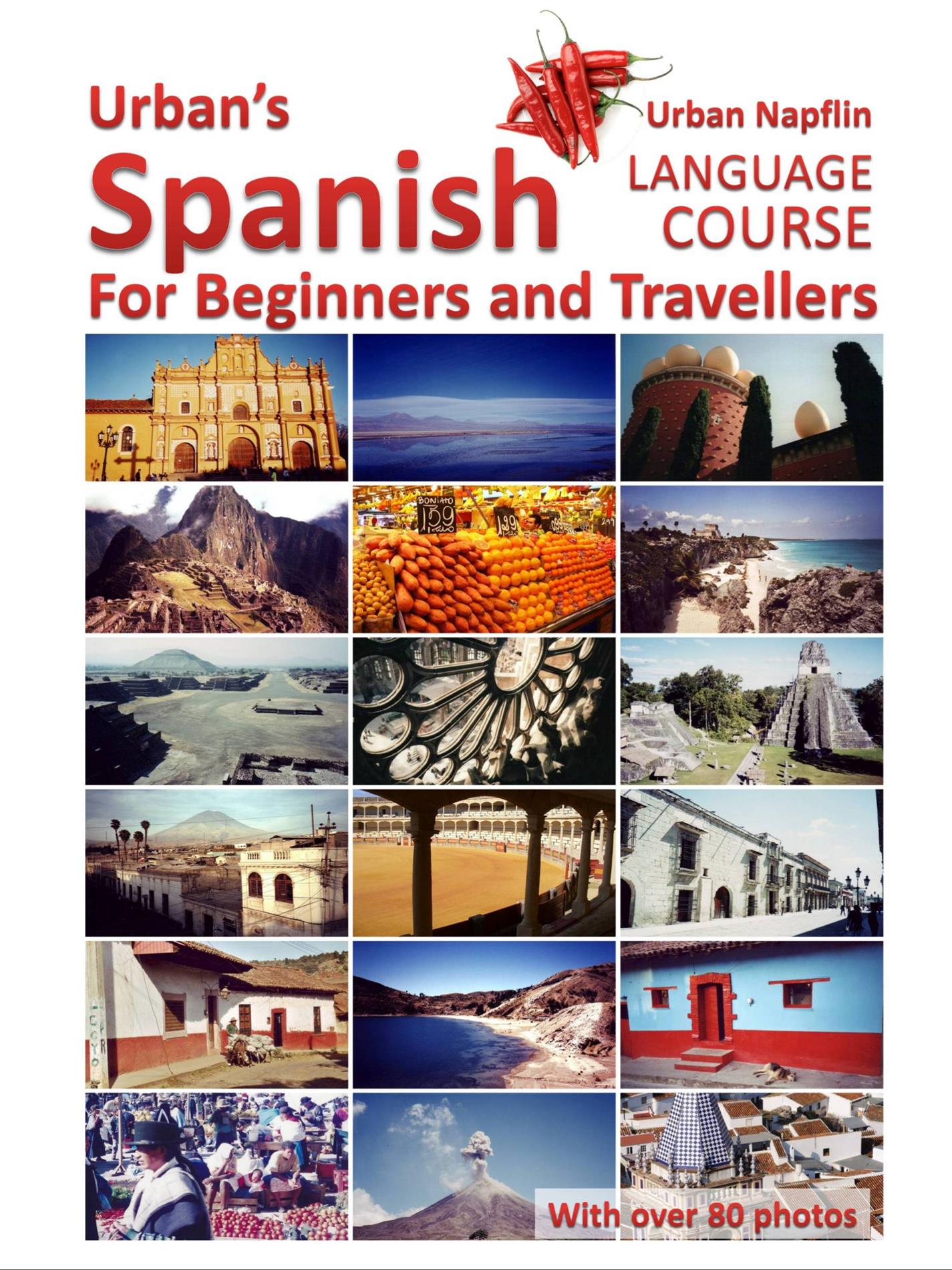
The goal of this easy Spanish ebook is to get you to a level that's decent enough to travel with, maybe even blend in. It will enable you to have fun communicating while being a great resource to take along on your travels.
Spanish is one of the top most spoken languages in the world and with this ebook you will soon be able to access that beautiful world of speaking, writing, singing & thinking!
This easy to grasp Spanish language course is written for beginners who want to learn with their mobile devices or computers. It also contains many advanced elements that you can skip and return to at a later stage.
With the help of this concise language course you will not only be able to quickly and easily understand the
example sentences (over 700 of them), but you'll also be able to form your own sentences.
The
comprehensive word lists contain a vocabulary of about 2,500 words necessary for travelling and reading. At least 400 of those words (in their own section) are so similar to English that you practically already know them!
Throughout the ebook you will find 80 of the author's own inspiring
travel photos from destinations in Latin America and Spain. It also contains over 130 links to interesting websites and other resources to learn Spanish, such as films to watch, literature to read and music to listen to, or how to text in Spanish!
The author shares his own experience from 30 years of learning Spanish and travelling in many Spanish speaking countries. This guide
avoids unneccessary detail and a provides a simplified vocabulary that is perfect to learn for beginners or to use when travelling.
The
simple formatting is designed to work with most devices, be it e-readers, tablets or other mobile devices.
Contents:
Introduction
Why learn Spanish / History and related languages / What makes learning Spanish easy / What makes learning Spanish difficult / The general success criteria for learning languages / Simple traveller talk / Pronounciation
Basic grammar
Articles / Nouns / Personal pronouns / Adjectives / Adverbs / Present tense / Present participle / Present perfect / Recent past with ‘acabar de’ / Past definite / Past imperfect / Past perfect / Immediate future with ‘ir a’ / Future tense / Conditional / Passive / Indirect speech / Subjuntivo / Commands / Expressing possession / Expressing relation / Demonstratives / Negative expressions / Diminutives / Prepositions
Vocabulary
Words you probably already know / Equivalent and similar words to English / Words you thought you knew / Numbers / Calendar and times / Locational expressions / Question words / Words to connect sentences / Colours / The human body / School / Eating / Transport / Computer and communications / More travelling words / Names / Countries / Cities / 400 verbs to start with / Other frequently occurring words / Exclamations and interjections / Slang / Grammar terms / A few advanced words... / More useful tips for beginners
Example sentences
Meeting people / Shopping / Transport / Accommodation / In the restaurant / More travelling sentences / Flirting / Some idioms and proverbs / Texting in Spanish / Letters
More resources
Learning resources: internet / Learning resources: books / Online dictionaries / Literature / Music / Film / Spanish schools in Spain and Latin America / Typing Spanish on the computer / Other interesting resources / How this ebook came about
New revised and updated edition, 2020.
Das E-Book können Sie in Legimi-Apps oder einer beliebigen App lesen, die das folgende Format unterstützen:
Veröffentlichungsjahr: 2022
Ähnliche
















Urban's
Spanish Language Course
for Beginners and Travellers
Urban Napflin
Copyright
Streetlib Version 2.5, License Notes
ISBN 978-0-473-27387-3
Copyright © 2022 Urban Napflin
All pictures taken by the author.
This ebook is licensed for your personal enjoyment only. This ebook may not be re-sold, borrowed or given away to other people. If you would like to share this book with another person, please purchase an additional copy for each recipient.
All rights reserved. Without limiting the rights under copyright reserved above, no part of this publication may be reproduced, stored, in or introduced into a retrieval system, or transmitted, in any form or by any means, without the prior written permission of the copyright owner or the publisher of this ebook.
Mexico: Cathedral in San Cristóbal de Las Casas, Chiapas
Table of contents
Introduction
Why learn Spanish
History and related languages
What makes learning Spanish easy
What makes learning Spanish difficult
The general success criteria for learning languages
Simple traveller talk
Pronunciation
Basic grammar - how to form sentences
Articles
Nouns
Personal pronouns
Adjectives
Adverbs
Present tense
Present participle (gerund)
Present perfect
Recent past with acabar de
Past definite (preterite)
Past imperfect
Past perfect (pluperfect)
Immediate future with ir a
Future tense
Conditional
Passive
Indirect speech
Subjuntivo ('subjunctive')
Commands
Expressing possession
Expressing relation
Demonstratives
Negative expressions
Diminutives
Prepositions
Vocabulary
Words you probably already know!
Similar and equivalent words in English
Words you thought you knew
Numbers
Calendar and times
Locational expressions
Question words
Words to connect sentences
Colours
The human body
School
Eating
Names
Computer and communications
Travelling
Countries
Cities
400 verbs to start with
Other frequently occurring words
Exclamations and interjections
Slang
Grammar terms
A few advanced words...
More useful tips for beginners
Example sentences
Meeting people
Shopping
Transport
Accommodation
In the restaurant
More travelling sentences
Flirting
Some idioms and proverbs
Texting in Spanish
Letters
More resources
Learning resources: internet
Learning resources: books
Online dictionaries
Literature
Music
Film
Spanish schools in Spain and Latin America
Typing Spanish on the computer
Other interesting resources
How this ebook came about
Peru: Machu Picchu waits for you at the end of the Inca Trail
Introduction
Spanish is one of the most widely spoken languages in the world and with this ebook you'll soon be capable to access that beautiful world of speaking, writing, singing & thinking!
Well, you still have to do the hard yards getting that grammar and vocabulary in check, of course...
But as this course is written for tablets and other mobile devices, I was trying to avoid excessive detail and a complicated vocabulary that isn't really necessary when travelling.
My goal was to get you to a level that's decent enough to travel, maybe even blend in, having fun communicating while keeping a great resource for a deeper foundation in your e-readers, always there if you feel like learning a little more.
I'm not a native speaker, not even a teacher, but I love languages and want to pass on my experience from 30 years of learning Spanish and travelling around, hopefully it will provide you with lots of fun while learning and many rewarding achievements on the way.
I tried to steer clear of grammatical terminology, but in spite of all good intentions I couldn't avoid those parts (they would have been enough to scare me off in the old times as well). Believe me, in the end you will find out that grammar is your friend and not your enemy - give it a chance, you won't regret it!
Don't forget to make use of a dictionary as well (a little pocket dictionary is enough) - you can find them wherever you travel, also ones written for Spanish speakers will do.
For a successful start you'll need to learn about pronunciation, listen to some Spanish, then learn a little grammar, a minimum vocabulary and a few simple sentences. After your first successful interactions go for more grammar, more words and when you get ready to read a book, go for the rest!
Spain: La Trapa on the idyllic west coast of Mallorca
Why learn Spanish
Over 400 million people worldwide speak Spanish as a first language and 60 million more as a second. It is the language most widely understood in the Western world and after English the second most important language for international communication.
Spanish is the primary language in a range of countries all over the globe:
Argentina
Bolivia
Chile
Colombia
Costa Rica
Cuba
Dominican Republic
Ecuador
El Salvador
Equatorial Guinea
Guatemala
Honduras
Mexico
Nicaragua
Panama
Paraguay
Peru
Puerto Rico
Spain
Uruguay
Venezuela
Western Sahara
Spain: Bullfighting poster in Sevilla
Spain with its 47 million inhabitants has lost its leading position in the Spanish world, now most Spanish speakers live in Mexico (125 million people) and most other countries above are in Latin America as well.
Although Spanish is one single language, all of these countries have their own dialects and vocabulary variations, especially when spoken - but whatever you learn from this ebook will be understood by everyone.
Spanish will also help you to get along well in other places, for example in the US over 44 million people are from Spanish speaking origins!
If you're not sure about making the effort to learn another language, consider this:
- You'll gather extremely positive experiences from meeting people whom otherwise you could not have talked to.
- Spain and Latin America were once the cultural epicentres of their continents and there are lots of very significant places to discover. You will find it easier to visit a lot of exciting countries, feeling less vulnerable, opening up a new world of travel with a new style of discovery.
- You'll get better access to another world of culture: music, film, literature, art, architecture, etc.!
- You'll be able to correctly pronounce the food you're eating!
- Regardless of age, learning a foreign language is a very satisfying personal achievement. You'll get back as much as you are ready to put in, even a little effort will get you some way and will not be in vain.
It's a very beautiful language and relatively easy to learn if you already understand English. Ideally, with the help of this short language course you will not only be able to understand the example sentences (over 700 of them), but by exchanging words, tenses, etc. you'll also be able to create your own sentences.
The course follows a certain order through the grammar and other sections, but feel free to skip the seemingly boring sections (whatever makes your eyes glaze over) and return later when you're ready - make sure you'll enjoy your path to becoming a fluent Spanish speaker, learning should ideally be interesting and fun.
The word lists contain a vocabulary of about 2,500 words necessary for travelling and reading (native speakers would know about 10,000, so there's still some way to go...), focusing on a quick and easy learning process. At least 400 of those words are so similar to English that you practically already know them!
After going through this ebook there's a lot more you can do:
- Go to a Spanish conversation class or take lessons.
- Get your hands on magazines and newspapers while travelling.
- Sing along to good music, organise the lyrics to your favourite salsa, mariachi or rock band.
- Watch Spanish speaking TV or films (possibly with English subtitles), listen to internet radio or download an interesting podcast.
- Start with a book that's translated from English into Spanish, the vocabulary is often easier than in original versions (how about a bestseller you already know, like Ángeles y Demonios).
Check out the section 'More resources' with loads of suggestions at the end of this ebook!
Mexico: Typical alley in Guanajuato, a beautiful old mining town
History and related languages
Spanish (español) is often also called castellano (Castilian), because the language evolved in the region of Castilla in northern Spain. Spain is located on the Iberian Peninsula (Iberia was the original Greek name), which the Phoenicians and later the Romans called Hispania.
The 'Vulgar Latin' spoken in the Roman Empire is the basis of all the 'Romance languages': Spanish, French, Italian, Portuguese and others (English on the other hand has a Germanic origin).
In medieval times Spanish was only spoken in Castilla, it was then one of few places in Spain not impacted very much by the Muslim invasion. When the Castilians were able to reconquer Toledo in 1085, the Christian reconquest of the peninsula was gaining momentum. Their Castilian language was spreading successfully until independence was finally complete in 1492, when Queen Isabella I (from Castilia) and King Ferdinand II (from Aragon) together ruled the beginnings of modern Spain.
The same year that the last Muslim stronghold in Granada fell, the royal couple authorised the expedition of Christopher Columbus (Cristóbal Colón), leading to the colonisation of Latin America (the word 'colonisation' is actually much older and derived from Roman Latin). Spanish has evidently been widely used since and there are also many creolic versions from mixing with native languages.
To prevent a drifting apart of all the Spanish accents and following the example of the French Académie Française, in 1713 the Royal Spanish Academy (Real Academia Española) was established, standardising the vocabulary and orthography of the language for longterm future use.
The Spanish of today incorporates many words of Arabic, English, French and Italian origin. Portuguese is the closest language (although a real mutual understanding is probably only possible when reading), followed by Catalán, Italian and French.
Spain: The Roman Aqueduct in Segovia
What makes learning Spanish easy
There are some characteristics of Spanish which make learning easier, at least at a first glance:
English with its Germanic origin is not directly related but many words are very similar. Spanish is the closest language to Latin - the basis of much of our vocabulary since Roman dominance. For example, words that end in -ción can usually be transformed into English by replacing the ending with '-tion'. See the separate word lists later in the ebook.
- Pronunciation is very regular. Unlike in English, spelling clearly determines pronunciation.
- The plural is simply formed by adding an -s to a vowel or an -es to a consonant:
Casa (house) - casas
Español (Spaniard) - españoles
- Spanish sentences are structured similarly to English:
Yo necesito algosubject-verb-objectI need something
- Questions can easily be formed and intonation alone can turn a normal sentence into a question:
Necesitas algoYou need something
¿Necesitas algo?Do you need something?
- Personal pronouns can usually be ignored as they are obvious from the verb conjugation or context:
Necesito algoI need something
- Adverbs are easily formed and simply end with -mente:
Rápido (adjective, meaning 'fast') Rápidamente (adverb)
- Past tense can easily (although not always correctly) be formed by using present perfect.
HablarTo talk
He habladoI have talked
- Also, future tense can simply (and also not always correctly) be formed by using a form for the near future, the equivalent of 'going to' in English:
ComerTo eat
Voy a comerI'm going to eat
- Numbers follow a regular pattern from 16 onwards.
- Other languages partly become understandable as well (Portuguese, Italian, French, Catalán).
- Spanish is accessible: there are thousands of websites, books, newspapers, magazines, TV and radio channels, comics, etc. waiting for you! For example, listen to the news broadcasts (noticias) of Spanish speaking TV and radio stations or search Youtube for 'Spanish pronunciation'.
Guatemala: Mayan temples in Tikal, a giant ancient city in the Petén jungle
What makes learning Spanish difficult
- Spanish nouns have two genders and are either masculine or feminine.
El libro (the book)
La casa (the house)
- There are formal and informal ways of addressing someone.
- There are many irregular grammar forms (conjugation, tenses etc.) that need to be memorised. Irregularities often occur when verbs are used very often, in a way that will make it easier to remember because they keep popping up.
- Some aspects of grammar are completely unfamiliar, as for example the subjuntivo (subjunctive mood).
- Some words seem to translate easily but are in fact very different, see under 'Words you think you knew'.
- You'll notice that regional slang is used a lot and you won't find it in the textbooks. You'll find a short section about slang words under 'Vocabulary'.
- Spanish speakers in some regions have a pronunciation or speed that can make understanding nearly impossible for the untrained listener.
- Accent marks may look confusing in the beginning but are clearly used for pronunciation reasons only and will actually help you pronounce correctly.
Spain: Dalí museum in Figueras
The general success criteria for learning languages
These four criteria are based on the book 'How language works' by David Crystal. As you can see, being talented is just one of the success factors:
Talent
Not only intelligence and memory are important but also an ability for empathy, flexibility and independence. You should also be able to recognise phonetic differences.
Motivation und attitude
Are you indeed going to use the language and how important is that goal to you? Do you have respect for the language and its culture?
Technique
How systematically do you approach your learning, do you have a strategy or are you simply curious?
Application
How often and intensely do you learn and do you apply the language in realistic situations?
My tips for learning:
Set yourself a goal! As ambitious as possible but still being realistic, like 'I want to understand the news', 'I want to be able to practice a bit of small talk while travelling', or 'I want to be able to completely blend in when in a restaurant' etc.
Take notes whenever you understand something new or have an 'aha' moment, the repetition alone will help you retain that memory. Take notes on your device if it allows it.
Summarise the grammar in your own words and your brain will process it better.
Exercise the conjugation of verbs and develop a feeling for the forms.
Mark important words in a small dictionary (or, if possible, highlight them in this ebook), it will help to actively remember them.
TalkSpanish - even to yourself if no one else is around! The most rewarding way to use your Spanish is to talk to people, followed far behind by reading and watching films - you simply have to do it to make the most of it!
Sing along to music, associate your learning with positive emotions!
Read interesting and fun Spanish newspapers and books with the help of your dictionary, try to access cool things you wouldn't have been able to before.
Repetition is key: reading this ebook from front to back won't make you speak Spanish, but going back to it again and again, taking notes, experimenting with new knowledge in discussions etc. will.
Don't be afraid of making mistakes. Some people may be near perfect in writing and are still unable to speak. It's probably better to make mistakes but communicate as much as possible - enabling you to acquire experiences and build on those. But don't get stuck on a poor level of grammar just because people do seem to understand you anyway. Once you commit to an inspiring goal (like blending in perfectly) you will find enough motivation.
Relax: don't feel under pressure because the grammar, vocabulary or anything else appear overwhelming, a relaxed playful brain will learn much faster than one forced to do so.
Persevere: a longterm problem is forgetting words that you previously knew - it's very frustrating to open your mouth and then not find that certain word again! Don't ever let your Spanish rest for more than 6 months or it will slowly fade away!
Bolivia: Walking at 3,812 metres (12,507 ft) altitude on Isla del Sol, an island in Lake Titicaca
Simple traveller talk
Even with just a few words you can make yourself understood in many situations, simply keep repeating the most useful traveller shortcuts below until you can get more accurate. To really appreciate your conversations try to extend your vocabulary to at least 500 words and you'll be able to tackle most everyday situations.
Starting a conversation:
HolaHello
Buenos díasGood day
¿Qué tal?How are you?
Mi nombre es...My name is...
Soy de...I'm from... (Soy de Inglaterra - 'I'm from England')
¡Mucho gusto!With pleasure! Good to know you! (when meeting someone)
Great words to start a sentence:
Permiso, ...Excuse me, ...
Disculpe, ...Forgive, sorry
Perdón, ...Sorry, ...
Por favor, ...Please, ... (Un café, por favor - 'A coffee, please')
Puedo...I can... (¿Puedo comprar un boleto? - 'Can I buy a ticket?')
Quiero...I like..., I want... (Quiero un café - 'I want a coffee')
Quisiera...I would like..., this is more polite than quiero (Quisiera un café - 'I would like a coffee')
¿Hay...?Do you have...? Is there...?
¿Es posible...?Is it possible...? (¿Es posible más barato? - 'Is it possible cheaper?')
Me gusta...I like (to praise something, such as Me gusta Bolivia - 'I like Bolivia')
Tiene...Do you have... (¿Tiene una habitación? - 'Do you have a room?')
Tengo que...I have to... (Tengo que comer - 'I have to eat')
Es que...It's that..., the thing is that... (Es que no me siento bien - 'The thing is that I don't feel well')
Pienso ir a...I think about going to, I plan to go to... (Pienso ir a Colombia - 'I think about going to Colombia')
¿Dónde es...?Where is...? (¿Dónde es el baño? - 'Where is the bath?')
¿Cuánto es...?How much is...? (¿Cuánto es la habitación? - 'How much is the room?')
Necesito...I need... (Necesito un taxi - 'I need a taxi')
Voy a...I will.... (for anything in the future, as in Voy a viajar a Quito - 'I'm going to travel to Quito')
He comprado..., he viajado a....I have bought..., I have travelled to... (use this simple tense for anything in the past - see under 'Present perfect')
Replying to questions and remarks:
Muy bien, graciasVery well, thanks
Muchas graciasMany thanks
BuenoGood
No hay problemaNo problem
De nadaThanks, don't mention it
No hay de que (preocuparse)No reason (to worry), no problem, you're welcome
No se preocupeDon't worry
No hay prisaThere's no hurry
IgualmenteLikewise
ClaroSure
QuizásMaybe
No estoy seguroI'm not sure
DependeIt depends
Lo sientoI'm sorry
¿De verdad?Really?
Desde luegoOf course
Un momentito, por favorA moment, please
No puede serThat can't be
De acuerdoOK, all right
¿En serio?Seriously?
Don't have much time? These are some ideal sections for learners in a rush:
Pronunciation
Articles
Nouns
Personal pronouns
Adjectives
Present tense
Present perfect
Immediate future with ir a
Words you probably already know!
Equivalent and similar words to English
Numbers
Calendar and times
Locational expressions
Question words
Travelling
Example sentences
Grammar may look terribly boring and complicated, but look at it like the rules of a game that have to be explained before play can start. Give it a go!
Dominican Republic: Street scene in Santo Domingo
Pronunciation
It's important that you get used to the right pronunciation quickly by listening to Spanish speakers (also TV, radio, songs) and don't rely on phonetic descriptions alone.
The alphabet:
The Spanish alphabet has 27 letters, but there are also special letters and digraphs:
A, B, C, D, E, F, G, H, I, J, K, L, M, N, Ñ, O, P, Q, R, S, T, U, V, W, X, Y, Z
Below are the letters, their Spanish names and similar pronunciations in English.
The vocals:
Make them short, don't stretch them out too long. Don't change the note, keep the sound even all the way through.
Aa'ah', 'luck', 'father'
Ee 'eh', 'nest', 'bet'
Ii'police', 'need', 'machine'
Oo'often'
Uu'fruit', 'rule', 'food'
Consonants that more or less sound the same as in English:
Bbe'best', 'bay'
Dde'day' (depending on the dialect the d is often also completely silent)
Fefe'fun'
Kka'kilo'
Lele'let'
Meme'man'
Nene'next'
Ppe'pen' (spoken softly)
Sese'hospital'
Tte'stand' (spoken softly)
Wve doble, uve doble, doble ve'when', 'water'
Yi griega, ye'you'
Consonants that sound different:
Cce before o, u, or a (comer, cubo, casa) like a 'k': 'key', 'cold'before an e or i like 's' in Latin America: 'sell', 'see' before an e or i like 'th' in Spain: 'thing', 'rather'
Ggebefore an a, o or u: 'got', 'good'before an e or i like a German 'ch' (harshly aspirated or soft): 'loch', 'hot'
Hhachesilent: prohibir sounds like 'proibir'
J jota harshly aspirated and gutturallike a German 'ch': 'loch'or sometimes soft like in the alternative written form of Mexiko: Méjico - 'Mehico'
Ñeñe or énye'canyon'
Qcu only occurs as the diagraph qu (pair of characters with one single sound, see below), like quiero: 'kiero', 'scan'
Rerrevery similar to English, but often with a trilling or rolling sound when at the beginning of a word: 'right'
Vve, uve'velocity' but often a v is spoken like a b, especially in Spain: 'bell'
Zzeta strong 's' in Latin America: 'cereal', 'sun''th' in Spain: 'thing'
Costa Rica: Green countryside around San Gerardo de Rivas
Special letters and symbols:
- Accent marks on á, é, í, ó and ú are used to denote a stress in the pronunciation (see below).
- The 'diacritical tilde' on the ñhas phonetic reasons anddemands a certain sound, for example piñata is pronounced like 'pinniata' (a so-called 'palatal nasal' sound, like 'onion'). It signifies the Spanish language more than any other letter.
- The letters k and w are not originally Spanish, they only appear in loan words from English or other languages.
- A digraph is a pair of characters used to write one single sound:
ch (che / ce hache)as in 'chapter'
ll (elle / doble ele)as in 'yes' or tortilla: 'torteeya'
rr (doble erre)a trilled 'rrr'
gu (ge u)as in 'wall' (agua) or 'got' (guerra)
- Sometimes you'll notice a ü within a -güe- or -güi-, which is called 'diaeresis'. The two dots on the ü signal that the u is not silent, it sounds like a 'w':
NicaragüenseNicaraguan
PingüinoPenguin
- Capitalisation of letters is used only for names and places, but not for languages, days or months. Also the abbreviations of señor (Sr. - 'mister'), señora (Sra. - 'Mrs'), usted (Ud. - 'you' singular) and ustedes (Uds. - 'you' plural) are capitalised.
- Inverted opening question ¿ and exclamation ¡ marks, as in
¿Necesitas algo?Do you need something?
¡Dígame!Tell me!
The Royal Academy introduced these in order to help recognise questions and exclamations in long sentences. An opening question or exclamation mark can appear in the middle of a sentence, it begins the sentence part with the question or exclamation, for example:
Te gusta, ¿verdad?You like it, don't you?
Trabajas hoy, ¿no?You work today, don't you?
Peru: The beautiful city of Arequipa was founded in 1540
Stress and accent marks:
Normally stress is placed on one of the vowels in a word, it is spoken with more emphasis and stretched a bit longer. The syllables to be stressed below are shown in bold.
Don't forget that native speakers also make mistakes with accent marks - social media on the internet is full of such errors.
For words that end with a vowel, an s or an n, stress is placed on the second last syllable:
Casa
Americano
España
Burgos
Necesitan
For words ending with other consonants, stress is placed on the last syllable - this rule is very easy to forget!
Madrid
Badajoz
Decir
Ciudad
Hablar
Matador
Salud
If words do not follow these rules then you can recognise them by their accent marks over the stressed vowel:
México
Málaga
León
Cádiz
Accent marks are also used on capital letters:
Ávila
Ópera
Sometimes two vocals are combined into one syllable (called a 'diphtongue') and treated as such: pronunciation remains the same as if it is one vowel only. This happens when a u, i or y appears next to another vowel, for example (syllables are shown separated):
Len-gua
Fa-mi-lia
A-yu-dar
Es-tu-diar
De-ma-sia-do
Here are some example sentences and how they would be pronounced phonetically in English. Make it a habit to speak out loud whatever you are reading, whenever you can:
Hola (Hello)oh-lah
Cómo (How)ko-mo
Estás (You are)es-tas
¿Hola, cómo estás? (Hello, how are you?)oh-lah, ko-mo es-tas?
Estas (These)es-tas
¿Habla usted inglés? (Do you speak English?)ah-blah oos-tehd een-glehs?
Juan es muy romántico (Juan is very romantic)hoo-ahn ehs moo-ee rroh-mahn-tee-koh
¿Qué hace ella? (What does she do?)keha-seh e-yah(Latin America)keha-theh e-yah (Spain)
Yo voy a aprender español (I'm going to learn Spanish)yohvoya a-pren-dehr es-pah-nyohl (Latin America)yohboya a-pren-dehr es-pah-nyohl (Spain)
Una generación feliz y agradable (A happy and pleasant generation)oo-nah heh-neh-ra-seeohn feh-leesee a-grah-dah-bleh(Latin America)oo-nah heh-neh-ra-seeohn feh-leethee a-grah-dah-bleh (Spain)
Es muy fácil (It's very easy)ehsmoo-ee fah-seel (Latin America)ehsmoo-ee fah-theel (Spain)
Sometimes the accent mark differentiates homonyms which are otherwise written the same:
LiquidoI liquidate, sell off
LiquidóHe or she sold off
LíquidoLiquid
Hacía Imperfect of haber (to have)
Hacia Towards
In the following one syllable examples the accent mark doesn't impact on the pronunciation, but instead on the meaning (also see in 'More useful tips' about how accent marks distinguish between pronouns and adjectives):
Tu (yours) - Tú (you)
Mi (my) - Mí (me)
Te (yourself) - Té (tea)
El (the) - Él (he, him)
Se (himself, herself) - Sé (I know)
Rio (he or she laughed) - Río (river)
Si (if) - Sí (yes)
Mas (but) - Más (more)
Some letters are hard to distinguish from each other based on pronunciation, which makes it difficult for learners. These difficulties can be encountered between:
B and v (mostly in Spain)For example basura (trash) vs. vaso (glass)
X, j or g before an e or iFor example general (general) vs. jefe (boss) vs. México
Hu and gu before a vowel For example Guatemala vs. Huatulco (the g and h are often silent anyway)
C, s and z (mostly Latin America) For example Celaya vs. San Pedro vs. Zacatecas
Y, i and llFor example leyendo (reading) vs. Maiorca vs. Mallorca
Due to pronunciation, y (and) changes into an e when followed by i- or hi- and o (or) changes into a u when followed by o- or ho-:
Madre y padreMother and father
Madre e hijaMother and daughter
Inglaterra e IrlandaEngland and Ireland
Siete u ochoSeven or eight
Mujeres u hombresWomen or men
Spain: The oldest bullfighting ring (plaza de toros) of Spain is in Ronda
Dialects:
While native speakers won't find much difficulty understanding each other, for learners it can be challenging when suddenly all you can hear is a Spanish sounding noise coming at you at lightning speed, a world of slang you never heard of or an unintelligible mumbling where words have no endings and everything is shortened by half!
You may not understand everyone, but the good news is that you yourself will be understood for sure. You also won't have to learn other local languages like Quechua or Catalán, pretty much everyone you'll meet will also understand Spanish.
The biggest difference between Latin America and Spain is the pronunciation of c and z followed by a vowel. This is called elseseo in Latin America, where they are pronounced as an 's' and in Spain as a 'th':
Cervezaser-veh-sah Beer (Latin America)
Cervezather-beh-thahBeer (Spain)
Another big difference between Spain and Latin America is the usage of formality. In Spain the usage of tú and vosotros is common when talking to strangers, while in Latin America nearly every conversation with anyone unknown is held with usted or ustedes. Latin Americans are very polite and in a way old-fashioned, but travellers will quickly get used to the simplicity of it. See again later under 'Personal pronouns'.
¿Cómo estáis vosotros? (Spain)How are you? (informal)
¿Cómo están ustedes? (Spain)How are you? (formal)
¿Cómo están ustedes? (Latin America)How are you? (both formal and informal)
Sometimes you'll notice that speakers don't pronounce the last consonant:
Ustedoos-tehYou (singular formal)
Hombresom-brehMen
Edadeh-dahAge
Sometimes a y turns into a 'sh' or 'zh' (like the English 'vision'), especially in Argentina, Paraguya, Uruguay & Chile:
Desayunodes-ahsh-oo-nohBreakfast
Yo soy chilenoshoh soh-ee chee-leh-nohI'm Chilean
Sometimes an ll turns into a 'sh', especially in Argentina, Paraguya, Uruguay & Chile:
Llavesha-behKey
Me llamo Pedromeh sha-moh peh-drohI call myself Peter, my name is Peter
Sometimes c, s, z or d turn silent in the middle of a word(especially in Central America, Colombia, Venezuela, Argentina, Paraguya, Uruguay & Chile):
Oscurooh-koo-rohDark
Frescofreh-kohFresh
Estadoes-tah-oh / eh-tah-ohState
Sometimes r turns into l (especially Cuba):
Mi amormee-a-mohlMy love
Pararpa-ralTo stop
We won't ever understand every dialect and slang word (also see under 'Slang' later), especially not the Lunfardo:about100 years ago Buenos Aires developed its own criminal underworld dialect. Many of its words made it into tango lyrics and are still used in today's Argentinian vocabulary.
Chile: Surprising sights in the Atacama Desert, the driest place in the world
Basic grammar - how to form sentences
Grammar is definitely not sexy and the terms used can be more confusing than helpful. Here are the most important terms in the context of this chapter:
Noun: A word that refers to a person, thing or place.
Article: A word that introduces a noun, such as 'the' or 'a'.
Pronoun: A word that replaces a noun in speech, such as 'you', 'we' or 'it'.
Adjective: A word that describes a noun, like 'sweet' or 'big'.
Subject: The person or thing that the sentence is about and that performs the action of a verb, like 'Peter', 'he' or 'the dog'.
Verb: A word that describes a subject's action or state and that is conjugated based on that subject and the tense, for example 'to sit' or 'to be'.
Conjugation: The different forms of a verb according to the subject and the tense involved, as well as other parameters, like 'I sit', 'you sat', 'they will be eating'.
Tense: The present, past, or future forms of a verb.
Adverb: A word that is used to describe a verb or an adjective, such as 'quickly' or 'really'.
Preposition: A word that connects a noun with other elements in the sentence, for example 'in', 'at', 'for', 'across' etc.
Present participle: The '-ing' form of a verb, like 'running' or 'sleeping'.
Past participle: The verb form of a certain past tense, typically with an '-ed' ending like 'cooked', 'baked', but also others like 'slept' or 'been'.
Infinitive: The base form of a verb, in English with a 'to' in front, like 'to do' or 'to sit'.
Costa Rica: A cemetary near Limón
Articles
Using the right article (artículo) is not that simple because Spanish nouns have a gender: masculine or feminine. However, there are rules worth remembering:
Most nouns that end with -a are feminine.
The ones that end with -o, -e or a consonant are usually masculine.
More about gender and exceptions in the section about nouns.
El ejemploThe example
La palabra
The word
Los ejemplos
The examples
Las palabras
The words
Un ejemplo
An example
Una palabra
A word
Unos ejemplos
Examples
Unas palabras
Words
El cocheThe car
El balcónThe balcony
A masculine article is used when the feminine noun starts with a stressed a, á, or ha. This is for pronunciation reasons alone. The plural form stays regular.
El agua
The water
El águila
The eagle
El ala
The wing
El hambre
The hunger
Las aguas
The waters
Las águilas
The eagles
Las alas
The wings
Las hambres
Famines




