


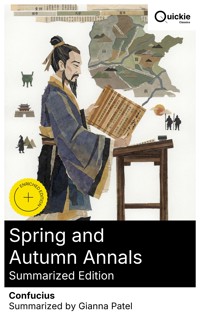
1,99 €
Mehr erfahren.
- Herausgeber: Quickie Classics
- Kategorie: Geisteswissenschaft
- Sprache: Englisch
The Spring and Autumn Annals is a spare chronicle of the state of Lu, recording year by year and season by season events from 722 to 481 BCE. Entries on battles, rites, eclipses, and embassies are famously terse; their wording—the Spring-and-Autumn brush—carries praise and blame. As one of the Five Classics, it links early Chinese historiography with moral-political teaching, elaborated by the Zuozhuan, Gongyang, and Guliang. Tradition attributes the compilation to Confucius (551–479 BCE) of Lu, whose brief service in office and long career as teacher aimed to restore Zhou ritual order. Drawing on state archives, he reportedly selected and phrased records to rectify names and guide rulers by indirection. Regardless of strict authorship, the text reflects his belief that moral governance begins with precise language and ritual propriety. Readers of early Chinese statecraft, ethics, and historiography will find the Annals indispensable. Read it slowly, ideally with a commentary, attending to titles, honorifics, and omissions that signal judgment. Scholars of political theory and philology will value its disciplined brevity and its quiet claim that style itself can govern. Quickie Classics summarizes timeless works with precision, preserving the author's voice and keeping the prose clear, fast, and readable—distilled, never diluted. Enriched Edition extras: Introduction · Synopsis · Historical Context · Author Biography · Brief Analysis · 4 Reflection Q&As · Editorial Footnotes.
Das E-Book können Sie in Legimi-Apps oder einer beliebigen App lesen, die das folgende Format unterstützen:
Veröffentlichungsjahr: 2026
Ähnliche



Spring and Autumn Annals (Summarized Edition)
Table of Contents
Introduction
Between the spare notation of public events and the pressing question of how a community should judge them, the Spring and Autumn Annals sustains a tension in which chronicle, statecraft, and ethics continually measure one another, asking whether the naming of a deed can also be a weighing of its worth, whether the order of seasons can steady the disorders of politics, and whether a record that says little on its surface can teach through the gravity of what it chooses to include, omit, or phrase with an austerity that demands attention to the smallest turn of words.
As a terse annalistic chronicle from the Eastern Zhou era, the work records affairs of the State of Lu over the centuries now called the Spring and Autumn period, roughly spanning the eighth to the fifth centuries BCE. Known in Chinese as the Chunqiu and traditionally attributed to Confucius of Lu, it was later canonized among the Five Classics of the Confucian tradition. Its entries proceed year by year, noting ritual observances, diplomatic missions, accessions, funerals, alliances, and conflicts in a compressed style. The text circulated with influential commentaries that shaped interpretation, but the core work remains strikingly spare and disciplined.
Readers encounter a sequence of brief entries ordered by regnal years and seasons, a cadence that foregrounds timekeeping as a civic frame. The voice is impersonal yet pointed, favoring nouns and titles over description, and the tone is austere, even lapidary. Syntax is lean; events arrive with minimal connective tissue, encouraging the audience to infer relations and evaluate emphasis. The experience is not narrative immersion but disciplined attention to selection, phrasing, and naming. Without recounting episodes in full, the text invites reflection on why certain rites, envoys, or campaigns are recorded, and how precision in designation can imply judgment.
Several themes recur across these laconic records. Order is measured through ritual propriety and calendrical regularity, suggesting that stability depends as much on correct forms as on force. Legitimacy appears in titles and protocols, where a choice of rank or verb can mark approval or censure, a dynamic elaborated by later traditions that read the Annals as a system of praise and blame. The chronicle also probes boundaries of sovereignty through alliances, oaths, and breaches, and it treats mourning and succession as public ethics. Above all, it explores how language—names, sequence, and omission—can serve as an instrument of governance.
For contemporary readers, the Annals matters as a study in how records shape responsibility. In an age of dashboards and headlines, its minimal entries model a civic archive that signals significance through structure rather than spectacle, reminding us that editorial choices—what to include, how to label, when to mark a breach—carry ethical weight. Its attention to ritual, diplomacy, and war offers frameworks for thinking about legitimacy, accountability, and restraint in public life. The work encourages close reading as a civic habit, alert to euphemism and emphasis, and it suggests that accuracy and judgment need not be enemies in historical writing.
Approaching the text benefits from patience and context. Many readers consult it alongside traditional commentaries—the Zuo Commentary, the Gongyang Commentary, and the Guliang Commentary—which expand events and articulate interpretive principles, though the Annals itself remains the touchstone. Modern translations differ in how they render titles, offices, and place-names; these choices affect perceived nuance, so comparing notes can clarify patterns of emphasis. Reading slowly, attending to repeated formulas, seasonal markers, and shifts in designation, helps disclose the work’s architecture. The aim is not to extract plot, but to perceive how a disciplined register turns civic memory into ethical reflection.
Canonized among the Five Classics and centered on the State of Lu, the Spring and Autumn Annals stands at the confluence of history writing and moral inquiry, a compact ledger that has drawn centuries of commentary precisely because it says so little so carefully. Its endurance owes less to spectacle than to method: a belief that public timekeeping and precise designation can steady collective life. Read today, it offers a training ground for ethical attention, demonstrating how records can uphold standards without collapsing into partisanship. In its quiet, the book continues to ask what responsible remembrance requires of language and power.
Synopsis
The Spring and Autumn Annals is a terse chronicle traditionally attributed to Confucius and recognized among the Five Classics. It records events in the state of Lu year by year from the early eighth to the early fifth century BCE, corresponding to the period later called Spring and Autumn. Organized by the regnal years of Lu’s dukes and dated by lunar months and seasons, it notes diplomatic missions, alliances, wars, rituals, births, marriages, funerals, and unusual phenomena. The text’s brevity and regularity give it a formal cadence, presenting a continuous record that anchors Lu within the wider Zhou interstate order.
The narrative begins with the first recorded year of a Lu ruler and establishes the rhythm that will continue: each year lists notable rites, official appointments, royal commands, and interstate contacts. Early entries show Lu positioning itself among neighboring states while acknowledging the prestige of the Zhou king. The chronicle treats sacrifices at ancestral temples, enfeoffments, visits, and marriage exchanges as matters of statecraft, juxtaposing ritual observances with military movements. By tracking both ceremonial and strategic actions, the Annals sets a framework in which propriety, rank, and timing are as consequential as force, suggesting that political order depends on correct forms.
As years pass, the record broadens to chart shifting balances of power. Assemblies of lords are convened, covenants are sworn, and punitive expeditions are launched, with Lu at times hosting gatherings and at others responding to initiatives from stronger neighbors. The chronicle’s formulae report the sending and receiving of missions, the entry of armies, and the adjustment of borders, while its choice of titles and names signals standing within the Zhou hierarchy. Without explicit commentary, the Annals registers the emergence of regional leadership through the pattern of conferences and collective actions, tracing how interstate norms evolve under pressure from ambition and rivalry.
Domestic governance in Lu appears alongside external affairs. The Annals marks accessions, deaths, and funerals for rulers and major nobles, noting mourning periods and temple rites that align the polity’s calendar to ancestral obligations. It records promotions and dismissals, boundary surveys, and infractions that breach decorum. Celestial and terrestrial anomalies—eclipses, earthquakes, floods, droughts—enter the annalistic flow as significant occurrences, often juxtaposed with political events. Although the text remains laconic, later readers have seen its precise wording as conveying judgment through inclusion, omission, or naming, reinforcing the idea that an orderly state depends on ritual correctness and measured, publicly recorded conduct.
The middle portions depict an increasingly dynamic interstate arena. Skirmishes expand into extended campaigns, while treaties and truces punctuate cycles of hostility. Hostages are exchanged to secure agreements; embassies move between courts bearing proposals and reproaches. The Annals notes when war is declared, when it is concluded, and where armies encamp, paying attention to sequence and place. It also distinguishes between justified punitive actions and opportunistic incursions by the language it uses for initiators and outcomes. Even without narrative embellishment, the accumulation of entries outlines a landscape where diplomacy, ritualized meetings, and controlled violence coexist within an acknowledged but strained hierarchy.
Later entries bring intensified turbulence within and among states. The chronicle records internal upheavals—forced departures, depositions, and killings—without elaboration, allowing the bare facts to stand as warnings. Powerful ministerial lineages grow in prominence as they lead armies, manage alliances, and at times overshadow their dukes, and the Annals tracks their actions through offices and clan names. Lu itself grapples with maintaining ritual order amid external pressures and domestic contention. Against this background, the text continues to note sacrifices, funerals, and seasonal rites, implying that adherence to established forms remains the measure by which authority and legitimacy are judged.
Formally, the work proceeds under successive Lu rulers, year by year, with entries arranged by season and month. Its consistent structure emphasizes continuity, while subtle variations in diction and sequence have drawn sustained attention. A substantial exegetical tradition developed to explain people, places, and implied judgments, and three classical commentaries—the Zuozhuan, the Gongyang Commentary, and the Guliang Commentary—became standard companions in study. These texts supply narrative context and interpretive frameworks, but the Annals itself retains its defining austerity. It functions simultaneously as an official register and as a touchstone for debates about how language, titles, and recording practices encode political norms.
Running through the chronicle is a set of core concerns: the maintenance of Zhou ritual hierarchy, the correct use of titles, the legitimacy of authority, and the responsibilities of rulers and ministers. By reporting what was done, who did it, and how it was styled, the Annals elevates naming and procedure to ethical significance. It suggests that governance rests on publicly knowable standards that can be upheld or violated in practice. The repeated juxtaposition of rites with warfare, diplomacy with calamity, offers a picture of order constantly challenged yet continually reaffirmed through formal acts whose meaning depends on shared conventions.
As a foundational chronicle, the Spring and Autumn Annals has had enduring influence on East Asian historiography, political thought, and education. Its sparse entries capture the tempo of a transformative era without imposing a single narrative, inviting interpretation while modeling disciplined record-keeping. Traditionally linked to Confucius and canonized among the Five Classics, it frames history as a domain where propriety, accountability, and public memory intersect. Read on its own or with its commentaries, the text proposes that the fate of states turns on the alignment of conduct with recognized norms, a message that remains resonant without depending on particular outcomes.
Historical Context
Spring and Autumn Annals (Chunqiu) is the official chronicle of the State of Lu, covering 722-481 BCE within the Eastern Zhou’s Spring and Autumn period. Traditionally attributed to Confucius of Lu, it presents terse, year-by-year entries arranged by seasons, noting diplomatic missions, battles, rituals, natural phenomena, and notable deaths. Compiled from Lu’s court archives, it exemplifies annalistic historiography kept by state scribes. The text later entered the Confucian Five Classics and was studied through authoritative commentaries. Its narrow geographic focus and concise style root it in the administrative practices and political concerns of a mid-sized Zhou feudatory on the Shandong peninsula.
The broader setting is the Eastern Zhou dynasty, when the royal court moved to Luoyang in 770 BCE and its authority steadily waned. Power devolved to enfeoffed regional lords who governed hereditary states under a ritual hierarchy nominally headed by the Zhou king. Governance relied on kin-based aristocracy, ancestral temples, and codified rites (li) regulating rank, ceremonies, and interstate protocol. The Annals’ chronological framework mirrors this order, dating events by the regnal years of Lu’s dukes and marking the seasons. It records how formal ritual norms persisted even as coercive capacity shifted from the center to ambitious regional powers.
Interstate politics defined the period. Hegemons (ba) arose to coordinate diplomacy and collective defense, notably Duke Huan of Qi, advised by Guan Zhong, and later Duke Wen of Jin. The Battle of Chengpu in 632 BCE affirmed Jin’s leadership against Chu, while Chu expanded aggressively south and north. States convened covenants and alliances, swore oaths, and enforced sanctions through congresses. The Annals records Lu’s participation in such meetings, border conflicts, and shifts of allegiance, depicting the mechanisms by which order was negotiated without strong royal command. Its entries trace the rhythms of alliance-building that structured regional stability and rivalry.
The State of Lu, centered near present-day Qufu in Shandong, bordered larger powers such as Qi and was intermittently influenced by Jin and Chu. Its dukes presided over a court where great hereditary lineages, later known as the Three Huan families (Jisun, Mengsun, Shusun), came to dominate government, often overshadowing ducal authority. Intrastate coups, ministerial conflicts, and pressure from neighbors shaped policy. Episodes of ducal flight and restoration, as with Duke Zhao of Lu’s exile, illustrate the fragility of rulership. Against this backdrop, the Annals’ attention to titles, ceremonies, and succession underscores concerns with legitimate authority and civil order.




