


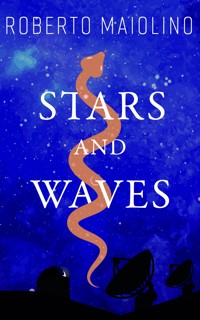
Erhalten Sie Zugang zu diesem und mehr als 300000 Büchern ab EUR 5,99 monatlich.
- Herausgeber: Clink Street Publishing
- Kategorie: Krimi
- Sprache: Englisch
Laura is a student in Astronomy at the University of Cambridge. Her work on exoplanets - planets orbiting other stars - is largely unnoticed by the scientific community. However, it attracts the interest of a secluded elderly Russian astronomer, Professor Kasparov, on the basis of his own research thirty years ago. He tries to contact Laura and her supervisor, Julia, but dies in mysterious circumstances. In the attempt to find out more about Kasparov's old data, Laura and Julia travel across the globe. During their journey, science becomes entangled with poetry, while astronomy gets embroiled with mystery. They face a dark pattern of strange accidents and deaths. Their quest for clues gradually becomes a frantic pursuit through some of the most fascinating and deadly environments. Will Laura and Julia uncover the truth? The whole truth? And… will they survive to tell the world?
Sie lesen das E-Book in den Legimi-Apps auf:
Seitenzahl: 379
Veröffentlichungsjahr: 2021
Das E-Book (TTS) können Sie hören im Abo „Legimi Premium” in Legimi-Apps auf:
Ähnliche



















Most of the astronomical observatories, institutes and organisations mentioned in the novel really exist, but this is a work of fiction and the characters involved are wholly imaginary. Any resemblance to actual people, living or dead, or actual events is purely coincidental.
To Cesare
Acknowledgments
Many people have been helpful during the writing of Stars and Waves on several fronts, from input on the technical and scientific aspects, to comments on the several human facets of the novel. I want to specially thank Asa Bluck, Steven Brereton, Giorgia Busso, Sara Cazzoli, Cathie Clarke, Romeo Ghiriti, Nadia Gorlova, Anais Gonneau, Valentin Ivanov, Nikku Madhusudhan, Manuela Magliocchetti, Filippo Mannucci, Alessandro Marconi, Annelies Mortier, Raffaella Schneider, and Alberto Sesana.
I owe special thanks to Philippa Donovan, whose tips helped raise the novel to a whole new level.
Finally, I am especially grateful to my family. Not only for their advice on the novel, but also for putting up with me being often absent-minded while thinking about the plot and, consequently, lagging behind in conversations. Sorry! Emilia has been the person who really provided the most extensive feedback and comments, improving the novel a lot. Clara has been a fantastic aide, not only in improving the style of the novel but by also providing excellent ideas. Her rubber stamp was the key step in finalising each chapter. I’m also extremely grateful to Gemma, not only for her suggestions, but also for the many ‘Well done!’ and smiley faces on her annotated copy, which were truly encouraging :)
CHAPTER 1
Stars dancing around each other, born in cosmic cradles, dying in apocalyptic blasts. Vast, greedy black holes devouring matter. Beautiful swirls of glowing gas and powerful jets approaching the speed of light. Matter and energy in continuous transformation…
His contemplation of the night vault was interrupted by the squeaking of the enormous dome behind him, as it adjusted its position to follow the movement of the telescope inside. It was tracking Messier 13, a star cluster in the constellation of Hercules, now high in the sky.
While waiting for the data acquisition to be completed he was lying on the lawn in front of the observatory, hands clasped behind his head, admiring the wonders of the revolving heavens.
Since he was a child, his musings on the starred sky had gone well beyond simple delight, beyond the glittering appearance that most people seemed to enjoy.
He would still be a shepherd in that secluded village in Siberia if it was not for her. “You are gifted,” his teacher used to say, beaming, “there’s a bright scientist inside you. We just have to nourish him.” She fed his unquenchable thirst for knowledge with books that his companions would not even glance at. Despite all the difficulties associated with his humble origins, he managed to persevere in his studies, excelling at university, thriving and becoming an internationally recognised scientist.
Yes, thriving.
But humiliation can change a man.
Many would have overcome it, but for him, that single event had become a permanent stain.
He squeezed his eyes shut. Wipe it away, erase it! No – it had sunk too deep. Opening his eyes again, as the night sky glowed above him, he sought comfort from his old shimmering friends.
Looking at the myriad of stars was like going back in time. Stars and galaxies appear to us as they were thousands, millions or even billions of years ago. No matter how fast light can travel, it still takes timespans, inconceivable to the human mind, to reach us from any part of the universe.
Going back in time.
Thirty years would have been enough. He would behave differently. He would not make the same mistake.
The dome squeaked again, like a child whining for attention. It was probably right, the scientific camera’s exposure should be nearly finished by now, he should start heading back to the telescope and its control room.
Grunting, he got up, joints clicking, and started walking towards the control room located next to the 54-metre-high dome. The large slit of the dome was wide open in front of him, revealing the majestic BTA-6 telescope of the Russian Special Astrophysical Observatory. From his position, he could see the telescope’s huge monolithic concave mirror, whose six-metre diameter had made it the largest telescope in the world until 1990. Since then it had been superseded by many other telescopes worldwide, yet he still looked at it with glinting eyes.
He entered the control room, stuffed with screens and electronic panels. The telescope operator was dozing on his reclined chair, feet on the main console, with its four large monitors and three keyboards. He was a graduate student, making some money by working as a telescope operator a few nights per month. Trainers, loose clothing, and black dishevelled hair poking out of the hood into which he had sunk.
“Nikolai, be careful, please! One day you’re going to accidentally hit some key while sleeping with your feet on the console.”
Nikolai awakened, and jumped out of his chair. “I’m sorry, Professor Kasparov.”
“No, you must excuse me,” Vladimir Kasparov said, shaking his head. “The fact is… you know how much I care about this telescope.”
“I know, Professor. It won’t happen again,” responded Nikolai, straightening up in his chair and placing his hands on the keyboard in front of him, without actually typing anything.
“That’s fine,” said the Professor. He grabbed his logbook and said, “It’s now time to move to the next target, the stellar globular cluster Messier 12, and start another exposure.”
Kasparov bent awkwardly over his desk, too tall and skinny to reach it properly. He was part of the telescope staff and also an extensive user of the telescope, mostly for research into stellar globular clusters – large and dense agglomerates of hundreds of thousands of stars, which look like sparkling puffs in the sky. In front of him was the latest issue of the Monthly Notices of the Royal Astronomical Society. Although Kasparov had relegated himself to the outskirts of scientific research, he kept up to date with the most recent publications.
He ran his hands through his white hair and started reading from where he had stopped just before leaving the control room – an article entitled ‘Monitoring of a sample of 30 nearby stars: detection of seven new exoplanets’ by Laura Bellini and Julia Russell, from the University of Cambridge. Kasparov quickly skimmed through the article. Exoplanets, aka planets orbiting other stars. Hundreds of new exoplanets were discovered every year.
He was about to move to the next article when a page caught his attention. The page reported a table listing the stars that had been observed, along with the main results for each of them. The name of one of them took his breath away.
70 Ophiuchi
A star in the constellation of Ophiuchus, the ‘serpent bearer’ in Greek mythology. Coincidentally, his next target, Messier 12, where the BTA-6 telescope was now pointed to, was also in this constellation.
He kept staring at the table. Still. Heart pounding fast.
Then, with a gleam in his eyes, he pulled the keyboard towards him. He copied the email addresses of both the authors of the article and started typing a message.
He had just hit ‘send’, when Nikolai tried to catch his attention. “Professor Kasparov, we seem to have a problem.”
Kasparov was motionless, staring at the screen of his computer. ‘Message sent’. His finger was trembling on the mouse.
“Professor?” insisted Nikolai.
Kasparov slowly moved his gaze towards him.
“The first images of the new target are completely blank,” explained Nikolai.
Kasparov raised an eyebrow. He stood up and went to take a look at the screen displaying the images delivered by the scientific camera – totally black.
“Must be the shutter of the camera, stuck again, or a loose wire,” he said. “Although…” he paused a few seconds, his forehead furrowed. “I’ll go and take a look. I can probably fix it quickly.”
“But Professor,” complained Nikolai, “you know the safety regul–”
“Oh please!” interrupted Kasparov. “No need to remind me about the regulations, those are for inexperienced people. I’ve done this many times. Don’t worry.”
“Ye— Yes, I know that you are very familiar with this telescope… probably more than anyone else…”
“And you also know that asking for assistance would mean waiting hours for the technicians to come. We would hardly get any observations for the rest of the night.” Kasparov’s face flushed. “Observing time on these large telescopes is precious. I don’t really want to waste half a night, especially such a clear one!”
Nikolai pursed his lips.
“Please park the telescope in the horizontal position,” requested Kasparov.
“Fine, I will override the automatic control system,” replied Nikolai.
Kasparov grimaced, as he did every time he was reminded of the new telescope control system. The BTA-6 telescope’s Technical Committee had recently approved an upgrade to the telescope software control system, prompted by an apparently ‘very convenient’ offer by an American company. Kasparov thought this had been a waste of money. He deemed the previous system just fine. Funding for science was under strain everywhere across the globe and Russia was no exception. As if that was not enough, in recent years the Russian government had diverted most astronomy resources to the space sector, claiming that the future of astronomical exploration was through telescopes in orbit. This had resulted in further draining of funds from ground-based telescopes, such as the BTA-6. In such a grim climate it was really inappropriate to spend money on fancy but unnecessary control systems. Kasparov made no secret of his reservations.
He left the control room, closing the door behind him, passed through a few narrow corridors and entered the huge expanse inside the dome. The interior of the vast dome always gave him the impression of entering a cathedral. A cathedral erected to serve science and human knowledge.
The telescope, dimly lit only by the glow of the Milky Way’s billions of stars filtered through the dome’s slit, was in a nearly vertical position. It was still pointing to Messier 12, now close to the zenith, the highest point in the sky.
The huge, concave mirror of the telescope was facing up. Fanning out from its perimeter, eight massive steel tubes supported a large metal ring 26 metres above the mirror. Inside this ring, four smaller tubes held the large scientific camera at its centre. The camera collected the light focused by the large mirror and sent the resulting images to the computer in the control room. Externally the camera looked like a black cylinder, more than two metres long, with a large lens on the side facing the mirror, and electrical wires sprouting out of its sides.
The whole telescope structure was moving rigidly while slowly tracking the movement of Messier 12 in the sky. The low humming of the gears and motors was echoing inside the dome.
The telescope stopped its movement and remained still for a few seconds. Nikolai had finally halted the tracking and given the command, Kasparov thought.
The telescope started to lean, faster and faster. The sounds of the gears and the accelerating motors became louder and high-pitched. The telescope kept tilting until it reached a nearly horizontal position, as if observing something on the nearby mountains.
Everything was now still and silent.
Kasparov scanned the whole telescope, back and forth. It was rare to see it lying down. Although more than 40 years old, it was still a stunning piece of technology. In this position, the large, curved mirror was nearly vertical. The long tubes attached to its edges were nearly horizontal and were holding the camera at a height of about ten metres above Kasparov’s head.
He approached the tall mobile scaffolding, parked on one side, which was used for maintaining the telescope and its instrumentation. He moved the scaffolding towards the telescope until its top reached the camera. He then blocked the scaffolding wheels, put on the safety harness and started climbing to the top. When he was at the height of the camera he hooked his harness to the scaffolding frame, leaned onto the camera and started checking the various wires and connectors. Everything appeared in order.
Placing one foot on one of the tubes holding the camera, he started to inspect its front side.
He froze – hearing the telescope’s motors engaging.
The telescope started to rotate horizontally. Kasparov grasped the camera to avoid the ten-metre fall. The telescope kept moving fast and hit the scaffolding. While still clinging to the camera, which was swiftly moving together with the whole telescope, he watched with horror as the scaffolding gradually leaned over, pushed by the telescope’s frame. It kept leaning… it toppled. But its fall was halted by Kasparov’s harness, still firmly hooked to it. The weight of the scaffolding was pulling Kasparov down. He would not survive the fall if his grip slipped.
“Nikolai!” he yelled.
The telescope wouldn’t stop spinning and the scaffolding, dragged by Kasparov’s harness, was clattering, rattling and hitting all kind of hardware on its way. While still gripping the camera with his left hand, he managed to free his right hand to reach a Swiss knife inside his pocket. He unfolded the blade with his teeth and swiftly cut the harness. The scaffolding crashed loudly onto the ground.
Suddenly the telescope stopped.
Nikolai, that clumsy student, must have finally realised the mess he had caused, Kasparov thought. He panted with relief. Still clinging onto the camera, he looked down at the pieces of scaffolding scattered over the ground, ten metres beneath him.
“Nikolai! You could have killed me! Come here immediately and help me!” yelled Kasparov.
The control room, as well as most of the offices in the building, were insulated very well to cope with the chilly winter nights, which also resulted in perfect soundproofing. To enable communications, the inside of the dome had an intercom that was continuously connected with the control room. So, surely, Nikolai must have heard the loud noise, the clattering of the scaffolding being dragged and its crashing onto the ground, as well as Kasparov’s cry for help.
Silence. Absolute silence.
No reply from Nikolai through the intercom.
Kasparov twisted his head in an effort to look at the dome’s entrance door, expecting Nikolai to appear at any moment now.
The door remained firmly shut.
He began to sweat.
The telescope started moving again, this time higher, towards the zenith. Was Nikolai trying to kill him?
As the telescope continued towards its vertical position, Kasparov’s grip slipped. He desperately tried to find other parts of either the camera or the telescope to grab, but any new grasp would quickly become ineffective as the telescope’s frame kept tilting, moving him higher, higher and higher. It was like riding a giant wild beast.
As the telescope reached its final, vertical position he lost his grip. He fell… but managed to grab two wires that were hanging out of the camera.
He looked down. He was now 25 metres above the telescope’s large mirror. He could see the reflected image of the starry sky, and himself, dangling high in the air.
The telescope was now still.
No sound of steps approaching. No hint of a human presence beside him.
Kasparov looked at the wires that he was grasping. They were thin but apparently strong enough to hold his weight.
His hand felt a vibration coming from the point where the wires were attached to the camera. The connectors were giving away. One broke, leaving the wire limp in his now dangling hand. Kasparov quickly grasped the only available wire with both hands.
The connector attached to the remaining wire started cracking under the strain of his weight. He looked around frantically. There was no other point within reach that he could grab.
The second connector came off.
He hurtled into the mirror of his beloved telescope.
The fall only lasted a few seconds. He saw his image, reflected by the huge mirror, getting larger and larger, with the starred vault petrified behind him.
Strangely the impact was not painful. Just sudden blackness.
Lying on the mirror, and the glittering night sky reflected in it, it was as if Kasparov was floating in space, among his adored stars. His head was next to the silvery Milky Way, now crossed by a scarlet stream.
CHAPTER 2
Her head hit the window hard.
It was not the pain, but the loud sound that woke her up.
She was so tired after her recent observation period at the telescope, that she had fallen asleep in her seat, only to be abruptly awoken by her head bumping against the window as the aeroplane touched the runaway.
Laura struggled to lift her backpack from the luggage belt and put it on her shoulders. She glanced at the tourists around her who were comfortably pulling their wheeled suitcases. Her envious glare soon turned into a smug grin. All these people were visiting Florence as tourists, rushing about, seeing nothing. She had been lucky to live in this gorgeous city for four years when she was an undergraduate student and was able to savour its atmosphere and hidden beauties. The intimate glimpses of the cathedral from secluded alleys. The concealed gardens adorned by elegant statues and flooded by the scent of roses. The tiny ice cream shop that she found when she got lost… Their pistachio gelato was sublime.
“Laura!” called a young woman, beaming at her while jumping up and down and waving with both arms from behind the barriers in the Arrivals Hall.
“Sofia!” Laura screamed back while speeding up her pace.
They hugged each other, lingering for a moment.
“I’m so happy you could pass through Florence before going back to Cambridge,” said Sofia.
“I’m glad too,” responded Laura. “Thank you for offering me somewhere to stay for a few days”
“Of course! I miss the time when we were roommates so much.”
Sofia grunted as she helped Laura lift her backpack and squeezed it into the small boot of her car. “You must have been at the telescope for a long period,” she commented, pushing hard onto the boot’s door as it would not close
Laura nodded, “Yes, long… far too long.”
Sofia was now speeding up on the road connecting the airport to the city. “So, where have you been for your scientific research this time?” she asked.
“The TNG telescope,” replied Laura.
Sofia looked at her cluelessly.
“It’s on the top of La Palma, one of the Canary Islands,” explained Laura.
“I must confess I’m a little bit jealous. I know that astronomical observations are complex and demanding, but they take you to such remote places, surrounded by breathtaking landscapes, far away from any human settlement,” said Sofia with a dreamy expression.
Laura smiled. She closed her eyes and visualised the immense, deep, revolving fresco visible from those sites, the night sky exploding with the most vibrant contrasts and gleaming with the softest shades. The vastness of the heavens above her was what made her blissful when visiting astronomical observatories. But her smile disappeared as she remembered the difficulties of the last observations at the telescope. “I couldn’t really enjoy it this time.”
“Why not?”
“It was an odd observing run,” responded Laura with a grimace
“Odd? In what sense?”
“For the first few nights, the telescope didn’t respond to the commands of the operator. It behaved like a defiant child.” Laura narrowed her eyes. “The telescope would simply refuse to point at the selected stars, it just moved to apparently random positions. Initially I couldn’t get any data.” She shook her head. “I was exasperated. And I was not the only one. The telescope operator and the engineering team had no idea what was going on.” She paused and sighed. “On the third night, they decided to completely shut down the computerised control system of the telescope. This meant that the telescope had to be guided manually from inside the dome, making the observations much more difficult and challenging… but at least I could get enough data for my PhD project.”
“You do look exhausted.”
“Yes, I must admit that I am very tired,” said Laura, closing her eyes and letting her head fall back on her seat. She opened her eyes slightly and frowned, “Tired and confused.”
“Confused?”
“Yes… well… the rebel telescope has not been the only oddity this week.” Her lips twitched. “I received a strange message a few days ago.”
Sofia raised an eyebrow.
After a few moments of hesitation, Laura pulled out her smartphone and started browsing through her mail.
“Here it is:
Dear Dr Bellini and Dr Russell,”
She paused, “The person who wrote this message didn’t bother checking that I’m still a student and that Julia is a professor, or maybe he simply wrote the message in a rush.” Laura shrugged her shoulders. Then she started again.
“Dear Dr Bellini and Dr Russell,
I read your recent article on the detection of seven
new exoplanets with great interest. I found it
extremely exciting!
I would like to share with you some data that I obtained
30 years ago, which I’m sure you’ll find intriguing.
I could call you or we could even meet in person.
Please let me know your availability as soon as possible.
Best regards,
Prof. Vladimir Kasparov
Resident Scientist at the Special
Astrophysical Observatory, Russia”
“I cannot really see anything ‘strange’ about that message,” commented Sofia, “I’m not a scientist, but to me, it actually sounds quite encouraging.”
Laura shook her head. “Technologies and instrumentation evolve very fast in our field. I can hardly believe that such old data, taken 30 years ago, can be of any interest for my project. I was not even born 30 years ago,” said Laura with a laugh, “and exoplanets had not been discovered yet. I initially thought it was a scam or a prank. But I’ve checked online: Kasparov really is a professor at the Special Astrophysical Observatory in Russia. So he is a scientist, but… I’ve looked at his publications – he has never worked on exoplanets. There isn’t a single article published by him on the topic. He has always worked on stellar atmospheres and stellar evolution. I cannot understand what the connection might be.”
Sofia shrugged, “Shouldn’t you take a look at his data before judging?”
“I did try. But here’s another strange thing about the story: Julia and I replied to Kasparov’s email, expressing our interest and availability to talk, and we gave him our contact details, but guess what? He never called. I sent another couple of messages asking him to share some information – he didn’t reply.” She turned to face Sofia. “Isn’t it puzzling? I mean, this Russian professor first contacts us with great enthusiasm, to the point of even offering to meet with us in person… and then he completely ignores us.”
“Well, perhaps he is just a peculiar person,” Sofia suggested. “On the other hand, I must say that, since I met you and your friends, I have learnt that scientists can be a little bit… how shall I put it… bizarre?” she said laughing.
Laura had heard this joke from Sofia several times, but this time, absorbed by her thoughts, she did not laugh with her. “If I have to be completely honest,” she said, “the weirdest thing is neither the story of his old data nor his lack of response.”
“No? Then what?” asked Sofia.
They had just entered the city centre, but Laura wasn’t looking around her. She was staring at a spot on the windshield and tapping her fingers on her lap.
“What is so weird?” insisted Sofia.
Laura sighed, “I have hardly ever found anyone even marginally interested in my results. My work is not in the mainstream, I think my colleagues barely glance at my articles, I’m sure nearly no one really reads them,” she paused, “so… the sudden enthusiasm of this stranger… there must be something wrong.”
“I’m sure that’s not true. Lots of colleagues must appreciate your work,” said Sofia with a comforting tone.
Laura looked down and shook her head. “I’m at the end of the second year of my PhD and I haven’t achieved much. I simply have to face it, I don’t really have the skills for scientific research.”
“Laura! You’re too harsh on yourself! You are just too tired. I’m sure you only need a good night’s rest.”
But Laura did not respond.
They were now crossing the Arno River in the late afternoon. Laura looked at Florence’s jagged skyline, with its mixture of medieval and renaissance buildings. She looked at the unique Ponte Vecchio, the old bridge, crowded with small ancient shops. Her green eyes reflected back at her in the window. Her bob looked more like a mane, but she was far too tired to care about her looks.
They entered San Frediano, one of Florence’s medieval quarters, where Sofia found a parking spot.
“We have to leave the car here. I recently moved into a flat in the pedestrian area, just a few blocks from here,” said Sofia, while helping Laura with her backpack.
Their footsteps on the worn stones echoed within the narrow streets. The late sunbeams hit the top of the ancient buildings, casting dense amber hues throughout the alley.
Laura stopped to watch the flight of swallows swiftly swooping across each other above their heads, their chirps high-pitched. She smiled.
“What?” asked Sofia, looking first at Laura and then up, trying to spot the point Laura was staring at.
Laura closed her eyes, “I had nearly forgotten this melody. It sounds like a warm welcome home.”
Sofia beamed. “I’m glad Florence feels like a second home for you. Even though you come back so rarely from Cambridge… By the way, what is the conference here that you mentioned?”
Laura’s smile faded away and her stomach turned. “Yes, there’s a conference on exoplanets here in Florence. It already started a few days ago. Tomorrow I will only attend the last day. My supervisor, Julia, suggested not going straight back to Cambridge after La Palma, but that I should attend this conference and present some of my results.”
“It does sound like a good opportunity for you,” commented Sofia.
Laura nibbled her lower lip. Taking a deep breath, she said, “Yes, but you know how it is for me. Giving presentations at conferences, in front of a large audience, is something I’m not really comfortable with.”
“Still? I thought by now you had overcome that problem,” remarked Sofia.
“Yes – no, not really,” Laura squeezed her eyes shut, “the mere thought of talking in front of one hundred astronomers makes my stomach churn.”
Sofia opened her mouth slightly, looking at Laura, but her lips just trembled in hesitation and no words came out.
They approached a small green, wooden door. “Here we are!” Sofia exclaimed while pulling a keyring out of her purse. They walked up a flight of narrow, stone stairs.
“It’s small,” apologised Sofia while opening the door of her flat, “but it’s comfortable.”
The colourful, multi-ethnic furniture and decorations contrasted with the uneven white walls, the dark wooden beams on the ceiling and some weathered stones protruding from the old, medieval structure of the building.
“I see that now that you have your own flat you have given free rein to the architect inside you,” said Laura with a grin.
“Maybe”, responded Sofia, feigning an uninterested tone. Then she opened a door. “Although small…” she said, letting Laura in, “I also have a room for guests.”
As Laura entered, her gaze focused on one single thing: a bed.
Sofia swung the window fully open, letting the refreshing air of the summer evening flood the room. It was facing a small busy square, full of restaurants and wine bars.
Laura pushed her bag into the room and collapsed on the bed.
“Take some rest,” said Sofia, “I’ll call you in about one hour. I want to take you to a very nice and tasty trattoria nearby for dinner.” Then she left the room, closing the door behind her.
Laura remained in bed, staring at the ceiling. Her thoughts were brought to the message from the Russian professor. She had to admit that, although weird, it had triggered her curiosity and created expectations. His lack of response had been frustrating. She was tempted to check if, in the meantime, he had replied, but she was too tired.
Her eyelids drooped.
Her phone rang. The sound floated in the air and mixed with the indistinct chattering of people dining at outdoor tables wafting in from outside. The phone rang two more times – but Morpheus had already embraced her.
CHAPTER 3
The zodiacal light plume emerged from the ocean like a giant brush that had just painted the firmament. Most people had never had the chance to see the beauty of the zodiacal light. This glowing strip in the sky, produced by microscopic sand particles on the plane of the solar system which reflect the light of the sun. Visible only rarely, in clear skies, far from cities and far from any light pollution.
He was sitting on the rim of the Caldera de Taburiente, an immense crater – 8 km across – formed out of a collapsed volcano millions of years ago, on the island of La Palma. It was now filled with low clouds, some of which were swirling out, pushed by the light breeze of the night. It looked like a gigantic cauldron in which some magic elixir was simmering.
Pedro was part of the TNG telescope staff. He was responsible for archiving all datasets obtained with the telescope and also for delivering the data to the visiting astronomers after their observing run.
Despite the spectacle around him, he was looking down at the clouds inside the Caldera.
He picked up a small porous stone next to him and examined it in his palm for a moment. Narrowing his eyes, he clenched the stone in his fist and then threw it in front of him. The stone hovered over the Caldera for a few seconds, seemingly lifted by the breeze, then it plummeted and vanished in the clouds beneath him.
He stared at the point where the stone had disappeared, as if somehow expecting it to return at any time… as if wishing that events could be reversed.
He was jolted from his thoughts by the sound of steps on the volcanic gravel approaching from behind.
Thomas, the TNG telescope operator, sat down next to him.
A stronger gust of wind moved the clouds and unveiled the wide, deep interior of the crater. It was crossed by water streams and waterfalls. Diverse species of plants and animals had developed in the unique microclimate inside it.
“Isn’t it fascinating?” said Thomas.
“What?” asked Pedro.
“That such an apocalyptic, prehistoric event has eventually turned into this paradise.”
Pedro nodded.
“I mean,” Thomas continued, “when I look at this immense crater… I always find it amazing that nature could generate such an infernal catastrophe and then the same, identical laws of physics could transform it into this heavenly sanctuary of life.”
Pedro hinted a smile. “Yes, it’s really amazing.”
He lifted his gaze to scan the horizon. From their high position, he could see the ocean surrounding the island in all directions. Some feeble hint of twilight was still visible, enough to illuminate the domes of the observatory scattered on the outer, more gently sloping surface of the extinguished volcano. All of them with their slits wide open and their telescopes already busy exploring the night sky. Among them the TNG telescope. Pedro felt his stomach twist.
Thomas stretched his back by pulling his arms above his head. “It has been a long week. I’m glad that my shift is over,” he said. “Gosh, it’s never happened before, the telescope behaved so weirdly, like a bucking animal!” exclaimed Thomas, shaking his head. “It wouldn’t respond to any of our commands. It affected the entire programme of that poor student from Cambridge, Laura Bellini. At the end of the observations, she looked quite frustrated.”
He glanced at the TNG dome, now glowing with red hues from the rising moon, which had just peered out of the ocean.
“Operating the telescope manually from inside the dome was exhausting and inefficient. I hope she got enough data for her thesis,” added Thomas.
Pedro said nothing. Motionless.
“Pedro? What’s going on with you? I’ve just told you that I’ve gone through a hell of a week… I would expect a little bit of sympathy from a colleague!”
Pedro covered his face with his hands and sighed, “The fact is that I’m not sure we’re going to be colleagues for much longer,” he said.
“Wh– What? Are you leaving?” stuttered Thomas, pushing his feet deeper into the gravel.
“I may lose my job,” said Pedro sharply. His lower lip was trembling.
“But wh– why?”
“Laura’s data.” Pedro sighed. “There’s no trace of it in the archive. I checked it today. Vanished.”
“What? But your archival software has always worked perfectly, like a Swiss clock.”
“Yes, always, until today. I don’t understand how it could have happened.”
“But… so… all datasets obtained by Laura last night are lost?”
“Not only last night’s data. All datasets that she has taken during the past week and also during her previous visits in the past six months… all wiped from the archive.”
“But… how… how is that possible? Anyway, there’s a backup copy in the headquarters’ central archive in Rome, isn’t there?”
“I’ve checked. Disappeared from the central archive too.”
Thomas gawped.
Pedro wrapped his arms around his knees and hid his head between them.
“I don’t understand,” he said, “it’s a mystery. It’s not a global fault of the archival system. All the other observing programs are unaffected. Only Laura’s program has been hit.”
He lifted his head, frowning. “I cannot think of any bug in the archival software that would specifically target Laura’s project. And why should any bug affect data only now? There has been no upgrade of the software since last year.”
“Are you sure that the system hasn’t been hacked?”
“You know it’s impossible for any hacker to enter the system!” responded Pedro with a scolding glare, “And anyhow, a hacker would have wiped the entire archive, why would anyone surgically erase only one specific program? Competing scientific interest?” he questioned with a sarcastic tone.
Thomas raised an eyebrow.
Pedro shook his head and sighed. “The director will hold me accountable for this… I am accountable for this mess.”
“But what could have you done to prevent it?” Thomas tried to comfort him. “This story is so absurd… the whole week has been absurd!”
Pedro turned to face Thomas for the first time since he had arrived. “How much is a night at the TNG telescope worth?” asked Pedro.
“I’m not sure…” Thomas hesitated, “the cost of a single night at modern, large telescopes is in the range of $40,000 to $60,000… I’m not sure specifically for the TNG telescope…”
“Higher than my monthly salary. I would gladly give several months of my salary if this could compensate.”
“Does Laura know?”
“Not yet. This morning, soon after the end of her observations, she left in a rush for the airport. She mentioned something about having to go to Florence to attend a conference… hectic life these students. I hadn’t discovered the issue yet at that time.” Pedro closed his eyes. “I’ll have to inform her soon, before she discovers it herself when she tries to download her data from the archive.”
Thomas’ forehead furrowed. “First the wild telescope, then the vanishing data… if I wasn’t a scientist I would say that Laura’s project is cursed.”
They both remained silent for a while.
Pedro’s thoughts were interrupted by the flash of a powerful laser, shot by one of the telescopes. Hitting the upper layers of the atmosphere, the laser had created an artificial star that could be used to correct the effects of atmospheric turbulence, which would otherwise blur astronomical images.
They both looked up at the far end of the beam.
“I always try to see the artificial star at the end of the beam. I know it’s too far high to be seen by the naked eye, yet I always try,” Thomas said.
The corners of Pedro’s mouth curved up. “So do I.” Then he added, “Staring as the laser beam fades into eternal distance feels hypnotic and soothing, doesn’t it?”
“It does… it does.”
Pedro kept staring at the beam for a while.
The laser went off, breaking the spell. A few seconds later the laser was shot again, but now aiming at the centre of the Milky Way.
“They must be observing the supermassive black hole at the core of our galaxy”, Pedro said.
He let his gaze drift down along the Milky Way’s silvery strip until it reached the dark rim of the crater. The evening breeze had now ceased and the low clouds inside the Caldera were a soft, steadily glowing layer under the shine of the night vault.
Everything was still. Peaceful.
But tonight none of this was of any comfort to him. He stood up and took a deep breath. “Time to share the bad news,” he said, “I will start with Laura.”
Thomas nodded, “I think the boss can wait a little longer, he’s already had enough troubles to deal with this week.”
CHAPTER 4
It was a clear, fresh morning. The night had wiped away the mugginess in the city from the previous day. The taxi passed the medieval city walls through Florence’s southern majestic gate. Then uphill along a boulevard flanked by high cypress trees and gorgeous villas of different styles, built over the last few centuries.
The beauty and calm of the surroundings was in striking contrast with her physical turmoil and the feeling of her shrunken and churning stomach. The tiredness after the lengthy period of observations at the TNG telescope, together with the tension for her forthcoming presentation at the conference, were a toxic blend. Nausea. She had not had any breakfast, making her even weaker.
The taxi ran past the university’s department of physics, home of so many fond memories of when she was an undergraduate student there. She recalled when she was first taught about the wonders of physics. She loved physics. The fact that everything can be explained in terms of a few fundamental laws. Finding out about the discoveries that became part of the history of physics, often gave her goosebumps. Among these, the detection of gravitational waves, which had left her sleepless the night it was announced in a press conference broadcast around the world. Just a graph: two oscillating curves tracing the gravitational waves resulting from the merging of two massive black holes. Laura regarded that simple graph as the Sistine Chapel of physics. Gravitational waves, ripples in space and time produced by any accelerated body. Propagating everywhere and through everything. Making every single particle, every single atom, resonate and vibrate in harmony. The discovery had added a new dimension to the human perception of the universe, offering a radically new way to explore the cosmos.
Her dream would have been to dedicate her graduate studies to gravitational waves, but events brought her to different shores. She was offered a PhD project on exoplanets at the University of Cambridge. Laura wasn’t totally convinced by the topic. Although fascinating, there were already several large research groups who had discovered thousands of exoplanets, and she was not sure how she would fit in such a competitive area. After two years of her PhD, doubts still lurked inside her.
She was jolted from her memories by the gleam of the small white domes against the clear blue sky of the early morning. The taxi was passing by the astrophysical observatory on the top of a hill overlooking Florence. The small telescopes inside those domes were now only used for educational activities and public outreach. Inside the offices of the observatory, Laura pictured dozens of astronomers in front of their screens, busy uncovering the mysteries of the cosmos by deciphering data coming from several large telescopes scattered around the globe or floating in space.
As soon as the taxi reached the top of the hill, the view opened out over the gorgeous Tuscan countryside, the multicoloured slopes surrounding Florence. On the ridge of the first hill, in front of the astrophysical observatory, lay a tiny village, which seemed painted on the landscape of vineyards, olive trees and cypresses. It was a cluster of ancient villas and rural houses, in pastel shades, that had preserved their original beauty across the centuries. Among them, in the distance, Laura promptly spotted the outline of one specific villa, their destination, Il Gioello, ‘The Jewel’. This was where Galileo Galilei spent the last ten years of his life, after the Roman Catholic Inquisition had tried him for his theories that placed the sun at the centre of our planetary system, and sentenced him to lifelong house arrest. The villa had been recently converted into a centre for conferences in physics and astronomy.
The cab stopped in front of the main entrance gate, a large wooden door, now partly open to let in the last few participants of the conference. Laura entered, slowly, as if entering a private house, as if Galileo was still living there. The entrance led directly into a large garden courtyard. Three sides of the court were surrounded by a colonnade. The side opposite to Laura had a low parapet and opened onto the countryside. Galileo had walked in this courtyard in his last days, nearly blind, pondering over the fantastic implications of the ‘new sciences’, as he secretly continued his experiments and astronomical observations, despite being forbidden by the Church to pursue any of his studies.
“Good morning. I would like to collect my badge,” Laura said, as she approached the registration desk.
“Good morning. Name?” asked the young man behind the table, while pulling a box towards himself.
“Bellini, Laura Bellini.”
“Oh, yes, finally! We were getting worried. You are the second speaker on the programme this morning and we haven’t seen you the whole week,” said the man with a hint of rebuke in his voice. “The session is about to start. Here’s your badge and this is the programme.”
Laura looked at the programme. The opening talk of the morning was scheduled to be a review presentation by the famous Professor Arthur Cecil-Hood, an authority in the field of exoplanets. Her skin crawled as she saw that she was scheduled to give her short presentation right after Cecil-Hood. The contrast would make her talk even more underwhelming, she thought.
She cautiously entered the main conference room. Most participants had already taken a seat. There were about one hundred of them. She sat in the back row. The first slide of Cecil-Hood’s presentation was already projected onto the large screen, with its title displayed in large capital letters: ‘A universe of new worlds: the discovery of hundreds of new exoplanets, from exo-Jupiters to exo-Earths’.
“Good morning everyone and welcome to the last day of this exciting conference,” the chairman of the session announced loudly, to quieten the hubbub from people still settling. “We start this morning session with a review by Professor Arthur Cecil-Hood.”
A man in his early 60s walked onto the stage. Suit and tie, greying hair, moustache and goatee. With a clear, loud and deep voice, he confidently went through the slides of his presentation. It wasn’t really a review of the field, he mainly presented the results from his own team. But it was an engaging and exciting presentation, with several fantastic new datasets from some of the best observatories. He and his team had really discovered hundreds of new planets orbiting other stars, with masses and sizes spanning from Jupiter-like to Earth-like. The presentation was followed by prolonged loud applause.
The chairman of the session stood up. “Thank you, Arthur, for such an exciting presentation. I’m sure there are many questions.”
Sure enough, many in the audience had their hands up, but rather than asking questions, most of the delegates praised Cecil-Hood’s results and his achievements.
Ten minutes later there were still many hands up. “I’m afraid that we cannot take any more questions, as we need to move on with the programme. You will have the chance to ask Arthur further questions during the coffee break. We shall now move on to the next presentation, by…” he looked at the programme, squinting his eyes and adjusting his spectacles “by Ballimi… er, Ballini, Laura Bellini.”
While walking towards the stage she looked at the first slide of her presentation, which was now projected onto the large screen, with the title: ‘An algorithm to detect candidate exoplanets from noisy data’.
“Wow, that’s an exciting title,” whispered someone in the audience, followed by some chuckling.
Her legs were trembling. She tripped on the steps of the stage. The laser pointer slipped from her hands twice. Then she tried to start, avoiding eye contact with the audience.




