


0,49 €
Niedrigster Preis in 30 Tagen: 1,99 €
Niedrigster Preis in 30 Tagen: 1,99 €
Mehr erfahren.
- Herausgeber: DigiCat
- Kategorie: Geisteswissenschaft
- Sprache: Englisch
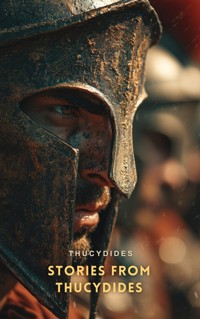
Thucydides' "Stories from Thucydides" presents a compelling narrative interwoven with political philosophy and historical analysis, focusing on the Peloponnesian War. Thucydides adopts a rigorous, analytical style that shuns mythological embellishments, aiming instead for an empirical account rooted in facts and eyewitness testimonies. The work stands as a cornerstone of historical writing, emphasizing the complexities of human nature, the causes of conflict, and the precarious balance of power. Through the lens of the war between Athens and Sparta, Thucydides explores themes such as ambition, morality, and the brutal realities of military engagement, offering a profound commentary on the cyclical nature of history and human folly. Thucydides, an Athenian historian and general, is often hailed as the father of scientific history for his critical approach to the past. His firsthand experiences in the war instilled in him a unique perspective that motivated him to document its events with unprecedented accuracy and depth. Living through a transformative era steeped in political turmoil and philosophical inquiry, Thucydides' grounding in the classical Greek tradition informs his focus on rational thought and ethics amidst chaos. This book is a must-read for historians, political scientists, and anyone intrigued by the intricate dynamics of power and conflict. "Stories from Thucydides" not only enriches our understanding of ancient Greece but also offers timeless insights into the nature of human behavior and the perpetual struggle for dominance in international relations, making it a relevant read for contemporary audiences. In this enriched edition, we have carefully created added value for your reading experience: - A comprehensive Introduction outlines these selected works' unifying features, themes, or stylistic evolutions. - The Author Biography highlights personal milestones and literary influences that shape the entire body of writing. - A Historical Context section situates the works in their broader era—social currents, cultural trends, and key events that underpin their creation. - A concise Synopsis (Selection) offers an accessible overview of the included texts, helping readers navigate plotlines and main ideas without revealing critical twists. - A unified Analysis examines recurring motifs and stylistic hallmarks across the collection, tying the stories together while spotlighting the different work's strengths. - Reflection questions inspire deeper contemplation of the author's overarching message, inviting readers to draw connections among different texts and relate them to modern contexts. - Lastly, our hand‐picked Memorable Quotes distill pivotal lines and turning points, serving as touchstones for the collection's central themes.
Das E-Book können Sie in Legimi-Apps oder einer beliebigen App lesen, die das folgende Format unterstützen:
Veröffentlichungsjahr: 2022
Ähnliche




Stories from Thucydides
Table of Contents
Introduction
This collection assembles, in a single-author sequence, a set of connected episodes from the History of the Peloponnesian War by the Athenian historian and general Thucydides. Its purpose is not to add to his text, but to present a coherent path through it for readers who wish to follow the war’s evolving logic from the first sparks to the great expeditions. Thucydides’ surviving oeuvre is a single, unfinished history; these stories are drawn from that work and arranged to emphasize its narrative rhythms and analytical turns. The aim is clarity of access, not abridgment of argument, and a renewed encounter with his rigorous way of seeing events.
The genres represented here are those of classical historiography: campaign narratives, diplomatic reports, and deliberative speeches. Thucydides writes neither fiction nor personal memoir; he offers inquiry founded on observation, testimony, and reasoned judgment. He states that speeches are reconstructed to express what was needed for each occasion, and he tracks events by campaigning seasons, summer and winter. Absent are letters, diaries, or lyrical interludes. Present instead are set pieces of analysis, precise topographical notes, and the steady progress of conflict recorded with an economy that resists ornament. The result is a concentrated literature of war, policy, and decision under pressure.
Gathering these episodes together serves two ends. First, it highlights the structural spine of the early and middle years of the Peloponnesian War, when causes, fears, and alliances hardened into open conflict. Second, it displays Thucydides’ habit of pairing action with reflection, showing how speeches, votes, and maneuvers interlock. The Prologue and Epilogue in this volume orient the reader to the fifth-century Greek world and to the unfinished character of the history. Between them, the selected stories trace the movement from origins and first clashes to campaigns whose scale and ambition forced cities to reckon with the limits of power.
Several unifying themes run through the whole. Thucydides is concerned with causation, distinguishing immediate triggers from deeper motives. He probes how necessity, advantage, and honor contend in councils and on battlefields. He studies the strain of war on institutions and language, the shocks of chance and weather, and the consequences of leadership, both prudent and reckless. The style is austere and exacting: compact argument, close attention to geography and logistics, and a refusal to invoke myth as explanation. The abiding significance of the work lies in this fusion of narrative and analysis, which has shaped later thinking about politics, strategy, and human conduct.
From the outset, the sections on Corinth and Corcyra and the Surprise of Plataea frame the war’s first phase. The dispute between Corinth and its colony Corcyra spreads beyond a local quarrel, drawing in allies and forcing Athens to weigh risk against treaty obligations. At Plataea, a nocturnal incursion becomes a test of preparedness, alliances, and the tempo of escalation. Together these pieces establish a pattern that recurs throughout the history: limited aims that enlarge under pressure, and choices made in the shadow of uncertain information and public expectation.
The Plague at Athens and the Investment of Plataea show war’s pressure on city and countryside. In Athens, disease coincides with siege and crowding, confronting institutions with a crisis that magnifies fear and rumor. Thucydides’ clinical narrative is notable for its restraint and detail, focusing on symptoms, sequences, and effects on civic life. At Plataea, methodical operations of siegecraft demonstrate how time, engineering, and supply can be as decisive as shock in the field. These chapters, read together, reveal the historian’s range: from epidemiological observation to the mechanics of encirclement and endurance.
The Naval Victories of Phormio turn to the sea, where Athens seeks advantage through seamanship, training, and tactical nerve. Thucydides guides the reader through harbors, channels, and wind, treating environment as an actor in the drama. The narrative demonstrates how command decisions interact with skill at the oar and the morale of crews. Sea power here is not an abstraction but a lived practice measured in formations, signals, and timing. The episode also showcases the historian’s balanced design: a precise engagement report embedded within a larger strategic contest between a maritime and a land-centered coalition.
The Revolt of Lesbos presents a crisis of alliance within the Athenian sphere. Cities that had accepted a leadership arrangement test its terms under wartime strain, and the Athenian Assembly must decide how to respond. Thucydides places debate alongside mobilization, capturing the collision between legal argument, precedent, deterrence, and expediency. The speeches reveal not private feeling but public reasoning, the calculus by which an imperial democracy seeks to preserve its position without undermining the sources of its strength. The episode is exemplary of the work’s attention to deliberation: policy emerges from words that are immediately tied to ships, money, and men.
Escape of Two Hundred Plataeans and Fall of Plataea continue the long arc of the siege narrative. One part shows the ingenuity and courage required to break a ring of investment; the other follows the formal procedures and political tests that attend the fate of a captured city. Thucydides’ focus remains steady on planning, weather, timing, and the institutional settings in which captors and captured face one another. The paired stories contrast motion and stillness, sudden risk and slow adjudication. They also illustrate how, in this history, individual episodes illuminate the ethics of power without departing from a strictly factual mode.
Capture of a Hundred and Twenty Spartans at Sphacteria marks a startling turn on a small island off the Peloponnesian coast. A combination of blockade, fire, and maneuver brings an outcome that challenges expectations about Spartan endurance. Thucydides is careful with numbers, positions, and the sequence of command decisions, allowing readers to see how contingency and persistence can reshape a negotiation. The episode’s significance within the narrative is less triumph than recalibration: it alters leverage, compels reassessment in councils, and shows how reputations and realities diverge when circumstances change under the pressure of sustained war.
Campaigns of Brasidas in Thrace and The Hollow Peace follow the war’s shift to the north and the attempt to stabilize the center. Brasidas’ movements illustrate how initiative, rhetoric, and local alliances can upend strategic maps without enormous fleets or pitched battles. The so-called peace that follows a series of reversals is presented as an armistice dense with reservations, hostages, and unresolved grievances. Thucydides treats agreement as a temporary alignment of interests that must still be carried by administration and trust. The narrative maintains his even tone while tracing a fragile balance that is always subject to surprise.
The Athenians in Sicily opens the grandest expedition of the history, conceived in debate and launched with confidence and awe. Thucydides lays out scale, logistics, and the political calculations that precede departure, setting the stage for a campaign far from home. His work breaks off before the war’s end, and the Epilogue of this collection situates that incompleteness, pointing to the historian’s exacting method and to the influence his analysis has had on later studies of strategy and politics. Read as a whole, these stories show why his unfinished book remains a decisive account of war and decision.
Author Biography
Thucydides (c. 460–early 4th century BCE) was an Athenian historian and general whose History of the Peloponnesian War reshaped how the past could be studied. Writing about the long conflict between Athens and Sparta, he rejected mythic causation and pursued verifiable explanation, making him a foundational figure for critical history and political realism. The subjects treated in this collection—early tensions between Corinth and Corcyra, the surprise and siege of Plataea, the plague at Athens, daring naval battles, revolts, and the shattering Sicilian campaign—all come from his narrative. Across them he explores power, fear, chance, and human decision, setting a standard later historians still confront.
Born an Athenian citizen and identifying himself as the son of Olorus, Thucydides had ties to Thrace through family property and mining interests at Scapte Hyle. His background afforded education in rhetoric and access to the intellectual life of Periclean Athens, where sophistic argument, tragedy, and the earlier inquiries of Herodotus shaped debate about human action. From this milieu he drew a commitment to inquiry (historia) grounded in firsthand observation and scrutiny of testimony. He came of age as Athenian sea power reached its height, something he later assessed with a cool eye, separating civic ideals from the harsher realities of imperial rule.
During the Peloponnesian War he served as strategos. He reports that he caught and survived the plague that ravaged Athens, an experience that sharpened his descriptions of suffering and social breakdown. In the late 420s BCE he was dispatched to defend Amphipolis in Thrace but arrived too late; Sparta’s Brasidas seized the city. Held responsible, Thucydides was exiled for roughly twenty years. The banishment proved crucial to his work: it allowed him to travel, consult sources on both sides, and cultivate detachment. From the vantage of exile he observed campaigns in Thrace and the shifting diplomacy that would yield a fragile “hollow peace.”
Thucydides’ method is explicit: he prefers evidence he could verify, uses chronology by summers and winters, and reconstructs speeches not verbatim but as he judged the speakers would have argued, to clarify motives and choices. He distinguishes proximate triggers from deeper causes, famously analyzing how fear, honor, and interest drive conflict. He attends to chance and misperception, and to how war corrodes norms. His statement that his work is “a possession for all time” encapsulates the ambition to move beyond local partisanship and instruct readers in recurrent patterns of human behavior revealed under the pressures of power and necessity.
Within this framework he narrates pivotal episodes. He traces the quarrel between Corinth and Corcyra and Athens’ entanglement. He recounts the surprise at Plataea, the investment and eventual fall of the city, and the daring escape of a band of Plataeans. He records Phormio’s audacious naval victories and the revolt of Lesbos, showing both strategy and civil strife. He follows the capture of Spartan hoplites at Sphacteria, a shock to Greek expectations, and details Brasidas’ campaigns in Thrace. He evaluates the unstable truce often called the Peace of Nicias—the “hollow peace”—revealing how fragile accommodations collapse under mistrust.
His most sustained tragedy is the Athenians in Sicily, where ambition, factionalism, and miscalculation culminate in ruin. Across these episodes, Thucydides probes leadership and public speech—Pericles’ soaring funeral oration set against the corrosions exposed by plague, stasis, and fear. He neither moralizes nor flatters; instead he charts how democracies and oligarchies alike can be driven to excess, how language itself is bent by crisis, and how fortune tests prudence. The result is not a handbook of rules but a disciplined inquiry into limits, agency, and contingency, whose clarity makes victories and disasters intelligible without diminishing their human cost.
The History breaks off in 411 BCE, before the war’s end; later writers, notably Xenophon, continued the narrative. Thucydides likely devoted his remaining years to revising and arranging his materials, but the circumstances of his death are unknown. His legacy is vast. Ancient and modern statesmen, historians, and theorists have learned from his analysis of power politics and his unsparing portraits of war. In international relations he is often cited for insights into security dilemmas, and in historiography for rigorous standards of evidence. The episodes gathered here retain urgency, inviting readers to test judgment against the enduring patterns he revealed.
Historical Context
This collection distills episodes from Thucydides’ account of the Peloponnesian War, fought roughly 431–404 BCE between an Athenian-led maritime empire and a Spartan-led land coalition. Thucydides, an Athenian general exiled after 424, wrote his history with unusual rigor, emphasizing eyewitness inquiry, chronology by summers and winters, and speeches that capture the logic of political debate. The episodes selected here map the war’s early flashpoints, its grim attrition, and its pivotal shifts in strategy and morale. Together they reveal how a contest for hegemony in the Greek world tested institutions, alliances, and norms, while reshaping the military, political, and intellectual life of classical Greece.
Fifth-century Athens combined radical democracy with an imperial tribute system, a powerful fleet, and the Long Walls linking city to port. Cultural life thrived—tragedy, philosophy, sophistic rhetoric, and medical inquiry—all of which sharpened public argument. Thucydides drew on this milieu, rejecting mythic causation and creating a methodological model centered on necessity, interest, and fear. His analytical tone and focus on decision-making under pressure illuminate how assemblies, councils, and generals weighed risk. The collection’s narratives exemplify his sustained inquiry into human behavior during prolonged crisis, showing how rhetoric, calculation, and chance interact when polities face strategic dilemmas and moral strain.
The prologue’s setting is the uneasy span after the Thirty Years’ Peace (446/445 BCE), when Spartan land power and Athenian sea power coexisted under formal truce yet collided through proxies. Athens’ Delian League had become an empire supported by tribute and garrisons. Thucydides famously identifies the deeper cause of war as the growth of Athenian power and the fear it inspired in Sparta. Immediate disputes—Potidaea’s rebellion, Megarian sanctions, and conflicts involving Corinth—strained arbitration mechanisms. The prologue frames the war not as a spontaneous eruption but as the culmination of interlocking grievances, competitive alliances, and perceived slights within a crowded network of Greek poleis.
Corinth and Corcyra spotlights a colonial quarrel that escalated into system-wide tension. Corcyra, a wealthy naval power and Corinthian colony, clashed with its mother-city over Epidamnus in the mid-430s BCE. Both sides appealed to Athens, where debates weighed treaty obligations against strategic advantage. Athens crafted a defensive alliance with Corcyra, aiming to avoid violating the peace while checking Corinth. Naval clashes near Sybota in 433 BCE exposed the fragility of truces when rival prestige and maritime routes were at stake. Thucydides uses the dispute to show how disputes at the periphery of the Greek world could trigger major realignments among leading states.
The surprise of Plataea unfolds in Boeotia at the war’s outset. Plataea, long aligned with Athens against Theban-dominated Boeotia, faced a nocturnal attempt by Theban forces to seize the city in 431 BCE. The incident exemplifies how local enmities and overlapping oaths into regional leagues catalyzed broader war. It also highlights the ambiguous status of truces during mobilization periods, and the peril of small communities caught between great-power spheres. Thucydides’ account underscores the decisive role of timing, terrain, and civic cohesion in urban warfare, and how a single failed stroke could harden attitudes across Greece, closing the window for compromise.
The plague at Athens, beginning in 430 BCE and recurring thereafter, struck a city crowded behind its Long Walls per Pericles’ defensive strategy. Thucydides’ vivid description—detailing symptoms, contagion, and social effects—reflects an observational approach akin to contemporary medical writers; the disease’s exact nature remains debated. The epidemic destabilized morale, disrupted religious and funerary customs, and weakened manpower at a critical phase. Political leadership changed as losses mounted, with Pericles dying in 429 BCE. The episode illustrates how epidemic disease can alter strategic balances, accelerate civic disorder, and force communities to reassess norms and expectations under acute stress.
The investment of Plataea demonstrates how prolonged siege warfare developed in the conflict. After early operations, Spartan and allied forces encircled the city in 429 BCE, constructing lines of circumvallation and employing mound-building and fire attacks. Thucydides charts the technical and organizational demands of such a siege—labor, supply, and engineering—alongside the defenders’ countermeasures. The broader context was Sparta’s effort to erode Athenian influence in central Greece by neutralizing an entrenched ally. The episode captures a shift from swift hoplite engagements toward attritional sieges that taxed economies, tested endurance, and forced hard political calculations about relief, surrender, and honor.
The naval victories of Phormio in 429 BCE reveal the centrality of seamanship to Athenian strategy. Operating near the mouth of the Gulf of Corinth, Phormio exploited training, formation discipline, and maneuvers like the diekplous to overcome numerically larger Peloponnesian fleets. These actions safeguarded western sea lanes, bolstered allied confidence, and offset setbacks on land and from disease. Thucydides uses them to contrast professional naval practice with hastily assembled opposition forces. The episodes also show how commanders combined tactical ingenuity with logistical preparation, reinforcing Athens’ reliance on its fleet for grain routes, tribute collection, and coercive leverage across the Aegean.
The revolt of Lesbos, centered on Mytilene in 428–427 BCE, tested Athenian imperial policy and democratic deliberation. Mytilene sought autonomy and Pan-Lesbian unity, negotiating for outside support while Athens mobilized a blockade. In Athens, the assembly debated reprisals. Thucydides presents speeches—often associated with figures like Cleon and Diodotus—arguing over deterrence, justice, and utility. A second vote famously altered the initial punitive decision, dramatizing how fast-moving events, public rhetoric, and couriered orders could decide fates. The revolt highlights the empire’s tensions: allies resented tribute and garrisons, while Athens balanced fear of contagion with the need to retain revenue and prestige.
The escape of roughly two hundred Plataeans during the siege exemplifies high-risk improvisation under pressure. Using a stormy night and careful reconnaissance, a selected group crossed ditches, scaled palisades, and slipped through blockading lines to reach friendly territory. Thucydides emphasizes preparation, coordination, and the exploit’s psychological impact on both besiegers and besieged. The episode illustrates how small-unit operations could alter the calculus of survival during prolonged sieges, and how weather, darkness, and deception served as force multipliers. It also underscores the limited but vital agency of individuals and compact groups within a war dominated by mass logistics.
The fall of Plataea, after years of isolation and famine, exposes the harsher norms emerging from a war of exhaustion. When the city finally surrendered in 427 BCE, Spartan authorities conducted a formal inquiry rather than a negotiated capitulation, leading to executions and the city’s destruction. Thucydides records the Plataeans’ attempt to defend their case, placing accent on memory, alliance obligations, and reciprocity. The outcome shows how legal forms could cloak punitive aims and how small poleis bore disproportionate costs. It also marks a moral hinge in the narrative, foreshadowing later episodes of stasis, sieges, and reprisals across the Greek world.
The capture of about a hundred and twenty Spartiates on Sphacteria in 425 BCE shocked the Greek world. Following the establishment of an Athenian fort at Pylos, Spartan hoplites were isolated on the island of Sphacteria. Athenian forces, deploying archers and light troops to offset hoplite strengths, compelled surrender. Thucydides emphasizes the unprecedented nature of elite Spartan prisoners, which furnished Athens with valuable leverage in negotiations and challenged Sparta’s reputation for unyielding valor. The episode illustrates tactical adaptation—using terrain, harassment, and combined arms—and shows how sudden reversals could open diplomatic opportunities even amid grinding stalemate.
The campaigns of Brasidas in Thrace (424–422 BCE) reveal Spartan strategic flexibility. Marching north through Thessaly, Brasidas cultivated local discontent with Athenian tribute-collectors, persuading several cities to revolt and capturing Amphipolis, a vital Athenian timber and route hub. Thucydides’ failure to relieve Amphipolis led to his exile, providing him time and perspective to write. Brasidas’ mixture of moderation, speed, and persuasion contrasted with blunt coercion, reshaping the northern theater. The culminating clash at Amphipolis in 422 BCE, where both Brasidas and the Athenian commander Cleon died, created conditions for a negotiated settlement that temporarily dampened direct confrontation.
The so-called “hollow peace” refers to the Peace of Nicias, concluded in 421 BCE, intended to last fifty years but only weakly implemented. Prisoners were exchanged and some territories restored, yet key allies on both sides resisted terms, and proxy warfare persisted. New alignments—such as the Argive coalition opposed to Sparta—kept tensions alive, while Athenian imperial assertiveness continued. Thucydides’ narrative suggests a truce haunted by mistrust, incomplete compliance, and shifting calculations. The interval allowed rearmament, political maneuvering, and renewed moral hardening, setting the stage for bolder Athenian ventures and Spartan countermoves that would reignite large-scale conflict.
The Athenian expedition to Sicily (415–413 BCE) represents the grandest projection of Athenian power beyond the Aegean. Debated intensely in the assembly, the campaign blended hopes for allies, resources, and prestige with underestimation of distances, logistics, and local resistance. Commanded initially by Nicias, Alcibiades, and Lamachus, the force confronted a resilient Syracuse and, ultimately, Spartan and Corinthian assistance under Gylippus. Thucydides stresses planning failures, counter-walling, and naval attrition in a confined harbor. The expedition’s collapse inflicted catastrophic losses in men and ships, emboldened Athenian enemies, and encouraged Sparta’s decision to fortify Decelea, deepening Athens’ strategic crisis.
These episodes mirror broader shifts in warfare and statecraft. Trireme fleets required skilled rowers, pay systems, and steady taxation; hoplite dominance eroded as light troops, engineers, and siege craft grew in importance. Fortifications, fieldworks, and logistics chains became crucial. Democratic deliberation and public finance enabled large, sustained operations, yet also exposed strategy to rapid swings in opinion. In many cities, stasis—factional civil strife—paralleled interstate conflict. Thucydides integrates these trends into a narrative of necessity and choice, where resources, leadership, and institutions determine resilience. The collection highlights how technology, organization, and political culture jointly shaped outcomes.
Thucydides’ method—critical autopsy, careful causation, and constructed speeches representing the arguments “as was called for”—renders these stories both immediate and analytical. He minimizes divine causation, emphasizing fear, honor, and interest as drivers. His seasonal chronology imposes rigor on dispersed theatres, from the Corinthian Gulf to Thrace and Sicily. The episodes also intersect with contemporary intellectual currents: sophistic rhetoric, forensic argument, and medical empiricism inform his approach to speeches, trials, and the plague. By assembling pivotal case studies, the collection underscores his ambition to produce a durable inquiry into power, fortune, and decision-making under systemic stress and uncertainty. The collection’s epilogue, like Thucydides’ unfinished account that breaks off in 411 BCE, invites later readers to connect these episodes to the war’s denouement and to enduring questions of political prudence. From early modern translators such as Thomas Hobbes (1629) to modern strategists and historians, readers have treated Thucydides as a realist analyst of interstate competition. Reinterpretations—whether focused on imperialism, democracy’s risks, or strategic overreach—reflect changing concerns, yet the selected narratives remain grounded in verifiable fifth-century events and institutions.
Synopsis (Selection)
Framing Texts: Prologue; Stories from Thucydides; Epilogue
These pieces frame the collection’s scope and method, presenting war as a field for disciplined inquiry into cause, chance, and character. They set an austere, analytical tone that privileges evidence, counterarguments, and clear sequencing of events, then close by drawing together the work’s concerns with power, contingency, and the limits of human foresight.
Corinth and Corcyra
A simmering quarrel between Corinth and Corcyra becomes a catalyst for wider conflict as alliances harden and diplomacy turns confrontational. Thucydides dissects the rhetoric of envoys and the strategic arithmetic behind alignment choices, emphasizing how fear, interest, and honor override appeals to tradition.
The Plataea Cycle: The Surprise of Plataea; Investment of Plataea; Escape of Two Hundred Plataeans; Fall of Plataea
This sequence follows a contested Boeotian city from a surprise attempt to seize it, through a protracted siege, to a daring breakout and eventual capitulation. Thucydides details siegecraft, negotiation, and legal argument, highlighting endurance under pressure and the moral ambiguities of wartime justice.
The Plague at Athens
A devastating epidemic strikes the city at the height of mobilization, testing leadership and the cohesion of civic norms. The narrative combines granular observation with reflection on fear, rumor, and the breakdown of custom, yielding a bleak, clinically precise portrait of society under extreme stress.
Naval Victories of Phormio
Athenian seamanship and discipline prevail in tightly contested engagements where formation, timing, and nerve decide outcomes. The episodes showcase tactical innovation and psychological pressure at sea, reinforcing the maritime foundations of Athenian power.
The Revolt of Lesbos
An island ally challenges Athenian authority, forcing a metropolis to weigh deterrence against restraint. Thucydides stages policy debates that expose the ethical and strategic costs of empire, balancing calls for severity with arguments for prudence.
Capture of a Hundred and Twenty Spartans at Sphacteria
An unexpected reversal on rough terrain leads to the seizure of elite opponents, altering diplomatic leverage across Greece. The account emphasizes improvisation, logistics, and the shock of shattered reputations, with strategy turning on small-unit decisions.
Campaigns of Brasidas in Thrace
A Spartan commander advances through persuasion as much as force, exploiting discontent to open a northern theater. Thucydides contrasts styles of leadership and alliance-building, showing how speed, rhetoric, and local politics can outflank static power.
The Hollow Peace
A formal truce pauses but does not resolve the underlying drivers of conflict, leaving grievances, proxies, and rivalries in place. The tone is coolly skeptical, attentive to paper guarantees that falter when interests and mistrust reassert themselves.
The Athenians in Sicily
A grand expedition draws Athens far from home amid ambitious plans, contested advice, and shifting objectives. The narrative probes decision-making under persuasion, the challenges of logistics and intelligence, and the risks of expanding aims beyond capacity.




