


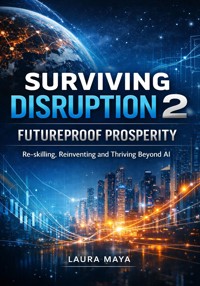
5,99 €
Mehr erfahren.
- Herausgeber: resourceinternet
- Sprache: Englisch
Reskilling, Reinventing and Thriving Beyond AI
Access. Coordination. Intelligence.
The world did not change in isolated waves. It evolved in layers.
The sharing economy challenged ownership. Platforms reorganized markets. Now artificial intelligence is magnifying human capability itself — reshaping how work is performed, how capital flows, and how competitive advantage is built.
This is not a separate revolution.
It is the continuation of the same structural shift.
Crowdfunding opened funding beyond institutions. Ride-hailing redefined mobility. Home-sharing unlocked underused assets. Today, intelligent systems compress time, automate analysis, generate content, and influence decisions across every sector.
The game did not reset.
It accelerated.
Small teams now operate with leverage once reserved for corporations. Tasks that required days now take minutes. Standards rise faster than most organizations can recalibrate.
This is not about human replacement.
It is about capability expansion — and rising expectations.
Surviving Disruption 2 connects the dots between the sharing economy, platform dominance, decentralized capital, and artificial intelligence. It reveals how these forces are not random disruptions, but stages of a continuous reorganization of value.
Disruption is no longer occasional.
It is the operating condition.
The real divide is not between technology and people.
It is between those who observe the pattern — and those who react too late.
In this era, survival is reactive.
Reinvention is deliberate.
Thriving is strategic.
The future will not slow down.
But it can be understood — and positioned for — by those willing to see the structure beneath the noise.
Das E-Book können Sie in Legimi-Apps oder einer beliebigen App lesen, die das folgende Format unterstützen:
Veröffentlichungsjahr: 2026
Ähnliche
















Table of Contents
Surviving Disruption 2: Futureproof Prosperity | Reskilling, Reinventing and Thriving Beyond AI
Prelude | A World That Changed While We Were Busy
Foreword | From Ownership to Access to Intelligence
Introduction | You Are Already Living Inside the New Economy
Chapter 1 | When Taxis Became Apps
Chapter 2 | Why We Stopped Owning Things
Chapter 3 | Crowdfunding and the Rise of the Small Player
From Crowdfunding to Decentralized Finance | The Evolution of Capital in a Programmable World
Chapter 4 | Food Delivery and the Invisible Workforce
Chapter 5 | The Real Power Was Never the App
Chapter 6 | Why Traditional Businesses Struggled to Keep Up
Chapter 7 | The Quiet Shift from Products to Ecosystems
Chapter 8 | When Intelligence Became the Product
Chapter 9 | AI Is Not Replacing You the Way You Think
Chapter 10 | The New AI Economy
Chapter 11 | Why Your Job Is Not Your Identity
Chapter 12 | Learning in a World That Does Not Slow Down
Chapter 13 | Building Small but Smart
Chapter 14 | Positioning Yourself Before the Next Wave
Chapter 15 | The Human Advantage
Chapter 16 | Designing Your Place in the New Economy
Conclusion
Surviving Disruption 2: Futureproof Prosperity
Reskilling, Reinventing and Thriving Beyond AI
Prelude
Foreword
Introduction
Chapter 1 When Taxis Became Apps
Chapter 2 Why We Stopped Owning Things
Chapter 3 Crowdfunding and the Rise of the Small Player
Chapter 4 Food Delivery and the Invisible Workforce
Chapter 5 The Real Power Was Never the App
Chapter 6 Why Traditional Businesses Struggled to Keep Up
Chapter 7 The Quiet Shift from Products to Ecosystems
Chapter 8 When Intelligence Became the Product
Chapter 9 AI Is Not Replacing You the Way You Think
Chapter 10 The New AI Economy
Chapter 11 Why Your Job Is Not Your Identity
Chapter 12 Learning in a World That Does Not Slow Down
Chapter 13 Building Small but Smart
Chapter 14 Positioning Yourself Before the Next Wave
Chapter 15 The Human Advantage
Chapter 16 Designing Your Place in the New Economy
Conclusion
Disclaimer
The ideas and perspectives shared in Surviving Disruption 2: Futureproof Prosperity are intended for informational and educational purposes only. This book discusses economic trends, technological developments, business models, and personal strategies related to disruption, the sharing economy, and artificial intelligence. It is not intended to provide financial, legal, investment, or professional advice.
While every effort has been made to present accurate and up-to-date information, economic environments, technologies, and regulations change rapidly. Readers are encouraged to conduct their own research and seek appropriate professional guidance before making financial, business, career, or investment decisions.
Examples of companies, platforms, or technologies mentioned in this book are used for illustrative purposes only. Their inclusion does not constitute endorsement, affiliation, or recommendation. Market conditions, platform policies, and business outcomes vary significantly, and individual results will depend on personal circumstances, timing, effort, and external factors beyond the author’s control.
Artificial intelligence and digital tools discussed in this book continue to evolve. The capabilities, limitations, and ethical considerations surrounding these technologies may change over time. Readers are responsible for ensuring that any use of digital platforms or AI tools complies with local laws, regulations, and professional standards.
The author and publisher disclaim any liability for loss, risk, or damages, whether direct or indirect, arising from the use or application of the material presented in this book.
By reading this book, you acknowledge that you are responsible for your own decisions and actions.
Copyright © Laura Maya 2026
Prelude
A World That Changed While We Were Busy
If you think back carefully, the world did not change in one dramatic moment. There was no announcement, no global countdown, no official declaration that the economy had entered a new phase. The changes slipped into our routines quietly, almost politely, arriving through small conveniences that made life easier and slightly more efficient.
At first, it was simply an app.
You downloaded it because someone recommended it, or because you were late and needed a ride quickly. You tapped a button. A car appeared. You saw the price before the journey began. It felt effortless, far better than standing by the roadside hoping for an empty taxi.
We did not think of it as disruption. We thought of it as convenience.
Then food ordering changed. Instead of calling a restaurant and repeating your address three times, you scrolled through photos and reviews. You paid instantly. You watched a rider move across a small digital map toward your home. It felt modern and reassuring, like progress doing its job quietly.
Travel followed the same path. Budget airlines multiplied. Comparison websites displayed dozens of prices in seconds. Hotels were no longer the only option because people began renting spare rooms and entire apartments. Staying in someone else’s home during a holiday became normal.
Few of us paused to consider what this meant for hotels or taxi companies. We were simply glad to save money and time.
Music stopped being something we owned physically. We streamed it. Movies followed. Software became subscription based. Office spaces became shared desks. Bicycles could be unlocked with a phone. Gradually, almost everything shifted from ownership to access.
That shift did not feel dramatic because each change seemed isolated. But they were not isolated at all. They were signals.
Something deeper was rearranging how value moved through society.
When ride hailing companies expanded, they did not own cars. When home sharing platforms grew, they did not own buildings. Delivery apps did not own kitchens. What they owned was the connection. They controlled the system that matched supply with demand.
That was new.
For decades, businesses were built around assets. To compete with a taxi company, you needed vehicles. To compete with a hotel chain, you needed property. To sell products at scale, you needed inventory and distribution networks.
Then the rule shifted.
The new players did not build their advantage through ownership of physical assets. They built it through control of networks. And when you control the network, you influence visibility. You decide who appears first. You shape pricing adjustments. You structure reputation through ratings and reviews. Most importantly, you collect information on every interaction.
Customers rarely noticed this shift because the service improved. It felt smoother. Behind that smoothness, however, data accumulated.
Every ride generated information.
Every delivery produced patterns.
Every search, click, cancellation, and review contributed to a growing system of insight.
The sharing economy was not only about sharing. It was about information flowing through centralized platforms.
And platforms learn.
At first, they learned simple patterns such as when demand was high or which neighborhoods were busiest. Over time those patterns became predictive. Prices adjusted automatically. Estimated arrival times improved. Recommendations felt personal. Customer support became faster because systems anticipated issues before they were raised.
By the time artificial intelligence became a public conversation, intelligent behavior was already embedded in everyday tools. It did not enter as a robot walking into your office. It entered as incremental improvement. Routes became smarter. Suggestions became more relevant. Processes became faster.
Those incremental improvements, layered over time, produced structural effects.
What began as subtle optimization gradually altered how businesses operated and how individuals made decisions. AI did not appear as a sudden disruption. It accumulated quietly until its influence became foundational.
While we were enjoying convenience, another shift was happening in parallel.
The cost of starting something new began to fall.
A person no longer needed a physical storefront to sell products. A marketplace could handle visibility. Marketing departments were replaced by digital tools. Data dashboards replaced teams of analysts for early stage ventures. Small operators began competing with larger companies by using leverage rather than scale.
The sharing economy lowered barriers to access.
Platforms centralized connections.
Intelligent systems lowered the barrier to sophisticated decision making.
Together, these layers changed how work is organized.
For many years, growth depended primarily on size. The larger the company, the more resources it controlled. Productivity increased with expansion of manpower and infrastructure. Today, productivity can rise without proportional increases in headcount. A small team equipped with intelligent tools can operate globally. A single creator can design, market, and distribute products across borders.
This creates opportunity and uncertainty at the same time.
Opportunity emerges because entry barriers are lower.
Uncertainty grows because efficiency reduces demand for certain repetitive roles.
If you are a customer, life feels more seamless. If you are a worker or business owner, the ground may feel less stable.
Emotional reactions are understandable, but they do not clarify the situation. What we are experiencing is not sudden collapse. It is structural rearrangement.
The sequence is clear.
Access replaced ownership.
Platforms replaced traditional intermediaries.
Intelligence began replacing manual coordination.
Each layer builds on the previous one.
None of this happened overnight. The changes unfolded over years, and gradual adjustment made them feel normal. But gradual does not mean insignificant.
The way we move, eat, travel, shop, and communicate has been reorganized. Businesses form and scale differently. Individuals generate income through more varied channels. Gig work expanded. Freelance platforms grew. Remote collaboration became common. Digital entrepreneurship became accessible.
At the same time, older structures felt pressure. Retail chains closed. Taxi licenses lost value. Travel agencies declined. Administrative tasks were automated.
History has seen many industrial shifts, but what distinguishes this period is the combination of global digital networks and embedded intelligence operating at speed.
The next stage is not about apps alone. It is about intelligence integrated into systems everywhere.
If you use navigation, search engines, online marketplaces, or digital communication platforms, you are already interacting with algorithmic systems. The question is not whether you are part of this economy. You are. The more useful question is how aware you are of the pattern shaping it.
Awareness matters because it creates choice.
If disruption appears random, it feels threatening. If the pattern becomes visible, it becomes navigable.
This book does not dramatize change. It explains it plainly. It connects the sharing economy, the rise of platforms, and the embedding of intelligence into a single movement rather than separate waves.
Understanding that movement changes how you respond.
If you run a business, it shapes how you structure operations.
If you are employed, it influences how you develop skills.
If you are starting out, it guides how you design your path.
The world did not announce that intelligence would become embedded in everyday tools. It evolved while we were occupied with daily responsibilities. Now that acceleration is visible.
Creation is faster. Automation is easier. Analysis is cheaper.
The core shift, however, is straightforward.
We are moving from a world organized around physical assets to one organized around connected systems. From connected systems to intelligent systems. And from intelligent systems to amplified individuals and teams.
This is not about becoming a technology expert. It is about understanding leverage.
Leverage once meant capital or manpower. Now it includes intelligence that amplifies cognitive effort. Just as electricity once extended physical capacity, intelligent systems extend analytical capacity. They do not remove human judgment. They relocate it.
Instead of manually processing information, people interpret outputs. Instead of drafting repetitive content from scratch, they refine direction. Instead of coordinating logistics manually, they supervise automated systems.
Contribution changes shape, and skills must adapt accordingly.
The chapters ahead revisit the sharing economy as foundation, examine platforms as structural systems, and explore artificial intelligence as an operational layer already present. Most importantly, they focus on positioning rather than reaction.
Disruption is no longer occasional. It is continuous.
The difference between anxiety and confidence in such an environment often comes down to clarity. Clarity about how systems operate. Clarity about where value moves. Clarity about what remains deeply human.
The world changed gradually while we were busy living. Now that pattern is visible enough to study.
This Prelude simply slows the pace long enough to observe what has already shifted.
Once the pattern is clear, the next chapters will feel less surprising.
The sharing economy laid the foundation.
Platforms structured the flow.
Intelligence is amplifying both.
Understanding that sequence prepares us for what comes next.
And that is where we now turn.
Foreword
From Ownership to Access to Intelligence
When the first wave of digital disruption arrived, most of us did not experience it as a wave. It felt like a set of useful improvements that simply made daily life more convenient. Booking a ride became easier.
Travel became cheaper. Working remotely became more practical. Ordering food required fewer steps. Even raising funds for an idea seemed more accessible than before.
At the time, these developments appeared unrelated. Each innovation seemed to solve a narrow problem. Yet when we step back now, we can see that they were connected expressions of a deeper shift in how value was created and distributed.
The earlier phase of disruption, explored in Surviving Disruption, focused on this transformation from ownership to access. Traditional industries were challenged not because they were inefficient, but because the assumptions beneath them were changing.
Access began to matter more than possession.
Platforms enabled small operators to compete with established firms. Consumers became active participants in markets rather than passive buyers.
That phase was not the end of disruption. It was the foundation.
While businesses debated whether new models were fair or sustainable, something more consequential was taking shape beneath the surface.
Platforms were not only facilitating transactions. They were collecting information. That information was structured, analyzed, and gradually used to automate processes. Efficiency increased, and with it came new pressures.
We now find ourselves in the continuation of that same movement.
Artificial intelligence is often described as a separate revolution, but in practice it is an extension of the earlier shift. The sharing economy changed how services were accessed. Platform systems reorganized distribution and visibility. The integration of intelligence is now reshaping how decisions are made and how work is performed.
This stage is less visible because it unfolds inside systems rather than on the surface. Customer service responses are drafted automatically. Marketing campaigns are adjusted continuously based on performance. Supply chains respond to demand patterns in real time. Even creative drafts can be generated within seconds.
Human effort does not disappear in this environment. It changes position.
Instead of manually processing information, individuals interpret outputs and make judgment calls. Instead of coordinating every task directly, they oversee automated systems. The nature of contribution evolves from repetition toward direction.
Understanding this evolution matters.
This book is not written for specialists in artificial intelligence. It is written for people who sense that change is accelerating and want to understand its structure rather than react emotionally to headlines. It is for business owners reconsidering their models. It is for professionals wondering how their roles may evolve. It is for individuals who prefer clarity over noise.
What we are experiencing is not chaos. It is restructuring.
Restructuring is uncomfortable because it alters familiar patterns before new ones feel stable. Yet history shows that such transitions create opportunity for those who observe carefully.
The purpose of this book is not to predict every emerging tool. It is to trace the pattern beneath the tools. Once the pattern becomes visible, the choices available to you become clearer.
Ownership gradually became less central.
Access became dominant.
Platforms concentrated coordination.
Intelligence is now amplifying capability.
This sequence is already unfolding around us. Artificial intelligence is not a distant possibility. It is embedded in systems we interact with daily. The question is no longer whether it will influence the economy, but how we choose to adapt within it.
Fear without understanding leads to hesitation. Understanding creates room for deliberate positioning.




