


1,99 €
Mehr erfahren.
- Herausgeber: Quickie Classics
- Kategorie: Gesellschafts- und Liebesromane
- Sprache: Englisch
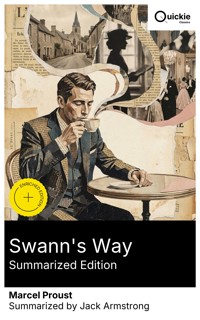
Swann's Way opens In Search of Lost Time with three movements: childhood reveries in Combray; the anatomy of jealousy in "Swann in Love"; and the desire-saturated toponyms of "Place-Names." Proust's long sentences, free indirect discourse, and phenomenology of perception install a modernist epic of consciousness. Set amid Belle Époque salons, the book displaces event with memory, showing how habit muffles experience until an involuntary shock—tea, paving stones—restores time to sensation. Born in 1871, asthmatic and salon-bred, Proust absorbed the Dreyfus convulsions and the rituals of high society. Translating Ruskin sharpened his conviction that attention is ethical; writing at night in a cork-lined room fixed the work's acoustics. Related by marriage to Bergson, he converted durée into narrative method, transforming filial grief and social observation into a inquiry into love, snobbery, and the alchemy of memory. Readers seeking a rigorous exploration of consciousness will find Swann's Way inexhaustible. It rewards patience with a theory of feeling, a cartography of desire, and the comedy—and cruelty—of the Belle Époque. Whether you read it as a self-contained drama of obsession or the portal to Proust's cathedral, it remains indispensable to lovers of Woolf, James, and Mann, and to anyone curious how art rescues time. Quickie Classics summarizes timeless works with precision, preserving the author's voice and keeping the prose clear, fast, and readable—distilled, never diluted. Enriched Edition extras: Introduction · Synopsis · Historical Context · Author Biography · Brief Analysis · 4 Reflection Q&As · Editorial Footnotes.
Das E-Book können Sie in Legimi-Apps oder einer beliebigen App lesen, die das folgende Format unterstützen:
Veröffentlichungsjahr: 2026
Ähnliche


![In Search of Lost Time [volumes 1 to 7] - Marcel Proust - E-Book](https://legimifiles.blob.core.windows.net/images/7bfeaa53b3db8b804e58de22616f49ec/w200_u90.jpg)




Swann's Way (Summarized Edition)
Table of Contents
Introduction
Between the evanescence of experience and the durable architectures of memory, Swann’s Way explores how time both dissolves and discloses the self. Marcel Proust’s first volume establishes the intimate scale and grand ambition of a project that treats recollection not as a storehouse but as a creative force. The book asks what remains of love, status, and habit when the present is gone, and what art can salvage from what has slipped away. Its drama is largely inward, yet its stakes are worldly: the making of a life-narrative from details that might otherwise vanish unnoticed.
First published in France in 1913, Swann’s Way inaugurates the multi-volume novel In Search of Lost Time, a landmark of modernist fiction. Its settings range from the provincial town of Combray to the salons and streets of Paris during the Belle Époque, attentive to both bourgeois domesticity and glittering high society. Proust situates his characters in a recognizably late nineteenth-century milieu of rituals, reputations, and shifting social hierarchies. The volume blends psychological exploration with social observation, developing a narrative method that privileges interiority while anchoring itself in precise places, customs, and sensations that define an era now past.
The premise unfolds in two complementary movements. A first-person narrator, from an adult vantage, tries to reassemble the dispersed fragments of childhood and family life, allowing ordinary circumstances to reveal unsuspected emotional contours. The book then turns to a separate yet thematically resonant portrait of Charles Swann, a cultivated figure whose consuming relationship draws him into patterns of enchantment, misreading, and self-scrutiny. The reading experience is meditative and immersive: long, flexible sentences follow thought as it turns, the tone by turns tender, ironic, and analytical. Proust’s voice welcomes patience, rewarding attention with exacting insights into perception and feeling.
At the heart of the volume lies an inquiry into memory—especially the difference between deliberate recollection and sudden, involuntary return. Proust shows how a sensory impression can break open the past with greater fidelity than will or effort, collapsing time so that the earlier self and the present observer seem to coexist. This is not nostalgia but investigation: How does one recognize the persistence of identity across change, and how does language reconstitute what has been lived? The novel proposes that memory is less a photograph than a composition, and that its truth emerges through shaping rather than mere retrieval.
Swann’s Way is also a study of desire within a finely graded social world. In salons and drawing rooms, status operates through speech, gesture, and rumor, and characters learn to read and misread one another’s signals. Swann’s attachment dramatizes how love can merge with jealousy, interpretation, and self-deception, binding emotion to the shifting evidence of everyday life. The novel’s scenes of conversation and observation reveal the subtle pressures of class and the volatility of self-image. Yet Proust neither condemns nor idealizes; he anatomizes the mechanisms by which hope and habit entwine, and by which time clarifies or corrodes illusion.
Art, in these pages, becomes a method for understanding time. Music, painting, and architecture provide models for arranging experience so that transient impressions gain form and resonance. The narrator’s groping toward an artistic vocation threads through the volume as a quiet promise: that careful attention can redeem scattered moments into coherence. Proust’s style itself—sinusoidal, exact, and patient—enacts this belief, returning to motifs so they accrue meaning. A haunting musical phrase circulates through the book as a figure for recurrence and transformation, suggesting how aesthetic pattern can gather dispersed feelings and make them legible without reducing their complexity.
For contemporary readers, Swann’s Way remains urgent because it models a sustained counterpractice to distraction, teaching how attention deepens understanding of self and others. Its portrait of social performance resonates in an era of curated identities, while its anatomy of desire and jealousy illuminates the interpretive work relationships demand. Above all, Proust offers an ethical aesthetics: by honoring small perceptions, he argues that value resides in the texture of experience. To read this novel is to rehearse a way of noticing that resists haste, accepts ambiguity, and finds meaning in the interplay of time, memory, and art.
Synopsis
Swann's Way, first published in 1913, inaugurates Marcel Proust’s multi-volume In Search of Lost Time. Composed of three linked parts—Combray, Swann in Love, and Place-Names: The Name—it establishes the work’s method: a meticulous exploration of memory, perception, and social life. The book moves between a narrator’s recollections of childhood, a close study of an older friend’s passion, and meditations on desire shaped by language and place. Rather than pursuing a linear plot, it arranges scenes and sensations so that meaning emerges gradually. The result is a narrative that examines how impressions coalesce into identity, and how social worlds are built out of habits, rituals, and interpretations.
In Combray, the narrator drifts between wakefulness and sleep, prompting recollections of evenings in his family’s provincial home. The rituals of bedtime, especially his yearning for his mother’s goodnight visit, focus attention on the fragile links between comfort, affection, and time. A visit from Charles Swann, a cultivated family acquaintance, unsettles the household’s routine, sharpening the child’s awareness of adult protocols and coded exclusions. These scenes foreground the book’s concern with the rhythms of domestic life, the authority of custom, and the way a single delay or interruption can magnify desire. The voice alternates between childlike immediacy and retrospective analysis.
The narrator’s memory opens onto the sensory world of Combray: the church of Saint-Hilaire presiding over seasonal change, Aunt Léonie’s constrained sickroom, and Françoise’s exacting kitchen. Ordinary tastes and textures acquire extraordinary force, most famously when a flavor unexpectedly unlocks a buried landscape of recollection. Proust uses these episodes to propose a distinction between voluntary, effortful memory and involuntary, sudden return, suggesting that identity rests on both habit and surprise. The town’s lanes, gardens, and interiors are presented less as fixed settings than as instigators of thought, each detail demonstrating how the mind reconstructs the past while living in the present.
Two habitual walks organize the child’s geography and social imagination: the path associated with Swann’s property, and the route toward the Guermantes, an aristocratic lineage. Each direction carries different stories and expectations—one linked to bourgeois acquaintance and intimacy, the other to distant prestige and history. These excursions clarify how landscapes become coded with class and desire, and how names precede experience by shaping what the narrator hopes to find. The alternation between routes also lets the book trace the interplay of chance encounter and carefully maintained boundary, establishing a map on which later figures, including Swann, will be placed and reinterpreted.
Swann in Love turns from the child’s perspective to an earlier period in Swann’s adult life. A man of refined taste who moves comfortably in elite circles, Swann frequents the Verdurins, a small, self-styled artistic coterie. There he becomes attached to Odette de Crécy, a woman whose charms initially do not align with his aesthetic ideals. The narrative follows the growth of his attachment through the rituals of visiting, letters, and shared amusements. A musical passage, part of a sonata by the fictional composer Vinteuil, becomes the emblem of his feeling, illustrating how art can endow personal experience with pattern, intensity, and persistence.
As Swann’s love deepens, uncertainty breeds jealousy. The informal rules of the Verdurin circle, with its exclusions and close surveillance, exacerbate his unease. Small gaps in Odette’s schedule expand in his imagination, and he begins to pursue clues, invent theories, and reorganize his days around the hope of reassurance. The narrative details how desire and suspicion feed each other, how social gossip can wound, and how pride coexists with abasement. Without resolving every question, these chapters anatomize the mechanisms by which longing turns to obsession: the search for signs, the temptation to confirm the worst, and the solace of aesthetic association.
Proust links Swann’s aesthetic sensibility to his emotional vulnerability. Paintings and musical motifs guide his vision, sometimes clarifying, sometimes distorting what he sees. The salons he frequents expose the pressures of reputation and the shifting alliances that define fashionable Paris. Within this milieu, love becomes a negotiation between image and reality, with language serving both as a veil and as an instrument of control. The section does not merely recount episodes; it models a method of psychological observation, showing how thought doubles back on itself and how interpretations harden into habits. Swann’s experience thus illuminates broader patterns of feeling and social conduct.
The final part, Place-Names: The Name, returns to the youthful narrator in Paris, charting the way imagination organizes the world before experience does. He develops a fascination with certain destinations, especially the seaside resort of Balbec, whose name alone carries a charge of promise. In the public gardens, he meets a girl named Gilberte and forms routines around the chance of encountering her, discovering how hope, disappointment, and minor rituals structure daily life. The narrative weaves expectations about travel, society, and friendship into a study of how names generate images that later encounters will confirm, complicate, or undo.
Across its three movements, Swann’s Way lays the foundations for an inquiry into time, memory, and the making of meaning. It presents domestic ritual, social performance, and artistic experience as forces that shape desire and identity, while showing how unexpected sensations can reanimate the past. Without relying on dramatic revelations, the book reveals the extent to which lives are governed by habits of attention and by the stories people tell about themselves and others. Its enduring significance lies in the precision of its psychological vision and its demonstration that the textures of ordinary life can disclose the structures of experience.
Historical Context
Swann’s Way unfolds against the French Third Republic’s Belle Époque (c. 1871–1914), centered on Paris and provincial towns modeled on places Proust knew. The novel’s society is structured by enduring institutions: the Faubourg Saint‑Germain aristocracy, a wealthy haute bourgeoisie, Catholic parishes, and a vigorous press. Railways bind Paris to the provinces; carriages and, increasingly, automobiles mark elite mobility. Republican education reforms had secularized schooling (Ferry laws, 1881–82), and church–state separation arrived in 1905, though Catholic ritual remained visible in rural life. Leisure spaces such as the Bois de Boulogne and art-filled salons frame encounters, while meticulously ordered domestic interiors reveal class codes and anxieties.
Published in November 1913 by Grasset after rejection by the Nouvelle Revue Française, Swann’s Way inaugurated Proust’s multivolume cycle. The author financed the edition himself; André Gide soon acknowledged the NRF’s mistake. Reception was promising but curtailed by the outbreak of war in 1914, after which the work gained readers steadily. Proust wrote within a literary field shaped by Naturalism’s legacy, Symbolist aesthetics, and emerging modernist experiments. He had already published pastiches and society pieces in Le Figaro and translated John Ruskin, honing a critical vocabulary of art and perception. The first volume’s settings predate 1914, yet its publication anticipates modernism’s momentum.
France’s fiercest political rupture of Proust’s adulthood was the Dreyfus Affair (1894–1906), which polarized the Third Republic around justice, nationalism, and antisemitism. Proust publicly supported Alfred Dreyfus, signing pro‑Dreyfus petitions in 1898 and rallying acquaintances. The Affair reshaped salon alliances and newspaper polemics, exposing prejudices within aristocratic and bourgeois circles. Swann’s Jewish origin within the novel’s society reflects this climate of conditional acceptance and social scrutiny. Without dramatizing the trials themselves, the book registers how conversation, invitations, and reputations could be inflected by the period’s political moralities, making private relationships and cultural taste inseparable from contested definitions of honor and belonging.
Parisian salons were crucial mediators of status and art during the Belle Époque. The old nobility clustered around the Faubourg Saint‑Germain, while ambitious bourgeois hosts assembled artists, critics, and financiers in rival circles. Proust observed such milieus closely through frequent attendance; figures like Geneviève Straus and the Comtesse Greffulhe exemplified the era’s tastemakers. Swann’s Way depicts the rituals of visiting, the economy of favors, and the tyranny of recommendations, alongside leisure in the Bois de Boulogne. The novel’s Verdurin circle caricatures a closed, aspirational salon, highlighting how judgments about music, painting, and conversation operated as social passports or barriers.
The book emerged amid intense debates about art. Impressionist painting had transformed ways of seeing, while Symbolist poetry privileged suggestion and nuance; both currents inform Proust’s attention to perception and atmosphere. Parisian “Wagnerism” divided audiences, and chamber music flourished in salons, contexts echoed by the fictional composer Vinteuil. Proust’s translations of John Ruskin (1904, 1906) deepened his engagement with Gothic architecture and the moral attention required by art, visible in the novel’s church descriptions and patient ekphrasis. References to artists and critics are historically grounded, but they serve to dramatize how taste mediates friendship, desire, and claims to cultural authority.
Late nineteenth‑century psychology foregrounded memory and habit. Théodule Ribot’s studies of memory (1880s) and Henri Bergson’s writings on duration (1889) sharpened public discourse, and Bergson was Proust’s cousin by marriage. Without adopting a doctrine, Swann’s Way stages involuntary memory within a culture fascinated by consciousness. Medical modernity—sanatoria, respiratory therapies, and hygienist advice—formed part of Proust’s world as an asthmatic. Technologies altered daily rhythms: photography circulated likenesses, the telephone and efficient postal service quickened communication, and railways structured movement between Paris and the provinces. Such contexts help explain the novel’s attention to timekeeping, sensation, and the mechanisms by which experience is stored and retrieved.
The Republican state promoted civic cohesion through secular schools and conscription, yet regional traditions persisted. Jules Ferry’s laws (1881–82) made primary education free, compulsory, and secular; the 1900 Exposition Universelle celebrated technological confidence. France’s expanding colonial empire and protectionist debates shaped newspapers and dinner‑table talk, though Swann’s Way largely confines itself to homes, churches, theaters, and parks. Proust contributed to Le Figaro, mastering the coded language of society news and reviews. The provincial parish church and Paris’s grand avenues thus coexist in the novel’s background, presenting a society that prized order and ceremony while navigating modernity’s disruptions to class and belief.




