


Erhalten Sie Zugang zu diesem und mehr als 300000 Büchern ab EUR 5,99 monatlich.
- Herausgeber: Nosy Crow Ltd
- Kategorie: Für Kinder und Jugendliche
- Sprache: Englisch
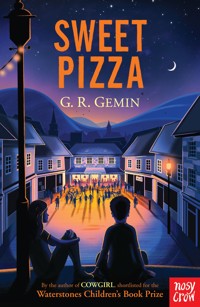
When Joe tasted a mouthful he was amazed how delicious it was - a dense taste, better than any pasta he'd eaten before. Food was suddenly different - he felt as if his taste buds were doing the cha-cha-cha onStrictly. Joe loves his Italian heritage: the language, the opera, the lasagne! But it's hard to celebrate his Italian roots in Bryn Mawr, South Wales, where his mam is sick of running the family's tatty café. Just like his great-grandfather, who opened the café in 1929, Joe is an entrepreneur. He vows to save the family business, and to spice up the tired High Street with a little Italian flavour! This is a heart-warming story about bringing a diverse community together and the amazing history of Italian immigrants in Wales. From the author of Cowgirl, shortlisted for the Waterstones Children's Book Prize. Cover illustration by Tom Clohosy Cole. "The warmth and charm of 'Sweet Pizza' are quite extraordinary; though there are some very moving moments, it is mainly a joyous and eccentric comedy." Kate Saunders, Guardian Children's Fiction Prize Judge Also by G. R. Gemin: Cowgirl
Sie lesen das E-Book in den Legimi-Apps auf:
Seitenzahl: 211
Veröffentlichungsjahr: 2016
Das E-Book (TTS) können Sie hören im Abo „Legimi Premium” in Legimi-Apps auf:
Ähnliche










![Tintenherz [Tintenwelt-Reihe, Band 1 (Ungekürzt)] - Cornelia Funke - Hörbuch](https://legimifiles.blob.core.windows.net/images/2830629ec0fd3fd8c1f122134ba4a884/w200_u90.jpg)





Praise forCOWGIRL
Shortlisted for the UKLA Book Award Shortlisted for the Branford Boase Award Winner of the Tir Na n-Og Award
Cowgirl has been adapted as a play by Oxford University Press.
“Ridiculously lovely and entrancing. This is a book written with a lot of love, a lot of passion, (a lot of cows!) and I’m so glad it exists.” Daisy Johnson, Did You Ever Stop to Think…
“Authentic, charming and narrated by a relatable, standout voice. It cheered me right up.”Pretty Books
“Friendly, refreshing and absorbing. Cowgirl is a great read.”My Book Corner
“Perceptive, down-to-earth and eminently readable. I really enjoyed this.”Parents in Touch
“Funny, moving and thoughtful. I thoroughly enjoyed this impressive debut.”The Bookbag
For Mamma, Barbara and Isabelle For all the lovely food
ONE
Joe loved fried chicken and chips smothered in tomato sauce and mayonnaise, especially after a day at school – nothing else hit the mark as far as he was concerned.
As he walked home with Combi he was feeling glum, and the grey sky and rain didn’t help his mood. When they reached Bryn Mawr High Street he knew Combi was heading for the Chicken Box, and he could see lots of children outside the shop.
“Don’t want any,” he said.
“Any what?” asked Combi.
“Chicken and chips.”
“Why?”
“Mam said I mustn’t. No more fizzy drinks either.”
“How come?” Combi asked as he stopped in front of the takeaway.
Joe gazed at the children all around him, tucking into the boxes of chicken and chips. “She reckons I’m overweight.” He waited for Combi to express surprise, but Combi just stared at him. “Doesn’t your mam go on at you?” Joe asked.
“’Bout what?”
“Being overweight.”
Combi’s lip curled. “I’m not though.”
For a moment Joe thought he was joking. “You’re as big as me!”
“But I’m in proportion,” Combi said as he went into the shop.
In proportion to what? Joe wondered.
He had hoped Combi would show solidarity and not buy any, so he felt let down. The rain drummed on his hood as he waited. He wished he had an umbrella, however uncool. The noise of the children eating all around him seemed to get louder and louder, like hyenas munching on a wildebeest, and the smell of the chicken was so strong his mouth filled with saliva.
Combi came out with the Chicken Box Deal and stood in front of Joe as he ate. “Oh, go on, ’ave some,” he said, his mouth smeared in sauce. “I won’t grass on you.”
Joe glanced up the High Street towards Cafe Merelli. He looked down at the chicken and chips, fast disappearing.
He swallowed.
“We’ve got to finish it before we get to the cafe.”
TWO
When Joe and Combi entered Cafe Merelli, Joe’s mam was behind the counter gazing out of the window, her eyes fixed and staring. “’Lo, Mam,” he said.
“Hello, love.” She blinked and sniffed the air. “Can I smell chicken and chips?”
“It was mine,” said Combi. “Joe never had any. Honest, Mrs Davis.”
“Did I ask?” She glanced at Joe, who licked his lips. “You must be hungry then?”
“Yeah.”
“That’s good,” said Mam as she took a plate from inside a glass cabinet. “I did you a tuna salad, heavy on the cucumber.”
“Ta,” said Joe.
“Can I have a Coke, please, Mrs Davis?” Combi asked.
“Glass?”
“No, thanks.”
As Mam turned to get a Coke out of the fridge, Joe elbowed him and frowned.
What? mouthed Combi.
Coke! Joe mouthed back, just as Mam turned and plonked the can on the counter.
“Glass of water, Joe?” asked Mam.
“Please,” he said, forcing a smile.
Mam handed him the glass of water and he went to sit in a booth with Combi.
Cafe Merelli had seen better days: the Formica wall panels were dirty and cracked in places; the red faux-leather seating was worn and dotted with taped repairs; and the vinyl floor tiles were peeling – it was all suffering from long-term neglect.
A pensioner, sitting at one of the other tables, was craning her neck. “Joe. Can you see if the bus is coming?”
Joe leaned close to the window and took a peek up the road. “Not yet, Gwen.”
“Oh, desperate to get home, I am,” she said. “My feet have swelled to twice their size, and I don’t want to be late for Flog It.”
Joe watched Combi’s Adam’s apple bob up and down as he gulped the drink, and then he paused for breath. “Chicken and chips always makes me so thirsty.”
“Really?” said Joe as he picked at his salad.
Then his attention was caught by Vaughan, the only other customer in the cafe – he had a perplexed expression on his face, with his mouth hanging open, and he was scratching his armpit. “Hey, Joe,” he said. “Just saying to your mam … you can’t tickle yourself.”
Joe glanced at Mam, who rolled her eyes.
“Someone else can tickle you,” Vaughan said, “but you can’t tickle yourself. Try it. Go on.”
“Take your word for it,” said Joe.
He noticed Combi slip his hand up to his armpit. “It’s true,” said Combi, then he arched back, guzzling more of his Coke.
“Look at that!” said Joe.
Combi stopped drinking, which was what Joe wanted. He pointed at a framed newspaper page. “We put the article about Nonno on the wall.”
“I seen it,” said Combi.
“Not on the wall, you haven’t,” said Joe. “We only put it up this morning.”
“I seen the article though – all about your granddad when he turned ninety.”
“It’s good, innit?” said Vaughan. “‘Beppe Merelli – the last of the original Italian cafe owners in Wales’,” he read out loud. “Proud to know him, I am.”
Joe turned and smiled. He pointed at a black-and-white photograph alongside the article. “And that’s my Nonno stood outside this very cafe—”
“In nineteen fifty-three,” interrupted Combi. “I know, I know.”
Joe went to speak, but Combi pointed at another photograph. “And that’s the cafe the year it opened in nineteen twenty-nine,” he said. “With your granddad’s dad, Vito Merelli, stood outside. See? I know.”
“You dissing my family?” asked Joe.
Combi screwed up his nose. “No.”
“What’s wrong with being proud of my Italian roots?”
“Because you’re Welsh.”
“I’m Italian!”
“Welsh.”
“So you’re not Afro-Caribbean then?” Joe asked.
“I’m Welsh,” said Combi. “And Afro-Caribbean on my dad’s side, but I don’t go on about it. Not like you, ‘Oh, I wish my name was Joe Merelli instead of Joe Davis,’” he said in a whiny voice. “‘It sounds SO much better…’”
Joe kicked him under the table.
“Did you say that?” Mam asked.
“I can’t remember,” said Joe, narrowing his eyes at Combi.
“Well, I apologise for not consulting you on the choice of family I married into, Joe,” said Mam. “But you weren’t born!”
“Merelli is a lovely name,” said Gwen. “Has to be said.”
Joe smiled, then he caught Mam’s eye. “I see there’s taekwondo classes on at the Community Centre,” she said. “Shall I put your name down, Joe?”
Combi stopped drinking his Coke and glanced at him.
“Oh, Mam. What for?” said Joe.
“Get you fit.”
“Not taekwondo, Mam.”
“Why not?”
Joe couldn’t think of a reason.
“I heard someone died of taekwondo,” said Combi.
Joe pointed at him. “See!”
Mam tutted. Combi held out the can of Coke to Joe, like a peace offering. “Want some?”
Joe kicked him under the table again. “No thanks, Combi,” he said aloud, sliding his eyes in the direction of Mam. “It’s all sugar. Besides, it’s a conflict of interest.”
“Conflict of interest? How?”
“I can’t sell a customer a Coke and then drink some, can I?”
“But your mam sold it me.”
“Yeah, but this is my cafe, Combi.”
“Oh, and it’s a goldmine,” said Mam, still staring out into the High Street.
“You dissing the cafe, Mam?” said Joe, but before she could reply the door behind the counter opened and there stood Joe’s granddad.
“Hi, Nonno!” Joe called.
“Hello, Mr Merelli,” said Gwen and Vaughan. Combi raised his can of Coke.
Nonno smiled and nodded at his faithful customers. He was tall and his voice was deep and soft. “Going for a passeggiata, Lucia.”
“OK,” said Mam.
Joe always accompanied Nonno for his evening stroll. He watched his granddad button his overcoat, neatly fold a scarf under the lapels and run his fingers round the rim of his felt hat.
“See you tomorrow, Combi,” said Joe. “Or, as I’m Italian, I should say, a domani!”
“What about your salad?” said Mam.
“I’ll have it later,” said Joe.
As he stepped outside with Nonno, Joe couldn’t resist a glance back at Combi, who pointed at him and shouted, “Welsh, you are!”
Joe saw the bus turn on to the High Street.
“Gwen!” he called, banging on the cafe window. “Bus!”
He waved for the bus to stop as Gwen hurried out of her booth.
THREE
“No one does the passeggiata round here, do they, Nonno?” Joe said as they walked along. “’Specially in the rain.”
Nonno shook his head. “Just us.”
Joe had been to Italy only once, when he was eight. It was a faded memory, but he remembered Nonno explaining la passeggiata – people strolling in their town centre in the late afternoon, even in winter.
“It’s nice to see people wandering about and chatting,” said Nonno. “It’s like marking the end of the day, and it makes you feel you belong.”
“Yeah,” said Joe, even though he wasn’t exactly sure what he meant. “The Welsh are Italians in the rain,” he added. It was an old phrase he knew would make Nonno smile. The wind had picked up but it didn’t deter them.
“Taking your constitutional, are you, Beppe?” asked Mr Lewis the butcher as he hurried by.
Joe liked the fact that he had the same name as his granddad. “If Beppe is Italian for Joe, how come my name’s Joe and not Beppe?”
Nonno pulled down the edges of his mouth. “Your mam thought you should be Joe, as you’ve got a Welsh surname.”
Joe felt a twinge of guilt knowing Mam had found out he preferred the surname Merelli.
After they walked a little more, Nonno stopped. “Your mam’s gonna sell, Joe.”
“Definitely?”
Nonno gazed across the street and gave the tiniest nod. “She called the estate agent,” he said. “Maybe it’s time.”
“I don’t get why,” said Joe.
“Look.” Nonno waved a hand towards the shops on the opposite side of the High Street. “It’s terrible, Joe. Once there were lots of shops. Lots of business. I’m talking many years ago. The old Bracchi cafe is gone – a betting shop now… People just don’t stay long when they come to the High Street any more.”
Joe scanned the shops that were left – a betting shop, a butcher’s, a few takeaways, including the Chicken Box, the Co-op and Post Office, and Mr Malewski’s Emporium. The rest were closed down.
“Malewski’s is always busy,” said Joe as they stopped in front of the shop that sold products from Eastern Europe. Mr Malewski waved from inside the store and Nonno waved back. “Nice man. Good business.”
“Mam says the Eastern Europeans are taking over the town,” said Joe.
“They come here and they work hard,” said Nonno. “Just like my Papà did.”
Joe hated the idea of Cafe Merelli closing. “But I love the cafe,” he said, looking up at his granddad.
Nonno smiled. It was a sad smile, it seemed to Joe, and Nonno’s hand was heavy as it fell on his shoulder. His granddad’s eyes were watering, but Joe couldn’t be sure if it was the wind or if he was crying.
FOUR
The kitchen behind the cafe was where Joe and his family ate their meals and cooked food for the customers. There was a dining table, and shelves stocked with supplies of takeaway cups, napkins, condiments and tins of various foods.
Joe helped Nonno prepare dinner in the kitchen; it was an established routine. Tonight they were making lasagne, Joe’s favourite. Nonno hummed along to one of his opera CDs while he cooked.
“Which opera’s this then?” Joe asked.
“Verdi’s La Traviata,” said Nonno.
“What’s ’appening?”
“Violetta’s dying.”
“Aw, right… Why they always dying?”
Nonno pulled the corners of his mouth down. “That’s opera.”
Joe loved helping Nonno fill the baking tray with sheets of pasta, minced meat with tomato, and the white sauce.
It wasn’t long before Joe’s dad came in noisily through the back door.
“All right, Joe. Beppe?” He went straight to the sink to wash his hands. “Three new double wall sockets I did for Mr Choudary,” he said. “All in an hour and no redecorating needed.”
“Nice one,” said Joe.
Dad dried his hands and put his arm round Joe’s shoulder. “Smells fabulous. Teaching him well, you are, Beppe.”
Nonno smiled and nodded, just as the door to the cafe opened and Mam came in. She switched off the lights behind her and Joe saw the cafe in darkness before she closed the door. “Another action-packed day over,” she said, before greeting Joe’s dad with a kiss.
Joe started setting the table. “Mam, you definitely selling the cafe then?”
“Yes, Joe,” she said. “That cafe is not what it was – hasn’t been for years. Not since I was a girl.”
“But, Mam, I thought that when I’m sixteen I’d take over. You can retire.”
“Retire? Get him. And take over what, Joe?” she asked. “What you don’t realise is that what pays the bills here is not the cafe…” She nodded at Dad. “It’s your father with his electrician work – he brings in money for us to live here. The only thing that makes this house different from any other is that room through there…” She pointed at the door to the café. “It opens on to the High Street and people walk in for a hot drink, a stale bun and a sit-down. That’s the only difference. It’s not a charity, Joe.”
“Yeah, but—”
“I can’t remember the last time someone ordered food, aside from breakfast,” said Mam. “When I open that till of an evening, there’s barely enough to cover the heating and light, let alone a wage.”
“But where would we live?” Joe asked.
“We could buy a small house, by the sea in Penarth maybe. I’ll get a job – don’t mind what I do – Nonno can take it easy, and Len carries on doing his electrics.”
Nonno opened the oven and brought the sizzling lasagne to the centre of the table.
“Pronto,” he said.
“Don’t forget your side salad, Joe,” said Mam.
Everyone took a seat.
Joe watched Nonno dishing out the steaming lasagne. They started eating and chatting about their day, but Joe suddenly didn’t feel hungry. He glanced at the door that led into the cafe. He was Joe Davis, heir to Cafe Merelli of Bryn Mawr. If it was sold he’d just be Joe Davis who lives in a house. It wasn’t the same.
FIVE
Joe thought it was funny that he lived in Wales and yet they had relatives in Italy.
“Mimi sends her love,” said Nonno, peering at the laptop screen.
Joe’s lip curled up. “She got on my nerves when we went over there.”
“She’s your only cousin, Joe.”
“Second cousin. Dragged me around and talked non-stop, and she said I ate too much ice cream. ‘Gelato Joe’, she called me.”
Nonno chuckled, then he grew serious and shook his head. “There’s no work out there, she says. She’s working in a coffee bar. It’s a waste – she’s a very good cook. We ought to invite her over here.”
“What for?” Joe said, thinking of Mimi telling him he was overweight, and Mam agreeing.
“She’d get a job far more easily here,” said Nonno. “We could offer good Italian food.” He slowly typed a reply on the laptop. “History repeats itself, Joe.”
“How d’you mean?”
“Well, your great-grandfather, Vito, came here because there was no work in Italy, back in nineteen twenty-five. Now Italians and Romanians and Polish, and all nationalities, come over for work, see, just like my dad.”
“Mam moans about the Eastern Europeans, doesn’t she?” said Joe.
“She shouldn’t,” said Nonno. “It’s natural to seek work to earn money and better yourself. They work hard too.”
“Nonno, you said you were going to tell me the history of the cafe, after that newspaper man came to interview you the other week. You said you were going to record it as a … as a something-or-other…”
“Oral history,” said Nonno.
“That’s it. Well, we should. I mean, you should do it.”
“Sure,” said Nonno as he typed.
“I’ll get your old tape recorder,” said Joe.
“What, now?”
“Why not?”
Nonno smiled. “OK.”
Joe sensed that Nonno was a bit shy to start. So he asked him something he’d never thought about until that moment. “Nonno, what that newspaper article didn’t explain was why Italians came to Wales in particular?” He pressed the record button on the tape recorder.
“The Italians were everywhere, Joe. All over South Wales,” said Nonno. “They came because South Wales had enough coal to supply the world – they just needed to get it out of the ground. Most of the Italians came from northern Italy, especially from the Bardi region. They came for the work, but where there’s work people need to eat. So they also came to feed people, and when they had enough money they opened cafes. That’s what Papà did before I was born.”
“What did he think of the Welsh?” Joe asked.
“Oh, he loved them – they’re people with song in their soul. That’s what makes Italians and Welsh fit together so well, I think. Papà always had music on in the cafe, a bit of Verdi or Puccini, or Neapolitan songs. He was always ready to help people too, whether they were Welsh or Italian recently arrived, or anyone for that matter. There were people from other parts of Europe back then, just like now.”
“What about the cafe?” Joe asked. “I mean, when it first opened.”
“Oh, the Italian cafes were popular – a place to gather, see, Joe. Somewhere to be. Cafe Merelli was always busy, right from the off. We sold tea, coffee, all sorts of provisions. Back then people didn’t know about Italian food – now you find it all over the world, of course. In the summertime we sold ice cream. Papà would stand in the doorway of the cafe in his white overcoat and straw hat, look up at the sky and say, ‘Beppe! Vai a vendere gelato.’ I was always a little bit nervous pushing the cart round the streets, but out I went. I was about your age, Joe. I’d ring a bell and call out ‘GELATO!’, which everyone got to know was Italian for ice cream. And it wasn’t long before I had a queue. I’d scoop out a ball and press it into a cone. Sometimes I’d give a bit more if it was a friend or a girl I’d taken a fancy to.”
“So why were you nervous?” Joe asked.
“Oh, there were a few boys who threw their weight around. I remember one day I was selling loads of ice cream as it was hot, then Johnny Corbett showed up with a couple of his mates. ‘Give us one then,’ he said. I scooped a ball of ice cream, put it in a cone and gave it to him. ‘Us too,’ the other boys said. So I made up two more. ‘Three pennies, please,’ I said, holding my hand out.
“‘Didn’t know we had to pay for them,’ says Johnny. ‘Should’ve said that before you give ’em!’”
“What an idiot,” said Joe.
“He wouldn’t have done it if people were around. He said to me, ‘I thought you Eyeties were giving ice cream free as we’ve given you work and a place to live.’ I was angry knowing how hard Papà and Mamma worked. ‘Pay me,’ I said, though I knew I was in trouble. ‘Gonna make me, are you?’ he said.”
“What happened?” asked Joe.
“They set about me. I gave as good as I got, mind, but they tipped the cart over and ran off. When I got back here I went in through the backyard, but Mamma could see something had happened, with the marks on my face and my jacket torn. They didn’t take the money though, and that’s all I really cared about.
“Mamma cleaned me up. ‘Please don’t tell Papà,’ I said. She kissed me on the forehead and held up a finger, like a warning. ‘For now I keep quiet … for now.’
“In the cafe I felt safe, see – it was my territory. My cafe.”
Nonno smiled and paused. “It’s good that you want to hear the story, Joe, but I’m tired. Little at a time, yeah?”
“OK. No problem.”
“Stay and listen to some opera with me, Joe.”
Nonno put on La Traviata by Verdi again.
“Lovely music,” said Joe, but for the first time he actually meant it.
SIX
The next day after school Nonno had a doctor’s appointment, and Joe said he’d go with him. The doctor’s waiting room was as full as a tin of tomatoes by the time they got there.
“Hello, Beppe,” said Lilly Matthews as they entered.
“Ciao, Lilly,” said Nonno. He took her hand and kissed it.
“Always the gentleman. How are you?”
“Fine. You been waiting long?” he asked her.
“Over half an hour, and there’s loads that were here before me.”
Nonno gazed around the waiting room and said, “You see the people here, Joe? This is how full the cafe used to be. Remember, Lilly?”
“I remember,” she said. “Hub of the town, Cafe Merelli was.”
Nonno smiled. “Never quiet in the cafe – there was always people. Always.”
An announcement came over the tannoy. “Lilly Matthews to Dr Dhital, room two.”
“About time,” said Lilly as she got up.
Nonno patted Joe’s hand. “It’s a pity that the cafe’s not as full as this waiting room any more.”
Joe felt sad for him, especially after the story he’d told on the tape.
Later, when they were called through, Nonno had to remove his shirt so that the doctor could listen to his chest. The sound of his long, heavy breaths filled the room. Nonno gave Joe a wink but he seemed older somehow, and more frail, and it made Joe feel uncomfortable – almost as if he was frightened of something.
Every morning Nonno opened the cafe to help cook the breakfasts. Joe helped out too, as it was the only time of day that business was brisk.
While Joe had his own breakfast in the cafe he watched Nonno serve – he was always smartly dressed in his white coat and hat. “Help yourselves to sauce, gentlemen,” he said as he put the plates down before the customers. “If you want more tea or coffee, just say. No extra.” Then he was back behind the counter watching over everyone or tidying things away. Joe had once heard someone describe Nonno as dignified, and he thought it was just the right word. The cafe doorbell rang and in walked Vaughan. “Morning, Mr Merelli – usual, please.”
Nonno gave him a nod. “Certainly. Straight away.”
Vaughan sat down opposite Joe. “How’s it going?”
“Fine.”
“What you eating?”
“Tea. Scrambled eggs on toast.”
“Lovely. Set you up good,” said Vaughan. “Funny, isn’t it? You’d never have those eggs, toast and tea all mashed together on a plate, would you? But once it’s in your stomach, where it’s all mixed up, it doesn’t matter, does it?”
“Well, you don’t have taste buds in your stomach,” said Joe.
“That’s right,” said Vaughan. “Still weird though.”
“What’s on the agenda today then?” Joe asked him, thinking it was a good customer-relations question, which is something Nonno had always told him was important.
“I got an appointment at the Job Centre at eleven, but I want to get away sharp as I’ve loads to do on my allotment, and Jason and the Argonauts is on telly, half-two.”
“What’s that? Film?”
“Aye. Fantastic. Special effects by Ray Harryhausen – the statue of Talos coming to life is my favourite bit. I got the DVD but there’s something nice about watching a film when it’s on the telly – all cosy. Know what I mean?”
Combi came into the cafe, holding a half-eaten iced finger. “Joe! Coming to school?”
Joe got up reluctantly, as he wanted to stay in the cafe a little longer. Nonno brought Vaughan a cup of tea and placed a hand on Joe’s shoulder. When Joe glanced up into his eyes the uneasy feeling came to him again.
“Work hard,” Nonno said as he picked up the empty plate and mug.
Joe felt a shudder of fear as he watched Nonno walk back behind the counter.




