


Erhalten Sie Zugang zu diesem und mehr als 300000 Büchern ab EUR 5,99 monatlich.
- Herausgeber: Pushkin Children's Books
- Kategorie: Für Kinder und Jugendliche
- Serie: True Adventures
- Sprache: Englisch
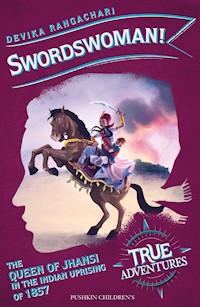
The true story of the fearsome Rani of Jhansi, the Indian Queen who took on the East India Trading Company in the Indian Rebellion of 1857 The British first came to India as traders. Now they're here as soldiers, taking over new territories, and they've got their eye on the small kingdom of Jhansi. But they aren't prepared for the kingdom's courageous queen. Lakshmibai, the Rani of Jhansi, rides a magnificent horse and wields her own sword; she trains other women to fight alongside her; she is determined that the kingdom will pass from her to her adopted son. So when the British demand that she hand over control, she refuses. And when an uprising begins to stir, the Rani will have to decide whether or not to join the fight. Devika Rangachari is an award-winning writer whose book, Queen of Ice (Duckbill), was on the White Raven list, won the Neev Young Adult Book Award and has been optioned to be made into a movie/TV series. Her other books include 10 Indian Monarchs Whose Amazing Stories You May Not Know, Tales of Love and Adventure, Swami Vivekananda - A Man With A Vision, Harsha Vardhana, The Merry Mischief of Gopal Bhand, The Wit of Tenali Raman and Growing Up. She is currently the recipient of a prestigious national fellowship awarded by the ministry of culture in India to research aspects of gender and historical fiction in Indian children's literature.
Sie lesen das E-Book in den Legimi-Apps auf:
Seitenzahl: 135
Veröffentlichungsjahr: 2021
Das E-Book (TTS) können Sie hören im Abo „Legimi Premium” in Legimi-Apps auf:
Ähnliche













![Tintenherz [Tintenwelt-Reihe, Band 1 (Ungekürzt)] - Cornelia Funke - Hörbuch](https://legimifiles.blob.core.windows.net/images/2830629ec0fd3fd8c1f122134ba4a884/w200_u90.jpg)






To Gautam – my joy, my cheer – and to my precious family.
And to Sayoni and Simon for making this possible.
note: Place names are given as they were at the time. Calcutta, for example, is now Kolkata.
CONTENTS
1854
JHANSI, INDIA
1
A NEW MOTHER
March 1854
A line of British officers, sweating profusely in their thick red coats, watched sourly as a distant figure on horseback emerged from the long shadows cast by the Jhansi sun. Behind them, near the entrance to the palace, row upon row of British soldiers waited impassively for further orders. The fort loomed, almost menacingly, a short distance away on a hill.
Jhansi was a small kingdom in the area of Bundelkhand. A somewhat rugged region, it was a hub for trade and the distribution of goods due to its convenient location between the plains of the north and central India. Now the British, in their 12bid to swallow up the country, had their eyes on this kingdom.
And, of course, on its ruler.
Major Ellis, the British political agent of Jhansi, stiffened. The task before him was a momentous but not particularly pleasant one, and he was eager to get it over and done with. He squinted, in the deepening glare, at the slender woman sitting elegantly on her white horse, her hair swept up into a concealing turban, her long sword rising and falling with every step. The sword itself was not for decorative purposes, for its wielder could impale anyone on its gleaming blade with an ease and accuracy born out of fierce practice.
In the time that he had spent in Jhansi, Major Ellis had developed immense respect for the young and intelligent Queen Lakshmibai – the Rani of Jhansi. She bore herself with a wisdom and maturity of one well beyond her years and, in fact, made more of an impact than her late husband, King Gangadhar Rao, ever had.
As he watched her approach, Major Ellis reflected on the chain of events that had brought them to this pass. The British, a seafaring nation, had come to the Indian subcontinent as traders, over two hundred years earlier, eager to make quick money and take it back home. For the purpose, the British East India Company had been formed in 1600. Many other 13European powers, such as the Dutch, the French and the Portuguese, had also been looking for colonies around the world to exploit – and India, as a region, attracted all of them because of its wealth. However, over the years, the British eventually managed to oust them all and take control over the country by dint of their superior resources, strategy and cunning.
From traders, they became soldiers, fighting petty battles on behalf of different warring powers in India. India, then and now, was largely disunited, with kingdoms fighting against each other for trivial reasons rather than banding together to face this new, implacable enemy. The British knew this all too well, and they began to devour the whole country, using this or that pretext to take over kingdoms and administer them directly.
Their most recent, crafty law had been devised by Lord Dalhousie, the new British Governor-General of India. It was called the Doctrine of Lapse and according to it, if an Indian ruler died without a natural-born heir to the throne to succeed him/her, then their territory would be taken over by the British.
Now the shadow of this law hung over Jhansi…
The queen was just a few paces away. The dust stirred up by her horse’s hooves swept into Major Ellis’s eyes and he moved back a little from the road. She nodded to him as she thundered past, casting a swift eye on the ranks of British soldiers before 14dismounting to claim a little boy’s embrace at the palace entrance…
This little boy was Jhansi’s ‘prince’.
Just before his fourth birthday the year before, a strange but beautifully dressed lady with sad eyes had come to visit him and bring him toys. She was Queen Lakshmibai, his mother said, and he must be respectful towards her. So he sat stiffly on her lap and answered her questions as best as he could because his parents were watching them from the other room, hawk-eyed. This lady, the queen, was to become his new mother, he was later told. A great honour. But he already had a perfectly nice mother and wondered why he needed another.
Not long after, in November 1853, he had been woken at dawn by his parents and made to wear new silk clothes that rustled when he moved and chafed his skin all over. It was all he could do not to cry.
‘Princes are strong,’ his father reminded him. ‘A new life awaits you and you must look forward to it – and be happy.’
He tried but it is not easy to be happy just because someone orders you to be. However, as he neared the palace in the royal carriage that had been sent for him, his eyes widened. The entire building was draped with colour, its every corner fragrant, some bright orange blooms even adorning the flag with the kettle 15drum that flapped noisily in the breeze from atop the ramparts. He had never seen so many flowers in one place before. He had no time to look around though, for he was hastily ushered into the main palace chamber for an adoption ceremony.
The air within was stifling and the little boy soon began to droop with exhaustion while the priest droned on and on. From time to time, he stole looks at the man in grand clothes who lay on a couch on the other side and who smiled at him whenever their eyes met. This was the king, he knew. He was soon to become his son – and this despite the fact that he already had a father whom he loved very much.
But the king was dying – this also he knew.
Meanwhile, Major Ellis and two other British officers watched the ceremony from their seats of honour. Once it was done, they would bear witness to the fact that Raja Gangadhar Rao, the ruler of Jhansi, and his wife, Rani Lakshmibai, had formally adopted the son of a distant relative and named him Damodar Rao, in memory of their own boy who had died in infancy.
Jhansi now had a legitimate heir to the throne who would ascend it as soon as the ailing king died. The Rani would be his regent and rule the kingdom till he came of age. Now Jhansi was safe from the British.
Or was it? 16
The queen kissed her new son after the ceremony and then turned to Major Ellis, her eyes showing their usual alertness. ‘The deed is done. Please convey this fact to Lord Dalhousie and your superiors. Jhansi has a secure heir to the throne; it will be safe even after the king and I are gone.’
Major Ellis ran a finger under his braided collar and wiped away the sweat, his face red with the heat. His uniform, designed for the cold English weather, was completely unsuited to the intense sun of Jhansi. He bowed. ‘I will convey your news to the British Governor-General, Your Majesty. And may I congratulate you and the king on your son? He is a fine boy.’
King Gangadhar Rao died the very next day. The palace was immediately shrouded in mourning and an endless round of rituals began. The little boy sat through it all, his new mother at his side, holding his hand.
And then life went back to normal at the Jhansi court with Rani Lakshmibai taking over the reins. She had, in any case, been ruling the kingdom for a while now on behalf of her husband, having set herself the task of learning what she needed while the king’s health had waned. In no time at all, she was administering the kingdom with ease and efficiency.
Meanwhile, as the days went by, little Damodar slowly became used to his new life. He had everything 17he wanted and more besides – delicious food, expensive toys, silken clothes, a royal home and the adoration of the palace staff. Many playmates too, as there was no dearth of girls and boys his age who could run around the endless palace corridors with him and explore the yawning grounds. As time wore on, he began to forget that he had lived any life other than this one. His birth parents, whom he dutifully visited once a week, were more like strangers to him now, whereas his new mother with the sad eyes and beautiful smile had staked out a large part in his heart and reigned therein.
She was busy – busier than he had ever seen anyone before – with meetings and assemblies and a hundred other things, but somehow, magically, she always had time for him. He had only to poke his head around the door of her chamber for her to instantly dismiss everyone, and usher him onto her lap. It was from her that he learnt all about the land, its history, its people and its future – and how the British were circling the kingdom much like lions circle their prey before pouncing.
‘Will they attack us?’ Damodar asked her one day in alarm.
In answer, she took him to the ramparts of the fort and pointed to the three huge cannons on its edges, their bulky outlines rearing against the darkening skies. 18
‘We are very well prepared,’ she said quietly. ‘War is never welcome but if it comes, we will take on the enemy.’ She ran her fingers through his thick, tousled hair. ‘Remember, Damodar, that when you are king, you must try all ways that you can think of to resolve a problem. Violence should always be your last resort. It harms everyone who is involved in it.’
But where the British were concerned, could they truly avoid violence?
2
THE LOSS OF A THRONE
And so to the momentous events on that day in March 1854. The Rani embraced Damodar at the gates of the palace, with the British officers and soldiers looking on. Then she turned to face Major Ellis. Her expression was grim, almost forbidding.
‘May I know the reason for your visit, Major Ellis?’ Her tone was casual but her eyes were stormy.
Major Ellis bowed, feeling inexplicably nervous. ‘I bring a message from Lord Dalhousie, Your Majesty.’
‘Follow me, then.’ The Rani strode into the palace and the soldiers hurried to keep pace with her.
Once in the main audience chamber, she seated herself on her throne and gestured to Major Ellis to speak. Now was the moment he had been dreading. 20He cleared his throat several times before he felt able to utter a word. But speak he did and his words effectively sealed the fate of Jhansi.
‘The right of your adopted son, Damodar Rao, to rule has been rejected. So, by the Doctrine of Lapse, this kingdom now belongs to the British.’
‘Main apni Jhansi nahi doongi!’
Her voice rang out, firm and true. It echoed all around the royal audience chamber and even along the corridors beyond. All the Jhansi officers and guards who heard it sprang to attention and stiffened their backs with pride, almost without realizing it.
‘What did she say?’ a British officer behind Major Ellis muttered to his companion, an officer who understood the native language, Hindustani, better than most.
‘She said she won’t give up her Jhansi.’
Major Ellis looked clearly uncomfortable, more so when Rani Lakshmibai turned her gaze on him. He had never seen the young queen look so angry. Her face was flushed, her eyes glittered with rage and her fists, partly hidden by her pearl bracelets, were clenched so tightly in her lap that her knuckles shone white.
She sat, proud and erect, on her throne, silently demanding a response from him, and he was the first to turn his eyes away, unable to justify the British decision. 21
22While he struggled to find the right words, she went on, her fury unabated. ‘Is this how the British repay loyalty? Generations of Jhansi rulers have supported them – have supported every step they have taken in this country, whatever our private feelings on the matter. So tell me, Major Ellis, what have we got for our pains?’
‘Your Majesty,’ he replied, his voice low so that those around had to strain to hear it. ‘I am a friend of Jhansi and a true supporter of your cause. But my hands are tied. I have no other option than to follow the orders of my superiors.’
‘You witnessed the adoption ceremony!’ she lashed out. ‘And you carried the news of it to your superiors. If they now doubt its validity, then it is clear that they don’t trust their own people. Don’t trust you. Yet you bend to their will and follow their unjust orders?’
Her words rankled. Major Ellis did understand her predicament but what could he do? ‘I am sorry, Your Majesty,’ he said steadily, ‘but the British will now take over the governance of Jhansi. You will receive a monthly pension and may stay on here at the palace. For now, I need to lock up the treasury and the military stores. Your money and weapons belong to the British from here on. All your soldiers will be dismissed, except a few that may remain for your personal safety.’ 23
The Rani’s silence was more ominous than her words. All eyes were on her; it was as if the very chamber was holding its breath. Sounds drifted in from the soldiers amassed outside the building – the murmur of voices, the clearing of throats, the shifting of feet – harmless in themselves, but indicative of the British military might mere steps away. It gave the Rani no option but to obey.
Her face was white and her hands trembled slightly as she signalled to her elderly prime minister, Dewan Rao Bande, to hand over the keys to Major Ellis. But she would not give up, she vowed to herself. Somehow, she would get her throne back and ensure Damodar’s succession.
Right now, Jhansi was like an ant before an elephant. But ants could bite and she would make sure this one bit hard…
Damodar raced up and down the corridors of the fort with his friends. The fort was full of dark, exciting places to explore and each day yielded a new hiding nook or a fresh area to play in. Around the corner, a flight of steps suddenly beckoned them and, in no time at all, they were all daring each other to jump down the staircase to the ground below. Damodar offered to go first. After all, he was the crown prince, even if the British were being silly about it right now. 24
Now he crouched, preparing to leap. Just as he was about to take flight though, someone seized the back of his tunic and pulled him upright.
‘What were you planning to do?’ demanded an irate voice. ‘You could have broken your legs or worse! Can’t you see how steep the stairs are?’




