


0,49 €
Niedrigster Preis in 30 Tagen: 1,99 €
Niedrigster Preis in 30 Tagen: 1,99 €
Mehr erfahren.
- Herausgeber: Booksell-Verlag
- Kategorie: Religion und Spiritualität
- Sprache: Englisch
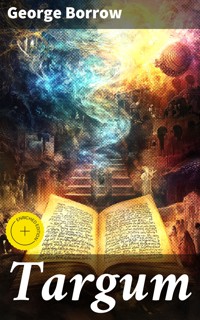
George Borrow's "Targum" is a remarkable exploration of the intersections between language, spirituality, and cultural identity. Written in 1851, the novel is imbued with Borrow's characteristic fusion of narrative, lyricism, and an acute sensitivity to the nuances of human experience. Set against a backdrop of theological and philosophical inquiries, the text delves into the process of translation'—not just of words but of ideas and beliefs'—mirroring Borrow's own quest for understanding the complexities of faith. Through its rich prose and vibrant characters, the work invites readers to traverse a landscape where the sacred and the mundane intertwine, echoing the literary context of the mid-19th century, a time when exploration of cultural and linguistic boundaries was becoming increasingly pertinent. George Borrow was a 19th-century English author and translator renowned for his interest in languages and diverse cultures. His experiences as a linguist and his travels across Europe, particularly in Spain and Eastern Europe, significantly influenced his worldview. "Targum" reflects Borrow's lifelong engagement with theological themes, as well as his fascination with the Romani culture, illustrating his commitment to portraying marginalized voices within literature. These elements, alongside his deep understanding of linguistic intricacies, chart the course for this compelling narrative. Readers intrigued by intricate narratives that challenge conventional beliefs and offer profound insights into the human condition will find "Targum" an essential addition to their literary repertoire. Borrow's masterful blend of history, spirituality, and personal reflection makes this work not only a captivating read but also a vital contribution to understanding the interplay of language and faith. This novel stands as essential reading for those seeking to comprehend the socio-cultural dynamics of Borrow's time and to appreciate the timeless journey of translation across both literal and metaphorical realms. In this enriched edition, we have carefully created added value for your reading experience: - A succinct Introduction situates the work's timeless appeal and themes. - The Synopsis outlines the central plot, highlighting key developments without spoiling critical twists. - A detailed Historical Context immerses you in the era's events and influences that shaped the writing. - A thorough Analysis dissects symbols, motifs, and character arcs to unearth underlying meanings. - Reflection questions prompt you to engage personally with the work's messages, connecting them to modern life. - Hand‐picked Memorable Quotes shine a spotlight on moments of literary brilliance. - Interactive footnotes clarify unusual references, historical allusions, and archaic phrases for an effortless, more informed read.
Das E-Book können Sie in Legimi-Apps oder einer beliebigen App lesen, die das folgende Format unterstützen:
Veröffentlichungsjahr: 2019
Ähnliche




Targum
Table of Contents
Introduction
Targum is a testament to how language carries stories across borders by changing their form. George Borrow’s collection gathers poems and songs from diverse traditions and recasts them into vigorous English verse, emphasizing movement, rhythm, and voice. Rather than presenting a single narrative, it offers a mosaic of tonalities—balladic, lyrical, and heroic—through which readers hear distant cadences in a new idiom. The result feels both scholarly and performative: a poet-translator channeling many sources while insisting on the pleasures of sound. In this way, the book invites us to consider translation not as a shadow of an original, but as a fresh act of literary creation.
Situated within the nineteenth century’s appetite for philology, folklore, and comparative literature, Targum belongs to the hybrid genre of poetry in translation. Borrow, a British writer noted for his linguistic pursuits, works here as a mediator between languages and readers, shaping material drawn from varied cultures into English metrical forms. Though the collection’s settings span far beyond Britain, its stage is ultimately the English page, where disparate voices meet in common measure. Published in the decades when European readers avidly sought national ballads and popular song, the book reflects that milieu while maintaining a distinctive energy that is recognizably Borrow’s.
The premise is deceptively simple: present readers with a series of metrical versions that preserve the momentum and character of their sources while making them immediately legible in English. What one encounters is an array of tones—martial vigor, melancholic reflection, earthy humor—filtered through a translator who values cadence as much as sense. The reading experience is that of an anthology shaped by a single sensibility: brisk, musical, occasionally archaic in diction, but never academic in manner. The mood is exploratory and generous, inviting readers to follow sound and story into unfamiliar territories without demanding specialist knowledge.
Translation here is not merely a technical problem; it is a theme. The very title invokes a long tradition of interpretive translation, since a “targum” historically denotes an explanatory rendering, most famously from scripture into Aramaic. Borrow’s usage foregrounds mediation: meaning emerges through reframing, not just replication. Throughout the collection, tensions between fidelity and freedom, foreignness and naturalness, are dramatized in line, stanza, and refrain. The pieces often seem to ask what must be kept to retain identity—rhythm, image, idiom—and what may be transformed to achieve live English verse. In this interplay, one senses translation as both homage and imaginative re-creation.
For contemporary readers, Targum matters because it models a way of reading the world through language—curious, outward-looking, and attentive to difference. It participates in the early formation of what we now call world literature, raising questions about representation, voice, and cultural transmission that remain urgent. How can a translator honor the strangeness of a source without surrendering clarity? What happens when oral textures meet print conventions? By foregrounding such issues in practice rather than theory, the book invites reflection on our own multilingual encounters, whether in literature, music, or everyday speech, and on the ethics and exhilarations of making meaning travel.
Borrow’s craft emphasizes pulse. He favors strong, singable meters and memorable rhyme schemes that evoke the oral life of many source traditions. Imagery tends toward the concrete—horses, roads, seas, festivals—anchoring the lyric lift of his lines. Diction varies with the piece: some poems wear a bardic mantle, others keep to plainer English, but all aim for immediacy. The translator’s presence is felt, though rarely obtrusive; one hears a guiding ear selecting cadence over strict literalism when the two conflict. This approach yields versions that perform on the tongue, revealing how rhythm can be a vehicle of cultural recognition as surely as vocabulary.
Readers approaching Targum may profit from treating it as both journey and conversation. Move across the collection as you might through a landscape, pausing to notice recurring patterns of beat, image, and refrain. Let the ear lead: these poems disclose themselves in sound. Context enriches the experience, but it is not a prerequisite; the book is designed to welcome, not to gatekeep. Consider, too, the historical moment of its making, when fascination with vernacular song met the English tradition’s formal resources. In that intersection, Borrow offers not a museum of curiosities, but a living exchange in which difference is rendered audible.
Synopsis
Targum is George Borrow’s collection of metrical translations drawn from a wide array of languages and dialects, assembled to display both the kinship and variety of world poetry. Rather than a narrative, the book is an anthology arranged to move the reader through different linguistic regions, with brief remarks that identify sources and meters. Borrow presents each piece in English verse, aiming to convey cadence, mood, and imagery while remaining readable. The volume functions as a tour of forms—ballad, hymn, epigram, and song—selected to illustrate characteristic voices. Throughout, the organizing idea is translation as re-creation, using English prosody to echo foreign rhythms.
The opening materials set out Borrow’s purpose. He frames Targum as an experiment in the reach of English verse and as evidence of his long study of languages. He explains that selection, not exhaustiveness, guides the book, and that fidelity to spirit will sometimes override literal phrasing. Short headnotes place each text in context, naming an origin, a traditional form, or a notable source. Borrow also acknowledges the compromises of meter and rhyme across idioms. The introduction, concise rather than theoretical, positions the volume as a practical demonstration: poems are presented to be heard in English while retaining traces of their native movement.
Early selections emphasize northern and Germanic traditions, where strong beats, alliteration, and ballad pacing shape the sound. Borrow chooses narrative pieces and songs that evoke seafaring, battle, winter landscapes, and stoic resolve. His English measures echo the originals’ driving rhythms without replicating them mechanically. Brief notes point to folk origins, manuscript witnesses, or long-circulating popular versions. In this cluster the reader meets compact stories and refrains that typify the region’s verse. The emphasis is on movement and tale-telling, establishing a baseline of directness that will contrast with later, more ornamented strains as the anthology advances through other language families.
Subsequent pieces draw from the Romance sphere, and the tone shifts toward lyrical smoothness, courtly address, and narrative romance. Borrow adapts strophic forms and rhyme schemes to suggest the flow of Iberian and Italian verse, choosing subjects that mingle love, honor, and piety. The English lines lengthen, cadences soften, and imagery expands into gardens, processions, and night songs. Headnotes sometimes flag the oral or printed provenance of a given romance or canzone. The selections demonstrate how a change of linguistic stock brings different melodic habits, and Borrow lets English accommodate those habits while keeping the poems brisk and intelligible.
Another group presents ancient and sacred strains. Here Borrow turns to classical and scriptural sources, where concision, gravity, and compact imagery predominate. Short hymns, epigrams, and paraphrases allow him to test English against venerable meters and elevated diction. He often remarks on the tension between literal sense and stately movement, indicating when a phrase has been broadened or compressed for metrical reasons. Names and allusions are clarified in passing. These pages serve as a midpoint, anchoring the collection in long-standing traditions of translation and paraphrase, and reminding the reader that metrical recasting has accompanied the transmission of revered texts for centuries.
From there the anthology travels eastward, sampling lyrics and maxims associated with Arabic, Persian, Turkish, and neighboring literatures. Themes of hospitality, transience, praise, and admonition come to the fore, often expressed through compact images and repeated turns. Borrow’s renderings favor clear quatrains and couplets, aligning English phrasing with patterns that suggest the originals’ balance and repetition. He offers occasional glosses on metaphors that may puzzle readers outside the tradition. The emphasis remains practical: to provide singable or speakable English that hints at unfamiliar ornament without obscuring meaning. These pieces broaden the book’s palette while maintaining its accessible, metrical approach.
The next stages move through Slavic and borderland songs, and into itinerant or marginal dialects that interested Borrow as a language collector. Laments, wedding songs, and brief narrative fragments predominate, marked by refrains and direct address. The translations keep a steady beat and plain diction, letting emotional patterns show without elaborate ornament. Notes may remark on performance contexts or recurring formulae. A handful of pieces from traveling communities underscores Borrow’s broader fascination with speech on the move. Here the collection stresses memory, refrain, and communal voice, showing how portable forms carry experience across frontiers and into English measure.
As the volume rounds out, Borrow turns to Celtic and other regional tongues, offering nature pieces, elegies, and proverbial verse. He adjusts cadence to suggest distinctive sound patterns while preserving clarity. Brief comments acknowledge difficulties of reproducing internal music in English lines. Shorter curiosities and fragments complete the tally of languages and dialects promised by the title. An appendix-like tail of notes and acknowledgments traces sources without heavy scholarly apparatus. The arrangement preserves momentum: variety remains the guiding principle, but each section has a recognizable profile. The closing pages reiterate the practical aim—English verse that carries echoes rather than replicas.
Across its course, Targum presents a compact, multilingual portrait of song, designed to demonstrate how English meters can register diverse idioms without losing intelligibility. The book’s key conclusion is pragmatic: translation in verse must balance faithfulness with movement, and success lies in preserving tone, cadence, and recognizable form. By sequencing selections geographically and stylistically, Borrow invites comparison while avoiding extensive theory. The overall message emphasizes kinship amid difference—shared themes of love, courage, sorrow, devotion—carried in varied shapes. The result is a portable gallery of voices, intended to acquaint readers with unfamiliar poetry and to suggest the possibilities of metrical translation.




