


3,99 €
Mehr erfahren.
- Herausgeber: Ediciones Deldragón
- Kategorie: Für Kinder und Jugendliche
- Sprache: Englisch
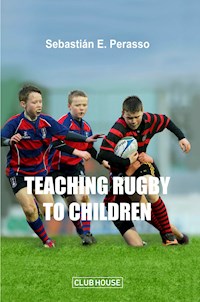
This book is an indispensable contribution for all those who coach under age rugby (from six to fourteen years). With a simple language, the author deploys the necessary tools so that the coaches can provide an integral education to the child, which implies to settle skills in the player and values in the person. All are invited to enter the universe of children's rugby, an exciting place and at the same time different, unique, that leaves deep traces in the lives of thousands of kids who practice this fabulous sport named Rugby.
Das E-Book können Sie in Legimi-Apps oder einer beliebigen App lesen, die das folgende Format unterstützen:
Veröffentlichungsjahr: 2019
Ähnliche














![Tintenherz [Tintenwelt-Reihe, Band 1 (Ungekürzt)] - Cornelia Funke - Hörbuch](https://legimifiles.blob.core.windows.net/images/2830629ec0fd3fd8c1f122134ba4a884/w200_u90.jpg)




TEACHING RUGBY TO CHILDREN
SEBASTIÁN E. PERASSO
TEACHING RUGBY TO CHILDREN
Translated by Florencia Ferraris
Perasso, Sebastián E.
Teaching rugby to children / Sebastián E. Perasso. - 1a ed . - Ciudad Autónoma de Buenos Aires : Deldragón, 2019.
Libro digital, Amazon Kindle
Archivo Digital: descarga
Traducción de: Florencia Ferraris.
ISBN 978-987-1884-98-8
1. Deporte. 2. Enseñanza. 3. Rugby. I. Ferraris, Florencia, trad. II. Título.
CDD 796.333
CLUB HOUSE Publishers
Un sello de Ediciones Deldragón
Emilio Mitre 71 – 7º B (1424) Buenos Aires
República Argentina
TEACHING RUGBY TO CHILDREN
© 2019, Sebastián E. Perasso
Dirección editorial: Ricardo J. Sabanes
Traducción al inglés: Florencia Ferraris
Diseño: Laura Restelli
Derechos de edición reservados para todo el mundo:
© 2019, Ediciones Deldragón
Primera edición impresa: febrero 2019
Primera edición digital: mayo 2019
www.edicionesdeldragon.com.ar/
ISBN edición digital: 978-987-1884-98-8
Digitalización: Proyecto451
Queda hecho el depósito que prevé la ley 11.723
Ninguna parte de esta publicación, incluido el diseño de la cubierta, puede ser reproducida, almacenada o transmitida en manera alguna ni por ningún medio, ya sea eléctrico, químico, mecánico, óptico, de grabación o de fotocopia, sin permiso previo del editor.
To my son, Isidro
THANKS
To Marcelo Loffreda, who kindly wrote the prologue for this book.
I have known him since I was very young because of his close bond with my father. However, the decade that separates us made having a relationship between us a true utopia.
Always with my nose on the fence, I grew up admiring the captain of the First fifteen of my club during nine seasons, the emblem player of the SIC [San Isidro Club]who played continuously for two decades.
The years went by and once I was on the senior squad, the opportunity to talk among peers was separated by an abyss. When I stopped playing and distanced myself from the active practice of rugby, the passing of time began shortening those vast distances and I finally had the possibility to get to know him closely and with no intermediaries…
Since very young, he stood out among the rest. Nevertheless, he assumed with nobility and responsibility the leadership that was imposed on him thanks to his strong personality, his sports stature, and his ability to play and, later on, coach. In times when examples are scarce, ‘el Tano’ is a compass that indicates the path of rugby.
Arrogance and pride are nowadays commonplace in many athletes that have reached only meagre sports achievements. As a counterpart, ‘el Tano’ has received the highest honours both as a player and as coach. However, that demeanour of the simple and prudent man is still unchanging. ‘El Tano’ belongs to a legion of people who, rather than feeling glorified, are uncomfortable with praise.
His feats and his achievements have made him one of the most important persons in the history of rugby in Argentina. His numbers cause amazement and his career would leave any renowned athlete of any discipline open-mouthed. Nonetheless, behind that waterfall of achievements and recognitions, that mountain of awards and trophies he has earned, there is a simple man, a person who loves my dear club and is proud to proclaim and spread the foundational values and principles of the game itself.
His gestures and his words are a guide for new generations not to lose their way and go down the road of self-improvement, honesty, and respect.
Let this space serve as an expression of my thankfulness.
Sebastián E. Perasso
PROLOGUE
One of the things I thank my parents for is taking me to a rugby club when I was nine. It was not precisely the one in which I played my whole life, but, paradoxically, its main rival. But that is another story.
I had a normal and nice childhood, with many friends. And thanks to rugby it was even better.
I got to my first training session holding my father’s hand, not knowing what it was about. I was wearing the famous (at least for my generation!) and dear football boots ‘Sacachispas.’ I was neat and tidy, the way my mum expected me to be. I wore a pair of blue shorts and a white T-shirt that I used to wear for gym lessons at school, and on my inside I felt a mixture of uncertainty and expectations, nerves, fear, and embarrassment. I could say at that moment I started feeling something unknown until then, something that would later on be called stress.
The most interesting thing was when the training session started, something arose inside me, still an incipient being in body and mind, something I still feel nowadays when I am involved in the game. It was a combination of passion, challenge, enjoyment, an intense experience of the here and now, I don’t know – something very strong and deep that keeps happening. A kind of magic formula that makes me be really alive, really attentive, and really alert.
This book is for those who already are, or intend to be, in contact with the thousands of kids that cover the rugby fields on Saturday mornings. Those kids, too, in some way, are ‘players’, but before that they are children, with everything that implies: they are open, pure, unprejudiced, spontaneous, inquisitive, authentic, honest, and innocent. That is why, they do not only need coaches or instructors, but they also need the educator, the counsellor, the confidant, and every once in a while, the teacher. These roles should coexist in a same person: the coach.
In the modern game, players are asked to be versatile, and the same should be asked of age grade rugby coaches – versatility, but obviously, together with specific qualities and a bigger responsibility.
Monumental task ahead, is it not? However, to begin, all that is needed is audacity and good will. From then on, you will be welcome in any rugby club. All you have to remember is that one of the main goals at an early age is to arouse interest in and enthusiasm for the game.
It is not my intention in these lines to talk about the virtues of rugby. That is what this excellent book is for, which not only delves into topics referring to the first stages of the kid-player, but also teaches us, nurtures and transmits concepts useful for any age. Forever, in fact. I invite you, then, to get into this enthralling adventure narrated by Cheba that surrounds us thoroughly, completely and responsibly in a different way of living and passing on values and principles.
What Cheba asks of us is to get involved, to commit to this wonderful game that from very early on trains, educates, and allows us to live generously and caringly, a game that influences many children’s lives in a respectful and positive way during a time in which whatever they learn is stuck with them forever.
The most amazing thing is that not only are we able to help the children be better people through the game, but the same will happen to us.
Marcelo Loffreda




