


0,99 €
Mehr erfahren.
- Herausgeber: Creative Quill Press
- Kategorie: Für Kinder und Jugendliche
- Sprache: Englisch
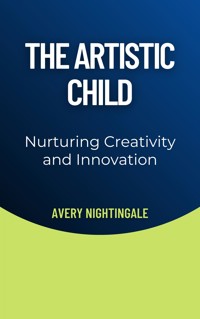
In a world where creativity is often stifled by traditional education systems, The Artistic Child: Nurturing Creativity and Innovation by Avery Nightingale shines a light on the importance of fostering artistic expression from a young age. Drawing on extensive research, this book explores how creativity is an innate biological mechanism that begins to develop in the earliest years of life. Nightingale delves into how children’s natural artistic instincts are often suppressed in formal education, highlighting the need for a more creativity-centered approach in early childhood development. Through a thoughtful examination of young children’s art, this book reveals how even the simplest drawings reflect a deep understanding of the world around them. Whether you're a parent, educator, or advocate for creative education, The Artistic Child provides valuable insights and practical strategies for nurturing the next generation of innovators.
Das E-Book können Sie in Legimi-Apps oder einer beliebigen App lesen, die das folgende Format unterstützen:
Veröffentlichungsjahr: 2024
Ähnliche








The Artistic Child: Nurturing Creativity and Innovation
Avery Nightingale
Published by RWG Publishing, 2024.
This is a work of fiction. Similarities to real people, places, or events are entirely coincidental.
THE ARTISTIC CHILD: NURTURING CREATIVITY AND INNOVATION
First edition. August 28, 2024.
Copyright © 2024 Avery Nightingale.
Written by Avery Nightingale.
10 9 8 7 6 5 4 3 2 1
Table of Contents
Title Page
Copyright Page
Introduction
Understanding the Artistic Child
Encouraging Creativity at Home
Fostering Artistic Expression through Education
Developing an Artistic Mindset
Exploring Different Art Forms
Nurturing Innovation and Problem-Solving Skills
Supporting the Artistic Child's Emotional Well-being
Building a Supportive Community for the Artistic Child
Overcoming Challenges and Obstacles
Recognizing and Celebrating the Artistic Child's Achievements
Conclusion
Introduction
Current educational and social systems have been designed to repress, or at best manage the expression of creativity in young children. Despite the fact that research yields substantial and continuous evidence of the importance for success and well-being to open the tap on abundant creativity in early school years, an artistic basis is intentionally withheld in the earliest years of formal education. Five human basic instincts include (but not limited to): perceptual, cognitive, artistic, communicative, emotional, and moral intuitions. In this piece, I would like to draw upon consideration of the further examination of the role of creativity as an innate biological mechanism that reflects the first five years in the life and the critical role played by the utilitarian fabric of a child's school in repressing the tap upon art.
For human beings, the creation of expressive art is wired into the brain by one and a half. From the first paintings and sculptures, compositional geometry can be seen in many examples of how young children call upon the collective visual experiences of humanity and current art events as they engage in producing their own individual images. In nearly half of the earliest drawings, young children's creations are observed to form iconic, schematic images that reflect the generic structure of a human figure or in experimental instances, a cat or a tree. Also, to reflect young children's intuitive understanding of kinetic actions, specific details, such as the fingers, toes, and neck are drawn as children gain increased command with their mark makers. Even objects drawn which are not human-like embody compositional features reflecting familiar shapes such as trees and flowers rounding the basis for the intuitive understanding of visual metaphors.
Understanding the Artistic Child
When we introspect our lives, the argument we present in the following paragraphs becomes intuitive. We had a prime interest in music, art, mathematics, biology, and history, among other things, way before we received our first "real education." This exposes the generative spirit that naturally captivates children and bears their inherent uniqueness – and for that, Isaac Stern pronounces that "creative juices exist in all human beings and are, I believe, the very essence of life." It seems to us most natural that, as parents, dishwashers, bakers, and at kindred places, we exposed our preschool children to these faculties. Does it mean that we were perhaps not chained to rigid schedules, at all times physically present with our children, vigilant towards eating clover-free bread, wakeful about our family priorities, and the like? No, not at all. While there were times we were on a trip, but it was not through time and history; while there were times when work and various obligations delayed us, we were always there to pick up the pieces from a subsequent collision, be it with a bruising fourteenth-century suit of armor or a hyper-realistic wax figure which was supposed to have remained still at least for a quarter, or even a supermarket window.




