


0,93 €
Mehr erfahren.
- Herausgeber: Wildside Press
- Kategorie: Krimi
- Sprache: Englisch
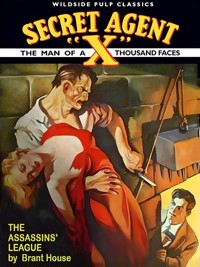
Ripped from the pages of the October, 1937 issue of Secret Agent "X" magazines comes this sensational novel, The Assassins' League! When a wealthy arms manufacturer and a powerful gang lord both kill themselves -- when each had the world by the tail -- Secret Agent X looks into the suicides.
What is the baffling, contradictory cause of their enigmatic deaths? Worse yet, through the course of his investigation, X's amazing disguises fail him at every turn. A strange, beautiful girl posses the power to see through his perfect impersonizations. Has the Man of a Thousand Faces finally met his match?
Das E-Book können Sie in Legimi-Apps oder einer beliebigen App lesen, die das folgende Format unterstützen:
Seitenzahl: 152
Veröffentlichungsjahr: 2024
Ähnliche




















Table of Contents
Secret Agent “X” in THE ASSASSINS’ LEAGUE by Brant House
COPYRIGHT INFORMATION
INTRODUCTION, by Karl Wurf
CHAPTER I
CHAPTER II
CHAPTER III
CHAPTER IV
CHAPTER V
CHAPTER VI
CHAPTER VII
CHAPTER VIII
CHAPTER IX
CHAPTER X
CHAPTER XI
Secret Agent “X” in THE ASSASSINS’ LEAGUEby Brant House
COPYRIGHT INFORMATION
Originally published in Secret Agent “X” magazine,
Volume 6, Number 2 (September 1935).
This edited edition copyright © 2004 by Wildside Press.
All rights reserved.
Published by Wildside Press LLC.
wildsidepress.com
INTRODUCTION,by Karl Wurf
Secret Agent “X” stands as a quintessential figure in the pantheon of pulp heroes, emerging from the vibrant era of pulp magazines in the 1930s. First introduced in 1934 by Ace Magazines, Secret Agent “X” captivated readers with his extraordinary talents and mysterious persona. Known for his mastery of disguise, unparalleled combat skills, and ingenious use of gadgets, Secret Agent “X” tackled the most sinister of villains and intricate criminal plots.
The series was primarily written by Paul Chadwick under the house pseudonym “Brant House,” though other writers occasionally contributed to the adventures. Each story plunged the reader into a whirlwind of action and intrigue, maintaining a relentless pace that kept the pages turning.
In The Assassins’ League, originally published in Volume 6, Number 2, in September 1935, Secret Agent “X” faces one of his most dangerous foes. This gripping narrative showcases the hallmarks of the series: intense action, clever subterfuge, and a shadowy atmosphere. As with many pulp stories, the identity of Secret Agent “X” remains shrouded in secrecy, adding to the character’s mystique and enduring appeal.
This new edition seeks to introduce modern readers to the thrilling exploits of Secret Agent “X,” preserving the legacy of a hero who epitomized the golden age of pulp fiction. Through this reissue, we celebrate the creativity and excitement that defined an era and continue to resonate with fans of classic adventure stories.
CHAPTER I
Killer’s Homecoming
The reputation for quiet dignity for which Chicago’s Ayreshire Hotel was famous had become somewhat defiled by the presence of twelve men who had come to meet a murderer. They were mostly young men, armed with cameras, pencils, photo flash-lamps, notebooks, wads of chewing gum, jeers, cigarettes, stories, wisecracks about passing women and press cards that served them as open-sesames to most of the doors in town.
They were reporters, their habitual nervous tension somewhat loosened for a few minutes. They were about to polish off a long story of legal and illegal warfare with a few photos and a final interview. Then most of them were going out to get drunk. A few anticipated their moments of relaxation by frequent visits to the Ayreshire bar.
The murderer was Steve Hackman. Whether it was because of smart work on the part of Hackman’s mouthpiece, Hackman’s money, the inexperience of the prosecutor, or jury intimidation, was a matter of considerable debate; but anyway, the law said that Hackman wasn’t a murderer.
These reporters knew differently.
If he hadn’t killed this time, he had a time or so before. So Hackman was a murderer—he was news.
A dour-faced reporter came out of the bar with a glass in his hand. He leaned against the door-frame and allowed his lackluster eyes to rove across the thickly carpeted lounge. Then his eyes brightened perceptibly. He beckoned with his glass to a near-by colleague. “Hey, ‘Red’,” he called softly.
“Red” broke away from a window and came toward the dour-faced man. Red was all that the name implied. He was perhaps the youngest man in the group. He had a turned-up nose, a laughing mouth, countless freckles and a shock of unruly red hair. He was lean-waisted and broad-shouldered. The pocket of his coat was sagged by the weight of his flash-lamp. He had a camera and a tripod over one shoulder. An otherwise sad hat was given an air of jauntiness by the way it was tilted on the back of his head.
The dour-faced reporter stuck out his glass and squinted over its rim at the stairway that curved artistically around the side of an immense, stone-faced fireplace in the lounge and climbed on up behind the huge chimney. He said:
“Red, how would you like to have that phone number? These old eyes have piped them from the Rialto to the Palmer House and never seen such a Juliet as the one about to do a balcony with Gee-Gee Janes.”
The “Juliet” was wearing a low-cut evening gown of flame-colored material that hugged her tall, svelte figure. She was blond. The wave of her straw-gold hair was unusual. Her eyes were so deep a blue that, in the parchment-shaded lights of the lounge, they appeared almost black.
“Hmmm,” breathed Red. “That nose and chin—a lot of hauteur, If I may say so.”
“Oh, quite,” said Dour-face. “And that mouth! Would you say luscious? I think I would. Who the hell is she? And what does a room in the Ayreshire cost, my boy?”
Red shook his carroty mop. His ignorance of the woman was a neat bit of deception. His very face was clever deceit. His hair was a toupee. And if the dour-faced reporter had paid any attention to Red’s eyes, be would have noticed that they were steel-gray instead of blue.
They were remarkable eyes, now lighter with ironic laughter, now grave with the responsibility that rested upon their owner, and again fired with tremendous will-power that was almost hypnotic. Had the reporters but known, here was a man whose adventures would have made greater news than the acquittal of a crimester-murderer like Steve Hackman.
For their redheaded colleague was Secret Agent X, whose life was devoted to leading men like Hackman to inevitable justice that lay along strange paths that wound in and out between law and lawlessness. Secretly sponsored by the federal government, Agent X could well afford to overlook the narrow boundaries between the world and the underworld; could ignore the orthodox routine that paralyzes an ordinary investigator.
Agent X knew the woman in the flame-colored frock. He had followed her for days, ever since her boat had docked at New York. But he had averted every chance of her knowing that she was being followed, by his masterly disguises. On previous days he had entered the Ayreshire, but always in different clothes and behind a different face. A great portion of his success as an investigator depended upon his uncanny skill to impersonate, both in appearance and in voice, almost any man. The woman had almost as many aliases as the Agent. For the moment, she was Sheila Landi. Yet always, for some reason unknown to Agent X, she was known as the “Mole.” And she was always involved in high crime, political intrigue or espionage. When secret police of Europe smelled scandal in high places, or learned of smoldering revolt, they sought the woman. When she was found, inevitably she was the “Mole.”
She was standing on the artistic stairway, an appropriate setting for her gemlike beauty. She had her slender, tapering hand on the arm of a man whose coat was the least bit too tight about the waist and across the shoulders:
“Wonder,” said Agent X, “why she’s turned her thousand candlepower charm on a guy like Gee-Gee?”
“Me too,” the reporter groaned. “Wonder if she don’t know any better. Apt to get herself a set of scorched fingers messing around with Gee-Gee. What’s he got that I haven’t?”
X chuckled. “A smile, for one thing.”
Gee-Gee Janes had a smile that spread all over his dark, round face.
“And dough,” sighed the reporter. Gee-Gee had some of the best dough in Chicago, though it was frequently scorched around the edges. Gee-Gee Janes was “in the racket.” He generaled one of the most powerful gangs in the town. He took off his hat to no one save Steve Hackman, and only to Hackman because it made him richer. Also, if you were in the rackets, you took off your hat to Hackman because you lived longer by doing so.
Janes and the woman continued up the stairway. They reached the balcony. They walked—or rather the woman walked—while Janes swashbuckled the length of the balcony. In the shadow of the great chimney, Janes became more presumptuous. He got one arm around Sheila Landi’s waist. His large, dark eyes met hers in an intimate glance. Then they were out of sight behind the great chimney.
“Hell!” said the dour-faced reporter, and turned away.
The Agent’s eyes studied the shadows along the balcony. Queer business—Sheila Landi playing up to a swaggering racketeer. He certainly wasn’t her usual game, nor was she the sort for Gee-Gee Janes.
A reporter flew off tangent from the revolving door of the Ayreshire, cupped his hands over his mouth and yelled: “Here’s Steve!”
Thus heralded, Steve Hackman came home. Just inside the door he stood, dwarfed by two strong-arm men who accompanied him, for Hackman wasn’t a big man physically. He had sleek, white hair. His eyebrows were bushy and never on the same level with each other. His eyes were expressionless, nor had his clean-shaven-face changed from the stoical mask it had always been in the court rooms.
The reporters circled Hackman, yelled questions, asked him to “hold it” for a photo. Steve Hackman silenced them with a gesture as perhaps no other man in the city could have done. Then, for the first time in a long while, Steve Hackman smiled.
“Quite a little reception, boys,” he said in a quiet, inflexible voice.
Then he saw Gee-Gee Janes coming in from the lounge. Janes had the woman in the flame-colored gown on his arm. She hung back, and Gee-Gee went forward to elbow his way between Agent X and the dour-faced reporter.
Closely, the Agent studied Janes’ face, its plump cheeks, slightly hooked nose, wide mouth, and that white, horizontal scar that creased Gee-Gee’s chin. He studied Janes’ walk and the curious twist he gave his shoulder after the manner of a fighter coming out of his corner of the ring.
“How yah, Steve?” Janes grinned and stuck out his hand at Steve Hackman. Hackman took the hand. With the knuckles of his left hand he rapped Janes’ barrel of a chest. Then Hackman looked past the reporters and saw Sheila Landi.
“Doing plenty for yourself—eh, Gee-Gee?” Hackman grinned.
“How about a story, Mr. Hackman?” asked the dour-faced reporter.
Hackman nodded. “Guess you boys treated me all right in the papers, didn’t you? There isn’t much in the way of a story, but come on upstairs and we’ll have a drink. How about it?”
Reporters and crimesters started for the elevator. X saw Janes turn his head and beckon to Sheila Landi. She moved quickly across the sheen of floor and was beside Janes by the time the crowd reached the elevator.
“Want you to meet Sheila Landi, boss,” announced Gee-Gee. “Sheila, this is my pal. Guess I don’t have to tell you his name.”
“Guess you don’t,” purred Sheila Landi. She extended her hand to Hackman. “How are you, Mr. Hackman?”
There was little that was continental in the way Sheila spoke and acted now, X noted. She had her part down well; knew exactly what she was after. X only wished that he knew as much.
“It’s a pleasure,” said Hackman, but he scarcely more than touched her hand.
Hackman leased the penthouse on top of the Ayreshire. Night breezes off the lake swept through French windows of the living room and brought along the perfume of flowers from Hackman’s roof garden. Hackman waved toward the walnut-paneled bar at one end of the room. “Help yourselves, boys. Get what you want. Take your time about it.”
“How about a picture, first?” said Agent X. “A little home stuff for the public.”
Hackman nodded, rested his hand on the back of a chair, and stared at the various cameras set up about him. Janes tried to crowd into the picture, but Hackman kept him at a distance with a gesture.
“When they mug you, Gee-Gee,” he laughed, “you’ll have a number on your chest…Get started, boys.”
Flash bulbs flared. Expert fingers manipulated plates. Hackman sighed after it was over, dropped into a chair. “Shoot!” he said to the reporters, but he was looking at Sheila Landi where she leaned on the back of a chair and kept admiring eyes on Gee-Gee Janes.
“Well, how do you feel, Mr. Hackman?” began one of the reporters.
“A little tired,” said Hackman. “I don’t want to rush you boys off, but as soon as you’re through, I’ll go to bed and relax. Don’t think I won’t relax.”
“Got nothing to worry about, eh?”
“Not a thing. Got the world by the tail.”
“And what’s on the ticket, next, Mr. Hackman?”
Hackman chuckled. “Wouldn’t a lot of people like to know? But—” he held up his hand—“don’t print that. Tell ’em I’m going to take a jaunt to Europe. Going to see the Louvre. Art and history, see?”
“And when you get back?” a reporter prompted.
“Well, it’s hard to keep a good horse out of harness,” Hackman admitted. “I’ve got business to attend to. Quite a bit of it.”
“Yeah?” The reporters waited breathlessly, for Hackman seemed in deadly earnest.
“What kind of business?” X asked. Hackman eyed the Agent’s red hair keenly. “Tell you what you can say, Red. Tell Johnny Q. for me that when I get back from the Louvre I’m going to raise chickens.”
Gee-Gee Janes’ roar of laughter was a welcome applause. Janes got a wink from his gray-faced chief. Then Hackman stood up: “And anything else Johnny Q. wants to know, tell him to go to hell. That’s all, boys.” Hackman glanced toward the bar where the dour-faced reporter was caught with a tall bottle in his hand. Hackman frowned. “You like that stuff, Long Pan?”
The reporter started to put the bottle down, but Hackman checked him. “Take it with you. Just save me enough rye for a nightcap. And get going, boys. Like to be alone for a change.”
Newshawks took what bottles they could get their hands on, thanked Hackman enthusiastically, and trooped out of the penthouse. Agent X was the last to go. Looking back, he saw Hackman saying good night to Sheila Landi, Janes, and the two strong-arm boys.
X said to his long-faced companion: “Guess he really means he’s going to do a Garbo.”
The reporter nodded. “And all along I thought he’d go for Gee-Gee’s girl friend. You know I’ve a crazy sort of a hunch that Steve Hackman will be back in print in a little while. Something’s in the air.”
“Love in bloom,” said the Agent as he and his companion stepped into the elevator.
Just as they passed the sixth floor, the Agent’s companion elbowed the elevator operator. “Back up to the sixth. That’s where we get off.”
“What’s the idea?” demanded the Agent.
“Wait.” The reporter had hold of the Agent’s arm, and as the car backed to the sixth floor, he shoved X into the hall hardly before the safety gate had slid all the way back. He was at X’s side, pointing down the hall in another second.
“See it, Red? It’s a story, if we’re smart.”
Down the hall, fumbling with a key in the lock of a door, was a tall, spare man with startled, pale eyes, a mustache that resembled a worn toothbrush, and close-clipped, yellow-gray hair.
“Mr. Madvig,” the reporter hailed the man.
The tall man whipped around.
Suspiciously, his pop-eyes rolled from X to the reporter.
“Mr. Leo Madvig, isn’t it?” The reporter nudged X. “Do your duty with the camera, Red. This is a scoop.”
“Eh?” said Madvig. “What is all this?”
X planted his camera, focused it on the startled Madvig, set off a flash-lamp.
Madvig jumped, cursed softly, cried: “No, no, no! I don’t want publicity. How many times have you got to be told I’m not for the papers?”
“You’re a little late, now,” X said as he slid the camera plate. “And we can’t print your picture without a story.” Aside to the reporter he asked: “Who is the guy?”
“Inventor,” whispered the reporter. Aloud he said: “Look here, Mr. Madvig, I’ve got just the spot for you on the science and invention sheet of the Sunday paper. You know the sort of stuff—what the future holds and so on.”
Madvig stamped his foot. “I tell you I’m not a soothsayer.”
The reporter buttonholed Madvig. “Listen, I saw you talking with a couple of big shots in the munitions business the other day. You hinted at a revolutionary weapon, something that would insure the victory of any nation possessing it in case of war. Now come across, Mr. Madvig. Everything’s confidential, see? If you don’t—well, I could just turn my imagination loose. Just give me an idea of what sort of a future hell a battlefield in 1950 will be, can’t you?”
Madvig smiled shyly. “Well,” he dragged out, “this much I can tell you. And don’t come asking for more. I have invented a weapon, the nature of which I refuse to reveal. To my own mother I wouldn’t reveal it, if I had a mother. But let me tell you this—my weapon will give an entirely new conception of death. It is so deadly that whole nations might be wiped out, and, as the saying goes, wouldn’t know what struck them. So you know why I guard my secret with my life. To me it is like Frankenstein’s monster. I have created it, yet I fear it.”
“As bad as all that, eh?” X chimed in.
Madvig shook his long head. “Worse. My weapon is destruction—noiseless, certain destruction.”
“And you’re going to market it?” demanded the reporter.
“I do not know,” replied Madvig sadly. Then his prominent eyes fell to jerking up and down the hall, glancing from door to door. “I—I should not have spoken,” he said huskily. “Good-night.”
“Hey, wait!”
But Leo Madvig had his door open. He backed into the room. The door slammed; the lock snicked.
“Ummm,” sighed Agent X. “What have you got now? Picture of a queer fish and pessimistic words concerning the destruction of the universe. Too bad Jules Verne is dead. Let’s get moving.”
They went downstairs and into the taproom. There the reporter started his celebration as soon as he had phoned his story and dispatched the picture X had taken of Steve Hackman.




