


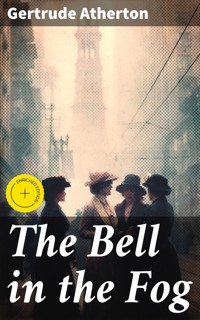
1,99 €
Niedrigster Preis in 30 Tagen: 1,99 €
Niedrigster Preis in 30 Tagen: 1,99 €
Mehr erfahren.
- Herausgeber: Booksell-Verlag
- Kategorie: Gesellschafts- und Liebesromane
- Sprache: Englisch
Gertrude Atherton's "The Bell in the Fog" weaves a rich tapestry of early 20th-century American life, merging gothic elements with a keen psychological insight into human relationships. Set against the atmospheric backdrop of foggy San Francisco, the novel explores themes of love, betrayal, and societal constraint through its intricate character studies. Atherton's prose is both lyrical and incisive, revealing the nuances of the human condition while reflecting her contemporary literary milieu, which includes the works of naturalists and modernists who sought to challenge traditional narratives. Gertrude Atherton, a prominent figure in the early feminist literary movement, produced this work during a dynamic period as women's rights were gaining traction in America. Her experiences growing up in California and her activist engagement undoubtedly influenced her portrayal of female characters grappling with the constraints of a rapidly changing society. Atherton's rich literary background and her personal trials imbue the narrative with authenticity, making her insights into gender roles and individual autonomy particularly resonant. "The Bell in the Fog" is a compelling exploration of identity and societal pressures that speaks to both historical contexts and contemporary issues. Readers seeking a profound understanding of human nature, layered storytelling, and a glimpse into the evolving role of women in literature will find this novel an essential addition to their literary repertoire. In this enriched edition, we have carefully created added value for your reading experience: - A succinct Introduction situates the work's timeless appeal and themes. - The Synopsis outlines the central plot, highlighting key developments without spoiling critical twists. - A detailed Historical Context immerses you in the era's events and influences that shaped the writing. - A thorough Analysis dissects symbols, motifs, and character arcs to unearth underlying meanings. - Reflection questions prompt you to engage personally with the work's messages, connecting them to modern life. - Hand‐picked Memorable Quotes shine a spotlight on moments of literary brilliance. - Interactive footnotes clarify unusual references, historical allusions, and archaic phrases for an effortless, more informed read.
Das E-Book können Sie in Legimi-Apps oder einer beliebigen App lesen, die das folgende Format unterstützen:
Veröffentlichungsjahr: 2020
Ähnliche







The Bell in the Fog
Table of Contents
Introduction
In Atherton’s The Bell in the Fog, the past refuses to stay buried, humming through the present like a muted warning bell, luring a solitary sensibility toward beauty and remembrance while testing the perilous boundary between cherishing what is lost and trying to command it—an invitation as consoling as it is treacherous, drawing the mind into mists where emotion thickens, reason thins, and the self must decide whether to trust what it hears or to accept that some callings are echoes with no source.
Gertrude Atherton, an American writer known for incisive social observation and a taste for the uncanny, introduced this story in the early twentieth century, collecting it under the same title among other tales. The Bell in the Fog belongs to the tradition of psychological ghost stories and refined Gothic, more suggestive than sensational. While the narrative perspective remains grounded in realism, the atmosphere is saturated with uncertainty, inviting readers to inhabit a liminal space where belief and skepticism coexist. The era’s preoccupation with memory, decadence, and the residues of history is palpable, shaping a narrative attentive to inner weather.
Without straying beyond the opening movements, the tale follows a cultivated figure who retreats from the noise of society and finds, in a secluded environment, a pattern of signs that seem to beckon: histories told in fragments, images that feel alive, and a bell that tolls through obscurity. The plot advances less by incident than by intensifying attention, as the protagonist’s private sensibility becomes a tuning fork for suggestion. What results is an experience that is intimate, hushed, and inexorably absorbing, focused on perception, mood, and the delicate pressures exerted by place, rumor, and recollection.
Atherton’s voice is poised and discriminating, favoring carefully modulated sentences, psychological shading, and an almost tactile sense of texture and sound. The prose cultivates ambiguity without vagueness, allowing meanings to accumulate by implication rather than explicit declaration. A subtle musicality governs the pacing: images recur, motifs deepen, and the bell—both object and idea—organizes attention. Readers encounter a quiet, cultivated eeriness rather than spectacle, the unease arising from what remains just out of reach. This is a story to inhabit rather than to race through, rewarding patience with tonal richness and a lingering, resonant aftereffect.
Among its central themes are obsession’s seductions and hazards, the ethics of looking, and the way beauty can become a form of possession that blurs sympathy into control. Atherton is alert to the fragility of memory and the theater of perception—the possibility that the mind edits experience to suit its longing. Doubleness runs throughout: past versus present, image versus reality, sound versus silence, devotion versus appropriation. The bell and the fog operate less as plot devices than as living metaphors for attention itself, at once clarifying and occluding, summoning and warning, promising knowledge while enfolding it in mist.
Contemporary readers may find the story strikingly current in its questions about curation, projection, and how narratives we inherit—or construct—shape what we think we know. In an age saturated with images and echoing signals, Atherton’s attention to ambiguous testimony and the ethical stakes of fascination feels timely. The tale encourages a wary empathy: to look closely without assuming mastery, to acknowledge the limits of one’s frameworks, and to respect the opacity of other lives. It also offers a refuge from noise, modeling an art of attentiveness that resists haste and prefers the difficult clarity of sustained contemplation.
Spoiler-free but candid, it is fair to say that The Bell in the Fog delivers its revelations with restraint, preferring psychological inevitability to dramatic flourish. The satisfaction it offers is cumulative and reflective, inviting rereading and reconsideration. For readers drawn to finely wrought atmospheres, moral complexity, and the quiet chill of suggestion, Atherton’s tale exemplifies how early twentieth-century short fiction could marry elegance with unease. It stands as a compact study of how the past can enthrall the present, and how attention—like a bell sounding through weather—can both guide and mislead the seeker who listens too closely.




