


Erhalten Sie Zugang zu diesem und mehr als 300000 Büchern ab EUR 5,99 monatlich.
- Herausgeber: Pushkin Children's Books
- Kategorie: Für Kinder und Jugendliche
- Serie: True Adventures
- Sprache: Englisch
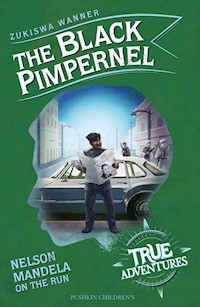
The story of Nelson Mandela's early years on the run from the apartheid authorities JOHANNESBURG. MARCH 1961. Thirty-one activists are on trial for treason. Among their number is Nelson Mandela, a rising star of the resistance movement and one of the biggest threats to the South African government and their racist system of apartheid. To everyone's surprise, they are found not guilty. But rather than relish his newfound freedom, Nelson disappears. With this, the incredible true story of Nelson Mandela's life on the run begins. For months, he is an outlaw, the police and secret services hunting him in vain, living under new identities and separated from his young family. His mission? To set up armed resistance to apartheid, and in doing so change the course of history. Zukiswa Wanner is the award-winning author of four novels, three children's books and two nonfiction books. Her last children's book was Africa: A True Book (2019). In 2020, she became the first African woman to be a Goethe Medailist. In the same year she founded the virtual literary festival Afrolit Sans Frontières and was selected among New African's 100 Most Influential Africans.
Sie lesen das E-Book in den Legimi-Apps auf:
Seitenzahl: 125
Veröffentlichungsjahr: 2021
Das E-Book (TTS) können Sie hören im Abo „Legimi Premium” in Legimi-Apps auf:
Ähnliche












![Tintenherz [Tintenwelt-Reihe, Band 1 (Ungekürzt)] - Cornelia Funke - Hörbuch](https://legimifiles.blob.core.windows.net/images/2830629ec0fd3fd8c1f122134ba4a884/w200_u90.jpg)






3
6
CONTENTS
PROLOGUE
THE END OF DAVID
8
9
5 AUGUST, 1962
‘Are you ready, David?’ his travelling companion asks.
‘Yes I am, Mister Williams,’ the man called David says.
It is their little inside joke whenever they travel together and are not in safe spaces.
Sometimes David even calls him baas, the Afrikaans word that white men expect to hear from black or brown men. A word that means ‘master’ and shows that they are in charge. That they are the ‘boss’.
Cecil Williams is older than David.
In the hierarchy of the anti-apartheid movement that they both belong to, however, David would be the boss.
But David is black and Cecil is white.
In South Africa of 1962, a country where a man is judged by his race, the black man is always 10expected to serve the white man. This policy of racial segregation, the law in South Africa, is known as apartheid.
David makes sure he carries himself like the respectful chauffeur he is supposed to be. He carries Cecil’s briefcase and puts it on the back seat. ‘Will you sit at the back with your briefcase, Mister Williams, sir?’ he asks as he opens the back door and doffs his cap.
Cecil, a theatre director who rather enjoys performing as much as he enjoys directing performance, answers, ‘No, old chap. You know what? I think I will drive today since you drove on your way here. I have a lot of work for you when we return to Johannesburg, so you will drive enough.’
David lowers his hat, opens the door for Cecil, and when Cecil is seated, he goes round and sits on the front passenger seat. He feels his revolver, a gift from his military trainer in Ethiopia, in its holster inside his jacket.
Once they start driving, they both relax.
‘You must be tired, comrade,’ Cecil says.
‘Exhausted. The trip and everything I did had to be done but I cannot wait to sleep for a few days.’ Then David’s eyes light up. ‘And of course there is Winnie. My poor wife. Widowed while I am alive. It will be so good to see her and the children.’
Cecil grunts in agreement but says nothing, leaving David alone with his thoughts. 11
Today, they are driving in the light of day.
David prefers it that way.
Night brings cover, but there is also the unknown. In their hunt for him, the police seem to imagine that he travels only at night and that is when they set roadblocks.
Two days ago when he arrived in Bechuanaland, the magistrate told him the South African police were already on the lookout for him.
Did someone in the movement let slip that he is coming back?
David shakes his head from the negative thought and looks outside. The route from Durban to Johannesburg is one of the most beautiful parts of his country. The hills and valleys are brown with some sparse greenery. The South African winter has just ended, but in this part of the country the weather is always warm and welcoming. He wonders if the hills have any caves.
He chuckles to himself. He has really started thinking more like a soldier than a politician.
‘What?’ Cecil asks, taking his eyes from the road for a moment and looking at him.
‘Nothing,’ David says.
He is thinking of his soldiers, well-trained and well-armed, using the caves up these hills as bases. They would be able to do some covert operations in Durban, Pietermaritzburg and surrounding 12areas from there without being detected, he thinks. And should someone finally find out where they are, assuming they come and investigate without helicopters first, they could hurl some boulders down the hills and cause some damage while escaping.
He looks outside again, this time as the man who grew up in the village but has become a city man.
He remembers the freedom of the outside.
He never tires of the beauty that he sees when he travels this road.
And today as he is travelling, as tired as he is, he is feeling happy even as he worries about the police. He is happy because he managed to brief the leaders of his organization, the African National Congress (ANC), on his travels on the continent and beyond.
Travels which were as fruitful to the movement as they were to him as the commander-in-chief of the armed wing of the movement, uMkhonto we Sizwe, Spear of the Nation. He believes that the training he received while he was away will allow him to truly be the spear that pricks the nation’s conscience. He hopes that perhaps through their military tactics, the President of South Africa, Hendrik Verwoerd, and his government can begin to see all people as equal whether black, white or brown.
Not everyone agrees but the man in the passenger seat believes that only an armed revolution will free them from the yoke of the apartheid state. 13
As far as the apartheid government is concerned, South Africa belongs to the Europeans and everyone else is there to serve them in different degrees.
The Asians have fewer privileges than the Europeans.
The Coloureds – a mixture of either Asian and African or African and European who failed to pass for whites, or Africans who succeeded in passing for Coloured perhaps with their softer curls that a pencil could fall through and lighter complexions – have it better than the Africans.
And then there are the Africans. In the opinion of the Europeans, and sometimes everyone else in this country without African origin, they are at the bottom.
Not on his watch, David thinks again with a sense of euphoria. Not any more. As commander-in-chief of uMkhonto we Sizwe, he plans to change this.
‘This land is beautiful,’ he says to his companion who is driving. ‘No wonder they will do anything to keep it, including inventing lies that there was no one living here when they first arrived.’
He is happy too that on his trip he met with the Durban Command led by Bruno Mtolo.
It was the first time he had met Bruno but he had heard good things about him. There had been one or two complaints about his drinking, but from what David saw of him yesterday, it is nothing to worry about.
Bruno has briefed him about the base they have set up in Durban’s Kloof neighbourhood. 14
A neighbourhood meant for Europeans on African soil.
Bruno justifies being there by pretending to be a gardener to one of their white comrades.
The irony.
Perhaps this is what it means to be ‘servant leaders’.
The Durban Command has been doing well with their acts of sabotage. David laughed with them and complimented them on blowing up a power station that caused darkness for a while in the city of Durban earlier in the year.
He is happy too because, after briefing both the party and the Durban Command, the comrades in Durban hosted a party for him. They called it a ‘welcome home’ party as he had just arrived back into the country. They also called it a ‘farewell party’ as he was leaving Durban to return to Johannesburg.
He looks in the rear-view mirror as he remembers the music and dancing and he gets anxious. ‘Cecil,’ he says to the man who is driving.
Cecil hears the seriousness in his voice, takes his eyes off the road briefly again and answers, ‘Yes, David?’
They both laugh a little. The use of this name, David, continues to be a source of amusement to them both. In the safety of the car, they can laugh.
‘You know this lawless state machinery wants me,’ David says, warming up to his subject. ‘How many 15years do you think they would give me if they knew that I’m now not just a speaker but am also a guerrilla, military-trained?’
Cecil does a small whistle before answering, ‘You are a lawyer, so what do your law books say? A life sentence?’
He shakes his head and replies, ‘It won’t be a life sentence. They want me dead. Definitely the death sentence.’
David’s anxiety increases. He is a father of five; if anything were to happen to him, what would happen to his children?
He smiles a little nervously but then remembers that he has nothing to worry about. He has good comrades across the racial groups. They would be loyal to his memory and look after his family.
Then he shakes his head.
Lately his feelings of apprehension have almost always become equal to his feelings of joy.
‘Nothing will happen to me,’ he whispers under his breath to give himself courage.
The apartheid police fumble, and for the last year and a half his greatest strength has been hiding in plain sight.
‘Do you think my little Zindzi will remember me? I have been away for so long,’ he asks Cecil.
‘It may take a couple of days before she does but eventually she will,’ Cecil answers earnestly. ‘In fact,’ 16he adds, ‘that beard of yours may throw her off. Maybe even scare her for a while.’
David caresses his chin with his right hand, feeling his beard. Should he shave off the beard? he wonders briefly. But he has become used to it and he likes it. The apartheid police are looking for a clean-shaven man. If he shaves his beard, he is setting himself up to get caught.
‘Ja. Nee?’ he says, rubbing his face again. ‘I guess her tata will have to scare his little girl for a while. I have soldiers to recruit and train for the revolution.’
But then his unease returns.
‘Did you see that Ford V-8?’ he asks as soon as they leave the small town of Howick, twenty miles out of Pietermaritzburg. They have been on the road for a little over an hour.
‘I saw it. It’s been following us from Pietermaritzburg,’ Cecil answers. ‘Oh, wait. Maybe we are both just overly worried,’ he says as the car goes past them.
It is full of white men.
‘Or maybe not. There are two more of its kind behind us,’ David says, while hiding his notebook and a revolver in the space between the two front seats.
The car that passed them signals them to stop.
As Cecil slows down and parks, he asks, ‘Who are these men?’
He knows who the men are. They both do. 17
The man Cecil referred to as David wishes he could jump out of the car and make a dash for it.
But that would be foolish. There is nowhere to run and these men will have no qualms about shooting him in the back.
He sits still and can only hope that the gun and the notebook will not be found. If they are, it’s a death sentence for him.
A man walks over from the parked car. He is looking haggard, as though he has been awake for days. He walks directly to the passenger side and asks the passenger to open his window.
Then he introduces himself. ‘My name is Sergeant Vorster of the South African Police, what is your name?’
‘I am David Motsamayi,’ the passenger answers.
‘Where are you coming from and where are you going?’
‘I had driven my baas,’ he says, nodding to the driver, ‘to Durban for some business.’
‘And why is your baas driving now?’
‘My baas, he is a good baas, baas. He said I should rest a little bit and I can continue driving from Harrismith,’ he answers.
‘You think this is a joke?’ Sergeant Vorster says, sounding irritated. ‘I am here to arrest you. I know who you are,’ he adds, producing a warrant of arrest. 18
The passenger looks at it. ‘My name is David Motsamayi. This,’ he says, pointing at the arrest warrant, ‘this is not my name, baas.’
Sergeant Vorster has had enough. He points his gun at the passenger. ‘Get out. Get out of that car now.’
The passenger obliges but feels the need to add, ‘But baas, I am not—’
‘Shut up. I know who you are. You are Nelson Mandela and that is Cecil Williams, and you are both under arrest.’
Nelson realizes that the game is up. He puts his hands behind his back.
He’s been seventeen months underground, and in some way he feels relieved.
He does not have to hide any more.
He can now be himself.
He can now shave the beard.
When the Durban comrades called the party yesterday a ‘farewell party’, did any of them know?
MARCH 1961
JOHANNESBURG, SOUTH AFRICA
Seventeen months earlier
20
1
A SERVANT OF THE MOVEMENT
24th March, 1961
It is late morning in a house in Johannesburg. It’s in this Parktown suburb that twelve members of the National Working Committee, along with a few supporters, shall gather. Two African women in domestic workers’ uniforms have just got off the bus. They walk together and ring the bell at a gate of a house. The house has a high and solid white gate. It opens and they enter.
Twenty-six minutes later, a small pick-up truck driven by an Indian man arrives at the same address. Once inside the gate, eight people – six African men, two Indian women, the driver and another Indian man who was on the passenger seat emerge from the vehicle. 22
One of the men would be called a Coloured in this country because of his fair skin. Everyone refers to him as an African. He identifies himself as an African, thereby ignoring what privileges he may be able to get because of the shade of his skin. Walter Sisulu is wearing a casual shirt and trousers. Among the men to emerge, he is the shortest.




