


Erhalten Sie Zugang zu diesem und mehr als 300000 Büchern ab EUR 5,99 monatlich.
- Herausgeber: Pushkin Press
- Kategorie: Krimi
- Sprache: Englisch
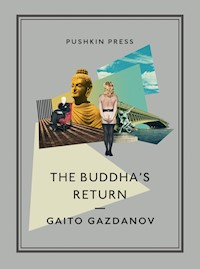
A millionaire is killed. A golden statuette of a Buddha goes missing. A penniless student, who is afflicted by dream-like fits, is arrested and accused of murder.Slipping between the menacing dream world of the student's fevered imagination, and the dark back alleys of the Paris underworld, The Buddha's Return is part detective novel, part philosophical thriller, and part love story.In typically crisp, unfussy prose, Gazdanov's delicately balanced novel is an irresistibly hypnotic masterpiece from one of Russia's most talented émigré writers.
Sie lesen das E-Book in den Legimi-Apps auf:
Seitenzahl: 274
Veröffentlichungsjahr: 2014
Das E-Book (TTS) können Sie hören im Abo „Legimi Premium” in Legimi-Apps auf:
Ähnliche




















GAITO GAZDANOV
THE BUDDHA’S RETURN
Translated from the Russian by Bryan Karetnyk
We always act as if there were something more valuable than human life.
—ANTOINE DE SAINT-EXUPÉRY
Contents
IDIED. I have searched long and hard for the right words to describe what happened, and, convinced that none of the usual, familiar terms will do, have finally settled on one associated with what seems the least imprecise of realms: death. I died in the month of June, at night, during one of my first years abroad. This, however, was far less remarkable than my being the only person to know of this death, the only one to have witnessed it. I saw myself in the mountains; with that absurd invariable sense of urgency characteristic of events in which personal considerations for some reason cease to play any part, I found myself having to scale a high cliff with a sheer drop. Here and there little thorn-bushes somehow managed to cut through the brownish-grey rock surface; in places there were even dead tree trunks and roots creeping along rugged perpendicular clefts. Below, where I had begun my ascent, there was a low stone ledge skirting around the cliff, and lower still, in the dark abyss, was the distant muffled rumble of a mountain river. At length I climbed up, carefully groping for cavities in the stone and clinging now to a bush, now to the root of a tree, now to a jagged rock jutting out of the cliff face. I was slowly nearing a small shelf that had been obscured from below, but from which I somehow knew a narrow path led away; I couldn’t shake off the oppressive and incomprehensible—like everything else that was going on—presentiment that I was destined nevermore to see it or to follow those narrow bends as it spiralled up unevenly, strewn with pine needles. Later, I remembered that I had sensed someone waiting for me up there, someone’s keen, impatient desire to see me. I had at last almost reached the top; with my right hand I grabbed onto a pronounced stone ledge and in another few seconds I might have managed to pull myself up, when suddenly the solid granite crumbled beneath my fingers and I began to fall headlong, my body hitting the cliff face as the latter seemed to be soaring upwards before my eyes. Then came a sharp, almighty jolt that winded me and made the muscles in my arms ache—I was suspended in mid-air, my numb fingers clinging convulsively to the dried-out branch of a dead tree that had once nestled in a horizontal crevice in the rock. Below me was a void. I dangled there, my wide eyes transfixed by the patch of granite in my field of vision, as I sensed the branch steadily yielding beneath my weight. A small transparent lizard flashed for an instant a little above my fingers, and I distinctly saw its head, its flanks rising and falling rapidly, and its deathly gaze, cold and unmoving—a reptile’s gaze. Then in one agile, elusive movement it darted upwards, vanishing. Shortly thereafter I heard the intense buzzing of a bumblebee, rising and falling in pitch, although not without a certain insistent melodiousness in some way resembling a vague acoustic memory, which I expected to crystallize at any moment. But the branch gave more and more under my fingers, and the terror penetrated deeper and deeper inside me. Least of all did this terror lend itself to description; what prevailed was an understanding that these were the final moments of my life, that no power on earth could save me, that I was alone, utterly alone, and that beneath me in those abysmal depths, which I could sense with every sinew of my body, death awaited me, and I was powerless against it. Never before had it occurred to me that these feelings—loneliness and terror—could be experienced not only mentally, but literally with every fibre of one’s being. And although I was still alive and there was not a single scratch on my body, I was, at a phenomenal speed which nothing could halt or even slow, undergoing such mental agony, such chilling languor and insurmountable anguish. Only at the very last second, or even fraction of a second, did I feel something like sweet sacrilegious exhaustion, curiously inseparable from the languor and anguish. It seemed to me that if I were to combine into a single entity every sensation I had experienced over the course of my life, the collective power of these would still pale in comparison with what I had experienced in these past few minutes. But this was my final thought: there was a snap, the branch broke, and around me the rocks, bushes and ledges began spinning with such unbearable speed, until finally, after an eternity, amid the humid air there came the heavy crunch of my plummeting body hitting the rocks on the riverbank. A moment later I watched helplessly as the image of the sheer cliff and the mountain river disappeared before my eyes; then it was gone, and nothing remained.
Such was my recollection of death, after which I mysteriously continued to survive, if I am to assume that I did in fact remain myself. Prior to this, as with the majority of people, I had often dreamt that I was falling, but each time I had awoken during the fall. Yet as I made this arduous ascent to the top of the cliff, and when I met the cold gaze of the lizard, and when the branch broke beneath my fingers, I was aware that I was not asleep. I have to say that throughout this vivid and frankly banal incident, devoid as it was entirely of any romantic or chimeric nuances, there were two people present—a witness and a victim. This duality, however, was barely noticeable, at times imperceptible. And so, having returned from oblivion, I once again found myself in the world where until now I had led such a notional existence; it was not that the world around me had changed all of a sudden, but rather that I couldn’t tell, amid the disorderly and random chaos of memories, unfounded concerns, contradictory emotions, sensations, odours and sights, what it was that demarcated my own existence, what belonged to me and what to others, and what was the illusive significance of that unstable compound of various elements, the absurd amalgam of which was theoretically supposed to constitute my being, imparting to me my name, nationality, date and place of birth, my personal history, which is to say that long sequence of failures, accidents and transformations. I felt as though I were slowly re-emerging, in the very place where I was never supposed to return—having forgotten everything that had taken place before now. But this wasn’t amnesia in the literal sense of the word: I had just forgotten irrevocably what one was supposed to consider important, and what insignificant.
I could now sense the strange illusoriness of my own life everywhere—an illusoriness that was many-layered and inescapable, irrespective of whether it had to do with projects, plans or the immediate material conditions of life, all of which had the ability to change entirely over the course of a few days or a few hours. In any case, I had been acquainted with this state for some time; it was one of the things I hadn’t forgotten. For me, the world consisted of objects and sensations that I recognized—as if I had experienced them long ago and only now were they coming back to me, like a dream lost in time. This had even been the case when I encountered them probably for the very first time in my life. It seemed as if, amid an enormous, chaotic combination of vastly disparate things, I had blindly sought the path I had trod before, without knowing how or where. Perhaps this is why the majority of events left me entirely indifferent and only a rare few moments containing—or seeming to contain—some sort of coincidence arrested my attention with incredible force. It would be difficult for me to pinpoint how exactly these moments differed from others—some inexplicable nuance, some random detail that was plain for me to see. They almost never influenced my own fate or personal interests directly; they were visions that usually appeared out of the blue. There had been years when my life somehow clearly didn’t belong to me, and I took only an external, insignificant role in its events: I was entirely indifferent to what went on around me, despite there having been tempestuous scenes, sometimes involving mortal danger. But I understood this danger only theoretically, and I could never fully appreciate its true meaning, which would probably have struck terror in my soul and compelled me to live other than I did. It often seemed to me—when I was alone and there was no one to prevent me from immersing myself in this endless series of vague sensations, visions and thoughts—that I lacked the strength for one last push, in order to discover myself and suddenly to comprehend at long last the hidden meaning of my destiny, which had until now been going through my memory like some haphazard relay of random occurrences. But I never managed to do this, nor did I even manage to comprehend why one thing or another, on the face of it bearing no relation to me whatsoever, would suddenly take on such a significance that was as incomprehensible as it was plainly apparent.
Now began a new phase in my life. A whole series of oddly powerful sensations, many of which I had never before experienced, passed through my very being: an unbearable thirst and the heat of the desert, the icy waves of a northern sea that surrounded me and in which I would spend hours swimming towards a far-distant rocky shore, the burning touch of a swarthy female body that I had never known. Often I endured torturous physical pain symptomatic of incurable diseases whose descriptions I would later find in medical textbooks—diseases from which I never suffered. I had gone blind more than once, I had been left crippled many times over, and one of the rare physical pleasures known to me was that of regaining consciousness and realizing that I was in the fullest of health and that due to some incomprehensible convergence of events I was now beyond these excruciating states of sickness or injury.
Of course, it was far from always the case that I had to endure such things. What had now become utterly immutable was a peculiarity owing to which I felt almost like a stranger to myself. Whenever I happened to be alone, I would be engulfed instantly by the troubled movements of a vast, imaginary world; it would hurtle me along uncontrollably and I would scarcely be able to keep pace with it. There was visual and auditory chaos, comprised of an array of disparate elements; sometimes it would be the music of a distant march, ensconced on all sides by high stone walls; sometimes it was the silent motion of an endless green landscape, broken only by the rolling hills and their strange undulation; sometimes it was the outlying environs of a Dutch town with stone troughs of uncertain origin, where the water trickled with a steady murmur—to intensify this obvious infringement of Dutch realism, women would go to them, one after another, carrying jugs on their heads. Nowhere was there any logical pattern in this, and the shifting chaos clearly failed to present even a remote semblance of any harmonious order. And so, accordingly, at that point in my life, which was marked by the constant attendance of chaos, my inner existence acquired an equally false and wavering character. I could never be certain how long any one feeling would last, I never knew what would come to replace it the very next day or in a week’s time. And just as I had been amazed to learn upon reading my first books, after having mastered the alphabet, that the people there managed to speak in full sentences, using classical constructions of subject and predicate with a full stop at the end—although it seemed to me that no one ever did this in reality—so too it now appeared almost inconceivable to me that one person or another could be an accountant or a minister, a labourer or a bishop, and remain firmly convinced that his work was more important and enduring than anything else, as if a bishop’s cassock or a labourer’s jacket mysteriously but exactly corresponded to the personal calling and vocation of the man who wore it. I knew, of course, that within a given timeframe and under normal circumstances a labourer would never become a bishop, just as a bishop would not turn into a labourer, and often this state of affairs would last until death set them equal with grim indifference. Yet I also sensed that the world in which the former was fated to be this, and the latter that, could suddenly turn out to be notional and illusory, and that everything could alter beyond recognition. In other words, the arena in which my life unfolded was for me devoid of any clearly defined and in any way concrete features; there was nothing constant about it—the objects and ideas that comprised it could change in form and content, like the impossible metamorphoses of a never-ending dream. And each morning, upon waking, I would gaze with troubled wonderment at the wallpaper patterns in my hotel room, which always seemed different from the night before, because so many changes had occurred between yesterday and today, and I knew instinctively that I too might have changed, swept up by that imperceptible and irresistible motion. I seemed to be living in an almost abstract world, never quite managing to uncover the logic behind certain objects and concepts that had seemed so crucial and definitive to a number of my former teachers, a sort of fundamental law of all evolution and human existence.
It was in these distant and neurotic times that I met a man who seemed to have been summoned out of inexistence with the sole purpose of appearing before me at this precise stage in my life. Strictly speaking, he was not a man, but the unrecognizable, distorted spectre of someone who had once been alive. That man was no more, he had vanished, but not without trace, as there yet remained what I saw when the figure first approached me and said:
“Excusez-moi de vous déranger. Vous ne pourriez pas m’avancer un peu d’argent?”*
His face was dark and covered in thick grey-and-ginger stubble, his eyes were swollen and his eyelids sagged; he wore a frayed black hat, a long jacket that looked like a short overcoat, or a short overcoat that looked like a very long jacket, dark grey in colour, black-and-whitish boots that were split all along the seams, and light-brown trousers covered in myriad specks of dirt. His eyes, however, looked ahead calmly and lucidly. But it was his voice that particularly struck me, being quite out of keeping with his appearance—a flat, deep voice, with an astonishing hint of confidence. It was impossible not to detect the echo of some other world, and not the one to which this man so evidently belonged. No vagrant or beggar should have, or has indeed ever had, the ability or the right to speak in such a voice. And if I had required irrefutable evidence that this man was himself the living spectre of another, someone who had vanished, then these intonations and this acoustic revelation would have proved more convincing than any biographical testimony. It immediately made me pay much more attention to him than I would have done to a common tramp asking me for alms money. The second factor that piqued my interest was his unnaturally correct French.
The encounter took place towards the end of April, in the Jardin du Luxembourg; I was sitting on a bench, reading notes on Karamzin’s travels. He fleetingly glanced at the book and launched into Russian—a very pure and correct Russian that preserved, incidentally, a few archaic turns of phrase: “I should consider it my duty”, “if you would deign to take into account”. Within a very short space of time he had divulged to me a number of details about himself that seemed no less fantastic than did his appearance; among these figured the misty buildings of the Imperial University in St Petersburg, where at one point he had studied, the Faculty of History, and some vague, cagy allusions to vast wealth, which he either had lost, or else was due to receive.
I extracted a ten-franc note and handed it to him. He bowed, maintaining an air of dignity that was perfectly out of place, and lifted his hat with a sort of undulating gesture, the likes of which I had never before seen. Then he walked off unhurriedly, carefully alternating his feet cased in their torn boots. Even in his back, however, there was none of that timid restraint or physical indignity symptomatic of people of his sort. Slowly he receded farther and farther into the distance; the April sun was already setting, and my imagination, running a few minutes ahead of itself like a bad watch, had already projected along the railings of the Jardin du Luxembourg the twilight that was to come a little later, but was absent at the time. And so this image of a beggar remained fixed in my memory, shrouded in the dusk that was yet to set in; the figure moved off and dissolved amid the milky softness of the outgoing day, and in this state, neurotic and illusory, it prompted several images in my mind. I later recalled that I had seen such light—light in which the last, just-departed ray of sun seems to have left a subtle though unmistakeable trace of its unhurried dissolution in the air—in a number of paintings, in particular one of Correggio’s, although I was unable to remember which.
Yet for me these efforts of memory were transforming imperceptibly into something else, something no less customary, but recently more intense: an endless sequence of haunting visions. I would see a woman in a black dress buttoned up to the neck trudging along a narrow street in a mediaeval town, a thickset man wearing spectacles and European clothes, lost and unhappy, searching for something he could not find, a tall, elderly man walking down a winding, dusty road, and a woman’s wide, terror-stricken eyes set in a pale face that was somehow very familiar to me. Simultaneously I would experience strange, distressing sensations that mingled with my own feelings on some event or other in my life. And I noticed that some states of mind triggered by very definite factors would persist long after their causes had disappeared, and so I would ask myself what actually came first—the cause or the state of mind; and if the latter, then did it not in certain circumstances predetermine something irrevocable and substantial, something belonging to the material world? Besides, I was faced with yet another persistent question: what was it that connected me to these imaginary people whom I had never wittingly invented and who would appear to me so unexpectedly—like the one who had fallen from the cliff, in whose body I had died not so long ago, like that woman in black, like those others undoubtedly lurking ahead, eagerly waiting to embody me for a few brief, illusory moments. Each of them had been unlike the one that followed, and it was impossible to confuse them with one another. What tied me to them? The laws of heredity, whose lines criss-crossed in such fantastical arabesques all around me, someone’s forgotten memories that were for some unknown reason being dredged up within me, or was it that I was part of some vast human collective and the impenetrable membrane that separated me from other people and contained my individuality had suddenly lost its impermeability, allowing something foreign to rush in, like waves crashing into the crevice of a cliff ? I was unable to tell anyone about this, knowing that it would be taken for delirium or some peculiar form of madness. But it was neither of these. I was perfectly healthy, every muscle in my body responded with an automatic precision, I found none of my university courses in any way difficult, and my logical and analytical faculties were fine. I had never experienced fainting fits and I knew almost no physical fatigue: I was built, as it were, for the real world. Yet there was another—illusory—world that pursued me everywhere, hounding me. And nearly every day, sometimes in my room, sometimes in the street, in the woods or in the garden, I would cease to exist—I as such-and-such a person, born in such-and-such a place, in such-and-such a year, having completed my secondary education only a few years ago and attending lectures at such-and-such a university—and with peremptory inevitability, someone else would take my place. This metamorphosis would usually be preceded by torturous physical sensations, sometimes taking over the entire surface of my body.
I remember waking up one night and distinctly feeling my long, greasy, rank hair against my face, the slackness of my jowls, and the curiously familiar sensation of my tongue touching the gaps in my mouth where I was missing teeth. Seconds later, however, the awareness that I was merely a spectator in all this, as well as the heavy odour I had detected from the outset, would vanish. Then slowly, like a man gradually beginning to distinguish objects in the half-light—which, incidentally, was typical at the start of almost all these visions—I would discover this next distressing incarnation, the victim to which I had now fallen. I saw myself as an old woman with a tired, haggard body, deathly pale in colour. Through a small window overlooking a dark, narrow courtyard the oppressive stench of a deprived neighbourhood blew into the room in sultry summer waves; amid the suffocating heat this decrepit body, by whose sides drooped long, fleshy breasts and whose stomach with its roll of fat concealed the origin of two equally chubby legs that ended in black ragged toenails, lay on a grey-and-white bed sheet that was damp with sweat. Sound asleep next to it, head thrown back, mouth agape and white teeth bared, like a dog, was an Arab boy with tight thick curls of black hair, whose back and shoulders were covered in pimples.
The image of this old woman did not, however, occupy my mind for long. She gradually faded into the semi-darkness, and once again I found myself on my narrow bed, in my room with its high window overlooking a quiet street in the Latin Quarter. In the morning, when I awoke and opened my eyes again, I saw—this time entirely as a spectator to the event—that the Arab boy was gone, and on the bed remained only the corpse of the old woman, the sheets stained with dried blood from a terrible wound at her neck. I never saw her again: she disappeared for ever. But this was undoubtedly the most repulsive sensation I had ever experienced in my life—this body, fat and sagging, in such a cruel state of muscular incapacity.
Since the day that I first met the Russian beggar in the Jardin du Luxembourg, so clearly and indelibly etched in my memory—the black frayed hat, the stubble on his face, the tattered boots and that amazing garment, be it an overcoat or something resembling a jacket—nearly two years had passed. For me these had been long, almost endless years, filled with swarms of silent, delirious visions that blended corridors leading God knows where, narrow chasm-like vertical shafts, exotic trees on the far-distant shores of a southern sea, black rivers that flowed into dreams, and an uninterrupted stream of various people, both men and women, the reason for whose appearance invariably eluded my comprehension, but who were inseparable from my own existence. Nearly every day I would feel this almost abstract psychological weariness, the result of some manifold, unrelenting madness that curiously affected neither my health nor my faculties—nor even did it prevent me from sitting the occasional exam or memorizing a host of university lectures. Sometimes this noiseless torrent would come to a sudden halt without any forewarning whatsoever; I was drifting through life then without a care in the world, breathing in the damp winter air of the Parisian streets and with carnivorous zeal devouring plates of meat in restaurants, tearing at the succulent morsels with my voracious teeth.
On one such day I was sitting at a table in a large café on the Boulevard du Montparnasse, drinking coffee and reading a newspaper. Behind me, an assured male voice, evidently concluding—judging by his final intonation—some period that I hadn’t heard, said:
“And believe me, I have enough experience in life to know.”
I turned around. There was something familiar about his voice. However, the man I saw was completely unknown to me. I quickly looked him over: he was wearing a fitted overcoat, a shirt with a starched collar, a deep-crimson tie, a navy-blue suit and a gold wristwatch. A pair of spectacles rested on his nose, and there was a book lying open in front of him. Next to him sat a blonde woman of around thirty, an artist whom I had met a few times at evenings hosted by some friends; she was puffing away on a cigarette and seemed to be listening to him distractedly. He then closed the book and took off his glasses—he was evidently far-sighted—and that was when I saw his eyes. To my utter disbelief, I recognized the man to whom I had given the ten francs in the Jardin du Luxembourg. I could never have identified him solely on the basis of his eyes and his voice, though, for the man sitting here in the café seemed to have nothing in common with the beggar who had approached me two years ago, asking for money. Never before had it occurred to me that clothes could so change a man. There was something unnatural and implausible about his metamorphosis. It was as if time had fantastically regressed. Two years ago this man had been a mere shadow; now he had miraculously transformed back into the man he had once been, whose disappearance ought to have been irreversible. I was unable to come to my senses for genuine astonishment.
The female artist got up to leave, waving to me both hello and goodbye simultaneously as she made her exit. Then I went up to the gentleman’s table and said:
“Forgive me, but I believe I’ve had the pleasure of meeting you somewhere before.”
“Please, do sit down,” he replied with quiet courtesy. “It’s a credit to your memory. You’re the first of those who knew me in the old days to have recognized me. You say we’ve met? You’re quite correct. It was back when I was living in a slum, in Rue Simon le Franc.”
He made a vague hand gesture.
“I presume you would like to know what happened to me? Well then, let us begin with the fact that miracles simply do not happen.”
“Until a few moments ago I’d have agreed with you, but now I’m beginning to wonder.”
“Oh, you’d be wrong to doubt it,” he said. “There’s nothing more deceptive than appearances. One can make assertions on the basis of these only if one acknowledges their total arbitrariness beforehand. In five minutes’ time the causes of my metamorphosis will seem entirely natural to you.”
He leant his elbows on the table.
“I don’t recall whether I told you back then…”
And so he told me exactly what had happened to him, and truly there was nothing miraculous about it. In one of the Baltic states—he neglected to mention which—lived his elder brother, who, in the wake of the Revolution, had managed to retain a sizeable fortune. According to my acquaintance, he was a cruel and miserly man, who hated everyone who had, or might have had, cause to ask him for money. He never married and he had no heirs. Some time ago he had drowned while bathing in the sea, and so the inheritance passed on to his brother, whom a solicitor tracked down in Paris, living in Rue Simon le Franc. Once the formalities had been concluded, he came into possession of a fortune valued at many hundreds of thousands of francs. Then he took an apartment on Rue Molitor, living alone and passing the time, as he put it, between reading and pleasant idleness. He invited me to drop by one day between appointed hours; there was no need to call in advance. Thereupon we parted. I stayed on in the café, and again, just as I had done two years ago, I watched him leave. It was April, but the day was cold by comparison with the previous year. He walked along the wide passage between the little café tables and slowly vanished into the soft electric light in his new fitted overcoat and new hat; now the assuredness of his gait could seem in no way out of place to anyone, even to me, who had been so struck by it at our first meeting.
Alone, I lapsed into thought—contemplative at first and without aim; then, among the formless motion of images, features gradually drew into focus and I began to recall the events that had taken place two years ago. Now it was cold, but then it had been warm, and I had remained sitting on that bench in the Jardin du Luxembourg, just as I did now in the café, following the man’s departure. Back then, of course, I had been reading Karamzin: immediately forgetting the words on the page, my thoughts kept returning to the nineteenth century and its sharp disparity with the twentieth. I even pondered the differences in political regimes—thoughts that, generally speaking, very seldom captivated my attention—and it seemed to me that the nineteenth century had known none of the barbaric and violent forms of government that characterized the history of certain nations in the twentieth century. I recalled Durkheim’s theory of “social constraint”, contrainte sociale, and, deviating once again from the university’s course material, I proceeded to considerations of a more general and more contentious order. I mused on the idiocy of state-led violence and how it ought to have been much more apparent to contemporaries than to so-called “future historians”, who would fail to grasp the personal tragedy of this oppression, along with its palpable absurdity. I also thought how state ethics, taken to their logical paroxysm—as the culmination of some collective delirium—would inevitably lead to an almost criminal notion of authority, and that, in such periods of history, power truly belongs to ignorant crooks and fanatics, tyrants and madmen: sometimes they end their life on the gallows or at the guillotine, sometimes they die of natural causes, their coffin accompanied on its journey by the unspoken damnation of those whose misfortune and disgrace it was to be their subjects. I also thought of the Grand Inquisitor and the tragic fate of his author, and how personal, even illusory freedom can essentially prove to have a negative value, with a meaning and significance that frequently eludes us because it contains, in an extremely unstable equilibrium, the roots of opposition.
But now I was far from such thoughts; they seemed obscure and insignificant by comparison with the egotistical considerations of my own destiny, the illusory and uncertain nature of which had never ceased to captivate my attention, all the more so as today’s encounter had coincided with the demise of this happy phase of my life, the blessedness—I could find no other word for it—of which lay in the fact that during these past few weeks I had lived without dreaming and without thinking about anything.
The previous day I had been seized by a vague sense of anxiety, inexplicable as always and for that very reason particularly troubling. The next day the feeling intensified, and now it no longer left me. It began to seem to me as if some danger, intangible and unfathomable in equal measure, were lurking in the wings. Had I not been so used to the constant presence of this hallucinatory world that so doggedly pursued me, I might perhaps have been frightened that this was the onset of some persecution complex. Yet the singularity of my situation resided in the fact that, as opposed to people afflicted by genuine madness, those utterly convinced that some invisible, elusive figure truly was following them—someone with a multitude of agents at their disposal: a bus conductor, a laundress, a policeman, a strange gentleman in spectacles and a hat—I knew that my unease could be attributed wholly and exclusively to random flights of imagination. Living as I did, with almost no independent means at my disposal, unaffiliated with any political organization, partaking in no form of social activity and in no way distinguishing myself from the anonymous multimillion mass of the Parisian public, I knew there was no way I could be the object of anyone’s pursuit. There was not a single person in existence to whom my life could have presented any interest, no one who could have envied me. I understood perfectly that my vague anxiety was entirely pointless, that there were and could be no grounds for it. Yet as inconceivable as it was, still the feeling persisted, and the fact that it was clearly unfounded failed to extricate me from this situation. Meanwhile, in contrast to maniacs, whose attention is strained to breaking point, who never miss a single detail of what is happening around them as they resolutely seek out the presence of their pursuant adversary, I lived and moved as if surrounded by a thin veil of fog, one that deprived objects and people of their sharply defined contours.




