


8,49 €
Mehr erfahren.
- Herausgeber: Titan Books
- Kategorie: Krimi
- Sprache: Englisch
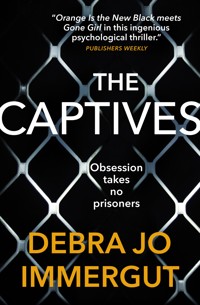
"Orange Is the New Black meets Gone Girl in this ingenious psychological thriller." (PW)Convicted of murder, destined for life in prison, Miranda is desperate for an escape. She signs up for sessions with the prison psychologist, Frank Lundquist, so that she can access the drugs to end it all. But unknown to her, Frank remembers her from high school, where, forgettable and unseen, he had a crush on Miranda Greene. Now, captivated again, his feelings deepen to obsession. What led the daughter of a former Congressman to commit such a terrible crime? And how can he make her remember him?As Miranda contemplates a dark future and a darker past, she soon realises that Frank might offer another way to the freedom she longs for. But at what cost?
Das E-Book können Sie in Legimi-Apps oder einer beliebigen App lesen, die das folgende Format unterstützen:
Seitenzahl: 376
Veröffentlichungsjahr: 2018
Ähnliche




















CONTENTS
Cover
Title Page
Copyright
Dedication
Chance
1
2
3
4
5
6
7
8
9
Choice
10
11
12
13
14
15
16
17
18
Flight
19
20
21
22
23
24
Postscript
Acknowledgments
About the Author
Also Available from Titan Books
THE CAPTIVES
THECAPTIVES
DEBRA JO IMMERGUT
TITANBOOKS
The Captives
Print edition ISBN: 9781785657542
E-book edition ISBN: 9781785657559
Published by Titan Books
A division of Titan Publishing Group Ltd.
144 Southwark Street, London SE1 0UP
www.titanbooks.com
First edition June 2018
10 9 8 7 6 5 4 3 2 1
Copyright © 2018 Debra Jo Immergut. All rights reserved.
This is a work of fiction. All of the characters, organizations, and events portrayed in this novel are either products of the author’s imagination or are used fictitiously.
No part of this publication may be reproduced, stored in a retrieval system, or transmitted, in any form or by any means without the prior written permission of the publisher, nor be otherwise circulated in any form of binding or cover other than that in which it is published and without a similar condition being imposed on the subsequent purchaser.
A CIP catalogue record for this title is available from the British Library.
all these years,for John
CHANCE
1
REFRAIN FROM TAKING ON A PROFESSIONAL ROLE WHEN OBJECTIVITY COULD BE IMPAIRED
(American Psychological Association Ethical Principles and Codes of Conduct, Standard 3.06)
What happened to me is universal. And I can prove it.
Think back on the people you knew in high school. Now zero in on that one person, the one who starred in your daydreams. The one who, when you glimpsed him or her down the corridor, set off that pre–Homo sapiens sensation, that brain-stem jolt of pure adrenaline. The crush, in other words.
See that person walk toward you now. Approaching along the noisy crowded hallway, toward you, toward you, and by you. The hair, the stride, the smile.
Your pulse has just heightened a bit. Right?
That shows you the power. You’re picturing a kid, this is years later and you’re picturing some gawky school-bound kid, and yet the image of this kid in your mind’s eye can still vibrate your cerebral cortex, disturb your breathing pattern.
So you see. There’s something involuntary at work in these situations.
* * *
Now imagine this: you’re a thirty-two-year-old man, and you’re a psychologist. You’re sitting in your basement office in the counseling center of a New York State correctional institution. A women’s prison. And you’ve come late to work on a Monday morning and haven’t had time to review your case files or even glance at your schedule. In walks the first inmate of the day, dressed in a state-issued yellow uniform.
And it’s that person.
Looking shockingly unchanged from the kid approaching down the hallway lined with slamming locker doors. The hair, the stride.
Would that not throw you for a bit of a loop?
Be honest. There’s no telling what you would do.
* * *
I recognized her instantly. Who wouldn’t? She’s not the kind you forget all that easily. At least, not the kind I forget. Especially not the face. I might compare it to the variety of flowers my mother used to tend in beds alongside our house, pretty in an unsurprising, backyard-grown way, but giving glimpses of inner complexities, if you looked carefully enough. This face had lingered around the fringes of my memory for almost fifteen years. Every so often something—a tune of the correct vintage, the sight of a female runner with long reddish hair—would summon her to the forefront. If I were the kind of guy who attended reunions—I’m not—I would have sprung for a ticket and pinned on a name tag just to get news of her, to see if she turned up. To see what had become of her.
Now I saw. She sat in the aqua vinyl chair across from me with NYS DOCS stamped in blurry black ink across her heart.
She didn’t remember me. This was clear. I couldn’t see a flicker or a flare of recall.
So I didn’t address it. What could I say? Crow out her name, how the hell are you, what brings you here? No. While trying to process this situation—her? here?—I propelled myself to the file cabinet in the corner, where I kept the makings for tea: a small red hotpot, boxes of oolong and Earl Grey, cardboard cups, plastic spoons. My brief tea ritual injected a mild coziness that put my clients slightly more at ease, and so I performed it at almost every session. As I shakily prepared two cups, I spewed out my usual opener, which is welcome, thanks for coming, let’s establish some ground rules, what you reveal here doesn’t leave this room. A speech that, after six months on the job, I could reel off without thinking. I offered her a steam-crowned drink, and she accepted, with a smile that stabbed me a bit. I returned to my seat, let my hands steady around the warm cup. A note clipped to her file folder stated that she’d just been released from segregation. So I asked her about this. But I didn’t hear her answer. I couldn’t help but sink back into that memory. A memory that had looped through my mind countless times over the years, like one of those sticky school-era radio hooks. Thinking about it with her sitting there in the flesh made me want to squirm, though I managed to uphold my professional demeanor and not squirm.
I remembered her naked back, a sweep of whiteness like a flag, and then the flash of a breast as she twisted to grab a towel from the bench. Her hair—that red with brown undertones—swished down over this breast and matched the nipple perfectly. Jason DeMarea and Anthony Li were snickering. But I was silent, clinging to the wall outside the girl’s locker room, my fingertips aching against the concrete windowsill, toes of my sneakers jammed hard against the brick. This had been my idea. I’d seen the windows cracked open to catch the breezes blowing on this sunny, only slightly chilly November day, and I had seen this member of the girls’ freshman track team heading in all alone after her race. I’d been covering the meet for the Lincoln Clarion. My beat was JV girls’ sports, and Anthony was the JV girls’ sports photographer, which gives you an idea of our status on the Clarion staff and at Lincoln High in general. Jason DeMarea just tagged along for lack of anything better to do on a Tuesday after school. They snickered and elbowed each other and after she had finished dressing (baby blue cords, shirt emblazoned with sparkly flowers), they dropped off the ledge. But I continued to cling there, watching. She sat on the bench, tying up the laces of her ankle boots. Then she grabbed her bundled track uniform and wiped at her eyes with it. I could only see a small slice of her face and one dainty ear—the ear with the intriguing double piercing, with the silver wire hoop, and, just above, the minuscule silver Pegasus that I’d secretly studied sitting behind her in trig class, wondering if it were a signifier for horse love, or drugginess, or for some other shading of hers that I would never decode. With her wadded uniform, she wiped her eyes and really looked extremely teary, she did. Her eyelids were all puffy. And then she turned her gaze up, up to her open locker. She tossed her track clothes in and reached toward the open door. Some kind of sticker was plastered there. I couldn’t read it from my perch. With a certain forcefulness, she yanked that thing, tore it right down. Then she slammed the locker shut and flung her hand out to toss the crumpled decal away. But it stuck to her palm. She stared at this obstinate clump of paper for an instant and she began to really cry now. Then she reopened her locker and carefully set the balled-up thing on the floor inside. She closed the door, held her hands to her eyes. After a while, she walked out of the room, and disappeared from my view.
* * *
I had opened her file folder. My eyes skated over the words without seeing them. I asked a bit about her recent stint in segregation, launched into the usual personality diagnostics. I spooled out a few sequences by rote, she responded, and I began to regain my focus then. I listened and I didn’t say anything about Lincoln High or her naked breast or the yanked decal or the fact that I was that guy from the last row of her trigonometry class. I didn’t say that I’d been in the stands every race she ran, that one season she ran track, and that I knew she’d won only once, that very day, that sunny November day. I didn’t say that I knew her father had been a one-term congressman, and I didn’t say that I’d adored her from afar through every long and confounding day of my high school career. She clearly did not remember me. Did this bother me? In a very slight, subsumed way, maybe. Not with any conscious awareness. In any case, I didn’t speak up.
We finished the diagnostic segment, and then she told me she had trouble sleeping. The noise, the shouting on her unit at night. She folded and unfolded her hands in her lap and asked hesitantly if there might be some pill that could help her. “I just need to fade out for a few hours,” she said.
I couldn’t help noticing that the tomato-colored polish on her nails was chipped. If there was one thing all my clients had, it was impeccable and usually jaw-droppingly intricate manicures—rainbows and coconut palms and boyfriends’ names, glittered stripes and stars and hearts. Those women didn’t pick at or chew their nails. They flashed them. But her nails were short. Ravaged.
I found myself scrawling on a blue slip, recommending Zoloft. Rising from my chair, I walked around the desk and held it out to her. She stood, a head shorter than me. Her downcast eyes, her long lashes. A scatter of faint freckles. I dragged my gaze away, pulled my shoulders back, summoning every inch of my height. “Just show this to Dr. Polkinghorne’s aide two doors down.”
She read it and thanked me softly. We both stood there for a minute. I debated about whether to say what I knew I should say. “Um, you know what?” I started. Then I said something else instead. “I’d like to add you to my list of standing appointments. I think we can pursue some solutions for you.”
She bent her lips into this tiny, melancholy smile. “Wonderful,” she said, then turned to leave. Her ponytail swayed gently to and fro as she walked away and out the door.
Letting her leave then, without revealing what I knew, was an ethical violation, the first in a string of them that I’ve committed since that moment. The American Psychological Association guidelines on preexisting relationships are very clear. They should be acknowledged, and if such a relationship might in any way impair objectivity, therapy must not go forward. It’s all pretty straightforward in the guidelines.
That must have been when I stopped following guidelines. Up to that point, I was more or less your average, law-abiding, guideline-following man.
She changed all that, though she didn’t mean to at all, this person in the state-issued yellows, with the backyard-flower face. She who I remembered so clearly as a girl. She who you wouldn’t forget.
I can’t refer to her here by name. Let’s call her M, and move on.
2
MAY 1999
Miranda Greene was born in Pittsburgh, PA. She was born in Pittsburgh, PA, she lived out the larger portion of her childhood in the suburbs of Washington, D.C., and in May of her thirty-second year, 1999, one of the loveliest Mays in memory on the Eastern Seaboard, she was making plans to die in New York. In Milford Basin, New York. More specifically, in the women’s correctional facility that occupied 154 shaven acres in the maple-and-scrub woods outside the town of Milford Basin.
A Rockefeller or a Roosevelt or someone rich had owned a spread in Milford Basin during the 1920s, real estate agents told prospective buyers. Unfortunately—for real estate reasons—this rich person had a zeal for the reform of wayward girls. What had been a hunting lodge was turned into a reformatory, and now, seventy or so years down the line, it had become a full-blown state prison, minimum to medium security. Women weren’t regarded as wayward anymore. They were perpetrators, criminals, and in need of fourteen-foot heavy-gauge perimeter mesh, festoons of razor ribbon, and armed guards.
The prison was up and over the crest of two hills from the semiquaint downtown center of Milford Basin. Up and over those two hills was a sprawling fenced complex, and inside this complex was Miranda, formulating her plans. The method would be an overdose of pills. Pills were abundant in the system; more than half the ladies of Milford Basin were being state medicated: Xanax, Lithium, Librium, and Prozac were dosed out daily by the medical staff. Certain shadowy characters offered them for sale, too—of course, the pharmaceuticals could be purchased, so many substances could be. But often, it was easier to get a prescription from the Counseling Center, a diagnosis of depression or violent associability or even mere social anxiety. Meds were dispensed liberally, since meds worked well, all around.
Miranda wished to die because, having been incarcerated for nearly twenty-two months, she saw no point in hanging around for the remaining portion of her sentence. The sentence stretched for such an obscene number of years that she shied away from thinking about its precise length in numerical terms, preferring to think of the time as a road vanishing into a fog. She had no chance of parole, and if she were ever free again, she would be much, much older than she was now. Somehow, the promise of a taste of liberty in time to enjoy the infirmities of advanced age did not seem reason enough to cling to her mortal coil. She wanted to shrug it.
This is why Miranda visited the Counseling Center. She did not like the idea of going to a shrink. Her mother had booked her an appointment once, during that turbulent stretch of her teenhood after Amy died. She’d refused to get in the car. Simply put, she had never been the introspective type. She took after her father that way. But at Milford Basin, where empty time was dished up in yawning craterfuls, she could hardly avoid contemplating her lot in life. What else was there to do? And two weeks in the Segregated Housing Unit had crystallized her thinking. The more deeply she searched within herself, the more certain she became. She would not wait for fate to make its move—hadn’t fate already had its way with her, slapped her down hard? No, now she would take her destiny into her own small, insignificant, incarcerated hands.
* * *
On a Monday morning at 9:30 A.M., Miranda strolled the asphalt walkway connecting Building 2A&B to the long low admin building, home to visits and counseling. She passed an old lady named Onida, who was working out her frustrations in the garden plot she’d been granted by administration. Onida was not allowed garden tools—sharp-edged metal implements were not smiled upon—so she clawed at the wormy spring dirt with her hands and a spade fashioned out of a square of cardboard, humming to herself. Flats of petunias donated by the local ladies’ garden club rested nearby. She looked up as Miranda passed. “God is good, he sure is,” she said.
“You think?” replied Miranda. She walked on. She heard Onida muttering behind her. The sky above stretched painfully blue. The smell of shorn grass, the meek breeze warming her skin. She still couldn’t get used to the idea. Walking outside, with only the dome of the universe above her. No heavy cement, no locked-down souls. She had been out of segregation just three days. Two weeks in the SHU—the shoe, the ladies called it—had flattened out her perceptions somehow, as if she’d been pressed and dried, an exotic cutting. Could she be soaked and reconstituted? “Doubtful,” she whispered to herself.
* * *
Did she know him from somewhere? At first glance, he seemed to shimmer with a faint familiarity, the face—perhaps she had seen it before, or maybe he just looked like someone she’d known. Gray-blue eyes, hair thick, blond, in slight disarray. Beneath pale stubble, his jaw was strong. Not a bad-looking man, in a subdued way. You had to look twice to see it. Frank Lundquist, she thought to herself, to test his name in her mind.
He was the first man out of CO uniform she’d talked to in almost a year, not counting family members and legal counsel. That could account for the strangeness.
“Welcome,” he said, shifting papers on his desk with a distracted air. “Thanks for coming to see me today.” He spoke with a halting, deep voice. He rose abruptly and he was quite tall, she realized. A little electric kettle murmured atop a file cabinet in the corner, misting. His back to her, he fiddled with cups for a longish moment, reciting something about ground rules. “What you say here won’t leave this room.” The tea was lovely, though. Worth the trip alone, perhaps. He sat and found a folder, stared down at it. Miranda let the tea vapors warm her nose and studied the forelock of hair that slipped over his brow, smooth as a bird’s wing. She tried to figure out how she would broach the subject of medication.
At last he looked up from his file folder and spoke. “Says here you’ve just been released from segregation. Can you tell me what happened to put you there?”
Surprised. “That’s not in your file?”
“I’d like to hear your side of things.” He leaned back in his chair. His eyes kept darting back and forth, to her face, then away, to her face, then away.
That could get on my nerves, she thought.
“My side of things.” She let slip the barest smile. “I didn’t know I still had a side of things.”
He nodded. “I hear you.” Rubbed his jaw. A sandpapery noise. “Take a moment. Take your time.”
* * *
She was watching frayed wisps of white, the suggestion of clouds, trailing past a thin slice of window eight feet over her head. She lay there in a corner of her cell in the shoe, trying to see out a window designed to reveal nothing. And slowly, as she watched the wisps, she grew aware of a rhythmic rumbling. A low repeated note that reminded her, in some primal part of her being, of early childhood. She couldn’t imagine what it might be.
She moved up toward the door and peeked out its little porthole, a piece of reinforced glass about the size of a kitchen sponge. All she could see was the cell door across the hall: beyond it was Patti, who’d murdered a surgeon in a dispute involving Blue Cross/Blue Shield payments.
She pressed her ear to the little metal flap that popped open three times daily, when meals were delivered. Through the thin steel, the rumbling continued.
She lowered herself to the floor, slicked with lumpy gray paint and eternally chilly, and pressed her mouth to the inch-high gap beneath the door. “Patti.”
No answer. She tried again. Then, suddenly, she pegged the rumbling sound. Patti was snoring, deep and snuffly. She snored just like Miranda’s dad had, nights when she’d woken from dreams as a little girl. Patti was asleep. Patrizia Melvoin, transgender HIV-positive swindler from Morrisania, the Bronx, snored in precisely the same key and rhythm as Edward Greene, onetime congressman from Pennsylvania’s Twenty-Eighth District.
Miranda sat back on the floor and giggled. She giggled and the noise of her giggle was alien to her ears and snapped her back into silence. The snoring pressed on.
It was her final day in the lock, and it had stretched for eons already. She squinted up at the patch of sky. It was certainly after noon.
Usually the COs released prisoners from the shoe in the morning. Why the delay? She thought about her photos, her clothes, her Cup-a-Soup waiting for her in a locked storage bin back on the unit. She unbelted her flannel wrap, which was dull yellow and reminded her of the bathrobes she and Amy used to get at Christmastime from Grandma Rosalie—always to their great dismay. They would have much rather received those dolls whose hair and makeup you could style, or drum majorette batons, or pet rabbits. The wrap had been issued to her when they took her standard yellows away as she’d been admitted into the lock. She shrugged it off and slipped off her state-mandated briefs. In the shoe, you weren’t allowed your own clothes, so it was NYS DOCS even across your ass.
She contemplated the steel toilet, lidless, seatless, a gawping frozen gullet. She sat. And began to bounce up and down. Fast.
Fourteen days ago, Miranda couldn’t do this. When Patti had told her about this peculiar pastime, she’d said, “I’ll never be that starved for entertainment.”
Patti had chuckled. “No cable TV in here. No Reader’s Digest to read.”
But the first few days had been okay—she’d suitcased four sleeping pills that Lu had pressed on her when it was clear that Miranda was doomed to the shoe, tucking two tiny pills in each nostril—she’d been sure her mouth breathing would give her away, but it didn’t. The pills kept her nicely conked. But they ran out and she was left staring at the patch of sky and wisps of Lewis Patterson began to drift across it, and Duncan, and worse, and soon she was in an agony of replays and desperate for anything to occupy her mind, to fill it and extinguish all thought.
And so she perched on the toilet and she bobbed. She bounced. Skeptically, at first. She even laughed. How ridiculous. She laughed, but she continued, as if riding English saddle, as she did at Camp Piney Top in the Allegheny front range, age nine. And then she heard a reverberating gulp, and sure enough, her bouncing had created a plunger effect, and the water had suctioned back down into the pipes, leaving them clear. She knelt beside the toilet, squeezed shut her eyes, plugged tight her nose, and lowered her head into the bowl.
She heard voices.
* * *
Dark custom suits, bright Italian ties spun with thick silk and tied in swollen knots. Plus matching pocket squares. One day peacock blue, the next day deep crimson with gold fleur-de-lis. Miranda sometimes wondered if that’s why she’d ended up with the mind-fogging sentence. Her lawyer exuded money. The members of the jury—the line cook at a pizza parlor, the snowplow driver—imagined they were shooting down a princess perched on a lofty mountain of cash. They didn’t know that the inherited capital talked up in the newspapers, the Greenes of Pittsburgh fortune built upon decades of drop-leaf dining tables and convertible settees and barrel-back patio chairs, had long since been depleted, the bulk of it bled out in advertising fees incurred during her father’s final, losing campaign. Alan Bloomfield, connoisseur of exciting Italian ties and pocket squares, was an old family friend, a frat brother of her dad’s, and in love with her mother, and providing his service at a steep discount.
Bethanne Bloomfield, Alan’s daughter, had been the same age as Miranda’s sister, Amy. They’d been best friends for a time; they’d go to Twin Oaks Mall, the movies, they’d lock themselves away in Amy’s room. A pair of fourteen-year-old adventuresses. Miranda remembered standing at the door to the room once, the teens primping for a junior-high dance. Blow-dryers, curling irons—the place sounded and smelled like a small factory. The adults weren’t around. The primpers decided to raid Barbara Greene’s vanity table, with its chunky flasks of perfume. They lingered over the dark interesting names, Opium and Skin Musk. Then Bethanne opened Edward Greene’s dresser and discovered a box of Trojans in the bottom drawer. She shrieked. “They use rubbers?”
Amy snatched the box. She studied it, then said with a frown, “I think my mom has an IUD.” Bethanne grabbed the package back from her, took out one of the little envelopes, and pocketed it. Then Amy took one, too, before shoving the box back into its hiding place.
Miranda didn’t know what an IUD was, and when she asked Amy about it later, she wouldn’t tell.
Miranda could pass hours like this, chasing down moments from her earliest years, scenes from a safe sliver of the distant past. But somehow the memories would meander to dangerous places. Bethanne was a lawyer herself now, and married to a lawyer, and they were leasing in a townhouse complex in Bethesda. From Bethanne, her mind would skip back to Alan Bloomfield, sitting stiffly to her left, gently thumping his pencil on his legal pad, watching their case fall apart.
From there, again, though she tried to stop it, to the woman on the stand, her commanding yet tremulous voice, her mounded body, a dignitary of nerves and grief. “My brother was a lifelong bachelor. An army clerk in Saigon. Captain in the volunteer hook and ladder. My brother was a fine man.” The woman would explode into tears. The woman would never look Miranda’s way.
* * *
The state knew her as 0068-N-97, because she was the sixty-eighth prisoner admitted to NYS DOCS Facility N, a.k.a. Milford Basin Correctional Facility, that year. She lived in C Unit 109 in cell number 34, the last cell on the south side of East.
There, CO Beryl Carmona was her Old Testament God, stern but often loving, all-powerful and terrifyingly unpredictable. Lu had sidled up to Miranda her very first day on the unit, eased an arm around her shoulder, and murmured to her about the lead guard. “Carmona is a very smart kind of stupid,” warned Lu. “Watch her.”
Ludmilla Chermayev, late of Moscow and Sheepshead Bay, was right about this, as she would be about almost everything at Milford Basin, Miranda found. In her first month on the unit, Carmona had ticketed Miranda twelve times.
Barb Greene couldn’t fathom how her daughter had accumulated enough discipline violations to be one ticket away from being tossed into the shoe. “In school, all I heard was how well behaved you were. Best comportment in your fourth-grade class,” she’d sniffled, hunched in the din of the visiting room, shredding a paper napkin. Miranda’s mother had struggled not to weep that time, but once again she did. Copious tissues, dislodged contact lenses. “Can’t you just follow the rules, sweetheart?” Barb had pleaded. “Can’t you just try?”
But Miranda did follow the rules, she did try. Stay sane and stay out of trouble’s way, just minding her own business and doing the time: this was the pact she’d made her very first week. She’d even written this vow in April Nicholson’s paperback copy of the abridged Bible, as April, who commanded the cell across from Miranda’s in reception, had insisted. “You’re just like me,” she’d said, that first awful night, a deadly solemn expression on her round face, the polished-bronze cheeks and lovely dark eyes and red-plum mouth that provided a bit of comfort, of beauty, across the dim corridor. “I am not street and I have never been and I never will be street,” April had said, in that voice Miranda grew to rely upon, low tones swirled with vague southern softnesses. “You just do the same as me, and you won’t have a problem here.”
And Miranda was not the problem. The problem was Beryl Carmona. That very first night she’d moved out of reception, dragging her prison-issue garb in a black plastic bag, April following with her books and stationery, Carmona had been waiting for her in 109C. “You’re looking at the head CO on this unit,” she said, pointing to her badge. Curly brown hair framed a long jaw, and when she walked, her handcuffs and flashlight flopped around her wide hips, the front pockets of her khakis popped open like little ears. She glanced at the pile in April’s arms, then turned to Miranda with a grin. “You read? I do, too. That’s great. We can have discussions. But don’t let me see you wearing those foot thongs.” She gestured at Miranda’s blue rubber flip-flops.
“They were issued by the storemaster.”
“They’re for the shower. I don’t like to look at toes.”
Several women were standing around, watching with good-natured curiosity. All of them were wearing flip-flops on their feet. The unit was hot and airless, after all.
Carmona followed her gaze, then heaved an exaggerated sigh. “Please don’t look on these ladies as inspiration. They’re sorry, without a doubt, but born sorry. You, I’m holding to a higher standard.” Winked and hoisted her giant knot of keys. “I just like the idea of you. I do. Now let me show you to your room.”
Carmona often called her Missy May. Other COs called her Miss Lady. The ladies usually called her Miss Prell or Lady Prell. “She has got Prell hair,” observed Chica in the unit kitchen one day during Miranda’s first week, looking up from the beans she was stirring and waving her wooden spoon in the direction of Miranda’s thick, glossy, russet hair. It had grown long, past her shoulder blades at that point. “Like my brother,” said Chica. “Shiny Prell hair. He shampoos twice a day. Always Prell. Always.”
“She Prells her hair, you can tell,” added another.
The ladies talked about each other in front of one another like that. Miranda knew her input wasn’t required or desired. She’d just shooed a fly from her grape-jelly sandwich and continued to read about Tess of the D’Urbervilles. She hadn’t minded being dubbed Lady Prell, not at all. She’d always been, admittedly, just a touch vain about her hair and was kind of glad it still shone. She hadn’t conditioned it in weeks. Those instructions—apply generously, comb through, wait five minutes, rinse—don’t really float in a prison hygiene room.
Chica was the lady with the bath mat, in fact, the thing resulted in the thirteenth ticket, the one that landed Miranda in the lock. Powder pink, and shaggy, and just a bit dirtied up around the edges. Miranda had coveted this bath mat from the moment she first saw it, because it evoked for her the Hotel Flora in Rome. Age twelve, with her father speaking at some conference. All expenses paid. Dad, Mom, Amy, and Miranda, put up for free in a hotel with floors of dark green marble, and white molded babies winging across the ceiling. Every evening a maid came in and turned back the beds and laid a thick pink towel on the cool floor by her nightstand. “For your feet,” said her mother. “So the last thing at night and the first thing in the morning is gentleness on your soles.” When Miranda saw that bath mat, she knew that if she could just feel gentleness on her soles, she might have a chance of retaining her sanity at least partway.
She broached the subject at lunch one day. As usual, the Dominicanas were gathered around the microwave, with the woman they all called Mami, a withered lady who’d run a safe house in Inwood, serving up a meal of canned tomatoes and instant rice. Most of the unit’s Latinas did not eat in the Zoo, except for a few of the Marcy crew. Miranda was more or less welcome in the kitchen circle; she was grateful for that, the food was decent, and she only wished she’d studied Spanish rather than French and German in high school, so she could follow all the conversation.
Anyway, on this day she’d gathered that Chica’s appeal had gone through, and she was to be out in a week’s time. Before Miranda knew it, she’d piped up. “Could I have that bath mat, Chica?” The ladies tittered.
“Lady Prell wants your mat, Chica,” one of them said.
Chica smiled at her, a very kind, gap-punctured grin. “Come by my room on my day. I think yes.”
The ladies and even the COs called the cells “rooms,” as if they were all in the Hotel Flora.
On Chica’s day of release a particular tension permeated the place, because during the night a woman in D unit had been found convulsing from a fermentation of torn toast, sugar cubes, the skins of Red Delicious apples, and a splash of peach-scented body spray. Everyone had been locked in and subjected to cell searches all morning. Four ladies had been found with the hooch and sent to segregation. A bruised anger pulsated along the corridors into the afternoon, when Miranda walked to the far end of the block, to find Chica packing up her things. Across the hallway, a woman called Dorcas, lanky and powerful with a face as hard and burnished as a chestnut, provided commentary: “Judge turned down my appeal. Give Chica a go. But COs wouldn’t have shit to do if Dorcas got a go.”
“Yeah, yeah, Dorcas,” came a voice from behind her. Her sidekick, a doughy girl named Cassie, was lolling on Dorcas’s bed, doodling on her pasty foot with a ballpoint pen. “Only reason you’re here is to give COs shit to do.”
“Chica,” said Miranda. “Remember what we talked about the other day?”
“Look at that girl’s arms. She has got the skinniest arms,” said Dorcas, regarding her distastefully.
“She thinks she’s something,” said Cassie.
Chica picked up the bath mat, almost sadly. “I even washed it for you, lady. My sister gave this to me. A nice thing to have.” She stroked the pink fuzzy rug as if it were a pet and then handed it to Miranda.
“I am so happy you’re leaving, Chica,” muttered Dorcas. “You don’t know.”
Chica scowled and, with an annoyed tug, covered her doorway, a sheet of scratched clear vinyl—a privacy curtain, they called these flaps, which were designed to be transparent, though the ladies always had their ways of clouding the view. She reached around the back of her bed and pulled out a tiny razor blade. “It gets fuzzy sometimes. I used this blade to trim.” She pressed it into Miranda’s hand. “Keep that very hidden,” she whispered.
Miranda put the razor into her pocket, then rolled up the bath mat and headed back to her cell. She hid the blade in the crack between the wall and the sink. Then she laid the mat out on the floor next to her bed, kicked off her sneakers, and put the soles of her feet to its warm gentleness. She lay back, her legs hanging over the edge, and passed two hours this way, thinking of the Hotel Flora and trying to recall every detail about that trip to Rome, the strange way the windows opened, the way she’d envied the Roman girls on the backs of their boyfriends’ scooters. Her mother would read to them from a guidebook in the Forum, the insane brilliant flowers everywhere, and orange trees. Amy all blond curls and tight jeans, drawing stares from men in the streetcars, her dad puzzling over the bills in restaurants. Twelve years old. Family together, intact.
Just before the evening count Carmona appeared at her door, shadowed by Dorcas and Cassie.
“What’d I tell you,” said Cassie. “There it is.”
“Well, Missy May.” The CO strode over to her as she sat up on the bed. “I’m let down. Stealing a bath mat from this sorry-ass.”
“That’s bullshit.”
“You want me to charge you for profanity?”
“I think you should charge that girl for profanity.”
Carmona turned to Dorcas. “Shut the fuck up.”
She faced Miranda again. “I will charge you for profanity if you don’t give me that mat. It doesn’t belong to you.”
Miranda sat down on the mat. “Chica gave it to me.”
Cassie piped up petulantly. “Chica gave it to me, she always said she would and she did.”
“I am trying so hard to actually believe this is happening. I am fighting over a bath mat.”
“Not in the White House anymore,” observed Dorcas with satisfaction.
“I am ticketing you for theft. You will be called to a hearing. Now give me that goddamn thing.” The CO shuffled toward Miranda, who clutched the mat with both hands as she sat on it.
“I won’t.”
Carmona grabbed for it, and Miranda dodged her. Shoulder swiveled, smacked into the guard’s flailing arm. By this time, a small crowd had gathered at the door to the cell. They shrieked in excitement, for they all knew what was coming next.
“That’s assault!” cried Carmona triumphantly as she straightened and stepped back. “You are so fucked, Missy May.”
The ladies were in a tizzy, onlookers at the scene of a thrillingly gruesome accident. Carmona pulled her ticket book out of her back pocket even as she began waving them all away from the door.
“What about my bath mat?” wailed Cassie.
“You’ll be getting it soon enough,” said Carmona. As the crowd dispersed, the CO strode back to the bubble, waving her mighty sheaf of tickets, taking a pen out of her pocket and pulling off its pointy cap with her teeth.
* * *
Miranda squeezed her eyelids even tighter and moved her ear closer to the outflow. You will never occupy this particular spot ever again, she promised herself.
“My mama loves John Wayne.” Miranda recognized this voice as belonging to Viv, the woman in the first slot, the one with the view of the desk. She cut in, asked Viv to check for any sign of an escort CO.
Hoots flooded through the tubes. “Hang on. I’ll just look,” said Viv.
Silence fell over the pipes, but for a low angry murmur: “That one gets out.”
Viv returned. “That guard is here now, hon. Paperwork, seems like. You’re out any minute.”
Miranda settled down on the floor next to the toilet, leaned her head back against the cool wall. Then Carmona’s wide rosy face appeared in the window, cut off at the brows. She smiled as the triple locks turned. The door swung open. “Come home, Missy May,” she said with what sounded like true affection. “All is forgiven.”
Miranda couldn’t tell if she knew what had happened just before the SHU guard had come for her, two astoundingly long weeks ago. Dorcas ambled by her cell, pausing in the doorway. “Cassie says keep the fucking mat. I told her it was wrong. I stole what wasn’t mine but I never said something was mine that wasn’t mine. Understand?”
Miranda did understand, funny thing. Prison logic was beginning to make sense to her.
* * *
She told Frank Lundquist all this. Then lapsed into silence, sipping her cooling tea. Finally he raised his eyes from his notes, gave her a small nod. A murky expression seemed to pass over his face, or was it a change in the light? She glanced up at the window behind his head. Luminous blue sky, a leggy shrub, seen from this basement vantage. It must have been wind in the branches, shifting the shadows in the room.
“I’d like to do some diagnostics with you,” he said. “Lay a baseline.”
“Sure,” nodded Miranda.
“Please answer true or false to the following statements. ‘I daydream very little.’”
“True. Are these from the MMPI? I’ve already been through a slew of tests.”
“Humor me. I know it seems ridiculous.”
“Sure, go ahead.” As long as I leave here with that medication remand, she thought. And she felt sure now that she would. Something too open about him, for a corrections staffer. Too human.
“‘My mother often made me obey even when I thought it was unreasonable.’”
“True. She was a good mom, though.”
“I’m sure. Please just answer true or false.”
He said this gently, not as a reprimand. Two COs passed in the hallway, voices booming, something about overtime pay.
“‘At times my thoughts have raced ahead faster than I could speak them.’” He leaned back in his swivel chair, a clipboard resting on his knee. He looks, thought Miranda, as if he’s confused by me. And why wouldn’t he be? I am confused by me. Deeply. “True.”
“‘I have used alcohol excessively.’”
“False.”
“‘Sometimes when I was young I stole things.’”
“False.” There was that time with her mother’s rings. Did that count? she wondered.
“‘I have no enemies who really wish to harm me.’”
“True.”
He jotted on the clipboard. His forehead was traced by worry lines, though they were visible only when he raised his brows, which he did each time he began to write. She found this faintly likable. She asked herself again: Did she know him? He looked to be approximately her age, or a few years older. She could have met him anywhere, wedged together in an airplane row, on a buffet line at a friend’s wedding. Miranda checked. No ring.
He looked up at her again. “ ‘I have never done anything dangerous just for the thrill of it,’” he said.
“What?” she said. “I didn’t hear.”
“‘I’ve never done anything dangerous just for the thrill of it.’”
Were those tears stinging her eyes? How did they come so fast? She blinked hard. She forced herself to meet his gray-blue gaze. “False,” she said.
3
DO NOT ENGAGE IN SUBTERFUGE OR INTENTIONAL MISREPRESENTATION
(Principle C)
I have to admit: I was curious.
Curiosity is an unacceptable emotion for a mental-health professional—or any kind of health-care provider, in fact. Satisfying a curiosity is tantamount to fulfilling a desire, and a mental-health counselor has no business fulfilling his desires (or hers), even mulling over those desires, when working with a client.
But how could I not be curious about M, this girl-turned-woman who’d float across my memories bracketed by bright sparks, who’d always seemed a key player in my story, though we’d hardly ever exchanged a word? After she left my office, I sat for a long time paging through that file folder. And it became clear that her crime was serious. This wasn’t embezzlement, it wasn’t a case of substance abuse careening out of bounds. M was in for murder.
I passed my ten-minute note-taking break launching my small foam basketball into the hoop on the back of my office door. I sometimes offered the ball to fidgety clients who might need more than a cup of tea—for some, movement was more soothing. Lately I’d been using the ball more myself. It calmed me, too, the well-aimed bank shot. At home, for the same reason, I’d take to the playground courts in Riverside Park. I had height, and I’d occasionally sink a respectable layup. Neighborhood teens sometimes nodded approval. This could be satisfying, for someone who’d been pretty clumsy as a kid. And it passed a few hours on those warm weekends, when the city could seem lonesome.
On this afternoon, though, my aim was off.
I had to assume she was guilty. White, well connected, well off. She didn’t fit the profile of the unjustly imprisoned. To have slid so far, spiraling down into the grim bowels of NYS DOCS, she’d taken some devastating missteps. Why? How?
Yes, I was curious, and that was wrong. But there was much more to my decision than that—my decision to keep quiet on our shared history.
I feared that if I did speak up, she’d bolt.
And I just figured I should help her in any way I could.
You didn’t need shared history, test results, or a degree—you didn’t need to know anything about her to see that her emotional state was dire. And this was my job, correct? Dispersing emotional shitstorms. Long-term therapy wasn’t in the budget at Milford Basin, nor would the taxpayers have stood for it. But crisis intervention, that was the idea.
Here was a crisis, someone needed to intervene, and she and I, we had navigated the same school hallways, we were schoolmates, after all. So I was convinced: for intervention, she needed me—specifically me.
I missed eighteen shots until finally I sank it.
* * *




