


1,99 €
Mehr erfahren.
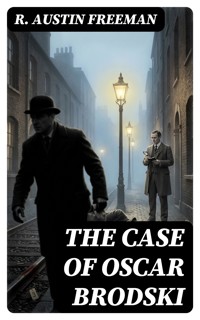
R. Austin Freeman's "The Case of Oscar Brodski" is a masterful work within the detective fiction genre that brilliantly utilize the scientific methods of forensic investigation, a hallmark of Freeman's literary style. Set against the backdrop of early 20th-century England, this narrative employs a tight, logical structure woven with meticulous detail, presenting a classic detective mystery that engages readers while exploring themes of justice, morality, and the fallibility of human perception. Freeman's use of the rationalist approach, particularly through the character of Dr. John Thorndyke—one of the first fictional detectives to utilize forensic science—elevates the narrative beyond mere entertainment to a commentary on the evolving methodologies of crime-solving in a rapidly modernizing society. R. Austin Freeman, a contemporary of Arthur Conan Doyle, was not only a prolific author but also a trained physician, which heavily influenced his portrayal of forensic science in his works. Freeman's background in medicine provided him with unique insights into the criminal mind and investigative processes, allowing him to imbue his stories with authenticity and a keen sense of realism. His experiences during the early 1900s, amidst burgeoning forensic advancements, inspired his innovative merging of scientific principles with fiction. "The Case of Oscar Brodski" is highly recommended for readers who appreciate a blend of intellectual rigor and thrilling narrative. Fans of Sherlock Holmes will find Thorndyke to be a worthy counterpart, embodying the analytical prowess and moral complexity that characterize the best detective literature. This novel is a notable achievement that showcases Freeman's deft storytelling and offers profound insights into the nature of crime and human behavior.
Das E-Book können Sie in Legimi-Apps oder einer beliebigen App lesen, die das folgende Format unterstützen:
Veröffentlichungsjahr: 2023
Ähnliche









The Case of Oscar Brodski
Table of Contents
Introduction
The Case of Oscar Brodski distills the contest between criminal improvisation and the slow, exacting clarity of scientific reason, staging a drama in which actions conceived in haste collide with the patient exposure of cause, trace, and time, where what is hidden seeks refuge in noise and chance while method sifts residue from distraction, reconstructing a path through the ordinary materials of urban life until, step by deliberate step, appearances give way to structure and the untidy improvisations of the moment are tested against procedures designed to outlast memory, misdirection, and fear.
R. Austin Freeman’s tale sits firmly within early twentieth-century British detective fiction, joining the adventures of his medico-legal sleuth, Dr. Thorndyke, and exemplifying the rigorous, evidence-centered school that developed alongside urban modernity. Set in and around London, with its trains, pavements, shops, and boarding houses, the story channels the rhythms of a metropolis where strangers brush past one another and small objects can carry heavy meanings. First appearing in periodical form and later included among the Thorndyke collections, it has been recognized as a celebrated early instance of the inverted detective story, in which reconstruction, rather than surprise alone, drives suspense.
The premise is disarmingly simple: a chance meeting leads to a death that looks convenient to someone and confusing to others, and a specialist in legal medicine undertakes to read the event as if it were a text. Freeman lets the reader observe crucial stages of the affair before the formal inquiry, then shifts to the incremental work of analysis, creating tension not from concealment but from the precision with which each sign is interpreted. The atmosphere is cool, almost clinical, yet never bloodless; the pacing rewards attentiveness, and the satisfactions come from process, proportion, and the assurance of fair play.
Freeman’s voice favors lucidity over flourish, with sentences that move like demonstrations and paragraphs that stack observations into arguments. Without pedantry, he pauses to name instruments and substances, to mark intervals, and to show how a scrap, a stain, or a scuff acquires meaning when placed within a sequence of acts. The tone is courteous and measured, occasionally dryly amused, grounded in professional routine rather than melodrama. Dialogue serves function and character lightly; description is selective, pragmatic, and oriented toward what can be tested. The result is a forensic poise that invites the reader to become a disciplined collaborator.
Under the surface narrative, the story traces themes that have long defined the genre: the ethics of seeing, the limits and reach of expertise, the fragile boundary between accident and design, and the moral weight carried by apparently trivial details. By dramatizing an investigation that converts scattered impressions into a coherent account, it treats knowledge as a form of justice, while acknowledging that facts emerge within social spaces shaped by anonymity and contingency. The inverted structure adds a further layer, separating mystery from mystification and recasting detection as the art of verifying, step by step, what readers already partly apprehend.
For contemporary readers, the case resonates with the ongoing fascination for forensic procedure and with debates about what counts as reliable evidence in a world saturated by data yet prone to haste. Its methodical cadence anticipates modern procedural storytelling, from casework documentaries to crime laboratories on screen, but it avoids sensationalism, modeling patient inference and intellectual humility. The emphasis on material culture—tickets, tools, dust, and habit—speaks to the way ordinary things record our choices. And its structural experiment remains instructive: suspense can flourish without concealment, and narrative honesty need not diminish wonder when craft and clarity guide the hand.
To approach The Case of Oscar Brodski today is to watch an architect of the form set parameters that many later writers would explore: transparency of method, respect for the reader’s intelligence, and the conviction that order can be carved from confusion. It is a compact, meticulously staged piece that rewards slow reading and close notice, not for shocks but for the serenity of problems correctly posed and exactly solved. Even when the streets feel familiar and the technologies modest, the story’s durable promise endures: that attention, honestly applied, can recover truth from the most ordinary traces of life.
Synopsis
The Case of Oscar Brodski, a Dr. Thorndyke story by R. Austin Freeman, stands as an early and influential example of the inverted detective tale. Collected in The Singing Bone, it departs from the conventional whodunit by placing the commission of a crime before the reader and shifting suspense to the working-out of proof. Freeman’s medical-legal sleuth, Dr. John Thorndyke, advances a rational, experimentally grounded approach to investigation, reading the world as a laboratory. The narrative balances clinical precision with atmospheric detail, embedding its puzzle within everyday routines and missteps, and inviting readers to weigh observation, inference, and the consequences of small choices.
At the outset, we follow Oscar Brodski, a solitary traveler whose movements on an evening bring him into the orbit of a calculating stranger. The scene is laid with economical touches: shifting light, an unhurried schedule, and the casual transactions that accompany a journey. Freeman stresses how minor delays and ordinary courtesies open the door to danger, transforming a routine passage into an opportunity for exploitation. The victim’s habits—what he carries, how he spends his time, and whom he trusts—become the raw material of a scheme. This prologue situates the later inquiry, fixing time and place while quietly scattering the physical seeds of evidence.
In a bold structural move, the crime is then depicted from the perpetrator’s vantage point, not to romanticize villainy but to chart the mechanics of preparation, improvisation, and concealment. The offender studies his mark, makes practical use of the tools at hand, and attempts to manipulate appearances so that violence will masquerade as misfortune. Care is lavished on plausible staging and the disposal or rearrangement of telltale objects, yet the process inevitably leaves residue: fibers, stains, impressions, and timing anomalies. By letting readers witness the steps and missteps, Freeman transforms the central question from who acted to how the action will be unmasked.
Discovery follows with restrained drama: officials take charge, routine procedures commence, and neat explanations present themselves, though none sits entirely at ease with the facts. The physical scene contains contradictions that call for disinterested measurement rather than intuition. Apparent signs of accident are countered by traces that resist easy classification, and the timeline hinted at by tickets and personal effects refuses to align. Freeman allows the institutional investigation to proceed in good faith while emphasizing its limits, preparing the ground for an inquiry that hinges on material minutiae, reproducible tests, and a willingness to let results, not preconceptions, shape the narrative.
Dr. Thorndyke enters as a physician-jurist whose practice is the disciplined reading of small facts. With an assistant to record and replicate, he collects samples, establishes controls, and reconstructs the sequence of events through experiment rather than conjecture. A scrap of matter under magnification, the geometry of a footprint, the behavior of a contaminant under heat—such details become statements that can be tested. He assembles them into a chain strong enough to bear the weight of accusation only if each link is verified. The narrative dwells on his patience and method, modeling a forensic ethic grounded in transparency and demonstrable proof.
The case reaches its dramatic phase in a formal setting where Thorndyke must translate laboratory work into plain reasoning and withstand cross-examination of procedures as much as conclusions. Suspense no longer turns on the identity of an offender—revealed earlier to the reader—but on whether cause-and-effect can be articulated with sufficient clarity to compel assent. Freeman underscores the moral stakes: to accuse is to accept responsibility for the means of knowing. The tension lies in the exposition itself, in whether patterns teased from ash, dust, and schedules will cohere before a standard of proof that values reproducibility over impression.
As the narrative closes, Freeman keeps the resolution within the bounds of professional exactitude, emphasizing process over theatrics and letting consequences emerge from established facts. The story’s broader significance lies in its pioneering inversion, which reorients mystery fiction from surprises of identity to the rigors of demonstration. It showcases Thorndyke’s influence on the forensic detective tradition, presenting scientific literacy as a civic good and inviting readers to treat the world as evidentiary. Without relying on sensational turns, The Case of Oscar Brodski endures for its lucid craft: a quiet insistence that truth, patiently assembled, can illuminate even the most contrived of shadows.
Historical Context
R. Austin Freeman (1862–1943) trained as a physician at Middlesex Hospital and served as a colonial medical officer on the Gold Coast in the late 1880s before illness returned him to London. Bringing clinical precision to fiction, he created Dr. John Thorndyke in 1907, a barrister-physician whose cases foreground expert evidence. The Case of Oscar Brodski was collected in The Singing Bone (1912), a volume notable for pioneering the “inverted” detective story. Arriving in the high-Edwardian-to-early-George V moment, it reflects a Britain fascinated by scientific modernity and institutional authority, and a readership cultivated by mass-market periodicals and circulating libraries.
The story’s milieu is Edwardian London and its surrounding commuter belt, a vast metropolis administered by powerful institutions. Policing centered on the Metropolitan Police and its Criminal Investigation Department, with prosecutions culminating at the Central Criminal Court, the Old Bailey. Coroners’ inquests, regulated by the Coroners Act 1887, probed unexplained deaths before trial. Urban space—lit by gas and spreading electric light, knitted by omnibus, tram, and rail—enabled both anonymity and surveillance. Within this setting, professional expertise, bureaucratic procedure, and the courtroom’s adversarial testing of evidence frame the moral and practical calculations that give detective fiction its procedural texture.
Freeman wrote amid rapid advances in forensic science that reshaped criminal investigation. Scotland Yard established a fingerprint branch in 1901, adopting Edward Henry’s classification system developed in colonial India. In the same year, Paul Uhlenhuth introduced the precipitin test to distinguish human from animal blood, and European pioneers such as Hans Gross advocated systematic criminalistics. Edmond Locard founded his laboratory in Lyon in 1910 and articulated the “exchange principle,” reinforcing the evidentiary value of trace materials. British trials—most famously the 1910 Crippen case—spotlighted expert pathology. Freeman’s fiction harnesses these developments, presenting methodical tests, chain-of-custody thinking, and reasoned inference.




