


0,49 €
Niedrigster Preis in 30 Tagen: 1,99 €
Niedrigster Preis in 30 Tagen: 1,99 €
Mehr erfahren.
- Herausgeber: Booksell-Verlag
- Kategorie: Krimi
- Sprache: Englisch
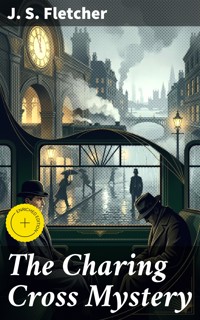
In J. S. Fletcher's gripping novel, "The Charing Cross Mystery," the narrative unfolds within the atmospheric backdrop of early 20th-century London, expertly blending elements of detective fiction and social commentary. Fletcher employs vivid, descriptive prose and a compelling plot structure, inviting readers into a labyrinth of intrigue as amateur sleuthing intermingles with themes of identity and morality. The intricacies of the investigation reveal not only the characters'Äô depths but also the societal mores of the time, making this a nuanced reflection of its literary context. Fletcher, a prolific author and journalist, carved his niche in the mystery genre with a distinctive voice that reflects both personal and societal observations. His background in journalism likely informed his meticulous attention to detail and his understanding of human psychology, making his characters unusually compelling. Living in a time when the mystery genre was burgeoning, Fletcher contributed significantly to its development, earning a reputation for plotting and characterization that resonates with the readers even today. For readers seeking an enthralling and thoughtful exploration of mystery, Fletcher's "The Charing Cross Mystery" is a quintessential choice. Its rich narrative and insightful commentary offer not just a page-turning experience, but also an opportunity to reflect on the human condition within a historical framework, making it a remarkable addition to any literary collection. In this enriched edition, we have carefully created added value for your reading experience: - A succinct Introduction situates the work's timeless appeal and themes. - The Synopsis outlines the central plot, highlighting key developments without spoiling critical twists. - A detailed Historical Context immerses you in the era's events and influences that shaped the writing. - A thorough Analysis dissects symbols, motifs, and character arcs to unearth underlying meanings. - Reflection questions prompt you to engage personally with the work's messages, connecting them to modern life. - Hand‐picked Memorable Quotes shine a spotlight on moments of literary brilliance. - Interactive footnotes clarify unusual references, historical allusions, and archaic phrases for an effortless, more informed read.
Das E-Book können Sie in Legimi-Apps oder einer beliebigen App lesen, die das folgende Format unterstützen:
Veröffentlichungsjahr: 2019
Ähnliche

















The Charing Cross Mystery
Table of Contents
Introduction
In a city where anonymity and proximity coexist, a single unexplained death can expose how fragile trust really is.
J. S. Fletcher’s The Charing Cross Mystery belongs to the tradition of early twentieth-century British crime and detective fiction, a mode attentive to clues, motives, and the social texture of everyday life. Set in London around the Charing Cross area, the novel draws energy from an urban environment shaped by crowds, transit, and chance encounters, where personal histories can be hidden in plain sight. Fletcher, known for his prolific output in mysteries, writes with an eye for practical detail and a pace calibrated to sustain curiosity rather than spectacle.
The premise begins with a disturbing incident linked to the Charing Cross vicinity, prompting questions that refuse easy answers. As attention turns from the bare fact of what happened to the harder matter of why, the narrative follows the gradual assembling of information through observation, conversation, and the testing of competing explanations. The book’s pleasures lie in its method: small facts accrue significance, ordinary settings become charged with implication, and readers are invited to weigh what characters say against what they do. The result is a mystery that emphasizes inference and judgment.
Fletcher’s approach favors clarity and forward motion, with scenes built to deliver new angles rather than ornamental digressions. The voice is controlled and investigative, balancing a newspaper-like plainness with a novelist’s sense of timing. Suspense arises less from sensational set pieces than from the steady tightening of possibilities, as each discovery narrows the field while complicating the moral picture. The tone remains sober, attentive to how quickly reputations can shift when doubt enters the public mind. This makes the reading experience feel both brisk and quietly unsettling.
One of the novel’s persistent interests is how evidence is made persuasive: which details are treated as decisive, which are dismissed, and who benefits from those choices. Alongside the mechanics of detection runs a study of credibility, as characters attempt to manage the stories others tell about them. London functions not merely as backdrop but as a system of pressures—economic, social, and informational—that shape behavior and limit candor. The mystery form becomes a way to examine how people improvise identities in public spaces and how easily appearances harden into verdicts.
The Charing Cross Mystery also reflects on the ethical ambiguity that often lies beneath clean solutions. In a world of partial knowledge, certainty can become a performance, and the pursuit of truth can collide with loyalty, self-preservation, or institutional convenience. Fletcher’s careful attention to motive underscores that wrongdoing is rarely isolated from circumstance; it grows within networks of obligation and opportunity. Without relying on graphic detail, the book keeps moral stakes in view, inviting readers to consider not only what happened but what kind of society allows it to happen.
For contemporary readers, the novel remains relevant because it dramatizes problems that have only intensified: information overload, rapid judgment, and the difficulty of separating fact from inference in a crowded public sphere. Its emphasis on method—patient observation, skepticism toward easy narratives, and respect for small corroborating details—offers an instructive counterpoint to the speed of modern accusation and outrage. At the same time, its London setting highlights how city life can amplify both vulnerability and concealment. Read today, Fletcher’s mystery rewards attention and prompts reflection on how truth is assembled and trusted.
Synopsis
J. S. Fletcher’s The Charing Cross Mystery is a London-set detective novel that opens by anchoring its intrigue to a familiar public space and the everyday routines that move through it. What begins as a puzzling incident quickly signals that appearances will be deceptive, drawing attention to the gap between what can be observed and what can be proved. Fletcher establishes an atmosphere of urban anonymity, where chance encounters and overlooked details can matter as much as deliberate actions. Early chapters focus on the immediate confusion and the first attempts to establish basic facts, motives, and responsibility.
paragraphs.1.0? Nope JSON error. Let's craft correctly.
The story then shifts into an inquiry that treats the initial event less as an isolated occurrence than as a doorway into a wider web of relationships. Investigators and interested parties pursue leads through streets, offices, and private rooms, testing alibis and tracing movements with careful attention to time and place. Fletcher’s narrative keeps the reader close to the mechanics of detection: how testimony is gathered, how inconsistencies are weighed, and how small, seemingly insignificant observations can alter the direction of the search. The central question becomes not only what happened, but how the truth is being hidden in plain sight.
paragraphs.2.0? Still wrong.
As attention broadens, the novel introduces additional figures whose connections to the mystery are not immediately clear, expanding the range of possible explanations. Personal histories, professional interests, and social standing begin to intersect with the practical demands of solving the case. Fletcher emphasizes the tensions between public reputation and private conduct, suggesting that what people fear losing can shape what they are willing to say or conceal. The investigation advances by revisiting earlier assumptions and reinterpreting early evidence, keeping the suspense rooted in procedure rather than sensationalism.
paragraphs.3.0? Need a single list of 7 strings.
Midway through, the inquiry encounters obstacles that complicate straightforward resolution: competing theories, partial disclosures, and the difficulty of distinguishing coincidence from design. The novel’s pace is driven by successive discoveries that refine, rather than replace, what has already been learned. Fletcher maintains a neutral, methodical tone as the detectives and their allies test one line of reasoning after another, mindful that a plausible narrative can still be wrong. The reader is invited to track the logic of pursuit while recognizing that the most important facts may be the ones nobody initially thought to question.
Historical Context
Published in the early 1920s, J. S. Fletcher’s The Charing Cross Mystery belongs to Britain’s post–First World War moment, when London was adjusting to demobilization, economic strain, and social change. The novel’s title points to Charing Cross, a central Westminster area historically associated with major routes, government offices, and busy streets linking the Strand, Whitehall, and the City. By this period, London was a dense administrative and commercial capital whose rail termini, hotels, clubs, and press institutions made it an ideal setting for investigations driven by movement, information, and public attention.
Charing Cross also referred to the railway station, opened in 1864 by the South Eastern Railway and rebuilt with a hotel in the late nineteenth century, anchoring traffic between central London and the south-east. Rail travel shaped urban rhythms by making rapid journeys routine and by concentrating crowds in stations, booking halls, and nearby streets. Such spaces mattered to crime reporting and detection because they provided anonymity, quick exits, and frequent encounters between strangers. Fletcher’s use of this setting aligns with the interwar city’s reliance on transport networks that connected Westminster, the Strand’s legal and journalistic districts, and the broader metropolitan area.
The police and courts provide a realistic institutional background for interwar mysteries. The Metropolitan Police, founded in 1829, policed most of London, while the City of London Police operated separately within the Square Mile, a division that could complicate jurisdiction in investigations. Scotland Yard, long associated with detective work, had formalized the Criminal Investigation Department in 1878, and by the early twentieth century detectives relied on systematic interviewing, record keeping, and growing use of forensic methods. British criminal procedure, shaped by coroner’s inquests and public trials, also fed press coverage and public interest.
The period’s media environment is essential to understanding the genre’s plausibility. London’s national newspapers and popular press had expanded dramatically since the late nineteenth century, aided by telegraphy, mass circulation, and competitive reporting. The Press Association, established in 1868, helped standardize and speed the distribution of news. High-profile cases were widely reported, reinforcing expectations that clues, witness statements, and official announcements would enter public discussion. Fletcher, himself a prolific journalist and editor, wrote within a culture where crime stories were consumed as both information and entertainment, and where investigators had to manage publicity and rumor.
Social geography in early twentieth-century London is another relevant context. The West End’s government buildings, theatres, and hotels sat near poorer districts and crowded lodging areas, and the city’s class distinctions were visible in speech, clothing, and access to private spaces such as clubs and professional chambers. After 1918, the Representation of the People Act 1918 greatly expanded the electorate and the Parliament (Qualification of Women) Act 1918 enabled women to stand for the Commons, reflecting changing civic participation even as many institutions remained traditional. Mysteries often used these contrasts to test respectability against secrecy and misconduct.
Economic and political pressures of the interwar years influenced themes of uncertainty and opportunism without requiring specific fictional parallels. Britain faced postwar debt, industrial unrest, and periodic unemployment, culminating in major disputes such as the General Strike of 1926. Although Fletcher’s novel predates that event, the early 1920s already saw labor tensions and shifts in employment patterns as wartime industries contracted. London remained the center of finance and administration, yet many citizens experienced insecurity. Detective fiction of the era frequently explored motives tied to money, inheritance, and status, reflecting a society attentive to material pressures and social mobility.
Legal and administrative London clustered near the novel’s implied locale. The Inns of Court lay just east along the Strand and Fleet Street, long associated with barristers, solicitors, and legal publishing; nearby were government departments and parliamentary offices in Westminster. These institutions created a setting where documents, contracts, wills, and official records could be pivotal, and where professional reputations carried great weight. The British state’s bureaucracy, expanding through the nineteenth and early twentieth centuries, reinforced the idea that truth could be pursued through papers and procedure as much as through physical pursuit—an assumption that shaped interwar investigative narratives.
Within the broader history of British detective fiction, Fletcher wrote during the transition from late-Victorian sensational traditions to the interwar “Golden Age,” which prized fair-play puzzles, careful reasoning, and coherent social milieus. Writers such as Arthur Conan Doyle had popularized the rational detective, and by the 1920s readers expected investigations to be grounded in observation, testimony, and logical reconstruction. By placing mystery in a well-known London hub and drawing on recognizable institutions—railways, police systems, the press, and legal culture—Fletcher’s work reflects the era’s confidence in method while also exposing how modern urban life could conceal wrongdoing behind routine and respectability.




