


0,49 €
Mehr erfahren.
- Herausgeber: DigiCat
- Kategorie: Religion und Spiritualität
- Sprache: Englisch
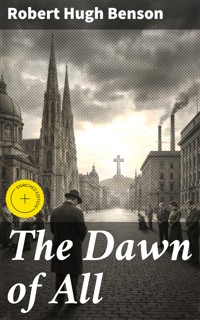
In "The Dawn of All," Robert Hugh Benson crafts a profound narrative that intertwines elements of science fiction and theological speculation. Set in a dystopian future where humanity is facing the repercussions of a world devoid of faith, Benson explores the moral and spiritual dilemmas that arise from a society guided only by materialism. His literary style combines vivid imagery with introspective dialogue, invoking the traditions of both speculative fiction and moral philosophy. The novel is steeped in the context of early 20th-century anxieties regarding secularism and a loss of spiritual direction, reflecting the author's concerns about the world in which he lived. Robert Hugh Benson was a former Anglican priest who converted to Catholicism, a shift that profoundly informed his writing and worldview. His experiences in the clergy, alongside his familiarity with religious themes, emboldened him to critique contemporary society's drift from spiritual values. Writing in the wake of the First World War, Benson sought to engage readers in a conversation about faith, redemption, and humanity's ultimate purpose within a challenging modern landscape. Readers seeking a thought-provoking exploration of faith's role in a secularized world will find "The Dawn of All" to be an enriching and enlightening read. Benson's unique blend of narrative depth and ethical inquiry invites reflection on the moral choices that define humanity's future, making it a timeless work that resonates with both spiritual seekers and literary enthusiasts alike. In this enriched edition, we have carefully created added value for your reading experience: - A succinct Introduction situates the work's timeless appeal and themes. - The Synopsis outlines the central plot, highlighting key developments without spoiling critical twists. - A detailed Historical Context immerses you in the era's events and influences that shaped the writing. - A thorough Analysis dissects symbols, motifs, and character arcs to unearth underlying meanings. - Reflection questions prompt you to engage personally with the work's messages, connecting them to modern life. - Hand‐picked Memorable Quotes shine a spotlight on moments of literary brilliance. - Interactive footnotes clarify unusual references, historical allusions, and archaic phrases for an effortless, more informed read.
Das E-Book können Sie in Legimi-Apps oder einer beliebigen App lesen, die das folgende Format unterstützen:
Veröffentlichungsjahr: 2022
Ähnliche



The Dawn of All
Table of Contents
Introduction
The Dawn of All turns the perennial conflict between spiritual authority and modern autonomy into a quietly disorienting thought experiment. Benson invites readers to awaken into a reordered world where familiar certainties seem inverted and the meaning of progress becomes a live question. Instead of shocks and catastrophes, he arranges a landscape of calm routines, public rituals, and administrative clarity, then asks what is gained and lost when culture coheres. The tension lies in the ordinary: streets and offices, schools and courts, rendered with an almost pastoral steadiness. The book’s strange power comes from serenity that contains unease, and conviction that invites scrutiny.
Robert Hugh Benson, an English Catholic priest and novelist, composed The Dawn of All as speculative fiction in the early twentieth century. Set chiefly in a future England, with occasional glances toward continental affairs, the novel imagines a social order drastically unlike the liberal modernity of its author’s day. Appearing before the First World War, it participates in an age of literary futures anxious about secularization, industrial power, and social reform. Read alongside the apocalyptic Lord of the World, it forms a contrasting vision rather than a sequel, turning from collapse to consolidation and using the apparatus of a functioning society as its dramatic stage.
At the level of premise, the book follows a man who regains health to discover that the public institutions around him operate under assumptions he does not share. Through guided encounters and steady observation, the narrator surveys courts, schools, ministries, and international relations, learning to read a city whose architecture and calendar signal different priorities. The movement is exploratory rather than plot-driven, with explanations arising in conversation and travel. Benson’s prose is deliberate, courteous, and occasionally ironic, favoring reflective pauses over spectacle. The effect is akin to a civic pilgrimage, a tour that doubles as a tutorial in another age’s common sense.
Against this measured pace, the novel develops themes of power, conscience, and the common good. It asks how a society might reconcile personal liberty with a shared moral grammar, and what happens when worship and public policy converge. Benson is also interested in work, welfare, and education, presenting structures that claim to restore dignity while restraining individual preference. The imagined equilibrium can appear humane or constraining, depending on the reader’s own outlook, and the book invites that ambivalence. By dramatizing principles rather than personalities, the story foregrounds the trade-offs inherent in any comprehensive vision of order, discipline, and solidarity.
Identity and perception form another axis. Because the protagonist’s previous assumptions sit at an angle to his surroundings, the narrative continuously stages acts of translation: words, customs, and hierarchies that look familiar prove to have altered meanings. This device gives the novel its pedagogical flavor while keeping the emotional temperature low, inviting contemplation rather than crisis. Benson’s scenes of ceremony, architecture, and public decorum show how aesthetics can shape conviction, and how belonging can feel both comforting and exacting. The book thereby doubles as a meditation on how people change, what persuades them, and where the border lies between conversion and conformity.
For contemporary readers, The Dawn of All matters less as a blueprint than as a diagnostic mirror. In an era preoccupied with polarization, loneliness, and institutional distrust, Benson’s imagined coherence tests our desires for unity and our fears of enforced sameness. The novel converses—sometimes sympathetically, sometimes critically—with ongoing discussions about pluralism, postliberal politics, and the public role of religion. It demonstrates how futures literature can surface first principles without resorting to catastrophe. By restoring patience, ritual, and duty to the center of debate, the book presses readers to articulate what they mean by freedom, community, and the ends of law.
Approached in this spirit, The Dawn of All offers a demanding, even contrarian, pleasure: it is a tour that reads like an argument and an argument that moves like a tour. Read slowly, it rewards attention to its institutional details and to the silences at their edges. The novel stands on its own, yet it also enriches a conversation sparked by Benson’s other speculative work, allowing readers to compare different futures grounded in competing diagnoses of modernity. Above all, it leaves room for judgment. Whether one is persuaded or not, the book clarifies the questions a society must resolve to endure.
Synopsis
The Dawn of All, by Robert Hugh Benson, is an early twentieth-century speculative novel that imagines a future in which the Catholic Church has returned to cultural and political centrality. The story unfolds through the eyes of a modern observer who finds himself moving within this reordered world and recording what he sees. Guided by courteous hosts, he enters ministries, chapels, schools, and streets, comparing inherited assumptions with what confronts him. Rather than a tale of battles or miracles, the narrative proceeds as a patient survey, letting institutions, customs, and conversations disclose the premises of a society consciously ordered around public religion.
In public life he observes a constitutional balance in which civil government openly collaborates with ecclesiastical authority. Officials speak of law as accountable to a shared moral order, and communal rites mark the calendar as visibly as elections or budgets. The narrator learns a compact history of how skepticism, faction, and exhaustion prepared populations to seek unity under a restored spiritual center. In offices and council chambers he sees deference to pastoral counsel without erasing political deliberation. The book attends to pageantry and routine alike, suggesting how ceremony, sacrament, and administration interlock to stabilize a polity that prizes unanimity over contention.
Economic life is portrayed in corporate and vocational groupings rather than atomized competition. Guild-like associations mediate between workers, management, and the common good, with arbitration and mutual obligations minimizing industrial conflict. The visitor is taken through workshops and rural districts where production is integrated with worship, festival, and education, and where relief is organized as personal service rather than impersonal subsidy. He notes efficiencies produced by shared purpose, yet he also senses the cost of uniform expectations. Debates he overhears turn on whether prosperity can be secured without reducing persons to functions, and how far moral direction should structure markets.
Schools and universities occupy a central place in the tour, modeled to cultivate intellect within a definite theological horizon. Scientific research proceeds, but laboratories and clinics answer to ethical oversight that insists means serve humane ends. Hospitals and charitable houses are conspicuous, staffed by religious communities and lay professionals collaborating under explicit spiritual aims. The press and the arts are shown as vigorous but responsible, with editors invoking standards that reject sensationalism in favor of formation. Conversations press the question of whether limits protect or stifle creativity, as the protagonist wrestles with the distinction between guidance and control in culture.
The handling of wrongdoing and dissent becomes a focal test of the order’s claims. Courts operate with procedural clarity while drawing on categories of fault and amendment that are moral as well as civil. Penalties emphasize responsibility, reparation, and reconciliation, yet there is no pretense that coercion has vanished. Religious minorities and ideological opponents appear, not as caricatures, but as neighbors whose freedoms are interpreted through the lens of the common good. Dialogues sharpen around propaganda, proselytizing, and the permissible limits of association. The visitor’s sympathies are stretched as he weighs mercy against security and examines the anatomy of authority.
As the survey widens to include international affairs, a diplomatic emergency arises that concentrates the book’s arguments in action. Negotiators invoke shared principles while confronting hard realities of pride, memory, and fear. The Church’s leadership seeks to mediate among states, claiming moral leverage rather than military force, and the civic rulers must decide how much to concede to conscience when sovereignty feels threatened. The observer watches preparations, speeches, and popular reactions, noting both fervor and unease. Without resolving every controversy, the episode measures whether a religiously ordered civilization can respond to external pressure without betraying either its ideals or its citizens.
By the end, the narrative leaves its guide changed but not simplified, and it refuses a final trumpet of victory or defeat. The book’s power lies in the patience of its imagining: a consistent, detailed picture of a world made coherent by faith, set against unresolved tensions about freedom, pluralism, and progress. Written as a counterpart to the author’s darker apocalypse elsewhere, it offers a thought experiment rather than a blueprint. Its abiding resonance is to pose, without easy answers, how a society’s highest convictions shape every lesser choice, and what costs are entailed when unity is pursued as a cure.
Historical Context
Robert Hugh Benson published The Dawn of All in 1911, in the last years of Britain's Edwardian era. An English novelist and Roman Catholic priest, Benson had converted from Anglicanism in 1903 and was ordained in 1904; he was the son of Edward White Benson, Archbishop of Canterbury. The novel belongs to early twentieth-century speculative fiction and situates its imagined future chiefly in England with the Roman Catholic Church as a central institution. It followed his dystopian Lord of the World (1907), offering a contrasting vision that engages contemporary debates about religion, governance, science, and social order without departing from recognizably modern settings and institutions.
The book emerged amid fierce controversies within and about the Catholic Church. Pope Pius X's encyclical Pascendi Dominici Gregis (1907) condemned Modernism, and in 1910 clergy were required to take the Oath Against Modernism. Across the Channel, the French Third Republic had enacted sweeping anticlerical measures, including the 1905 law separating church and state and the expulsion of many religious orders. In Italy, the Papal States had been annexed in 1870, leaving the Roman Question unresolved. In Britain, Catholic numbers and institutions grew steadily after the 1850 restoration of the hierarchy, provoking debate over authority, doctrine, education, and national identity.
British politics and society were also in tumult. The Liberal government's welfare reforms culminated in the People's Budget crisis (1909) and the Parliament Act (1911), which curtailed the House of Lords' veto. The National Insurance Act of 1911 introduced health and unemployment insurance. Industrial Great Unrest between 1910 and 1914 saw widespread strikes by miners, dockers, and railwaymen. The suffragette campaigns escalated direct action. Socialist and Fabian ideas circulated, while trade unions surged in membership. Against this backdrop, Pope Leo XIII's Rerum Novarum (1891) shaped Catholic discourse on labor, property, and the role of the state, informing proposals for corporative or guild models.
Rapid scientific and technological change fed hopes and anxieties that speculative fiction explored. Since Charles Darwin's On the Origin of Species (1859), evolutionary theory and biblical criticism had challenged traditional interpretations. Mass literacy and popular newspapers expanded public argument. Wireless telegraphy, the telephone, electrification, and urban transit transformed communication and space; in 1909 Louis Bleriot flew the Channel, and airships and aeroplanes became symbols of modernity. Writers such as H. G. Wells produced influential futures, including A Modern Utopia (1905) and The War in the Air (1908), that tested political and ethical schemes. Benson's novel joins this discourse, yet filters it through Catholic institutional language.
Continental politics sharpened debates over church, nation, and sovereignty. The French anticlerical campaign dissolved many congregations and regulated education, while the 1905 separation ended the Concordat regime. In Germany, memories of the Kulturkampf of the 1870s lingered as a warning about state control of religion. In Britain and Ireland, the question of Home Rule intensified after 1910, with a Third Home Rule Bill introduced in 1912; Irish Catholic identity remained central to political mobilization and migration patterns within British cities. These currents framed perceptions of how confessional allegiance might shape public life, law, and international alignments in Europe.
English-language Catholic culture was intellectually active. John Henry Newman's writings, The Idea of a University (1852) and Apologia Pro Vita Sua (1864), continued to guide debates about faith and reason. Periodicals like The Tablet offered commentary on politics and theology. The Liturgical Movement, articulated publicly by Dom Lambert Beauduin at Malines in 1909, encouraged renewed attention to worship's social character. Catholic education expanded through parochial schools and universities. Lay writers such as Hilaire Belloc argued vigorously about democracy, economics, and the state. This milieu provided concepts of authority, sacrament, and solidarity that shaped expectations of how a resurgent Church might organize communal life.
Publishing and reading habits favored didactic fiction that dramatized public questions. Benson's own Lord of the World (1907) imagined an aggressively secular, quasi-totalitarian future; The Dawn of All, by contrast, presents a future in which Catholic institutions regain wide influence. Contemporary readers knew genre touchstones from H. G. Wells and William Morris, and they encountered apologetic prose across denominations. Censorship regimes, such as the Index Librorum Prohibitorum maintained by the Holy See, signaled the stakes of doctrinal conflict. Within this literary field, Benson's novel functioned as a thought experiment about authority, conscience, and social organization in a technologically modern society.
The Dawn of All thus reflects anxieties and aspirations distinctive to the 1900s and early 1910s. It answers anticlerical politics, the Catholic Modernist crisis, and Britain's experiments with welfare and constitutional reform by imagining stability rooted in sacramental practice and hierarchical governance. It registers fascination with new media and mobility while asserting an alternative to secular liberalism and revolutionary socialism. Without requiring detailed foreknowledge, the book invites readers to compare rival blueprints for social peace and moral authority. In doing so, it both captures the contested atmosphere of its age and critiques its presuppositions about progress, freedom, and unity.
The Dawn of All
PREFACE
IN a former book, called Lord of the World[1], I attempted to sketch the kind of developments a hundred years hence which, I thought, might reasonably be expected if the present lines of what is called "modern thought" were only prolonged far enough; and I was informed repeatedly that the effect of the book was exceedingly depressing and discouraging to optimistic Christians. In the present book I am attempting—also in parable form—not in the least to withdraw anything that I said in the former, but to follow up the other lines instead, and to sketch—again in parable—the kind of developments, about sixty years hence which, I think, may reasonably be expected should the opposite process begin, and ancient thought (which has stood the test of centuries, and is, in a very remarkable manner, being "rediscovered" by persons even more modern than modernists) be prolonged instead. We are told occasionally by moralists that we live in very critical times, by which they mean that they are not sure whether their own side will win or not. In that sense no times can ever be critical to Catholics, since Catholics are never in any kind of doubt as to whether or no their side will win. But from another point of view every period is a critical period, since every period has within itself the conflict of two irreconcilable forces[1q]. It has been for the sake of tracing out the kind of effects that, it seemed to me, each side would experience in turn, should the other, at any rate for a while, become dominant, that I have written these two books.
Finally if I may be allowed, I should wish to draw attention to my endeavours to treat of the subject of "religious persecution," since I strongly believe that in some such theory is to be found the explanation of such phenomena as those of Mary Tudor's reign[2] in England, and of the Spanish Inquisition[3]. In practically every such case, I think, it was the State and not the Church which was responsible for so unhappy a policy; and that the policy was directed not against unorthodoxy, as such, but against an unorthodoxy which, under the circumstances of those days, was thought to threaten the civil stability of society in general, and which was punished as amounting to treasonable, rather than to heretical, opinions.
ROBERT HUGH BENSON.
ROME Lent 1911
THE DAWN OF ALL
PROLOGUE
Gradually memory and consciousness once more reasserted themselves, and he became aware that he was lying in bed. But this was a slow process of intense mental effort, and was as laboriously and logically built up of premises and deductions as were his theological theses learned twenty years before in his seminary. There was the sheet below his chin; there was a red coverlet (seen at first as a blood-coloured landscape of hills and valleys); there was a ceiling, overhead, at first as remote as the vault of heaven. Then, little by little, the confused roaring in his ears sank to a murmur. It had been just now as the sound of brazen hammers clanging in reverberating caves, the rolling of wheels, the tramp of countless myriads of men. But it had become now a soothing murmur, not unlike the coming in of a tide at the foot of high cliffs—just one gentle continuous note, overlaid with light, shrill sounds. This too required long argument and reasoning before any conclusion could be reached; but it was attained at last, and he became certain that he lay somewhere within sound of busy streets. Then rashly he leapt to the belief that he must be in his own lodgings in Bloomsbury; but another long slow stare upwards showed him that the white ceiling was too far away.
The effort of thought seemed too much for him; it gave him a sense of inexplicable discomfort[2q]. He determined to think no more, for fear that the noises should revert again to the crash of hammers in his hollow head. . . .
He was next conscious of a pressure on his lip, and a kind of shadow of a taste of something. But it was no more than a shadow: it was as if he were watching some one else drink and perceiving some one else to swallow. . . . Then with a rush the ceiling came back into view: he was aware that he was lying in bed under a red coverlet; that the room was large and airy about him; and that two persons, a doctor in white and a nurse, were watching him. He rested in that knowledge for a long time, watching memory reassert itself[3q]. Detail after detail sprang into view: farther and farther back into his experience, far down into the childhood he had forgotten. He remembered now who he was, his story, his friends, his life up to a certain blank day or set of days, between him and which there was nothing. Then he saw the faces again, and it occurred to him, with a flash as of illumination, to ask. So he began to ask; and he considered carefully each answer, turning it over and reflecting upon it with what seemed to him an amazing degree of concentration.
". . . So I am in Westminster Hospital," he considered. "That is extraordinarily interesting and affecting. I have often seen the outside of it. It is of discoloured brick. And I have been here . . . how long? how long, did they say? . . . Oh! that is a long time. Five days! And what in the world can have happened to my work? They will be looking out for me in the Museum. How can Dr. Waterman's history get on without me? I must see about that at once. He'll understand that it's not my fault. . . .
"What's that? I mustn't trouble myself about that? But—Oh! Dr. Waterman has been here, has he? That's very kind—very kind and thoughtful indeed. And I'm to take my time, am I? Very well. Please thank Dr. Waterman for his kindness and his thoughtfulness in enquiring. . . . And tell him I'll be with him again in a day or two at any rate. . . . Oh! tell him that he'll find the references to the thirteenth-century Popes in the black notebook—the thick one—on the right of the fire-place. They're all verified. Thank you, thank you very much. . . . and . . . by the way . . . just tell him I'm not sure yet about the Piccolomini matter[4]. . . . What's that? I'm not to trouble myself? . . . But . . . Oh! very well. Thank you. . . . Thank you very much."
There followed a long pause. He was thinking still very hard about the thirteenth-century Popes. It was really very tiresome that he could not explain to Dr. Waterman himself. He was certain that some of the pages in the thick black notebook were loose; and how terrible it would be if the book were taken out carelessly, and some of the pages fell into the fire. They easily might! And then there'd be all the work to do again. . . . And that would mean weeks and weeks. . . .
Then there came a grave, quiet voice of a woman speaking in his ear; but for a long time he could not understand. He wished it would let him alone. He wanted to think about the Popes. He tried nodding and murmuring a general sort of assent, as if he wished to go to sleep; but it was useless: the voice went on and on. And then suddenly he understood, and a kind of fury seized him.
How did they know he had once been a priest? Spying and badgering, as usual! . . . No: he did not want a priest sent for. He was not a priest any more; not even a Catholic. It was all lies—lies from the beginning to the end—all that they had taught him in the seminary. It was all lies! There! Was that plain enough? . . .
Ah! why would not the voice be quiet? . . . He was in great danger, was he? He would be unconscious again soon, would he? Well, he didn't know what they meant by that; but what had it to do with him? No: he did not want a priest. Was that clear enough? . . . He was perfectly clear-headed; he knew what he was saying. . . . Yes; even if he were in great danger . . . even if he were practically certain to die. (That, by the way, was impossible; because he had to finish the notes for Dr. Waterman's new History of the Popes; and it would take months.) Anyhow, he didn't want a priest. He knew all about that: he had faced it all, and he wasn't afraid. Science had knocked all that religious nonsense on the head. There wasn't any religion. All religions were the same. There wasn't any truth in any of them. Physical science had settled one half of the matter, and psychology the other half. It was all accounted for. So he didn't want a priest anyhow. Damn priests! There! would they let him alone after that? . . .
And now as to the Piccolomini affair. It was certain that when Aeneas was first raised to the Sacred College. . . .
Why . . . what was happening to the ceiling? How could he attend to Aeneas while the ceiling behaved like that? He had no idea that ceilings in the Westminster Hospital could go up like lifts. How very ingenious! It must be to give him more air. Certainly he wanted more air. . . . The walls too. . . . Ought not they also to revolve? They could change the whole air in the room in a moment. What an extraordinarily ingenious . . . Ah! and he wanted it. . . . He wanted more air. . . . Why don't these doctors know their business better? . . . What was the good of catching hold of him like that? . . . He wanted air . . . more air . . . He must get to the window! . . . Air . . . air! . . .
PART I
CHAPTER I
(I)
The first objects of which he became aware were his own hands clasped on his lap before him, and the cloth cuffs from which they emerged; and it was these latter that puzzled him. So engrossed was he that at first he could not pay attention to the strange sounds in the air about him; for these cuffs, though black, were marked at their upper edges with a purpled line such as prelates wear. He mechanically turned the backs of his hands upwards; but there was no ring on his finger. Then he lifted his eyes and looked.
He was seated on some kind of raised chair beneath a canopy. A carpet ran down over a couple of steps beneath his feet, and beyond stood the backs of a company of ecclesiastics—secular priests in cotta[6], cassock, and biretta, with three or four bare-footed Franciscans and a couple of Benedictines. Ten yards away there rose a temporary pulpit with a back and a sounding-board beneath the open sky; and in it was the tall figure of a young friar, preaching, it seemed, with extraordinary fervour. Around the pulpit, beyond it, and on all sides to an immense distance, so far as he could see, stretched the heads of an incalculable multitude, dead silent, and beyond them again trees, green against a blue summer sky.
He looked on all this, but it meant nothing to him. It fitted on nowhere with his experience; he knew neither where he was, nor at what he was assisting, nor who these people were, nor who the friar was, nor who he was himself. He simply looked at his surroundings, then back at his hands and down his figure.
He gained no knowledge there, for he was dressed as he had never been dressed before. His caped cassock was black, with purple buttons and a purple cincture. He noticed that his shoes shone with gold buckles; he glanced at his breast, but no cross hung there. He took off his biretta, nervously, lest some one should notice, and perceived that it was black with a purple tassel. He was dressed then, it seemed, in the costume of a Domestic Prelate[5]. He put on his biretta again.
Then he closed his eyes and tried to think; but he could remember nothing. There was, it seemed, no continuity anywhere. But it suddenly struck him that if he knew that he was a Domestic Prelate, and if he could recognize a Franciscan, he must have seen those phenomena before. Where? When?
Little pictures began to form before him as a result of his intense mental effort, but they were far away and minute, like figures seen through the wrong end of a telescope; and they afforded no explanation. But, as he bent his whole mind upon it, he remembered that he had been a priest—he had distinct memories of saying mass. But he could not remember where or when; he could not even remember his own name.
This last horror struck him alert again. He did not know who he was. He opened his eyes widely, terrified, and caught the eye of an old priest in cotta and cassock who was looking back at him over his shoulder. Something in the frightened face must have disturbed the old man, for he detached himself from the group and came up the two steps to his side.
"What is it, Monsignor?" he whispered.
"I am ill . . . I am ill . . . father," he stammered.
The priest looked at him doubtfully for an instant.
"Can you . . . can you hold out for a little? The sermon must be nearly—-"
Then the other recovered. He understood that at whatever cost he must not attract attention. He nodded sharply.
"Yes, I can hold out, father; if he isn't too long. But you must take me home afterwards."
The priest still looked at him doubtfully.
"Go back to your place, father. I'm all right. Don't attract attention. Only come to me afterwards."
The priest went back, but he still glanced at him once or twice.
Then the man who did not know himself set his teeth and resolved to remember. The thing was too absurd. He said to himself he would begin by identifying where he was. If he knew so much as to his own position and the dresses of those priests, his memory could not be wholly gone.
In front of him and to the right there were trees, beyond the heads of the crowd. There was something vaguely familiar to him about the arrangement of these, but not enough to tell him anything. He craned forward and stared as far to the right as he could. There were more trees. Then to the left; and here, for the first time, he caught sight of buildings. But these seemed very odd buildings—neither houses nor arches—but something between the two. They were of the nature of an elaborate gateway.
And then in a flash he recognized where he was. He was sitting, under this canopy, just to the right as one enters through Hyde Park Corner; these trees were the trees of the Park; that open space in front was the beginning of Rotten Row; and Something Lane—Park Lane—(that was it!)—was behind him.
Impressions and questions crowded upon him quickly now—yet in none of them was there a hint as to how he got here, nor who he was, nor what in the world was going on. This friar! What was he doing, preaching in Hyde Park? It was ridiculous—ridiculous and very dangerous. It would cause trouble. . . .
He leaned forward to listen, as the friar with a wide gesture swept his hand round the horizon. "Brethren," he cried, "Look round you! Fifty years ago this was a Protestant country, and the Church of God a sect among the sects. And to-day—to-day God is vindicated and the truth is known. Fifty years ago we were but a handful among the thousands that knew not God, and to-day we rule the world. 'Son of man, can these dry bones live?' So cried the voice of God to the prophet. And behold! they stood up upon their feet, an exceeding great army. If then He has done such things for us, what shall He not do for those for whom I speak? Yet He works through man. 'How shall they hear without a preacher?' Do you see to it then that there are not wanting labourers in that vineyard of which you have heard. Already the grapes hang ready to pluck, and it is but we that are wanting. . . . Send forth then labourers into My vineyard, cries the Lord of all."
The words were ill-chosen and commonplace enough, and uttered in an accent indefinably strange to the bewildered listener, but the force of the man was tremendous, as he sent out his personality over the enormous crowd, on that high vibrant voice that controlled, it seemed, even those on the outskirts far up the roads on either side. Then with a swift sign of the cross, answered generally by those about the pulpit, he ended his sermon and disappeared down the steps, and a great murmur of talk began.
But what in the world was it all about, wondered the man under the canopy. What was this vineyard? and why did he appeal to English people in such words as these? Every one knew that the Catholic Church was but a handful still in this country. Certainly, progress had been made, but. . . .
He broke off his meditations as he saw the group of ecclesiastics coming towards him, and noticed that on all sides the crowd was beginning to disperse. He gripped the arms of the chair fiercely, trying to gain self-command. He must not make a fool of himself before all these people; he must be discreet and say as little as possible.
But there was no great need for caution at present. The old priest who had spoken to him before stepped a little in advance of the rest, and turning, said in a low sentence or two to the Benedictines; and the group stopped, though one or two still eyed, it seemed, with sympathy, the man who awaited him. Then the priest came up alone and put his hand on the arm of the chair.
"Come out this way," he whispered. "There's a path behind, Monsignor, and I've sent orders for the car to be there."
The man rose obediently (he could do nothing else), passed down the steps and behind the canopy. A couple of police stood there in an unfamiliar, but unmistakable uniform, and these drew themselves up and saluted. They went on down the little pathway and out through a side-gate. Here again the crowd was tremendous, but barriers kept them away, and the two passed on together across the pavement, saluted by half a dozen men who were pressed against the barriers—(it was here, for the first time, that the bewildered man noticed that the dresses seemed altogether unfamiliar)—and up to a car of a peculiar and unknown shape, that waited in the roadway, with a bare-headed servant, in some strange purple livery, holding the door open.
"After you, Monsignor," said the old priest.
The other stepped in and sat down. The priest hesitated for an instant, and then leaned forward into the car.
"You have an appointment in Dean's Yard, Monsignor, you remember. It's important, you know. Are you too ill?"
"I can't. . . . I can't. . . ." stammered the man.
"Well, at least, we can go round that way. I think we ought, you know. I can go in and see him for you, if you wish; and we can at any rate leave the papers."
"Anything, anything. . . . Very well."
The priest got in instantly; the door closed; and the next moment, through crowds, held back by the police, the great car, with no driver visible in front through the clear-glass windows, moved off southward.
(II)
It was a moment before either spoke. The old priest broke the silence. He was a gentle-faced old man, not unlike a very shrewd and wide-awake dormouse; and his white hair stood out in a mass beneath his biretta. But the words he used were unintelligible, though not altogether unfamiliar.
"I . . . I don't understand, father," stammered the man.
The priest looked at him sharply.
"I was saying," he said slowly and distinctly, "I was saying that you looked very well, and I was asking you what was the matter."
The other was silent a moment. How, to explain the thing! . . . Then he determined on making a clean breast of it. This old man looked kindly and discreet. "I . . . I think it's a lapse of memory," he said. "I've heard of such things. I . . . I don't know where I am nor what I'm doing. Are you . . . are you sure you're not making a mistake? Have I got any right——?"
The priest looked at him as if puzzled.
"I don't quite understand, Monsignor. What can't you remember?"
"I can't remember anything," wailed the man, suddenly broken down. "Nothing at all. Not who I am, nor where I'm going, or where I come from. . . . What am I? Who am I? Father, for God's sake tell me."
"Monsignor, be quiet, please. You mustn't give way. Surely——"
"I tell you I can remember nothing. . . . It's all gone. I don't know who you are. I don't know what day it is, or what year it is, or anything——"
He felt a hand on his arm, and his eyes met a look of a very peculiar power and concentration. He sank back into his seat strangely quieted and soothed.
"Now, Monsignor, listen to me. You know who I am"—(he broke off). "I'm Father Jervis. I know about these things. I've been through the psychological schools. You'll be all right presently, I hope. But you must be perfectly quiet——"
"Tell me who I am," stammered the man.
"Listen then. You are Monsignor Masterman, secretary to the Cardinal. You are going back to Westminster now, in your own car——"
"What's been going on? What was all that crowd about?"
Still the eyes were on him, compelling and penetrating.
"You have been presiding at the usual midday Saturday sermon in Hyde Park, on behalf of the Missions to the East. Do you remember now? No! Well, it doesn't matter in the least. That was Father Anthony who was preaching. He was a little nervous, you noticed. It was his first sermon in Hyde Park."
"I saw he was a friar," murmured the other.
"Oh! you recognized his habit then? There, you see; your memory's not really gone. And . . . and what's the answer to Dominus vobiscum?"
"Et cum spiritu tuo."
The priest smiled, and the pressure on the man's arm relaxed.
"That's excellent. It's only a partial obscurity. Why didn't you understand me when I spoke to you in Latin then?"
"That was Latin? I thought so. But you spoke too fast; and I'm not accustomed to speak it."
The old man looked at him with grave humour. "Not accustomed to speak it, Monsignor! Why——" (He broke off again.) "Look out of the window, please. Where are we?"
The other looked out. (He felt greatly elated and comforted. It was quite true; his memory was not altogether gone then. Surely he would soon be well again!) Out of the windows in front, but seeming to wheel swiftly to the left as the car whisked round to the right, was the Victoria Tower. He noticed that the hour pointed to five minutes before one.
"Those are the Houses of Parliament," he said. "And what's that tall pillar in the middle of Parliament Square?"
"That's the image of the Immaculate Conception. But what did you call those buildings just now?"
"Houses of Parliament, aren't they?" faltered the man, terrified that his brain was really going.
"Why do you call them that?"
"It is their name, isn't it?"
"It used to be; but it isn't the usual name now."
"Good God! Father, am I mad? Tell me. What year is it?"
The eyes looked again into his.
"Monsignor, think. Think hard."
"I don't know. . . . I don't know. . . . Oh, for God's sake! . . ."
"Quietly then. . . . It's the year nineteen hundred and seventy-three."
"It can't be; it can't be," gasped the other. "Why, I remember the beginning of the century."
"Monsignor, attend to me, please. . . . That's better. It's the year nineteen hundred and seventy-three. You were born in the year—in the year nineteen hundred and thirty-two. You are just forty years old. You are secretary and chaplain to the Cardinal—Cardinal Bellairs. Before that you were Rector of St. Mary's in the West. . . . Do you remember now?"
"I remember nothing."
"You remember your ordination?"
"No. Once I remember saying Mass somewhere. I don't know where."
"Stay, we're just there." (The car wheeled in swiftly under an archway, whisked to the left, and drew up before the cloister door.) "Now, Monsignor, I'm going in to see the Prior myself and give him the papers. You have them?"
"I. . . I don't know."
The priest dived forward and extracted a small despatch-box from some unseen receptacle.
"Your keys, please, Monsignor."
The other felt wildly about his person. He saw the steady eyes of the old priest upon him.
"You keep them in your left-hand breast pocket," said the priest slowly and distinctly.
The man felt there, fetched out a bundle of thin, flat keys, and handed them over helplessly. While the priest turned them over, examining each, the other stared hopelessly out of the window, past the motionless servant in purple who waited with his hand on the car-door. Surely he knew this place. . . . Yes; it was Dean's Yard. And this was the entrance to the cloister of the Abbey. But who was "the Prior," and what was it all about?
He turned to the other, who by now was bending over the box and extracting a few papers laid neatly at the top.
"What are you doing, father? Who are you going to see?"
"I am going to take these papers of yours to the Prior—the Prior of Westminster. The Abbot isn't here yet. Only a few of the monks have come."
"Monks! Prior! . . . Father!"
The old man looked him in the eyes again.
"Yes," he said quietly. "The Abbey was made over again to the Benedictines last year, but they haven't yet formally taken possession. And these papers concern business connected with the whole affair—the relations of seculars and regulars. I'll tell you afterwards. I must go in now, and you must just remain here quietly. Tell me again. What is your name? Who are you?"
"I. . . I am Monsignor Masterman. . . secretary to Cardinal Bellairs."
The priest smiled as he laid his hand on the door.
"Quite right," he said. "Now please sit here quietly, Monsignor, till I come back."
(III)
He sat in perfect silence, waiting, leaning back in his corner with closed eyes, compelling himself to keep his composure.




