


2,99 €
Mehr erfahren.
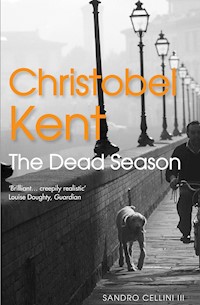
THE THIRD INSTALMENT IN THE SANDRO CELLINI SERIES: Florence lies deserted. The sluggish Arno and the Ponte Vecchio shimmer in the summer haze. A corpse lies on the roadside, waiting for discovery... Every August, Florence shimmers in the summer heat. But this year the heatwave is fiercer than usual, and the city's inhabitants have fled to the cool of the hills. So it is no surprise that amidst the shrubbery of a normally busy roundabout, a corpse lies unnoticed, bloating in the humid air. Sandro Cellini will not be joining the crowds of holidaymakers this year. The former policeman turned private detective has a case: a man who seems to have vanished into thin air - leaving his pregnant young wife alone in the city. Meanwhile, bankteller Roxana Delfino is also stuck in the city for the season, with nothing to do but worry for her aging mother and puzzle over the disappearance of one her regular clients. As all Florence sweats it out, Cellini attempts to grapple with his case and the complications it throws up. And when the weather finally breaks, it brings with it a shocking revelation...
Das E-Book können Sie in Legimi-Apps oder einer beliebigen App lesen, die das folgende Format unterstützen:
Veröffentlichungsjahr: 2012
Ähnliche

















CHRISTOBEL KENT’S previous books include A Time of Mourning, A Party in San Niccolo, Late Season and A Florentine Revenge. She lives near Cambridge with her husband and five children.
For Carrie, brave and kind.
First published in the UK in 2012 by Corvus, an imprint of Atlantic Books Ltd.
Copyright © Christobel Kent, 2012.
The moral right of Christobel Kent to be identified as the author of this work has been asserted in accordance with the Copyright, Designs and Patents Act of 1988.
All rights reserved. No part of this publication may be reproduced, stored in a retrieval system, or transmitted in any form or by any means, electronic, mechanical, photocopying, recording, or otherwise, without the prior permission of both the copyright owner and the above publisher of this book.
This is a work of fiction. All characters, organizations, and events portrayed in this novel are either products of the author’s imagination or are used fictitiously.
9 8 7 6 5 4 3 2 1
A CIP catalogue record for this book is available from the British Library.
Hardback ISBN: 978-1-84354-952-9 Trade Paperback ISBN: 978-1-84887-152-6 Ebook ISBN: 978-0-85789-677-3
Printed in Great Britain.
Corvus An imprint of Atlantic Books Ltd Ormond House 26-27 Boswell Street London WC1N 3JZwww.corvus-books.co.uk
Bridging the gap left by Michael Dibdin ... Suspense, atmosphere, and the architectural beauty of Florence ... Fantastic.
— Irish Examiner
Like Dibdin’s Zen, Cellini is a reluctant inquirer ... fascism, the mafia and revolving-door post-war governments have left many secrets that score dark marks on the surface of daily life. Taut and thoughtful mystery that draws on the contrast between location ... and the savage passions and politics that lie underneath.
— MARK LAWSON, Guardian
Dark, gloomy and often sinister ... An intelligent and convincing thriller with fleshed-out characters you want to meet again.
— Daily Mail
Death, espresso, and political manoeuvring ... An ex-cop plying his trade outside the boundaries of normal Italian police procedure. Brooding Italian noir.
— Independent on Sunday
CONTENTS
Prologue
Chapter One
Chapter Two
Chapter Three
Chapter Four
Chapter Five
Chapter Six
Chapter Seven
Chapter Eight
Chapter Nine
Chapter Ten
Chapter Eleven
Chapter Twelve
Chapter Thirteen
Chapter Fourteen
Chapter Fifteen
Chapter Sixteen
Chapter Seventeen
Chapter Eighteen
Chapter Nineteen
Chapter Twenty
Chapter Twenty-One
Chapter Twenty-Two
Chapter Twenty-Three
Chapter Twenty-Four
Chapter Twenty-Five
Chapter Twenty-Six
Chapter Twenty-Seven
Chapter Twenty-Eight
Chapter Twenty-Nine
Chapter Thirty
Chapter Thirty-One
Chapter Thirty-Two
THE CITY IS DEAD in August. There is movement, but it’s not life.
By day the cruise groups still crawl the streets, slower and slower as the heat intensifies, filing like ants from the Palazzo Vecchio to Santa Croce, their queues snaking around the Duomo and under the arcades of the Uffizi, trying to find shade. The shops beyond the tourist centre are shuttered and silent, the restaurants closed. By day it is bad enough: by night it is a ghost of a place and the tall palaces along the Via dei Bardi, north of the Duomo, and behind Santo Spirito stand even more silent than usual.
There are pockets, on the city’s fringes, where those too poor to escape the heat congregate in the shadows, the Senegalese and Nigerian traders, the travellers, the dispossessed. There is the African market, tucked in between the bridge of San Niccolo on the city’s eastern edge, the embankment and the green flow of the river below – or there was. Earlier this summer there has been a drive among the city’s combined police forces to move the various itinerants along to some other and less visible meeting place; like almost all such moves, its effects will be temporary. The sellers of painted gourds and chipped Nubian heads and tasselled sandals will come back, to sell and to talk, to cook on improvised barbecues and drink sickly canned orange under the scrub oak, the air clouded with mosquitoes from the river below. But for now the place is deserted, or almost.
Where the scrubby trees abut the road, dilapidated crash barriers crowd against oleanders whose crimson flowers look black in the sulphurous streetlighting: even in the hard glare of an August midday, it is hard to see what lies under the densely packed bushes, and by night impossible. Tonight there is a breath of hot wind, a Saharan wind that carries with it tiny particles of sand that will be found the next morning along windscreen wipers. With the wind, the shadows under the trees flicker and shift.
One shadow, though, a low, crumpled shape between oleanders, does not move with the breeze, nor when another set of car headlights briefly illuminates its length beneath the leaves. A silk-socked foot, shoeless; a dark trouser leg, stained darker higher on the leg with a colour that will not be distinguishable against the grey until dawn comes. A battered hand twisted under the body and what should have been a face turned into the dirty scrub.
The flow of August traffic passes on its way out of the city, but no one notices or stops to look. There is no knowing how long he has been there, nor when he will be found.
*
Sandro Cellini was hardly aware of having slept at all, but the luminous dial of the bedside clock told him that it was two-thirteen when he started up in the dark, unable to breathe. Just raising himself from the pillow brought Sandro out in a sweat: he sat against the bedhead and told himself, slow down. It was the heat.
He breathed: slow, shallow, in and out. Sandro knew that if he mentioned this – to his old friend Pietro, heaven forbid to Luisa – they might suggest, gently, that he talk to someone. A professional. He sat as still as he could, felt the sweat cool on his skin, felt the strong thump of his heart slow to normal.
Beside him, lying on her back, Luisa didn’t stir. Her forearms were folded over her chest, protective of its asymmetry under the thin nightgown. On one side a hollowed scar where once there had been a breast; careless of it by day, in her sleep his wife’s hands infallibly found their way to the site of the excision. In the slitted light falling through the shutters, Luisa’s cheekbones gleamed marble-blue and monumental. A motorino whined past, then another and on the street’s southern corner twenty metres away a burst of cackling rose from the drunks. This apartment, thought Sandro out of nowhere: this place. I hate this place.
It was the heat.
CHAPTER ONE
Tuesday
WORKING IN THE CITY in August just wasn’t civilized. Climbing the stairs to his office for an eight-thirty appointment foisted on him by Giuli, his assistant insofar as anyone was, with a tiny, scalding plastic cup of espresso in his hand, Sandro reflected glumly on this conclusion. Only the dregs of society found themselves sitting at a desk in August, only the driven and desperate and enslaved. Forty degrees in the shade by day, and at two-thirteen that morning, when Sandro had been gasping like a fish in the bathroom, it had been thirty-one.
Luisa had not wanted him to buy a thermometer – Why torture yourself? What is this obsession with numbers? – but Sandro had done it on the sly; it hung just outside the bathroom window. Going in there in the early hours, as he often needed to do these days, he could lean out and take a look.
Thirty-one degrees three hours before dawn, and not a breath of cooler air anywhere in the city. Even the moon, shining perfectly round and white overhead, seemed to give out heat. During the day there were distractions but at night, in those long, dead hours between midnight and dawn when by rights the world should be cooling, the heat bore down like a weight. The very thought of Florence’s tonnes of sun-soaked stone, of the eighty kilometres of baked earth separating them from the coast, of the humidity that rose off the sluggish river and the encircling hills that held it in, was enough to bring on a panic attack.
Which was all it was: panic. The heat.
Luisa had pointed out to him a week ago – when the month had begun not with a bang but with the sigh of departing life: empty parking spaces everywhere, shutters pulled down – that now he was a private investigator, a freelance who could theoretically please himself, whereas when Sandro had been a captain in the Polizia dello Stato, he had been obliged to work in August.
‘That was different,’ Sandro had said.
Hands on hips, Luisa had not dignified this with a reply, but Sandro could have defended himself if he had had the energy.
It had been different, though: different having one desk of many in a big, air-conditioned building, moving through quiet corridors, everyone being in the same boat, the bar next to the police station staying open all year round – even on the mid-August holiday, Ferragosto – not to mention Christmas Day – to cater to the officers. Who after all were providing an essential service. And out in the patrol car, there had always been Pietro to talk to.
Sandro’s partner – official or otherwise – for twenty of his thirty years in the Polizia dello Stato, Pietro Cavallaro was a modest, thoughtful man six years his junior, with a round, red-headed wife of permanently sunny disposition and a pretty daughter now coming up to eighteen. (Sandro registered that the big day was tomorrow, wasn’t it? He’d arranged to meet Pietro tonight, with their gift for the girl. Damn.) A careful, meticulous man, slow to anger: the perfect complement to Sandro, who had been described as impatient, irascible, impetuous – given to obsessive pursuits but also flashes of insight.
Very occasional flashes, these days, Sandro thought gloomily, gazing out of the window, and no Pietro to bounce them off. He heard a siren, not far away, and by ear he mapped its path around the viale from the four-lane modern span of the Ponte alla Vittoria to the choked roundabout of the Porta Romana. A motorino crash on one of the bends that the Viale Michelangelo carved through the wooded hillside south of the city, perhaps? There was at least one a week. Lucky if the kid wasn’t under a bus. He turned away, telling himself simply to be grateful he wasn’t knocking on some parent’s door.
If August was a quiet month in the police, there was always something to do: there was paperwork to catch up on; there was drunkenness among tourists, rough sleepers to be moved on, and never mind the domestic squabbles that broke out or the psychiatric patients wandering the streets. People just went nuts in the heat, whether they were already on the edge or not.
And now Sandro was going the same way. ‘So take some time off,’ said Luisa. The irony was, last year it had been Sandro begging her to take it easy, as she recovered from the cancer treatment.
Sitting down at his desk out of habit, Sandro put a hand to his testicles, just for luck. God willing, Luisa would be two years cancer-free in January. He knew you couldn’t breathe again until five had passed, but Luisa was doing a good job: ever practical, she had decided that no purpose was served by thinking about it, so she didn’t.
Even Giuli had been away for a week to the seaside. ‘On your own?’ Luisa had quizzed her straight off, never one for the indirect approach – and on her return, brown as a nut, with a big smile and new fine lines around her eyes (‘Skin cancer, yeah, I know, I know. But it does make you feel good, the sun, doesn’t it?’), she’d been straight out of the gates with a favour to ask.
‘I don’t know if she’s got any money,’ Giuli had pleaded, calling round after her first day back at work at the Women’s Centre. Following it up slyly with, ‘But it’s not as if you’re overrun, is it?’
Standing at the desk with the sweat already beading on his forehead – next year, air-con, vowed Sandro – he could hear her downstairs, the cheerful clatter at the front door, a babble of conversation. She was bringing the client in herself. He downed the thimbleful of coffee, crushed the tiny plastic cup and dropped it in the wastebasket.
‘Hey, Giuli,’ he called through the open door.
She called back, ‘Hey, Babbo.’
‘Babbo’: Dad. It was only half a joke. Part-time at the Women’s Centre – giving free advice on STDs, contraception, pregnancy and the rest for Florence’s errant females, of which there were many and various, from middle-class runaways to Roma to illegal immigrants – and part-time receptionist-cum-assistant to Sandro, Giulietta Sarto could be a nightmare, but she was also the closest thing he and Luisa would ever have to a child.
Forty-three this year, if he remembered right, and now three years clean of drugs and booze and bad men. Giuli was an ex-con into the bargain, although no one but the most hard-hearted would have been unmoved by the full story behind her incarceration. Not a trivial matter, murder, but the man whose throat she’d cut had been her abuser and a murderer himself into the bargain, and Giuli, drug-addicted, anorexic and living on the street, had run out of options.
It was taking them longer than he expected to get up the two short flights of stairs, and Sandro found himself listening. To the slow steps, a couple taken, then a pause. To Giuli’s voice, cheerful, encouraging, solicitous. Sandro was thinking with pride that she’d turned out to be surprisingly good at compassion, little tough-nut Giuli, with her sharp little face and her spiky aubergine-dyed hair. And still listening, he heard the other voice, apologetic, breathless.
His curiosity overcoming him, Sandro was at the door himself when Giuli pushed it open on him, ushering in his first client of the day – the month. My God, thought Sandro, and he took an awkward step back, suddenly nervous as a cat at the sight that presented itself.
‘Sandro,’ Giuli said cheerfully, ‘this is Anna Niescu.’ And fixed him with a frown that said, Pull yourself together. She’s only pregnant.
And she certainly was.
But somehow more pregnant than anyone he’d ever seen before. Not because Anna Niescu was huge, exactly, although the great thrust of her belly was surely close to a full-term gestation, round as a beachball and tight as a drum under a thin cotton dress. If anything, it was because she herself was so tiny, staggering under the burden of her pregnancy: a sweet, small, heart-shaped face, narrow shoulders, one childlike hand clasping a big, cheap handbag against her stomach. Her black hair, shiny as liquorice, was parted in the centre and drawn back in a tight bun: nothing but a child herself, thought Sandro.
He could feel the unwary emotion rising in him at the sight of her. Stop it, he told himself. He stepped hastily back and, remembering himself, pulled out a chair. ‘Please,’ he gestured. ‘Please. Sit down.’
Giuli stood in the door, arms folded.
‘Giuli,’ said Sandro, knowing she was about to put her oar in, ‘a glass of water, maybe? For Signora – ah – for Anna?’
Rolling her eyes, Giuli turned on her heel.
Watching her lower herself gingerly on to the bentwood chair, one hand behind her for support, Sandro remained standing, his heart heavy. Because it was clear to him, first of all, that Anna Niescu’s was an old story and a hopeless one, even clearer that, no, she didn’t have any money, and clearest of all that Sandro would have to help her anyway.
‘So,’ he said gently. ‘When are you due?’
CHAPTER TWO
August
IF PEOPLE WEREN’T WHERE you expected them to be, well, no wonder: it was August.
Roxana Delfino sat behind her plexiglas teller’s screen in the bank’s gloom with nothing better to do and wondered, for example, whether the Carnevale had closed for August this year, because their guy hadn’t been in with the porn cinema’s takings in a cloth bag, as he had every Tuesday since Roxana’d been there.
In Florence in August you couldn’t rely on anything: not the parking regulations, not the market stalls, not the staff of your favourite bar nor the stock of your favourite grocery, supposing they were open at all. A month off in August, that was the tradition, sometimes brought forward and stretched to five weeks if July became unbearable. For Roxana, who liked things the way she liked them, August in the city was a nightmare.
Her mother said it was why she hadn’t got a man: had said it again last night. ‘You’re thirty-three,’ she’d said darkly. ‘It’s a dangerous age. I had three kids by the time I was thirty-three. You’re just too fussy, Roxana. You have to have everything – just so.’ As if she, Violetta Delfino, was any different.
Roxana had still been grinding her teeth over that when at seven-thirty that morning she had zipped on her silver Vespa down the narrow, high-sided length of the Via Romana, a road that annoyed her every day for its not-quite-straightness, kinked in the middle so she had to ease off halfway down to make the bend. There was – as there always was, even in August – a bus looming behind her, just waiting for her to make a mistake. Not yet eight in the morning and the hot wind had blown on her face like it came straight from a hairdryer.
Roxana had kept her cool, her gloved hands steady on the handlebars; she heard the bus squeal reluctantly to a stop in her wake and she had sailed on.
Then down the Via Maggio, dead straight, stone palaces to either side with their huge eaves projecting so far into the street that they almost met overhead. At ground level the darkened interiors of antique shops, all closed for the month: some with brown cloth blinds down, some with metal shutters, some displaying brocade chaises and heavy wooden frames with patrician disregard for the possibility of a smash and grab. Would anyone have the energy in this heat, Roxana had wondered as she sailed past, to ramraid, to heave all that stuff into a van? The answer, she supposed, was yes: there were always some people desperate enough. Last night a baby had cried somewhere in a nearby house for hours in the heat and eventually a row had interrupted, the child’s father shouting at its mother, the mother screeching, Just do it. Finish me off.
Three kids, and where were the others, Mamma? she wanted to say, but never did. Got their freedom and left Roxana to look after Ma. Luca in London, twenty-nine and working in a bar, clubbing till dawn most nights, taking God knew what illicit substances – but Luca could do no wrong. Susanna was up north, working in a hotel in Lugano on the Swiss border, with two kids under three and a feckless husband who kept disappearing, but at least she was married, at least she had her family. And Roxana wasn’t going to tell Mamma how it really was: and even if Susi called at least once a week to moan about Carlo, sounding worn out and angry, then she’d say, the kids were beautiful, it was worth it. That was always how the call ended: a coded warning not to tell Mamma.
And they were beautiful; Roxana had a picture of them at work, stuck under the counter where the customers wouldn’t see it. She looked down now, no need to be furtive, the place was as quiet as the grave. Paolino was one and a half and had his dad’s dark red hair and a fierce little face; Rosa, three, black-eyed and cherubic, took after her grandmother.
Not that easy though, Mamma. As if she could just nip out of the bank and on to the Via del Corso in her lunch break and nab a man with I want kids tattooed on his forehead.
Mamma had this theory that if women lived alone too long – chance would be a fine thing: what she meant was, lived without a man too long – they turned strange and fussy, liked their own little way of doing things too much. They turned into spinsters, and according to Mamma, Roxana was a prime example. ‘Sometimes,’ she’d pronounce, watching Roxana restack the dishwasher or order the cupboards or check they’d double-locked the door, ‘I wonder if you’ve got that thing. That obsessive–compulsive whatsit.’
Sliding her neat little motorino into the space under the embankment wall that was unofficially reserved for it next to Valentino’s fat, shiny, show-off Triumph motorbike, Roxana had climbed off gingerly, not wanting to raise a sweat, not before a day’s work. She unclipped her helmet, eased off the thin cotton jacket and stowed them away in the pillion box. Removed her handbag and locked the box, fastened the big yellow steel immobilizer and set off for the bank. Even then as she turned off the river into the warren of streets east of the Uffizi, she looked back over her shoulder, to be sure.
The city seemed so empty, bathed in heat and desolate, but there were always thieves: always. Roxana was a Florentine through and through, born in the hospital of Careggi that sat on the hills to the north; she’d been knocked off her motorino twice – a broken wrist the first time, a collarbone the second – and mugged seven times. Not in the last couple of years, though: she was careful these days. Her mother’s little villa in Galluzzo, where they had both lived since her father had died last year of a heart attack at fifty-eight, had been burgled three times. The thieves came in the early hours, high on something: you woke up in the morning to find wires where the flatscreen TV had been (My only pleasure, these days, Ma had wheedled to get her to buy it) and her handbag gone.
Now the revolving security airlock hissed, the mechanical voice instructed the new arrival to turn around and remove all metallic objects from all pockets, as it always did. Only the odd flustered tourist, having strayed off the beaten track, ever complied; the security capsule’s early morning occupant stood patiently and waited for the door to open.
Here he is, thought Roxana, almost with disappointment. The bank’s most reliable customer, not quite regular as clockwork any more – it was close to ten by now, rather than the usual eight-fifteen – but—
It wasn’t him. Signora Martelli, proprietress of the newspaper stand in the tiny Piazza Santa Felicita shuffled through the door, dragging her shopping trolley after her, pale and sweaty with the heat under her habitual full make-up, to deposit her meagre takings. The typical customer: on her last legs, heart trouble, swollen ankles, the summer would probably see her out. Roxana eyed her. She didn’t envy the executors of that will. The old lady wasn’t letting ill health mellow her – she was one of those who had her favourites, Roxana theorized, a working woman who disapproved of other working women. Yet, with a disdainful sniff, she eventually allowed Roxana to investigate the failure of a standing order to pay her water bill. Not quite satisfied by the explanation that an annual review had been specified on the standing order and it had lapsed, she had shuffled off again, leaving the place to return to glum silence, dust motes hanging in the murk.
The last time they’d been burgled, Roxana had been woken by the intruders and she’d got up, bleary with rage, the heavy immobilizer for the Vespa in her hand, only Ma had appeared in her bedroom doorway white with terror and clung on to her. Roxana had had to stand there, stupid big piece of plastic-sheathed metal in her hand, and do absolutely nothing. Nothing but stroke Mamma’s hair to calm her. They hadn’t even claimed, not wanting the insurance to go higher: Roxana had gone for the cheapest TV she could find this time.
Too many drugs, too many desperate types, too little respect. Easy pickings from the wealthy tourists bred crime as uncleared garbage bred rats.
Obsessive–compulsive? Roxana didn’t know where Ma had picked up that little bit of psycho-babble. It was simply that the answer was to be wary, and to pay attention to the detail.
The boss would laugh at her, gently, for this tendency, but then he’d reassure her that this was precisely why he’d employed her. It was why she was such an asset to the bank, with her thoroughness, her conscientiousness.
In the silent interior, Roxana couldn’t suppress a sigh. It was also why she was left holding the fort for most of August – that big mummy’s boy Valentino Sordi, currently messing about happily with the coffee machine in the little staff room.
The offices behind her were dark and empty: the boss’s sanctum – with Direttore in big letters on the frosted glass – and that of his deputy Marisa, who could do no wrong as Gestore, Business e Family with special responsibilities for bringing in commercial customers. The use of English words in Marisa’s title was intended to indicate modernity.
Were they having an affair? Roxana mused, with nothing better to do than indulge in flights of fantasy. Their holidays were more or less coinciding, even if Marisa had been away a day or two longer than him, and since the boss was supposed to be at the seaside with his family, would he even have time for an affair? Not to mention the fact that Marisa, with her designer clothes and her evenings at the Gallery Hotel drinking cocktails, had a wealthy boyfriend already. But still …
Could Roxana have been appointed Gestore, Business e Family if she’d played her cards right? Marisa Goldman, the daughter of a Swiss banker and a Torinese countess, had nothing but good breeding and the right wardrobe, a certain aristocratic way with customers. Whereas despite her degree in economics and accounting, and her thesis on the decline in small-scale manufacturing in rural northern Italy, Roxana was still only a sportellista. A teller, a bank clerk, after three years behind the plexiglass, for all the boss’s professions of enthusiasm for her attention to detail.
And it wasn’t as though the Banca di Toscana Provinciale was one of the big names. No, it was a small, old-fashioned bank, a niche bank, if you wanted to put it kindly, with just ten branches, three of them in Florence. It was her mother’s bank, though, which was more or less why she’d ended up here. It had been where her father had brought her to open her own first bank account – now a source of constant frustration to her because the bank was too small, too obscure, and too backward to have its own cash machines anywhere but in the city, so every time she took money out she had to pay some other bank’s whopping charge and feel a mug all over again. The Banca di Toscana Provinciale wasn’t ready for the modern world, and Roxana had always thought that she was, more than ready. So what was she still doing here?
She stared at a terrible poster, dog-eared on the outside of the boss’s office. A man with a white grin and a sharp suit, holding out his hand, and customers queueing in the bank, a dream bubble over each one’s head. Kids playing in the garden, a shiny car. Look ahead! the man was saying. Get in line! Who’d come up with that one? Queue up like a drone, borrow more than you can afford, don’t bother to read the small print.
Roxana’s friends – friend, really, Maria Grazia, whom she hardly saw now she’d moved to Rome to work in film production – told her, get out, the Cassa di Risparmio di Firenze had vacancies, a big shiny new building in the north of the city; get an apartment up there, there are some great offers on the new developments. Break free.
And she would. Roxana told her – over a snatched coffee the last time she visited, Maria Grazia with that worried look in her eyes – she would, only for the moment, there was that tug at her heart that was Mamma.
‘She’s only sixty,’ Maria Grazia had said in an exasperated outburst. Then hissed, ‘She could live another thirty years, Roxi. Getting more cranky and ill every year.’
It was all right for Maria Grazia; her mother, long divorced, was a journalist, she prided herself on being modern, didn’t want her kids hanging on to her apron strings until they were forty or married.
Suddenly, unwatched, unsupervised, Roxana felt like calling up Maria Grazia and telling her. Asking her what she thought about the only interesting thing that had happened in the bank for months.
If Maria Grazia was even there. She hadn’t been, Roxana had found with a sense of obscure humiliation, on the last couple of times she’d called – out on location, a kindly, condescending assistant had said. As if the girl knew that Maria Grazia’s best friend from school was stuck in a dead-end job while the fledgling production director was hanging out with a film crew in Romania.
And if she was there, she’d think her old friend was losing it. Roxana could imagine the intake of breath, the disbelieving laugh. ‘You mean, that’s the highlight of your day, Roxi?’ she’d say. ‘Some old guy failing to turn up to deposit his takings?’
Not old, at least, not very, not much older than Roxana. Deep lines around his eyes, but then working at the Carnevale might have that effect on you. Not her type, even in a different line of work, she’d have to make that clear to Maria Grazia or she’d start matchmaking straight away. Though there was something about him … Otherwise why would his absence keep nagging at Roxana? Dark hair. Black, black eyes. Not always quite clean, not always close-shaven; there was nevertheless something about the Carnevale’s bagman, who no doubt had a name but Roxana had never learned it, that made you think twice. Something that made you wonder, or maybe, as Maria Grazia would undoubtedly say, You’ve got a bit too much time on your hands, Roxi, if you’re wondering about every customer that comes through the door. A tendency to daydream: perhaps that was why Roxana had never been promoted.
There was a clatter at the little staff door behind Roxana, and a grunt, and Val was back, a tiny tin tray in his hand with two coffees on it and a ridiculously pleased expression on his big, stupid, handsome face. The coffee smelled good, Roxana had grudgingly to admit. She hadn’t felt like breakfast this morning, waking in a sweat after a night of broken sleep, that neighbouring baby crying, the suffocating humidity, Mamma’s grumbling still turning over and over in her head, and a bitter taste in her mouth.
‘Thanks,’ she said, downing the thimbleful and pushing back her chair. ‘God,’ she sighed, ‘I don’t remember it being this quiet last year.’
Val shrugged. ‘Don’t knock it,’ he said with indifference, stacking the cups carelessly back on the tray, setting it down on her neat working surface and parking himself beside her. Spinning on the adjustable seat like a child at the barber’s. Roxana retrieved one of the cups as it tipped and threatened to spill its dregs. He set his big feet up on the counter in a parody of insolence. Val didn’t have a thesis or even a degree; he’d scraped through the Liceo Scientifico with a decent grade thanks to private tuition but had dug his heels in when university was suggested. He was simply too lazy.
Val had got his job at the Banca di Toscana Provinciale because he was connected: his uncle was one of the directors. He might stay a sportellista all his life, too, but the thing was, Val didn’t really care. His mother – who worked all the hours God sent running a grocery-cum-wine bar – would keep him supplied with money, and business was booming, if Val’s appearance was any guide. All Val cared about was how he looked. He would spend the first half an hour of each morning brushing himself down after the ride in on his big Triumph, examining the creases in his sharp wool trousers, adjusting the angle of his tie.
Roxana stood up abruptly, the tray in her hand: she’d wash up. She always did.
‘He hasn’t been in,’ she said, and even as she said it, she experienced a minute, sudden, unexpected nudge of panic. As if shining a light on this small and apparently inconsequential mystery might conjure up a whole world of unforeseen consquences: one tiny thing out of place, one idle, curious question asked.
‘Hasn’t been in?’ repeated Val stupidly. ‘Who hasn’t been in?’
Dimwit. Val dealt with the bagman just as often as Roxana.
‘The Albanian.’ To her he was an ‘Albian’ – he might have been anything Eastern European. ‘From the – the cinema, with his cashbag. It’s Tuesday, and he hasn’t been in.’ Then, patiently as if she was talking to a slow child, ‘Every Tuesday since I’ve been here, eight-fifteen – or at least, between eight-twelve and eight-twenty – he comes in to make his deposit.’
Val stared back at her. ‘Dunno,’ he said, and shrugged, but he was frowning. So maybe it really was odd if it had penetrated Val’s thick skull. Or maybe he just didn’t know what she was talking about.
‘Really,’ said Roxana, turning away with the tray but she felt that sharp little tweak of anxiety again. Kept her face impassive, shrugged. ‘Maybe it’s just that it’s August.’
A porn cinema, in this heat. And these days there was the internet. Ugh.
‘Yeah,’ said Val indifferently. Then, with a child’s expression of transparent craftiness, ‘How about we bunk off early, then?’
CHAPTER THREE
EVEN LATER AS THE light faded and the heat refused to die in the stifling streets, as Sandro waited on the corner for Pietro, standing awkwardly with the gift in his hands, trailing gold ribbon and all, he couldnt get her out of his head.
Anna Niescu had not been what he expected.
He had felt Giulis eyes on them every time she came back into the room, on one pretext or another; it had been like being a teacher or a doctor trying to coax a word out of a child, with a pushy parent hovering nearby.
Giuli, hed said in exasperation on something like the fourth interruption looking for the tax forms, shed said, as if Giuli had any interest in her own tax code, let alone anyone elses. Anna Niescu had stopped what she was saying and turned to smile that innocent, trustful smile at Giuli as she entered as shed done on the previous three occasions. Giuli her protector.
A bit too protective. It was as if Giuli thought she needed an interpreter, as if she didnt trust the girl woman, Sandro supposed, as he now knew her to be twenty-eight years old, despite appearances to speak her own mind, or possibly to be able to form a coherent sentence. Sandro himself, he had to admit, had had the impression before Anna Niescu spoke that she might be simple. Too good for this world, as had used to be said of the backward child of every village; no doubt there was a term in modern psychology for it, but Sandro was quite happy not to know it.
Lesen Sie weiter in der vollständigen Ausgabe!
Lesen Sie weiter in der vollständigen Ausgabe!
Lesen Sie weiter in der vollständigen Ausgabe!
Lesen Sie weiter in der vollständigen Ausgabe!
Lesen Sie weiter in der vollständigen Ausgabe!
Lesen Sie weiter in der vollständigen Ausgabe!
Lesen Sie weiter in der vollständigen Ausgabe!
Lesen Sie weiter in der vollständigen Ausgabe!
Lesen Sie weiter in der vollständigen Ausgabe!
Lesen Sie weiter in der vollständigen Ausgabe!
Lesen Sie weiter in der vollständigen Ausgabe!
Lesen Sie weiter in der vollständigen Ausgabe!
Lesen Sie weiter in der vollständigen Ausgabe!
Lesen Sie weiter in der vollständigen Ausgabe!
Lesen Sie weiter in der vollständigen Ausgabe!
Lesen Sie weiter in der vollständigen Ausgabe!
Lesen Sie weiter in der vollständigen Ausgabe!
Lesen Sie weiter in der vollständigen Ausgabe!
Lesen Sie weiter in der vollständigen Ausgabe!
Lesen Sie weiter in der vollständigen Ausgabe!
Lesen Sie weiter in der vollständigen Ausgabe!
Lesen Sie weiter in der vollständigen Ausgabe!
Lesen Sie weiter in der vollständigen Ausgabe!
Lesen Sie weiter in der vollständigen Ausgabe!
Lesen Sie weiter in der vollständigen Ausgabe!
Lesen Sie weiter in der vollständigen Ausgabe!
Lesen Sie weiter in der vollständigen Ausgabe!
Lesen Sie weiter in der vollständigen Ausgabe!
Lesen Sie weiter in der vollständigen Ausgabe!




