


6,99 €
Mehr erfahren.
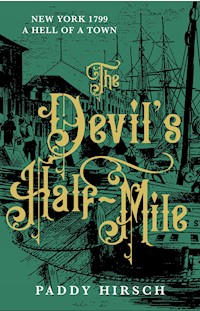
Golden Hill and The Alienist meet Gangs of New York in this sweeping historical crime drama set in 18th century New York. New York, 1799: Justy Flanagan, lawyer, soldier, policeman, has returned to his native city, bloodied and battered after fighting in the Irish Rebellion against the English. Determined to hunt down the man who murdered his father, his inquiries lead him to Wall Street and the fledgling stock market there. But as his investigations into the past move ahead, the horrific murders of young slave women in the present start to occupy his time. Convinced that there is a link between his father's murder, the deaths of the young women, and amassive fraud that nearly destroyed New York's economy, Justy can trust no one. As the conspiracy deepens, it becomes clear that those involved will stop atnothing to keep their secrets. Justy is forced to choose: will he betray his father's memory, compromise his integrity, and risk the lives of his closest friends, to get to the bottom of a tale so dangerous, it could change the landscape of America forever?
Das E-Book können Sie in Legimi-Apps oder einer beliebigen App lesen, die das folgende Format unterstützen:
Veröffentlichungsjahr: 2018
Ähnliche



















THE DEVIL’S HALF MILE
Paddy Hirsch was educated in Dublin and Belfast. He started his journalism career in Hong Kong after a short stint in the military, and eventually moved to America, where he spearheaded coverage of the 2008 financial crisis for the public radio program Marketplace. He lives in Los Angeles now, but makes frequent trips back across the Atlantic to fill up on good stout and proper bacon. And to see family, of course.
First published in the United States of America in 2018 by Forge, Tom Doherty Associates, an imprint of Macmillan Publishing Group, LLC, New York.
First published in Great Britain in 2018 by Corvus, an imprint of Atlantic Books Ltd.
Copyright © Paddy Hirsch, 2018
The moral right of Paddy Hirsch to be identified as the author of this work has been asserted by him in accordance with the Copyright, Designs and Patents Act of 1988.
All rights reserved. No part of this publication may be reproduced, stored in a retrieval system, or transmitted in any form or by any means, electronic, mechanical, photocopying, recording, or otherwise, without the prior permission of both the copyright owner and the above publisher of this book.
This novel is entirely a work of fiction. Th e names, characters and incidents portrayed in it are the work of the author’s imagination. Any resemblance to actual persons, living or dead, events or localities, is entirely coincidental.
1 2 3 4 5 6 7 8 9
A CIP catalogue record for this book is available from the British Library.
Hardback ISBN: 978 1 78649 350 7
Trade Paperback ISBN: 978 1 78649 351 4
E-book ISBN: 978 1 78649 353 8
Printed in Great Britain
Corvus
An Imprint of Atlantic Books Ltd
Ormond House
26–27 Boswell Street
London
WC1N 3JZ
www.atlantic-books.co.uk
To Eileen, for helping me give myself permission
Contents
One
Two
Three
Four
Five
Six
Seven
Eight
Nine
Ten
Eleven
Twelve
Thirteen
Fourteen
Fifteen
Sixteen
Seventeen
Eighteen
Nineteen
Twenty
Twenty-One
Twenty-Two
Twenty-Three
Twenty-Four
Twenty-Five
Twenty-Six
Twenty-Seven
Twenty-Eight
Twenty-Nine
Thirty
Thirty-One
Thirty-Two
Thirty-Three
Thirty-Four
Thirty-Five
Thirty-Six
Thirty-Seven
Thirty-Eight
Thirty-Nine
Forty
Author’s Note
Acknowledgments
Glossary
THE DEVIL’S HALF MILE
New York, 1799
ONE
Monday
Justy Flanagan leaned on the gunwale of the Netherleigh and watched two big men square up to each other on the wharf below. They were like a pair of cart horses, one black, the other white, their fellows in a half circle behind them, grim looks on their faces.
“How goes the negotiations?” Lars Hokkanssen leaned on the rail. He was a giant of a man, with a shaved head and a ragged red beard. Justy was six feet tall, which meant he saw over the heads of most men, but the Netherleigh’s first mate was nearly a foot taller, and wider. His build and his name came from his Norwegian father. His red hair, his Galway accent and his politics were all courtesy of his mother.
“Negotiations?” Justy asked.
Lars gave him an amused look. “How long is it you’ve been away?”
“Four years.”
“A lot’s changed in that time. This isn’t the town you grew up in, I’ll tell you that. There’s a lot more free Negroes here, for one thing, and they all want to graft. They’re forming gangs and taking work, either by force or by selling their labor cheap. The Irish aren’t happy about it. There’s been a few small riots. Men killed, even.” He nodded at the two men, who were now circling each other, ready to come to blows. “This here’s the way they usually decide who gets to unload a ship.”
A shout went up from the other side of the wharf. The two fighters dropped their fists, and the crowd broke up as men rushed to the water’s edge.
One man called for a gaff. Then the crowd went quiet, and Justy knew it was a body. They pulled it up onto the huge granite blocks, and when they all stood still for a moment, their heads down and their caps off, he knew it was a woman.
Four men picked her up. Justy saw the head roll backwards as though it had detached from the body. One of the Negro longshoremen vomited, and there was a ripple through the small crowd as the men in front stepped back.
Two men carried the body to a cart beside the Netherleigh’s gangway. They heaved the corpse up and pulled a tarpaulin over it, but as they walked away the wind gusted and pulled the canvas loose, showing the dead woman’s legs, her dark skin turned gray by the seawater.
The Negro workers were arguing, and one of them, a short, wiry man in a peaked cap, climbed onto a crate and started haranguing his fellows. Justy couldn’t hear the words, but the white longshoremen began edging closer to one another, the gang closing in tight and facing outwards, like a squad of soldiers caught in an open field.
Stung by the words of the small man in the peaked cap, the black workers turned and started shouting at their rivals. The white workers shouted back, stoking themselves and their mates towards the point where they would hurl themselves across the narrowing gap between the two gangs.
“I’m glad I’m up here and not down there,” Lars muttered.
Business on the wharf had stopped. People knew the difference between a labor dispute and a fight. Shoppers were hurrying up the streets, away from the docks. Stall owners were hastily packing boxes and stowing their goods away. And the open space of the emptying wharf was filling with a trickle of men, both black and white, coming to join their fellows on the dock.
A long whistle blast made Justy look up towards the Broad Way. Another whistle, and then a half-dozen watchmen, dressed in their long dark coats and leather firemen’s hats, were pushing through the crowd of shoppers. The watchmen forced their way onto the dock and ran down between the two groups of men. They made a wall, some facing the Irish stevedores, the others facing their black rivals. The watchmen stood firm, slapping their long billy clubs into their palms, their eyes steady as the workers screamed abuse and spat.
A man in a red coat was pushing his way through the gang of white workers. The men parted way, until he was face-to-face with a white-haired man with a ruddy face and a knit cap perched on the back of his head. They spoke for a moment, and then the white-haired man nodded and shouted something to his fellows.
For a moment, nothing happened, and then the Irish gang began to move slowly away from the water. It was clear some men weren’t happy about leaving, but the white-haired man shouted again, and the protestors fell into line, unwilling to be left alone on the dock without their fellows. The black workers fell silent and watched as the Irish withdrew, followed by the watchmen.
When they reached the street, the white-haired man spoke a few words to his men. He took off his cap, and those who were wearing hats followed his lead. He turned towards the docks and nodded at the small, dark, wiry man who was still standing on the crate. And then he turned away and led his men into the town.
The wiry man stepped off the crate. The black crew went to work.
Lars exhaled loudly. He winked at Justy. “So, welcome back to New York, a chara. You glad to be home?”
Justy shrugged, and Lars laughed. “Glad to be three thousand miles away from the bloody English, though, eh?”
“There are plenty of English here.”
“Aye, but they don’t have bayonets fixed and artillery support.”
Justy said nothing.
“Jesus, look at the face on you!” Lars said. “You look like you’re about to stab someone. And speaking of which . . .”
He dug in his pocket and held out a small bundle of filthy linen. Justy unwrapped it carefully. It was a folding knife, a six-inch length of steel tucked into a handle made of a single piece of carved teak. Justy smiled at the weight and the feel of it, the warm, smooth wood and the cool, polished metal bands under his thumb. “You oiled it.”
“Only a couple of times. I was worried about rust.” Lars grinned. “Plus a good piece of steel needs to see the light of day every now and again.”
“So long as you didn’t shave with it. That beard of yours would blunt an executioner’s axe.” Justy tucked the knife into his boot. “And the other thing?”
Lars fumbled in the band of his breeches with both hands and pulled out a thick canvas belt. It was gray with dirt and sweat. He handed it over. “I stashed it in the galley, behind the hardtack. No one wants to steal that stuff, let alone eat it, so I figured it’d be safe there.”
Justy quickly strapped the money belt around his waist. “I hope you took a few coins for yourself.”
“The pleasure of being of service is payment enough.”
“Jesus, you took that much?” Justy smiled at his friend. “Don’t spend it all in the one tavern, will you?”
The big sailor frowned. “That’s a terrible thing to say.”
“The truth cuts like a sharp blade, a mhac,” Justy said.
Shaking hands with Lars Hokkanssen was like getting to grips with a bear. They stood for a moment, hands clasped, not saying any of the things they were thinking.
Justy was the first to let go. “Thanks for finding a place for me.”
“A small thing, after what you did.”
“You don’t owe me.”
“You’ll let me be the judge of that.”
Justy nodded farewell to his friend and went to the top of the Netherleigh’s gangway. He pushed his face into the gust of wind that carried the smell of the city down the hill to the docks. Woodsmoke from a thousand hearth fires, urine from the tanners’ shops, horse shit from the streets, sewage from the septic tanks, fresh blood from the abattoirs, rotting meat and produce from the tips. Bad breath, sour beer, raw spirits, stale sweat. It was like a pungent cloud rolling down the Broad Way to the water, a slap in the face of every newcomer who arrived in the city.
Justy smiled. It was the smell of home.
And then he remembered why he had made the long trip back from Ireland. He thought about what he had to do and his mouth set into a thin line.
The cart that held the woman’s body was at the bottom of the gangplank. Her head was wedged against a pile of sacks, so that her chin was touching her right shoulder, but as Justy came down the gangplank he could still see the ragged purple wound in her neck. Close up, her skin looked darker, and there was a cut on her right cheek. She looked as though she was barely thirteen years old.
A man wearing the gorget of an accountant of the harbormaster’s office pushed past to look at the corpse. The man was bald, with skin the milky color of a dead fish. He sniggered and wiped his nose. “I’d say she was a pretty one, for a Negro bobtail.”
“She wasn’t a whore.”
“She was surely,” the man said. “Look at the mark on her face.”
“That cut’s fresh. Someone did that to make fools like you think she was a whore. Or they did it for spite.”
The accountant leaned over to peer at her face. “Maybe,” he said. He reached for the tarpaulin. “I wonder if he cut her up some more.”
“Leave her.”
The man shrank back. “I was only going to cover her up.”
“She doesn’t need help from the likes of you. Get away from here.”
The man ducked his head and slunk away.
Justy took one more look at the dead girl. A young man was leaning against a stack of crates, watching him. He was dressed in a black coat and breeches, with cheap peg-soled shoes and a white shirt that was grubby at the collar. He looked like any apprentice, but his dark green caubeen hat was unusual. The caubeen was a kind of oversized beret, popular with the oldtimers who came over on the boats from Ireland but rarely worn by anyone so young.
The man grinned. His teeth were white in his tanned face, and Justy felt a prickle of recognition.
“He was only wondering what the rest of us are wanting to know,” the young man said.
“What’s that?”
“Why, whether it’s the same man going about killing Negro girls. That’s the third in less than a week.”
Justy looked back at the body. He felt the skin prickle at the back of his neck.
“Were they all killed the same way?”
“What do you mean?”
“I mean did they all have their throats cut like this? And were they marked like that? The cut on the cheek?”
The man looked at Justy thoughtfully. “New in town, are you?”
“I’ve been away.”
“I’d say you have, indeed.” The grin flashed.
Justy looked down at his stained breeches and threadbare coat. He had worn the same clothes for nearly a month. His spares had been chewed to ribbons by rats on the voyage, and he had thrown them over the side. At least his boots looked like the sort of thing a gentleman might wear.
The man held up his hands. “No offense.” He tapped two fingers to the brim of his hat.
“I’ll see you,” he said, and slipped into the crowd of tradesmen and shoppers. Justy stood for a moment, watching him go, struck by the feeling that he knew the man from somewhere.
He shook his head. He had traveled for months, and now that he had arrived, back in New York, he wasn’t about to dawdle. There was work to do, and still a full half day to do it in. He would not waste the time searching his memory for half-forgotten faces.
He set off up the hill.
The sun was high in the sky, and the streets were crowded with gigs and horses. Coachmen and riders cursed and shouted as they tried to navigate around one another. The air was heavy with the smell of horse manure, and the cobbled streets were slippery with it, despite the piles of straw thrown onto the ground.
The sidewalks were equally busy. Shoppers and passersby competed for space with a crush of handsellers and their carts: chive fencers selling cutlery, swell fencers touting the sharpness of their sewing needles, flying stationers flogging their penny ballads and histories, crack fencers offering bags of nuts, and everywhere the cakey pannam fencers, whose trolleys were piled with pies, sweet bowlas tarts and savory chonkeys, the minced-meat pasties that no true New Yorker could resist.
Justy was at the top of the hill, crossing Wall Street across from Trinity Church, when he saw the young man in the green hat again. He was striding across the Broad Way, dodging carriages and carts, but as he stepped up onto the sidewalk he stumbled, staggering into a man dressed in ivory breeches, an immaculately cut sky-blue coat and an old-fashioned powdered wig that slipped over his forehead.
“God damn it, you fool!” the bewigged man shouted, groping at the horsehair.
“Sorry, sir!” The young man bowed. “I slipped in some horse shit. There’s just too many carriages on the road. My apologies.”
The gentleman brushed him aside. “Out of my way!”
Clutching his wig to his head, he puffed past Justy, clearing a way through the crowd with his cane. Justy turned to watch him go, and when he looked back up the hill the young man had disappeared again.
TWO
Justy had felt the eyes on him as soon as he stepped off the ship. Not that he was surprised. Any new arrival in New York was fair game, even one dressed in rags and carrying no baggage.
There were three of them, all dressed in loose homespun breeches, wooden shoes and threadbare coats. Street bludgers, thieves who weren’t small enough to burgle, or deft enough to pick pockets, and who relied on violence and intimidation instead. He felt the crew hemming him in after he passed Wall Street, a touch of a shoulder in the crowd edging him gently to his right. One man in front, another behind.
The man ahead of him stopped suddenly on the other side of an alley. Justy was supposed to stumble into him, so that the man on his flank could crowd him down the alley. Instead, he deliberately stepped to his right and took four quick steps down the dank, stinking lane. The bludger on his left had committed to a shoulder charge, but there was no one there to receive it, and he came staggering down the alleyway, slipping in the mud and falling flat on his face in front of Justy.
His mates crowded in behind the man, who tried to struggle to his feet.
“Stay down,” Justy ordered.
One of the men sneered at him. He had lost his front teeth, and a stream of snot ran down from his nose and over his upper lip.
“There’s three of us, so,” he said, his accent a mangle of West Coast Irish and New York waterfront. “And there’s just the one of you. So let’s have what you’ve got hidden in your breeks there and we’ll let you go without a hammering.”
The man on the ground began pushing himself up.
“I told you, stay down,” Justy said.
“Or what?”
Justy had left New York to study law at the new Royal College of St.Patrick in Maynooth, just west of Dublin. But he had done much more in his four years away than page through books and take exams. The Monsignor of St. Patrick’s believed that travel was an enriching experience and had included a number of cathedral tours in the first year of the syllabus. Justy had attended every trip, more as a way to see other cities, rather than the churches themselves. On a visit to the cathedral of Saint Marie in Sheffield, Justy had grown bored by a lecture on stained glass and slipped out into the streets of the town. Sheffield was famous for its cutlers, and Justy went from shop to shop, comparing blades, learning about steel and shanks and hafts and curvature, so that by the time he crept back into the chapel for evening prayers he knew more about cutlery than he thought possible.
He also had possession of the unusual knife that he had left with Lars for safekeeping during the voyage.
Folding blades were common on the streets of every modern city, but what made this one different was the spring in the blade, and the release catch in the side under Justy’s thumb.
Which he now pressed.
With a tiny click, six inches of polished steel appeared magically in the air. It was dim in the alley, but the light caught the blade well enough. The eyes of the man on the ground flickered, the whites showing in the gloom, and he let himself slide back into the mud.
Justy felt his heart thump a little harder at the feeling of power over another man. “I’m not some culchie just in from the old country. I’m a New Yorker, same as you. And I don’t appreciate being welcomed home in this unfriendly way by you filthy scamps.”
The two men still standing were looking at him, wide-eyed. The leader ducked his head. “Sorry, mister. We thought yiz might be good for a lift, ye know?”
“No. I don’t know. Now pick up your boy and fuck off.”
The men looked at each other again and then lifted the third man to his feet. Without looking back, they hurried up the alley to the Broad Way.
Justy leaned on the wall of the alley. He felt sweat on his forehead and his pulse hard in his temples. And something else. Shame. The look in the man’s face, the fear in his eyes, had made Justy feel things he hadn’t felt in a while. And hoped he’d never feel again.
He folded his knife and tucked it back into his boot.
“Welcome home, a mhac,” he muttered to himself, and followed the men back up to the street.
THREE
The New Gaol was located in the middle of the Common, a large expanse of open land sandwiched between the Broad Way, which ran along the spine of Manhattan Island, and Chatham Row, which curved east, towards the Bowery. The gaol was a solid, square three-story building, with a small dome on its roof. Its walls had been recently whitewashed, making a stark contrast with the black iron of the bars on the windows and the railings that separated the gaol from the sidewalk.
A small gate in the railings opened on to a narrow path that led to the door of the gaol. Two benches placed on either side of the path faced each other, and Justy sat down to gather himself.
He thought about the long road that had brought him back to New York. Four years, and scores of letters written, hundreds of miles traveled and dozens of people seen. Few of the letters were answered, and only a handful of the interviews revealed anything useful, but in the end a man in London named William Constable had given him two names. Isaac Whippo. And William Duer.
The last was a name Justy already knew. Everyone in New York had heard of Duer, a businessman and a politician, part of the Continental Congress and a friend and onetime ally of both George Washington and Alexander Hamilton. But as wealthy and well-connected as Duer was, he was also a reckless speculator who lost everything in the Panic of 1792—a panic many said he started—and was sent to debtors’ prison.
He had been there ever since.
Justy looked up at the white walls and the barred windows. They all had curtains. This was hardly a prison. Not like Kilmainham Jail, in Dublin. So perhaps the rumors were true. The word was Duer’s friends may not have helped him with his debt, but they paid handsomely to be sure he was comfortable. They said he had a suite of well-furnished rooms, a personal library, his own wine cellar, even his own privy.
Justy tried to remember what Duer looked like. His father had introduced him once, when Justy was twelve. It was the autumn of 1790, two years before the Panic. They were in one of the coffee houses that stock traders used to do business, buying and selling commodities, company shares and paper debts. He recalled a tall man, with a narrow face and a quick, dry handshake. Duer’s small, cold eyes had flicked up and down, summing him up and then looking away. It had made him think of a snake.
His father had not felt the same way. He had been quick to laugh at Duer’s witticisms, eager to please. He had gazed at Duer like a priest enraptured by an image of the Christ child. Justy had seen a flash of contempt in Duer’s eyes. He recalled feeling the same in himself.
“This man will make us wealthy,” his father had whispered, after Duer had gone. “You’ll see.”
But instead, Duer had killed him.
The bench was hard, and the late summer sun was hot on his neck, but Justy didn’t move. He had been in such a hurry to get here, but suddenly all of his questions seemed foolish. What if Duer denied everything? What if he said nothing? Justy imagined the tall, thin man waving him off with a languid flick of his bony wrist. It was a long way to come for such a short conversation.
He heard the Trinity Church bell strike three, and suddenly he had an image of his father, hanging in the stairwell of the house on Dutch Street. The grotesquely tilted head, the rictus grin, the bruises and scratches on his neck, the half-opened eyelids showing a spray of red dots on the whites of his eyes. Justy felt the anger build in his chest, making his teeth clench, his muscles taut, his face pale.
He stood up and walked to the door.
It opened on to a long hallway, lit by a simple chandelier and a window set high in the wall above the door. There was a strong smell of wood polish. Behind a heavy wooden desk sat a heavyset man dressed entirely in black. His bald head was flat on one side, like a bruised piece of fruit. There was a large, purple brand mark on his right cheek. His eyes were like two blue lights in his battered face. They flicked up and down, taking in Justy’s long hair and ragged clothes.
“What d’ye want?”
“I’m here to see one of your prisoners.”
The jailer said nothing. Justy tried to see what he saw. A young man in his early twenties, unkempt fair hair, scruffy, stinking. But he was tall, with good bearing, and even though the coat and the breeches were patched and dirty, they were obviously tailored. Justy’s boots were the clincher. They were the color of summer honey, made of soft leather, a little scuffed here and there, but gleaming with a luster that spoke of a valet’s care. Justy was glad he had gone barefoot during the voyage. He had oiled the boots and wrapped them in linen and hidden them in a barrel to keep them from the rats. His bare feet had been blistered and scraped and shredded by splinters, but it had been worth it.
Without taking his eyes off Justy’s face, the jailer opened a ledger, turned it around and pushed it across the polished surface of the desk.
“Sign in.”
Justy plucked the quill pen from the inkpot, tapped it and wrote: Monday, 15 July 1799; Justice Flanagan; William Duer; 1pm.
The jailer took a long time reading the entry. Without saying a word, he tucked the ledger under his arm, turned and walked up a short flight of stairs at the end of the hall. He disappeared through a door.
Justy sat on a plain, upright chair and let the silence fill his ears. He closed his eyes. For nearly two years while he was in Ireland, Justy had served with the Defenders, one of the many Catholic rebel groups that joined forces in the ill-fated Rebellion against the British. They had trained him, how to use a pistol and a knife, how to move silently and how to watch and wait. How to measure time by counting breaths. Ten breaths, in and out, made a minute. The discipline had the added advantage of calming him, so that after a hundred breaths his pulse was level, his head was cool and the anger in him had congealed to a cold resolve. He had counted 421 when he heard the sound of two sets of footsteps beyond the door. He stood up.
The jailer came down the stairs, the same blank expression on his face. He put the ledger on the table and stood to one side as an enormously fat man, dressed all in black, made his way slowly down, holding tight to the banisters and wheezing every step of the way. He stood opposite Justy, sweat breaking out from under his wig. He pulled a handkerchief from his sleeve and mopped his face.
His eyes glistened, like two currants peeping out of a scone. “You are here to see William Duer?” He used the lazy, affected English drawl that had fallen out of favor during the Revolution but that had become popular again in certain circles in New York.
Justy looked him in the eye. “I am.”
“Who are you?”
“My name is Justice Flanagan.”
“So you have written. But who are you?”
“I’m an attorney.”
The fat man looked surprised.
“You don’t look like one.”
“I’ve just arrived in New York. It was a hard passage. I came straight here.”
“To see Mr.Duer.”
“That’s right.”
The fat man smirked. “Well, Mr.Duer has no further need of legal representation.”
“I’m not here to represent him. I’m here to talk with him.”
“I’m afraid that’s not possible.”
The fat man glanced at the jailer, who behaved as though he were made of stone.
Justy felt the pilot light catch inside him. “You are the Marshal?”
The fat man drew himself up. “I certainly am.”
“And what is your name?”
“What business is that of yours?”
“I am an attorney-at-law, Marshal, come to see Mr.William Duer in the services of my client. As such, I would appreciate it if you paid me the courtesy of furnishing me with your name, so that I can note it in my files. Unless, of course, you would prefer that I pursue my inquiries at Federal Hall.”
The fat man looked startled. “That won’t be necessary, of course,” he said, quickly. “I am Henry Desjardins.”
Justy nodded. “Thank you. And forgive my tone. I’ve come a long way. It’s an important matter. I’d appreciate it if you could ask Mr.Duer if I might speak with him immediately.”
The fat man cleared his throat. “You misunderstand me, sir. It is not a matter of Mr.Duer not wishing to speak with you. It is a matter of his not being able to speak with you.”
“Not able?”
“No, sir.”
“Mr.Duer is ill?”
“No, sir.” The fat man frowned and mopped his face. “Mr.Duer is dead.”
FOUR
Justy sat on the bench outside the New Gaol. He stared into the distance, away from the city, towards the Collect Pond and the bare hump of Bayard’s Mount beyond.
He went over the words again and again. Mr.Duer is dead. Desjardins had told him Duer had died at the beginning of May, while Justy had been in Liverpool, seeking passage to New York. And Duer hadn’t even died in jail. That gross slug of a Marshal had allowed him to go home for his last days, to live with his wife.
Justy’s mouth tasted foul. A film of bile coated his tongue. He spat into the grass and rubbed his face with the heel of his hand. He had come all this way for nothing. The man who had all the answers about his father’s murder was dead.
The sound of singing made him turn in his seat. A half-dozen men and women had assembled in the northwest corner of the Common and were grouped around a man who was standing on what looked like a fruit crate. The singers were all solidly middle-class, the women wearing bonnets and long dresses of subdued colors, the men dressed in black. The song was “Soldiers of Christ,” which made them Methodists, and Justy watched over the stretch of grassy Common as the hymn drew to a close and the man on the platform began to address them.
The man brandished a pamphlet in the air as he spoke. His voice did not carry well, but Justy heard enough to tell he was pressing his audience to boycott enterprises that used slaves. The gathering began to attract attention, and soon there was a small crowd standing in the corner of the Common. Most were middle-class people, like the chorus, but soon a number of laborers joined them, marked by their battered straw hats, their long trousers and shapeless linen coats that hung like sacking on their backs.
“Tarrywags!” one of the laborers shouted, his voice coarse with rum and tobacco and what sounded to Justy like the north end of Dublin city. “You’d set them fuckers free to take our jobs? Keep ’em in chains, I say. Or send ’em home.”
“Or drown ’em!” one of his companions shouted.
The speaker said something Justy couldn’t hear, but the first laborer went red in the face. “Just because I’m a Catholic don’t make me unchristian, you Quaker madge. Set the bastards free, then. Unleash the black tide, and see what that does to this city. We’ll either drown in it, or we’ll burn.”
He stopped. Everyone in the crowd turned to look at something in the street. It was a moment before Justy saw a team of slaves, all dressed in identical homespun shirts and long trousers, hauling an enormous cart, loaded with stone blocks, along the top of the Common. The six men doing the heavy work were barefoot, drenched with sweat, leaning hard into the wide leather straps slung over their shoulders. The seventh man walked behind them, carrying a coiled bullwhip. He wore cheap, heavy boots, a black coat and a battered white wig that denoted his status of overseer.
The team trudged, heads down, heavy-footed, past the small, silent crowd. The overseer kept his eyes front.
“Goddamned snowball!” one of the laborers shouted. No one laughed or spoke. The overseer walked on, and in his wake the crowd began to disperse.
The stone on the cart looked like the granite Justy had seen ten years ago, stacked up on Wall Street, the last time his father had taken him down to his place of business. Francis Flanagan had been a stock trader, a jobber who bought and sold the pieces of paper that represented debts, shares in banks and ships’ cargoes. Like all traders, he did his business in one of the riotous coffee houses where the other jobbers gathered to exchange information and gossip and to buy and sell. His favorite was the Merchant’s Coffee House at the corner of Water and Wall Streets.
But before going inside the Merchant’s that day, Justy’s father had pointed to the building being demolished on the other side of the road and the new stone that had been piled up, ready to form a foundation for the building that was to take its place. The Tontine Coffee House. A new kind of gathering place, his father had said, a membership club, for traders and brokers only, unlike the free-for-all coffee houses like the Merchant’s, the Exchange and the notorious King’s Arms. Justy recalled his father’s excitement, and his anticipation that he would be one of the first members of the Tontine. But he hadn’t lived to see the cornerstone laid.
Justy hadn’t set foot on Wall Street since that day, but he knew the Tontine had been built. He wondered what it looked like. The Merchant’s had been a crammed, riotous, run-down place, albeit one with plenty of history. No doubt the Tontine was much more genteel—the word was that it had cost $43,000 to build. A fortune.
“A penny for ’em.”
The young man in the green caubeen hat was leaning on the small iron gate.
Justy took a long look at the floppy beret-like hat, feeling the same prickle of recognition he’d felt before.
“It’s the fashion now, to wear a tile like that, is it?”
The young man gave him a careful look. “Not really.”
“There’s a woman I know wears one just like yours.”
The man flashed his grin, white against the tanned skin. “Is that right? Maybe I know her.”
“You’re more likely to know her niece. She’s about your age.”
“Oh aye? What’s her name then?”
“Kerry O’Toole.”
The young man blew out his cheeks. “O’Toole? That’s a name to be sharp about, around this way.”
“It’s good to know some things haven’t changed.”
The young man swung the gate open. “Mind if I rest a bit?”
“Be my guest.”
He sprawled on the bench opposite Justy. “So are you after finding this Kerry lass? You’re sweet on her, are you?”
Justy laughed. “Sweet on her? No. She was barely fourteen when I last saw her. She’ll be all grown-up now. A different person altogether. I doubt I’d even recognize her.”
“What about you? Do you think she’d twig you?”
“I don’t look so different.”
“A lot can happen in four years to change a man.”
He had the sensation of something falling into place in the back of his mind. The last time he had seen Kerry O’Toole, she was still a girl, wearing a long blue dress. He remembered her coil of back hair, pinned up behind her head, her wide smile, blinding white against her caramel skin, and her startling sea-green eyes. And now, four years later, he saw the same smile, the same eyes, the color of the sea on a bright day. But now she was wearing a man’s clothes and shoes, and it was a farmer’s hat holding up her hair.
“Who said I’ve been away four years?” he asked, trying to stop himself from smiling.
“Did you not just say so?” she asked, trying to look casual.
“I did not, indeed.” Justy folded his arms. “Let me see that hat.”
“I will not, so.”
“You’ll take that thing off now and hand it to me.” Justy thickened his accent. “Or I’ll knock it off with my fist, and your head with it.”
She rolled her eyes, and that did it. It was the same thing she’d done when he’d tried to teach her how to read, so many years ago.
She reached behind her head, pulled out a long hairpin and took off the hat.
Her hair uncoiled itself slowly, like something stirring after a long sleep. She shook her head slightly, and her hair slid down over her shoulders, all the way to her waist.
Justy felt as though the world had stopped. There was nothing but the girl in front of him and the pulse in his throat, the sound of his heartbeat in his ears.
He had known Kerry O’Toole from the day she was born. Her father was from the same village as the two Flanagan brothers. O’Toole had hired himself out to them as a porter in return for passage to America. Justy’s father had hired him on for the voyage, but it was Justy’s uncle Ignatius, the Bull, who had seen O’Toole’s long-term potential. When Francis Flanagan took the high road to Wall Street, the Bull stayed on the waterfront, with O’Toole beside him as his bodyguard and his enforcer.
The free blacks and the Irish may have fought each other ceaselessly when it came to finding paid work, but they mixed freely in the cheap, dank taverns and rickety dance halls that had sprung up on the waterfront. Relations between Irishmen and the free Negro girls of the town were common. Some even had black mistresses. But the unwritten rule of the Irish community in New York was that no one ever married outside his race. O’Toole didn’t give a damn for the rules. He fell in love with a black woman and married her. She gave birth to Kerry but died on the same day, and the story was that O’Toole had picked up the little brown baby, taken her down to St.Peter’s, made a bed for her out of the green silk altar cloth and left her screaming on the steps of the sacristy.
Then he went to get drunk.
The priest had called the Flanagan brothers, and while Francis looked after the child the Bull went in search of the father. It took him nearly two days to find O’Toole, who had vowed to drink himself to death. But the Bull laid him out with a single punch and had his lads carry him up to the Collect Pond. It was February, and the water was frozen solid. The men had to cut a hole, and then they tossed O’Toole in. The shock of it brought him round and they pulled him out again, but only after he swore to take care of his responsibilities.
He had taken the pledge and stopped drinking, but he became a sour, morose man, given to sitting in the dark in the front room of his narrow house on the rare occasions he was home and not out breaking heads for the Bull. Kerry was raised by her aunt Grainne, she of the green hat, and because Justy lived only a few doors down, he had come around every day, to play with Kerry and read her stories.
He remembered how she used to be: lanky and scrawny, as though she never got enough to eat. Now she was even taller, almost as tall as him. Not scrawny anymore, but wiry instead, filled out and muscled, with long legs, slim hands and broad shoulders. She looked like she would be quick on her feet, quicker than he was, maybe. Her flat chest and narrow hips meant the clothes she had chosen fit her well, and she passed easily for a man, with her long hair piled under the spacious caubeen.
He tried to think of something to say. A gaggle of children hurried past. One of them grabbed another’s hat, and they screeched with laughter as they tossed it about.
Finally: “It looks like you haven’t had a haircut since I last saw you.”
She pulled a face. “Is that so? Well, you look like you haven’t had a shave.”
He smiled, rubbing his stubbled chin. He wondered how bad he smelled.
He nodded at the caubeen on her lap. “So what does your auntie Grainne think about you wandering about the place in men’s clothes, wearing her hat?”
“She doesn’t think. She’s dead.”
He bowed his head. “I’m sorry. I didn’t know.”
She shrugged. “I would have written you. Except I still don’t have my letters.”
“I thought O’Toole agreed to let you go to school.”
She laughed drily. “Oh sure, his mouth opened and he said the words all right. But when it came to putting his hand in his pocket . . .”
“I’m sorry.”
“You’d best cheese saying that.”
“All right.” He paused a beat. “I’m sorry.”
They grinned at each other.
“You’d better put that tile back on, if you’re not to be caught,” he said.
She wrapped the long rope of her hair around her fist and tucked it quickly under the caubeen. The long hairpin flashed as she put her hands behind her head and pinned the hat into place.
“You really had me fooled there. You have your act down exact,” Justy said.
“Well, I’ve been called a long-meg mopsie so many times, I may as well make use of what God gave me.”
“I saw you fish that mackerel out of that fat fella’s pocket earlier.”
She gave him a cool look. “Are you going to tell me off?”
“Not at all. I thought you did a fine job.”
He meant it. She was an excellent thief. She was daring, aggressive, and as quick as a cat. He looked at her hands. She had long, slim fingers, perfect for dipping into a man’s coat pocket.
Kerry looked amused. “So it’s all right with you? Me being a street knuckler? Dressing up in men’s clothes?”
Justy felt suddenly embarrassed. He avoided her eyes.
“I didn’t have much of a choice,” she snapped.
“How’s that?”
“Look at me. Half Negro, half gangster’s daughter. No one’s going to marry this, black or white. So it’s either get on my knees and scrub floors or get on my back and put Madge Laycock to work.”
He felt himself flush. “Jesus, Kerry!”
“What?” Her face was tight. “You think I’m joking? My own cousin offered to get me started on the game. He said my light skin would make up for the fact I’ve got neither heavers nor crackers and a body like a boy.”
“What did you say to him?”
Kerry smirked. “Not much. I did give the madge a good kick in the tarrywags, though. He didn’t mention it again after that.”
Justy didn’t know what to say. She seemed cool and collected, an entirely different person from the one he’d known before. He wondered whether she really had kicked her cousin in the balls. He looked at the tilt of her chin and the tight line of her mouth and decided she had.
She kicked her heels out and stretched, arms up, arching her shoulders over the back of the bench.
“So now you’re back, where are you staying? With the Bull?”
Justy shook his head. “I’ll go to see him, but I’ll not stay. I’ll find a room in a boardinghouse somewhere.”
She nodded. “Aye, I’d be a bit skittery, staying with him just now.”
“Why’s that?”
“You saw that carry-on down at the dock today, didn’t you? It’s not a safe time to be out and about on the waterfront. Or in Canvas Town. Or anywhere else there’s gangs. You’ll see.”
“So where’s safe?”
She smirked. “There’s a lady I know in the New Town who rents rooms. Her name’s Mrs.Montgomery. She made the mistake of marrying an Englishman who got milled in the war. But she’s pals with O’Toole, and he gave her some money to buy a place and start over. She’s a lively old girl. You’ll like her.”
They walked slowly along the side of the Park and up to Chambers Street. It was getting dark, and the lamplighters’ carts were squeaking their way up the main thoroughfares. Candles illuminated a thousand windows around them, silk and muslin curtains filtering the light into a patchwork of colors.
Justy glanced at her. She looked strong and confident, her head up, her shoulders thrown back, cock of the walk in her boys’ clothes. He was suddenly uncomfortably aware of the patched, grubby rags he was wearing.
They crossed the Broad Way. Down the hill, closer to the town, the main streets had been fitted with new lanterns that hung from iron posts every twenty yards or so. But here the streets were dark, the town houses only recently built.
“This is the New Town,” Kerry said. “They’re building all the way to Greenwich Village, can you believe it?”
Justy peered north, into the darkness. “They’ll have to. The way things’re going in Ireland, I can imagine people coming over by the shipload.”
“To this hole of a city?”
“Better here than there, let me tell you. You wouldn’t believe the way we’re treated in Ireland. I’d say slaves in America are better off.”
“Fuck off.” Her lip curled.
“It’s true. The English treat the Irish like animals. Worse. Certainly they treat their horses better. I’ve seen folk living in caves there, like wild beasts. The English take everything. Land, livestock, food, even children, to work their fields and serve them at table. And they pay nothing in return.”
“It’s not the same as being a slave.” Her mouth was a tight line.
He felt a surge of anger. “No, it’s not. In a way, it’s worse. At least an owner looks after his slaves. The bastard English just strip the land bare and leave the people to starve.”
She stopped. She was almost as tall as him, and they stood, eye to eye.
“You should try being a slave sometime yourself, Justice Flanagan.” Her voice was quiet, but her eyes burned. “Then maybe you’d know the kind of shite you’re talking.”
“Kerry?”
But she was already walking away. He hurried to catch her.
“I’m sorry, Kerry. That was a benish thing to say.”
She ignored him. Her face was tight, her chin thrust upwards. He could feel the anger coming off her, like heat from a fire.
He matched her stride, kept his mouth shut. It was a few moments before she spoke. “So what were you doing at the jail?”
“Do you remember my father?”
“Sure. He used to take us to Drammen’s shop on Saturdays. He always bought me butterscotch.”
Justy smiled. “I forgot that.”
An old woman came slowly up the hill towards them, bent double under the weight of an enormous linen bag, stuffed with laundry. Her ankles were as thin as rails, and her white hair floated over her dark brown skin like a puff of smoke. She glanced up and smiled gratefully as Justy and Kerry separated to let her pass.
“Do you remember how my father died?” Justy asked.
Kerry looked away. “He hanged himself.”
He kept his eyes on her until she looked back. He had the sudden feeling that he needed her to understand what he was doing there. “What if I told you he didn’t? Hang himself, I mean.”
“But you’re the one who found him.”
“I know. And he had his neck in a noose, right enough. But what if that wasn’t how he died?”
“I don’t know what you mean.”
He stopped under a streetlight. Clouds had rolled in with the dusk, so that the sky looked like a low roof over the town.
“Do you know what I was studying, while I was away?” he asked.
“You told me you went for the law.”
“I did. But I studied a lot more than the law. I was in France for a while, my second year. They have something there called a police force. It’s like the Marshals and the bailiffs and the Watch all rolled into one, but better.”
“Well, they couldn’t be worse.”
He smiled. “Their constables go after lawbreakers, especially murderers and thieves, and try to bring them to trial. I spent a summer with them in Paris, to see how they investigate crimes and suspicious deaths. It was fascinating. They have a whole library there, full of pictures and sketches, showing how people die.”
She shivered. “They sound like a bunch of ghouls, so.”
“Not at all. They use it to decide whether a death is suspicious or not. Someone only has to describe a body for an investigator to get a good idea of how someone died. You can tell if it’s a natural death or an accident or a murder. And if it is a murder, you’re already halfway to catching the killer.”
He leaned close. “I’ll never forget finding him, Kerry. I remember it, like it was this morning.” He tapped his temple. “There’s a picture in here, as fresh and exact as though someone painted it the moment I walked into the house and saw him there. But there was something wrong with that picture, I always knew it. I never really believed he was the kind to kill himself, but it was more than that. Something just wasn’t right.”
Kerry shrugged. “It’s hard to accept, someone topping themselves.”
Contents
Cover
About the Author
Title
Copyright
Dedication
Contents
One
Two
Three
Four
Five
Six
Seven
Eight
Nine
Ten
Eleven
Twelve
Thirteen
Fourteen
Fifteen
Sixteen
Seventeen
Eighteen
Nineteen
Twenty
Twenty-One
Twenty-Two
Twenty-Three
Twenty-Four
Twenty-Five
Twenty-Six
Twenty-Seven
Twenty-Eight
Twenty-Nine
Thirty
Thirty-One
Thirty-Two
Thirty-Three
Thirty-Four
Thirty-Five
Thirty-Six
Thirty-Seven
Thirty-Eight
Thirty-Nine
Forty
Author’s Note
Acknowledgments
Glossary
Guide
Cover
Title
Start




