


4,49 €
4,49 €
oder
-100%
Sammeln Sie Punkte in unserem Gutscheinprogramm und kaufen Sie E-Books und Hörbücher mit bis zu 100% Rabatt.
Mehr erfahren.
Mehr erfahren.
- Herausgeber: Kim Paradowski
- Kategorie: Gesellschafts- und Liebesromane
- Sprache: Englisch
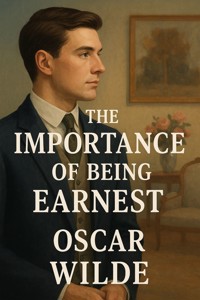
- This is an illustrated edition featuring elegant illustrations, a detailed summary, an author biography, and a complete list of characters.
This illustrated edition beautifully complements Wilde’s sharp dialogue and sparkling wit with expressive artwork that brings his lively characters and elegant settings to life. In addition, this special edition includes:
A comprehensive summary to help readers grasp the play’s key themes and social commentary
A biography of Oscar Wilde, offering insight into the genius and complexity of the author’s life
A character list to guide readers through the relationships and intrigues that drive the story
A timeless masterpiece of humor, irony, and social insight, The Importance of Being Earnest remains one of the most celebrated works in English literature — a must-have for lovers of classic plays and literary brilliance.
Das E-Book können Sie in Legimi-Apps oder einer beliebigen App lesen, die das folgende Format unterstützen:
Veröffentlichungsjahr: 2025
0,0
Bewertungen werden von Nutzern von Legimi sowie anderen Partner-Webseiten vergeben.
Legimi prüft nicht, ob Rezensionen von Nutzern stammen, die den betreffenden Titel tatsächlich gekauft oder gelesen/gehört haben. Wir entfernen aber gefälschte Rezensionen.
Ähnliche

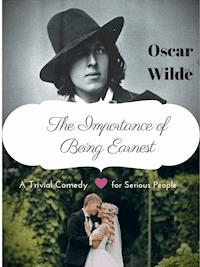



The Importance of Being Earnest
By
Oscar Wilde
ABOUT WILDE
Oscar Wilde was born on October 16, 1854, in Dublin, Ireland. He was the son of Sir William Wilde, a well-known doctor, and Lady Jane Wilde, a poet and supporter of Irish nationalism. From a young age, Wilde showed exceptional intelligence and a love for art, literature, and language. His mother encouraged his creative interests, and his family’s social connections exposed him to the cultural and intellectual life of the time.
Wilde attended Trinity College in Dublin, where he excelled in classical studies, and later earned a scholarship to Magdalen College at Oxford University. At Oxford, he became known for his wit, charm, and flamboyant style. He also began developing his belief in “art for art’s sake,” a philosophy that valued beauty and creativity over moral or practical purpose. After graduating, he moved to London to pursue a literary career and quickly gained fame as a brilliant conversationalist and writer.
In the 1880s and 1890s, Wilde became one of the most prominent literary figures in England. He wrote essays, poems, and stories, but his greatest success came from his plays. His most famous works include The Picture of Dorian Gray, Lady Windermere’s Fan, An Ideal Husband, and The Importance of Being Earnest. The last of these, first performed in 1895, is a witty comedy that satirizes Victorian society’s values, manners, and obsession with appearances. It remains one of the most beloved and performed plays in English literature.
Despite his fame, Wilde’s life took a tragic turn due to his relationship with Lord Alfred Douglas. In 1895, Wilde was accused and convicted of “gross indecency” because of his homosexuality, which was a crime in Britain at the time. He was sentenced to two years of hard labor, an experience that deeply affected him both physically and emotionally. After his release, Wilde lived in exile in France under the name Sebastian Melmoth and continued to write, though his health declined.
SUMMARY
The Importance of Being Earnest is a comedy about identity, love, and social rules. It tells the story of two young men, Jack Worthing and Algernon Moncrieff, who both lead double lives. Jack lives in the country but pretends to have a brother named Ernest in the city, so he can visit London and enjoy himself. Algernon, who lives in London, also pretends to have an invalid friend named Bunbury, whom he uses as an excuse to escape boring situations.Jack loves Gwendolen Fairfax, Algernon’s cousin, and wants to marry her. However, Gwendolen insists that she can only love a man named “Ernest,” because she thinks the name sounds noble. Meanwhile, Algernon learns that Jack has a pretty young ward named Cecily and decides to visit Jack’s country home, pretending to be “Ernest,” Jack’s imaginary brother.In the countryside, Cecily falls in love with Algernon, believing that he is also named Ernest. Soon, both women—Gwendolen and Cecily—think they are engaged to the same man named Ernest. When they meet and compare their stories, confusion and arguments follow. Eventually, Jack and Algernon are forced to tell the truth about their lies and reveal their real names.At the same time, Gwendolen’s mother, Lady Bracknell, strongly disapproves of Jack’s marriage proposal because he was found as a baby in a handbag and does not know his real parents. This scandal shocks everyone, as social class and family background are very important to her. However, after more confusion and questioning, it is discovered that Jack is actually Lady Bracknell’s nephew and Algernon’s older brother.The play ends happily with all misunderstandings cleared. Jack learns that his real name is, in fact, Ernest, making Gwendolen’s wish come true. Both couples—Jack and Gwendolen, Algernon and Cecily—are free to marry. The story closes with laughter and a lesson about honesty, love, and how silly social expectations can be. Oscar Wilde uses humor to show that being “earnest” (honest) is more important than just having the name “Ernest.”
CHARACTERS LIST
Jack Worthing (Ernest) – The play’s main character who leads a double life, being “Ernest” in the city and “Jack” in the country.
Algernon Moncrieff – Jack’s charming, witty friend who also leads a double life through “Bunburying.”
Gwendolen Fairfax – Algernon’s cousin and Jack’s love interest, who insists on marrying a man named Ernest.
Cecily Cardew – Jack’s young ward in the country, who falls in love with Algernon, believing him to be “Ernest.”
Lady Bracknell – Gwendolen’s domineering mother and a symbol of Victorian social values and class obsession.
Miss Prism – Cecily’s governess, who misplaced baby Jack in a handbag years earlier.
Rev. Canon Chasuble – The local rector, romantically interested in Miss Prism.
Lane – Algernon’s butler, known for his dry wit and subtle sarcasm.
Merriman – Jack’s servant at his country home, who helps maintain his “Ernest” identity.
Mr. Thomas Cardew – Cecily’s late grandfather, who adopted Jack as a baby (mentioned but never appears).
Ernest Worthing – Jack’s fictitious brother, invented by Jack as an excuse for his secret double life.
The Messenger – A minor servant who delivers messages, representing the social order and structure of upper-class life.
FIRST ACT
SCENE
Morning-room in Algernon’s flat in Half-Moon Street. The room is luxuriously and artistically furnished. The sound of a piano is heard in the adjoining room.
[Lane is arranging afternoon tea on the table, and after the music has ceased, Algernon enters.]
Algernon. Did you hear what I was playing, Lane?
Lane. I didn’t think it polite to listen, sir.
Algernon. I’m sorry for that, for your sake. I don’t play accurately—any one can play accurately—but I play with wonderful expression. As far as the piano is concerned, sentiment is my forte. I keep science for Life.
Lane. Yes, sir.
Algernon. And, speaking of the science of Life, have you got the cucumber sandwiches cut for Lady Bracknell?
Lane. Yes, sir. [Hands them on a salver.]
Algernon. [Inspects them, takes two, and sits down on the sofa.] Oh! . . . by the way, Lane, I see from your book that on Thursday night, when Lord Shoreman and Mr. Worthing were dining with me, eight bottles of champagne are entered as having been consumed.
Lane. Yes, sir; eight bottles and a pint.
Algernon. Why is it that at a bachelor’s establishment the servants invariably drink the champagne? I ask merely for information.
Lane. I attribute it to the superior quality of the wine, sir. I have often observed that in married households the champagne is rarely of a first-rate brand.
Algernon. Good heavens! Is marriage so demoralising as that?
Lane. I believe it is a very pleasant state, sir. I have had very little experience of it myself up to the present. I have only been married once. That was in consequence of a misunderstanding between myself and a young person.
Algernon. [Languidly.] I don’t know that I am much interested in your family life, Lane.
Lane. No, sir; it is not a very interesting subject. I never think of it myself.
Algernon. Very natural, I am sure. That will do, Lane, thank you.
Lane. Thank you, sir. [Lane goes out.]
Algernon. Lane’s views on marriage seem somewhat lax. Really, if the lower orders don’t set us a good example, what on earth is the use of them? They seem, as a class, to have absolutely no sense of moral responsibility.
[Enter Lane.]
Lane. Mr. Ernest Worthing.
[Enter Jack.]
[Lane goes out.]
Algernon. How are you, my dear Ernest? What brings you up to town?
Jack. Oh, pleasure, pleasure! What else should bring one anywhere? Eating as usual, I see, Algy!
Algernon. [Stiffly.] I believe it is customary in good society to take some slight refreshment at five o’clock. Where have you been since last Thursday?
Jack. [Sitting down on the sofa.] In the country.
Algernon. What on earth do you do there?
Jack. [Pulling off his gloves.] When one is in town one amuses oneself. When one is in the country one amuses other people. It is excessively boring.
Algernon. And who are the people you amuse?
Jack. [Airily.] Oh, neighbours, neighbours.
Algernon. Got nice neighbours in your part of Shropshire?
Jack. Perfectly horrid! Never speak to one of them.
Algernon. How immensely you must amuse them! [Goes over and takes sandwich.] By the way, Shropshire is your county, is it not?
Jack. Eh? Shropshire? Yes, of course. Hallo! Why all these cups? Why cucumber sandwiches? Why such reckless extravagance in one so young? Who is coming to tea?
Algernon. Oh! merely Aunt Augusta and Gwendolen.
Jack. How perfectly delightful!
Algernon. Yes, that is all very well; but I am afraid Aunt Augusta won’t quite approve of your being here.
Jack. May I ask why?
Algernon. My dear fellow, the way you flirt with Gwendolen is perfectly disgraceful. It is almost as bad as the way Gwendolen flirts with you.
Jack. I am in love with Gwendolen. I have come up to town expressly to propose to her.
Algernon. I thought you had come up for pleasure? . . . I call that business.
Jack. How utterly unromantic you are!
Algernon. I really don’t see anything romantic in proposing. It is very romantic to be in love. But there is nothing romantic about a definite proposal. Why, one may be accepted. One usually is, I believe. Then the excitement is all over. The very essence of romance is uncertainty. If ever I get married, I’ll certainly try to forget the fact.
Jack. I have no doubt about that, dear Algy. The Divorce Court was specially invented for people whose memories are so curiously constituted.
Algernon. Oh! there is no use speculating on that subject. Divorces are made in Heaven—[Jack puts out his hand to take a sandwich. Algernon at once interferes.] Please don’t touch the cucumber sandwiches. They are ordered specially for Aunt Augusta. [Takes one and eats it.]
Jack. Well, you have been eating them all the time.
Algernon. That is quite a different matter. She is my aunt. [Takes plate from below.] Have some bread and butter. The bread and butter is for Gwendolen. Gwendolen is devoted to bread and butter.
Jack. [Advancing to table and helping himself.] And very good bread and butter it is too.
Algernon. Well, my dear fellow, you need not eat as if you were going to eat it all. You behave as if you were married to her already. You are not married to her already, and I don’t think you ever will be.
Jack. Why on earth do you say that?
Algernon. Well, in the first place girls never marry the men they flirt with. Girls don’t think it right.
Jack. Oh, that is nonsense!
Algernon. It isn’t. It is a great truth. It accounts for the extraordinary number of bachelors that one sees all over the place. In the second place, I don’t give my consent.
Jack. Your consent!
Algernon. My dear fellow, Gwendolen is my first cousin. And before I allow you to marry her, you will have to clear up the whole question of Cecily. [Rings bell.]
Jack. Cecily! What on earth do you mean? What do you mean, Algy, by Cecily! I don’t know any one of the name of Cecily.
[Enter Lane.]
Algernon. Bring me that cigarette case Mr. Worthing left in the smoking-room the last time he dined here.
Lane. Yes, sir. [Lane goes out.]
Jack. Do you mean to say you have had my cigarette case all this time? I wish to goodness you had let me know. I have been writing frantic letters to Scotland Yard about it. I was very nearly offering a large reward.
Algernon. Well, I wish you would offer one. I happen to be more than usually hard up.
Jack. There is no good offering a large reward now that the thing is found.
[Enter Lane with the cigarette case on a salver. Algernon takes it at once. Lane goes out.]
Algernon. I think that is rather mean of you, Ernest, I must say. [Opens case and examines it.] However, it makes no matter, for, now that I look at the inscription inside, I find that the thing isn’t yours after all.
Jack. Of course it’s mine. [Moving to him.] You have seen me with it a hundred times, and you have no right whatsoever to read what is written inside. It is a very ungentlemanly thing to read a private cigarette case.
Algernon. Oh! it is absurd to have a hard and fast rule about what one should read and what one shouldn’t. More than half of modern culture depends on what one shouldn’t read.




