


2,49 €
Niedrigster Preis in 30 Tagen: 1,99 €
Niedrigster Preis in 30 Tagen: 1,99 €
Mehr erfahren.
- Herausgeber: Booksell-Verlag
- Kategorie: Poesie und Drama
- Sprache: Englisch
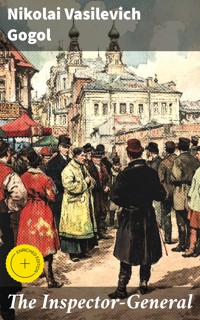
Nikolai Vasilevich Gogol's "The Inspector-General" is a masterful satirical play that explores themes of corruption and bureaucratic incompetence within 19th-century Russian society. Written in a rich, comedic style, it captures the absurdity of the human condition through a farcical plot centered on a case of mistaken identity. The narrative unfolds as a small provincial town mistakenly believes that a seemingly insignificant traveler is an undercover inspector sent by the government, leading to a humorous yet poignant critique of societal corruption and moral decay. Gogol's sharp wit and vivid characterizations provide a compelling commentary on the folly of authority and the superficiality of appearances, underscoring the era's collective anxieties about governance and societal norms. Gogol, often regarded as the father of Russian realism, drew inspiration from his own experiences growing up in a bureaucratic family that confronted the complexities and dysfunctions of Russian life. His keen observations of society, coupled with his deep understanding of human nature, propelled him to craft this work as an entertaining yet critical reflection on the relationship between individuals and authority. His unique background and literary influences, including European Romanticism and folk traditions, profoundly shaped his voice and narrative techniques. This timeless work is essential reading for those interested in the interplay of politics and society, and it offers profound insights relevant even today. "The Inspector-General" invites readers to engage with its comedic yet severe examination of human folly, making it a vital piece of literature for understanding not just Russian culture but the universal themes of governance, identity, and the absurdity of life. In this enriched edition, we have carefully created added value for your reading experience: - A succinct Introduction situates the work's timeless appeal and themes. - The Synopsis outlines the central plot, highlighting key developments without spoiling critical twists. - A detailed Historical Context immerses you in the era's events and influences that shaped the writing. - An Author Biography reveals milestones in the author's life, illuminating the personal insights behind the text. - A thorough Analysis dissects symbols, motifs, and character arcs to unearth underlying meanings. - Reflection questions prompt you to engage personally with the work's messages, connecting them to modern life. - Hand‐picked Memorable Quotes shine a spotlight on moments of literary brilliance. - Interactive footnotes clarify unusual references, historical allusions, and archaic phrases for an effortless, more informed read.
Das E-Book können Sie in Legimi-Apps oder einer beliebigen App lesen, die das folgende Format unterstützen:
Veröffentlichungsjahr: 2019
Ähnliche

![Home Life in Russia, Volumes 1 and 2 [Dead Souls] - Nikolai Vasilevich Gogol - E-Book](https://legimifiles.blob.core.windows.net/images/bb86edf465f93e3f7da3938759cde139/w200_u90.jpg)
![Home Life in Russia, Volumes 1 and 2 [Dead Souls] - Nikolai Vasilevich Gogol - E-Book](https://legimifiles.blob.core.windows.net/images/53f2e0324169db729fe9dee72b29fe63/w200_u90.jpg)













The Inspector-General
Table of Contents
Introduction
In a provincial town where fear outruns truth, a nobody becomes the mirror its rulers cannot bear. Gogol’s The Inspector-General turns a simple misunderstanding into a panoramic comedy of power, panic, and human vanity. Through a chain of nervous assumptions, petty evasions, and sudden displays of servility, the play exposes how corruption thrives less by grand conspiracies than by everyday compromises. Its world is at once specific and universal: a place where officials dread scrutiny, citizens expect little, and appearances stand in for reality. The result is a theatrical machine that converts anxiety into laughter while revealing the fragile foundations of authority.
This work endures as a classic because it crystallizes, with startling clarity, the dynamics of self-deception and institutional rot. It established a model for modern political satire on stage, proving that farce could carry moral weight without preaching. From nineteenth-century playhouses to contemporary theatres, it remains a touchstone for directors and writers who seek to critique systems by amplifying their absurdities. Its influence can be traced in countless comedies that push panic to the edge of chaos, then let the audience see itself in the confusion. Few plays balance civic diagnosis and theatrical delight with such elegant audacity.
Written by Nikolai Gogol in the mid-1830s and first staged in 1836, The Inspector-General (often titled The Government Inspector) is a five-act satirical comedy set in a small town of the Russian Empire. The English-speaking world has long known the play through translations, notably that of Thomas Seltzer, which helped anchor its reputation beyond Russia. Gogol’s premise is disarmingly simple: rumors of an inspection from the capital throw a complacent bureaucratic apparatus into disarray. His purpose is not to lecture but to reveal, through laughter and escalating misjudgment, how fear of accountability distorts behavior and erodes the line between private vice and public duty.
The story opens in a town governed by officials who are brisk in paperwork and lavish in excuses. A traveler, lodged at a local inn, is mistaken for an emissary of oversight; suddenly every hallway whispers, every ledger trembles, and every smile is recalibrated. The comedy arises from the speed with which people rearrange their principles to accommodate a new center of power. Doors swing, favors multiply, and language itself becomes a currency. Without disclosing the play’s turns, it is enough to note that the confusion is both specific to its setting and emblematic of wider human tendencies when authority is imagined to be near.
Gogol’s intentions were artistic and civic. He sought a theatrical form capable of holding a mirror to the times without falling into pamphleteering. By using mistaken identity and comic acceleration, he isolates traits that flourish under unexamined power: vanity, fawning, bluff, and the reflex to hide. The play does not sermonize; it orchestrates situations in which characters reveal themselves through their own words and choices. That is why the laughter it provokes is uneasy and clarifying. Audiences recognize patterns of speech and habit that hardly belong to one country or era. In exposing social ailments, Gogol diagnoses private ones as well.
Formally, the play blends the mechanics of farce with the scrutiny of satire. Scenes pivot on entrances, exits, and overheard assurances, yet the comic machinery never feels purely mechanical; it hums with psychological truth. Gogol’s dialogue captures the evasions of officialdom and the bravado of the cornered, using repetition, delay, and sudden confession as instruments of tempo. Ensemble scenes surge with collective fear, while private encounters crackle with opportunism. The play rewards actors with vivid roles and directors with pliable stage pictures, which is why it survives constant reinterpretation. Its structure, tight and cumulative, funnels laughter toward recognition rather than mere release.
The historical context deepens the satire. Written under a regime whose bureaucracy was vast and vigilant, the play reflects the anxieties of officials operating between local interests and central oversight. Yet it withstood the risks of controversy to achieve a public life on major stages, provoking debate while attracting sustained audiences. That reception signals a truth at the heart of its classic status: it was understood, from the beginning, as a work looking beyond topical grievance toward patterns of governance and human conduct. The specific titles and uniforms may be of the past; the behaviors, alas, remain broadly legible.
In literary history, The Inspector-General demonstrates how high comic art can reshape public conversation without didactic apparatus. Its influence is felt in subsequent stage comedies that expose institutions by heightening the ordinary into the absurd. Playwrights who chart the collision of private ambition with public role find in Gogol a model of compression and theatrical wit. The play also belongs to a broader lineage of civic satire, standing alongside works that reveal what happens when language, power, and self-image collide. Because its engine is a universal mechanism of panic and self-justification, it travels effortlessly across cultures and epochs.
Thomas Seltzer’s English translation has been instrumental in carrying Gogol’s cadence, irony, and momentum to readers and theatre practitioners. While any translation must navigate idiom and historical nuance, Seltzer’s version preserves the quicksilver shifts of tone that make the comedy sting and sparkle. For many English-language audiences, his rendering shaped first encounters with the characters’ evasions, bluster, and dawning dread. It demonstrates how translation is not merely a conduit but a creative lens, aligning wit and rhythm with contemporary ears while staying faithful to the play’s intentions. Through such mediation, the work’s international life has grown steadily and securely.
The play’s themes are both civic and intimate. It probes the psychology of fear as a governing force, the elasticity of conscience under pressure, and the spectacle of public faces arranged for inspection. It considers how institutions breed habits of speech that mask rather than reveal, and how a community’s hunger for approval can curdle into complicity. Beneath the bustle lies a portrait of self-delusion: people who mistake performance for character and proximity to power for virtue. The Inspector-General uses laughter to pry open these habits, inviting viewers to gauge not only a town’s health but their own moral reflexes.
Contemporary readers and audiences find the play uncannily current. In offices public and private, rumors of audit or review can still reorder priorities overnight. The technologies and hierarchies have changed; the choreography of appeasement has not. Gogol’s comedy speaks to any setting where appearances substitute for accountability and where officials, eager to court favor, forget the people they serve. It also resonates in a media-saturated climate: image management, strategic apologies, and hurried reputational repairs feel like direct descendants of the behaviors on stage. That recognition fosters empathy and vigilance, reminding us that systems are only as sound as the characters within them.
To approach The Inspector-General today is to encounter a work of bracing clarity, mischievous invention, and moral bite. It remains engaging because it entertains without surrendering seriousness, and because its target is not merely a bureaucracy but the human tendency to prefer reassurance to truth. Gogol marshals speed, surprise, and an ear for double talk to craft a comedy that reveals as it delights. In Seltzer’s English, its vigor and nerve are readily felt. What endures is a constellation of themes—fear, vanity, responsibility, and self-knowledge—sharpened by laughter. That is the mark of a classic: a mirror we cannot help returning to.
Synopsis
The Inspector-General, in Thomas Seltzer’s translation of Nikolai Gogol’s play, unfolds in a small provincial Russian town where public officials learn that a high-ranking government auditor may arrive incognito. The Mayor assembles judges, police, and administrators to warn them that their procedures, institutions, and reputations will be scrutinized. The town is on edge: complaints from merchants linger, schools are poorly run, and hospitals are neglected. Determined to avoid exposure, the Mayor orders a rapid cleanup and tight coordination. The possibility of surprise inspection quickly becomes the organizing force for the day, setting in motion a chain of cautious maneuvers and hurried appearances.
Officials scramble to mask irregularities. The Judge hides hunting paraphernalia, the Postmaster admits opening letters, and minor clerks are coached to present orderly records. Fines are adjusted, street scenes tidied, and visiting rooms brushed into a semblance of civic efficiency. Rumors spread that the inspector travels in plain clothes and may already be in town. Anxiety grows alongside a plan to anticipate his needs and win favor. Bribes and gifts are quietly discussed as tokens of respect. The Mayor asserts authority, yet his orders reveal a patchwork administration vulnerable to scrutiny. The mood is defensive, busy, and charged with uncertainty.
Meanwhile, a young civil servant named Khlestakov, traveling with his servant Osip, has been stranded at the local inn, short of funds and living on credit. His debts and complaints have made him conspicuous to townspeople seeking signs of the rumored inspector. When the Mayor decides to confront this mysterious guest, a misunderstanding forms. Khlestakov’s anxious manner is taken as deliberate reserve. The town’s fear supplies the context that elevates an ordinary visitor into a supposed official. Conversations become tense yet deferential, and minor ambiguities cement the mistaken identity. The stage is set for a series of encounters shaped by misreading and expectation.
Convinced they face an inspector incognito, the town’s leaders shower Khlestakov with attention. He is moved from the shabby inn to better quarters and presented with generous hospitality. Pressed with concerns and petitions, he receives private visits from nervous officials who offer small loans and favors. Khlestakov’s uncertainty gives way to improvisation. Surrounded by flattery, he enhances his status through bold claims and polished anecdotes, while Osip quietly advises caution. Merchants seek redress for grievances, and administrators compete to make the best impression. The atmosphere grows theatrical, as displays of loyalty and civic pride crowd out questions that might clarify identities.
At the Mayor’s home, social courtesies intensify. The Mayor’s wife, Anna, and daughter, Marya, welcome Khlestakov with ceremony, interpreting his presence as a sign of opportunity. Between visits, Khlestakov balances charm and bravado, adding to his aura through confident talk and familiar ease among strangers. He writes a letter to a friend, describing his experiences and the lively reception he has received, while the town continues to treat him as an honored guest. Meanwhile, the Postmaster, known to monitor correspondence, remains attentive to the flow of mail. The household scenes underscore how private ambitions align with public concerns in this moment of uncertainty.
As attention accumulates, Khlestakov enjoys the role while contemplating a quick departure. Promises are offered, favors hinted, and good will secured. The town’s leading figures feel relief as apparent harmony replaces initial panic. Khlestakov accepts tokens that he frames as temporary assistance, giving assurances that future recognition will follow. Yet the pressure of sustained performance encourages him to leave before questions harden into investigation. Expressing thanks and confidence, he departs with courteous words and optimistic suggestions. The officials interpret his exit as a sign that their efforts have succeeded, concluding that their careful hospitality has turned potential peril into a manageable, even favorable, encounter.
In the aftermath, relief spreads through the administration. There is talk of tidying up lingering irregularities and preparing for formal confirmation of their good standing. Some begin to boast of how decisively they acted under pressure. However, information soon emerges that complicates the narrative they have constructed. A piece of correspondence and scattered reports raise doubts about the visitor’s true identity. Whispered conversations tighten into alarm. The Mayor, who took the lead throughout, grapples with conflicting accounts and the possibility that earlier assumptions were unfounded. Confidence gives way to restless recalculation, and the town’s leaders reassess what they have said, given, and promised.
Uncertainty turns to agitation as officials compare details and probe contradictions. The careful order they staged begins to look brittle under renewed scrutiny. There is a flurry of justifications and appeals to procedure, as each participant tries to frame actions in the best possible light. The Postmaster’s habit of opening letters, previously a quiet practice, now takes on greater significance. The Mayor seeks to stabilize the situation with authoritative guidance, but evidence accumulates that their interpretation may have been misguided. Preparations for vindication are interrupted by a final, disruptive announcement that forces an immediate reckoning with appearances, intentions, and the consequences of their hurried decisions.
The play’s arc presents a sequence in which fear of oversight, desire for approval, and reliance on appearances converge to produce errors in judgment. Without relying on extremes, it shows ordinary administrative habits magnified by rumor and expectation. The central message emphasizes how self-interest and institutional anxiety can distort perception, allowing improvisation to masquerade as authority. Seltzer’s translation keeps the language brisk and accessible, preserving swift exchanges and layered misunderstandings. By moving from panic to triumph to renewed uncertainty, the work outlines a clear narrative of mistaken identity and public pretense, culminating in a moment that clarifies the stakes of honesty, responsibility, and civic trust.
Historical Context
The Inspector-General is set in a nameless provincial town in the Russian Empire during the reign of Nicholas I (1825–1855), typically located in the 1820s–1830s. Such towns lay far from St. Petersburg, separated by long postal roads and dependent on distant ministries. The administrative head was the gorodnichy, a town chief who combined police, municipal, and judicial oversight. Daily life moved at the pace of horse posts, petitions, and inspections. Officials answered upward to governors and ministries, while local merchants, petty bourgeois, clergy, and state peasants navigated an opaque hierarchy shaped by imperial decrees, police ordinances, and the Table of Ranks.
Public services in these towns—hospitals, schools, postal stations—were underfunded and often corruptly managed. Bribes, gifts, and favors lubricated decisions on taxes, permits, and court cases. Information traveled by rumor before it arrived by courier; thus, news of a possible inspector from the capital could sow panic. The built environment included the governor’s office, the police bureau, barracks, an inn for travelers, and a market square. Social inequality was pronounced: officials and their families enjoyed rank privileges; townspeople sought protection; peasants and servants had little recourse. Within this milieu, Gogol dramatized the sudden arrival of a supposed state auditor and the frenzy of fearful administrators.
Nicholas I’s autocracy defined the political climate in which the play’s world takes shape. Ascending the throne in 1825, he centralized authority, tightened bureaucratic discipline, and extolled a state creed later summarized by Minister Sergey Uvarov as Orthodoxy, Autocracy, Nationality (1833). The emperor relied on a vast civil service regulated by uniform statutes, regular reporting, and personal oversight. His periodic surprise inspections of regiments, offices, and public works were well known. The play reflects this environment: the officials’ terror at an incognito inspector mirrors the genuine fear provincial administrators felt toward unexpected audits emanating from the capital and the emperor’s own vigilant ethos.
The Decembrist Revolt of December 14, 1825—an elite officers’ uprising in St. Petersburg seeking constitutional limits—was crushed by Nicholas I. Participants were executed or exiled to Siberia; military and civil bureaucracies were purged and re-disciplined. The uprising’s failure ushered in a punitive vigilance that marked provincial governance for decades. In the play’s background is this post-Decembrist atmosphere of suspicion. Officials anticipate that even small irregularities could trigger catastrophic consequences. Their desperate attempts to conceal abuses when a supposed inspector appears dramatize the culture of caution and self-preservation born from the state’s reaction to the revolt.
The Third Section, established in 1826 under General Alexander Benckendorff, served as the empire’s political police, supervising censorship and internal security, assisted by the Corps of Gendarmes (created 1827). These institutions monitored dissidents, clergy, universities, and officials, and they gathered reports from across the provinces. The fear that an investigator might arrive unannounced—possibly traveling incognito, collecting testimony, and filing confidential memoranda—was justified by practice. The play capitalizes on this reality: the townspeople interpret an unknown visitor as a state agent with connections to the Third Section, and they scramble to manage impressions, paperwork, and bribes accordingly.
Legal codification under Nicholas I intensified bureaucratic routines. Led by Mikhail Speransky, the Complete Collection of Laws (first edition, 45 volumes, 1830) systematized imperial legislation. The Svod Zakonov, a 15-volume Digest published in 1832 and put into force in 1835, arranged these laws for practical use. Although designed to bring order, codification produced a flood of forms, registers, and circulars. Provincial offices became paper mills, measured by filings and compliance rather than outcomes. In the play, the avalanche of petitions, receipts, and official books, and the officials’ obsession with formalities while neglecting substance, reflect the post-1832 culture of legalistic bureaucracy.
Catherine II’s Provincial Reform, the Statute on the Administration of the Provinces (1775), reorganized governorates and districts and created layered town and district authorities. The office of gorodnichy, prominent in the play, emerged as a police and municipal executive in district towns under this system and endured into the mid-nineteenth century. He was subordinate to the provincial governor and responsible for public order, inspections of institutions, oversight of markets, and the application of imperial decrees. Gogol’s mayor embodies the latitude and temptations of this position: opportunities for petty exactions, the arbitrariness of small-town power, and the chronic anxiety of answering up the administrative chain.
Peter the Great’s Table of Ranks (1722) structured civil and military service into 14 classes, granting status, pay, and often nobility according to rank. By the 1830s, career advancement through the civil service shaped social ambition. Officials cultivated patrons, senior connections, and titles; lower ranks performed routine work with limited prospects. The play’s impostor is a minor clerk—precisely the type who inhabited the lower rungs of the Table—who leverages talk of high acquaintances and proximity to ministries to overawe provincial authorities. The fascination with class, rank, and access to St. Petersburg mirrors the rank-obsessed social order of imperial service.
Serfdom framed provincial society and administration. In the 1830s, roughly one-third of the empire’s population lived as privately owned serfs; on the eve of emancipation in 1861, about 22–23 million people were legally enserfed. Town economies relied on peasant labor, grain deliveries, and guild merchants who mediated between estates and markets. Officials controlled passports, tax registers, and vagrancy policing, often extracting payments and favors. The play’s background references to shabby hospitals, corrupt provisioning, and vulnerable locals evoke this economy of dependency. Administrative abuses disproportionately affected peasants and townsfolk, while officials secured incomes beyond meager salaries through gifts, levies, and under-the-table deals.




