


Erhalten Sie Zugang zu diesem und mehr als 300000 Büchern ab EUR 5,99 monatlich.
- Herausgeber: Crossway
- Kategorie: Religion und Spiritualität
- Sprache: Englisch
A Big Picture Overview of Each Old Testament Book The Old Testament is the story of God's promises to his people. Below its somewhat obscure surface is hidden magnificent truth about the love and power of God. Throughout its pages the reader can find promise after promise from God, all of which are fulfilled in the New Testament—in the incarnation of Jesus Christ. Based on sermons in the early years of Mark Dever's ministry at Capitol Hill Baptist Church, The Message of the Old Testament explores the Old Testament as a glorious whole so that readers are able to see the big picture of the majesty of God and the wonder of his promises. - Big-Picture Analysis: Covers each book of the Old Testament concisely and accurately - Appeals to Pastors and Laypeople Alike: A helpful resource for gaining a deeper understanding of the Bible or preaching an overview sermon to a congregation - Written by Mark Dever: Based on 28 sermons taught at Capitol Hill Baptist Church in Washington, DC - Replaces ISBN 978-1-58134-717-3
Sie lesen das E-Book in den Legimi-Apps auf:
Seitenzahl: 1930
Veröffentlichungsjahr: 2025
Das E-Book (TTS) können Sie hören im Abo „Legimi Premium” in Legimi-Apps auf:
Ähnliche





Thank you for downloading this Crossway book.
Sign up for the Crossway Newsletter for updates on special offers, new resources, and exciting global ministry initiatives:
Crossway Newsletter
Or, if you prefer, we would love to connect with you online:
“This is a bold project, some might say foolhardy, but Mark Dever has brilliantly succeeded. This is no mere textbook; it is powerful preaching. We are not only introduced to the sweep and message of each book of the Bible but also, and above all, confronted by our great God and called to obey his living word.”
Vaughan Roberts, Rector, St. Ebbe’s Church, Oxford, England; author, God’s Big Picture
“In these distinctive overview sermons, Mark Dever manages to bring together around the core issues of each biblical book three concerns that ought to occupy every faithful preacher of God’s word: theological content, exegetical wisdom, and pastoral application. Here is a walk through the Bible that is well worth taking!”
Timothy George, Distinguished Professor of Divinity, Beeson Divinity School, Samford University; General Editor, Reformation Commentary on Scripture
“Mark Dever has done the Christian community a great service in publishing these sermons. The material is academically informed but presented in a very accessible way with relevant application. With its Christological focus and careful Christian application of the Old Testament, this book enables readers to get into the theological heart of the message of each biblical book.”
David Peterson, Emeritus Faculty, Moore Theological College
“Mark Dever has written a needed book and written it well. With a pastor’s heart, a scholar’s mind, and the intimacy of a friend, Dever introduces the reader clearly and creatively to a book that has changed the world but to which contemporary culture remains largely unexposed. This book is warm, engaging, straightforward, and profound. It will be a valuable resource for individuals, study groups, churches, and unbelievers and believers alike. Dever takes the reader on an unforgettable journey into the most remarkable and moving book ever written.”
John Shouse, Senior Professor of Christian Theology, Gateway Seminary
“This is a good book, written by a pastor/scholar for people in the pew. Clear, concise, thoroughly readable. Buy two and give one to a friend.”
Alistair Begg, Senior Pastor, Parkside Church, Chagrin Falls, Ohio
“For many Christians the Old Testament is daunting and confusing. The books are long and speak about a culture dramatically different from ours. Mark Dever’s sermons do not substitute for reading the Old Testament, but they do provide a wonderful help in understanding it. Dever unpacks the major themes of each book with remarkable clarity, and the book also shines in conveying the message of the Old Testament for today. Here is a survey of the Old Testament that is accessible and spiritually edifying.”
Thomas R. Schreiner, James Buchanan Harrison Professor of New Testament Interpretation, The Southern Baptist Theological Seminary
“The modern Church is biblically illiterate. Her members do not know the basic content of the Bible or the great themes that weave its beautiful tapestry together. This series of sermons by Mark Dever, a superb and faithful expositor, provides a helpful strategy for healing a major malady of the twenty-first-century church. I am delighted to commend this excellent volume to all who love the word of God and the great truths contained therein.”
Daniel L. Akin, President, Southeastern Baptist Theological Seminary
“This book is a landmark in the history of Bible exposition—a homiletical tour de force. At the rate of one long sermon per book, Mark Dever has preached his way through the entire Bible. Reading this collection of his messages is an ideal way to get a sweeping overview of the Old Testament, or else to begin preparing to teach or preach any one of its individual books.”
Philip Graham Ryken, President, Wheaton College
“In a day of worrisome biblical illiteracy, even among Christians, there is a pressing need for books that give the big picture and provide sure-footed guides for negotiating the Bible’s vast and subtle territory. To produce such a book is no easy task, yet that is what Dever has done. Forged in the furnace of weekly expository preaching and pastoral ministry, this book is a wonderful gift to the church that will, I am sure, be of great help in promoting deeper understanding of the message of the whole Bible, not just those parts with which readers are most familiar or comfortable. Buy two copies: one to keep, one to give to your pastor.”
Carl R. Trueman, Professor of Biblical and Religious Studies, Grove City College
“Mark Dever does here what all pastors should do—he preaches the whole Bible patiently and thoroughly. These sermons will help readers see the Bible as a unity inspired by a God who is a unified and coherent person. They focus on God; therefore, they drive readers to worship and obedience.”
Paul R. House, Former Professor of Divinity, Beeson Divinity School
“To hear the Bible tell its own story in its own way—this is the obvious but all-too-rare strategy for reading the Book of books. I thank Mark Dever for showing us how. We are immeasurably enriched.”
Ray Ortlund, Pastor to Pastors, Immanuel Nashville, Tennessee
“Mark Dever’s one-sermon whole-Bible-book overviews are a treasure trove for preachers, Bible teachers, and growing Christians. Dever has already given us a comprehensive overview of the New Testament, and here he covers the Old. Preachers will recognize these expositions as Greidanus and Goldsworthy applied. That is, Dever preaches the person and work of Christ from all of Scripture, naturally and exegetically, in a way that does justice to redemptive history. Christians hungry for a spiritual feast in the word will find here faithful, biblical, rich, meaty, and challenging pastoral overviews of Scripture from the heart of a preacher who wants his people to know, love, and live the truth. Dever gives us a model for how to preach didactically, practically, apologetically and evangelistically all at once.”
J. Ligon Duncan III, Chancellor and CEO, Reformed Theological Seminary
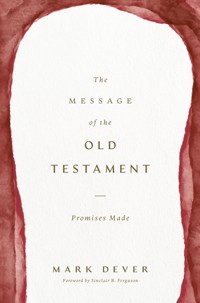
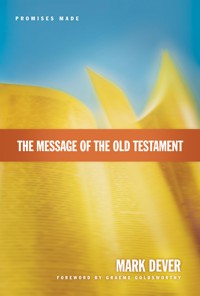
The Message of the Old Testament
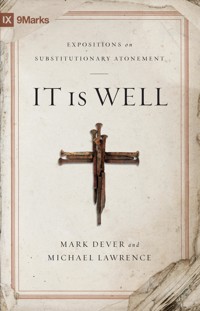
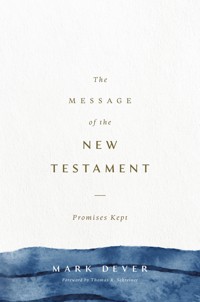
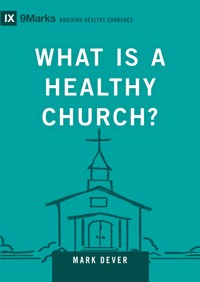
Crossway Books by Mark Dever
The Compelling Community, with Jamie Dunlop
Discipling
The Gospel and Personal Evangelism
How Can Our Church Find a Faithful Pastor?
How to Build a Healthy Church, with Paul Alexander
In My Place Condemned He Stood, with J. I. Packer
It Is Well, with Michael Lawrence
The Message of the New Testament
The Message of the Old Testament
Nine Marks of a Healthy Church
What Does God Want of Us Anyway?
What Is a Healthy Church?
Why Should I Join a Church?
The Message of the Old Testament
Promises Made
Mark Dever
Foreword by
Sinclair B. Ferguson
The Message of the Old Testament: Promises Made
© 2006 by Mark Dever
Published by Crossway1300 Crescent StreetWheaton, Illinois 60187
All rights reserved. No part of this publication may be reproduced, stored in a retrieval system, or transmitted in any form by any means, electronic, mechanical, photocopy, recording, or otherwise, without the prior permission of the publisher, except as provided by USA copyright law. Crossway® is a registered trademark in the United States of America.
Cover design: Jordan Singer
First printing 2006
Reprinted with new cover 2025
Printed in the United States of America
Unless otherwise indicated, Scripture quotations are taken from the Holy Bible, New International Version®. NIV®. Copyright © 1973, 1978, 1984 by International Bible Society. Used by permission of Zondervan. All rights reserved worldwide.
Scripture quotations marked ESV are from the ESV® Bible (The Holy Bible, English Standard Version®), © 2001 by Crossway, a publishing ministry of Good News Publishers. Used by permission. All rights reserved. The ESV text may not be quoted in any publication made available to the public by a Creative Commons license. The ESV may not be translated in whole or in part into any other language. All rights reserved.
Scripture quotations marked KJV are from the King James Version of the Bible. Public domain.
Scripture quotations marked NASB 1995 are taken from the New American Standard Bible®, copyright © 1960, 1971, 1977, 1995 by The Lockman Foundation. Used by permission. All rights reserved. www.lockman.org.
All emphases in Scripture citations have been added by the author.
Hardcover ISBN: 978-1-4335-9925-5ePub ISBN: 978-1-4335-9927-9PDF ISBN: 978-1-4335-9926-2
Library of Congress Cataloging-in-Publication Data
Dever, Mark.
The message of the Old Testament : promises made / Mark Dever
p. cm.
Includes bibliographical references and index.
ISBN 13: 978-1-58134-717-3 (HC : alk. paper)
ISBN 10: 1-58134-717-0
1. Bible. O.T.—Criticism, interpretation, etc. 2. Bible. O.T.—Sermons.3. Baptists—Sermons. 4. Sermons, American—21st century. I. Title.
BS1171.3.D43 2006
221’.06—dc22 2005031730
Crossway is a publishing ministry of Good News Publishers.
2025-05-28 01:43:27 PM
To
Ligon Duncan,
C. J. Mahaney,
and R. Albert Mohler Jr.,
friends and colaborers, together for the gospel
Contents
Foreword
Preface
Acknowledgments
Introduction: Fly First, Walk Later
The Whole Bible: What Does God Want of Us?
The Old Testament: Promises Made
PART 1: THE GREAT STORY
1 The Message of Genesis: “. . . Which in Their Seeds and Weak Beginning Lie Intreasured”
2 The Message of Exodus: “All the World’s a Stage”
3 The Message of Leviticus: “The World Is Not Thy Friend nor the World’s Law”
4 The Message of Numbers: “Past and to Come Seem Best, Things Present, Worst”
5 The Message of Deuteronomy: “What’s Past Is Prologue”
PART 2: THE OTHER MILLENNIUM
6 The Message of Joshua: Conquest
7 The Message of Judges: Stalemate
8 The Message of Ruth: Surprise
9 The Message of 1 Samuel: Faith in Faithless Times
10 The Message of 2 Samuel: Repentance
11 The Message of 1 Kings: Decline
12 The Message of 2 Kings: Fall
13 The Message of 1 Chronicles: Heights
14 The Message of 2 Chronicles: Depths
15 The Message of Ezra: Renewal
16 The Message of Nehemiah: Rebuilding
17 The Message of Esther: Surprise
PART 3: ANCIENT WISDOM
18 The Message of Job: Wisdom for the Troubled
19 The Message of Psalms: Wisdom for Spiritual People
20 The Message of Proverbs: Wisdom for the Ambitious
21 The Message of Ecclesiastes: Wisdom for the Successful
22 The Message of Song of Songs: Wisdom for the Married
PART 4: BIG HOPES
23 The Message of Isaiah: Messiah
24 The Message of Jeremiah: Justice
25 The Message of Lamentations: Justice up Close
26 The Message of Ezekiel: Paradise
27 The Message of Daniel: Survival
PART 5: ETERNAL QUESTIONS
28 The Message of Hosea: What Is Love?
29 The Message of Joel: Whom Will God Save?
30 The Message of Amos: Does God Care?
31 The Message of Obadiah: Does God Have Enemies?
32 The Message of Jonah: Can You Run from God?
33 The Message of Micah: What Does God Want?
34 The Message of Nahum: Who’s In Charge?
35 The Message of Habakkuk: How Can I Be Happy?
36 The Message of Zephaniah: What’s There to Be Thankful For?
37 The Message of Haggai: Are Your Investments Sound?
38 The Message of Zechariah: Does God Give Second Chances?
39 The Message of Malachi: Does It Matter How I Worship God?
Person Index
Scripture Index
Foreword
Over the years, I have had the privilege of getting to know Mark Dever and to share in conferences with him, and I have come to enjoy his energetic company and to appreciate and admire his ministry.
On one such occasion, at a conference for pastors, he invited his audience to turn for the Scripture reading to Psalm 119. He meant it.
Psalm 119 is a skillfully crafted acrostic poem of 176 verses (the longest chapter in the Bible). It is divided into twenty-two sections of eight verses that begin with the same Hebrew letter, each section structured using a successive letter of the Hebrew alphabet. At the end of the section headed Aleph, Mark continued to read through the section marked Beth. But he did not stop. Behind me in the audience, I felt a sense of “Oh, he’s going to read the section headed Gimel as well.” The initial sense of “This is a longer reading than usual” changed in a couple of minutes to “This is really unusual” as he read on into the fourth octet (Daleth) and then without pause all the way through He, Waw, Zayin, and Heth. The mood of “That’s unusual” was changing to “What’s he doing?” And then, as we reached Teth and Yodh, it felt that the penny was beginning to drop. Mark’s reading of Scripture was not going to end until he had read verse 176, the closing word of the last section, marked with the final word of the Hebrew alphabet, Taw).
I have a suspicion that many men who were there would struggle if examined on the details of the address that followed. But I doubt that anyone forgot that they were once present when the whole of Psalm 119 was read in a public assembly.
I have never asked Mark why he did that. It is not the kind of thing an experienced minister does by accident or mistake. He was making a point, perhaps several points.
I suspect that the subliminal message many of the men present heard was that if we believe Paul’s words in 2 Timothy 3:16, that “all Scripture is breathed out by God,” why do contemporary church services contain so little of it in reading, praying, and singing? And is there not an intimate connection between the way we read Scripture and the way we expound it? Our spiritual forefathers insisted that the Scriptures be read in our services by the ministers who preach from them since they will have immersed themselves in the passage. Are we wiser than the ancients? We seem to think so. Certainly, Mark was reminding us by example that the Scriptures should be read well, in a way that expresses their meaning. The reading visibly and audibly demonstrated the centrality and importance of all Scripture being “breathed out by God” and “profitable” (2 Tim. 3:16).
Nobody who knew Mark Dever at the time should have been overly surprised by this 176-verse-long Scripture reading and the exposition that followed. For more than a decade before the conference session I have just described, Mark had, through his preaching ministry, practically expressed his commitment to the apostolic teaching of Scripture’s divine origin and power: The “sacred writings” of the Old Testament “make you wise for salvation through faith in Christ Jesus”; indeed “all Scripture . . . is profitable for teaching [to instruct the mind], for reproof [to probe the conscience], for correction [to mend broken limbs], and for training [to train as if a child] in righteousness” (2 Tim. 3:15–16). Not only so, but as Paul urged Timothy, the preaching of the word arises out of and should align with the purposes for which the word was originally given. Thus, he was called to “preach the word . . . in season and out of season” and to “reprove, rebuke, and exhort, with complete patience and teaching” (2 Tim. 4:2).
If this is the case, not only should more Scripture be read in our worship, but also surely all Christians need to be introduced to all Scripture in a way that demonstrates the authority of its God-breathed character and its life-transforming power. This is how we will hear something grander than a “talk” on the contents of the Bible and will begin to understand what Paul was talking about when he rejoiced that the Thessalonians had experienced “the word of God . . . at work in [them]” (2 Thess. 2:13).
The twin volumes The Message of the Old Testament and The Message of the New Testament contain the record of one of the forms of the ministry of God’s word in which Mark Dever has sought to accomplish this mandate for his congregation at Capitol Hill Baptist Church in Washington, DC. Here in this first volume is a series of expository sermons devoted, one by one, to each book of the Old Testament.
The Message of the Old Testament is a monumental accomplishment—extending as it does to more than a thousand pages. But if anything, the quantity of these expositions is surpassed by their quality. Each contains an introduction to a book in the Old Testament canon. But far from giving us more background information than we can cope with, Mark Dever wisely tells us only what we need to know in order to understand the message of the book—which he also clearly articulates. And in surveying each book, he makes insightful, always-relevant applications, so that the expositions vibrate with the searching and convicting power of God’s word. The result is that as we read, we feel that Scripture is being handled the way God intended it to be—yes, “for teaching” to inform the mind but also for “rebuking” and “correction” as it touches our lives, warming our affections toward the Lord, restoring what has become deformed, and in the process training us up as children of God who are better equipped to serve him.
All this is done with a deep awareness that the Old Testament Scriptures point us to Christ—without (as sometimes happens) treating the text of the Old Testament as though it were little more than an allegory of what was still to come in the incarnation and had no significance for the saints of the old covenant. Rather, as in the Old Testament itself, in these pages too we encounter men and women with real lives who face real challenges, experience sharp and painful conflicts, commit serious sins—and yet like Noah find “favor in the eyes of the Lord” (Gen. 6:8) even if they did not live to taste the full blessing of new covenant life in Christ. Thus, The Message of the Old Testament introduces us to people with real spiritual understanding and genuine love for God as well as faith in his longest-standing, most-opposed, and hardest-to-keep promise of the seed to come who would bring salvation. All this is offered to us here in an energetic style that is enhanced by illustrations drawn from history and literature and presented in a way that is as pleasing as it is apposite.
The fact that The Message of the Old Testament is being republished is itself testimony to its tested worth and reflects the appreciation accorded to it in the almost two decades since it first saw the light of day. It was some time in Egypt before a pharaoh arose “who did not know Joseph” (Ex. 1:8); books are forgotten more quickly in the evangelical subculture, in which enormous numbers of them appear on an annual basis. I for one am therefore glad that this new edition gives a valued book a new lease on life for the present generation and am confident that it will be a real help to Christians today, struggling as many do to come to grips with the message of the Old Testament and its significance for our times.
One of the strengths of The Message of the Old Testament lies in the variety of ways that it can be used. Of course, it can be read in the way we usually read books—page by page, chapter by chapter. But my feeling is that you may gain more from it if you ration out its chapters over an extended period of time, one chapter at a time, allowing yourself the leisure to glance through the biblical book on which the chapter is based, thus giving this volume an opportunity to work its way into your memory banks and the space to make a lasting impact on your life.
This is also a book that is ideally suited to be used in a reading group, Bible study group, or Sunday school class. I can envision people gathering on a regular basis just to read the book aloud to each other. (Since, like much of the Old Testament, the book’s contents were originally spoken aloud, its full force is best felt that way.) No doubt such a corporate experience of reading and listening will lead very naturally to reflection and discussion. And since each chapter includes discussion questions already prepared, the book is tailored to this purpose.
But there is one more context in which I believe The Message of the Old Testament can be used with great profit—in daily family devotions. Granted, it will take a little forethought on the part of a parent to divide each chapter into appropriate bite-size pieces to be read, say, after the evening meal, perhaps one chapter per week. But scanning each chapter and making some judicious pencil marks to indicate a five-, six-, or sevenfold division will take only a few minutes, and the benefits to the family may be lifelong. The prospect of a growing family reading and discovering together the message of each book of the Old Testament is surely sufficiently exciting for parents to say, “Let’s give it a go this year.” And the vision of our children growing into their mid- and later teens with a good handle on the whole of the Old Testament is surely one we should not allow to grow dim. In an age of staggering biblical ignorance, knowledge is power of a good kind! And the experience of natural, happy, and yet challenging family conversations stimulated by God’s word will surely never be forgotten by our children.
So the book you are holding in your hands has many potential uses, and each of them offers many blessings. Crossway deserves our thanks for producing this new edition. And Mark Dever is to be saluted for his enthusiastic commitment to first being a servant of the word of God to his own people and now giving us the privilege of tasting the spiritual food he prepared for them on a regular basis.
On the second Sunday in Advent each year, the Book of Common Prayer directs worshipers toward the incarnation of the Lord Jesus as the climax of the message of the Old Testament. The New Testament reading for that day is, significantly, Romans 15:4:
For whatever was written in former days was written for our instruction, that through endurance and through the encouragement of the Scriptures we might have hope.
Appropriately, only a few weeks prior to this reading, the Book of Common Prayer gives us this famous collect:
Blessed Lord, who hast caused all holy Scriptures to be written for our learning: Grant that we may in such wise hear them, read, mark, learn, and inwardly digest them, that by patience and comfort of thy holy Word, we may embrace and ever hold fast the blessed hope of everlasting life, which thou hast given us in our Saviour Jesus Christ. Amen.1
It seems that every decade or so, someone in the evangelical subculture suggests some new method or technique, some new model of church life, that will bring success. Decade after decade, the latest fad fades and gives way to another one. Bucking this trend, Mark Dever has demonstrated by word and example that there is a God-given way to grow as a Christian and to build the church of God. It is simply the good old way applied and expressed to times that are new—just as our spiritual forefathers wrote,
The Spirit of God maketh the reading, but especially the preaching of the Word, an effectual means of enlightening, convincing, and humbling sinners; of driving them out of themselves, and drawing them unto Christ; of conforming them to his image, and subduing them to his will; of strengthening them against temptations and corruptions; of building them up in grace, and establishing their hearts in holiness and comfort through faith unto salvation.2
What we have in these pages, then, is an illustration and confirmation of this high evangelical view of Scripture and of the importance of its reading and preaching. Approached in dependence on the Spirit, these pages have the potential to make that kind of impact on us. If so, as you turn over the last pages of The Message of the Old Testament, you will surely feel that you have been helped to “embrace and ever hold fast the blessed hope of everlasting life . . . in our Saviour Jesus Christ.”
Sinclair B. Ferguson
2025
1 The Book of Common Prayer, “Proper 28 (the Sunday Closest to November 16),” The (Online) Book of Common Prayer, accessed March 25, 2025, https://www.bcponline.org/.
2 “The Westminster Larger Catechism,” in Creeds, Confessions, and Catechisms: A Reader’s Edition, ed. Chad Van Dixhoorn (Crossway, 2022), 392 (q. 155, “How is the Word made effectual to salvation?”).
Preface
I still agree with everything I said in the introduction. I am simply surprised and grateful for the continuing usefulness that these sermons have found. Since they were published almost two decades ago, I’ve received communications almost every week from readers. This one came a couple of days ago from a pastor: “I’m really benefiting from your Message of the Old Testament series as we’re doing minor prophets. Wonderful resource. Thanks for the labor!”
At the same time, perhaps as frequently, I’ve received notes from other preachers, letting me know that they have undertaken such an overview series of sermons in their own pulpits. Invariably, they find them equal parts difficult and rewarding—difficult to produce and rewarding for themselves and their congregations.
All that remains, dear reader, is for me to inform you that the only major change from the first edition is that you’ll find a new Job overview sermon here. Nothing is wrong with the original sermon. I simply had the opportunity to preach a new version last year (2023). The circumstances were, I was preaching three sermons on Job’s very dark chapter—chapter 3. They were challenging sermons to preach, and I decided that the congregation would be helped by ending this short series with an overview of the entire book. I decided to replace the original Job sermon with the one contained in this volume merely because it offers more reflections on the same precious truths refracted through the increased richness of three more decades of experience.
So, once again, as I prayed at the conclusion of the introduction of the original volume, these sermons “go out with my prayer that God will magnify himself in the life of you, the reader, as you come to understand of the ways he has chosen to reveal himself in his Word. And I pray that these sermons can help you to do that. If they do, then I will have been more than repaid for the comparatively small price of the effort that has gone into preparing them.”
Mark Dever
Capitol Hill Baptist Church
Washington, DC
August 2024
Acknowledgments
Once again, I am indebted to many others who have aided and assisted, without whom you would not be reading this book.
A number of friends have been especially encouraging to me. C. J. Mahaney has been unfailing in this regard. On one occasion, I was preaching to a group of Sovereign Grace pastors and had finished one overview sermon when he told me to preach another—even though a Duke/Maryland basketball game was being broadcast!
The scholars who have taught me the Old Testament—either in person or through their books—are Gordon Hugenberger, Graeme Goldsworthy, Alec Motyer, Christopher Wright, Ray Ortlund, Jr., William Dumbrell, and Doug Stuart. And, of course, I cannot omit the grandfather of them all, Geerhardus Vos. God has used these men to shape my understanding of the great sweep of redemption history.
Editors are a race of people who, if they are converted, must have special virtues. Bill Deckard at Crossway has been kind and quick to respond to questions and to shepherd this manuscript through the publication process. Jonathan Leeman gave a year of his life to read and edit my overview sermons from the New and the Old Testaments. I can only begin to perceive the virtues that must have grown in him through working with me for a year in this task. Certainly what you now read has been clarified by Jonathan’s careful and thoughtful questions, suggestions, and edits. He has given his time generously and has been a joy to work with.
Preaching is a wonderful and demanding calling. It is a joyful work that helps a preacher both to understand himself and to attempt to teach others in a way that will hold interest. Our congregation in Washington, D.C., has been blessed with many who love this work and are good at it. All of them have been an encouragement to me. Michael Lawrence particularly has been a colaborer in the gospel in our congregation, and he has more than once been an example, a questioner, and a corrector in helping me to think through and preach the Old Testament. He loves God’s Word and has been gifted to understand and communicate it well for God’s glory. Conversations with him have sharpened and improved these sermons.
The preacher’s family always stands in a special place of difficulty and of blessing. The difficulties come, in part, through the expectations of others and of themselves, as people who are redeemed sinners like other Christians. The blessings are sometimes less obvious. These sermons were prepared in the hope that those blessings will be realized in the life of each member of my family—Connie, Annie, and Nathan. I praise God for how much I can see that now, and look forward to even more of God’s marvelous plan.
And now, reader, to the book at hand! May God help you to see even more of his marvelous plan throughout history and in your own life as you peruse these sermons.
Introduction
Fly First, Walk Later
The highest I have ever been above the surface of the earth has been in an airplane. A commercial airline cruises at around 34,000 feet, which is about 5,000 feet higher than the tallest mountain on earth. Only military pilots, astronauts, and a few daredevils have been higher than I! Of course, countless people—millions?—have been just as high, sitting comfortably in pressurized cabins, munching away on peanuts or pretzels.
Every year more and more people travel to faraway destinations by flying. When we fly, we routinely get higher above sea level than anyone had ever been just one hundred years ago! For all of history, the record for how high a human ascended into the atmosphere would have rested with some adventurous, hard-working climber. Now, all we have to do is get to the airport an hour ahead of time, stand in a couple of lines, and then sit in a well-padded chair for several hours.
My favorite moment is takeoff. The airplane rolls along slowly. A pause comes, then it lurches into a higher gear. Seconds later you look out the window and see that you are racing faster than any car on the highway. Then the wheels lift off the ground, first the front, then the back. Before you know it, you’re looking down at the tops of the buildings around the airport, the highways that feed into it, the layout of the city, and the hills and rivers and coastline!
I’ve just looked away from the computer because I’m writing this introduction on a train, and we’ve just crossed a high bridge over a wide river. Looking out, I can see for a great distance. Such sights—from an airplane or a train—give you a whole new perspective on where you are. You can locate yourself, and better understand where you are going and how you are getting there.
In all of life, of course, we need to better understand where we are going, and this requires locating where we are in the first place.
The collection of sermons contained in this volume—first preached at Capitol Hill Baptist Church in Washington, D.C.—tries to help us do just that by flying higher than sermons often go. Each sermon in this book presents an overview of an entire book of the Old Testament (I have also thrown in a sermon on the entire Old Testament and one on the whole Bible). I have hoped that these “Bible overviews” would help my congregation better learn both where we are and where we are going. I hope they will do the same for you. They certainly have for me.
I was already familiar with some of the Old Testament books when the week came to preach them—Genesis, Deuteronomy, the Psalms, Jonah, Malachi. But turning to other books felt more like my first trip into a new country! In both categories, however, I found far more than what I expected: a richness, a newness, a healthy strangeness, and, simultaneously, a familiar quality that let me know I was simply seeing more of the same God I have come to know and love through Jesus Christ.
I remember preaching through the Major Prophets in a series entitled “Big Hopes.” As I worked through Isaiah one Sunday, Jeremiah the next, then Ezekiel, and finally Daniel, it seemed as if I were hearing the four movements of a great symphony. Isaiah begins the symphony with grand and brooding premonitions of destruction, the terrible love of atonement, and then the triumphant joy of eschatological hope. Jeremiah takes over the second movement with the horrifying siege of Jerusalem, minor in its key, yet not without sweet themes of a promised deliverance and justice. Then we turn our ears to Babylon, where we hear Ezekiel’s variations on Jeremiah. His tune is familiar, but it is less particularized, more abstracted. It gives us new and riveting perspectives on God’s love for his people and his people’s rejection of him. Finally, Daniel, taking the great themes of the previous books, recasts them in several beautiful vignettes of individuals who trust and hope in God, who oppose and are opposed by God, and of some who experience his judgment and restoration. The themes carry forward into Daniel’s visions of a mystifying and marvelous future, as the “music” of the Major Prophets fades out.
Understanding each book on its own is one thing. Seeing them next to one another—how each one complements, counterbalances, and expands on the others—brings a new luster to each and to the whole.
In this volume, we turn particularly to the Old Testament. For some Christians, the New Testament can feel like the densely populated states on America’s East Coast. The New Testament books are generally smaller, more traveled, more familiar. The books of the Old Testament, on the other hand, can feel like the unknown and storied lands of the American West probably felt to nineteenth-century pioneers. The great open plains of Patriarchal history, the impenetrable Rockies of Levitical law, and the thick forests and deep canyons of prophets frighten off many would-be travelers. Everyone knows a favorite story or two brought back by the brave souls who have ventured into the unknown, but many Christians are content to spend their quiet times among the more well-known, seemingly habitable landscapes of the Gospels or the epistles. The books of the Old Testament are large. We don’t know them very well. They require us to know all sorts of history we have either forgotten or never learned. And all those unpronounceable names! The whole idea of journeying into the Old Testament begins to sound overwhelming, time-consuming, unprofitable, and maybe even dangerous.
For reasons like these, most of us have abandoned the Old Testament for the New. Let the scholars, the archaeologists, the prophecy-hounds, and the children’s Sunday school teachers deal with it!
Yet, by abandoning these books, we abandon the revelation of God. More than that, we hinder our ability to understand the New Testament’s revelation of Jesus Christ. If Christ is the key to human history, the Old Testament carefully describes the lock.
If Christ is the climax of the story, the Old Testament sets the stage and begins the plot. Do you read just the endings of books?
If the New Testament presents God’s promises kept, the Old Testament tells us about God’s promises made.
In other words, if you don’t get what the Old Testament teaches, you’ll never get Christ. Our God does not waste words. Each Testament needs the other. You will best be able to comprehend Christ’s cross if you first understand the question left unanswered by the Old Testament. The cross is the answer. How well do you know the question?
In order to acquire a sense of the grandiosity of God’s work, the majesty of his plan, and the tenacity of his love, there is no replacement for the Old Testament. Deprive yourself of this part of God’s revelation, and your God will seem smaller, less holy, and less loving than God really is.
Yet in view of the fears people have concerning the Old Testament, I have attempted in these overview sermons to display God’s amazing work in the Old Testament not by walking step-by-step across the plains, over the mountains, and through the canyons but by flying at 34,000 feet. That way, we can all begin by seeing the great sweep of the whole continent. My hope is that you will be inspired to return later and explore the Old Testament’s many trails more minutely.1
As I have mentioned in the introduction to the companion volume The Message of the New Testament: Promises Kept, we have included at the beginning of every chapter the date on which each sermon was first preached, in part because of occasional references to then-current events. Yet in recognition of the continuing relevance of God’s Word, we are delighted to present these sermons for print.
These sermons go out with my prayer that God will magnify himself in the life of you, the reader, as you learn more of the ways he has chosen to reveal himself in his Word. If you do, then I will have been more than repaid for the comparatively small price of the effort that has gone into preparing them.
1 If you want to know more about this kind of preaching, you may read the introduction to the companion volume for this book, TheMessage of the New Testament: Promises Kept (Wheaton, Ill.: Crossway, 2005). Or you may read the articles on preaching on the Internet at http://www.9marks.org/mark1. The original versions of these sermons are also available in audio format at www.capitolhillbaptist.org.
The Whole Bible: What Does God Want of Us?
The Big Picture
Promises Made: The Message of the Old Testament
A Particular History
A Passion for Holiness
A Promise of Hope
Promises Kept: The Message of the New Testament
The Promised Redeemer: Christ
The Promised Relationship: A New Covenant People
The Promised Renewal: A New Creation
Conclusion
The Whole Bible
What Does God Want of Us?
The Big Picture1
The Bible has been the subject of numerous and varying opinions.
Many people have not liked it. The great French philosopher Voltaire predicted the Bible would vanish within a hundred years. He said that more than two hundred years ago—in the eighteenth century. His kind of skepticism may have been rare when he lived, but it became more commonplace in the following century. One historian writes, “By the nineteenth century Westerners were already more certain that atoms exist than they were confident of any of the distinctive things the Bible speaks of.”2 By the twentieth century, great sections of the formerly “Christian” parts of the world had fallen into official skepticism about the Bible. A Dictionary of Foreign Words, published by the Soviet government about fifty years ago, defined the Bible as, “A collection of different legends, mutually contradictory and written at different times and full of historical errors, issued by churches as a ‘holy’ book.”
At the same time, many people have had a very high opinion of the Bible. Ambrose, bishop of Milan in the fourth century, described the Bible beautifully when he said, “As in paradise, God walks in the Holy Scriptures seeking man.” Immanuel Kant once stated, “A single line in the Bible has consoled me more than all the books I have ever read.” Daniel Webster said of it, “I pity the man who cannot find in it a rich supply of thought and of rules for conduct.” Abraham Lincoln called it, “the best gift God has given to man.” He also claimed, “But for it we could not know right from wrong.” Theodore Roosevelt said, “A thorough knowledge of the Bible is worth more than a college education.” Certainly one of the most profound understandings of the Bible comes from the great Greek scholar A. T. Robertson, who attested, “Give a man an open Bible, an open mind, a conscience in good working order, and he will have a hard time to keep from being a Baptist.”3
Some people believe they have great faith in the Bible, yet their sincerity is no guarantee of understanding. King Menelik II, the emperor of Ethiopia a hundred years ago, had great faith in the Bible. Whenever he felt sick, he ripped a few pages from the holy book and ate them! This was his regular practice, and it never did seem to harm him. He was recovering from a stroke in December 1913, when he began to feel particularly sick. He asked an aide to tear out the complete books of 1 and 2 Kings and feed them to him page by page. He died before he could eat both books.
Whether you like the Bible or not, it has certainly been popular. It is an all-time best-seller. Polls show that Americans generally say they believe the Bible.
Yet the book is probably more purchased than read. Most Americans may not have the gastronomic fervor of King Menelik, which is just fine, but they may also have less knowledge of the Bible than he did. Pollster George Gallup reports,
Americans revere the Bible, but they don’t read it. And because they don’t read it, they have become a nation of biblical illiterates. Four Americans in five believe the Bible is the literal or inspired Word of God, and yet only 4 in 10 could tell you that it was Jesus who gave the Sermon on the Mount and fewer than half can name the Four Gospels. . . . The cycle of biblical illiteracy seems likely to continue—today’s teenagers know even less about the Bible than do adults. The celebration of Easter . . . is central to the faith, yet 3 teenagers in 10—20% of regular churchgoing teens—do not even know why Easter is celebrated. The decline in Bible reading is due in part to the widely held conviction that the Bible is inaccessible and less emphasis on religious training in the churches.4
It is exactly such ignorance we hope to help remove with this study. You or I may not be able to learn everything about Christianity in one fell swoop. In fact, I am certain we cannot. But I do hope to bring your attention to the overarching theme of the Bible as well as the basic message of Christianity or what is called “the gospel.”
Many people are surprised to hear that the Bible has any sort of over-arching theme. It is well-known as a collection of books. As one Bible scholar put it,
No less than sixty-six separate books, one of which consists itself of one hundred and fifty separate compositions, immediately stare us in the face. These treatises come from the hands of at least thirty distinct writers, scattered over a period of some fifteen hundred years, and embrace specimens of nearly every kind of writing known among men. Histories, codes of law, ethical maxims, philosophical treatises, discourses, dramas, songs, hymns, epics, biographies, letters both official and personal, vaticinations . . .
Their writers, too, were of like diverse kinds. The time of their labors stretches from the hoary past of Egypt to and beyond the bright splendor of Rome under Augustus. . . .
We may look, however, on a still greater wonder. Let us once penetrate beneath all this primal diversity and observe the internal character of the volume, and a most striking unity is found to pervade the whole. . . . The parts are so linked together that the absence of any one book would introduce confusion and disorder. The same doctrine is taught from beginning to end. . . . Each book, indeed, adds something in clearness, definition, or even increment, to what the others proclaim. . . .5
Clearly, the Bible is made up of many parts. Yet this book is one whole: “utter diversity in origin of these books, and yet utter nicety of combination of one with all.”6
Have you heard of the Above series of large coffee-table photography books? There is Above Washington and Above London and Above Europe and many others. I enjoy the series because of the sweeping panoramas it provides. The plans of the original city planners, hidden when walking down the streets with building tops high overhead, suddenly become visible as the pictures let us rise up and look down on the whole. The aerial photographs provide a sense of perspective and interrelatedness, and we see what the planners envisioned in their minds and blueprints. Clearly, the sense of the whole is important for understanding and for planning. Some people suggest the ecology movement did not begin until the first pictures of the whole earth, taken from space, were published around 1970. Wasn’t it on the cover of the old Whole Earth Catalog? Seeing a photograph of the earth, I think, jelled our understanding of the world as a whole and galvanized certain individuals to action. In the same way, we want in this sermon to pull up and get an “Above the Bible” or “Whole Bible” view all at once.
Or we might consider the concept of time-lapse photography. In time-lapse photography, the photographer positions the camera to take a shot of the same location multiple times over the course of a day. That allows him to see the changes that occur in one place over a long period of time in just a few moments of flipping through pictures. Reading through the Bible has the same effect. The Bible is, of course, much briefer than what it records. I know it would take you a long time to read it, but it would take you much less time to read it than it took to write it, and it took less time to write it than it took for the events to happen. So the text of Scripture itself is already like a time-lapsed series of photographs, and in the course of this study we will try to flip through an even more condensed series of pictures that present the message of the whole.
The story line we will follow, and the outline of this study, is the story of promises made and promises kept. God makes promises to his people in the Old Testament, and he keeps his promises in the New Testament. This message of promises made and promises kept is the most important message in all the world, including for you. Maybe you will “get it” in this study. Or maybe it will get you. As Martin Luther said, “The Bible is alive, it speaks to me; it has feet, it runs after me; it has hands, it lays hold on me.” I pray that happens to you.
Before we continue, let me mention several good resources for helping you understand the Bible further. First, J. I. Packer’s God Has Spoken7 will help you understand why you should study and read the Bible as a Christian. Second, whether you are a Christian or a non-Christian, Chris Wright has written a great little book called User’s Guide to the Bible8 that will help you know what the Bible contains. It has pictures and timelines and bright colors, and it is so very thin! It is a wonderful resource. Finally, Graeme Goldsworthy’s little Gospel and Kingdom, which comprises the first of three works in his Goldsworthy Trilogy,9 is one of the best treatments of the story line of the whole Bible. In all of Scripture, Goldsworthy contends, God is bringing his people into his place under his rule.
Promises Made: The Message of the Old Testament
Not everyone who reads the Bible regards it as one whole. Some ignore the Old Testament. Toward the close of the second century, the followers of a man named Marcion rejected the Old Testament, even though the Old Testament was the Bible of Jesus and the apostles. Marcion and his followers also cut everything out of the New Testament except Luke and ten of Paul’s epistles. Though Christians quickly and universally rejected this radical surgery, the Old Testament too often suffers a similar fate in evangelical circles today. No one says what Marcion said, but the effect is the same: the Old Testament is ignored. We may mine it for good stories about Joseph, David, or Moses. Perhaps we look for good examples of bravery or devotion for our children to emulate. Maybe we sentimentalize a few of our favorite psalms and proverbs. But on the whole, we ignore it. Is it just laziness?
If you are a Christian, you surely know of God’s wonderful revelation of himself in Christ as recorded in the New Testament. Yet if you ignore the Old Testament, you ignore the basis and foundation of the New. The context for understanding the person and work of Christ is the Old Testament. God’s work of creation, humanity’s rebellion against him, sin’s consequence in death, God’s election of a particular people, his revelation of sin through the law, the history of his people, his work among other peoples—I could go on and on—all these form the setting for Christ’s coming. Christ came in history at a particular point in the story line. So the parables taught by Jesus often refer back to the story line begun in Genesis. His verbal battles with the Pharisees are rooted in differences over the meaning of the law. And the epistles build upon the Old Testament again and again. Understanding God’s purpose in history, understanding the story line, requires us to begin at the beginning. If we can better understand the Old Testament, we will have gone a long way toward better understanding the New Testament and, therefore, better understanding Jesus Christ, Christianity, God, and ourselves. Within the Old Testament, we will first consider a particular history. Second, we will consider God’s passion for holiness. Third, we will observe the Old Testament’s promise of hope.
A Particular History
Our text begins, not surprisingly, on page 1 of your Bible: “In the beginning God created the heavens and the earth” (Gen. 1:1). That is where the story line of a particular history begins. The Bible is not only a book of wise religious counsel and theological propositions, though it has both. It is a story, a real story set in real history. It is a historical saga—an epic. And the story in the Old Testament is amazing!
In this very first verse, the story begins with the greatest event in world history. You have nothing, and then all of a sudden you have something.
But keep reading; there is more! You have inanimate creation, and then all of a sudden you have life.
You have creatures, and then you have man made in God’s image.
You have the Garden of Eden, and then you have the Fall.
And all this occurs in the first three chapters of the Bible. Some people have called the third chapter of Genesis, where Adam and Eve sin in the Garden, the most important chapter for understanding the whole Bible. Cut out Genesis 3, and the rest of the Bible would be meaningless.
After Adam and Eve’s sin, Cain kills his brother Abel. Humankind further degenerates for a number of generations. And God finally judges the world with a flood, saving just one righteous man—Noah—and his family. The generations following Noah fare no better. Humankind rebels at the Tower of Babel; this time God disperses everyone over the face of the earth. A new beginning is then promised as God shows his faithfulness to another particular person, Abraham, and his family. After a brief period of prosperity, Abraham’s descendents, now called Israel, fall into slavery in Egypt. Then the Exodus occurs, in which Moses leads the people out of Egypt. God gives Israel the law. The people enter the Promised Land. They are ruled by a series of judges for a short time. A kingdom is established, with kings David and David’s son Solomon representing the pinnacle. Solomon builds the temple, which houses the ark of the covenant and functions as the center of Israel’s worship of Yahweh. Shortly after Solomon’s death, the kingdom divides between Israel and Judah—the northern and southern kingdoms. Idolatry grows in Israel until the Assyrians destroy the northern kingdom. Judah then deteriorates until it is destroyed by Babylon. Survivors are carried off to exile in Babylon, where they remain for seventy years. A remnant then returns to Jerusalem and rebuilds the temple, yet Israel never regains the glory it knew under David and Solomon. And that is the whole history of the Old Testament!
If you turn to the table of contents in your Bible, you can see that this story line is not recounted in just one book but in thirty-nine smaller books. These books, which together make up the Old Testament, are quite different from one another. Genesis through Deuteronomy, the first five books, is called the Pentateuch or the five books of the Law. Following these five are twelve books called the histories—Joshua through Esther. Taken together, these seventeen books chronicle the narrative from Creation to the exiles’ return, and they conclude about four hundred years before Christ. All seventeen books, one after the other, are fairly chronological.
The five books that follow the historical narrative books in your table of contents—Job, Psalms, Proverbs, Ecclesiastes, and Song of Songs—focus on some of the more personal experiences of the people of God. These books are largely collections taken from throughout this Old Testament period of wisdom literature, devotional poems, and ceremonial literature from the Temple.
Following Song of Songs, you will see in the table of contents a series of seventeen books, beginning with Isaiah and ending with Malachi, the last book of the Old Testament. These are the prophets. If the first seventeen books follow Israel’s history, and the middle group describes individual experiences within that history, this last group provides God’s own commentary on the history. The books of prophecy are, as it were, God’s authoritative editorials.
So the Old Testament as a whole provides one very clear and concrete revelation of God to his people, given through a variety of authors and genres over a long stretch of time. And what a tremendous way God has chosen to reveal himself to us. If you have ever been in a position to hire someone, you know what it is like to get a one-page résumé that attempts to sum up an individual. And you know how unsatisfying a one-page summary is for knowing an individual and making an important decision. Meeting and interacting with someone in person is much more revealing. Well, in the Old Testament, God provides us far more than a flat résumé. He gives us an account of how he worked with his people over the ages. We see how he treated them. We see how they responded to him. We see what he is like. And that brings us to the second thing for us to notice about the Old Testament if we want to understand the message of the Bible.
A Passion for Holiness
The Old Testament presents us not only with the particular history of Israel; it introduces us to God’s passion for holiness.
A lot of people associate the Old Testament with an angry God. They even think of this Old Testament God as unjust. But nothing could be further from the truth! When God becomes angry in the Old Testament, you can be sure it is not whimsical tyranny. He is committed to his own holy and glorious character, and he is committed to his covenant with his people. Sin, the culprit that stirs up God’s anger, robs God of glory and breaks his covenant with his people.10
What is meant by this language of “covenant”? Christians refer to a “covenant” when they gather at the Lord’s Supper and recall Jesus’s words, “this cup is the new covenant in my blood” (Luke 22:20). Jesus’s language of covenant is not cold or legal, as some might think; he takes it from the Old Testament language for relationship-making. A covenant is a relational commitment of trust, love, and care, and God makes a number of covenants with his people in the Old Testament—with Abraham, Moses, and others. God’s passion for holiness becomes most evident when his people break the terms of their covenantal relationship with him, terms that are defined by the Mosaic Law and that accord with his own holy character. So we can define sin as law-breaking, but we also know that law-breaking means covenant-breaking, relationship-breaking, and—at the deepest level—“God’s holiness–defying.” So does the Old Testament present us with an angry God? Yes, but it is a God who is angry exactly because he is not indifferent to sin and the incredible pain and suffering it causes.
Like the New Testament, the Old Testament teaches that every man and woman is a sinner, and that no one can deal with this by himself or herself.11 Sin requires some kind of reparation. But how can reparation occur? God is holy, and justice can be restored only, it would seem, when God justly condemns the person who has wickedly broken his law (the terms of his covenant with Moses). So the sinner must be condemned! Or—and here is our only hope—some type of atonement must be made.
What is atonement? Our English word “atonement,” Anglo-Saxon in origin, is a great picture of what the word means—at-one-ment. An offering of atonement enables two warring parties to be at one or reconciled. The people of Israel were not the only people in the ancient Near Eastern world who knew they needed atonement before God; the idea of placating a deity was common, yet only the Old Testament places the idea of atonement within the context of a genuine covenantal relationship between God and man.
Atonement in the Old Testament is unique in another way. As in many cultures, it is linked with sacrifice. But in the Bible, a sacrifice of atonement does not depend on human initiative, such as some pitiful attempt to propitiate a volcano god by dropping a beloved object into the fire. In the Old Testament, the living God speaks, and he tells his people how to approach him. He takes the initiative in providing the way of reconciliation.
Sacrifice is not the only image the Old Testament uses to describe atonement,12 but it does play a central role from the beginning. Immediately after the Fall, Cain and Abel offer sacrifices (Gen. 4:3–4). Before leaving Egypt, the Israelites are commanded to slaughter a Passover Lamb without defect and paint its blood on the doors of their houses (Exodus 12). The lamb’s blood causes the Spirit of God to pass over a house, sparing the life of a family’s firstborn (who represents the whole family) from God’s just punishment of sin. In all of this, God very clearly is the object of the sacrificial event. Sacrifices are done to satisfy him and his just requirements. So God says to Moses, “when I see the blood . . .” (Ex. 12:13).
The book of Leviticus played a large role in teaching the Israelite people that their relationship with God needed to be restored through a sacrifice. Every sacrifice was to be voluntary, costly, accompanied by a confession of sin, and according to God’s prescriptions. The life of the animal victim, symbolized by its blood, was given in exchange for the life of the guilty human worshiper. What does some animal have to do with an individual’s guilt? In one sense, nothing. In fact, the animal was supposed to be unblemished.13 Yet atonement had to be made through blood.14




