


0,00 €
Mehr erfahren.
- Herausgeber: Mount Street Press
- Kategorie: Krimi
- Sprache: Englisch
On his return from South Africa, Charles Knox is invited to spend the weekend at the country home of Sir Neville Strickland, whose beautiful wife Rosamund was once Knox's fiancée. But in the dead of night Sir Neville is murdered. Who did it? As suspicion falls on each of the house guests in turn, Knox finds himself faced with deception and betrayal on all sides, and only the enigmatic Angela Marchmont seems to offer a solution to the mystery. This 1920s whodunit will delight all fans of traditional country house murder stories.
Das E-Book können Sie in Legimi-Apps oder einer beliebigen App lesen, die das folgende Format unterstützen:
Veröffentlichungsjahr: 2020
Ähnliche
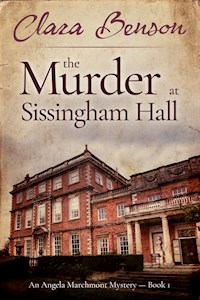
The Murder at Sissingham Hall
An Angela Marchmont Mystery Book 1
Clara Benson
© 2012 Clara Benson
All rights reserved
The right of Clara Benson to be identified as the author of this work has been asserted by her in accordance with the Copyright, Designs and Patents Act, 1988
The characters and events portrayed in this book are fictitious. Any similarity to real persons, living or dead, is coincidental and not intended by the author
This book is sold subject to the condition that it shall not, by way of trade or otherwise, be lent, resold, hired out, or otherwise circulated without the publisher's prior consent in any form of binding or cover other than that in which it is published and without a similar condition including this condition being imposed upon the subsequent purchaser
Cover design by Shayne Rutherford
WickedGoodBookCovers.com
clarabenson.com
If you’d like to receive news of further releases by Clara Benson, you can sign up to my mailing list here.
Or follow me on Facebook.
Contents
The Murder at Sissingham Hall
Chapter 1
Chapter 2
Chapter 3
Chapter 4
Chapter 5
Chapter 6
Chapter 7
Chapter 8
Chapter 9
Chapter 10
Chapter 11
Chapter 12
Chapter 13
Chapter 14
Chapter 15
Chapter 16
Chapter 17
Chapter 18
Chapter 19
Chapter 20
Chapter 21
Chapter 22
Books by Clara Benson
The Murder at Sissingham Hall
On his return from South Africa, Charles Knox is invited to spend the weekend at the country home of Sir Neville Strickland, whose beautiful wife Rosamund was once Knox's fiancée. But in the dead of night Sir Neville is murdered. Who did it? As suspicion falls on each of the house guests in turn, Knox finds himself faced with deception and betrayal on all sides, and only the enigmatic Angela Marchmont seems to offer a solution to the mystery. This 1920s whodunit will delight all fans of traditional country house murder stories.
Chapter One
It is always a very odd feeling, returning to one’s home country after a long period abroad. The countryside, the towns, the cities, people going about their daily business, even the weather, look familiar and yet at the same time strange. It reminds me of the feeling I once experienced on accidentally observing myself in a looking-glass which had been placed at right-angles to another—it was quite a shock to see a reflection of my reflection and suddenly realize that my true face was all lop-sided. When I got my first glimpse of the quayside from the deck of the Ruthin Castle, a welcome sight after the long voyage, a jolt of joy went through me, yet at the same time I felt oddly shy, like a small boy made to stand up in the drawing-room and recite poetry before a gathering of stern aunts.
‘No-one will be here to welcome me,’ I thought to myself, as the vessel drew ponderously into Southampton dock. ‘I am like a stranger in my own country. Shall I be able to settle down, I wonder?’
The gang-plank went down and I disembarked with the rest of the passengers, alone in the midst of a teeming mass of humanity. For a moment I stood on the quayside, my feet on English soil for the first time in eight years, discomposed by the bustling crowd of passengers, sailors and porters and momentarily uncertain as to which way to go. But just as I was heartily beginning to wish that I had remained in South Africa, I heard a piercing whistle through the din and, turning my head, saw two figures weaving with difficulty towards me. My heart leapt. I was not a stranger after all.
‘Bobs!’ I cried. It was indeed my oldest friend, ‘Bobs’ Buckley, accompanied by a rather good-looking girl I didn’t recognize. I had written to Bobs, informing him of my impending return but I had been far from expecting him to come and meet me. I started forward.
‘Bobs! How marvellous to see you,’ I said, beaming, as I wrung his hand. ‘I had no idea you intended to come and meet me. I thought I should have to slink up to town all alone like a disgraced relative.’
‘Think nothing of it, old chap,’ said Bobs, with a grin. ‘Couldn’t let an old friend down. Thought we’d give you a surprise. As a matter of fact, your return has come at just the right time. I’ve been wanting to try out the Lagonda on a straight run, just to see what she can do. My word, you should have seen her fly!’
‘Oh! I know I shall never recover from the fright. I’m certain my hair has turned completely white,’ cried the girl. ‘Bobs, I’m sure you ran over that cat in Winchester.’
‘A mere bump in the road, I assure you,’ said Bobs airily. ‘In any case, it would serve it right if I had run over it. A cat has no business getting in my way when I am in a hurry.’
‘Silly!’ said the girl, exasperatedly. ‘How was your trip, Charles? Was it too terribly ghastly? Where are your things? Bring the bags along please,’ (to the porter). ‘By the way, you are coming back to Bucklands with us, aren’t you? I mean, I suppose you don’t have any immediate business in town? Mother and Father are very much looking forward to seeing you.’
‘I—I—’ I said, confused by this torrent of speech and puzzled as to which question to answer first. Before I could answer any of them, it dawned upon me suddenly who she was and I started in surprise.
‘Sylvia!’ I exclaimed. ‘I hardly recognized you. Good heavens! I had no idea you had grown up. Have I really been away that long?’
When I had last seen Bobs’s sister, she had been an ungainly schoolgirl with a grubby face and a reckless disregard for the state of her clothes; quite different from the smart, fashionable young woman standing in front of me now. I could not help staring at her, astonished at how much she had changed. She flushed slightly and pulled a face, which immediately brought to memory the tom-boy she had once been and I laughed.
We all stood there for a few moments, grinning foolishly at each other as the crowd flowed around us, then Bobs said:
‘Better get going then, if we’re going to make it back to Bucklands at any time today.’
‘Oh, yes,’ sighed Sylvia. ‘I suppose I shall have to risk life and limb once again. I simply insist that you come back with us,’ she said, linking her arm through mine and turning towards a monstrous, dark-green contraption that could only be Bobs’s latest motor-car, ‘Otherwise I shall have to listen to Bobs’s piffle all the way back to Bucklands.’
‘Rot. You know perfectly well that I speak only words of the utmost wisdom. I say, isn’t she a beauty, Charles?’ said Bobs, eagerly. ‘I’ve never had a car like her. On a clear stretch of road she can easily do eighty miles per hour.’
Having duly expressed my admiration, I was permitted to climb in. Once the baggage was safely installed and the porter suitably remunerated, we set off at breakneck speed, narrowly missing an elderly gentleman and a nurse pushing a pram. It was clear that Sylvia had not been exaggerating when she had spoken of Bobs’s driving skills.
‘I see that you are still seeking out danger wheresoever it may lurk, Bobs,’ I remarked, as we reached the London road and the powerful motor-car began to eat up the miles. Bobs shrugged.
‘You know how it is. I never could seem to settle back into things after the War. I should have liked to join the Air Force but Father wouldn’t hear of it. Not after Ralph died, you know.’ Ralph was Bobs’s elder brother, who had been killed at Arras. ‘So I confine myself to more sedate activities.’ He looked as though he were about to say something more but then thought better of it.
I made some reply and tactfully changed the subject.
Sylvia had, understandably, preferred to sit in the back seat. I turned round and complimented her on her new-found elegance.
‘It seems only yesterday that you were putting frog-spawn in my pockets,’ I said. ‘But how you’ve changed! You are quite the chic lady. I hardly know what to say.’
Sylvia accepted my compliments with great composure.
‘Oh, Sylvia still puts frog-spawn in people’s pockets,’ Bobs assured me. ‘Only last week there was very nearly an embarrassing incident with the American Ambassador during cocktails. Luckily, Rankin came to the rescue just in time. I really don’t know what we’d do without Rankin. In fact, I shouldn’t be at all surprised if Father disinherits me and adopts Rankin as his heir. There’s no doubt he deserves it more than I.’
‘Well, I’m sure he doesn’t go around running over people’s cats,’ said Sylvia.
‘Of course not! He’s far too solemn and lugubrious for that. I say, isn’t “lugubrious” a marvellous word? And it fits Rankin to a nicety. No, I can’t see him running over cats but I can imagine him wringing their necks as a hobby,’ he continued darkly. ‘Perhaps if we went into his room we should see them hanging around the walls like bunting.’
‘How absurd you are, Bobs! As you can see, Charles, he hasn’t changed a bit. Neither have I, really. I’m just a little more polished these days, now that Rosamund has taken me in hand.’
Too late, Bobs shot her a warning look, as a thrill ran through me.
‘Rosamund?’ I inquired. ‘Rosamund Hamilton?’
‘Rosamund Strickland now,’ corrected Sylvia.
‘Yes, of course, I forgot. Has she been giving you lessons in dress and deportment? Picking up handkerchiefs and all that, what?’
‘Not exactly. A couple of years ago when she was down at Bucklands, I happened to admire her clothes and she insisted on introducing me to her dressmaker. You know Mother—she is rather vague and much happier grubbing about in the garden in tweeds, so it was quite a relief to find someone who really takes an interest. One receives so many invitations these days and I was quite floundering, as it was no use begging Mother to take me up to town. Luckily, Rosamund came to the rescue. She knows all the best places to go and Mother was quite happy to relinquish the responsibility. Look out!’ she said, suddenly, as Bobs swerved to avoid a pheasant.
As she and Bobs argued, I was silent, deep in thought. It had come as a shock to hear Rosamund’s name mentioned so soon after arriving back in England and now I examined my feelings closely, not wholly able to make them out. Certainly, I admitted to myself, I should not have been surprised to hear about her—she had always been part of our ‘set’ in the old days and there was no reason why she should not have remained so, especially since I had left England shortly after our engagement came to an end. It was hardly reasonable to expect her to stop seeing my friends once I was out of the picture; in fact it sounded pretty much as though she and Sylvia had become bosom pals in the meantime. Rosamund was not the reason for my leaving the country—so I had always told myself, but was that true? At any rate, there was no use in regretting how things had turned out, as she had married at almost the same time as I left and I—well, I had found myself with other things to worry about in that harsh, unforgiving heat.
So I reflected, then smiled to myself as I decided that the romantic feelings I had once had for Rosamund had long since disappeared. In fact, it would be rather nice to see her again. After all, she had always been a most charming woman, with the ability to make a chap feel like the wittiest and most attractive man in the room. Tired and jaded though I was, I was looking forward to getting back into things and showing the world that while experience might have battered me a little, it had certainly not beaten me and that I was ever the man I had been.
The rest of the journey was uneventful and as we turned in at the lodge gates of Bucklands, Bobs threw me a sideways glance.
‘All right, old man?’ he asked. I knew what he meant.
‘All right,’ I replied, smiling.
‘Here we are. It’s not much but it’s home,’ he said, as we drew up in front of the stately pile that had been the seat of the Buckleys since the Restoration or thereabouts, so it was claimed. The Buckleys were an old, old family that throughout the ages had survived and prospered by shrewdly backing the right side during times of strife, marrying into the right families and sending its sons into Parliament to pursue long, worthy careers. The present generation was no exception.
I received a quiet yet sincere welcome from Lord and Lady Haverford, whom I had always considered as a second family, my own having been so unhappy in so many ways. I was shown to a warm, comfortable room and urged in the friendliest manner to remain at Bucklands for as long as I liked.
We were a gay party that evening, talking nineteen to the dozen, recalling old times. My sun-tan was remarked upon and I was begged most flatteringly to recount some of my adventures abroad which, I must admit, were not as thrilling as I should have liked. Not for me the daring, dangerous life of a true pioneer or a big game hunter. I had left England to take up a respectable post running a farm; subsequently, finding farming a disappointment, I had tried mining and as luck would have it, had struck gold—literally—almost immediately. Much of my time abroad had therefore been taken up with the day-to-day running of my business. Fortunately, my adventures were enough to entertain my audience and Lord Haverford in particular intimated that he would like to pursue talks further at a later date, on a more business-like footing.
Despite my tiredness after the long journey, we talked late into the night, until, one by one, the various members of the family were overcome by sleep and went up to bed. At last, only Bobs and I remained, sitting in companionable silence in two easy-chairs set one each side of the fire. I watched Bobs as he stared at the flames. He had not changed a bit: still the same knowing smile and easy laugh, always with a ready joke to enliven and lift the spirits of any party. In his earlier youth, he had ever been a source of worry to his family, given his unfortunate liking for tearing about town with a succession of unsuitable young women. I wondered if he had mellowed at all.
Bobs looked up and caught me smiling.
‘I was just thinking of the old days and wondering whether you are still causing your parents’ hair to turn grey,’ I explained.
He laughed.
‘Yes, I was rather a rapscallion, wasn’t I? Mother lived in constant terror that I would run away to Paris and marry an opera singer. Mind, it was a close thing sometimes. Do you remember Lili Le Sueur?’
I remembered her only too well. Bobs had met her when she was dancing in the chorus of one of the lesser productions. For professional purposes she claimed to be French, although in reality she was an American with laughing eyes and an enormous sense of fun.
‘I should say so. But I seem to recall that it was all over between you by the time I left England. Didn’t she return to America?’
‘Yes. She wanted to star in pictures, she said, but I heard that she married a dentist back home in Wisconsin. I suppose she has got fat and lost her looks by now,’ said Bobs regretfully. ‘That’s the worst of these married women. They settle down and get caught up in domestic cares and then they are not worth looking at any more.’
I found myself wondering whether Rosamund had lost her looks and was vexed with myself. Why should it matter? I must be tired after the journey, I thought, or I would not be giving in to such weakness. Rosamund was part of my past and I was keen to embrace the future.
‘So have you given up consorting with unsuitable young ladies?’ I asked, half-jokingly.
Bobs did not answer immediately. He seemed absorbed by the fire, or possibly by thoughts of the enchanting Miss Le Sueur. I repeated my question and he started.
‘Eh—what’s that? Oh, yes, I have done with all that kind of thing. I am older now and get into a different kind of scrape.’
There was a strange look in his eye. I glanced questioningly at him but he did not elaborate. Instead, he continued to stare wistfully into the glow.
Nothing remained of the fire but smouldering embers and I was starting to feel the chill of an English October after my years in the sun.
‘I think I had better go to bed,’ I said, standing up and stretching. ‘It is simply splendid to see you again, Bobs. I can’t tell you how grateful I am that you came to meet me at Southampton. I was looking forward to a night in a dreary hotel in London but how much pleasanter it is to spend my first evening among friends!’
Bobs waved my thanks away airily.
‘Go and get a good night’s sleep, old chap, and dream of the veld.’
I bade him goodnight and climbed wearily up the stairs to my room, where I found my things neatly unpacked and laid out for me. Undressing quickly, I fell into bed and soon drifted off into a deep sleep untroubled by any dreams at all.
Chapter Two
I spent several days with the Buckleys, joining them in the usual country pursuits and round of social events that are generally attached to a great house such as Bucklands. After such a long time away, I was surprised to find how easily I fell back into the old way of things. The heat and dust, the sounds and the smells of Africa began to seem like part of a previous life and after only a few days, I ceased to feel like a foreigner in my own land. Bobs and I spent several enjoyable days fishing in the stream that ran through Bucklands Park. In the evenings there were cocktails and parties, while on the rare occasions on which there were no visitors, we all talked and laughed together late into the night.
During that week, I also spent some time getting re-acquainted with Sylvia—or rather, getting acquainted with the lively young woman she now was, instead of the mischievous child she had once been. We passed endless hours walking around the grounds; she asking me intelligent questions about the life of a gold-miner and making me laugh with amusing tales of her friends in London, who seemed rather a wild crowd. I found her very good company and I sensed that she liked me too. My mind wandered into idle speculations of a most pleasant nature. I supposed I ought to be thinking of settling down before I became too set in my ways and Sylvia was the sort of girl I had always been attracted to: pretty, clever and sympathetic. Furthermore, I was sure that I would encounter no opposition from Lord and Lady Haverford. Despite misfortune, my family background was considered almost impeccable and now that I had become a successful man in my own right, their minds would certainly be relieved of any lingering doubts. I drew back from making any firm commitment, however, reflecting that I had only just returned to England and that I had no wish to act precipitately or take an irrevocable step that I might regret.
‘You seem rather preoccupied, Charles. What are you thinking about?’ asked Sylvia, looking sideways at me as we strolled around the rose garden, taking advantage of a short spell of autumn sunshine after several days of drizzle. I roused myself from my musings.
‘How rude of me. I’m afraid I let my mind stray to business matters,’ I replied. ‘It seems I have not yet shaken off the cares of the world, which can be my only excuse for letting my attention wander.’
‘Oh dear! Well, we simply must try and bring you out of yourself. You were rather stern and reserved when you first arrived but a few days have already done wonders for you. But we can still do better. Bobs and I are going down to Sissingham Hall to visit the Stricklands in a couple of weeks. You must come with us. I shall get Rosamund to invite you.’
I must have hesitated, because Sylvia immediately blushed, put her hand to her mouth and cried:
‘How simply dreadful of me, I completely forgot! Of course, you can’t have seen Rosamund since—’
Feeling, for my own sake as well as hers, that I must reassure her quickly, I laughed as naturally as I could and told her not to be an idiot.
‘Rosamund and I are old friends, nothing more,’ I said easily. ‘Our engagement was a mistake and both of us quickly realized it. We parted on the best of terms and I should be very happy to see her again after all these years.’
Sylvia had been watching me intently as I made this not-entirely-truthful speech and seemed relieved.
‘I’m glad of it,’ she said. ‘I was afraid I had said the wrong thing. I’m always doing that. Mother says I shall never make a diplomat’s wife.’
Again I told her not to be silly and instructed her in no uncertain terms that she was by no means to avoid Rosamund’s name; that I was looking forward to seeing Rosamund again; and, moreover, that I also relished the prospect of renewing my acquaintance with her husband, Sir Neville Strickland. I further intimated that there were other women—a woman even—whom I found more attractive these days. Sylvia quite rightly snorted at this thunderingly clumsy attempt at gallantry but seemed satisfied with my assertions.
‘Anyway,’ she said, reverting to the topic of my self-improvement, ‘I hope you are planning to stay with us for a good while yet. I—we are very much enjoying having you here. And besides,’ she continued in a practical tone that was more like herself, ‘You won all my money last night and I want to win it back.’
I laughed and we argued the point all the way back to the house.
‘What were you two talking about so cosily in the rose garden?’ Bobs murmured to me with eyebrows raised, as we came in to tea.
‘Haven’t you anything better to do than to watch people strolling in the rose garden?’ I replied blandly. Bobs’s eyebrows rose further but he did not press the point.
‘Charles, dear boy,’ boomed Lord Haverford as he entered the room. ‘We must have that chat about the prospecting rights. I have the maps all prepared.’
‘I’m ready now, sir, if you like.’
‘Then let’s go to my study, where we won’t be disturbed. As for bringing someone else into the business, I know the very man. Have you met Sir Neville Strickland? He already has interests in Africa and knows the work.’
Sylvia looked up warily and I couldn’t help but catch her eye as I was conducted out of the room. I smiled brightly and she gave me a wink, much to Bobs’s evident entertainment. I felt a little guilty for leaving her to withstand Bobs’s merciless teasing alone but Lord Haverford was not to be refused. And anyway, I reflected, she must surely be used to it by now.
After a week or so of more or less idle enjoyment, I reluctantly felt I must go up to London. I had business awaiting me there and, more pressingly, I was finding that my light clothes were wholly inadequate to ward off the chills of a dank October. So, dressed in a warm suit lent to me by Bobs, I arrived at Waterloo station for my first encounter with the fogs of London in more than eight years. After the ruin and subsequent death of my father, I had left town almost a pauper, owning little more than the clothes I stood up in; now, as I hailed a taxi and pronounced the words: ‘The Ritz’, in emphatic tones, I experienced a certain feeling of jubilation, for which I think I can hardly be blamed.
Once I had firmly installed myself and my belongings in that luxurious establishment, the next few days were spent in conducting essential business. I very soon possessed myself of a suitable wardrobe and as I surveyed myself in the long glass, I noted with satisfaction that, apart from the sun-tan, no longer could I be immediately set down as a Colonial. The next step was to set inquiries afoot for a discreet valet: I had lived in the rough for long enough and now I was determined to avail myself of all the comfort and convenience that London life affords. Of course, I would also have to find somewhere to live but that was not yet an immediate concern.
Town was rather quiet at that time of year but I managed to look up a few old school-mates, who were very glad to see me, or gave every appearance of it, and saved me from the unspeakable dullness of spending each evening alone. I dined out, disported myself rather disgracefully at the newest and most fashionable jazz night-clubs, danced with a string of pretty women and generally shook the dust of South Africa from my feet altogether.
Shortly after my arrival in London, I received a letter from Sir Neville Strickland, inviting me to lunch at his club with a view to discussing the prospecting rights. He rose and shook my hand warmly as I was ushered in to the grand, wood-panelled room in which so many vital affairs of state had been discussed over the years—and so many questionable deals done.
‘Delightful to see you again, my boy,’ he said. ‘It must be five years since you left, what?’
‘Eight, sir,’ I replied.
‘Indeed? So long? My, how time flies! Well, well, let us sit down. What will you have? The fish here is very good.’
Sir Neville was a florid man of around fifty, who was much more at home in the country than in town. He made cursory inquiries about my recent return to England, then plunged straight into the business at hand. This lasted us all the way through to coffee, when he suddenly changed the subject and invited me down to Sissingham Hall.
‘We should be very happy to see you,’ he said. ‘I know that Rosamund particularly wishes you to come, since you are such old friends. Young Buckley and his sister will be there and one or two other people. I expect it will be quite a jolly party. What do you say, hm?’
I accepted his invitation with thanks and promised I would play my part in making it a lively weekend. I had no idea when I said it that this would turn out to be truer than I had supposed.
‘How is Rosamund?’ I inquired.
‘Oh, she’s splendid, splendid. Of course, she finds it terribly dull in the country, so she’s very keen on these house parties. Naturally, I leave it to her to do all the organizing. Women are much better at that sort of thing, don’t you know. We men do well to stay out of it!’ He gave a short bark of laughter.
I well remembered how Rosamund used to bask in the gay brilliance and glitter of a large party, with herself as the queen of the evening. She had an almost child-like delight in being the centre of attention and would repay the devotion she received by graciously bestowing notice on her worshippers, rewarding them with dazzling smiles and a few moments in the bright circle of her radiance. I had been one such acolyte myself for a short while but this time I would resist.
The conversation touched on sport and fishing and then turned to politics and public affairs. Sir Neville bemoaned the rising costs of running his estate and became quite heated on the subject of tax. I nodded and made sympathetic replies whenever called upon to do so, although in truth, I was not really listening. I was instead reflecting on the strange forces that bring people together. Sir Neville and his wife were two very different people, with apparently very little in common: he was a staid, middle-aged man, strongly attached to the countryside and much preferring a tranquil life and family surroundings, while she was a lively, beautiful young woman with a wide circle of friends and a taste for excitement—and yet by all accounts, they were a devoted couple whose mutual attachment nobody doubted. But perhaps Rosamund had altered in the eight years since I had last seen her. Time wreaks many changes, as I knew only too well.
Sir Neville and I parted with cheery salutations on both sides; he to return to his Norfolk estate and I to my suite at the Ritz, where I had some letters to write. On my return, I found a telegram waiting for me. It read:
Hope Neville remembered to invite you Sissingham. Do come. Will not be the same without you. Strong silent Colonial simply essential to complete party.
I could not help but smile. However else she might have changed, it appeared that Rosamund was still as impulsive as ever.
Two days later, I happened to wander into a restaurant which was well-known among certain circles for its discretion and caught sight of Bobs dining with a rather striking-looking woman. They seemed to be having a private conference and I was just about to ask tactfully to be seated well away from them, in order to avoid causing embarrassment to all concerned, when Bobs caught my eye and beckoned me over.
‘Hallo, old chap,’ he said. ‘Come and join us. We were just talking about Sissingham. Have you met Mrs. Marchmont? Angela, this is my great friend Charles Knox. Angela is Rosamund’s cousin. She’s been living in America but now she has returned to England and is coming to Sissingham next weekend. Try not to let the fact that she dines with disreputable types such as I put you off, by the way. She is a woman of impeccable reputation and delightful company to boot.’
Mrs. Marchmont took this pleasantry with good humour.
‘How do you do, Mr. Knox,’ she said. ‘As Bobs says, I’m afraid you catch me at a disadvantage. Still, I suppose that is the way society is going these days and you know in the States we take these things much less seriously, which must be my excuse!’
She gave a wide smile and shook my hand as she spoke. I must say I rather took to her immediately. Tall, dark-haired and dressed elegantly but not ostentatiously in shimmering blues and greens, she appeared no more than thirty at first glance but a closer look revealed one or two lines about the eyes and the mouth that told a different tale. She was not precisely beautiful but there was a certain look in her eye that attracted and yet challenged. I had heard about Rosamund’s American cousin of course, and remembered vaguely that they had been close as children but had not seen each other since Mrs. Marchmont left England. The waiter drew up a chair for me and I sat down.
‘How long were you in America?’ I asked politely.
‘Oh, longer than I care to remember! Why, it must be fifteen years, now I think about it,’ she replied. ‘I went out there a year or two before the War. And yet, now I have returned, it seems only yesterday that I left.’
She told me about her delight in meeting Rosamund again, after so many years apart. As children they had been almost like sisters but circumstances had separated them and she was looking forward to getting reacquainted with her cousin, of whom she spoke with great fondness.
Mrs. Marchmont seemed to be on the most friendly terms with Bobs, which did not surprise me, as Bobs knew everyone. She had had many interesting experiences in America and made some intelligent observations about how things had changed in England since she left. In this respect, we had much in common, both of us having spent time away from our native land and seeing it for the first time in many years from the perspective of outsiders.
Mrs. Marchmont did not remain with us for long, as she had an engagement elsewhere. I escorted her to her car.
‘It has been very nice to meet you,’ she said, as the car drew up. ‘I look forward to continuing our conversation at Sissingham.’
I assured her that the feeling was mutual and watched for a moment as the motor pulled away. It struck me that Mrs. Marchmont was very different from her cousin. Then I returned to our table, where Bobs was just lighting up a cigar.
‘A fine woman, that,’ he remarked. I could not help but agree with him.
‘Rather inscrutable, too, perhaps,’ I said. ‘She appeared to me to be quite unlike the average woman who has an interest only in jewellery and fine dresses. You may think it odd but while we were talking, I had the strangest feeling that she held many secrets and could reveal a great many interesting things if she chose.’
‘Yes, she does strike one that way, doesn’t she?’
‘Is there a Mr. Marchmont? She didn’t mention him at all.’
‘Why, I couldn’t say. I believe there is, or was. A financier, or a captain of industry, or something like that, back in America.’
‘From what she said, it sounded as though she and Rosamund were as thick as thieves, once.’
‘Yes, that’s true—despite the age difference,’ Bobs said. ‘Angela is rather older than Rosamund, you know. I believe she has always been fiercely protective of Rosamund—especially after the trouble happened with old Hamilton. But Angela’s family weren’t exactly well-to-do either and she had to make her own way in the world, so they parted. She was a secretary to some Duke or other and then took a post with Bernstein, the financier. That’s how she ended up in America. Rosamund was still a child at that time and she stayed in England with her mother and grew up with very little money—but of course you know about all that.’
I did indeed. When my own father had been ruined, throughout all the misery and difficulties that ensued I had at least felt, for a short time, that Rosamund and I had something in common. But it soon became clear to me that I could not expect her to live in poverty with me. Despite her penniless childhood, Rosamund was not a person whom one associated with saving and scrimping. One could not imagine her cheerfully ordering the cheapest cuts from the butcher, or darning socks, or washing the plates on the maid’s day off. When one pictured Rosamund, it was in a grand, elegant, warm setting, surrounded by brightly burning lights and dressed in glittering array. No, the rough-and-ready life of South Africa, the struggle for existence, the uncertainty of the future—they were not for her.
‘Tell me about Sissingham,’ I said. Bobs waved his cigar vaguely.
‘Oh, it’s comfortable enough, I suppose. A bit on the small side but it has some jolly good shooting. Miles from anywhere, of course.’
I took the comment about the house’s size with a grain of salt, knowing well that Bobs judged all buildings against the standards of Bucklands.
‘Sylvia spends quite a bit of time there, doesn’t she?’ I asked.
‘Yes, she and Rosamund are great pals these days. In fact, we both go to Sissingham quite often. The Stricklands are fond of entertaining—at least, Rosamund is. Neville less so.’
‘What do you mean, less so?’
Bobs grinned.
‘Oh, he’d much prefer to sit by his fireside or work alone in his study every evening. He puts a brave face on it but Rosamund has the upper hand of him there. I mean, dash it, you can’t marry a good-looking woman like that and keep her all to yourself, can you?’
‘Do they spend a lot of time in town?’
‘Not as much as Rosamund would like. That’s why they have so many house parties, to keep her from getting bored.’
‘Do you know who is coming next weekend?’
‘I believe it is to be a smallish party. Apart from us and Angela, the only other guests will be the MacMurrays. I don’t think you know them. Hugh MacMurray is a cousin of Sir Neville.’
‘MacMurray…MacMurray. I don’t recall the name.’ I frowned, trying to remember.
‘No? Well, you’ll meet them soon. He’s a nice enough chap but I wouldn’t trust him with anything important. His wife is a rather interesting woman.’
‘In what way?’
Bobs smirked knowingly and lowered his voice to a confidential whisper.
‘She has come up in the world these days but I knew her slightly when I was going around with Lili. Just be sure not to believe anything she tells you about herself. I shan’t say any more.’ He gave an exaggerated wink.
I sat back in my seat.
‘Bobs, you really are the most frightful old gossip!’ I chided. ‘You are quite an old woman. I’m half-ashamed of myself for listening to such rot!’
Bobs disclaimed my epithet with a grin.
‘No harm in a little idle chatter. I’m sure you will find her a fascinating woman. She has a certain charm about her, in her own way. In fact, what with the MacMurrays and your seeing Rosamund for the first time since you left England, it promises to be a most interesting weekend.’
I thought this a rather malicious attitude and told him so with dignity. Deep down, however, I felt that he could be right.




