


7,19 €
Mehr erfahren.
- Herausgeber: Pushkin Children's Books
- Kategorie: Für Kinder und Jugendliche
- Sprache: Englisch
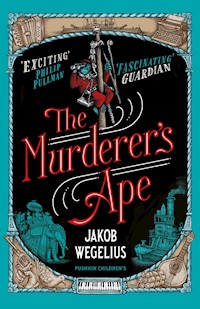
A captivating mystery adventure story, with gorgeously detailed black-and-white illustrations throughout Sally Jones is an extraordinary ape and a loyal friend. In overalls or in a maharaja's turban, this unique gorilla moves among humans without speaking but understanding everything. She and the Chief are devoted comrades who operate a cargo boat. A job they are offered pays big bucks, but the deal ends badly, and the Chief is falsely convicted of murder. For Sally Jones this is the start of a quest for survival and to clear the Chief's name. Powerful forces are working against her, and they will do anything to protect their own secrets. Jakob Wegelius is a Swedish writer and illustrator. The Murderer's Ape was a bestseller in Sweden and Germany, won the August Prize for Best Children's Book, the Nordic Council Children and Young People's Literature Prize, and is an International Youth Library White Raven selection.
Das E-Book können Sie in Legimi-Apps oder einer beliebigen App lesen, die das folgende Format unterstützen:
Veröffentlichungsjahr: 2017
Ähnliche














![Tintenherz [Tintenwelt-Reihe, Band 1 (Ungekürzt)] - Cornelia Funke - Hörbuch](https://legimifiles.blob.core.windows.net/images/2830629ec0fd3fd8c1f122134ba4a884/w200_u90.jpg)




CONTENTS
CHARACTERS
THE TYPEWRITER
The other day the Chief gave me an old typewriter, a 1908 Underwood No. 5. He’d bought it from a scrap merchant down by the harbor, here in Lisbon. Several of the keys were broken and the release lever was missing, but the Chief knows I like fixing broken things.
It’s taken me a couple of evenings to mend my Underwood No. 5, and this is the first time I’ve written anything on it. Several of the keys still stick, but a pair of pliers and a few drops of oil will soon put them right.
That will have to wait until tomorrow. It’s already dark outside my cabin window. The lights from the vessels lying at anchor on the river are reflecting in the black water. I’ve strung my hammock and I’m about to climb into it.
I hope I don’t have those horrible dreams again tonight.
It’s evening again.
The Chief and I were lucky today. Early every morning we go to a harbor café where unemployed sailors wait round hoping to get work for the day. There is not usually anything much, but today we struck lucky and so we have been heaving sacks of coal from dawn to dusk. The pay was poor, but we need every penny we can earn. My back aches, my arms ache and my fur is itchy with coal dust.
More than anything else, though, I’m tired. I didn’t sleep well again last night. It must be at least a month since I had a full night’s sleep undisturbed by nightmares.
The same dreams return time after time.
Some nights I’m back in the engine room of the Song of Limerick. I’m being held from behind by strong arms while the engine is racing and the ship is sinking.
Other nights I dream of Chief Inspector Garretta. It’s dark and I don’t know where I am. Among the tombs in Prazeres Cemetery, perhaps. The only things I can see are Garretta’s small eyes, which shine with a cold gleam under the brim of his hat. And I can smell the acrid gunpowder from his revolver— the shot is still ringing in my ears.
The most horrible dream is the one about the Chief. I am standing in the rain waiting for him outside an iron gate in a high wall. Time passes and I’m chilled to the bone. I try to convince myself that the gate will open at any moment, but I know in my heart that I’m fooling myself. It’s never going to open and the Chief is caught behind that wall forever.
There are times when I scream in my sleep. One night not long ago I was woken by the Chief rushing into my cabin waving a big pipe wrench. Hearing my screams, he’d thought someone had crept aboard and was going to hurt me. That was a distinct possibility, for we’ve made dangerous enemies in Lisbon.
I’m too tired to write any more at present. I’ll probably write again tomorrow. I’m really pleased with my Underwood No. 5!
It’s foggy tonight. It came rolling in from the Atlantic during the afternoon. I went up on deck just now and couldn’t see beyond the cranes a short way along the quay. Every so often the gruff noise of foghorns and the ringing of ships’ bells can be heard from the river. It sounds a bit ghostly.
The Chief and I have been carrying sacks of coal again today. I was thinking about my Underwood No. 5 while doing it, and now I’ve decided what I’m going to use it for.
I am going to use it to tell the truth.
The truth about the murder of Alphonse Morro.
So that everyone knows what really happened.
And maybe the writing will help to rid me of my nightmares.
PART ONE
CHAPTER 1
Me, the Chief and the Hudson Queen
For those of you who don’t know me, the first thing I need to say is that I’m not a human being, I’m an anthropoid ape. I’ve learned from scientists that I belong to the subspecies Gorilla gorilla graueri. Most of my kind live in Africa, in the thick jungle along the banks of the Congo River, and that’s probably where I originally came from.
I don’t know how I ended up among people, and I probably never shall know. I must have been very small when it happened. Maybe I was caught by hunters or by natives and they then sold me on. My very first memory is of sitting on a cold stone floor with a chain round my neck. It may have been in the city of Istanbul, though I can’t be completely certain.
Since then I’ve lived in the human world. I’ve learned how you human beings think and how to understand what you say. I’ve learned to read and to write. I’ve learned how people steal and deceive. I’ve learned what greed is. And cruelty. I have had many owners and I would prefer to forget most of them. I don’t know which of them gave me my name. Or why.
But I’m called Sally Jones anyway.
Many people think the Chief is my present owner, but the Chief isn’t the sort to want to own others. He and I are comrades. And friends.
The Chief’s real name is Henry Koskela.
We first met many years ago when I stowed away on a freighter called the Otago. The crew found me, and the captain ordered them to throw me overboard. But the ship’s chief engineer stepped in and saved my life. That was the Chief, that was.
We chanced to meet again a couple of years later in the harbor district of Singapore. I was seriously ill and standing chained to a post outside a sleazy bar. The Chief recognized me and bought me from the bar owner. He took me with him to the ship he was working on and gave me food and medicine. That was the second time he saved my life.
When I eventually recovered I was allowed to help the Chief with various little jobs round the engine room. I liked the work, and thanks to the Chief I became good at it too. Everything I know about seamanship and ships’ engines I’ve learned from him.
We’ve stuck together ever since, the Chief and I. From Southeast Asia we worked our way to Australia. We bought our own steamer, the Hudson Queen, in New York and ran her along the coasts of the Americas, Africa and Europe with various cargoes. We were our own masters and made enough money to keep the ship in good condition.
It was a good life, impossible to imagine a better one.
I hope it can be like that again.
Just under four years ago everything changed. That’s when our misfortunes began. The Chief and I had been sailing in British waters the whole of that summer, and when autumn arrived we decided to head for warmer latitudes to avoid the winter storms in the North Sea. In London we took on a cargo of tin cans bound for the Azores, a group of islands in the middle of the Atlantic.
The journey went well at the start. We had good weather and gentle winds, but our luck ran out early one morning when we collided with a whale. The whale survived, but the Hudson Queen took such a thump that her rudder was bent. While we were trying to mend the damage, the weather changed and a violent storm blew up. The Hudson Queen drifted helplessly, and if it hadn’t been for the drag anchor we’d have been lost. It was only once the wind had eased that we managed to rig emergency steering, set a course for the Portuguese coast and seek refuge in Lisbon.
Once we had unloaded our cargo, the Hudson Queen had to go into dry dock for rudder repairs. That took a fortnight and cost all the money we had saved. The Chief went round all the shipping agents in the port, trying to arrange a new cargo, but he found nothing. The quayside was already lined with freighters with empty holds waiting for better days.
The weeks passed. It’s never much fun to be stuck ashore, but there are worse ports than Lisbon to be stuck in. We used to spend our Saturdays riding round the city by tram. You won’t find smarter trams than Lisbon trams anywhere in the world, not even in San Francisco.
Our mooring in the harbor was below the Alfama district, a poor quarter of the city, sleepy by day and full of danger by night. No one batted an eye at the Siamese twins who sold shoelaces on Rua de São Pedro, nor at the Devil Dancers from the Pepper Coast who were to be found in the darkest alleyways when the moon was waning. In Alfama they didn’t even bat an eye at an ape in a boiler suit, and that was good for me.
Most evenings we went to O Pelicano, an inn used by many seamen when they are in Lisbon. It’s on Rua do Salvador, a dark and narrow lane rarely reached by the rays of the sun. The owner was called Senhor Baptista. He used to be a cook on the ships of the Transbrazil line and he always offered his guests a glass of aguardiente before they ate. Aguardiente is a sort of brandy, so I usually took a glass of milk instead.
I have many good memories of our evenings in O Pelicano, but I have a bad one too. Because it was in O Pelicano that we first met Alphonse Morro.
CHAPTER 2
Morro
The Chief and I had been working late in the engine room of the Hudson Queen. I remember it was raining hard when we went ashore to have supper. The light from the gas lamps round the harbor was glinting off the wet paving stones of the quay, and dirty water was gurgling in the gutters and street fountains in the narrow streets of Alfama.
It was warm and smoky in O Pelicano. The regulars were squeezed in round the circular tables and several of them greeted the Chief and me with a wave or a nod. There were seamen and stevedores from the harbor, hollow-eyed streetwalkers and sleepless musicians. A big woman in black called Rosa was singing a fado about unlucky love. Fado singers are typical of the poor districts of Lisbon.
One of the guests was a man I hadn’t seen before. He was sitting on his own at the table nearest the door, and he looked up from his coffee as we entered. He had a narrow, very pale face, and his eyes shone black under the brim of his hat. I sensed that his eyes followed the Chief and me as Senhor Baptista showed us to an empty table in the innermost corner of the inn.
Senhora Maria, Senhor Baptista’s wife, served each of us a bowl of tomato soup and bread. We had just started to eat when the solitary man by the door stood up and came over to our table. I thought he must have been waiting for us.
“My name is Morro,” he said in a low voice. “I hear that you have a ship. And that you need work.”
At first the Chief looked surprised, then he looked pleased.
“You’ve hit the nail on the head,” he said. “Take a seat.”
The man called Morro threw an anxious look over his shoulder and sat down.
“There are some crates,” he said in a voice so low the Chief had to lean forward slightly to hear him. “They need to be picked up in Agiere, a small port on the River Zêzere. I have a map here.”
From his inside pocket Morro produced a folded map and spread it on the table. The Chief studied the map carefully. I realized that what interested him was the depth of the river.
“It’s rained a lot in recent weeks,” Morro said. “The water level of the rivers is high. You don’t need to worry about running aground.”
“That will depend on how heavily laden we are,” the Chief said. “How many crates are we talking about? And what’s in them?”
“Azulejos,” Morro said. “You know, ceramic tiles. There are six crates, and each crate weighs about six hundred fifty pounds.”
The Chief looked surprised.
“Is that all? Why don’t you bring the crates to Lisbon by horse and cart instead?”
“These are valuable and delicate tiles,” Morro said quickly, as if he had the answer prepared. “The roads are bad and I don’t want the tiles shaken about so that they break. Are you willing to take the job?”
“That may depend on how much you are offering,” the Chief said with a smile.
Morro produced an envelope and gave it to the Chief, who opened it and quickly thumbed through the banknotes it contained. I could tell from his expression that there was more money than he’d expected.
“The crates are to be brought here to Lisbon. To Cais do Sodré,” Morro said. “If you can finish the job in four days, I’ll pay you the same amount again.”
The Chief’s face lit up.
“You’ve got a deal,” he said, holding out his hand.
Morro shook it briefly and then got to his feet. Without saying another word he pushed his way between the tables and disappeared out through the door and into the night.
A couple of hours later the Chief and I strolled back down to the harbor to the Hudson Queen. The rain had stopped and a hazy moon was peeping through the broken clouds that were sweeping across the sky. The Chief was in a splendid mood. He had stood a round of drinks for everyone in O Pelicano to celebrate that we had a job at last. And a well-paid job at that.
“Our luck has turned!” he said when we reached the quayside. “With this much money we can fill our bunkers with enough coal to reach the Mediterranean! And there are always cargoes there for a vessel like the Hudson Queen.”
I wanted to feel as happy as he did, but something was holding me back. The man called Morro had made me feel uneasy. His eyes, perhaps? There had been a strange, feverish gleam in them, and I could tell from his scent that he was afraid.
CHAPTER 3
Agiere
The following morning I rose before dawn to light the fire under the boiler. By the time we’d finished breakfast the engine was steamed and the Hudson Queen ready for departure. We cast off and steered out into the River Tagus. We set a course northeast, up the wide river.
It was a wonderful autumn day. The sun was shining, and in the wheelhouse the Chief was singing at the top of his voice. It’s always the same song that he sings when he is setting out to sea after too many days in harbor.
Farewell, you cruel maiden,
Farewell, goodbye, I say,
For I’m weary now of waiting,
So I’m off to sea again.
My ship is weighing anchor
And we’re sailing for Marseille,
My love evoked no answer
So I’m off to sea again.
The first day’s voyage went without a hitch. The shipping traffic on the Tagus was busy and we met broad-beamed sailing barges with cargoes of wine, vegetables and fruit, as well as small steamers whose passengers waved to us.
We reached Constância at dusk. It’s a small town with whitewashed houses up on a high headland. We moored at the quayside for the night and early the following morning continued our voyage, now up the smaller River Zêzere. The current was stronger here and the Chief had his work cut out to find the channel between sandbanks and reefs. We did not meet any other boats, and we saw very few houses and farms along the banks of the river.
Late in the afternoon we came to a small waterfall. That was as far as we could go. On the south bank there was a stone quay and a solitary house. This—according to the map Morro had given us—was Agiere.
Down in the crystal-clear water we could see many sharp rocks projecting from the sandy riverbed. I stood in the bow and kept a lookout while the Chief brought us carefully alongside the quay.
Once we had tied up we went ashore and looked round. The solitary house proved to be deserted. There was no glass in the windows, and most of the roof at the back had collapsed. A narrow road with brushwood and ferns sprouting down the middle led through trees into the woods. There was nothing to suggest that anyone had been there for a very long time.
Nor was there any sign of crates of tiles.
“What do you think?” the Chief said, scratching his head. “Have we been tricked?”
I shrugged. It certainly looked like that. On the other hand the man who said his name was Morro had paid us a large sum of money in advance. The whole business was very strange. And worrying. This deserted spot felt more than a little creepy.
Back on board the Hudson Queen the Chief prepared our supper in the galley while I cleaned the engine for the night. We were going to stay until morning anyway: it would have been too dangerous to turn round and sail down the narrow river in the hours of darkness with the current behind us.
We ate in the cabin as usual. Then we took out a deck of cards, and the Chief smoked a cigar while we played a hand of rummy. I won, so the Chief had to do the washing up.
It was a fine, still evening. The sun went slowly down, and midges danced in the hazy evening light over the river. I strung my hammock between the mast and one of the shrouds and lay in it looking up at the swallows that were swooping about high above. The Chief sat on deck and spliced new mooring ropes for the lifeboat. When the light became too poor he put aside the work and fetched his hammock.
The noise of the waterfall made us sleepy, and before I fell asleep I could hear that the Chief was already snoring in his hammock.
I didn’t know what time it was when I woke but the stars were still twinkling in the black sky. It took me a few seconds to recognize what had woken me.
A noise, a kind of squealing noise, was coming from the woods behind the derelict house. A few moments later I saw a light moving in the distance among the trees.
I slid down from my hammock and crept over to the Chief. He woke with a jerk when I shook his shoulder gently. Seamen on board ship rarely sleep very deeply.
I pointed toward the woods and he followed my finger. The light between the trees was growing stronger, and we guessed it was coming from a swaying lantern.
Hardly a minute later a horse-drawn cart came trundling past the house and emerged on the rough patch of grass by the quay. There were three men sitting on the coach box, and a fourth man was following them on horseback. All four were dressed like farmers—torn jackets, sheepskin waistcoats and slouch hats.
The man on the horse dismounted, stretched and then strode out onto the quay. He had a short black beard that shone in the moonlight as if it had silver glitter in it. The Chief climbed over the rail and stepped down onto the quay to meet him.
“Lord be praised!” the bearded man said, and roared with laughter. “You got here! Saint Nicholas must have been watching over you. Monforte’s the name. You can call me Papa Monforte—all my friends do!”
He held out an enormous fist to the Chief and they shook hands.
“My men are keen to get back to their village,” Papa Monforte said. “So it would be good if we could get the load aboard straightaway. Would that be possible?”
The three men on the cart had already stepped down and started to untie the ropes holding the wooden crates.
“Yes, of course. That will be no trouble,” the Chief said.
“Excellent!” Papa Monforte said with a laugh, and gave the Chief a friendly pat on the shoulder. “Let’s get started!”
The Chief came back on board. We lit a couple of paraffin lamps and set about opening the hatches to the hold and starting the steam winch. The Chief worked silently and doggedly. He seemed thoughtful.
“I don’t like this,” he whispered to me when we were ready to swing out the loading crane. “Who on earth loads tiles in the middle of the night? And out in the wilderness?”
I nodded to show agreement. Everything about it felt wrong.
Papa Monforte and his men stood waiting by the cart. In the light of the lantern I could see them watching the Chief with hard, guarded eyes. The kind of eyes that make you think of soldiers or bandits but not of farmers.
The Chief scratched his chin, which is what he usually does when trying to reach a decision. Then he picked up a lantern and went ashore. I reached out a hand to stop him, but it was too late.
“Everything ready?” I heard Papa Monforte ask.
“Everything’s ready,” the Chief said. “But before we load the crates I’d like to have a look inside them.”
Papa Monforte’s face was in shadow. He laughed again, just as loudly as before, but rather less heartily this time.
“Why’s that?” he said.
“I want to see what’s in them.”
“You already know what’s in them, my good fellow. The crates are full of azulejos.”
I could tell from the Chief’s back that he was tense.
“Tiles are delicate things,” he said. “I need to check whether any are broken. Otherwise there’s always the chance that I’ll be blamed if they turn out to be damaged when we arrive at the other end.”
“I guarantee that everything is in order,” Papa Monforte said in a quiet but harsh tone. “Now let’s start loading.”
The Chief put his lantern down on the ground and shoved his hands into his trouser pockets.
“No,” he said. “We won’t. Not before I know what is in the cargo I’m taking on board my ship.”
Papa Monforte and the Chief looked at one another in silence for a moment. Then Papa Monforte sighed and raised his hand as a signal.
The next moment his three companions all drew revolvers from the waistbands of their trousers.
CHAPTER 4
A Cargo of Weapons
We loaded the cargo with their pistols pointed at us. The Chief was so angry that his hands shook as we unhitched the crates and stowed them down in the hold. My hands were shaking too, but that was fear. I was terrified the Chief would start arguing with the bandits, or do something silly that would give them an excuse to shoot him.
Papa Monforte and one of his gang had gone up to the wheelhouse and lit the paraffin lamp above the navigation table. They were studying something that I assumed to be the chart of the river. Since the windows were open I could hear them discussing things: Papa Monforte wanted to cast off immediately, whereas the other man thought it would be wiser to wait until dawn. Finally Papa Monforte said, “I’m more worried about the soldiers of the Republican Guard than I am about sandbanks in the river. We have to travel by night. Now let’s see about getting away from this place.”
They ordered the Chief to prepare things for departure. He refused.
“In that case,” Papa Monforte said to the Chief calmly, “I’ve no more use for you, my friend. You can go ashore, and I’ll steer the boat down the river myself. But I’ll take this gorilla with me, of course, since she’s the one who looks after the engine. If we run aground, she’ll be the one I blame—and that will be the end of her!”
The Chief and Papa Monforte stared at one another, after which the Chief went up to the wheelhouse, his face black with rage. This business was not going to end well, that much I knew.
One of the bandits accompanied me down to the engine room to see that I fired up the boiler. He watched in amazement as I shoveled fresh coal into the firebox.
“Strange sort of gorilla you are,” he said, spinning his pistol on his finger. “Given the things you can do.”
I didn’t listen to him. To keep my terror at bay I forced myself to concentrate on what needed to be done. I did my rounds with the oilcan, and I had just finished when the engine room telegraph bell rang. The Chief was giving the order “Slow ahead.” I opened the steam regulator, and the pistons and connecting rods began working. The Hudson Queen moved out from the quay. I kept thinking of the sharp rocks on the riverbed, and every muscle in my body tensed in expectation of running aground.
Maneuvering a boat running downstream demands speed; otherwise the boat drifts out of control. I guessed the Chief would order “Half speed ahead” as soon as we came out into the current, and that is exactly what he did.
I tried to work out in my head how far we had traveled. Just when I thought we must have reached clear water, I heard a short, dull thud beneath us. I held my breath. For one moment it felt as though time was standing still; then a violent shudder ran through the hull of the vessel. Even above the noise of the engine I heard the dreadful ripping sound of metal being cut open by rock. The bandit and I both fell over. He was back on his feet before me, and he rushed to the ladder to get up on deck.
I shut off steam and lifted one of the floor panels to shine a light down on the keel. But there was no need of light to see what had happened. There are few things more frightening to a sailor than the sound of rushing water down below. Panic-stricken, I began scouring the engine room for blocks of wood and rags to plug the hole. But I needed help; I needed the Chief.
There was chaos on deck. Papa Monforte’s men realized we were taking in water and were yelling and arguing about how to save their crates from the sinking ship. One of the bandits was still holding his pistol to the Chief’s side. And that was probably all for the best, since the Chief’s face looked completely wild.
“Where have we been holed?” he said as soon as he saw me.
I pointed to the starboard side, just in front of the boiler.
“Any chance of reaching the hole from the engine room?”
I nodded.
“Right, then,” the Chief said, “let’s get to work.”
Paying no attention to the pistol, the Chief turned on his heel and walked quickly to the door leading to the engine room ladder.
“Stop or I’ll shoot!” the bandit yelled.
The Chief very rarely swears, but what he said over his shoulder to the bandit with the pistol is not fit to be written down here.
The Chief and I did our best to plug the hole, but we didn’t succeed. After no more than a quarter of an hour the water had risen to the engine room floor, and it was no longer possible to reach the hole in the hull. The Chief hurried up on deck to plumb the depth. He wanted to find out how far the Hudson Queen would sink before she settled on the riverbed. I followed him.
Papa Monforte and his gang had lowered the lifeboat into the water and were filling it with rifles. Rifles from the wooden crates in the hold!
So it was weapons, not tiles, that we were supposed to have shipped to Lisbon!
Just as the Chief was heaving the lead over the rail, a roar like thunder came from below. The glass in the starboard porthole of the engine room shattered, and a hissing plume of steam rushed out into the cool night air. The Chief and I both knew what had happened: cold river water had risen to the level of the boiler fire tubes and would soon find its way into the glowing-hot furnace. We could expect further explosions—and more powerful ones—very soon.
Papa Monforte and his men were in the grip of panic. They almost threw themselves into the lifeboat. The last of them, the one who had been down in the hold passing up the rifles, had to leap into the water to catch up with them.
The Chief and I also had to leave the ship. There was nothing else for it. The Chief tried to go down to the cabin to fetch the cashbox, but he couldn’t make it. Belowdecks the ship was already full of scalding steam.
I can’t swim. The Chief put one of the Hudson Queen’s two life belts over my head and put the other on himself. Then we jumped into the water. We had only gone about thirty yards from the vessel when we heard another dull explosion behind us. Steam poured from the Hudson Queen’s funnel and a white cloud rose toward the night sky.
CHAPTER 5
A Sorry Spectacle
Sodden and frozen, we sat under a willow tree on the riverbank as the Hudson Queen went to the bottom. The whole sorry spectacle was lit up by the lanterns and the lamp in the wheelhouse. The Chief hid his face in his hands.
Above all, though, I was happy we were both still alive. A dense mist filled the river valley as the sun rose. As the mist dispersed we could see that our ship was sitting on the bottom. The mast, half the wheelhouse and the funnel were above the surface, and a heron was sitting on top of the mast surveying its hunting grounds. Flotsam and jetsam of all sorts were floating round or had been washed up on the riverbank.
Papa Monforte and his gang had disappeared. We could see that they had moored the lifeboat to a tree close to the quay and the tumbledown house. We walked through the woods in that direction, creeping along for the last bit in case the bandits had sheltered in the house for the night.
Silently and cautiously we pushed the lifeboat out, and the Chief rowed us to the Hudson Queen with quick but quiet strokes. We tied the boat to the wheelhouse and climbed up on the roof to survey the damage. The explosions of steam in the engine room did not seem to have blown holes in the deck or in the hull. But what it looked like inside the ship was harder to tell.
There wasn’t much more we could do at that stage, and it would have been stupid to hang round longer than necessary. If the bandits were in the house they might emerge and start shooting at any moment.
We left the Hudson Queen and began rowing south. The current was with us, so we made good time. The Chief said very little, but he was thinking hard. There were times when a black look came to his face and he pulled on the oars so violently that they looked as if they would snap. I assumed he was thinking about Papa Monforte and his bandits. Or, perhaps, about the man called Morro.
We did not reach Constância until long after midnight. The reflections of the few lights in the little town sparkled on the river. The outline of the church tower showed up against the dark sky. We pulled the lifeboat up on a sandbank and found a path that led in among the silent houses with their closed shutters.
The town square was not far from the river, and we could see a warm glow coming from an open doorway. As we approached we could smell newly baked bread. The Chief knocked on the door and the baker almost jumped out of his skin when he saw me. Once he had finished staring he sold each of us a warm loaf, and the Chief asked if there was a police station in the town.
“Yes, there is,” the baker said. “But our police inspector is attending a wedding in Santarém. It’s his constable who is getting married, and neither of them is likely to be back for a couple of days.”
The Chief thanked him and we returned to the boat. Without waiting for daylight, we cast off and headed for the River Tagus.
During the morning we were given a lift by a timber barge that took us on tow. The bargee was a nice man who gave us soup and biscuits even though we had no money to pay him. The Chief had used the last of our money to pay for the bread in Constância, and now we were completely broke. Everything we owned apart from the lifeboat was at the bottom of the River Zêzere.
When we reached Lisbon the bargee cast off the lifeboat; we rowed in to the Hudson Queen’s old mooring place and made fast on a beam under the high quayside. Then we went straight to Rua da Alfândega, where the office of the Lisbon harbor police is located.
The harbor police had just closed for the day, and no one was prepared to open up again however much the Chief pounded on the door. He sank to the ground, leaning against the wall of the building, and rested his head on his knees. I sat down beside him, and we stayed like that for a long time until the Chief rose to his feet with a deep sigh. He was gray-faced and his eyes were rimmed red with exhaustion.
“Food and sleep,” he said. “That’s what we need. Then everything will look a bit brighter. Let’s go to O Pelicano.”
When we arrived at his inn, Senhor Baptista noticed at once that something was seriously wrong. He and Senhora Maria served us fried fish and rice. The Chief explained that we didn’t have a penny to pay, and it looked as if Senhor Baptista hadn’t heard him. Instead he fetched a bottle of brandy and poured a glass for the Chief.
“Drink that first,” Senhor Baptista said. “And then you can tell me what’s happened.”
The Chief told him our story and Senhor Baptista listened, his mouth hanging open in astonishment.
“I’ve never heard anything like it!” he said several times. “Is it really true?”
It was obvious that Senhor Baptista was finding it hard to believe what we were telling him. And I could understand that. The story sounded unbelievable, even to me, and I had been present throughout.
“That’s what really happened,” the Chief said. “I swear to it.”
Senhor Baptista sat in silence for a while and then said, “They must have been anarchists. They let off bombs and cause riots every so often. Who else would be trying to smuggle arms into Lisbon?”
The Chief shrugged in a tired gesture.
“They were bandits for sure, but I’ve no idea what kind of bandits. I just know that they forced me to scuttle my own vessel. Their leader called himself Papa Monforte. The one who tricked us into going there was called Morro—and we met him in here!”
“Yes, yes, I haven’t forgotten that,” Senhor Baptista said. “A frail-looking fellow with a mustache and smart clothes. I’d never seen him here before, but if he comes again I’ll ring the police immediately. Have you been to the police yet?”
The Chief told him that we had tried, both in Constância and on Rua da Alfândega.
“In that case I think you should go to the police station at Baixa,” Senhor Baptista said firmly. “It’s a couple of blocks above Comércio Square and they are open twenty-four hours. The sooner you report this business the better. There’s no sense in waiting until tomorrow. I’ll give you the money for tram tickets.”
The Chief didn’t want to take money for the tram. It wasn’t that far to walk, he thought. In retrospect, however, I wonder whether we wouldn’t have been better taking the tram. If we had done so, everything might have been different, although it’s impossible to be sure. You just can’t tell, can you?
CHAPTER 6
A Nocturnal Drama
It was dark outside when we left O Pelicano. Arguments and laughter and the mournful tones of out-of-tune guitars reached us from bars and open windows as we walked down toward the harbor; we intended to follow the quayside to Comércio Square.
The food and drink had done the Chief good. When we arrived by the river he stopped, drew the mild breeze from the Atlantic into his lungs and said, “This is all going to turn out all right, you’ll see. Once the police have arrested the bandits, the insurance company will be forced to salvage our ship. They’ll have to pay for a new boiler and for new fittings for the cabin. Meanwhile we shall have to live in a hotel and eat at Senhor Baptista’s place every day. That doesn’t sound too bad, does it?”
That’s typical of the Chief. He loses his temper and gets depressed very easily, but it doesn’t usually last very long. On this occasion, though, I did wonder whether he really believed what he was saying. It sounded too good to be true.
We were still standing on the quay when I heard quick, quiet footsteps coming up behind us. I turned round.
I didn’t recognize the man at first, as his face was shaded by a broad-brimmed hat. He came a few steps closer and said, “Koskela?”
The Chief turned round and we both found ourselves looking at the man who called himself Morro.
The gas lamp outside one of the harbor shops cast a yellowish light on his narrow face. His eyes seemed to be protruding, as if he was afraid. His jacket was unbuttoned, his tie was loose and the light glinted on a silver chain round his neck. In his outstretched and trembling hand he was holding a very small pistol, and it was aimed straight at the Chief’s chest.
My heart skipped a couple of beats. Out of the corner of my eye I could see the Chief start with amazement. Then his mouth snapped shut and he went white in the face.
The seconds ticked past slowly, very slowly. I tried to stay completely still and not show my teeth. Morro’s hand was shaking more and more. A drop of sweat trickled down from under his hat and ran slowly down his forehead.
It seemed to take several minutes for the drop of sweat to reach the tip of his nose, where it came to a stop, trembled a little and then dripped off.
And then Morro took a step back, followed by another step, after which he lowered the gun, muttered something inaudible and began running.
The Chief stood rooted to the spot, his jaw clenched, as he watched Morro. Then his cheeks flushed bright red and his eyes flashed.
“Oh no you don’t, blast you!” he roared, and took up the chase.
Morro ran in the direction of Comércio Square. It was a mild night and there were plenty of people on the quaysides. I couldn’t keep pace with the Chief, but I could see that he was closing in on Morro.
Later, during the course of the trial, there were many people who said that the Chief had thrown Morro into the river. Some went so far as to claim that he had struck Morro on the head before throwing him in. But it simply isn’t true! I saw what happened. The Chief caught hold of Morro’s collar to stop him, but Morro lost his balance, tripped over a mooring rope and fell over the edge of the quay. It was an accident, and anyone who says anything different is lying!
When I caught up with the Chief he was standing there panting and looking down into the river. A small locket with a broken chain lay on the quay: I recognized it as the chain Morro had been wearing round his neck. The chain must have been broken in the rumpus just before he fell into the water. I picked it up and put it in my pocket so that it wouldn’t get stolen.
People began gathering round us. They were all talking and shouting at the same time. The Chief lay down and looked under the edge of the quay, but there was no sign of Morro there, so he took off his jacket and jumped in.
I should have tried to stop him. The tide was going out, and the current flowing toward the open Atlantic was running at seven or eight knots at least. There was no chance of the Chief finding Morro in the water and, in fact, he could only just keep himself afloat. When his head broke the surface he was already a good twenty yards downstream.
It was lucky there was a barge tied up close by, and the Chief managed to catch hold of one of its mooring chains and hang on it while he gasped for breath. I ran toward him, but a couple of dockworkers got out to the barge before me and pulled him up. I have never, neither before nor since, seen the Chief so miserable and despairing.
“O my Lord,” he sniffed. “What have I done?”
The police must already have been close, because two black cars came skidding to a halt on the quay less than a minute later. A broad-shouldered man in a gray woolen overcoat climbed out of the passenger seat of the first car, and a number of constables in blue uniforms emerged from the second. The man in the overcoat made inquiries among the crowd as to what had happened and then ordered the constables to organize a search for the man who had fallen into the water.
People began arriving from all directions, and the constables made a lot of noise trying to get all these inquisitive people to spread out and search for the missing man.
The Chief had recovered somewhat by this point and was running anxiously back and forth along the edge of the quay trying to find any sign of Morro in the black waters.
“We need to move farther downstream,” he said with panic in his voice. “Lord Above, if the current takes him out from the shore he won’t have a chance. We need a boat.”
But then two constables approached us. One of them took the Chief by the shoulder; the other stood with his hand resting on the pistol that was sticking out of an open holster on his uniform belt.
“You, come with us!”
The Chief looked at them in surprise.
“But there’s a man in the water. We need to—”
“Other people will have to see about that. Chief Inspector Garretta wants to talk to you.”
The two constables led the Chief over to the police cars. I followed them, overwrought and full of uneasy premonitions.
The man in the woolen overcoat was leaning against one of the police cars and flipping through a notebook.
“Name?” he said, without even looking up when the constables brought the Chief to him.
“Koskela,” the Chief said.
“Full name, please,” the man said, still without looking up.
“Henry Koskela,” the Chief said impatiently. “Listen to me now, we must get hold of a boat and lights….”
The man in the overcoat held up his hand to silence the Chief. Only then did he slowly raise his eyes from the notebook. His eyes were expressionless.
“Henry Koskela, you are under arrest,” he said.
The Chief stared openmouthed. Before he had time to say a word, the constable pushed him into the backseat of the police car. I took a step forward to go with them, but the man in the overcoat blocked my way.
“No animals in my car,” he said in a low voice. “Just shove off, you!”
He climbed into the passenger seat and the car set off. I caught a glimpse of the Chief’s frightened face through the rear window as the car disappeared at high speed toward Comércio Square.
There was quite a crowd of people on the quay by now, and the atmosphere was one of excitement. I didn’t know what I should do, and while I was standing there in a state of confusion I noticed that the people round me were eyeing me threateningly. Several rough-looking men who didn’t seem completely sober were beginning to form a circle round me.
“Now it’s that gorilla’s turn!” I heard one of them yell.
An older, stern-looking policeman was standing just a few yards away.
“You lot!” he roared. “There’s been quite enough trouble here for one evening. Leave the beast alone!”
I ran off without looking back. An empty bottle came sailing through the air and smashed just in front of me, and I heard the policeman shout again. Not until I’d run fifty yards or more did I dare look back. I could see them shaking their fists, but no one was actually following me.
I was soon climbing down one of the rickety ladders that went down the side of the quay to the river. Our lifeboat was still there, bobbing on the water. I untied it quickly and shifted it as far in under the quay as I could. My heart was pounding and fear was making it impossible to think clearly, but I knew that I should be safe there, at least as long as it was dark.
CHAPTER 7
The Murderer’s Gorilla
I stayed hidden in the lifeboat for two days and two nights.
At first I was terrified that the angry crowd up on the quay would find me. I lay there listening for voices and ready to untie the mooring rope and push the boat out without a moment’s delay. The river was my escape route. But if I deserted our usual place at the quayside, how was the Chief ever to find me when the police released him?
At some point late at night I must have fallen asleep from sheer exhaustion. The cold woke me and I curled up under a piece of sailcloth to keep out the raw gray chill of the morning mist rising from the river.
The day that followed seemed the longest day of my life. The waters of the Tagus rushed past, and the sun moved slowly, so slowly, across the sky. And the whole time I was expecting to hear the Chief’s voice or to see his face peering under the quay. Why was it taking him so long? Surely the police would let him go once they realized that what had happened to Morro was an accident?
When darkness fell again I was beside myself with anxiety. Where was the Chief? Were the police still holding him? And if so, why? The man in the woolen overcoat frightened me: what if he had harmed the Chief?
Terror and cold kept me awake all night. The more tired I became, the more awful the thoughts that ran through my head. It was a bad dream. The Hudson Queen had gone down and the Chief had disappeared. I had no idea what to do.
But with the sun came warmth, and I fell asleep. I must have slept quite a long time, because it seemed to be afternoon when I woke. Fear and anxiety immediately dug their claws into me, and my stomach was aching with hunger.
As dusk began to fall, I realized I would never survive another night in the lifeboat. I had to do something to stop my imagination running riot, and I had to find something to eat.
There was only one place I could think of and that was O Pelicano. Senhor Baptista would give me food, and he would wonder why I was on my own. He would help me find the Chief.
I waited until I had the cover of darkness, then I climbed up onto the quay and dived into the lanes and alleys of Alfama. I pulled my cap down over my face and kept to the shadows between the streetlamps. In spite of that, however, I was seen when I was crossing the tramlines on the bend in Rua das Escolas Gerais. Some old men were sitting playing cards outside a tobacconist’s that was still open, and one of them caught sight of me and shouted: “Look! There’s the gorilla! The murderer’s gorilla!”
Everyone turned round to look, and some pointed their fingers my way. I sped up and tried to stop myself looking back. I could see the sign over the door of O Pelicano just a little farther along Rua do Salvador. Not far now. I could hear loud voices behind me. Inquisitive faces peered out of windows and doorways. I began to run. Some men in front of me turned round.
“Stop the gorilla!” the voices behind me shouted. “It’s the murderer’s gorilla! Catch her!”
The men in front of me held out their arms to block my way. My heart was beating wildly in my chest.
I leapt through an open gateway that led into a dark yard. There was a drainpipe in one corner, and I began to climb it. Excited voices echoed between the walls of the houses as my pursuers stormed into the small yard. I carried on climbing upward without looking down.
A few minutes later I was sitting crouched on a roof several blocks away. I was shaking all over, and my heart was still pounding fast and hard.
The trembling gradually subsided, and I rocked myself gently back and forth to calm my heart. I had to keep moving, I thought, and I needed food. My mind was in such a spin that those were my only sensible thoughts.
After a little while I worked out where I was. The city looked quite different from the rooftops. My legs were shaky and weak, and I went on all fours so as not to slide down the tiles. Once or twice I was forced to jump from one house to another to make progress. It was horrible.
Eventually I reached a projecting roof opposite O Pelicano. I looked over the edge and saw that Senhor Baptista seemed to have a full house that evening. There were some guests standing outside smoking. Their laughter and general hubbub echoed along the street. How would I dare go down there?
Hunger was making me light-headed, and my stomach was knotted with cramp. I climbed back over the ridge of the roof and at the rear of the house found an inner yard with dustbins. I carefully shinned down a drainpipe and began rummaging through the bins. I struck lucky—someone had thrown away a sack of old bread.
With the sack over my shoulder, I climbed back up the drainpipe and moved across the rooftops until I found a safe hiding place behind a chimney stack. I sat there and ate all the bread in the sack. The crusts were so dry that I had to soften them in the rainwater lying in a gutter.
Tiredness came over me once I had eaten. I leaned back against the chimney stack and looked out over the huge city. There were thousands and thousands of points of light twinkling in the black night. It ought to have felt safe and friendly, but not to me. I was on my own now, and there were dangers lurking everywhere.
In my head I could still hear the shrill voices yelling after me:
“Look! It’s the gorilla! Stop her! It’s the murderer’s gorilla!”
The murderer’s gorilla! Why were they calling me that?
I felt a chill run down my spine when I realized why.
They believed the Chief was a murderer.
That he had murdered Morro.
What if the police believed that too?
Was that why they hadn’t released him?
Was the Chief going to end up in prison?
CHAPTER 8
The Singing
I stayed there all night, barely moving. My mind was in a complete muddle, and it took until dawn for me to bring some order to my thoughts. Everything would be fine. After all, I wasn’t the only one who had seen what happened when Morro fell into the water. Everyone who had been on the quay that evening would be able to tell the police it had been an accident. The Chief wasn’t a murderer, so he must be set free. What stupid people shouted on the street was utterly irrelevant.
Now I had to try to get some sleep, and after that I was sure I could find a way of getting in touch with Senhor Baptista.
I found a hole in the roof and climbed down into a filthy loft that stank of pigeon droppings, but at least it was somewhere I’d be able to rest for a while.
My stomach was grumbling again. I fished round in my pocket for some of the pieces of bread I’d saved and I suddenly realized I could feel something else in there too. I drew out a thin silver chain that I didn’t recognize at first. Then I remembered. It was the chain Morro had dropped on the quay.
Attached to the chain was a locket, which I opened carefully. It contained a lock of hair, tied with thin red ribbon, and there was a portrait painted on the inside of the locket. Beneath the portrait were three short lines:
My heart is yours.
My life is yours.
To my beloved Alphonse from Elisa.
I felt a stab of pain. The girl in the picture must be Morro’s beloved, and she was the one who had written those lines.
But Alphonse Morro was now dead.
Drowned and gone forever.
Poor, poor girl.
And poor Chief. The accident wasn’t his fault, but he would never forgive himself; I knew that.
I put my arms under my head and lay down in the dirt on the hard wooden floor.
I slept all day. In my dream I heard someone singing in the distance. It sounded beautiful and sorrowful and I believe I cried in my sleep.
By the time I opened my eyes it was already late evening. The pigeons were cooing and flying in and out of a big hole low in the roof. The smell of pigeon droppings stung my nostrils.
After a while I noticed I could still hear the same singing I’d heard in my dream. It was very faint, and sometimes the noise from the street drowned it out.
But it was there.
I climbed out on the roof. The stars were just coming out. There was a gentle breeze blowing from the north, and the singing was coming with it. I listened.
Suddenly—and I couldn’t understand why—I felt a strong and warm feeling inside. A feeling that perhaps things were not as dreadful as they seemed.
Without thinking, I slid down the roof tiles, which still retained the heat of the sun, and jumped across a narrow alley to the next house. I climbed up to the ridge of the roof and looked down the other side. The singing was clearer now, and I could see where it was coming from.
There was a woman sitting by the open dormer window of an attic room. She was working on something she had on her knee, and she was singing. She was wearing a shawl over her shoulders, and her dark hair was gathered up in a loose knot.
I still had the warm feeling inside. I sat down with my back to a chimney and listened. After a while I closed my eyes, and a feeling of utter calm came over me.
I think I went to sleep again. I didn’t notice the moon rise above the hills inland and spread a cold light over the city. When I opened my eyes the singing had stopped.
The light in the attic room was off.
But the woman was still sitting in the window, and she was looking straight at me. Her face was pale and her eyes wide.
I fled the same way as I had come and didn’t stop until I was back in my hiding place with the pigeons.




