


8,99 €
Mehr erfahren.
- Herausgeber: Glagoslav Publications B.V. (N)
- Kategorie: Krimi
- Sprache: Englisch
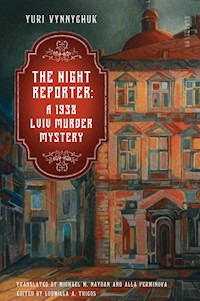
The events of the novel The Night Reporter take place in Lviv in 1938. Journalist Marko Krylovych, nicknamed the “night reporter” for his nightly coverage of the life of the city’s underbelly, takes on the investigation of the murder of a candidate for president of the city government.
While doing this, he ends up in various love intrigues as well as criminal adventures, sometimes risking his life. Police Commissioner Roman Obukh, who was suspended by administrators from the murder investigation, aids him in an unofficial capacity. Meanwhile, German, and Soviet spies become involved, and Polish counterintelligence also takes an interest in the investigation.
The picturesque and vividly described criminal world of Lviv of that time appears before us – dive bars, batyars, and establishments for women of ill repute. The reader will have to unravel riddle after riddle with the characters against the background of the anxious mood of Lviv’s residents, who are living in anticipation of war.
The Night Reporter is a compelling journey into the world of the enthralling multicultural past of the city.
Sie lesen das E-Book in den Legimi-Apps auf:
Seitenzahl: 354
Veröffentlichungsjahr: 2021
Ähnliche


















The Night Reporter
A 1938 Lviv Murder Mystery
Yuri Vynnychuk
Glagoslav Publications
Contents
A Note on the Translation
Introduction
Author’s Preface
THE FIRST DAY
Chapter 1
Chapter 2
Chapter 3
Chapter 4
Chapter 5
Chapter 6
Chapter 7
THE SECOND DAY
Chapter 1
Chapter 2
Chapter 3
Chapter 4
Chapter 5
Chapter 6
THE THIRD DAY
Chapter 1
Chapter 2
Chapter 3
Chapter 4
Chapter 5
Chapter 6
Chapter 7
THE FOURTH DAY
Chapter 1
Chapter 2
Chapter 3
Chapter 4
Chapter 5
Chapter 6
Chapter 7
Chapter 8
THE FIFTH DAY
Epilogue
About the Author
About the Translators
About the Artist
Notes
Dear Reader
Glagoslav Publications Catalogue
The Night Reporter: A 1938 Lviv Murder Mystery
by Yuri Vynnychuk
Translated from the Ukrainian by Michael M. Naydan and Alla Perminova
Edited by Ludmilla A. Trigos
This book has been published with the support of the Translate Ukraine Translation Program
© 2021, Yuri Vynnychuk
Cover art: © Olha Fedoruk, “Stare misto’’ (2016) and “Nich nad starym mistom’’ (2005)
Book cover and interior book design by Max Mendor
Publishers Maxim Hodak & Max Mendor
© 2021, Glagoslav Publications
www.glagoslav.com
ISBN: 978-1-914337-30-7 (Ebook)
First published in English by Glagoslav Publications in October 2021
A catalogue record for this book is available from the British Library.
This book is in copyright. No part of this publication may be reproduced, stored in a retrieval system or transmitted in any form or by any means without the prior permission in writing of the publisher, nor be otherwise circulated in any form of binding or cover other than that in which it is published without a similar condition, including this condition, being imposed on the subsequent purchaser.
A Note on the Translation
“Translation is the art of failure.”
– Umberto Eco
Those who have ever questioned Umberto Eco’s statement about translation being the art of failure would suspend all doubts once exposed to the task of translating any of Yuri Vynnychuk’s works into any language – be it structurally and culturally remote English, German, and French or the more kindred Polish and Russian. And it is not only because any literary work is, according to Lawrence Venuti, an asymptote – a line that a curve of translation infinitely approaches but never crosses. The thing is that any of Yuri Vynnychuk’s works is merely not “any.” It is always a unique outlier that evades generalizations and escapes the traps of classifications. It is small wonder that throughout the entire project our minds seemed to have been haunted by Eco’s voice repeating “I told you so… I told you so…,” especially when we had to spend hours upon hours dismantling the author’s densely idiomatic style, dissecting the polyphony of his registers, resorting to countless resources, online dictionaries, etc., while chasing the meaning of batyar1 slang and deciphering the contaminated speech of his characters. We groped for adequate means in the English language to convey the spirit of the original and create asymptotic equivalence rather than a dynamic (Eugene Nida) one. Just like perfection itself, the latter proves to be unattainable, because “no man ever steps in the same river twice, for it’s not the same river and he’s not the same man” (Heraclitus).
Translating Vynnychuk (Винничук) one is doomed to feeling “vynnym/винним” – guilty for all the inevitable losses that happen on the way of transferring his unfathomable literary world condensed in this particular work – The Night Reporter (Нічний репортер). Rendering the synesthetic plasticity of his kinesthetic, acoustic and olfactory images could be compared to an attempt to give a verbal account of a pantomime, a symphony, and a perfume at the same time. Therefore, translating Vynnychuk is not only an interlinguistic, but also an intersemiotic endeavor, with which Roman Jakobson would surely agree. It is like subtitling a movie with a very elaborate script in which the actors’ speech is so swift, and the scenes change so fast that you cannot but cite Faust’s’words “Verweile doch, du bist so schön” (Ah, linger on, though art so fair!).
Nevertheless, the feeling of vyn-a (вин-а – guilt) in translating Vyn-nychuk did not prevent us from being vynakhidlyvymy (винахідливими – inventive) while balancing between foreignization and domestication strategies as well as literality and co-creativity. There were many question marks and gaps that were filled with the help and advice of our friend and colleague Svitlana Budzhak-Jones and the author himself, for which we express our heartfelt gratitude. By a remarkable turn of events or just by pure accident (the law of literary attraction must have come into play), the Universe seemed to be prompting answers to our questions by letting us stumble onto various sources of information (books, movies, and websites) that resulted in being of high value in the execution of our translation. One such helpful hand stretched by the Universe was the 1941 movie The Maltese Falcon based on the 1930 Dashiell Hammett novel by the same name. We watched it and took notes on linguistic features to get a sense of the kind of language used in English around the time the action of Vynnychuk’s novel takes place (1938). As much as possible, we strove to exclude contemporary English slang such as “dude” in the current sense of the word or “bro” that were not widely in use in 1938. With no disrespect intended, we also opted for what would now be politically incorrect slang such as “dame” and “chick” to maintain the flavor of vocabulary in use circa 1938. However, a highbrow translation scholar might still not agree with all such decisions. Therefore, we’ll return to Umberto Eco’s words and make them even shorter and simpler – TRANSLATION IS THE (AN) ART.
Alla Perminova
Introduction
Yuri Vynnychuk’s novel TheNight Reporter reminds us considerably of Dashiell Hammett’s The Maltese Falcon (1930) as well as the world-famous 1941 John Ford movie. While the statuette of the Maltese falcon comprises the Hitchkockian McGuffin in the movie as well as in the novel, Vynnychuk’s McGuffin is a missing notebook that will unlock the secret to a series of apparent murders of members of a powerful business syndicate in Lviv, Ukraine in 1938. Like Hammett’s Sam Spade, Vynnychuk’s protagonist Marko Krylovych is a handsome man who has considerable success with the ladies. Commitment issues and his rough and tumble life keep him from settling down. He is an investigative reporter of the seedy, nighttime underworld of Lviv. The crooks, who use violent methods to acquire the notebook, visually are reminiscent of the fat man Syndney Greenstreet and his two oddball henchmen, particularly the one played by Peter Lorre, from the movie. Instead of a single femme fatale love interest as found in The Maltese Falcon, Vynnychuk’s protagonist has several possibilities, including the rich wife of the politically powerful murdered candidate for president of the city government Yan Tomashevych. The Night Reporter is unapologetically retro-masculininist (the way the world was in 1938 for better or for worse). It is a novel whose events happen over five days, so the action is compressed in a brief time period like that of the movie Three Days of the Condor, which like the movie adds to the dramatic tension of the novel. All the action occurs in September 1938 in the picturesque city of Lviv, which was then called Lvov and under Polish control. Vynnychuk artfully recreates the time and place of the tense atmosphere of Lviv of that era just a short time before the Nazi invasion.
While plot elements are significant in the novel, Vynnychuk’s prose is equally about texture, the subtlety of dialectal linguistic features and the nuances of his characters’ speech, who come from various socio-ethnic layers of society, including, among others, criminals, batyars, prostitutes, shopkeepers, waitresses, members of the police and secret services, and the rich and powerful. They each speak in their own distinctive way. While there is minimalist description in the novel, the plot presses forward mostly in dialogic fashion. It unravels like a slowly peeled onion or a nesting doll that reveals bits and pieces of the story from various perspectives until you arrive at the denouement and the final reveal. The narrative is told from the first-person perspective of the protagonist with more and more of what truly happened in what people tell him in conversations as well as in his various interactions with them. He above all else is a relentless seeker of the truth with a lofty sense of scruples (though with his flaws – smoking, drinking, fighting, and an excessive interest in the ladies).
The novel fuses two genres: the detective story and the spy novel. It follows the trail of the mystery of a string of murders related to a syndicate of individuals controlling the Association of Brewers, each of whom dies under questionable circumstances. The reporter plays the dual role of muckraking journalist and that of a detective, secretly deputized by the police commissioner to investigate the mystery. He meets several possible love interests over the course of his dangerous investigation. Will he get the girl? And if he does, which one does he get? Or is he incapable of being tied down by just one woman? You’ll have to read the novel to the very end to find that out.
Vynnychuk began writing the novel in 1979 when it was impossible to publish such a work under Soviet censorship and published it only recently in 2019. While he revised it some forty years later, it represents an important point in his early development as a storyteller. Vynnychuk became infamous for his lighthearted Maidens of the Night about a pimp and two Odesan prostitutes, which he began to write at virtually the same time as The Night Reporter. The former delves into the underbelly of underground Lviv in contemporary times. The latter does the same, but in the more distant prewar Galician past, the examination of which becomes an essential passion for Vynnychuk’s oeuvre. The Night Reporter is a compelling journey into the world of that fascinating multicultural past of Lviv.
Michael Naydan
Author’s Preface
I started writing this novel in 1979, and in 1980 I finished it along with a planned sequel. I didn’t have high hopes for publication. I couldn’t write a crime novel about the Soviet era in the way the situation required at the time. It would have been very boring for me and, ultimately, I didn’t read anything about any courageous police investigators. I was brought up on foreign detective novels and read tons of them, mostly in Polish and Czech.
At that time, the first part of my novella Maidens of the Night was already lying in my desk drawer going nowhere. The authorities wouldn’t let me publish it. Then piles of paper copied from the new story were added to it, and I was too lazy to reprint the entire text. I printed out only one section and sent it to the magazine Dnipro in Kyiv and dropped it off at the magazine October in Lviv. The editor of Dnipro, Volodymyr Drozd, told me he wasn’t interested in a story about Lviv. Roman Ivanychuk, who headed the prose department at October, said it wasn’t suitable for them either.
The piles of paper had to wait for better times. So, I forgot about them. However, since the 1990s it would have been possible to publish all of it. But I had certain doubts about whether it was worth publishing. So I recently dove back into those piles of paper, began to reread them, and saw that it actually was quite a decent story. I typed it into my computer, refined it, enriched it with realities I had no idea about in the Soviet era, and here it is for you.
My hero is a journalist who gets into various and sometimes dangerous adventures. He drinks and smokes. And he smokes because I also smoked at that time. My passion for cigarettes lasted only four years, and I was seduced into smoking by a girl with whom I had a fling. The affair ended, and my smoking ended with it.
But I just couldn’t say goodbye to my hero, because all my habits coincided too much with his. How could I not drink if the hero of the story is a tippler? Together we are a single whole. And when he falls into the arms of an elegant babe, I fall into her arms with him. Fortunately, when they smack him on the noggin, I don’t have to take painkillers.
Now with inconsolable distress I look at another pile of paper, where the continuation of this tale has been hidden, and I’m pondering whether I should undertake completing and reprinting it....
Yuri Vynnychuk
THE FIRST DAY
Thursday
September 22, 1938
Chapter 1
It was a drizzly, though still warm, September day. The forest is floating in the window, beyond that – there are sprawling pastures and white geese near streams. Boys are crawling among the reeds, groping for fish in the water. The landscape is commonplace to the point of tedium, but there’s still nothing to do because I’ve already leafed through the newspaper, which I took with me on the train. I have nothing to do but look out the window, and as soon as I look away, my eyes catch sight of an old lady all in black, still wearing a black kerchief. Maybe she’s going to a funeral or coming from one. Her lips are tightly pursed, her gaze blank; she’s all deeply inside herself. Next to her there’s a traveling salesman with a suitcase stuffed with all sorts of wares, or rather trinkets, with which he goes from door to door and grinds out the same spiel over and over again, because he’s not capable of anything else, and then, upon returning home, makes excuses to his wife for getting buggered again, for spending more for the trip than he earned. A young fat dame with wide hips and an enormous bust sits down next to me. She’s moaning and snoring heavily like a blacksmith’s bellows. Her snoring’s lulling me to sleep, and I feel like closing my eyes and not thinking about anything. From time to time she shudders, looks around timidly, and for some reason straightens out her long skirt and hides back in her shell again. The salesman asks if he can read my newspaper. I say by all means and give it to him. He buries himself in the first page and wags his head sadly. There’s nothing good in the news, that’s for sure.
“September 22, 1938. The Italians continue to fight in Ethiopia,” he reads aloud under his breath for some reason. “Ethiopian guerrilla units are holding off significant forces of the Italian army. Emperor Haile Selassie, who was forced to leave his homeland, delivered a speech in Geneva. That’s good, that’s good,” he shakes his head, “that they’re holding off the Italian army. Hitler can’t take advantage of it fully. On the Yablonovskys, in a part of Lviv densely populated by Germans, the appearance on the street of a young man dressed in shorts and white knee stockings caused a sensation. Aha,” he raises up his finger, “Hitler’s fashion has already come to us. Soon these kinds of young guys will become much more visible, fashion is contagious ... Eh.... In the Community Hall a viche1 was held in support of the autonomy of Transcarpathian Ukraine. Hullo,” he becomes furious, “they’ve been tempted by autonomy. What good comes from autonomy here. Did you hear? They tried to free Bandera2again. But the police aren’t snoozing, no. ‘Conspiracy Exposed!’ But there’s good news too: ‘Six Jews were beaten at the Foreign Trade Academy, and at the University – two more.’ It’s time to show them their place. Have you heard there’s a government plan to resettle all the Jews in Uganda? What a great idea!”
Without sensing any answer or approval from anyone present, he thoughtfully folded the newspaper and put it on the table. Finally, there’s peace and quiet.
Uganda! Yes, yes, a fashionable topic recently. They’re discussing all the details of the future resettlement really seriously. Our newspaper also has written about it, and I even interviewed a tzaddik3 who was outraged by these rumors and denied that the Jews were waiting to leave for Uganda.
My trip to Stanislaviv is as unexpected as it is secretive. Yesterday I had no idea about what I heard this morning. And it all started with a phone call and someone’s insinuating whisper, asking if I’d like to know how Tomashevych’s career advanced, how he became rich, and now has become the likeliest candidate for the office of president of the city government. Well, to be honest, I could give a damn about all these Tomashevyches, who, like flowers rising up from dung, suddenly blossom lavishly, because the scent of shit hasn’t dissipated from them, but after the editor grabbed me by the chest and shook me, all the bottles I had downed over the last month when I was in a weightless state began to ring in my head, I was forced to come to my senses. Otherwise, I would have been booted out of the newspaper again. I had to do some digging and write about something that would stir fresh interest in the newspaper. No wonder I was nicknamed the “night reporter,” because in fact I used to hang out in various seedy pubs and dive bars, in casinos, in dens of iniquity and bordellos, got smacked in the chops, and even had my gut sliced with a blade, fell covered in barf in the gutter, because, there was no other way to get something interesting or of a sensational nature than to hang out with the kinds of people I hung out with. Of course, so that they wouldn’t have any suspicions about me, I needed to be like them. I had to speak their language, drink what they were drinking, swear like them, laugh rowdily like them, mingle with prostitutes in pubs, allow them to pat me on the head, and not just my head, kiss me on the ears and neck. I needed to smoke opium in a bordello, so that I could wheedle out something useful, and then, so that it would all not vanish in the wind I’d go to the outhouse and in the dim light of a light bulb jot down key words, the meaning of which no one other than I would have comprehended. And little by little I became so involved that I didn’t have any need for company either. I became my own company – and that was the worst.
But then I came to my senses. I sat in front of the mirror, looked at the unshaven face of a thirty-six-year-old man who had never achieved anything decent in his life, but who found so many problems on his ass and got in so many picklesin a short period of time that another person would never be able to get in this many pickles in a lifetime. I looked into the mirror and sighed heavily: “Marko, you have to fight your way out of this swamp you’ve dragged yourself into. You have to!”
Just the day before, the editor ordered everyone to prepare materials for the election and dig up as much dirt as deeply as possible on everyone, regardless of personal preferences. At the same time, he looked sympathetically at my mug wearied by life, because I hadn’t yet made a foray into politics. My sphere of interest was narrowed to clients from beneath a dark star. It was easier for me with them. Among them I could be myself. Even when they battered my ugly mug, the next day they slapped down a bottle of booze on the table, hugged me, and said: “You Matska,4 just don’t be angry! ‘kay? Yes, ‘kay, cause why not, ‘kay?”
Well, it just happened that I immediately took an interest in Tomashevych, although if it hadn’t been for that call, I wouldn’t give a damn. Though his rapid ascent surprised more than a few journalists and forced them to try to solve this mystery, they did so without success. An unknown person offered to meet in Jesuit Park.5 I was supposed to take a stroll, and he would approach me. That’s perfect. I shaved, sprayed on some cologne from a little left at the bottom of a bottle, put on a clean, though haphazardly ironed light blue shirt, a dark blue jacket over it, polished my black lace-up boots, and looked in the mirror again. Hey! A really handsome man was looking at me, who always had wild success with women until his breath began to reek so badly that it would scare away crows. Just a week without alcohol – and here’s the result for you! I’m the same again as I used to be.
The morning was sloppy and the park deserted. Water was dripping from the trees. Muddy mirrors of puddles lay underfoot and reflected the gloomy sky. There were thick crowns of trees and doused lanterns. I walked back and forth with my hands behind my back, when suddenly I heard the same insinuating whisper behind me:
“Don’t look back, Pan6 Krylovych.” Walk slowly ahead. So, if you’re interested in Tomashevych, you have to find out where his shady deals began. The notary Yosyp Martyniuk, who knows a lot, will help you with this, because he actually witnessed Tomashevych suddenly becoming rich. And he continues to get richer, but thanks to this.... Take it.” Here I felt that something like a folder was placed into my hand. “Don’t look back. Count to twenty and then you can look back.”
In the puddle I saw a dark figure in a raincoat with a raised collar and a hat. He was a tall, broad-shouldered man. He was holding his left hand in his raincoat pocket with his thumb sticking out. He, too, apparently must have noticed his reflection, though it was not as clear nor as murky as the puddle itself, and turned sharply, making his way out of the park. I opened the folder and saw intimate photographs of an elderly gentleman hugging half-naked girls in a bordello. The gentleman’s face was scratched over so that there was no way to recognize him. What did these photographs mean? As he said: “... continues to get rich, but thanks to this…?” So, is this about blackmail? Is Tomashevych blackmailing this gentleman? To whom were these photographs sent with a ransom offer? But this wasn’t the man whose reflection I saw in the puddle, because he’s thin and tall, while the gentleman in the pictures is fat....
I looked around: the park was deserted again.
Chapter 2
That’s interesting! I’ve known Martyniuk for a long time, but I’ve never heard a word from him about Tomashevych. I had no idea that he had ever been involved with him, and, in the end, I was not interested in him. However, this unexpected clue tore me from my seat. That very morning I started off for the notary. I was convinced that he wouldn’t mess with me, that he’d tell me everything he knew, at least for the sake of the memory of our friendship from our school days.
Martyniuk had his office on Legioniv Street. In the morning this particular street was not as crowded as in the evening, when the Korso promenade was flooded with hundreds of citizens who went for a walk and showed themselves, when you had to look closely at everyone coming from the other direction, so as not to miss any greetings and politely convey salutations. Now you could walk fast without encountering anyone, but I was in no hurry. I wondered if I should tell the editor-in-chief today what I was going to do, and I came to the conclusion that it was better not to do so until the article was already written, if, of course, it does get written, because perhaps all this isn’t worth anything. Maybe Tomashevych is just an ordinary careerist, about whom the same claims can be made as hundreds of others.
I entered the gate and went upstairs. There were no signs on the door. Martyniuk hung up no advertising and worked just with a narrow circle of well-to-do clients, which was enough for him to make a living. To be honest, I wouldn’t want to have anything to do with him, because the dark world he frequented wouldn’t bode well. But the matter at hand, that’s one thing, and to nicely chat about someone – that’s another.
“Hey there, night reporter!” He shouted out, walking toward me with open arms. This habit of his to pretend to be infinitely happy with someone’s visit, evidently, had remained with him.
“Don’t play stupid,” I cooled him down. “You probably can sniff out that I haven’t come for a friendly chat or with an offer to go out for a shot.”
“Well...,” he dropped his hands, and little by little his happy theater mask began to slide off his face. “Sit down and don’t beat around the bush. Spill the beans.”
He was sniffling and evidently had a cold.
“I’ll spill them,” I said, sitting down in a chair as I took out a notebook. “I’m interested in Tomashevych. As it turns out, you used to be involved with him.”
He looked at me with surprise.
“It’d be interesting to know who apprised you of this?”
“You know, we reporters happen upon quite unexpected contacts. I don’t know who the man is, but in as much as our editor ordered us to dig up stuff about all the candidates for president of the city government, a tip from a stranger came to me just in time. Why not figure out how Tomashevych rapidly rose to the top?”
“And you need my information, of course, not to sing his praises. Do you want to knock him from the top? Do you have any personal accounts to settle?”
“No, nothing of the sort. It doesn’t seem to be purely about his career.”
“Lord! There are hundreds of people who don’t have a squeaky-clean career. But how can I be of help to you? I was involved with him six years ago. After that, I never had anything to do with him again. Will such ancient information really help you somehow?”
“That was the beginning of his career. Six years ago. We have to start somewhere. I want to go forward from that point.”
“But listen...,” he spread his hands apart, “I haven’t kept any material since that time. And to reconstruct it from memory....”
“Well, please don’t complain to me about your memory if you can recite Ovid by heart in Latin for an hour.”
He smiled – he was pleased that I recalled his unique memory.
“Okay. In 1932, the Galician Joint-Stock Association of Brewers took over the Association of Tavernkeepers that didn’t object and was happily acquired by them. It was a really unpopular union, because most of the tavernkeepers refused to join it. It was more profitable for them to become a small cog in a large wheel. And the Brewery Association, founded in 1897, was and is the largest in Poland in terms of the number of employees and the amount of capital. In terms of beer production, Lviv now exceeds all other Polish cities. When I read these documents for the first time, I thought this merger happened all too quickly. The law, which established rules for mergers, was passed only a year before and had many loopholes. One of these, in fact, was used by the merger’s organizers.
“Wait a second,” I interrupted, “explain how the thought to do it even occurred to you. Whom did you represent?”
“The head of the Association of Tavernkeepers hired me. I had to maintain the legality of the merger and protect their interests.”
“Okay. Go on.”
“The main loophole was that according to the regulations of the Association of Tavernkeepers, female tavern-owners did not have the right to vote at all, although they belonged to that union. Therefore, only full-fledged male members were invited to the meeting where the vote on the merger of the two organizations took place. And no one noticed that the second paragraph of the current law requires a vote of all members, regardless of the statutes of individual organizations.”
“Were you present at that meeting?”
“I was supposed to be,” he nodded. “But I wasn’t. The chairman of the Association of Tavernkeepers sent me an invitation, but for unknown reasons I didn’t receive it. After some time, I was sent a copy of the memorandum. That is after everything had already taken place. Thus, I was unable to intervene in time and to follow the legitimacy of the process of the merger. But even in the memorandum I found a bunch of incongruities. The mere fact that the conditions of the second paragraph were not complied with called into question the entire legality of the merger of the two organizations. But what happened at that meeting isn’t what interested me. I was preoccupied with the events that took place before and after it. As I studied the accounts of the Association of Tavernkeepers for the past five years, I wondered whether Mr. Tomashevych should be a free man or admire the sky through black gratings.
“You’ve yet to tell me what role he played there.”
“Tomashevych was their secretary and cashier. And now pay attention for a moment,” with these words Martyniuk got up, went to a cabinet, and opened the doors. I saw straight rows of folders with glued-on labels. He took out one of them, flipped through it for a moment and continued: “Here it is... The membership fee was sixty-five zloty1 per year. The income from yearly membership fees amounted to an average of about twenty thousand zloty. The expense – lighting, heat, taxes, insurance, postage for correspondence, expenses for participation in conferences, etc. – less than twelve thousand.”
“So, they saved eight thousand every year.”
“Yes. All this went into their fund. When the Association of Tavernkeepers was supposed to merge with the Association of Brewers, the last balance was... I’ll tell you in a second...,” he leafed through several pages, “47,920 zloty. This is from the last annual report of Tomashevych to the head of the Association. Interestingly, he didn’t report to the registrar of the associations, because his Association was unregistered.”
“And how did you become suspicious that the reports were falsified?"
“Not right off the bat. Of course, they had the look of being a bit amateurish, but they were authentic. In order for you to understand what concerned me in them, I had to look at the balance sheets. The merger of both societies took place in the fall. The terms of the merger were signed in November. And under this circumstance, Tomashevych’s Association had to prepare its balance sheet.”
“It’s clear to me. However, I still don’t understand what’s the root of the problem here.”
Martyniuk smiled, obviously enjoying the fact that I swallowed the worm.
“It’s a question of their fund. In the draft report, it had 47,920 zloty. And in the protocol of transfer of the fund of tavernkeepers to the fund of brewers twenty-two thousand disappeared. The difference was alleged to have gone for the costs of the merger.”
“But that makes sense. They needed lawyers....”
“As I said, the Association saved eight thousand annually. The account recorded a report for 1931. The year 1932 wasn’t involved, but it was almost a full year, and we can easily add to those forty-seven thousand another eight. Now take away the pre-merger account from this amount. There would be 33,920 zloty. But they couldn’t sustain such expenses in any way. And most importantly... there were no costs at all for that one year.”
“How is that?..,” I was taken by surprise.
“The Association of Brewers took all costs on themselves. Few people knew about it. But Tomashevych was in the know about all these activities.”
“And nobody noticed anything?”
“It was not so easy to catch. To do that required three independent pieces of information. The first would be a draft report of the Association of Tavernkeepers, which only the head saw. The second would be the annual report, which was sent to the registrar of the associations and was seen only by the registrar, because the Association of Brewers was registered. And the third would be the merger agreement. So, there was no single person who would see all these documents together. Each of them was seen by different people.
“But did you see them?”
“Only after I got suspicious of Tomashevych’s machinations. And who would become suspicious, because of course it wouldn’t occur to check all these documents. Especially since there was another incentive,” he said with a mysterious expression. “Tomashevych’s association lost some members every year. Not many, but his membership still was in decline. This was one of the reasons that they wanted to merge with the breweries. The second reason was that the price of Lviv’s beer rose. It was more profitable to import it from outside of the city, so the city treasury was losing income. Thus, it was in the city’s interest to hasten the merger of the companies so that the tavernkeepers could receive benefits. However, most of the taverns were outside the Association, and the interests of the city and the interests of individual taverns failed to coincide. The tavernkeepers had no patriotic interests in filling the city coffers. It was easier for them to bring beer from other cities or say, sell beer from Sambir under a fake Czech label. Therefore, when the idea of the merger became known, the tavernkeepers lost a bunch of members. What does that mean? The fact that that year could not result in that much profit.”
“That is, there might not have been a surplus of eight thousand in income?”
“Yes.”
My enthusiasm began to wane. It turned out that everything that was turned upside down several minutes ago was now taking on a natural appearance.
“In a word,” I sighed, “we’re back to scratch.”
“Not at all.”
“You won’t argue that if one side decides to cover all the costs of a particular transaction, it doesn’t mean that the other side will not have any costs at all. Tomashevych could have had a number of problems. Maybe he needed to travel to different cities where there were branches of the Association? Those could be the costs.”
“You can dig up tens of similar versions. But I figured out something else. A few months before the merger, Tomashevych nearly went to court due to a debt to the bank. And the debt was just thirty thousand.”
“And where did those funds go?”
“Maybe to buy a villa in Bryukhovychi. I just don’t know.”
I whistled in surprise, although the feeling never left me that Martyniuk would introduce some clarifications now, and the case would no longer be criminal again. But he was silent.
“Why don’t you go finish?” He shrugged his shoulders.
“That’s it.
“How is that?” I didn’t believe him.
“Just like this. I completed my mission. They no longer needed my services.”
“You said you were hired by the head of the tavernkeepers.”
“Yes, but after the merger the leadership of the Association changed. They elected another man as chairman.”
I sensed that he was losing interest in our conversation and would prefer to get rid of me. But all this was little like Martyniuk, whom I always knew as a fanatic.
“And you just walked away from the matter?” I asked him.
“What was left for me to do?”
“If I hadn’t known you for so many years, I might have believed you.”
“Do you think I continued digging into it?”
“Of course. Otherwise, it would be unlike you. You have to finish telling the truth. You won’t get rid of me so easily.”
“Well, just say one thing to you damn writers....”
“I give you my word that none of what you say further will come to light if you insist on it.”
“You’re getting excited for nothing. My activity in this matter really stopped then. Only once I came to my office and found an unbelievable mess. Everything was smashed – my desk, chairs, a cabinet. Some papers were torn up, others were scattered, and those relating to both societies completely disappeared. Then that evening I was jumped in a dark alley, and they kicked the crap out of me to their heart’s content.
This was something new and smelled rotten. I sensed that I was probably straying into a dangerous place. But was this the first time something like this happened to me?
“So, we’ll have to start from scratch,” I sighed. “I need to find all three documents, then find out how many members the Association lost during the reporting period, and finally if Tomashevych kept the costs associated with the merger, and which ones.”
“There is one document. I’ll give you a copy. It was at my house when my office was ransacked. It concerns the debt that Tomashevych paid just before the merger.”
“And where is that document?”
He rubbed the flat of his hand against his chin.
“I need to remember. Call later. You’ll have to do a lot of digging yourself. But it’s not such an easy task. Tomashevych is a much more important figure now than when I was working with him. And yet even then he found an opportunity to harm me. And now.... I won’t try to dissuade you, but in my opinion, this is all hopeless. What will come of it if you’re able to obtain his six-year-old machinations? It won’t explain the genesis of his rise or his current financial situation. There was always someone behind him; that was clear to me for a long time. Someone from the upper echelons is still either dependent on him or has obligations to him. They won’t let you make a move.”
“And what happened to Tomashevych after the merger?”
“He left there and started working for a company that sold malt and hops. And soon became its director in chief, and then a National Democrat. He joined the People’s Democracy Party.... Well, he ended up in the city government, because thanks to him the party gained about ten more seats. They value him. And who knows whether he’ll soon become president of the city government.”
“That seems to be the point. And that’s all you know about him?”
“I’m saying: I wasn’t interested in him any longer. Only once, about two years ago, I was approached about a case in the low country in Zamarstyniv. There was a pasture. And Tomashevych bought it four years ago for grazing, because, apparently, he was planning to breed alpine goats. And it was written up in statements. But suddenly construction began in the lowlands. No one had ever seen any alpine goats there. People who had houses on both sides of the lowlands began to complain. I filed those complaints for them, but they lost the lawsuit.”
“Did Tomashevych begin construction?”
“No. He resold the pasture as a construction site, earning ten times more for its resale.”
I put down the folder in front of him.
“Here, take a look.”
He opened it with surprise and began to look at the photographs with interest. I told him about the meeting in the park. His conclusion was the same as mine: Tomashevych was obviously blackmailing his political opponents. How he managed to obtain these photographs from the brothel is unknown, but here they are in all their beauty.
“Now can you see that I have to do everything in my power to prevent him from becoming president of the city government?” I asked, closing up the folder.
“It’s your business. Knocking your head against the wall also has benefits. You become hard-headed. As for your teeth, I’m not sure.”
I got up and was about to leave when he seemed to have collected himself and remembered something, hesitating whether he should say it.
“Wait,” he said thoughtfully. “So that my conscience doesn’t torment me, I’ll tell you something else. You asked me about the members, but nothing about the shareholders.”
Were the shareholders not simultaneously members?” I was surprised.
“They were. There were five shareholders in total. By the terms of the agreement, the shares of a deceased shareholder became the property of the living ones. Six months ago, three of them died. Suddenly. One after another.”
“So, there are two left... And all the shares have been transferred to them?”
“Yes.”
“And who are they?”
“You know one of them.”
“You don’t say! Tomashevych, really?”
“One and the same.”
“Who’s the other?”
“That’s unknown. The names of the shareholders were kept secret. They became known only on the day of their death.”
“How did you find out Tomashevych’s name?”
“The matter looked like this. The court’s medical examination, despite certain suspicions of the police, did not find anything criminal in those sudden deaths. Just human carelessness, the confluence of coincidences, etc. Witold Pogorzelski crashed his car – sped off a bridge into the Dniester River. Roman Korda slipped during an ice storm and struck his head against a curb. Then Jan Fursa turned to me and asked for advice. He suspected that something was wrong here. Fear gripped him. But it would have been ridiculous to go to the police with such suspicions. I advised him not to leave the house at all and not to let anyone in. When asked whom he suspected, he looked at me so expressively that I guessed and said questioningly, “Tomashevych?” And I saw him become startled. “Is he also a shareholder?” I asked him. He nodded. He didn’t want to name the other one. And two months later he died from smoke inhalation – his chimney got clogged with soot. Those entire two months he sat at home.”
“That is, all deaths are tragic.”
“Open any newspaper,” Martyniuk said carelessly, “these are everyday cases that few people pay attention to. Oh, if you please: just this night an entire family died – a father and his daughter with her two girlfriends. They lit the stove with charcoal and forgot to open the flue.”
“Sо wait...,” I thought. “Then two shareholders are still alive. Did the Association of Brewers buy their shares?”
“The shares yes. But the shareholders owned four more stone apartment buildings and three restaurants. The members of the Association knew nothing about it. Although all this was acquired during the existence of the Association.”
“Did Fursa tell you about that?”
“Yes.”
“So, someone is still under threat....”
“If you think that one of these two organized their murders, then that is really brazen. You won’t be able to convince the police of this.”
“Who were the people that died?”




