


3,99 €
Mehr erfahren.
- Herausgeber: No Exit Press
- Kategorie: Krimi
- Sprache: Englisch
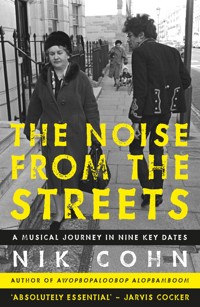
The book to read if you want to get some idea of the original primal energy of pop music. Nik Cohn: A Derry boy who became the omnipresent man in music's developing story from the 50s to the present; a self-styled rat, addicted to adventure, a rock legend, forever at the heart of the real action. This memoir provides a strong flavour of the person whose writing inspired Saturday Night Fever and several other pop-culture landmarks. Cohn leads us, in reverse order, through the decades of his musical life and times, meeting familiar heroes and rogues - let readers decide the categories to which Hendrix, Moon, Proby, Vicious et al belong. The Noise From The Streets is elegiac, charming and thoughtful - wallow in it. Nik Cohn recently headed Jarvis Cocker's top 10 music books in The Guardian (13 June 2014) for his title Awopbopaloobop Alopbamboom. 'The original title for this book was 'Pop from the Beginning' and that pretty much sums it up. Nik Cohn was only just out of his teens when he wrote it and it's the book to read if you want to get some idea of the original primal energy of pop music. Loads of unfounded, biased assertions that almost always turn out to be right. He went on to provide the inspiration for Saturday Night Fever (Hurrah!) and Tommy (Boo!), but this is still his best book. Absolutely essential.'
Das E-Book können Sie in Legimi-Apps oder einer beliebigen App lesen, die das folgende Format unterstützen:
Veröffentlichungsjahr: 2014
Ähnliche
















NOISE FROM THE STREETS
This is the memoir to read if you want to get some idea of the original primal energy of pop music
Nik Cohn is a rock legend – a Derry boy who became the omnipresent man in music’s developing story from the 50s to the present; a self-styled rat, addicted to adventure, forever at the heart of the real action.
This short memoir provides a strong flavour of the person whose writing inspired Saturday Night Fever and several other pop-culture landmarks. Cohn leads us, in reverse order, through the decades of his musical life and times. Along the way, we meet familiar heroes and rogues – let readers decide the categories to which Hendrix, Moon, Proby, Vicious et al belong.
The Noise From The Streets is elegiac, charming and thoughtful – wallow in it.
Nik Cohn recently headed Jarvis Cocker’s top 10 music books inThe Guardian(13 June 2014) for his titleAwopbopaloobop Alopbamboom,who said;
‘The original title for this book was Pop from the Beginning and that pretty much sums it up. Nik Cohn was only just out of his teens when he wrote it and it’s the book to read if you want to get some idea of the original primal energy of pop music. Loads of unfounded, biased assertions that almost always turn out to be right. He went on to provide the inspiration for Saturday Night Fever (Hurrah!) and Tommy (Boo!), but this is still his best book. Absolutely essential.’
NIK COHN
Nik Cohn was the original rock & roll writer. Arriving in London from Northern Ireland in 1964, aged 18, he covered the Swinging Sixties forThe Observer,The Sunday Times,Playboy,Queenand theNew York Timesand he published the classic rock historyAwopbopaloobop Alopbamboomin 1968. Later he moved to America and wrote a short story that was filmed as Saturday Night Fever. His other books include Rock Dreams (with Guy Peellaert), Arfur Teenage Pinball Queen (which helped inspire the Who’s Tommy) and Yes We Have No.
Introduction
Music has been my life’s obsession. My centre, one might say. Not merely how music sounds but the ways it operates, the functions it performs.
For me, these functions have expressed themselves as two extremes, seemingly incompatible. On one hand music means safety. Sanctuary. You know the feeling? The world is mad, violent, uncontrollable; it’s tearing me apart. So I take refuge in music. That at least is within my control. It is my finger on the play button. I wrap my skull in headphones and select the playlists or podcasts that fit my mood. I decide which concert or club to go to. The choice is mine alone.
In the age of the iPod and all our other gadgets, this function is stronger than ever. For me, for almost everyone. We travel to work, we take a walk, we exercise, relax, we even eat in an isolation tank. What protects us also imprisons us. Just look at our eyes. That blank stare. Cut off by our ear buds, we notice nothing, respond to nothing. Music shuts the world out. By our choice.
OK. But, for me, there is another pull, even more powerful, the opposite of safety. Risk, adventure, the dare of taking a blind plunge.
Let’s say I’m walking down a street – any street, in any city. I feel restless, incomplete. I’m looking for something, I don’t know what. Then a car speeds by, hiphop blasting, the apocalyptic thump of bass that makes the chassis bounce. Or I hear a jukebox in a café playing something I’ve never heard before, alluring. Or a woman’s voice in an upstairs room, a ballad, an Arab chant...
I must give chase. I have no choice.
No choice – that’s the key. What happens is out of my control. Found sounds, random. This is the noise from the streets. The music that catches you without warning, that takes you on a journey you didn’t expect. The journey may take one hour, a night, it might last months. Once I heard an old Cambodian pop song, the magical voice of Ros Sereysothea, and chased it halfway round the world. Madness. But I could not refuse it. I can never say No. I am the rat that follows the Pied Piper of Hamelin to the river.
So far I have been lucky, the river has not drowned me. Instead, over and over again, all through my life, it has baptised and cleansed me, renewed me. Even now it can carry me off, beyond time and place, my age, my everyday existence, into another dimension.
Looking back, I see that chasing the noise from the streets has been a key narrative of my life. Many of the stories remain as vivid to me now as when they happened. In these pages, I’ll restrict my canvas to British streets, almost all of them London. But, in some sense, the stories could come from anywhere. Every street in every city is unique, every street is alike.
Possibilities…seductions… mysteries…
2012
…But really this story begins many years before.
In the late 1970s I lived in a village about an hour north-east of London. Every Sunday afternoon in summer we all used to play cricket in the street with a tennis ball and a garbage bin. The whole village took part, old men of eighty, small children, boys and girls.
One Sunday a new family appeared. Man and wife, two tiny boys. All four were very beautiful. The father joined the game while his young wife stayed with the boys, aged two and four. She looked as if she’d stepped out of a pre-Raphaelite painting – slim, very pale, in a long skirt and with long ash-blonde hair. That first time she didn’t speak.
The summer passed. Every Sunday, another cricket game. The father played and his wife stood apart with her boys, watching. Then one week the ritual was suddenly, violently disrupted. A car came roaring down the street. Strangers, city boys, hung out of the windows shouting. I heard the Clash song, Guns of Brixton.
For a moment I thought they were going to plough straight into us. At the last moment they braked, too late to prevent them from knocking over the garbage bin. Then they roared off again, back where they’d come from, the Guns of Brixton slowly fading.
The villagers were furious. Disgusting, criminal, we could have been killed. But I happened to glance across at the pre-Raphaelite girl with the flowing hair. For the first time our eyes connected. A wild and wicked smile. The smile of a born conspirator.
Her name was Louise. We became friends. Co-conspirators against the world. We shared the same humour, some of the same hungers. She was full of curiosity and intelligence, desperate for knowledge. I lent her some books. She devoured them. Often her insight into what she read was deeper than my own. If I began as a mentor, I didn’t remain so for long. Very soon she was the one teaching me.
After some years our lives diverged. I moved to New York and spent less and less time in the village. And one year Louise was gone. Almost forty, her boys grown up, she had left her marriage and moved to Cambridge to study. I heard nothing more from her.
Twenty years went by. Then I got an email from my daughter. ‘Is this the same Louise?’ she wrote. There was a link to the Guardian newspaper and sure enough, when I accessed it, there she was, Louise Foxcroft, now a feminist historian. She had won a major award for a book on the history of the menopause, she spoke at conferences and symposiums, wrote articles, advised boards. In other words, a star.
The next time I returned to London we met again. And it was as if no time had passed. We talked and talked and couldn’t stop. Louise was still slim, still beautiful, her eyes still bright with laughter, although her hair, like Mme Arnoux’s at the end of L’Education Sentimentale, now flowed silvery in the light.
What of her two boys? They were now in their late thirties and ran a venue in Shoreditch, the Village Underground, which staged music and art events.
That night Nas, the rapper, was doing a show there. But when I showed up the place was so packed, I couldn’t beat a path through the crush. Never mind. It was a lovely autumn night. A golden moon. I sat on the pavement across from Village Underground and let the thud of the bass move through me. A railway bridge was just down the street, the rumble of the passing trains mingled with the cadences of Nas’s flow.
I have always loved his rapping. Nas, Biggie, Ghostface Killah – for me they are three immortals, the soul of the New York streets. The fact that tonight I could only hear him dimly from inside the club, distorted, almost added to his power. It gave his verses something of the effect of an old LP, scratched and warped. A time machine. So I let go of the present and drifted, back and forth across more than thirty years, the various Proustian twists and changed incarnations that had brought us from that village street to here.
Passers-by drifted along the street. Some looked at me oddly, this old dog in a suit, nodding to hiphop beats. Finally, one young couple stopped. The boy was mixed race, West Indian and British, and the girl dark, exotic, possibly eastern European, though she did not speak.
The boy asked what I was doing there. ‘Listening to Nas,’ I said. Pretty obvious.
They moved on a few yards, returned. Did I like dub step? There was a DJ night nearby, want to check it out?
The dark girl, still without speaking, linked my arm, and the three of us walked under the railway bridge, through the Shoreditch back streets, till we came to a pub and a side doorway that led to the club upstairs. We walked up a steep flight of stairs. The noise of dub step was deafening. At the top, just before we entered the club, the silent girl turned to me. A wild and wicked smile. The smile of a born conspirator.




