


1,99 €
Mehr erfahren.
- Herausgeber: Booksell-Verlag
- Kategorie: Krimi
- Sprache: Englisch
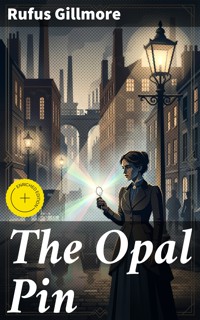
In "The Opal Pin," Rufus Gillmore weaves a compelling narrative that marries historical intrigue with elements of magical realism. Set against the backdrop of an industrializing society, the story follows its protagonist, a young woman entangled in the mysteries surrounding a peculiar opal pin that holds secrets linking the past to the present. Gillmore's prose is both lyrical and evocative, employing vivid imagery that invites readers into the psychological and emotional landscapes of his characters. The novel reflects the anxieties of a changing world, skillfully intertwining personal and collective histories, making it a rich tapestry of life in an era defined by both promise and peril. Rufus Gillmore, an author deeply influenced by his own cultural heritage and familial narratives, draws upon personal experiences to explore themes of identity, loss, and the search for connection. His background in both history and the arts informs not only the intricate plotting but also the richly layered characterization present in "The Opal Pin." Gillmore's literary journey, marked by a passion for storytelling, resonates through his work, illuminating the human experience in ways that evoke both empathy and introspection. For readers seeking literary depth combined with a touch of enchantment, "The Opal Pin" is a splendid choice. Gillmore not only captivates his audience with an immersive tale but also provokes thoughtful reflection on the ties that bind us through time and memory. Engaging and poignant, this novel is sure to linger in the hearts and minds of its readers. In this enriched edition, we have carefully created added value for your reading experience: - Hand‐picked Memorable Quotes shine a spotlight on moments of literary brilliance. - Interactive footnotes clarify unusual references, historical allusions, and archaic phrases for an effortless, more informed read.
Das E-Book können Sie in Legimi-Apps oder einer beliebigen App lesen, die das folgende Format unterstützen:
Veröffentlichungsjahr: 2021
Ähnliche

















The Opal Pin
Table of Contents
The Opal Pin
Chapter 1
The tall, reserved-looking Englishman in evening dress, Inverness on arm, stick in hand, consulted his watch, then sauntered quietly out of the foyer of the Waldorf[1]. Interested apparently only in the shop-windows and passing women, he walked slowly along Thirty-fourth Street. On Broadway he stopped to mail a letter. A few steps further he drew another letter from his pocket, tore it and dropped the pieces carelessly into the gutter. Without change of gait or look behind, he then entered the bar of the Martinique. Once inside, he glanced back guardedly through the door. The short, athletic but slightly corpulent man whom he had seen approach one of the Waldorf house detectives, was picking up the pieces.
Smiling, the tall, reserved-looking Englishman moved to the bar, bought a high-ball, drank it. After that he wandered out into the foyer and reserved two seats for the following night at the Little Theater. He gave the name of Howe. Then he descended to the grill room, ordered food and drink, and sat there placidly enduring the music of the negro-minstrels[2] until one o’clock came and the room closed.
Now, he took the elevator to the office floor and started with a direct, swinging gait toward the Thirty-third Street exit of the hotel. Half way through the long vestibule he stopped suddenly, as if recalling something, retraced his steps and left the hotel by its Thirty-second Street exit. Along this street to Fifth Avenue, down the avenue to Thirty-first, along Thirty-first Street he sauntered. Not until he neared the corner of Madison Avenue did he venture his first look behind. Then he dropped his stick and turned in picking it up. The short, athletic but slightly corpulent man was far behind, on the other side of Thirty-first Street.
The Englishman turned up Madison Avenue. Around the corner he drew a master-key from his pocket and quickened his gait. The outer of the two doors of the house he was approaching someone had left ajar. After a hurried look back he entered the vestibule and noiselessly closed the outer door. With the master-key he opened the inner door.
It was a boarding house. Carpets, furniture, the absence of anything personal lying about, said so. Screened by the heavy hangings at the windows of the front parlor, he watched stealthily. He saw the man who had followed him stop at the corner of Thirty-second Street, look indecisively west, north, east, and then hurry away toward Fourth Avenue.
The tall, reserved-looking Englishman waited in the dark shadows of the parlor for nearly an hour. No one entered the boarding house, no one left it. At the end of this time he drew over his shoes a pair of thick black woolen hose. His tread thus muffled, he went up the stairs.
He walked as one who knew definitely where he was going. On the fourth floor he proceeded to the front room on the left. He tried the door. It was locked. He bent down and with a pair of nippers deftly turned the key in the lock. Then he extinguished the dimly burning hall light and entered the room.
The refracted light from the street made everything clear. He went straight to the bureau at the front of the room and surveyed the things scattered over its top. The photograph of an actor matinee-idol seemed to cause him doubt, and the sight of a piquant tri-cornered hat to increase it. He turned, looked sharply at the ink-black hair of the young woman asleep on the couch and shook his head.
His gaze returned with annoyance to the bureau and fell upon a few rings, pins and trinkets in a glass dish. Sneeringly he emptied them into his pocket. Immediately something happened.
“The opal pin! Had that anything to do with it? Carl! Carl! Tell me[1q]!”
The young woman was talking in her sleep. He bent down into the shadow beneath the sill of the window and waited to make sure that he had not roused her. Then he crossed the room and went out.
In the hall he listened an instant, then crept carefully down one flight. Again he used his nippers on the key in the door, put out the dim hall light and entered the room immediately under the one he had just left.
The lights in the street made this even brighter than the room above. His eyes gleamed as they fell on the bonnet of an older woman on the bureau; they glistened as they stopped on the pistol beside it. In the chambers and barrel of that pistol were the unset diamonds and pearls he sought.
They were just across the room, his in one moment. He stood quietly observing, weighing, relishing, before taking them. It was so easy now! All the rest, after what he had been through!
Suddenly he started and cocked his ears. The young woman in the room above had risen, was walking across her room, and her footsteps made what in the quiet night seemed like a vast noise. All the inaction went out of his manner; he stepped briskly toward his prize.
“Here! Here! What are you doing in my room?”
He stopped half way to the bureau. The woman had raised herself on her arms in the bed and was peering at him. Quickly he lifted an arm shielding his face from view.
“I—I beg your pardon, madam,” he stammered. “I—I must have got into the wrong room.”
“Well, make yourself scarce!” The woman seemed not a whit alarmed.
“I’m very sorry, madam—” he paused, gazing eagerly at the pistol containing the treasure and evidently reckoning his chances—”I’m very sorry to have made such a mistake and disturbed you.” After a quick glance at her under his arm, he turned and pretended to stagger out of the room.
He had been none too quick at arriving at his decision. As he ran down the stairs he heard her calling out the front window:
“Help! Murder! Thieves! Help!”
Her cries were arousing the people in the house and the whole street in front. He stopped to open the front door and to shut it with a slam that would mislead. Then he crept craftily downstairs, opened a window, stepped through into the back yard, and coolly closed the window behind him.
Hastily but noiselessly he scaled the fence into the yard beyond, scaled the fence of that into the next. Here, he paused to remove the mufflers from his shoes and to bury them deeply under the rubbish in a garbage barrel; then he passed through the gate of that yard into the adjacent alley and reconnoitered. The outcries had as yet attracted attention only to the front of the house. He walked slowly, very slowly, along Thirty-first Street to Fifth Avenue, made sure that no one saw him turn south, and a few minutes later crossed Madison Avenue to the east at Twenty-eighth Street. He must have calculated that the alarm further up the avenue would draw away the fixed policeman at this post.
Ten minutes later he was giving the railroad signal—two long and then two short rings—on one of the bells at a tenement house on the East Side. As soon as the door clicked he entered and ascended noiselessly to the back apartment on the second floor. On the door of this he knocked, repeating his former signal. Without waiting for answer he knocked out the signal again; then again, this time stopping after the first two slow knocks.
“Is that you, Brit?” some one called softly through the closed door.
“No,” he answered.
Apparently this was the countersign. The door opened.
The little dark man who admitted him wore a badge of one of the city inspection departments. He had shoebutton eyes, one a glittering black, the other the color of a deep purple. He followed his visitor silently into the inner room. Here double curtains were drawn tightly over the windows, the lamp was so shaded as to cast little light save upon the table, and the openings for heating pipes were snugly sealed with felt.
“Get ‘em, Brit?” The little dark man slumped confidently into the only comfortable chair.
British remained standing, meditating, one hand resting on the table. The question had to be repeated before it gained his attention.
“You told me third floor front. I made a mistake, went up three flights, and got into the wrong room.”
“Getting careless. Well?”
British made a gesture of impatience at the interruption to his thoughts. “This is all I got. I don’t know why I bothered to take them.” He threw upon the table the contents of his pocket.
“Chicken feed!” The little dark man eyed the loot contemptuously. But, his further questions remaining unanswered, he was soon at the table greedily overhauling the booty. Suddenly his attention became centered on a single piece. It was a scarf-pin, its large blue stone carved into the form of a devil’s head. The leering, sinister face seemed to fascinate him. His small eyes glittered until they both seemed black. He picked up the pin and examined closely the grinning head; even after he put it down he continued to poke it about upon the table, in order to bring out the wonderfully translucent, lifelike glints in the blue.
“Say, haven’t you pulled an opal here?” he exclaimed suddenly.
British gave it but a glance. “Mink, you’re a greedy little bounder! Blind to everything except the spoil, aren’t you?”
“Well, droppin’ to earth, what else is there to it?” Mink’s shoebutton eyes deserted the opal pin and rested for a moment on his frowning companion. One corner of his mouth curled sarcastically with the small certainty that he had asked an unanswerable question.
“There’s the game, though I can’t seem to make you see it.”
“The game! Guff!” Mink sneered. “If I was going round mixing in with the silk-stocking and lobster-palace ginks and ginkesses like you, but me—all I’m trusted with is the bell-hop, messenger-boy work. All I care about is the stuff. Don’t try to put over any more of that gentleman-preacher dope on me. The game! O mummer!” His voice ascended mockingly to the pitch of a woman’s. “ ‘Mrs. Sy-mansky—Mrs. Sy-man-sky!’” he called, “ ‘can your Arthur come over and play with my little Willie?’ ”
Brit smiled. “No respect left for me at all, have you?” he commented carelessly.
“Not when you hand over that line of talk.”
“It’s strange,” Brit considered him smilingly, “vulgar, sordid little beggar that you are, I can’t help wanting to convince you. Doesn’t it mean anything to you to have a hand in a game no one else has ever thought of playing? A lone game, and so splendidly protected! You’ve been wondering lately why nothing gets into the newspapers about our little operations. Do you know why? Because I mapped out a game in advance that would remove both the police and the newspapers from our track.”
“Gee! Some swelled-up, as well as swell guy, ain’t you?”
Brit went on, untouched. “We’ve taken nothing except the jewelry and unset stones smuggled in here from the Continent. Do you remember that, after the first few hauls, I stopped, laid low, waited, and you couldn’t understand why? That was head-work, Mink, and a part of my plan. Those first few losers made a great noise about their losses to the police and newspapers. Then your conscientious Collector of Customs did just what I had planned he should. He made those careless smugglers pay the tariff. After they had lost their jewels they had to pay the duty on them; delayed advices from the Continent told their value. They were robbed twice, once by us and afterward by your absurd Customs tariff. Do you understand now why later losers shut their mouths tight, never went near the police or reporters, and put only private detectives on our track?”
Mink evaded the issue. “Private detectives! Say, Brit, ain’t they a cinch?”
“Yes.” Brit waited hopefully. “Is that all you have to say?”
“Sure.” Mink grinned. “I might be more enthusiastic if I got a fairer share of the stuff.”
“Not even satisfied with the spoils! On my word, you’re a low-down, ungrateful gnome!” Brit turned intolerantly away. “But it doesn’t matter now, thanks be!”
“Why not?”
“Well, I was shadowed for the first time tonight.”
“Hell, that’s nothing.” But Mink watched him anxiously.
“No; nothing. Quite right, Mink—because I know precisely what it means. Shall I explain? I don’t know why your low order of intelligence makes the attempt so fascinating.” He smiled when Mink this time trusted his head rather than his tongue to reply. “Well,” he went on, “I was shadowed to-night, not by a mere private detective, but by one of your Secret Service men. This means that your Government has waked up to the news we are getting from its social spies abroad about jewels to be smuggled. Your Government has gone over its secret files, found that I, up to last Summer one of its paid agents in Paris, have not only withdrawn from the work, but have fled—vanished without leaving address or ripple. Hence, it follows that your Secret Service men are on the track of me and everyone who even remotely resembles me in appearance.”
“Moonshine, Brit; nothing but moonshine! Probably he was nothing but a private bull.”
“July to March! Nearly nine months! Quite a little longer than I expected!” Brit passed a careless hand over his brow.
Mink’s jaw dropped. “Brit, you ain’t going to run?” he demanded nervously.
“I come of excellent family. I’m the only bad egg of the lot. This is the first time the bobbies have ever had a chance at me. It would be really witty of me, wouldn’t it, to wait for them to catch up with me?”
“Brit, you’re joking!”
“Can it be that you’re beginning to appreciate me?”
“It’s such a perfect game. A wonder! No man ever thought up a better one.”
“What? The game, too! My soul leaps up!” British laughed with a sort of good-natured disdain.
“But a trifle too late on your part. While you were fondling that opal pin I was thinking higher thoughts—planning how to cover and begin all over again.”
Mink swallowed. “How?” he asked with sudden meekness.
“Well, I have no objection to telling you. I remain here to-night. To-morrow or the next day I slip into my rooms for a few trifles whose absence will not be noticed. The police inherit all clothes, furnishings, et cetera, with my compliments. That night the clothes I now wear will be found over by the river, traced back to my rooms where a note will be discovered stating that I have drowned myself rather than bring disgrace on my family, and that is the last that will ever be seen or heard of this man named Howe. Afterward I remain in hiding here until I can get a new outfit, or as long as we can stand each other, and then you, like all the rest, lose me for good and ever.”
“Then this ain’t no con game? You’re really going to cut me out?”
“Yes.”
“Gimme the clothes and furnishings in your Fifth Avenue rooms and I won’t say a word.”
“No.”
“You’d better.”
“You don’t know now and you never shall know where my rooms on the Avenue are located.”
Mink was temporarily silenced. “How do I know but you’re just dropping me for somebody else?” he complained at last.
“You don’t know.”
Mink’s face grew white and his eyes vindictive. “Where are you going?” he demanded.
“Another thing you’re not to know.”
“Yes,” he sneered, “and, after your getaway, I suppose you’ll arrange to have all those foreign letters about the stones sent to you, instead of me.”
“No.” British smiled. “Burn them. Write that I’m dead and the game is up. Mention my suicide. Enclose a newspaper cutting to make sure.”
He of the shoebutton eyes, one black and the other purple, attempted to stare down his confederate, but failed. “Fine; but you come off your high-and-mighty or I’ll squeal on you to the cops,” he threatened.
“Very well.”
“You don’t think I dare to?”
“No; and you’re too greedy. You know very well that I would see that you were plucked of everything you have set aside from our short but unhappy partnership in crime.”
Mink was extinguished. He sank back in his chair and relapsed into abject silence, his eyes on the floor. “Ain’t you going to tell me nothing?” he whined, after a long silence.
British looked at him, appeared to relent at his complete triumph. “Come, Mink, buck up, and I’ll tell you something about my new scheme,” he said with sudden kindness. “It’s better even than the old one. Ah, I thought that would gain your attention. Now listen carefully. Don’t miss a word. Before it’s too late I intend to begin all over and learn what I can accomplish as a gentleman. I’m thinking of prescribing a little marriage for myself. Has it ever occurred to you? Why should I run all these risks for money in small sums when I can probably carry an American heiress off her feet and marry a lump sum? I’ve determined to try it. I’m going to a new city, reform my late wicked ways, and try to marry back into the station in life I was born in, bred in, and belong in. Many a worse man has done that. Why shouldn’t I?”
“And you’re going to let them silk-stocking smugglers off with stuff that belongs to us as much as anyone?”
“Yes; I’m going to try something honest before I get so deep in I won’t care to get out; before crime gets me the way it does every one, and while I’ve got looks enough, yes, and character enough, left to be worth something. You don’t think I’m starting too late, do you?” British smiled ingratiatingly.
Mink did not answer, merely regarded him sullenly.
“You don’t think I’ve lost too much of my manners and polish to win one of your American heiresses and keep straight and make her happy, do you?”
“How do I know?” Mink turned away from him with a vicious impatience. “No; I don’t think you can do it, not in a thousand years,” he added with a snarl.
“Now you make me feel quite sure that I can.”‘ British laughed and passed into the adjoining room..
Chapter 2
The young man was tall and slender; he had heavy black hair and peculiarly dark and lustrous brown eyes. The young man was well groomed, his clothes seemed to lend, and, at the same time, to take, a certain air of distinction. The young man had the aquiline nose of the man that ventures, but neither one nor all these details quite explained the strange interest he excited in two other passengers on that Boston-bound Knickerbocker Limited[3].
He was brooding, brooding over something so deeply that to him there was no other person in that parlor-car. But some queer cast of chance had deposited him in the next chair to Benjamin Bunce. And Bunce was—varying the old phrase to suit events—Bunce certainly was the dub in the machine.
Bunce, one gathered from a self-importance that fairly bugled, was a prominent Boston business man; Bunce was one of those short, corpulent, self-made men who overlap, who are so pleased with themselves that they are pleased to talk to the man in the next seat. The pleasure is mostly theirs.
Now, in that slow, tedious ride with which the railroad separates Boston from New York, it is common enough for men of Bunce’s order to endeavor to make friends; but, when all their early advances are checked by a certain positive, if polite, distance, they seldom try to force an acquaintance. Not a bit of it! That is not Boston-bound behavior. Also, it is common enough for a traveler, doomed to Boston, to be distant, to indicate plainly that he would like to be left to himself. But usually one thus frigid turns his chair toward the window, plants his feet upon the heating conduit and uses the high back of said chair as a bulwark against intrusion.
The young man in the smug Wagner had neglected to do this. He sat sprawled low in a chair still pointed up the aisle; and he seemed too engrossed in his thoughts even to be scratched by Bunce’s ludicrous determination to make his acquaintance.
Bunce retired from his vain attempt to drag the young man into conversation with a knowing nod of his fat, round head, and a smile where one would have expected a frown. He turned, and behind the high back of his own chair consulted again the picture, the headlines and the few paragraphs he had torn from an inner page of one of New York’s yellow newspapers. This time he folded over the picture, which was as like the stranger as newspaper cuts are like anybody, skipped the headlines which told the meat of the story and read eagerly the fervent language in which they were rehashed by a thoroughly impassioned rewrite man. They declared:
“Late last fall the wreck off the Balearic Islands of their yacht caused the loss to the Earl of Ashburton of his two eldest sons, and obliged him to summon from America a younger scion of his noble name upon whom devolved the title of Lord Bellmere. The present Lord Bellmere returned, endured the endless round of gaieties of English social life for one brief winter, and acted as became the son and heir of one of the wealthiest peers of the realm. One brief winter! And now he has fled the parental roof-tree and vanished into thin air.
“Rumor saith that the rebellious lord has had words with his hot-tempered father over the same old opinions that separated them of yore, and has hied him back to America to prove that his birthright is but a mess of pottage, and that he is capable of making a name and place in life for himself.
“Whether this be true or no, this much is known: The young and handsome Lord Bellmere thinks for himself, and is no longer to be found in his old haunts, while the Earl, his father, gruffly denies having any knowledge whatever of his present whereabouts, though he will say no more.
“More than likely, Lord Bellmere has returned to America, where he was educated and insisted upon living until summarily called home. During the brief London season, which he has just graced, he was known as ‘The American Lord’ because of his unconventional ideas and speech. He disdains society, and has even been known to use slang.
“Perhaps he is already among us, incognito, and making good as man was intended to make good. It is said that he conld easily be taken for one of us.
“Welcome, Lord Bellmere!”
Bunce hid the newspaper clipping away in an inner pocket and pondered, until a look of sly cunning appeared in his small eyes. He turned quickly toward the stranger.
“My lord,” he whispered.
The young man started, but reverted to his abstractions without turning his head.
Bunce grinned, resumed his louder tone and baited with a fresh subject.
“Awful rumpus those suffragettes are kicking up on the other side.”
The stranger nodded without looking up.
“Getting so it isn’t safe for a man to go out walking alone. Seen the afternoon papers?” Bunce thrust a bunch of them toward him.
The young man thanked him and took the papers, but, after a perfunctory glance at the topmost, allowed them to drop into his lap.
Bunce shook his head and turned toward his neglected companion on the other side. Here he could command attention, for this young man was in his employ.
“Ice, David; ice!” he muttered, taking for granted that his actions had been watched and his defeat noticed. “I tell you what, our Cabots and Endicotts and Coolidges may have walked with God, but they haven’t got a thing on this young man. You just know he’s somebody by the way he treats you—”
David Shaw, business manager of Benjamin Bunce & Company, recalled his eyes reluctantly from the young woman sitting a few seats ahead on the other side of the car.
He had happened to be looking in her direction when she turned to observe Bunce’s amusing pursuit of the stranger. He had seen a pair of dark eyes full of lurking mischief light casually on the victim, widen, and then remain fastened incredulously upon him. He had seen her look change from doubt to startled certainty, her face grow suddenly white, her lips fall apart as from dismay. Then Bunce—confound him!—had chosen this moment to speak to him.
As soon as Bunce grew less attentive David’s curiosity sent his eyes back to her. She had wheeled her chair around and was staring at the stranger with an intentness that enabled David to scrutinize her unobserved. And there was that in her appearance which intensified his interest. It was a face, dimpled and beguiling, without being weak; a face all curves, without the monotony of a single straight line, extraordinarily soft, intelligent and expressive. And the hair—heavy, abundant, raven-black— parted at one side, pressing over the brow in two great waves before allowing itself to be turned back over the ears, gave her a picturesque appearance of strength that her soft young face belied.
The panic had all but left her attitude by now; her dark eager eyes dwelt upon the stranger with the steady stare of recognition. David waited for the young man to lift his eyes from the floor and bow. He wanted to hear her voice and to see that interesting face light up again.
The young man glanced up. For an instant his eyes rested incuriously upon the girl who so obviously studied him. Then, without a sign of recognition, they returned to the floor. But not before the girl, blushing to her ears, had picked up her book, hastily, and in a very flutter of confusion.
Didn’t she know him? Then why, David wondered, had the mere sight of him given her such a shock? He watched her, his astonishment making him unashamed, but, though her chair remained pointed in their direction, she did not allow herself another glance toward the young man in the seat between them. And, although she kept her eyes scrupulously fixed upon her book, five—ten—minutes passed and she had not yet turned a page.
Chapter 3
“Manner’n’ tone, David, manner’n’ tone! That’s what the four hundred[4] have on us, and that’s all, too[2q]. One generation ices-up for the next, and the next gets in all right without so much as a struggle. ‘Tain’t a case of money, breeding or leading a vertical life—nothing of the sort—just cold storage. Take Gideon Tucker! What’s he got? Nothin’ but a name that once was, shiny clothes, and the patented freezing process. Gus Ames, social tramp; not money enough to buy a drink, too lazy to do anything but dance for a living—leads the swell Boston cotillions, doesn’t he? Hired, of course. We all know that. Sim Hodge, farmer’s boy, self-made man like me; how’d he wriggle into that Cold Roast Boston set? Married one of their cold-storage women. I could buy and sell Sim; we’re good friends still, but his hand now would give you a chill. Manner’n’ tone, frost an’ distance—that’s the recipe! Look at Algy Coolidge. . . .”
Bunce kept on down the list of Boston people of birth and rank, handling their names with the familiarity of a megaphone-man on a sight-seeing auto, talking to David but really addressing the neighborhood. David rejoiced because it left him free to observe others in whom he was more interested.
Bunce talked on tirelessly. The young man in the chair ahead apparently paid no attention. And the girl—was she still watching him? Was she, each time that she lifted her eyes from her book, using the highly polished mahogany paneling as a mirror?
The train clicked along, and David could not determine. Gradually lack of event made him weary of his espionage and brought his attention back to his employer. Bunce was an inveterate smoker; Bunce had always spent most of his time on the train in the buffet smoker at the end. They were within an hour of Boston and Bunce had yet to leave his seat. Why was he so greatly interested in the stranger? Bunce had ceased to talk, lay back in his chair, eyes closed, apparently dozing. Had he given up all hope of achieving acquaintance? That wasn’t like Bunce.
David, unable to decide, looked out the window at the moving pictures. He was aroused by a sudden movement on the part of his employer. He turned to find the stranger’s seat vacant and both the young woman and Bunce looking toward the rear exit of the car. Bunce waited a moment, then yawned and rolled to his feet.
“Come on, David, my boy,” he said, “let’s slip back for just one smoke before we get into the Hub of the Universe.”
There were a number of unoccupied chairs in the smoker, but Bunce stood in the entrance until he located the stranger. The young man was seated in one of the cross seats just at their left. David, securing his first fair view of him, noticed that he was tall and distinguished looking, that his face wore the tan of travel or leisure. He was sitting in the corner with his feet sprawled out beneath the table. In the long-fingered right hand upon the table a cigarette sent up thin ribbons of chiffon across the rays of the descending sun of April. The cigarette bore a long ash, suggesting that he had lighted it, taken a puff or two, forgotten it. Attitude, look, everything, indicated that he desired to be left to himself.
Bunce paused only to locate him. Overlooking all the empty chairs beyond, he whisked masterfully up to the compartment occupied by the stranger.
“These seats taken?” he asked, and then, not waiting for an answer, he waved toward the other seat. “You sit in there, David,” he ordered and himself stood waiting for the stranger to make room beside him.
“I hope you don’t mind, friend,” he apologized, “it makes me carsick to ride backward.”
For a moment the young man looked up at Bunce expressionlessly. Then he rose.
“It’s all right. I was just going,” he announced politely, attempting to get by Bunce out into the aisle.
“Now, see here, I won’t stand for driving you out,” declared Bunce without moving aside.
“Not at all, I assure you. Really, I was about to leave.” The young man smiled.
Bunce never budged. “See here, stranger,” he expostulated, “this isn’t being very friendly, now, is it? Sit down and have a drink or a smoke just to show there’s no ill feeling. I’m the last man in the world to think of driving a man off his own doorstep.”
“Thank you, but—”
Bunce took insult, started indignantly away. “Here, you keep your seat and we’ll go somewhere else,” he stormed. “Never dreamed you’d object to our sitting in with you.”
“My dear sir! I’ll stay, of course, if that’s the way you feel about it.”
The young man dropped back into his corner, and, without further ado, Bunce, beaming, planted himself beside him. “Have a cigar?” he asked, throwing two upon the table and biting off the end of a third himself.
The stranger held up his cigarette as an excuse for not taking one. With the other hand he opened and placed upon the table his own cigarette case. It was a huge affair of chased silver, monogrammed, containing thirty or forty cigarettes. “Perhaps you will have a cigarette,” he said to David.
David’s hand stopped on its way to one of Bunce’s cigars. He held the contempt for cigarettes of one without the habit, but the way the stranger had immediately included him in the party won his heart. He looked up and met his eyes. Certain of the Latin races issue those black-brown eyes, big and shining and intense, never dull or without luster, filled with a passion strangely touching when things go wrong. David looked into them and went under. His hand strayed from the desired cigar to one of the stranger’s undesired cigarettes.
Bunce granted only the respite necessary to get his own cigar drawing.
“Going to stop off long in Boston?” he began.
“I wish I knew.” The young man carefully killed his cigarette, and lighted one of Bunce’s cigars.
“Ah, undecided! Visiting friends?”
“No. As a matter of fact, I’m looking for work.”
“Work!” Bunce looked him over. “What!—with those clothes?”
“What’s the matter? Has the fashion passed me?”
“Work!—with those fancy hands!”
“They grew on me. What can I do—cut them off?”
Bunce decided to laugh. “Ho, ho, ho, ho!” he exploded. “The next thing you’ll be telling me you sign your checks with a cross.”
The young man smiled politely, but said nothing. “Say, friend, what kind of a con game are you trying to put over on us?”
Bunce stopped chuckling and got down to business. “Plenty of this what you call ‘work’ right in New York. Couldn’t you get away with any of it?”
“Yes; but I thought I’d like to try my fortune in another city.”
“Oh!” Bunce waited for further confidence; it did not come.
“What’s the matter? Overspent your allowance? Been living like a Pittsburgher?” he pushed on.
“No.”
“If you asked me, I’d say your trouble was lockjaw.”
The stranger laughed.
Bunce took immediate advantage of the opening. “Well, what do you say to having a high-ball with us?” he asked, ringing for the porter.
“Thank you.”
Bunce affected not to notice the shake of the head that went with the words. He ordered and, when the stranger’s drink came with theirs, he made short work of his protest.
“Drink it, man, it won’t do you a bit of harm,” he insisted, “ain’t a Keeley-cure[5] graduate, are you?”




