



1,99 €
Niedrigster Preis in 30 Tagen: 0,00 €
Niedrigster Preis in 30 Tagen: 0,00 €
Mehr erfahren.
- Herausgeber: Musaicum Books
- Kategorie: Geisteswissenschaft
- Sprache: Englisch
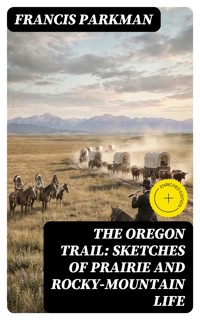
In Francis Parkman's 'The Oregon Trail', the reader is immersed in a vivid and detailed account of the author's journey along the Oregon Trail in the 19th century. Written in a captivating narrative style, the book serves as both a historical document and a work of literature, offering insights into the challenges and triumphs of the settlers who ventured westward. Parkman's rich descriptions of the landscape and encounters with Native American tribes provide a unique perspective on a significant period in American history. The book combines adventure, history, and personal reflection in a way that continues to resonate with readers today. As a renowned historian and writer, Parkman's expertise and passion for the subject shine through in every page of this classic work. His firsthand experience on the Oregon Trail gives the book an authenticity and depth that few others can match. 'The Oregon Trail' is a must-read for anyone interested in the history of the American West, pioneer life, and the enduring spirit of exploration. In this enriched edition, we have carefully created added value for your reading experience: - A succinct Introduction situates the work's timeless appeal and themes. - The Synopsis outlines the central plot, highlighting key developments without spoiling critical twists. - A detailed Historical Context immerses you in the era's events and influences that shaped the writing. - An Author Biography reveals milestones in the author's life, illuminating the personal insights behind the text. - A thorough Analysis dissects symbols, motifs, and character arcs to unearth underlying meanings. - Reflection questions prompt you to engage personally with the work's messages, connecting them to modern life. - Hand‐picked Memorable Quotes shine a spotlight on moments of literary brilliance. - Interactive footnotes clarify unusual references, historical allusions, and archaic phrases for an effortless, more informed read.
Das E-Book können Sie in Legimi-Apps oder einer beliebigen App lesen, die das folgende Format unterstützen:
Veröffentlichungsjahr: 2022
Ähnliche





The Oregon Trail
Published by
Books
Table of Contents
Introduction
Threaded through the low swales and high sky of the Great Plains, the long brown road of the continent becomes a testing ground where curiosity, ambition, and endurance meet wind, dust, and distance, and where the imagined West, shimmering beyond the next rise, is exchanged for the felt realities of hooves, river crossings, hunger, storm light, and human encounter, in a journey that measures a nation’s desires against the stubborn facts of land and culture.
The Oregon Trail, by Francis Parkman, is a landmark of American travel writing first published in book form in 1849. It arises from Parkman’s overland journey of 1846 from the Missouri frontier toward the Rocky Mountains, where a young New Englander follows the emigrant road, rides with hunters and traders, and visits frontier posts such as Fort Laramie. The book’s premise is simple yet inexhaustible: to observe and record the people, landscapes, hardships, and improvisations of the trail at close range, transforming movement itself into narrative while withholding any outcome beyond the open horizon that draws the traveler on.
Parkman undertook this expedition in his early twenties, and its immediacy shapes the prose. Portions of the narrative first appeared serially in 1847 in Knickerbocker’s Magazine under the title The California and Oregon Trail before being gathered and refined for the 1849 volume. The author would later gain renown as a historian for France and England in North America, but here he writes as a participant-observer, coupling youthful vigor with a disciplined eye. The result is a record both of a particular year on the Plains and of a mind learning how to see a vast, contested geography.
As narrative art, The Oregon Trail uses the travel chronicle to frame a series of scenes, portraits, and meditations. It is organized by the natural cadences of movement—day’s march, camp, storm, repair—and by the encounters that punctuate them. Parkman blends reportage with reflective set pieces and the descriptive reach of landscape writing. Rather than a continuous diary, the book advances through crafted episodes that together create a mosaic of the overland experience: the press of miles, the economy of supplies, the etiquette of trail companionship, and the improvisations demanded by weather, terrain, and chance.
The book’s style gives it enduring life. Parkman’s sentences carry the gait of travel, alternating quick notations with broader panoramas that set light, color, and contour before the reader. He is a skillful sketcher of character, from seasoned plainsmen to families in wagon trains, and an equally attentive observer of animals, rivers, and sky. The descriptive energy is grounded in detail—tracks, grasses, storms, tools—and lifted by an alertness to mood. This combination of tactile precision and narrative poise allows the book to remain vivid long after the world it depicts has changed.
At its core, The Oregon Trail explores themes that outlast its immediate moment: the pull of migration, the costs and exhilarations of risk, the testing of ideals against circumstance, and the moral complexity of cross-cultural encounter. It maps a space where strangers share provisions and stories, where cooperation and misunderstanding coexist, and where the land itself sets the terms. The narrative registers both the magnetism of possibility and the discipline required to continue, asking what it means to move through a place that others call home and to tell that passage truly.
The book holds classic status because it combines literary craftsmanship with documentary importance. It preserves one of the most influential roadways in American memory at a time when it was carrying thousands westward, yet it does so through a distinctive voice and careful shaping. Readers return to it for the clarity of its scenes and the tension between myth and reality it constantly calibrates. Its pages have been reprinted in many editions, studied by historians of the West, and appreciated by general readers who find in it both a chronicle and an artful performance.
The Oregon Trail also helped set templates for later writing about the American West. Theodore Roosevelt admired Parkman’s vigor and narrative force, and Bernard DeVoto championed and edited Parkman’s work, seeing in it a model of lucid historical storytelling. Beyond such explicit praise, Parkman’s fusion of firsthand observation, scene-making, and reflective commentary has informed historians, essayists, and travel writers who seek to balance ground-level detail with interpretive reach. The book’s influence resides not only in what it describes but in the method by which it turns observation into durable narrative.
Historically, the book stands at a pivotal moment. The 1840s saw intertwined overland routes bearing emigrants toward the Pacific Northwest and California, and Parkman followed part of this network from the Missouri Valley into the Plains and toward the Rockies. The title names a famed corridor rather than a fixed destination, and the narrative stays close to the practicalities of the road—supply, route, weather—while registering the broader context of expansion into lands that were and are the homelands of Native nations. Its observation is local; its implications stretch across a continent.
Modern readers should approach the book with both appreciation and critique. Parkman’s perspective reflects nineteenth-century assumptions, and some portrayals, especially of Indigenous peoples, carry the prejudices and limitations of his time. Many contemporary editions frame these issues with historical notes and contextual essays. Reading the narrative with this awareness allows its documentary value and literary qualities to be recognized alongside its blind spots, encouraging a conversation about how accounts are made, who speaks, and what responsibilities attach to describing others in a moment of upheaval.
For those coming to it for the first time, the book repays attention to pace and texture. Notice how distances are felt in hoofbeats and wheel ruts, how weather dictates decisions, and how conversation by firelight sketches a society on the move. The cast includes emigrants, traders, soldiers, and people of the Plains, and the interplay among them becomes a study in improvisation. Parkman’s scenes often begin in concrete observation and open into reflection, inviting the reader to inhabit both the day’s work and the ideas that travel alongside it.
The Oregon Trail endures because it speaks to perennial questions—about mobility, encounter, risk, resourcefulness, and the stories we tell about places we cross. In an era still defined by movement and by debates over land, belonging, and representation, Parkman’s narrative offers a vital, if imperfect, window onto a formative passage in American life. It remains compelling as literature—precise, vivid, and shaped—and as evidence, asking readers to weigh dream against terrain. That double claim, at once aesthetic and historical, sustains its relevance and secures its lasting appeal.
Synopsis
Francis Parkman’s The Oregon Trail, first published in 1849, is a nonfiction narrative drawn from his 1846 journey across the North American plains and into the Rocky Mountains. Written as a series of sketches, it blends travel reportage, natural description, and cultural observation. Parkman, a young Bostonian, sets out to witness the great overland migration then funneling westward, using the prominent wagon road as his corridor. The book situates readers at the edge of the Missouri frontier and proceeds steadily west, charting places, people, and customs encountered along the way, while registering both the hardships of travel and the allure of an expansive landscape.
The early chapters follow Parkman’s departure with a small party that includes the experienced hunter Henry Chatillon. They parallel emigrant caravans pushing their wagons toward distant promises. Camp routines, guard duty, and long days in the saddle shape the rhythm. Parkman records the challenges of route-finding, equipment failures, and uneven trail conditions. The Platte River valley, with its broad, monotonous reaches, provides a setting where weather, grass, and water supplies govern progress. Amid tedious stretches come striking moments—wildlife sightings, sudden storms, and night watches—through which Parkman calibrates his own expectations against the realities of overland travel.
As the journey unfolds, the narrative broadens to include the complex society of the trail. Parkman meets emigrants driven by aspiration, traders who knit together distant markets, and scouts who translate terrain into safe passage. He depicts hunting expeditions for bison and antelope that provision the camp while exposing the precariousness of relying on the chase. Practicalities—repairing wagons, negotiating river fords, rationing—occupy as much space as scenery, anchoring the book in the tangible mechanics of movement. The repetitive labor of travel becomes a lens for observing character, improvisation, and the informal rules that hold improvised communities together.
A frontier post on the Platte serves as a major waypoint, and Parkman treats it as a social crossroads. He notes the mingling of traders, military personnel, emigrants, and Native delegations, all exchanging news and goods before fanning back into the plains. The post signals a threshold, beyond which trails thin and distances widen. Parkman pays attention to ceremonies, horse trading, and the brokerage of peace and commerce that such hubs attempt to stage. Rest and resupply create a pause in the narrative rhythm, allowing him to register voices and perspectives that give contour to a region in rapid transition.
Parkman then spends time living among an Oglala Lakota camp, an episode central to the book’s middle sections. He describes domestic life, mobility patterns, hunting practices, and moments of ritual, while acknowledging his dependence on intermediaries and guides. These pages aim to portray a social order built around the buffalo economy and skilled horsemanship. At the same time, the account carries the limitations and biases of its mid-nineteenth-century author, whose language and judgments reflect his era. The result is an entwined record of curiosity, misunderstanding, and selective insight at a moment of intensifying cross-cultural contact.
Turning from the main wagon road, Parkman and his companions push toward rougher country at the foot of the Rockies. Trails become less distinct, and the party confronts steeper ascents, colder nights, and the fatigue of sustained exertion. The narrative alternates between practical concerns—finding wood, water, and passable routes—and reflective passages that register the sublimity of mountain vistas. Parkman’s intermittent illness heightens the sense of risk and dependence, while Chatillon’s fieldcraft becomes ever more essential. Wildlife thins and changes with elevation, underscoring the ecological gradients that structure movement and survival in the high country.
The route then bends southward, away from the Oregon-bound current and toward the Arkansas River, where a prominent trading post anchors another network of exchange. Parkman sketches the different commercial circuits that connect the plains to the Southwest, contrasting them with the emigrant stream he has left behind. On the homeward leg, which overlaps stretches of the Santa Fe Trail, he encounters trappers and freighters whose livelihoods turn on timing, credit, and weather. The tone becomes more retrospective as fatigue accumulates and the narrative begins to consider how a journey’s scattered episodes cohere into a larger impression of place.
Across these segments, Parkman develops several intertwined themes: the logistics of mass migration, the economics of the fur and provisions trade, the tactical presence of the U.S. military at strategic nodes, and the sovereignty and adaptability of Native nations negotiating shifting power. His strengths lie in vivid scene-setting and fine-grained detail—animal behavior, camp craft, the look of river bottoms after a storm—set against the march of expansion. Yet the book also bears the imprint of its author’s prejudices, requiring readers to weigh observation against assumption and to read its ethnographic passages with historical caution.
Without depending on a single climactic revelation, The Oregon Trail accumulates significance as a closely observed snapshot of a pivotal moment in North American history. It offers a durable record of landscapes on the cusp of transformation and of peoples whose trajectories intersected uneasily along the great roads west. The work endures for its narrative energy and descriptive power, even as modern readers reassess its limitations. As a document of movement—of bodies, ideas, and economies—it poses lasting questions about how travel reshapes cultures and environments, ensuring its place in discussions of the American West and its literature.
Historical Context
Francis Parkman’s The Oregon Trail is set against the mid-1840s North American West, a region stretching from the Missouri frontier across the Great Plains to the Rocky Mountains and beyond. The institutions shaping this space were overlapping: private fur-trade companies operating forts and posts, Native nations with established territorial claims and mobile economies, and a U.S. polity increasingly committed to continental expansion. Trails converged on river corridors—the Platte, Sweetwater, and Green—while waystations like trading posts and ferries structured travel rhythms. Long-distance wagon migration, seasonal buffalo hunts, and riverine transport by steamboat formed the practical background of daily life that Parkman records and interprets for readers in the East.
Parkman undertook his journey in 1846, traveling from the St. Louis region onto the overland road that emigrants used toward Oregon and California. He followed the Platte and North Platte, visited the private trading post commonly known as Fort Laramie, and spent time with a Lakota (Sioux) village before continuing toward the Rockies. The book, published in 1849 and based on journal notes and earlier periodical writing, presents a firsthand travel narrative rather than a settler’s manual. It captures encounters with emigrant caravans, traders, soldiers, and Native communities during a year when competing imperial claims and mass migration transformed the trans-Mississippi West.
The ideology most clearly reflected in the book’s world is Manifest Destiny, a term popularized in 1845 to express the belief that U.S. expansion across the continent was justified and inevitable. The Polk administration pressed for territorial acquisition in both the Pacific Northwest and the Southwest. Parkman’s narrative inhabits this expansionist climate, showing emigrant movement and official surveying that presumed a United States stretching to the Pacific. Yet the pages also register friction—logistical obstacles, clashing expectations, and cultural misunderstandings—that complicate any triumphalist view, revealing how the grand doctrine translated into difficult, contested encounters on the ground.
The political status of the Pacific Northwest shifted decisively during Parkman’s trip. Since 1818, the United States and Great Britain had accepted “joint occupation” of the Oregon Country. In 1846, the Oregon Treaty fixed the U.S.–British boundary at roughly the 49th parallel west of the Rockies, clearing diplomatic ambiguity for American settlers in the Willamette Valley and beyond. This agreement validated the assumptions of many emigrants Parkman met, who were already moving as if U.S. jurisdiction were assured. The book’s scenes of wagon traffic and migrant optimism echo the treaty’s effects, even as the terrain, climate, and distance revealed the limits of paper diplomacy.
Overland migration to Oregon had grown since the early 1840s, with family groups starting from Independence, Westport, and St. Joseph in Missouri, following established traces to South Pass. Travellers timed departures to grass growth and river levels, organized companies for mutual aid, and relied on prior trail knowledge recorded in letters and guidebooks. Parkman’s narrative, though not a how-to manual, chronicles these rhythms: river crossings, supply scarcities, and disputes over pace. He was a visitor rather than an emigrant, but his portrayal of camp routine and caravan dynamics provides a snapshot of the civilian logistics that underwrote westward movement.
The Mexican–American War (1846–1848) formed the geopolitical backdrop for much of the overland corridor, especially toward New Mexico and California. Although the Oregon road aimed northwest, military reconnaissance and topographical surveying affected the entire interior West. Reports by U.S. Army engineers and explorers—most notably those of John C. Frémont published in the mid-1840s—circulated widely, shaping expectations with maps and descriptions. Parkman’s encounters with soldiers and surveyors point to an emergent federal imprint: charting routes, assessing resources, and extending U.S. visibility into regions where sovereignty and practical control remained uncertain and negotiated.
Another population moving along parts of the same corridor in 1846–1847 was the Latter-day Saints, emigrating from the Midwest to the Great Salt Lake region. Their organized companies, way stations, and subsequent settlements would influence infrastructure along shared segments of the trail. Even where Parkman does not dwell on them, the Mormon migration helps explain the era’s churn of traffic, provisioning challenges, and the creation of informal information networks—word-of-mouth updates, road conditions, and notes left at river crossings—that linked otherwise separate journeys into a fluid, continent-spanning exchange.
The fur trade still structured much of the Great Plains economy, though the beaver trade had declined since the 1830s as fashions shifted. By the mid-1840s, bison robes and provisioning emigrants sustained many posts. Fort Laramie (then a private post commonly called by that name), Fort Bridger (established in 1842), and other stations tied Native producers, traders of mixed ancestry, and Euro-American companies into dense networks. Parkman’s stops at such places capture a transitional moment: the older world of mountain men and seasonal trade was giving way to a corridor dominated by settler traffic, military logistics, and territorial governance.
Native nations—among them Lakota (Teton Sioux), Cheyenne, Arapaho, and Pawnee on the central Plains; Shoshone and others nearer South Pass—exercised authority over hunting grounds, river crossings, and the movement of outsiders. Equestrian mobility, a buffalo-centered economy, and sophisticated diplomacy with trading companies and rival nations shaped daily life. Parkman’s time with a Lakota village offers ethnographic description of camps, councils, and hunts. Modern readers note that his portrayals also carry nineteenth-century biases: he admires martial skill and hospitality yet interprets through a Boston elite’s assumptions, revealing both valuable observation and the era’s ethnocentric frames.
U.S. Indian policy framed relations even where formal treaties had not yet reached specific locales Parkman visited. The Indian Removal Act of 1830 had earlier displaced many Eastern nations, intensifying pressures west of the Mississippi. On the central Plains, a major multilateral Treaty of Fort Laramie would come in 1851, after Parkman’s trip, seeking to define territories and protect the road. Meanwhile, the late 1840s saw the first permanent U.S. military posts in the Platte valley, such as Fort Kearny (established 1848). Parkman’s narrative captures a pre-garrisoned window when traders, migrants, and Native parties negotiated rules more informally along the trail.
Disease and ecology powerfully shaped the trail experience. Epidemics had long ravaged Native communities—smallpox and measles outbreaks earlier in the century altered demographics and power balances. For emigrants, cholera surged along the Platte in 1849, the year Parkman’s book appeared, devastating wagon companies and leaving grave markers beside the road. Even without epidemic, the sheer number of animals and people eroded grass, fouled water, and displaced game. Parkman’s accounts of buffalo hunts, scarcity of timber on the Platte, and debates over grazing illustrate how environment and movement intertwined, often to the detriment of both travelers and resident nations.
Technological and practical know-how determined success. Emigrants selected wagons—light “prairie schooners” rather than heavy Conestogas—debated oxen versus mules, and rationed flour, bacon, and ammunition. Steamboats carried people and goods to jumping-off towns on the Missouri, while the latest maps—especially Frémont and Charles Preuss’s cartography—guided route choices to South Pass. Parkman traveled largely on horseback with hired expertise, highlighting the role of experienced hunters, interpreters, and traders in translating landscapes for newcomers. Firearms, black powder, and repair skills were as vital as navigation, binding frontier technology to daily routine and occasional crisis.
Social order on the trail often mirrored domestic hierarchies. Families apportioned labor—women cooked, mended, and managed children, while men tended animals, drove wagons, and hunted—though necessity frequently blurred roles. Parkman, a Harvard-educated Bostonian, observes this division while participating in a masculine culture of the hunt and the camp. His contrasts between urban refinement and prairie hardship were legible to readers who prized frontier vigor yet feared moral and physical degeneracy. The book thus records both the endurance demanded by the road and the class-inflected lens through which an elite traveler evaluated the people he met and the skills they practiced.
Literary culture amplified the impact of such journeys. American readers consumed travel narratives that blended Romantic description, adventure, and quasi-ethnographic detail. Parkman wrote in that vein, crafting scenes of sublime landscapes, storms, and mountain vistas while providing close-up sketches of lodges, forts, and campfires. He would later become a major historian with his multivolume France and England in North America, but The Oregon Trail stands at the intersection of journalism and history, offering raw notes from a transforming region. Its style helped fix popular images of the West that circulated through newspapers, magazines, and parlors.
Protestant missions had been active in the Oregon Country since the 1830s, led by American boards that sent clergy to evangelize and found schools. Events at the Whitman Mission near present-day Walla Walla in 1847, where missionaries and settlers were killed amid disease and mounting tensions, shocked the nation and influenced territorial policy. Though Parkman’s 1846 journey predated those killings, his occasional references to missionaries in the broader West sit within this contentious context: cultural translation proved difficult, health crises bred suspicion, and religious zeal at times collided with Native sovereignty and the practical authority of trading networks.
Legal and territorial structures shifted quickly after Parkman’s return. In 1848, Congress created the Oregon Territory, formalizing U.S. governance in the Pacific Northwest. The California Gold Rush of 1848–1849 then sent unprecedented numbers onto the overland roads, intensifying demands for ferries, military protection, and reliable provisioning. Parkman’s book appeared in 1849 to an audience hungry for both guidance and spectacle; while not a guidebook, it mapped peoples, hazards, and landscapes that many readers were considering crossing themselves. Soon after, policies such as the Donation Land Claim Act of 1850 accelerated settlement, transforming the world his narrative had captured.
As state power consolidated, the trail corridor shifted from trader-policed commons to federalized thoroughfare. The U.S. Army purchased the former trading post at the Laramie site in 1849, formalizing it as Fort Laramie, and extended a chain of posts to patrol migration. Later treaties and conflicts would remake the Plains yet again. Parkman’s text preserves an interstitial phase: wagons already rumbling west, Indigenous diplomacy still robust, and federal institutions only beginning to assert regularized control. That temporal position makes the book a valuable document for tracing how space becomes territory and how territory becomes governed land in the American imagination and lawscape.
Author Biography
Francis Parkman (1823–1893) was a leading American historian of the nineteenth century, renowned for his sweeping narratives of European empires and Indigenous nations in North America. Writing in a vigorous, highly readable style, he explored the transatlantic contest between France and Britain and its shaping of the continent’s political and cultural landscapes. His multivolume series France and England in North America, together with books like The Oregon Trail and The Conspiracy of Pontiac, secured his standing with general readers and scholars alike. Parkman’s work combined documentary research with on-the-ground observation, leaving a legacy both admired for literary power and scrutinized for cultural and religious biases characteristic of his time.
Educated at Harvard College, where he graduated in the mid-1840s, Parkman absorbed a humanistic curriculum that encouraged broad reading and historical inquiry. He briefly pursued legal studies before committing himself to history and travel writing. The era’s Romantic historiography influenced his approach, as did the example of prominent American historians such as William H. Prescott and George Bancroft, whose narrative methods and attention to archival sources Parkman admired. Harvard’s intellectual environment and Boston’s publishing world gave him access to libraries, manuscripts, and a receptive readership, helping to shape his blend of scholarly documentation and dramatic storytelling that became his signature.
In 1846 Parkman undertook a strenuous journey across parts of the American West, an experience that furnished the material for The Oregon Trail. First appearing in periodical form and then as a book in 1849, it combined travel narrative with observations on landscapes, settler life, and encounters with Plains peoples. The volume quickly established Parkman as a distinctive voice, admired for vivid description and narrative momentum. During and after these travels he struggled with chronic illness that impaired his eyesight and concentration. These limitations influenced his working routines, forcing him to write in brief intervals and to rely at times on assistants, yet they did not deter his historical ambitions.
Parkman’s first major historical monograph, The Conspiracy of Pontiac (1851), examined the 1763 uprising that followed the Seven Years’ War and the complex interplay among Indigenous nations, imperial authorities, and colonial communities. Drawing on British, French, and colonial records, the book demonstrated his commitment to primary sources and his capacity to render multifaceted events in a coherent dramatic arc. He continued to consult archives in North America and Europe, refining a method that joined documentary rigor with field reconnaissance of historic sites. The work’s success confirmed Parkman’s trajectory toward a grand synthesis of the continent’s early modern struggles.
That synthesis found its fullest expression in France and England in North America, a sequence published between the 1860s and early 1890s. The series traced European exploration, missionary efforts, colonial governance, and warfare from the sixteenth century through the climactic Anglo-French conflict. Notable volumes include Pioneers of France in the New World, The Jesuits in North America, La Salle and the Discovery of the Great West, The Old Régime in Canada, Count Frontenac and New France under Louis XIV, Montcalm and Wolfe, and A Half-Century of Conflict. The books were widely read, praised for research and prose, yet frequently criticized for Anglo-Protestant bias and for caricatured depictions of Indigenous peoples and Catholic orders.
Parkman’s worldview shaped both his subjects and his judgments. Skeptical of centralized authority and critical of Catholic missionary orders—especially the Jesuits—he emphasized individual enterprise and imperial rivalry in framing North American history. These positions, prominent in his narratives, drew sustained debate then and since. Alongside history, he pursued horticulture with seriousness, publishing The Book of Roses in 1866 and cultivating gardens that also served therapeutic purposes amid ongoing illness. His working methods were painstaking: he mined archives, compiled extensive notes, and, when necessary, dictated or used visual aids to continue writing despite physical constraints.
In his later years Parkman completed additional volumes of his series and consolidated his reputation as a master of literary history in the United States. He died in 1893 in Massachusetts, leaving a body of work that remained in print and continued to attract new readers. Twentieth- and twenty-first-century scholars have reassessed his contributions, distinguishing enduring research strengths and narrative craft from period prejudices. An award bearing his name honors distinguished historical writing, reflecting the lasting association of Parkman with narrative excellence. Today his books are studied both as influential interpretations of early North America and as artifacts of their cultural moment.
The Oregon Trail
CHAPTER I
THE FRONTIER
Last spring, 1846, was a busy season in the City of St. Louis. Not only were emigrants from every part of the country preparing for the journey to Oregon and California, but an unusual number of traders were making ready their wagons and outfits for Santa Fe. Many of the emigrants, especially of those bound for California, were persons of wealth and standing. The hotels were crowded, and the gunsmiths and saddlers were kept constantly at work in providing arms and equipments for the different parties of travelers. Almost every day steamboats were leaving the levee and passing up the Missouri, crowded with passengers on their way to the frontier.
In one of these, the Radnor, since snagged and lost, my friend and relative, Quincy A. Shaw, and myself, left St. Louis on the 28th of April, on a tour of curiosity and amusement to the Rocky Mountains. The boat was loaded until the water broke alternately over her guards. Her upper deck was covered with large weapons of a peculiar form, for the Santa Fe trade[1], and her hold was crammed with goods for the same destination. There were also the equipments and provisions of a party of Oregon emigrants, a band of mules and horses, piles of saddles and harness, and a multitude of nondescript articles, indispensable on the prairies. Almost hidden in this medley one might have seen a small French cart, of the sort very appropriately called a “mule-killer[2]” beyond the frontiers, and not far distant a tent, together with a miscellaneous assortment of boxes and barrels. The whole equipage was far from prepossessing in its appearance; yet, such as it was, it was destined to a long and arduous journey, on which the persevering reader will accompany it.
The passengers on board the Radnor corresponded with her freight. In her cabin were Santa Fe traders, gamblers, speculators, and adventurers of various descriptions, and her steerage was crowded with Oregon emigrants, “mountain men,” negroes, and a party of Kansas Indians, who had been on a visit to St. Louis.
Thus laden, the boat struggled upward for seven or eight days against the rapid current of the Missouri, grating upon snags, and hanging for two or three hours at a time upon sand-bars. We entered the mouth of the Missouri in a drizzling rain, but the weather soon became clear, and showed distinctly the broad and turbid river, with its eddies, its sand-bars, its ragged islands, and forest-covered shores. The Missouri is constantly changing its course; wearing away its banks on one side, while it forms new ones on the other. Its channel is shifting continually. Islands are formed, and then washed away; and while the old forests on one side are undermined and swept off, a young growth springs up from the new soil upon the other. With all these changes, the water is so charged with mud and sand that it is perfectly opaque, and in a few minutes deposits a sediment an inch thick in the bottom of a tumbler. The river was now high; but when we descended in the autumn it was fallen very low, and all the secrets of its treacherous shallows were exposed to view. It was frightful to see the dead and broken trees, thick-set as a military abatis, firmly imbedded in the sand, and all pointing down stream, ready to impale any unhappy steamboat that at high water should pass over that dangerous ground.
In five or six days we began to see signs of the great western movement that was then taking place. Parties of emigrants, with their tents and wagons, would be encamped on open spots near the bank, on their way to the common rendezvous at Independence. On a rainy day, near sunset, we reached the landing of this place, which is situated some miles from the river, on the extreme frontier of Missouri. The scene was characteristic, for here were represented at one view the most remarkable features of this wild and enterprising region. On the muddy shore stood some thirty or forty dark slavish-looking Spaniards, gazing stupidly out from beneath their broad hats. They were attached to one of the Santa Fe companies, whose wagons were crowded together on the banks above. In the midst of these, crouching over a smoldering fire, was a group of Indians, belonging to a remote Mexican tribe. One or two French hunters from the mountains with their long hair and buckskin dresses, were looking at the boat; and seated on a log close at hand were three men, with rifles lying across their knees. The foremost of these, a tall, strong figure, with a clear blue eye and an open, intelligent face, might very well represent that race of restless and intrepid pioneers whose axes and rifles have opened a path from the Alleghenies to the western prairies. He was on his way to Oregon, probably a more congenial field to him than any that now remained on this side the great plains.
Early on the next morning we reached Kansas, about five hundred miles from the mouth of the Missouri. Here we landed and leaving our equipments in charge of my good friend Colonel Chick, whose log-house was the substitute for a tavern, we set out in a wagon for Westport, where we hoped to procure mules and horses for the journey.
It was a remarkably fresh and beautiful May morning. The rich and luxuriant woods through which the miserable road conducted us were lighted by the bright sunshine and enlivened by a multitude of birds. We overtook on the way our late fellow-travelers, the Kansas Indians, who, adorned with all their finery, were proceeding homeward at a round pace; and whatever they might have seemed on board the boat, they made a very striking and picturesque feature in the forest landscape.
Westport was full of Indians, whose little shaggy ponies were tied by dozens along the houses and fences. Sacs and Foxes, with shaved heads and painted faces, Shawanoes and Delawares, fluttering in calico frocks, and turbans, Wyandottes dressed like white men, and a few wretched Kansas wrapped in old blankets, were strolling about the streets, or lounging in and out of the shops and houses.
As I stood at the door of the tavern, I saw a remarkable looking person coming up the street. He had a ruddy face, garnished with the stumps of a bristly red beard and mustache; on one side of his head was a round cap with a knob at the top, such as Scottish laborers sometimes wear; his coat was of a nondescript form, and made of a gray Scotch plaid, with the fringes hanging all about it; he wore pantaloons of coarse homespun, and hob-nailed shoes; and to complete his equipment, a little black pipe was stuck in one corner of his mouth. In this curious attire, I recognized Captain C. of the British army, who, with his brother, and Mr. R., an English gentleman, was bound on a hunting expedition across the continent. I had seen the captain and his companions at St. Louis. They had now been for some time at Westport, making preparations for their departure, and waiting for a re-enforcement, since they were too few in number to attempt it alone. They might, it is true, have joined some of the parties of emigrants who were on the point of setting out for Oregon and California; but they professed great disinclination to have any connection with the “Kentucky fellows.”
The captain now urged it upon us, that we should join forces and proceed to the mountains in company. Feeling no greater partiality for the society of the emigrants than they did, we thought the arrangement an advantageous one, and consented to it. Our future fellow-travelers had installed themselves in a little log-house, where we found them all surrounded by saddles, harness, guns, pistols, telescopes, knives, and in short their complete appointments for the prairie. R., who professed a taste for natural history, sat at a table stuffing a woodpecker; the brother of the captain, who was an Irishman, was splicing a trail-rope on the floor, as he had been an amateur sailor. The captain pointed out, with much complacency, the different articles of their outfit. “You see,” said he, “that we are all old travelers. I am convinced that no party ever went upon the prairie better provided.” The hunter whom they had employed, a surly looking Canadian, named Sorel, and their muleteer, an American from St. Louis, were lounging about the building. In a little log stable close at hand were their horses and mules, selected by the captain, who was an excellent judge.
The alliance entered into, we left them to complete their arrangements, while we pushed our own to all convenient speed. The emigrants for whom our friends professed such contempt were encamped on the prairie about eight or ten miles distant, to the number of a thousand or more, and new parties were constantly passing out from Independence to join them. They were in great confusion, holding meetings, passing resolutions, and drawing up regulations, but unable to unite in the choice of leaders to conduct them across the prairie. Being at leisure one day, I rode over to Independence. The town was crowded. A multitude of shops had sprung up to furnish the emigrants and Santa Fe traders with necessaries for their journey; and there was an incessant hammering and banging from a dozen blacksmiths’ sheds, where the heavy wagons were being repaired, and the horses and oxen shod. The streets were thronged with men, horses, and mules. While I was in the town, a train of emigrant wagons from Illinois passed through, to join the camp on the prairie, and stopped in the principal street. A multitude of healthy children’s faces were peeping out from under the covers of the wagons. Here and there a buxom damsel was seated on horseback, holding over her sunburnt face an old umbrella or a parasol, once gaudy enough but now miserably faded. The men, very sober-looking countrymen, stood about their oxen; and as I passed I noticed three old fellows, who, with their long whips in their hands, were zealously discussing the doctrine of regeneration. The emigrants, however, are not all of this stamp. Among them are some of the vilest outcasts in the country. I have often perplexed myself to divine the various motives that give impulse to this strange migration; but whatever they may be, whether an insane hope of a better condition in life, or a desire of shaking off restraints of law and society, or mere restlessness, certain it is that multitudes bitterly repent the journey, and after they have reached the land of promise are happy enough to escape from it.
In the course of seven or eight days we had brought our preparations near to a close. Meanwhile our friends had completed theirs, and becoming tired of Westport, they told us that they would set out in advance and wait at the crossing of the Kansas till we should come up. Accordingly R. and the muleteers went forward with the wagon and tent, while the captain and his brother, together with Sorel, and a trapper named Boisverd, who had joined them, followed with the band of horses. The commencement of the journey was ominous, for the captain was scarcely a mile from Westport, riding along in state at the head of his party, leading his intended buffalo horse by a rope, when a tremendous thunderstorm came on, and drenched them all to the skin. They hurried on to reach the place, about seven miles off, where R. was to have had the camp in readiness to receive them. But this prudent person, when he saw the storm approaching, had selected a sheltered glade in the woods, where he pitched his tent, and was sipping a comfortable cup of coffee, while the captain galloped for miles beyond through the rain to look for him. At length the storm cleared away, and the sharp-eyed trapper succeeded in discovering his tent: R. had by this time finished his coffee, and was seated on a buffalo robe smoking his pipe. The captain was one of the most easy-tempered men in existence, so he bore his ill-luck with great composure, shared the dregs of the coffee with his brother, and lay down to sleep in his wet clothes.
We ourselves had our share of the deluge. We were leading a pair of mules to Kansas when the storm broke. Such sharp and incessant flashes of lightning, such stunning and continuous thunder, I have never known before. The woods were completely obscured by the diagonal sheets of rain that fell with a heavy roar, and rose in spray from the ground; and the streams rose so rapidly that we could hardly ford them. At length, looming through the rain, we saw the log-house of Colonel Chick, who received us with his usual bland hospitality; while his wife, who, though a little soured and stiffened by too frequent attendance on camp-meetings, was not behind him in hospitable feeling, supplied us with the means of repairing our drenched and bedraggled condition. The storm, clearing away at about sunset, opened a noble prospect from the porch of the colonel’s house, which stands upon a high hill. The sun streamed from the breaking clouds upon the swift and angry Missouri, and on the immense expanse of luxuriant forest that stretched from its banks back to the distant bluffs.
Returning on the next day to Westport, we received a message from the captain, who had ridden back to deliver it in person, but finding that we were in Kansas, had intrusted it with an acquaintance of his named Vogel, who kept a small grocery and liquor shop. Whisky by the way circulates more freely in Westport than is altogether safe in a place where every man carries a loaded pistol in his pocket. As we passed this establishment, we saw Vogel’s broad German face and knavish-looking eyes thrust from his door. He said he had something to tell us, and invited us to take a dram. Neither his liquor nor his message was very palatable. The captain had returned to give us notice that R., who assumed the direction of his party, had determined upon another route from that agreed upon between us; and instead of taking the course of the traders, to pass northward by Fort Leavenworth, and follow the path marked out by the dragoons in their expedition of last summer. To adopt such a plan without consulting us, we looked upon as a very high-handed proceeding; but suppressing our dissatisfaction as well as we could, we made up our minds to join them at Fort Leavenworth, where they were to wait for us.
Accordingly, our preparation being now complete, we attempted one fine morning to commence our journey. The first step was an unfortunate one. No sooner were our animals put in harness, than the shaft mule reared and plunged, burst ropes and straps, and nearly flung the cart into the Missouri. Finding her wholly uncontrollable, we exchanged her for another, with which we were furnished by our friend Mr. Boone of Westport, a grandson of Daniel Boone, the pioneer. This foretaste of prairie experience was very soon followed by another. Westport was scarcely out of sight, when we encountered a deep muddy gully, of a species that afterward became but too familiar to us; and here for the space of an hour or more the car stuck fast.
CHAPTER II
BREAKING THE ICE
Both Shaw and myself were tolerably inured to the vicissitudes of traveling. We had experienced them under various forms, and a birch canoe was as familiar to us as a steamboat[1q]. The restlessness, the love of wilds and hatred of cities, natural perhaps in early years to every unperverted son of Adam, was not our only motive for undertaking the present journey. My companion hoped to shake off the effects of a disorder that had impaired a constitution originally hardy and robust; and I was anxious to pursue some inquiries relative to the character and usages of the remote Indian nations, being already familiar with many of the border tribes.
Emerging from the mud-hole where we last took leave of the reader, we pursued our way for some time along the narrow track, in the checkered sunshine and shadow of the woods, till at length, issuing forth into the broad light, we left behind us the farthest outskirts of that great forest, that once spread unbroken from the western plains to the shore of the Atlantic. Looking over an intervening belt of shrubbery, we saw the green, oceanlike expanse of prairie, stretching swell over swell to the horizon.
It was a mild, calm spring day; a day when one is more disposed to musing and reverie than to action, and the softest part of his nature is apt to gain the ascendency. I rode in advance of the party, as we passed through the shrubbery, and as a nook of green grass offered a strong temptation, I dismounted and lay down there. All the trees and saplings were in flower, or budding into fresh leaf; the red clusters of the maple-blossoms and the rich flowers of the Indian apple were there in profusion; and I was half inclined to regret leaving behind the land of gardens for the rude and stern scenes of the prairie and the mountains.
Meanwhile the party came in sight from out of the bushes. Foremost rode Henry Chatillon, our guide and hunter, a fine athletic figure, mounted on a hardy gray Wyandotte pony. He wore a white blanket-coat, a broad hat of felt, moccasins, and pantaloons of deerskin, ornamented along the seams with rows of long fringes. His knife was stuck in his belt; his bullet-pouch and powder-horn[3] hung at his side, and his rifle lay before him, resting against the high pommel of his saddle, which, like all his equipments, had seen hard service, and was much the worse for wear. Shaw followed close, mounted on a little sorrel horse, and leading a larger animal by a rope. His outfit, which resembled mine, had been provided with a view to use rather than ornament. It consisted of a plain, black Spanish saddle, with holsters of heavy pistols, a blanket rolled up behind it, and the trail-rope attached to his horse’s neck hanging coiled in front. He carried a double-barreled smooth-bore, while I boasted a rifle of some fifteen pounds’ weight. At that time our attire, though far from elegant, bore some marks of civilization, and offered a very favorable contrast to the inimitable shabbiness of our appearance on the return journey. A red flannel shirt, belted around the waist like a frock, then constituted our upper garment; moccasins had supplanted our failing boots; and the remaining essential portion of our attire consisted of an extraordinary article, manufactured by a squaw out of smoked buckskin. Our muleteer, Delorier, brought up the rear with his cart, waddling ankle-deep in the mud, alternately puffing at his pipe, and ejaculating in his prairie patois: “Sacre enfant de garce!” as one of the mules would seem to recoil before some abyss of unusual profundity. The cart was of the kind that one may see by scores around the market-place in Montreal, and had a white covering to protect the articles within. These were our provisions and a tent, with ammunition, blankets, and presents for the Indians.
We were in all four men with eight animals; for besides the spare horses led by Shaw and myself, an additional mule was driven along with us as a reserve in case of accident.
After this summing up of our forces, it may not be amiss to glance at the characters of the two men who accompanied us.
Delorier was a Canadian, with all the characteristics of the true Jean Baptiste. Neither fatigue, exposure, nor hard labor could ever impair his cheerfulness and gayety, or his obsequious politeness to his bourgeois; and when night came he would sit down by the fire, smoke his pipe, and tell stories with the utmost contentment. In fact, the prairie was his congenial element. Henry Chatillon was of a different stamp. When we were at St. Louis, several gentlemen of the Fur Company had kindly offered to procure for us a hunter and guide suited for our purposes, and on coming one afternoon to the office, we found there a tall and exceedingly well-dressed man with a face so open and frank that it attracted our notice at once. We were surprised at being told that it was he who wished to guide us to the mountains. He was born in a little French town near St. Louis, and from the age of fifteen years had been constantly in the neighborhood of the Rocky Mountains, employed for the most part by the Company to supply their forts with buffalo meat. As a hunter he had but one rival in the whole region, a man named Cimoneau, with whom, to the honor of both of them, he was on terms of the closest friendship. He had arrived at St. Louis the day before, from the mountains, where he had remained for four years; and he now only asked to go and spend a day with his mother before setting out on another expedition. His age was about thirty; he was six feet high, and very powerfully and gracefully molded. The prairies had been his school; he could neither read nor write, but he had a natural refinement and delicacy of mind such as is rarely found, even in women. His manly face was a perfect mirror of uprightness, simplicity, and kindness of heart; he had, moreover, a keen perception of character and a tact that would preserve him from flagrant error in any society. Henry had not the restless energy of an Anglo-American. He was content to take things as he found them; and his chief fault arose from an excess of easy generosity, impelling him to give away too profusely ever to thrive in the world. Yet it was commonly remarked of him, that whatever he might choose to do with what belonged to himself, the property of others was always safe in his hands. His bravery was as much celebrated in the mountains as his skill in hunting; but it is characteristic of him that in a country where the rifle is the chief arbiter between man and man, Henry was very seldom involved in quarrels. Once or twice, indeed, his quiet good-nature had been mistaken and presumed upon, but the consequences of the error were so formidable that no one was ever known to repeat it. No better evidence of the intrepidity of his temper could be wished than the common report that he had killed more than thirty grizzly bears. He was a proof of what unaided nature will sometimes do. I have never, in the city or in the wilderness, met a better man than my noble and true-hearted friend, Henry Chatillon.
We were soon free of the woods and bushes, and fairly upon the broad prairie. Now and then a Shawanoe passed us, riding his little shaggy pony at a “lope”; his calico shirt, his gaudy sash, and the gay handkerchief bound around his snaky hair fluttering in the wind. At noon we stopped to rest not far from a little creek replete with frogs and young turtles. There had been an Indian encampment at the place, and the framework of their lodges still remained, enabling us very easily to gain a shelter from the sun, by merely spreading one or two blankets over them. Thus shaded, we sat upon our saddles, and Shaw for the first time lighted his favorite Indian pipe; while Delorier was squatted over a hot bed of coals, shading his eyes with one hand, and holding a little stick in the other, with which he regulated the hissing contents of the frying-pan. The horses were turned to feed among the scattered bushes of a low oozy meadow. A drowzy springlike sultriness pervaded the air, and the voices of ten thousand young frogs and insects, just awakened into life, rose in varied chorus from the creek and the meadows.
Scarcely were we seated when a visitor approached. This was an old Kansas Indian; a man of distinction, if one might judge from his dress. His head was shaved and painted red, and from the tuft of hair remaining on the crown dangled several eagles’ feathers, and the tails of two or three rattlesnakes. His cheeks, too, were daubed with vermilion; his ears were adorned with green glass pendants; a collar of grizzly bears’ claws surrounded his neck, and several large necklaces of wampum hung on his breast. Having shaken us by the hand with a cordial grunt of salutation, the old man, dropping his red blanket from his shoulders, sat down cross-legged on the ground. In the absence of liquor we offered him a cup of sweetened water, at which he ejaculated “Good!” and was beginning to tell us how great a man he was, and how many Pawnees he had killed, when suddenly a motley concourse appeared wading across the creek toward us. They filed past in rapid succession, men, women, and children; some were on horseback, some on foot, but all were alike squalid and wretched. Old squaws, mounted astride of shaggy, meager little ponies, with perhaps one or two snake-eyed children seated behind them, clinging to their tattered blankets; tall lank young men on foot, with bows and arrows in their hands; and girls whose native ugliness not all the charms of glass beads and scarlet cloth could disguise, made up the procession; although here and there was a man who, like our visitor, seemed to hold some rank in this respectable community. They were the dregs of the Kansas nation, who, while their betters were gone to hunt buffalo, had left the village on a begging expedition to Westport.
When this ragamuffin horde had passed, we caught our horses, saddled, harnessed, and resumed our journey. Fording the creek, the low roofs of a number of rude buildings appeared, rising from a cluster of groves and woods on the left; and riding up through a long lane, amid a profusion of wild roses and early spring flowers, we found the log-church and school-houses belonging to the Methodist Shawanoe Mission. The Indians were on the point of gathering to a religious meeting. Some scores of them, tall men in half-civilized dress, were seated on wooden benches under the trees; while their horses were tied to the sheds and fences. Their chief, Parks, a remarkably large and athletic man, was just arrived from Westport, where he owns a trading establishment. Beside this, he has a fine farm and a considerable number of slaves. Indeed the Shawanoes have made greater progress in agriculture than any other tribe on the Missouri frontier; and both in appearance and in character form a marked contrast to our late acquaintance, the Kansas.
A few hours’ ride brought us to the banks of the river Kansas. Traversing the woods that lined it, and plowing through the deep sand, we encamped not far from the bank, at the Lower Delaware crossing. Our tent was erected for the first time on a meadow close to the woods, and the camp preparations being complete we began to think of supper. An old Delaware woman, of some three hundred pounds’ weight, sat in the porch of a little log-house close to the water, and a very pretty half-breed girl was engaged, under her superintendence, in feeding a large flock of turkeys that were fluttering and gobbling about the door. But no offers of money, or even of tobacco, could induce her to part with one of her favorites; so I took my rifle, to see if the woods or the river could furnish us anything. A multitude of quails were plaintively whistling in the woods and meadows; but nothing appropriate to the rifle was to be seen, except three buzzards, seated on the spectral limbs of an old dead sycamore, that thrust itself out over the river from the dense sunny wall of fresh foliage. Their ugly heads were drawn down between their shoulders, and they seemed to luxuriate in the soft sunshine that was pouring from the west. As they offered no epicurean temptations, I refrained from disturbing their enjoyment; but contented myself with admiring the calm beauty of the sunset, for the river, eddying swiftly in deep purple shadows between the impending woods, formed a wild but tranquillizing scene.
When I returned to the camp I found Shaw and an old Indian seated on the ground in close conference, passing the pipe between them. The old man was explaining that he loved the whites, and had an especial partiality for tobacco. Delorier was arranging upon the ground our service of tin cups and plates; and as other viands were not to be had, he set before us a repast of biscuit and bacon, and a large pot of coffee. Unsheathing our knives, we attacked it, disposed of the greater part, and tossed the residue to the Indian. Meanwhile our horses, now hobbled for the first time, stood among the trees, with their fore-legs tied together, in great disgust and astonishment. They seemed by no means to relish this foretaste of what was before them. Mine, in particular, had conceived a moral aversion to the prairie life. One of them, christened Hendrick, an animal whose strength and hardihood were his only merits, and who yielded to nothing but the cogent arguments of the whip, looked toward us with an indignant countenance, as if he meditated avenging his wrongs with a kick. The other, Pontiac, a good horse, though of plebeian lineage, stood with his head drooping and his mane hanging about his eyes, with the grieved and sulky air of a lubberly boy sent off to school. Poor Pontiac! his forebodings were but too just; for when I last heard from him, he was under the lash of an Ogallalla brave, on a war party against the Crows.
As it grew dark, and the voices of the whip-poor-wills succeeded the whistle of the quails, we removed our saddles to the tent, to serve as pillows, spread our blankets upon the ground, and prepared to bivouac for the first time that season. Each man selected the place in the tent which he was to occupy for the journey. To Delorier, however, was assigned the cart, into which he could creep in wet weather, and find a much better shelter than his bourgeois enjoyed in the tent.
The river Kansas at this point forms the boundary line between the country of the Shawanoes and that of the Delawares. We crossed it on the following day, rafting over our horses and equipage with much difficulty, and unloading our cart in order to make our way up the steep ascent on the farther bank. It was a Sunday morning; warm, tranquil and bright; and a perfect stillness reigned over the rough inclosures and neglected fields of the Delawares, except the ceaseless hum and chirruping of myriads of insects. Now and then, an Indian rode past on his way to the meeting-house, or through the dilapidated entrance of some shattered log-house an old woman might be discerned, enjoying all the luxury of idleness. There was no village bell, for the Delawares have none; and yet upon that forlorn and rude settlement was the same spirit of Sabbath repose and tranquillity as in some little New England village among the mountains of New Hampshire or the Vermont woods.
Having at present no leisure for such reflections, we pursued our journey. A military road led from this point to Fort Leavenworth[4], and for many miles the farms and cabins of the Delawares were scattered at short intervals on either hand. The little rude structures of logs, erected usually on the borders of a tract of woods, made a picturesque feature in the landscape. But the scenery needed no foreign aid. Nature had done enough for it; and the alteration of rich green prairies and groves that stood in clusters or lined the banks of the numerous little streams, had all the softened and polished beauty of a region that has been for centuries under the hand of man. At that early season, too, it was in the height of its freshness and luxuriance. The woods were flushed with the red buds of the maple; there were frequent flowering shrubs unknown in the east; and the green swells of the prairies were thickly studded with blossoms.




