


2,49 €
Mehr erfahren.
- Herausgeber: Strelbytskyy Multimedia Publishing
- Kategorie: Für Kinder und Jugendliche
- Sprache: Englisch
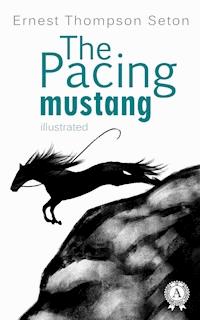
Tales of animals are not accidentally so loved in many countries by adults and children. The heroes of the stories written by the famous Canadian writer Ernest Thompson Seton, and among them stands out for its originality the "The Pacing Mustang", are animals and birds. However, often their life and behavior are more exalted and noble than that of people. A beautiful black mustang was a pacer, that is, when running, he moved first both right legs, then both left. The Mustang took home mares with him and they eventually got used to the wild life.
Das E-Book können Sie in Legimi-Apps oder einer beliebigen App lesen, die das folgende Format unterstützen:
Seitenzahl: 39
Veröffentlichungsjahr: 2017
Ähnliche






THE PACING MUSTANG
by
Ernest Thompson Seton
Tales of animals are not accidentally so loved in many countries by adults and children. The heroes of the stories written by the famous Canadian writer Ernest Thompson Seton, and among them stands out for its originality the "The Pacing Mustang", are animals and birds. However, often their life and behavior are more exalted and noble than that of people.
A beautiful black mustang was a pacer, that is, when running, he moved first both right legs, then both left. The Mustang took home mares with him and they eventually got used to the wild life.
I
JO CALONE threw down his saddle on the dusty ground, turned his horses loose, and went clanking into the ranchhouse.
"Nigh about chuck time?" he asked.
"Seventeen minutes," said the cook glancing at the Waterbury, with the air of a train starter, though this show of precision had never yet been justified by events.
"How's things on the Perico?" said Jo's pard.
"Hotter'n hinges," said Jo. "Cattle seem O.K.; lots of calves."
"I seen that bunch o' mustangs that waters at Antelope Springs; couple o' colts along; one little dark one, a fair dandy; a born pacer. I run them a mile or two, and he led the bunch, an' never broke his pace. Cut loose, an' pushed them jest for fun, an' darned if I could make him break."
"You didn't have no reefreshments along?" said Scarth, incredulously.
"That's all right, Scarth. You had to crawl on our last bet, an' you'll get another chance soon as you're man enough."
"Chuck," shouted the cook, and the subject was dropped. Next day the scene of the roundup was changed, and the mustangs were forgotten.
A year later the same corner of New Mexico was worked over by the roundup, and again the mustang bunch was seen. The dark colt was now a black yearling, with thin, clean legs and glossy flanks; and more than one of the boys saw with his own eyes this oddity-the mustang was a born pacer. Jo was along, and the idea now struck him that that colt was worth having. To an Easterner this thought may not seem startling or original, but in the West, where an unbroken horse is worth $5, and where an ordinary saddlehorse is worth $15 or $20, the idea of a wild mustang being desirable property does not occur to the average cowboy, for mustangs are hard to catch, and when caught are merely wild animal prisoners, perfectly useless and untamable to the last. Not a few of the cattle-owners make a point of shooting all mustangs at sight, they are not only useless cumberers of the feeding-grounds, but commonly lead away domestic horses, which soon take to wild life and are thenceforth lost.
Wild Jo Calone knew a 'bronk right down to subsoil.' "I never seen a white that wasn't soft, nor a chestnut that wasn't nervous, nor a bay that wasn't good if broke right, nor a black that wasn't hard as nails, an' full of the old Harry. All a black bronk wants is claws to be wus'n Daniel's hull outfit of lions."
Since, then, a mustang is worthless vermin, and a black mustang ten times worse than worthless, Jo's pard "didn't see no sense in Jo's wantin' to corral the yearling," as he now seemed intent on doing. But Jo got no chance to try that year.
He was only a cow-puncher on $25 a month, and tied to hours. Like most of the boys, he always looked forward to having a ranch and an outfit of his own. His brand, the hogpen, of sinister suggestion, was already registered at Santa Fe, but of horned stock it was borne by a single old cow, so as to give him a legal right to put his brand on any maverick (or unbranded animal) he might chance to find.
Yet each fall, when paid off, Jo could not resist the temptation to go to town with the boys and have a good time 'while the stuff held out.' So that his property consisted of little more than his saddle, his bed, and his old cow. He kept on hoping to make a strike that would leave him well fixed with a fair start, and when the thought came that the Black Mustang was his mascot, he only needed a chance to 'make the try.'
The roundup circled down to the Canadian River, and back in the fall by the Don Carlos Hills, and Jo saw no more of the Pacer, though he heard of him from many quarters, for the colt, now a vigorous, young horse, rising three, was beginning to be talked of.




