


9,99 €
Mehr erfahren.
- Herausgeber: Atlantic Books
- Kategorie: Für Kinder und Jugendliche
- Sprache: Englisch
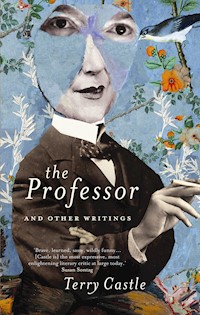
At the heart of this striking collection is the title work: a candid and wrenching exploration of Castle's relationship, during her graduate school years, with a female professor. At once hilarious and rueful, it is a pitch-perfect recollection of the fiascos of youth: how we come to own (or disown) our sexuality; how we understand (or fail to) the emotional needs and wishes of others; how the ordeals of desire can prompt a lifelong search for self-understanding. With The Professor: And Other Writings Terry Castle cements her reputation as a truly remarkable writer: distinctive, wise, frank, incredibly funny and utterly fearless.
Das E-Book können Sie in Legimi-Apps oder einer beliebigen App lesen, die das folgende Format unterstützen:
Veröffentlichungsjahr: 2011
Ähnliche












![Tintenherz [Tintenwelt-Reihe, Band 1 (Ungekürzt)] - Cornelia Funke - Hörbuch](https://legimifiles.blob.core.windows.net/images/2830629ec0fd3fd8c1f122134ba4a884/w200_u90.jpg)






The Professorand Other Writings
Also by Terry Castle
The Apparitional Lesbian:
Female Homosexuality and Modern Culture
The Female Thermometer:
Eighteenth- Century Culture and the
Invention of the Uncanny
Boss Ladies, Watch Out!
Essays on Women and Sex
The Literature of Lesbianism:
A Historical Anthology
from Ariosto to Stonewall
The Professorand Other Writings
Terry Castle
First published in 2010 in the United States of America by Harper, an imprint of HarperCollins Publishers, 10 East 53rd Street, New York, NY 10022.
First published in hardback in Great Britain in 2011 by Tuskar Rock Press, in association with Atlantic Books Ltd, and in a hardcover limited edition by Tuskar Rock Press.
Copyright © Terry Castle, 2011
The moral right of Terry Castle to be identified as the author of this work has been asserted by him in accordance with the Copyright, Designs and Patents Act of 1988.
All rights reserved. No part of this publication may be reproduced, stored in a retrieval system, or transmitted in any form or by any means, electronic, mechanical, photocopying, recording, or otherwise, without the prior permission of both the copyright owner and the above publisher of this book.
“Courage, Mon Amie” image courtesy of the author.
“My Heroin Christmas” image of Art Pepper courtesy of the Concord Music Group.
“My Sicily Diary” image by permission of Marco Lanza.
“Desperately Seeking Susan” image, Susan Sontag, 1975: Copyright © The Peter Hujar Archive, LLC, courtesy Matthew Marks Gallery, New York.
“Home Alone” image, Portrait, Miss Elsie de Wolfe, 1905, by permission of the Museum of the City of New York, Byron Collection.
“Travels with My Mother” image of Agnes Martin by permission of Cary Herz Photography.
“The Professor” image courtesy of the author.
Every effort has been made to trace or contact all copyright holders. The publishers will be pleased to make good any omissions or rectify any mistakes brought to their attention at the earliest opportunity.
1 3 5 7 9 10 8 6 4 2
A CIP catalogue record for this book is available from the British Library.
Hardback ISBN: 978 1 84887 740 5 eBook ISBN: 9780 8 5789 312 3
Printed in Great Britain
Tuskar Rock Press Ormond House 26–27 Boswell Street London WC1N 3JZ
To Blakey
Author’s Note
SEVERAL OF THE ESSAYS COLLECTED in this volume were produced for specific publications. I am deeply grateful to the sympathetic editors who commissioned and indeed helped me to polish them—notably Mary-Kay Wilmers at the London Review of Books, a spectacularly generous reader and critic of my work over the years, and the equally inspiring Benjamin Schwarz and Jon Zobenica at the Atlantic. I also wish very much to thank Rakesh Satyal and Tina Bennett, whose discerning comments and suggestions—on the long final piece especially—have been indispensable. Blakey Vermeule, Margo Leahy, and Beverley Talbott have likewise been of inestimable assistance. Needless to say, all errors, infelicities, and lapses in judgment are my own.
The essays appear in the order they were written. The earliest, “Courage, Mon Amie,” is from 2002; the latest, “The Professor,” was written just last year. All have autobiographical elements. Having labored in the dusty groves of academe for over twenty years, I felt—as a new millennium unfolded—a desire to write more directly and personally than had previously been the case.
It should also be noted that in several essays, notably the title-piece, “The Professor,” I have changed names, places, and other details to protect the privacy of various individuals involved.
Contents
COURAGE, MON AMIE
MY HEROIN CHRISTMAS
SICILY DIARY
DESPERATELY SEEKING SUSAN
HOME ALONE
TRAVELS WITH MY MOTHER
THE PROFESSOR
Courage, Mon Amie
You speak like a green girl,
Unsifted in such perilous circumstance.
—HAMLET, I. III. 101–2
A YEAR AGO THIS PAST autumn—a year before the old life so shockingly blew away—I made a long-contemplated trip to France and Belgium to see the cemeteries of the First World War. My quest, though transatlantic, was a modest, conventional, and somewhat geeky one: I hoped to locate the grave of my great-uncle, Rifleman Lewis Newton Braddock, 1st/17th (County of London) Battalion (Poplar and Stepney Rifles), the London Regiment, who had died in the war and was buried near Amiens. Facts about him are scarce. My grandmother, whose only brother he was, has been dead now for twenty years. No one else who knew him is still alive. By stringing together odd comments from family members, I’ve learned that he worked as a greengrocer’s boy in Derby before joining up in 1915; that he served first in the Sherwood Foresters; that he managed to survive three years before getting killed during the final German retreat in June 1918. My mother, born eight years after his death, claims to have heard as a child that he was shot accidentally, “by his own guns.” But my uncle Neil, her only brother, can’t believe “they would have told the family that.” Newton was said to be artistic: two dusty little green-gray daubs, both of them Derbyshire landscapes, are among his surviving effects. There are two photographs of him in uniform, one from the beginning of the war, the other from the end. In the first he looks pale, spindly, and rather stupid: a poorly-fed late-Victorian adolescent overfond of self-abuse. In the second, the one with the mustache, he is stouter, tougher, dreamier, and looks distressingly like both my mother and my cousin Toby. My companion Blakey says he looks like me. I don’t see it. I’ve been fascinated by him—and the Great War—since I first heard of him, at the age of six or so. I’m now forty-eight.
Somebody should write about women obsessed with the First World War. Everybody knows Pat Barker, of course, but there’s also Lyn Macdonald, a former BBC producer whose dense, addictive, exhaustively researched oral histories of the war (1914 : The Days of Hope, 1915 : The Death of Innocence, Somme, They Called It Passchendaele, The Roses of No Man’s Land, To the Last Man: Spring 1918) are a fairly devastating moral education for the reader. And once you begin to delve, as I have done, into the netherworld of popular military history—battlefield guides, memorial volumes, regimental histories, military-souvenir Web sites—it is peculiar how many lady-archivists you encounter. Some of these, it’s true, are part of husband and wife teams: the prolific Valmai Holt, for example, author with her husband of My Boy Jack? The Search for Kipling’s Only Son (1998). (John Kipling died in his first half-hour in action—at the age of eighteen—at Loos in 1915. Though his stricken father carried on a twenty-year search for his grave, his remains were not found until 1992.) When not writing, the Holts run a sprightly operation known as Major & Mrs. Holt’s Battlefield Tour Company. “Their Battlefield Guide to the Somme and Battlefield Guide to Ypres,” reads one cheery promotional blurb, “have brought these areas to life for tens of thousands of people.”
Other female obsessives work in austere isolation. The late Rose E. B. Coombs, MBE, former special collections officer at the Imperial War Museum, is the author of Before Endeavours Fade: A Guide to the Battlefields of the First World War (1976 and 1994). Miss Coombs’s bleak volume, illustrated with her own amateur snaps, is a necro-phile’s delight: photograph after photograph in tiny, eye-straining black and white of crosses, graves, plaques, inscriptions, bombed-out blockhouses converted into monuments, decaying trench relics, dank rows of cypresses, grassed-over mine and shell craters, obscene-looking barrows, and yet more crosses and graves. Some of the photos show boxy 1970s cars parked in the background—a peculiarly depressing sight—and anonymous male tourists with period comb-overs and long sideburns. I bought my secondhand copy through the mail from a military book dealer in Dorset and its once-glossy pages reek of must and damp.
My own war fixation is equally grim and spinsterish; its roots primal and puzzling. My first awareness of the Great War came, quite literally, with the crackup of my parents’ marriage. They had emigrated from England to California in the early 1950s and divorced ten years later, in 1961. (I was born in San Diego in 1953.) It was a bit of a mess, my mother had been having an affair with a lieutenant in the Navy, and in the convoluted aftermath my irascible grandfather, a former buyer for the co-op in St. Albans, prevailed on her, the Extremely Guilty Party, to come back to England and rehabilitate herself in some respectable, out-of-the-way spot. My baby sister and I were bundled onto a plane at 4:00 a.m., me sobbing dolefully at the breakup of my little world. Gone into transatlantic blackness—forever, it seemed—my cowboy hat and Mickey Mouse books, the pixie-cutted members of my Brownie troop, our blue and white Rambler, and the sunny back patio where my father had, in happier days, filmed me in vivid Kodachrome disporting in a blowup plastic pool.
Our first few months in England were spent in my grandparents’ little brick bungalow at the foot of Caesar’s Camp, near Folkestone. (Their house and lane have since disappeared, razed to make way for the stark, moonscaped run-up to the Channel Tunnel.) It was in those lonely, quiet days—the clock ticking on the mantelpiece, the adults discoursing in another room—that I first examined my great-uncle’s bronze memorial disk, which stood on a bookshelf next to my grandmother’s Crown Derby. It was six inches across, heavyish, and the same greeny-gold color as a three-penny bit, a piece of coinage with which I had recently become acquainted. I was immediately charmed by its glint, its inscriptions, its palpable seriousness. It seemed to have survived, like a dense, tooth-breaking wafer, from some unknown time and place. I asked my mother, only slightly babyishly, to ask my grandmother if I could have it for my new collection of oddments, begun when our plane had stopped in Iceland for refueling and my mother bought me a ceramic puffin from the tiny airport gift shop. This request, received with embarrassed laughter, was not granted.
The following three years in England, a stagnant time characterized mainly by my mother’s depression and sexual loneliness, deepened my war curiosity without clarifying it. We moved to our own little bungalow in nearby Sandgate, at the top of a rise just below the Shorncliffe Army Camp. There were several new things here. I saw my first person without a leg, an old man with a horrible stump in Sandgate High Street, and though I never mentioned him to anyone, I was terrified for months we would run into him again. The village had its own little grime-blackened war memorial (standard vintage and style) and an air of lugubrious decay unlike anything I had encountered before. The gray waves of the Channel flopped endlessly and drearily on the shingle beach that ran alongside the High Street. This blighted strand, impossible to walk on in bare feet, bore no resemblance to the palm-studded sands of infancy and toddlerhood. I fixated on orange-flavored Aero chocolate bars as a means of survival.
My primary school, Sir John Moore’s, was part of the Shorncliffe Camp. I have no recollection of the sun shining during my sojourn there. Each day I walked to school and back past deserted, dusky parade grounds, the occasional ghostly soldier in puttees looming up out of the mist. Except for a few barracks and the red brick officer quarters, all dating from Napoleonic days, the place seemed largely uninhabited. Once in a while an army truck lumbered up Artillery Road. My first suicidal fantasy had to do with flinging myself under one in the presence of my horrified parents, now strangely reunited, as if by magic carpet, to witness the act. This, I know, makes it all sound bad, but Sir John Moore’s wasn’t really so awful—our teacher once took us out to make bark rubbings—and I soon developed a powerful aesthetic attraction to the various uniforms I saw, the officers’ peaked caps and regimental insignia especially.
But when I dream of the place—and sometimes I still do—my brain usually fixes on the baleful rituals of Armistice Day. Nothing was explained. Who, or what, was an armastiss? It was never made very clear. Nonetheless, schoolmates and I were duly instructed to bring cut flowers from home, the bottoms of the stems to be moistened with a wrapper of wet tissues in aluminum foil. My mother obliged—I’m not sure how, given that nothing very posy-like grew in the leftover building rubble around our house. And intriguing, too, the break in school-day routine. At half-past ten we mustered in the playground by the toilets—no talking, straight lines, wipe your noses, please—then set off through the camp. We passed by Sir John Moore’s poky little museum, the Folkestone bus stop, and the abandoned cinema. We trundled across playing fields, skirted stinging nettles, rounded unknown corners, then ascended a rolling procession of new-old Kentish hills, hills that must have been close by, but, uncannily, never seemed to exist except on that particular day. At the top of these, the sky suddenly lifting, an astonishing vista broke out before us: greensward and chalk and Lear-like white cliffs, the cold massy sea and lofting gulls, the distant line of France, and everywhere, like some vibrant, disturbing retinal trick, hundreds of identical graves, sweeping down in rows to the cliff’s edge, as far as the eye could see.
We stayed near the top, of course, our teacher deploying us in little ranks till each of us ended up with our own white marker to stand in front of. The grave at one’s feet at once prompted animistic dread. Were you supposed to stand right on the spot under which the dead person lay? Could he feel your presence through the grass? If so, it was creepy, possibly even foolhardy, to be there. Might he not, late at night, get up from his grave, glide down Artillery Road, and seek you out? Southern California, a place entirely lacking in cemeteries, offered no precedents. The scariest thing back there had been a Time-Life book of my father’s with a picture of a grim, tiny-eyed shark, jaws open wide in prehistoric eagerness. This was far worse: a ghastly corpse-face at the bedroom window! The tattered rendition of the Last Post, by a pair of insect-buglers on the hill opposite didn’t help. A prayer was said; the bouquets deposited; the tremors persisted. I had yet to see any Night of the Living Dead movies at this point; but when I did, back in San Diego a few years later, alone in the cheerless TV den of the house my father now shared with his new wife and stepdaughters (the same place I was sitting when I saw Oswald get shot), I realized I already knew all about them.
All very sad and picturesque (poor little female-Terence!); but enough to explain a forty-year Craving for More? For just such a craving—acquisitive, pedantic, and obscurely guilt inducing—is what I ended up with. Not all at once, of course; like most obsessions, this one took a while to get going. In my twenties, as a literature student, I read and acquired the obvious classics: Graves, Owen, Sassoon, Remarque, Barbusse, Brittain, Fussell. But I had lots of other fads and hobbies going, too: opera, Baroque painting, Kurosawa films, the Titanic, the Romanovs, trashy lesbian novels. Sometimes my preoccupations overlapped. I became fascinated, for example, with the long World War I sequence in Radclyffe Hall’s The Well of Loneliness. I read up on butch lady–ambulance drivers at the Western Front. But the world had not yet retracted to a gray, dugout-sized, lobe-gripping monomania.
Then, starting in my thirties, things seemed to intensify. I was in England teaching in my university’s overseas program in 1989, as it happened, on the seventy-fifth anniversary of the start of the war. An item on the news one evening, showing tottery, beribboned veterans saluting at the Menin Gate, reduced me to sudden tears. I began absorbing ever more specialized fare: Macdonald’s books, Taylor and Tuchman on the political background, battle histories of Gallipoli, Verdun, and Passchendaele, books about Haig and Kitchener, VAD nurses, brave dead subalterns, and monocled mutineers. I read Michael Hurd’s desolating biography, The Ordeal of Ivor Gurney, on the train to Edinburgh, the city where the nerve-wracked composer, on his way to insanity and death, was hospitalized after being gassed in 1917. I stared at the few surviving pictures of him: the one in a private’s tunic (2nd/5th Gloucesters); the one where he’s standing, in ill-fitting civvies, alone and blank and looking down at the grass, in the grounds of his asylum in 1922.
And more and more I began investigating the filthy minutiae of 1914–18 trench warfare. John Keegan, the Face of Battle man, was my trench guru. I read all his books. I became an armchair expert on Lewis guns and enfilade fire, shrapnel and mortars, wiring parties, trench raids and listening posts, the tricky timing of the creeping barrage. I pondered the layout of dugouts and communication trenches, the proper distance between parapet and parados, the placement of machine gun nests. (They’re always called “nests.”) It seemed at the time, I realized, an odd obsession for a girl. But it seemed to go along with various other un-girlish things about me: my vast bebop collection and dislike of skirts, my aversion (polite) to sleeping with men.
I remember a conversation with a famous feminist poet in the late 1980s in which I grandly pronounced it a “disgrace” that so few women knew anything about military history. In an apotheosis of pomposity (and also to see if it would get her goat) I boasted about my great-uncle and proudly asserted that I could never have been a pacifist in August 1914.
Over the past ten years the folie has only become more involved. A couple of years ago I started collecting first editions of World War I books (latest Internet bandersnatch: a battered copy of Reginald Berkeley’s Dawn, a patriotic tear-jerker, complete with garish pictorial dust jacket, about the martyrdom of Nurse Cavell).
I’ve got several faded trench maps and a tiny, pocket-sized “Active Service Issue” book of psalms and proverbs, issued by the Scripture Gift Mission and Naval and Military Bible Society in 1918. Every year, when I go to London, I load up on greasy wartime postcards in one of the memorabilia shops in Cecil Court (“Helping an Ambulance through the Mud,” “Armée Anglaise en Observation,” “The Destruction at Louvain, Belgium,” “Tommy at Home in German Dugouts!”). I’ve got a whole shelf on war artists: C.R.W. Nevinson, Paul Nash, William Roberts, Wyndham Lewis, and the skullishly named Muirhead Bone. I’ve got books about Fabian Ware and the founding of the Commonwealth War Graves Commission. I’ve a 1920 Blue Guide to Belgium and the Western Front and a Michelin Somme guide from 1922, both published for the so-called pilgrims—the aged, widowed, and dead-brothered—who flooded France and Flanders after the war seeking the graves of the lost. I have scratchy recordings of “Pack up Your Troubles” and “The Roses of Picardy”; a tape of a (supposed) German bombardment; and yet another of a Cockney BEF veteran describing, rather self-consciously, the retreat from Mons. I have videos and documentaries: Renoir’s Grande Illusion, Wellman’s Wings, Bertrand Tavernier’s Life and Nothing But, and a haunting excerpt from Abel Gance’s famous antiwar film J ’Accuse. And then, too, there are all my mood-setting “highbrow” CDs: the songs of Gerald Finzi, Vaughan Williams, George Butter-worth, Gurney, Ernest Farrar. (The baritone Stephen Varcoe is unsurpassed in this repertoire.) I have but to hear the dark opening bars of Finzi’s “Only a Man Harrowing Clods” to dissolve in sticky war nostalgia and an engorged, unseemly longing for things unseen.
Yet something about my fixation has always bewildered me, as it indubitably has those friends and bedmates forced to enthuse over grimy mementos and the latest facts. (Thanks to a trawl around at www.fallenheroes.co.uk I recently discovered, for example, that Shorncliffe Camp was a major Great War jumping-off point, notably for the Canadian units who went on to fight, with appalling losses, at Vimy Ridge in 1917. The soldiers in the cemetery were mostly men who had died of wounds or sickness in nearby military hospitals after returning from the front. But a few graves hold other kinds of casualties: a small group of Belgian refugees, a single Portuguese soldier, several members of the Chinese Labor Corps, some civilian victims of a daylight air raid on Folkestone on May 25, 1917, in which ninety-five people were killed and 195 injured.1) I guess an obsession is defined, crudely enough, by the fact that one doesn’t understand it. Even as it besets, its determinants remain opaque. (The word “obsession,” interestingly, is originally a military term: in Latin it signified a siege action, the tactical forerunner of trench warfare.) The obsessions of others embarrass and repel because they seem to dehumanize, to make the obsessed one robotic and alien and unavailable. It’s like watching an autistic child humming or scratching or banging on a plate for hours on end.
I suppose it was some desire to get free of a certain robot feeling in myself that prompted my trip to France and Belgium. Not that I was planning on renouncing my books or my collections. (Nor have I.) It was more a matter of, Okay, you’ve been talking about it forever; go find him. Blakey was teaching and couldn’t go, but Bridget could, and wanted to, even though she is not from the Braddock side of the family. She turned out to be the ideal companion. She’s my first cousin, a South Londoner by way of Ipswich. Our estranged fathers are brothers. We knew each other as children—for a brief time, before my mother took us back to San Diego—but then I didn’t see her for two decades until I looked her up one day in the London telephone book. (After my parents’ divorce I’d let all the Castle relatives go to hell.) Bridget, it turned out, had been in the Army for eleven years, in Germany and Belfast, and was now running the transport department for a London borough. She is slangy and brusque and ultracompetent—knows all about plumbing and engines and dogs—and regards me, the Prodigal Bluestocking, as a bit feckless. A couple of years ago we went down to Dungeness to see Derek Jar-man’s garden and ran into a man with his wife and mother-in-law whose car had got stuck in the wet gravel. Bridget had it hitched up in a trice and dragged it free, while the man stood by looking utterly flummoxed and outdone. (“Ex-military,” she said, by way of explanation.) Anyway, Bridget set it all up: our Chunnel car-ticket, the package-deal hotel in Ghent, our route map. Needless to say, she drove all the way from Herne Hill to the outskirts of Ypres, with me a slightly cranked-up presence in the passenger seat.
I’d been hoping, obviously, that the trip might bring some new understanding, might clarify both my relationship with my dead great-uncle and my war fixation. But no such éclaircissement took place, at least not immediately. On the contrary. Though a “success” from a practical standpoint—we found Newton’s neat little grave and red geraniums on the second day—the journey seemed only to provoke more disorientation. As Bridget gamely motored us from one memorial to the next, the freezing rain walloping down on the windscreen (“Hooge Crater is just up here”), I found myself less and less able to grasp what I was doing there. I felt misty, numb, a bit ghoulish. I was the Big Girl-Expert: an Unusual and Fascinating Person Now at Last Visiting the Western Front. (She’s slept with more women than her father has!) But I felt increasingly disgusted with myself. I started thinking that probably a lot of people I knew didn’t really like me, were only pretending to.
The nadir came on the second day. We’d spent the first day in and around Ypres, visiting Tyne Cot and neighboring cemeteries, moping around the In Flanders Fields museum. Ypres itself is a huge bummer, fake and nasty and foul, with machine-cut cobblestones and dead-eyed people everywhere. Numerous renovations were going on, presumably to make the spot more of a “target” destination for European Community tourists (though it’s already been flattened and rebuilt more times than anyone can count). We found a Great War souvenir shop, run by a surly Falklands War vet, but I couldn’t bring myself to buy anything, not even one of the dull gold cap badges or orphaned tunic buttons. That night we retreated in a downpour to our Ibis in Ghent Zentrum, the only good news being the charred steak and frites we gobbled down in a place near the cathedral. The hotel was filled with paunchy Benelux businessmen who took one look and didn’t bother giving us the eye; the bedroom was cramped and small, with two narrow beds about a foot apart. I got horribly self-conscious at having to undress in front of Bridget, and started blushing. The Incest Taboo, in one of its weirder manifestations, seemed to descend thickly, like a cloud of odorless gas.
The next day we zipped south on a motorway, Moby on the CD player, huge container trucks from Holland and Germany careening by in the rain. Coffee in Albert, a quick gander in the drizzle at the French war memorial in the town square, then on to the giant Lutyens monument to the Missing of the Somme at Thiepval. It was midmorning, and we were the only people there apart from a sullen group of French lycée students playing around on the steps of the thing. (They all had the same annoyed-teenager look: We’re too old to be standing around here!) The memorial itself is a massively ugly parody-arch in the middle of nowhere. You see it coming up on the horizon from miles away. (“The majestic Memorial to the Missing,” says Miss Coombs, “stands amid fields still scarred with the trench lines of the Leipzig Redoubt.”) Blakey would call it fugly. Loads of Castles among the 73,000 or so incised names, though nobody known to us. One of them had been in the Bicycle Corps, which made us laugh because it was all so Edwardian and English and pathetic. “He died heroically, his bicycle shot out from under him.” Housman could have written a poem about it.
Uncle Newton, it turned out, was not far off, halfway between Amiens and Albert, in a pretty little walled “extension” cemetery at Franvillers filled mainly with Australians. The cemetery was on a small rise, presumably close to the place where he had died, and impeccably maintained. It had three or four farmhouses around it, probably built in the 1960s. I figured I was the fifth person to visit him in the eighty years since his death, the other four being my grandmother, her sister Dolly, her sister’s daughter Sue, and my uncle Neil (on his way back from the Italian Front in 1945). As Bridget and I unlatched the gate and went in, the sun came out, just like in a Jane Austen novel when the heroine is about to get proposed to. We walked around; we scrutinized the inscription on the Blomfield Cross of Sacrifice. We read the homely greeting-card messages in the memorial book. (“Sleep well, lads!” “We’ll never forget you!” “Thinking of you always with love and gratitude.” “Always with us.”) Bridget took a photograph of me by the grave—glum and fat and respectful—and that was that.
But even as we began winding back north towards Calais and home in the late afternoon, I suppose we were getting close to having had enough. I started to feel broody and compulsive and “Urne Buriall”–ish; the sky got dark and pent again. I asked Bridget, as we drove, if she thought soldiers buried in tidy little battlefield cemeteries like my great-uncle’s occupied separate plots. True, they had their individual headstones; but might they not, in the hurry and chaos of war, have simply been piled willy-nilly into a single burial pit somewhere in the vicinity of the present markers? A mass grave, if you like. Bridget said, “Yes, I’m afraid so,” and kept her handsome gray-blue eyes on the road. We both hunkered down. Then back toward Ypres we decided on one last stop: a little old-fashioned war museum that, according to the guidebook, incorporated some vestiges of front-line trench—something, for all of our perambulations, we hadn’t yet seen. We followed an ancient Roman track a mile or two across sodden beet fields; made several bumpy turns up a hill and into a copse; then rolled up, even as the rain started again, in the little dirt parking lot.
Dank thoughts in a dank shade. In the front of the “museum”—a little cluster of dilapidated houses and sheds—was a café, deserted inside except for a couple of bloated Flemish men with wet black mustaches. Empty beer glasses. The drill here was: buy your ticket in the café; walk through the two side rooms where the “exhibits” were; then out into the back garden where the bit of old trench was; then back again. The bleary-eyed proprietor, likewise with mustache, looked like that Belgian serial killer who got caught by Interpol a while ago. He contemplated us briefly with deep alcoholic hatred. How yoo zhay in Inghlissh? Who arrhh zeeez two fhucking dykes? The place was damp and cold and dirty—old spiked Uhlan helmets and things lined up on a shelf behind him—and smelled like hell.
The place, I learned afterward, is famously horrible. Stephen O’Shea, the wonderful Canadian writer, has a stark riff on it in Back to the Front, his extraordinary 1996 account of hitchhiking the entire length of the Western Front. (O’Shea is another catastrophe junkie: one of his later books is on the Cathars.) But Bridget and I needed no guidebook to alert us to the vibe. Down one side of the display room we proceeded, dutifully examining the fly-blown war photos on the wall. They got worse as you went along. Battlefield shots first—mudslides, craters, collapsing limbers and dead horses—then a switch to British and German wounded laid out in hospital beds. The photographer, “Ferdinand of Ypres,” had signed each picture in a flowery chemical script. (An early example of diversification no doubt: the Ypres carte de visite business must have fallen off dramatically when the place got pulverized in November 1914.) The last two were clearly Ferdinand’s masterpieces: tight, nauseating close-ups of men with ghastly facial injuries, jaws and mouths gone, rubbery slots for noses, an eye or an ear the only human thing left. The one other person in the room with us was a pale young man in a windbreaker, one of the Four Horsemen on his day off. He was busy taking photos of the photos and smiling delightedly.
We passed next through a kind of garage with rusty stuff piled all around: shell casings, barbed wire, rotting Sam Browne belts, a pair of ludicrous French shop dummies gaily attired in mismatched officers’ uniforms. Then on out to the display trenches, snaking off into the woods behind the building. These had a neat, generic, recently packed-down aspect, the corrugated iron supports looking as if they’d just come from the Lille DIY store. Not much to see really, once you’d peered down into them or clambered in—as Bridget briefly did—so we went back in the house and down the other side of the exhibit room. Here was further war debris: ammunition boxes, ancient bully-beef tins and, jarringly, some bits of Nazi regalia and Hitler junk (a blotted letter to him at the front from his grandmother). I knew Hitler had fought—valiantly—in a Bavarian infantry regiment near the Messines Ridge, but this part of the show seemed nonetheless a mite too enthusiastic. A big dusty swastika banner, sorely in need of dry-cleaning, was draped in a corner, like a prop from the Hall of the Grail scene in Syberberg’s postmodern Parsifal.
But they saved the best till last. Zhose ughly girls get snooquered Beeg Time! Along the far wall by the exit was a long wooden work desk with five or six seats attached, rather like a junior high school science class setup. Mounted at each seat was a beautiful old-fashioned viewing machine—a kind of antique stereopticon—made of brass and polished wood, with a double eyepiece and hand crank. It was all too exquisite and Proustian to resist. Like silent film cameramen, Bridget and I took our seats and eagerly began to crank.
Yet hellish indeed what assailed us. Trench-pix again, in lots of twenty, but now eternally fixed in a lurid, refulgent, Miltonic 3-D. Sickening and brain-twisting. A clicking, clacking kaleidoscope of atrocities. Don’t forget the vertigo. Even as I sat and stared I felt myself lurching forward, into the bright intolerable sunshine of some ruinous as usual summer day in 1917. The light itself was a somatic wedge tilting one into the past. The cerebellum went walkabout.
Granted, the light preserved in old photographs can be unnerving at the best of times. I have a picture in one of my books of Mahler and Richard Strauss stepping out into bright sunlight after a matinee of Salomé in Graz in 1906. The Old World sun glinting off the side of Mahler’s polished shoe, the sharp edge of Strauss’s boater, the geometric shadows thrown onto the wall behind them: these teleport one instantly into the scene. You start remembering what the day was like. But here the illusion of reality was fearsomely, even fiendishly intensified. The febrile glare, conjoined with the stereoscopic depth of field, equaled My God They’re Right There. A corpse with flies. A headless body upside down in the sand. Two skulls on a battlefield midden. An obscure something or other in feldgrau. I got up in disgust after seeing yet another moribund horse, its intestines spilled out and glistening.
In the weeks and months that followed, nothing made very much sense. (After a surreal shopping spree at the vast Eurostar mall outside Calais, Bridget and I got back to Herne Hill without incident.) I confess I was moody. I was on sabbatical; I should have been happy. But I maundered and malingered. On the flight home to San Francisco I stopped for the weekend in Chicago to see Blakey. She politely admired the absurd keychain I’d brought her from Flanders: a laminated reproduction of a 1914 recruiting poster. A cadre of shrewish females exhorting their unfortunate men, “Women of Britain Say—Go!” (I myself had a plastic, finger-pointing Kitchener, the brave homo-warlord bristling like a 1980s Castro Street clone.) We took my photos of Tyne Cot and Franvillers to be developed at the Walgreens on Michigan Avenue. But then we had a big blow-up fight that evening and she rushed out of her apartment building in a rage. I had to ask the Polish doorman which way she’d gone and ran after her, gesticulating like a Keystone Cop, up Lake Shore Drive.
When I got back to California, friends asked about the trip. I gave brief, potted, cousin-rich recountings; sometimes I even described the stereopticon. But I felt like a bit of a sociopath, especially when one of my colleagues looked at me with revulsion as I related the itinerary. At the same time I became irrationally indignant when listeners seemed insufficiently captivated by my odyssey of death. In March I gave a lecture at an esteemed university where I hoped to get a job. (The people there knew that Blakey and I wanted to be together; I had been asked to apply.) The talk had to do with the war and writers of the 1920s: Wyndham Lewis, Woolf, the Sitwells. I showed slides of Claud Lovat Fraser’s sad little trench drawings and expressed, all too dotingly, my love for them. I even mentioned (obliquely) Uncle Newton. It was not a success. The department Medusa—a steely Queer Theorist in bovver boots—decided I was “wedded to the aesthetic” and needed “nuking” at once. And so I was. Hopes dashed, I fell into a pompous, protracted, maudlin depression, like Mr. Toad when he finds the stoats and ferrets have taken over Toad Hall. Friends kept saying “But they are the ones who look bad!” But I couldn’t get over the ghastly cruelty of it all. I felt like a bullet-ridden blob. The cemetery trip had done something to me—induced a kind of temporary insanity?—but I couldn’t get a grip on how or why. I was cabin’d, cribb’d, confin’d, and bound in to saucy doubts and fears.
My resolution’s plac’d, and I have nothing
Of woman in me; now from head to foot
I am marble-constant, now the fleeting moon
No planet is of mine.
—ANTONY AND CLEOPATRA, V. II. 237–40
A clue to the nature of my feelings came only this past autumn, haltingly, in the wake of the attacks on the East Coast. Even in balmy California there was no escaping what had happened. Televisions—especially the silly little army of them suspended above the treadmills at the gym I belong to—became existential torture devices. No more Frasier reruns or baseball; just Peter Jennings and dirty bombs.
The boys with tattoos flexed nervously. Even the female-to-male transsexuals looked shaken. (It’s a gay gym.) I went through my own quiet days feeling gusty, shocked, and forlorn. Blakey was still in Chicago. One evening I broke down and called my father for the first time in months. He was surprised to hear from me. I mumbled that I was “calling to see how he was,” that I was upset by the attacks. Long, baffled pause. He allowed that he was fine. Silence, followed by clotted hmmms. He seemed to apprehend that I wanted something. I started raging inwardly. After a long silence, as if goaded by tiny jumper cables, he morosely acknowledged that when he and his brother were evacuated to the North of England in 1940, he thought it was “the end of the world.” Two weeks later, though, he was feeling “somewhat better.” Glum Larkinesque half-chuckle. Now, this was all unprecedented self-revelation, but didn’t help much. I asked after his wife and the trombone-playing nephew. He sank back into his customary Arctic mode. I hung up, swearing as always never to call again.
I’d got off the World War I thing after the job fiasco—couldn’t bear to look at my lecture notes, had tried to put everything out of my mind. But now it came inching back. I was desperate for something to read in those disordered weeks, something to match up with the lost way I was feeling. I galloped through Ann Wroe’s book on Pontius Pilate, but it was too weird and dissociated. I ordered Kenneth Tynan’s diaries from Amazon but found I was in no mood for high camp and dominatrixes. I wanted something stolid and sad. With a sense of oh-what-the-hell, I finally picked up a book I’d bought on the trench trip and then instantly lost interest in: a new paperback edition of Vera Brittain’s Great War diary, the very diary she later transmuted into her celebrated 1933 war memoir, Testament of Youth.2
Brittain was hardly an unknown quantity. I’d read Testament of Youth in my twenties and had never forgotten the intensity with which she related the primal bereavements of her early years. (I had once observed my grandmother surreptitiously dabbing at her eyes while reading it in the 1970s; her own Great War losses—of fiancé and only brother—duplicated Brittain’s exactly.) Yet I couldn’t say I had ever exactly warmed to Brittain, as either author or woman. For all the pain and horror she had suffered—and for all the integrity of her subsequent personal and political commitments—she struck me as abrasive and conceited. I tended to agree with Woolf, who, after devouring Testament of Youth, applied the usual backhanded praise in a comical diary entry from the 1930s:
I am reading with extreme greed a book by Vera Brittain. Not that I much like her. A stringy metallic mind, with I suppose, the sort of taste I should dislike in real life. But her story, told in detail, without reserve, of the war, and how she lost lover and brother, and dabbled her hands in entrails, and was forever seeing the dead, and eating scraps, and sitting five on one WC, runs rapidly, vividly across my eyes.
And as I started in, it all began coming back to me: the Head Girl self-righteousness; the smug rivalry with other women; the gruesome fascination with period bores like Mrs. Humphry Ward and Olive Schreiner. (In her wartime letters to the doomed Roland Leigh-ton, her nineteen-year-old fiancé, Brittain is forever comparing their poetical puppy love to that of the unfortunately named “Lyndall and Waldo” in Story of an African Farm.) Nor did I find much at first to obviate my ill humor. I’ve got big irritable underlinings, I see, at just that point early in 1915 when Brittain, still at Somerville, contemplates enlisting as a VAD nurse:
Janet Adie came to tea to help me learn to typewrite. She is feeling very busy because she now has the secretaryship of one of those soup-kitchen affairs on her shoulders. It does not sound very strenuous an occupation; these people who never had anything to do before don’t know the meaning of work . . . I was told I ought to join this & that & the other. Everyone seems to be so keen for me to give up one kind of work for another, & that less useful, but more understandable by them. The general idea seems to be that college is a kind of pleasant occupation which leads to nothing—least of all anything that might be useful when the results of war will cause even graver economic problems than the war itself. If only I can get some work at the Hospital in the summer. I wonder what they will say when they see me doing the nursing which seems to exhaust them all so utterly, & my college work as well! I always come out top in the end, & I always shall.
Yet as I continued to read, something else began coming through too—something less rebarbative. I started noticing, amid all the boasts and bitchiness and careening ressentiment, a more vulnerable side to Brittain’s personality. I hadn’t remembered—at all—what a phobic and self-critical woman she was, or indeed how deeply she had had to struggle, throughout the First World War, with what she felt to be her own pusillanimity. Now among the myriad painful feelings the attacks of September 11 had evoked in me—grief, despair, outrage—perhaps the most shame-making had been a penetrating awareness of my own cowardice. I worried incessantly about crashes, bombs, sarin gas, throat slitting, eye gouging, burning, jumping, falling. I brooded over horrific illnesses—anthrax, smallpox, radiation sickness, plague—and imagined my own blood, teeming with bacteria, oozing thickly from my pores. I became afraid of bridges and tall buildings and the incendiary, blue-gold beauty of the city in which I lived. My childhood fear of flying revivified, I shed tears of self-disgust when I saw the pregnant Mrs. Beamer, whose husband had died on United Flight 93, take the same flight a few weeks later to show her resilience in the face of disaster. While straining to appear normal, I felt a vertiginous dread—of life itself—soar and frolic within me, like an evil biplane on the loose. I was not brave, it seemed, as men were, or even semi-stoical. I struggled with hysterical girlishness. It was an archaic and humiliating problem. I was female—and a wretched poltroon.
Yet signs of similar struggle—against girl-frights of such magnitude that she “ached,” she said, “for a cold heart & a passionless indifference”—were everywhere in Vera Brittain’s journals. And perhaps because I was already alert to the theme, I found myself peculiarly affected by her testimony. I rapidly consumed the remaining diaries; reread Testament of Youth in a single great dollop; then turned to Paul Berry and Mark Bostridge’s excellent Brittain biography of 1995. Before I knew it, I was up to my ears again in Great War matériel, but this time with a difference. I was getting a weensy bit more honest. To confess in public that you are afraid of death—and violent death especially—is to break a powerful taboo. Simple people will pity you and say nothing; the sophisticated will accuse you of being insufferably bourgeois. (“Spirited men and women”—or so maintains the title character in Bellow’s Ravelstein—“were devoted to the pursuit of love. By contrast the bourgeois was dominated by fears of violent death.”) Yet precisely in Brittain’s unsentimental revelation of her fear and candid hankering after the kind of physical bravery she saw in the men she knew at the front, I found not only a partial clue to the meaning of my war obsession, but a necessary insight into my own less admissible hopes and fears.
Brittain’s own anxieties, to be sure, were to some degree part of a difficult family inheritance. As Berry and Bostridge point out, she was a delicate woman: small and gamine in appearance, even in her starched VAD uniform. (Her brother Edward, who won a Military Cross on the first day of the Somme and died in June 1918, a few days after my Uncle Newton, towers over her by at least a foot in family photographs.) And in many ways she was delicate in spirit, too. Insanity ran in the family—she worried greatly as an adult about a “bad, bad nervous inheritance” in the Brittain line—and she was prone all her life to irrational frights and fancies. In an unfinished autobiographical novel from the 1920s she recalls the panic produced in her as a child by the sight of a “leering” full moon:
The little girl in the big armchair had gazed at it, tense with fear, till at last it grew into a face with two wicked eyes & an evilly grinning mouth. Unable to bear it any longer, she hid her face in the cushions, but only for a few moments; the moon had a dreadful fascination which impelled her, quite against her will, to look up at it again. This time the grin was wider than ever & one great eye, leering obscenely at her, suddenly closed in a tremendous & unmistakable wink. Four-year-old Virginia was not at any time remarkable in her courage . . . Flinging herself back into the chair, she burst into prolonged & piercing screams.
Similar hallucinations plagued her later in life. In one of the stranger asides in Testament of Youth, she describes a “horrible delusion” she suffered after being demobilized in 1918. Returning to her studies at Somerville, traumatized and embittered by her war losses, she seemed to perceive, each time she looked at herself in the mirror, a “dark shadow” on her face, suggestive of a beard. For eighteen months she was tormented by this “sinister fungus” and feared she was becoming a witch. In the memoir she attributes the fantasy to the strain she was under and passes over it relatively quickly. (“I have since been told that hallucinations and dreams and insomnia are normal symptoms of over-fatigue and excessive strain, and that, had I consulted an intelligent doctor immediately after the war, I might have been spared the exhausting battle against nervous breakdown which I waged for 18 months.”) Yet one has a sense, here and elsewhere, of a woman painfully susceptible to mental distress. Despite her subsequent achievements as journalist, public speaker, and political activist—or so say Berry and Bostridge—Brittain had always “to fight hard for what little confidence she achieved, and even in old age the predominant impression she created among those meeting her for the first time was of a woman who seemed to be in a state of almost perpetual worry.”
But cowardice, as Brittain herself knew well, was also something more or less imprinted on women. By coddling and patronizing its female members, society enforced in them a kind of physical timidity; then, with infuriating circularity, defined such timidity as effeminate and despicable. Both practically and philosophically, Brittain rebelled against the linkage. In Testament of Youth she recalls, broodingly enough, the violent “inferiority complex” she felt in the early days of the war with regard to her lover Roland. He had enlisted in the Norfolks and would soon have his courage “tested” in the most literal way possible. Yet while fearing for his safety, Brittain envied him the trial. When he admitted in a letter how proud he was to be going to the front—it relieved him of the appearance of a “cowardly shirking of my obvious duty”—she declared, with palpable chagrin, that “women get all the dreariness of war, and none of its exhilaration.” By “exhilaration” she meant, among other things, a certain exemption from self-contempt. Women got to hand out white feathers—notoriously—but the gesture took on its odium precisely because women themselves epitomized “cowardly shirking” so perfectly. They were the skulkers and moochers and tremulous babies of modern life, emasculated beings in need of protection, forbearance, and forgiveness.
Everyone knows what Brittain did: made herself as manly as possible by becoming a nurse on the Western Front. (Her subsequent beard-in-the-mirror fantasy suggests the psychic intensity of her rejection of conventional femininity.) It was as if by getting as close to the fighting as she could—within striking distance of long-range German artillery—she sought to subject herself to the same practical test of bravery imposed on Roland and her brother Edward. Her war diaries make unabashedly clear the impinging wish: to act as a man would and be emboldened thereby. “I had no idea she would get so thrilled as she seemed about the nursing,” she writes in 1915 after telling her classics tutor at Somerville that she is signing up for war service; “she seemed to put it quite on the level of a man’s deed by agreeing with me that I ought not to put the speedy starting of my career forward as an excuse, any more than a man should against enlisting.” Joining up was doing something “on a level” with a man—facing up to fear like a soldier—and “all part of the hard path I have assigned myself to tread.”
Which is not to say that Brittain entirely mastered her fearfulness. During her two years of nursing she was often afraid, and sometimes abjectly so. On her way by ship to Malta, her first foreign posting, she dreaded being blown up by enemy mines. During an air raid on Etaples during the final German advance in 1918, her teeth “chattered with sheer terror.” But always there to sustain her was the faith that one might be inspirited—as if by magic—simply by mimicking, as far as possible, the stoic attitudes of men. Men had a certain mana, it seemed, a native supply of aplomb and insouciance that a courage-hungry woman might draw on. Blood transfusion technology, sadly, had yet to be perfected at the time of the First World War; thousands of soldiers who died from blood loss at casualty clearing stations might easily have been saved in later wars. Yet if hemoglobin could not be transfused, valor might be. By placing herself in harm’s way, or as near to it as she could get, Brittain seems to have hoped to absorb, as if by osmosis, the palpable gallantry of the men she loved and admired.
After Roland’s death in 1915 by sniper bullet near Louvencourt, Brittain immediately elevated him, talismanically, to the role of chief exemplar and courage infuser. Since his death was less than glorious (he seems merely to have lifted his head up inopportunely while slithering on his stomach through No Man’s Land on a routine nighttime patrol), Brittain’s posthumous exaltation of him depended on some ambitious mental maneuvers. In the weeks after his death, she repeatedly sought to assure herself that despite the humiliating manner of his demise he was as brave an English warrior as any Arthurian knight. “I had another letter tonight from Roland’s servant,” she writes in February 1916,
giving a few more illuminating details of His death. It proves Him conclusively not to have thrown His life away recklessly or needlessly. He was hit because he was the last man to leave the dangerous area for the comparative safety of the trench, and so was at the post where the Roland we worship would always have wished to be when he met Death face to face.
“Worship” is the operative word. In Testament of Youth, Brittain presents herself as godless and disillusioned, but it is clear from the ardent tributes to Roland in the diaries that she viewed him, for a time at least, as a sort of new Jesus Christ, whose martial self-sacrifice had made possible the “salvation” of others—including her own. Almost as soon as Roland was killed, she began referring to him with a Godlike “He”: “Whether it was absolutely necessary for Him to go [on the fatal patrol] is questionable, but He would not have been He if He had not, for not only did He like to do everything Himself to make sure it was done thoroughly, but He would never allow anyone, especially an inferior, to take a risk he would not take Himself.” She herself became “His” principal devotee and disciple, the mystic practitioner of a new sort of imitatio Christi, as her entries from 1916 make clear:
SUNDAY, 2 JANUARY.
We had more details today—fuller, more personal, more interesting, & so much sadder . . . Two sentences—one in the Colonel’s letter & one in the Chaplain’s hurt me more than anything. The Colonel says, “The Boy was wonderfully brave,” and the Chaplain, “He died at 11 p.m. after a very gallant fight.” Yes, he would have been wonderfully brave; he would have made a gallant fight, even though unconsciously, with that marvelous vitality of his. None ever had more to live for; none could ever have wanted to live more . . . I can wish to do nothing better than to act as He has acted, right up to the end.
MONDAY, 31 JANUARY.
There was very much of a Zeppelin scare tonight. The Hospital was in utter darkness, passages black, lamps out, blinds down. I stood at the window of my ward, feeling strangely indifferent to anything that might happen. Since He had given up all safety, I was glad to be in London, which is not safe.
SUNDAY, 22 OCTOBER.
We had a simple sermon comparing harvest with the Resurrection of the Dead, & sang the hymn “On the Resurrection Morning” to end with. I don’t believe half the theology implied in these things, of course, & yet it is all a reminder. “I could not if I would forget”—Roland. But I never would, since in all this hard life He is my great & sole inspiration, & if it were not for Him I should not be here.
In 1917, when Roland’s old school friend Victor, blinded by a bullet at Arras, lies dying in a London hospital, she admits that one reason she can’t bear to lose him is because in his “accurate, clear & reverent memory of Him, Roland seems to live still.” “All that I ask,” she concludes, “is that I may fulfill my own small weary part in this War in such a way as to be worthy of Them, who die & suffer pain.”
In the nervy state that gripped me after September 11, such reflections struck me with new and incriminating force. Had I resisted Brittain for so long—cast her off as an important Not-Me—precisely because, deep down, I felt so much like her? I found out now, with a sudden embarrassed poignancy, precisely how much I sympathized, both with her anxiety and with the florid hope that the men she knew might infect her, so to speak, with physical courage. Not very butch of me, I know. Not very feminist. But I had to confess it: I admired and coveted—quite desperately at times—the insane, uncomplaining, relentless bravery of men.
I hear the shrieks. I write this knowing full well that some readers will find such veneration wholly charmless, part of an objectionable idealization of war or some absurd reversion to worn-out sex roles. So let me try to be a bit more precise. It seems to have something to do, first of all, with walking. Walking, paradoxically, is one of the great leitmotifs of the First World War. (I say “paradoxically” because we are so used to imagining the nightmarish stasis of the trench world—a stasis more notional, perhaps, than actual. Even in times of relative quiet the typical front-line trench was an ant heap of comings and goings.) Under normal conditions British soldiers traveled to the battle sector by troop train; contemporary accounts of “going up the line” are full of descriptions of men crammed into creaking boxcars, and the slow, juddering rides towards Abbeville or Béthune. (How often the physical imagery of the First War anticipates, diabolically, that of the Second.) But on disembarking, soldiers usually had to march—sometimes for ten or twenty miles—toward billets, reserve trenches, and other staging-areas behind the lines. “This in fact,” Malcolm Brown writes in Tommy Goes to War, “was the classic progress ‘up the line’: train to the railhead, after which the Tommy had to fall back on the standard means of troop-transportation in the First World War—his own feet.” All the famous soldier songs of the time—“Here We Are,” “Tipperary,” “Mademoiselle from Armentières”—were first and foremost marching songs.




