


0,49 €
Mehr erfahren.
- Herausgeber: Quickie Classics
- Kategorie: Geisteswissenschaft
- Sprache: Englisch
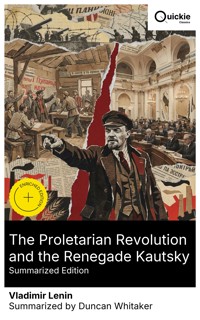
Lenin's The Proletarian Revolution and the Renegade Kautsky (1918) is a vehement defense of the October Revolution and the dictatorship of the proletariat against Karl Kautsky's The Dictatorship of the Proletariat. It opposes bourgeois parliamentarism to soviet democracy, justifies the dissolution of the Constituent Assembly, and reads legality through the prism of civil war and imperialist siege. Combining pamphlet heat with rigorous citation of Marx and Engels, it extends State and Revolution into the concrete problems of holding power. Lenin writes as both theorist and head of a besieged revolutionary government. A veteran of exile and factional struggle in the Second International, editor of Iskra, and author of Imperialism, he had just overseen the seizure of power and the painful Brest-Litovsk peace. His intimate engagement with Marxist doctrine and the immediate pressures of governance—food shortages, sabotage, the need to centralize authority—inform his insistence that proletarian rule requires new institutions and a break with parliamentary gradualism. Essential reading for students of Marxism, democratic theory, and modern revolutions, this work illuminates the 1917–1918 split in socialism and the meaning of "proletarian democracy," provoking reflection on strategy, legitimacy, and political form. Quickie Classics summarizes timeless works with precision, preserving the author's voice and keeping the prose clear, fast, and readable—distilled, never diluted. Enriched Edition extras: Introduction · Synopsis · Historical Context · Author Biography · Brief Analysis · 4 Reflection Q&As · Editorial Footnotes.
Das E-Book können Sie in Legimi-Apps oder einer beliebigen App lesen, die das folgende Format unterstützen:
Veröffentlichungsjahr: 2026
Ähnliche

The Proletarian Revolution and the Renegade Kautsky (Summarized Edition)
Table of Contents
Introduction
This book stages a decisive confrontation over whether the road to socialism can be pursued through the inherited mechanisms of parliamentary democracy or must be forged by a revolutionary proletariat constructing new institutions of power, a conflict between reformist continuity and transformative rupture that hinges on how one reads Marxism, how one defines democracy under capitalism, and whether overturning an old state to found another can be justified, compelling readers to consider not only which political forms can serve the many, but also who is entitled to build them, by what means, and under what historical circumstances.
Vladimir Lenin’s The Proletarian Revolution and the Renegade Kautsky is a political polemic published in 1918, written in the aftermath of the October Revolution and the collapse of the old imperial order in Russia. It addresses the immediate controversies of the early Soviet period while engaging a broader audience in the socialist movement. The book is framed as a response to Karl Kautsky, a prominent theorist of the Second International, whose recent critique of the Bolsheviks became influential among socialists wary of revolutionary methods. Set against wartime dislocation and fragile new institutions, Lenin situates his arguments within an unsettled global and domestic horizon.
At its core, the book examines competing interpretations of the dictatorship of the proletariat, the character of democracy under capitalism, and the forms of authority that follow a successful uprising. Without rehearsing every turn of the debate, readers should expect a rigorous counterargument to Kautsky’s positions, grounded in textual readings of Marxist sources and in the political experience of 1917 and its aftermath. The premise is straightforward: if socialism requires a break with capitalist power, what shape should that break take, and how should it be justified? The reading experience interweaves theory, historical reflection, and pointed engagement with a contemporary opponent.
Lenin writes in an exacting and combative register, moving from definitions to applications with a focus on clarity of terms. The prose is insistent, often repetitive for emphasis, and uses close citation of canonical Marxist texts to anchor claims. He pairs conceptual distinctions with concrete examples drawn from recent events, producing a rhythm that alternates between analytic exposition and polemical critique. While the tone is severe, the structure is methodical: a claim by Kautsky is reconstructed, its assumptions pulled apart, and an alternative conception is advanced. Readers encounter a voice intent on guarding theoretical precision while defending choices made under revolutionary pressure.
Several themes recur with special force: the difference between bourgeois and proletarian democracy; the purpose of a transitional state rooted in working-class power; the relationship between legality, legitimacy, and revolutionary necessity; and the tension between representative institutions and direct class rule. The book also navigates the fate of the Second International, the pitfalls of opportunism, and the obligation to read Marxism as a guide to action rather than a purely academic doctrine. Throughout, the argument insists that the meaning of democracy cannot be abstracted from class relations, and that forms of government are judged by whose power they enable.
For contemporary readers, the text remains a bracing guide to questions that outlast its moment: how movements relate to institutions, what kinds of mandates authorize sweeping change, and where the line falls between reform and transformation. Debates about emergency powers, constituent processes, and the promise or limits of elections recur in many settings, and Lenin’s intervention clarifies the stakes when established norms meet demands for structural equality. Even where one dissents from his conclusions, the book sharpens vocabulary and criteria, challenging readers to specify what democracy means, for whom it operates, and which strategies can realistically dislodge entrenched forms of rule.
Approached as a historical document and as a work of theory, The Proletarian Revolution and the Renegade Kautsky rewards careful, active reading. It offers a stringent test of ideas that continue to animate labor struggles, left strategy, and constitutional imagination. By foregrounding the dispute with Kautsky, it dramatizes how divergences within a shared tradition can shape choices with world-historical consequences. The book matters not only as a defense of a particular revolution, but as a sustained attempt to define the means and ends of egalitarian politics. It invites readers to measure their own commitments against the demands of transformative change.
Synopsis
Vladimir Lenin’s The Proletarian Revolution and the Renegade Kautsky, written in 1918, is a polemical response to Karl Kautsky’s critique of the Bolshevik seizure of power and the concept of proletarian rule. Framed against the immediate backdrop of the Russian Revolution and the First World War’s political upheavals, Lenin sets out to defend the legitimacy of Soviet power while challenging Kautsky’s interpretation of Marxism. He identifies Kautsky as a prominent theorist who has, in Lenin’s view, broken from revolutionary principles. The work’s stated aim is to clarify what proletarian democracy entails and to expose what Lenin presents as Kautsky’s theoretical evasions and political inconsistencies.
Lenin begins by defining the dictatorship of the proletariat as a class rule intended to suppress the exploiters and reorganize society along socialist lines. He argues that Kautsky distorts classical Marxist teachings by separating democracy from its class content. Drawing on well-known precedents in Marx’s and Engels’s writings, Lenin maintains that revolution requires a new form of state power. The Soviets are presented as the institutional expression of working-class rule, formed through mass participation rather than parliamentary procedure. Throughout this early section, Lenin asserts that revolutionary authority is not an accident but the necessary political form of the transition to socialism.
Central to the book is a debate over democracy itself. Lenin contrasts bourgeois parliamentary democracy with proletarian democracy, claiming the former is structured to preserve capitalist dominance while the latter expands participation for workers and the poor. He contends that Kautsky treats democracy as abstract and class-neutral, thereby obscuring the realities of power. Lenin’s argument emphasizes the material conditions that shape institutions, insisting that form cannot be separated from social content. In this framework, suffrage, rights, and representation are assessed by whom they empower, with Lenin holding that Soviet structures bring the masses directly into governance and administration.




