


0,49 €
Mehr erfahren.
- Herausgeber: Quickie Classics
- Kategorie: Geisteswissenschaft
- Sprache: Englisch
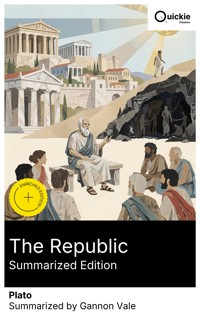
Plato's Republic is a dramatic Socratic dialogue that interrogates the nature of justice in the individual and the city, weaving dialectical argument with myth and images. Across ten books, Socrates and his interlocutors construct the kallipolis, governed by philosopher-kings, articulate the tripartite soul, and advance a rigorous program of education, including music, gymnastics, and mathematics. The analogies of the Sun and the Divided Line culminate in the Allegory of the Cave, situating politics within a metaphysics of Forms and a critique of poetry and mimesis. Composed in the early fourth century BCE, the work bears the imprint of Plato's aristocratic Athenian upbringing, the trauma of the Peloponnesian War, and, above all, the execution of his teacher Socrates. As founder of the Academy, Plato seeks a curriculum for rulers, reshaping civic life through philosophical training and ethical discipline, against the perceived excesses of democratic and oligarchic regimes. Readers interested in political theory, moral psychology, education, or epistemology will find The Republic inexhaustible. Approach it patiently, attending to its dramatic form as well as its arguments; it rewards with a vision of civic order linked to the quest for truth, and a bracing challenge to our assumptions about freedom and culture. Quickie Classics summarizes timeless works with precision, preserving the author's voice and keeping the prose clear, fast, and readable—distilled, never diluted. Enriched Edition extras: Introduction · Synopsis · Historical Context · Author Biography · Brief Analysis · 4 Reflection Q&As · Editorial Footnotes.
Das E-Book können Sie in Legimi-Apps oder einer beliebigen App lesen, die das folgende Format unterstützen:
Veröffentlichungsjahr: 2026
Ähnliche
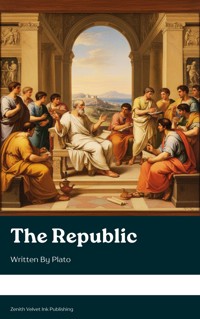


The Republic (Summarized Edition)
Table of Contents
Introduction
What kind of justice could harmonize a city and a soul, and what must be sacrificed to achieve it? Plato’s The Republic orchestrates a dramatic, searching inquiry into the shape of a good life and a well-ordered community. Through the voice of Socrates and a chorus of interlocutors, the dialogue probes definitions, tests arguments, and builds bold proposals, constantly inviting the reader to join the examination. It is neither manifesto nor mere debate; it is an extended exercise in thinking together under pressure. By moving between personal ethics and political design, it exposes how our convictions about fairness, knowledge, leadership, and education collide and cohere.
Composed in the 4th century BCE, The Republic is a philosophical dialogue set in classical Athens and written in ancient Greek. It belongs to the tradition of Socratic conversations that Plato crafted to explore enduring questions by staging lively exchanges. Rather than narrating events, it presents a conversation led by Socrates among citizens and visitors, unfolding over the course of a single meeting. The work survives as part of Plato’s corpus and has been studied for centuries through manuscripts and translations, shaping the disciplines of ethics, political philosophy, and epistemology.
The premise is disarmingly simple: asked what justice is and why it matters, Socrates examines common opinions and confronts confident rivals. The discussion intensifies as positions are tested, revised, and sometimes overturned. Readers encounter analogies, definitions under strain, and carefully constructed thought experiments designed to make hidden assumptions visible. The tone alternates between playful challenge and severe scrutiny, with an exacting yet accessible voice that models inquiry rather than preaching. Without revealing later turns, it is enough to note that the conversation ranges from everyday practices to sweeping visions that let the initial question be seen anew.
Central themes include the nature and value of justice, the relationship between individual character and civic institutions, the education of citizens and leaders, and the conditions under which knowledge can guide power. Plato also examines the pull of desire, honor, and wealth, the stability of constitutions, and the tension between poetry, persuasion, and truth-seeking. By juxtaposing the order of a city with the order of a soul, the dialogue invites readers to consider whether political reforms without personal transformation—or vice versa—can ever suffice. Throughout, the work asks what authority reason can claim amid competing values and interests.
For contemporary readers, these questions remain urgent. Debates about leadership, institutional trust, civic education, inequality, and the role of expertise echo the dialogue’s central concerns. The Republic offers tools for diagnosing how communities justify power and distribute burdens, how citizens form beliefs, and when ideals clarify or distort reality. Its arguments do not require agreement to be productive; they sharpen disagreement by demanding clarity about ends and means. In classrooms, public discourse, and private reflection, the dialogue continues to frame conversations about justice and the responsibilities that come with freedom and authority.
As a reading experience, The Republic is richly layered. Its dialectical rhythm moves from refutation to construction, using definitions, divisions, and illustrative stories to trace the contours of an argument. Characters serve as intellectual stances as much as persons, giving the exchange both dramatic immediacy and conceptual range. Arguments return in revised form, so early pages acquire new significance as later sections unfold. Different translations capture different nuances of tone and technical vocabulary, but the core experience remains: a disciplined, imaginative conversation that treats philosophy as a shared, demanding practice.
Approached with patience and curiosity, The Republic rewards readers who treat it less as a blueprint than as an invitation to examine their own assumptions. Its enduring power lies not only in specific proposals but in the method of arguing in the open, testing claims against counterclaims, and accepting the costs of coherence. The dialogue’s closing resonance is not finality but orientation, a sense that the pursuit of justice requires continuous recalibration in thought and action. To enter this work is to learn how to ask better questions about what we owe to ourselves, to others, and to the common world.
Synopsis
Plato’s The Republic, composed in the fourth century BCE, is a philosophical dialogue that stages an inquiry into justice and the best political order. Set in and around the Piraeus in Athens, it follows Socrates in conversation with Cephalus, Polemarchus, Thrasymachus, Glaucon, Adeimantus, and others. Across ten books, the discussion moves from everyday opinions to sustained theoretical construction. The central questions are what justice is, whether the just life is desirable for its own sake, and what institutions would cultivate it in a city. The work blends ethical psychology, political theory, and epistemology, using imagined models and rigorous argument rather than appeals to authority or custom.
The dialogue opens with Socrates examining conventional notions of justice. Cephalus proposes a view tied to truthful speech and paying debts, which Socrates shows can produce contradictions in difficult cases. Polemarchus recasts justice as helping friends and harming enemies, but Socrates argues that harming anyone makes them worse and cannot be a virtue’s aim. Thrasymachus intervenes forcefully, claiming that justice is the advantage of the stronger and that ruling powers define what benefits themselves. Socrates challenges the coherence and desirability of this position, pressing issues of expertise and common good. The exchange ends without final agreement, setting the stage for a deeper, more systematic inquiry.
Glaucon and Adeimantus renew the challenge by demanding a defense of justice that shows it valuable in itself, not merely for rewards or reputation. To test this, the discussion considers how people might behave if consequences could be avoided, and whether social order rests on mere compacts. Socrates proposes constructing a city in speech to find justice writ large. Beginning with a simple community founded on need and division of labor, the account traces pressures toward luxury, increased desires, and conflict. To protect the city, a class of guardians is introduced, requiring careful selection and training to combine spirited courage with philosophical steadiness.
The education of guardians is presented as the soul’s shaping through music and gymnastics, supervised tales, and habits that cultivate harmony. Socrates insists that young minds should encounter narratives that foster courage, moderation, and reverence for what is noble, while avoiding stories that incite fear, cruelty, or disorder. Physical training aims at balance rather than extremes, pairing strength with gentleness. The guardians must learn to love their city and hate its enemies appropriately, yet remain open to rational persuasion. A founding civic story is proposed to promote solidarity and acceptance of roles, subject to the overarching requirement that leadership be guided by knowledge, not appetite or honor alone.
With the guardian class established, the dialogue identifies the virtues of the city. Wisdom resides in the knowledge of its rulers, courage in the steadfastness of its defenders, and moderation in the concord among all classes about who should rule. Justice appears as each part doing its own work without interference. This civic pattern becomes a model for the individual soul, which is analyzed into rational, spirited, and appetitive parts. Justice in the person is likewise a harmonious ordering in which reason governs with the support of spirit, restraining unruly desires. The city thus provides a magnified mirror for diagnosing and cultivating personal virtue.
The argument then advances toward the question of who should rule. Socrates proposes that only true philosophers, lovers of wisdom who grasp stable realities, are fit to govern. The inquiry introduces the Forms as objects of knowledge, with a special emphasis on the Form of the Good as the source of intelligibility and value. To approach it, prospective rulers undergo a long curriculum in mathematics and related studies that train the mind away from the senses. Dialectic crowns this education, but only at the right time and with carefully tested natures, to avoid cynicism or sophistry that could harm the city.
To convey the difference between opinion and knowledge and the path of education, Socrates offers connected images that contrast the seen with the intelligible and depict ascent from darkness to light. The famous allegory presents a journey from captivity in appearances to the vision of what truly is, followed by a compelled return to care for those below. Education is recast as a reorientation of the soul, not mere information transfer. The city must arrange stages of study, service, and examination, selecting those who persevere through intellectual and moral trials. The best are obliged to rule, balancing contemplation with civic responsibility.
Having outlined the just city and its rulers, the dialogue examines how real cities change and decline. It presents a sequence of constitutions that depart from reason’s rule: a regime valorizing honor, one dominated by wealth, a broad democracy marked by unregulated freedom, and finally tyranny, where a single ruler’s lawless desires prevail. Each political form is paired with a corresponding type of soul, showing how institutional arrangements shape character and vice versa. The analysis probes how admirable traits can, without guidance, turn into sources of disorder, and how unchecked appetites can enslave individuals and communities alike.
The final book turns to the status of poetry and imitative art, arguing that certain kinds of representation, if unregulated, can mislead judgment and inflame passions. A case is made for aligning cultural forms with ethical education. The discussion also addresses the soul’s resilience and the stakes of choosing a life, culminating in a concluding tale that frames human conduct within a larger moral horizon. The Republic closes by reaffirming the inquiry’s scope: the search for justice in city and soul, the role of knowledge in governance, and the lifelong task of education. Its questions continue to shape debates about virtue, power, and the common good.
Historical Context
The Republic is set in classical Athens during the late fifth and early fourth centuries BCE, with its opening scene in the bustling port of Piraeus. The dialogue begins during the Bendideia, a Thracian festival introduced to Athens late in the Peloponnesian War, signaling the city’s cosmopolitan connections. Socrates converses at the house of Cephalus, a wealthy metic and arms manufacturer from Syracuse, whose family included Lysias and Polemarchus. The presence of metics, slaves, and citizens in Piraeus exemplifies the social and economic fabric of Athenian life, where trade, religious rites, and political talk intertwined in homes, marketplaces, and gymnasia.
Athenian democracy operated through the Assembly, the Council of Five Hundred, and large popular courts. Most offices were assigned by lot, and jurors and other civic participants received pay, encouraging broad citizen involvement. Public policy rested on persuasive speech in the Assembly and courts, where litigants, politicians, and ambassadors competed before mass audiences. The educational marketplace responded: professional sophists offered instruction in rhetoric, argument, and civic virtue for fees. The prominence of forensic and deliberative oratory shaped the terms in which justice, law, and advantage were debated. The Republic stages its questions against these institutions that rewarded persuasion and quick judgment.
Between 431 and 404 BCE, the Peloponnesian War pitted the Athenian empire against Sparta and its allies, drawing in many Greek states and Persian funding. Athens endured plague, political turmoil, and catastrophic setbacks, notably the failed Sicilian Expedition of 415–413. Tribute from subject cities supported Athenian fleets and juror pay but bred resentment and revolt. Wartime strains sharpened debates about leadership, expertise, and the reliability of mass decision-making under pressure. The Republic emerges from this climate of defeat and reassessment, probing what kind of education and institutions might sustain a stable, virtuous polis rather than a volatile, overreaching one.




