


Erhalten Sie Zugang zu diesem und mehr als 300000 Büchern ab EUR 5,99 monatlich.
- Herausgeber: Corvus
- Kategorie: Abenteuer, Thriller, Horror
- Serie: A Revolution Spy series
- Sprache: Englisch
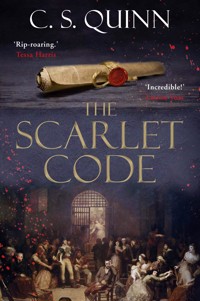
Amazon reviewers love The Scarlet Code! 'A rollicking good tale' 'Thoroughly enjoyable, highly recommend' 'Exciting, swashbuckling adventure' 'Everything you could want from an adventure thriller: excitement, a fabulously endearing heroine and pirate to fall in love with, a cruel killer and... well-written historical detail. Superb.' 1789. The Bastille has fallen... As Parisians pick souvenirs from the rubble, a killer stalks the lawless streets. His victims are female aristocrats. His executions use the most terrible methods of the ancient regime. English spy Attica Morgan is laying low in Paris, helping nobles escape. When her next charge falls victim to the killer's twisted machinations, Attica realises she alone can unmask him. But now it seems his deadly sights are set on her. As the city prisons empty, and a mob mobilises to storm Versailles, finding a dangerous criminal is never going to be easy. Attica's only hope is to enlist her old ally, reformed pirate Jemmy Avery, to track the killer though his revolutionary haunts. But even with a pirate and her fast knife, it seems Attica might not manage to stay alive. 'A rip-roaring adventure' Tessa Harris on The Bastille Spy
Sie lesen das E-Book in den Legimi-Apps auf:
Seitenzahl: 458
Veröffentlichungsjahr: 2020
Das E-Book (TTS) können Sie hören im Abo „Legimi Premium” in Legimi-Apps auf:
Ähnliche



















Also by C. S. Quinn
A Revolution Spy Series
The Bastille Spy
The Thief Taker Series
The Thief Taker
Fire Catcher
Dark Stars
The Changeling Murders
Death Magic (short story)
Published in hardback in Great Britain in 2020 by Corvus, an imprint of Atlantic Books Ltd.
Copyright © C. S. Quinn, 2020
The moral right of C. S. Quinn to be identified as the author of this work has been asserted them in accordance with the Copyright, Designs and Patents Act of 1988.
All rights reserved. No part of this publication may be reproduced, stored in a retrieval system, or transmitted in any form or by any means, electronic, mechanical, photocopying, recording, or otherwise, without the prior permission of both the copyright owner and the above publisher of this book.
This novel is entirely a work of fiction. The names, characters and incidents portrayed in it are the work of the author’s imagination. Any resemblance to actual persons, living or dead, events or localities, is entirely coincidental.
10 9 8 7 6 5 4 3 2 1
A CIP catalogue record for this book is available from the British Library.
Hardback ISBN: 978 1 78649 846 5
E-book ISBN: 978 1 78649 849 6
Printed in Great Britain
Corvus
An imprint of Atlantic Books Ltd
Ormond House
26–27 Boswell Street
London
WC1N 3JZ
www.corvus-books.co.uk
For Simon, Natalie and Ben
CHAPTER ONE
Lisbon, 1789
IT IS NIGHT. THE DOCKYARD IS STILL, SAVE FOR THE CREAK of masts and tap of wood as boats knock against one another. From the crow’s nest of an empty ship, I survey the shore. Guitar sounds and the occasional shout float on the air. A scent of garlic and frying fish from grills outside sailor taverns. As I watch, the last torch on a quay flutters out. The land guard is asleep. There is no time to lose.
I draw my knife; a great curved black blade. Placing it between my teeth I drop silently from the crow’s nest to the deck, landing feet apart, balance perfect, taking the weapon into my hand. I wear assassin’s garb – soft-soled dancing slippers, loose Arabic-style clothes, black silk trousers, a long-sleeved kurta cut short, tied with a thick scarf at the waist. My dark hair is braided up.
I slip across the deck, barely making a sound, step on to the prow, and jump easily across to the next ship. I assure myself the vessel is deserted, the crescent darkness of my knife invisible in the moonlight.
Looking out on to the water, I count the ships. Three to pass over until I reach the one where the captive is held. Her kidnappers have hidden her well: in an empty floating prison bound for Africa, to be filled with slaves.
Since there is no cargo yet loaded, there is a scant guard, but still I am careful. Assuring myself all is clear, I cross the deck, leap to the next boat. I’m in a rhythm now, running, jumping, checking for threats, knife held tight in my fist. I traverse a ship destined to take wool to England, a lumber transporter from Sweden, the smell of cut pine still fresh on deck. I arrive finally on The Saint Jose. A gilded diplomatic ship, old-fashioned, with a broad belly and shapely rear rising to a duck’s tail of decorative carving and small windows.
Now my pace slows. There will be guards here. Quietly, I pad towards the captain’s quarters at the back. As I suspected, the door is tightly secured from the outside. I need to open the padlock.
The first attack comes swiftly from behind. Feet strike the deck, then someone grabs my shoulder. My own hand sweeps back, locating my attacker’s jugular, and I turn to face him. For a moment our stance is almost romantic, my fingers lightly at his throat, his grip still on my shoulder. With our faces only inches apart, his lips part in surprise. He hadn’t been expecting a woman, and other instincts are befuddling him. Before he can resolve his confusion, my knife arrives at the artery my fingers have located. He drops soundlessly, blood filling his lungs.
The second man is only half-awake, a strong smell of drink pouring from him as he staggers to his feet. My eyes log the keys swinging at his hip. I close in before he can point his gun, since silence is imperative. His hand shoots out, grabs my chin. My knife is under his armpit, up and out before he realises. As he loses his grip on me, my knife comes up and around the base of his skull. The right eyelid spasms and he drops. I catch him before he thuds to the deck and lay him softly down.
I stand watching his twitching eye, still trained on me in disbelief. When the dying gaze clouds, I unhook his set of keys, then take the pistol from his belt and launch it through the air. It lands loudly on the deck of the lumber ship and a flurry of footsteps rings out on the adjacent deck. I listen, tense, making sure that any other guards are headed away. Then I approach a magnificent cabin door with its gaudy lock.
Always the way with Catholic countries, I think to myself as I fit the golden key, to keep captives in finery.
The door opens to reveal a woman, fashionably dressed in the latest French style of blousy muslin. She is sat at a table with a carafe of red wine and a silver plate before her. To her right is a bread basket and she holds a torn piece of its content half to her mouth as she stares at me in surprise.
‘Am I being abducted?’ she asks finally. ‘How droll. Did the Duke send you?’ she adds hopefully.
Naturally, as a noblewoman, she reads a good deal too many romance novels.
‘You are Fleur de Lucile?’ I confirm, as she adjusts her dress to expose more of her shoulders.
She nods.
‘You have already been abducted,’ I tell her. ‘It is only that you haven’t noticed.’
She looks around the decorated captain’s cabin.
‘It is a jest?’ she suggests, the slightest frown of puzzlement crinkling her smooth, white forehead. ‘As you can see, I am very well cared for.’ She gestures by way of explanation to the spread of food and wine, the finely set mahogany table.
‘Silver forks do not ensure a host is trustworthy.’ I walk to the window of tiny glass panes, assuring myself no warning torches have been fired on the docks. ‘Your husband’s stance against slavery has gained you powerful enemies.’ I turn back to her. ‘Did you ever question why your door was bolted from the outside? Why you are here alone, with guards placed to keep watch?’
‘They said it was for my own protection,’ she says slowly. ‘The Portuguese ambassador—’
‘Is in the pockets of the slave traders,’ I say, moving closer to her table. ‘You are aware how much money is made by slave trading every year?’
‘Oh yes,’ she says, rolling her eyes. ‘My husband’s friends are tiresome on the subject. But what has this to do with me?’
‘Your husband is due to address the King and convince him to sign the Rights of Man.’
Her mouth moves slowly, trying to match the words to a memory.
‘The document written after the Bastille was stormed,’ I explain patiently. She smiles in polite confoundedness.
‘Agreeing that all men are equal,’ I say, keeping my frustration in check.
‘Oh that!’ She claps her hands together. ‘Why should plantation owners care if commoners and nobles are equal?’
‘If the King signs the Rights of Man,’ I tell her, ‘he accepts that all men are equal. All men. Including the blacks in the French colonies.’
She does the thing with her mouth again, as though sounding out difficult words.
‘Your captors are ruthless men; plantation owners, who will do anything to protect their business,’ I tell her. ‘Believe me, they have done worse than cut the throat of a lady and toss her in the sea.’
Understanding finally flickers over her features. She stands in shock.
‘Who are you?’ she manages. ‘Are you Portuguese?’ she adds, taking in the shade of my skin and my black hair. I reach into my kurta and remove a letter from her husband. She takes it wordlessly.
‘My name is Attica Morgan,’ I say, as she reads. ‘I’m an English spy. I have come to rescue you.’
CHAPTER TWO
FLEUR STARES FOR A LONG TIME AT HER HUSBAND’S LETTER.
Her eyes dart to me, something in her mind not matching.
‘How am I to trust you?’ she asks eventually. ‘How can I be sure you are a friend?’
In reply I show her the slave brand, hidden under my hair at the back of my neck.
‘My mother was African,’ I explain. ‘We were enslaved together in Virginia when I was a girl. She died.’
Her eyes dart all over me now, looking for clues and inconsistencies. I often have this effect on people, since I am half of one continent, half of another. The medley of tawny skin and light eyes has been a great boon in my spy work, since I can pass for many nationalities.
‘As soon as I got old enough to outrun my captors, I escaped to England and found my father. Lord Morgan,’ I tell her.
‘You are Lord Morgan’s daughter?’ She says it that way people always do, when they know rumours of my bastard origins. ‘I have heard of Lord Morgan,’ she says slowly.
‘Everybody has,’ I say, unwilling to have the same tired conversation about my brilliant, yet erratic, father, and his brief awful decline into laudanum addiction. ‘He is better now,’ I add. ‘Remarried. We should go.’
My family history has been enough to convince her. Fleur follows me on to the dark deck, and then grips my arm tight at the sight of the slaughtered guards littering the floor outside her cabin.
‘They’re dead,’ I assure her, but it doesn’t have the effect I hoped. I wonder briefly if I should have brought smelling salts, but Fleur manages to collect herself.
‘This way.’ I draw her to the prow, looking out on to the inky black water of the docks.
We creep along the edge of the boat. Moving to the side of the deck, I pull out my tinderbox and strike it. There’s a pause and then across the docks another light flickers in reply. I count the flashes. Three.
‘That’s the signal,’ I tell Fleur, identifying the ship. ‘Our rescuers are near. We will sail by night, and you shall be back with your husband by morning.’
‘You surely will not attempt to sail us out of these docks?’ says Fleur, panic rising. ‘They are guarded. As soon as we raise anchor, they will gun us out of the water.’
‘You must keep faith, madame.’
I unwrap the scarf from my waist and begin fashioning a makeshift grappling hook, tying the end to my knife handle.
Fleur watches the black curved blade in amazement.
‘It is a Mangbetu,’ I say proudly, ‘awarded to the fiercest fighters of the African Congo. My mother gave it to me.’
I send the blade winging over the side of the ship to lodge in a little yacht bobbing adjacent to us. Walking to the ship’s wheel, I attach the other end of the silk and begin turning. Gripping with both hands, I haul on the scarf, winding it in. There’s a creaking sound as the little yacht begins drifting towards us. It’s hard work and sweat beads my forehead, but I manage to pull the vessel close.
I allow the scarf to slacken. Our boats bob naturally against another. I put one leg over the prow and begin climbing down the rungs of the side of our larger boat, with Fleur following above me.
Once aboard I strike the tinderbox again. There is a pause, then a rope at the prow lifts clear from the water and tightens, and, slowly but surely, we are pulled silently between the enormous ships until we reach the hull of a large vessel waiting at the edge of open water.
A grappling hook spins from above and lands loudly on the side of our yacht. Fleur starts back with a cry of fear, then clamps her hands over her mouth. I can see the whites of her eyes in the moonlight, wide and frightened. A pack of swarthy men can be seen from the higher deck, winching our boat close to theirs.
‘You mustn’t mind their appearance,’ I tell Fleur. ‘They are here to help us.’
A dark figure slides expertly down one of the ropes and lands nimbly on our deck. He steps from the shadows. Jemmy Avery, almost invisible in his black shirt and trousers, only his sword and flashy set of pistols glinting in the moonlight. He makes me a mock bow.
‘Your Ladyship.’ Jemmy winks.
I give him a wide smile. ‘Good to see you, Captain Avery.
‘This is Jemmy Avery,’ I tell Fleur, noticing the fear in her eyes has deepened. ‘He is …’ I decide to omit the word ‘pirate’. ‘… a good sailor,’ I conclude.
‘Best sailor this side of the South Sea,’ corrects Jemmy. ‘And only that because we know of no land beyond it.’
‘A humble man, as you see,’ I murmur.
To Fleur, Jemmy bows low, taking off his broad-brimmed hat and rolling it smoothly along his forearm. I notice Fleur’s shoulders relax, her expression soften.
‘And this must by Fleur de Lucile? Do not fear; you are quite safe with me.’ Jemmy is the very devil for charm when he needs to be.
He offers her his hand. ‘May I? There is a ladder along the side of my ship.’ He points to where nailed planks can be seen, picking a route up the side to the top.
Fleur’s blue eyes widen. She is smiling coquettishly.
‘It looks very dangerous,’ she says, her voice suddenly breathy and low. ‘I am afraid.’
‘Madame, I shall climb beneath you,’ Jemmy assures her. ‘If you slip I can break your fall. You are quite safe.’
Her smile broadens. I roll my eyes. Jemmy hands her to the first rung, and we all three ascend to our ship, Fleur moving faster than I might have thought possible for a woman so afraid of heights.
As we reach the top, Jemmy leaps to a nearby rope and pulls himself up the final distance on to deck, so he might reach down and hand Fleur up.
‘Welcome to my ship,’ he tells her.
‘My saviour,’ she says, batting her lashes. ‘How can I ever repay you?’
‘A word, Captain Avery?’ I interject, heaving myself up unaided and swinging my legs on to the deck.
‘Thank you kindly,’ mutters Jemmy, raising a dark eyebrow at me and glancing back at Fleur. ‘Anyone would think you were jealous.’
‘Everything is as we planned?’ I ask.
His eyes meet mine, their mongrel mix of green and brown masked by the moonlight. The teardrop-shaped burn at the side of his face looks more livid in the shadow.
‘It is all as you wished it,’ he says. ‘The boys have been working hard. Lining below deck with barrels of pitch and brimstone, honeycombed. Brush and straw across the top. It goes against my boys’ nature, to be sure, treating good ships that way. You’re certain this will work, Attica?’
‘I’m certain there’s no other way out of this dock.’
His lips press together.
‘I made a great study of naval warfare in my youth,’ I assure him. ‘So long as you can sail us where we need to be, it will work.’
‘I can sail a horse trough through a hurricane, Attica, you needn’t worry about that. She’ll be where you want her.’ He pats the prow then glances to Fleur, who is standing a little apart from us now. Jemmy runs a hand over his shoulder-length black hair. ‘Ready to blast the slave traders all to hell?’ he says.
‘Ready.’
Jemmy strides to the ship’s wheel, calling orders to his men. We are all action now, with no time for silence. Sails are trimmed, yardarms swing. The night breeze fills the sail. Shouts come from the shore. A torch lights.
‘They’ve seen us now,’ mutters Jemmy, turning the wheel expertly. ‘Let’s hope this old girl doesn’t fall apart on us. There’s a good tide once we’re clear.’
The crew are cutting away the wrapping ropes, severing our connection to the smaller yacht as we drift free. We pick up the wind and begin a slow course off shore.
Men are running along the quay, their voices raised as they near us, climbing aboard a man-of-war bristling with cannons.
Fleur is shaking her head, hands gripping the side of the boat.
‘We’ll never make it,’ she whispers. ‘They’ll blow us to pieces.’
In answer, I strike a flint. It sparks on a little puff of cotton-flower kindling. I pick up the flaming material, lean overboard and drop it straight through the opening of the smaller yacht, drifting away from us. There’s a silent moment before a crackling of ignition. Then smoke begins pouring up.
Moments later, flames lick upwards. The vessel continues to drift, headed straight for a cluster of moored boats that Jemmy’s crew have already packed with tar and brimstone.
‘We’re not going to escape these docks,’ I tell her, as Jemmy and his crew manoeuvre our rickety boat expertly towards the open ocean. ‘We’re going to burn them. Every last ship.’
Jemmy spins the wheel and the sails catch fully. Our boat begins to pick up speed, sailing fast from the Lisbon docks.
When I look behind us, all is blazing fury, as the fiery boat bobs benignly against the other moorings, spreading flaming cinders on everything it touches.
We enter the cool night air of the ocean with nothing but smoke and flames behind us.
CHAPTER THREE
Paris, one week later
JEMMY AND I APPROACH A SMART TOWNHOUSE – ONE OF THE newly built edifices of cream-coloured stone. All along the street the carved façades are designed to echo ancient Greece, with stucco shaped like temple thresholds and half-pillars.
‘The most soulless part of town,’ murmurs Jemmy. ‘Not a wine shop in sight.’
‘No stink of overflowing gutters,’ I point out, though I am inclined to agree with him. My own apartment is in a neighbourhood of multi-generational buildings.
‘You have to admit this is getting more risky,’ says Jemmy. ‘Since this Rights of Man, the plantation owners are out for blood.’
‘They’re afraid,’ I say. ‘It’s a good thing.’
‘Think the King will ever actually sign it?’
‘We can only hope. And continue to rescue those the plantation owners threaten.’
I raise my hand and knock on the door.
‘You might have worn something French,’ he says wistfully, looking at my rigid clothing as we wait. ‘Floaty gauzy things are all the fashion now.’
‘I wouldn’t expect an American to understand,’ I tell him. ‘But I have loyalty to my country. Not to mention, thick corsetry hides all manner of lethal things.’ I pat the sturdy confines of my stays.
‘Patriotism extends to fashion, does it?’
‘Of course it does. It’s the only way women can be political. You were born in a country that is not a country,’ I tell him. ‘There is a code to it all that is lost to you.’
I glance up at the house, wondering why it is taking so long to answer the door.
‘As you well know, I live to my own code,’ says Jemmy. ‘Be loyal to your crew, defend those who need defending—’
‘And don’t kill anyone you like,’ I finish. ‘I know. You are tiresome on the subject of pirate honour.’
‘And what is your code, Lady Morgan?’
‘I am English.’
He throws his hands up in frustration. ‘You were born illegitimate to an African slave mother, and spent the first five years of your life in America.’
‘My mother was Queen of her Congo tribe,’ I say, insulted. ‘And my parents were married in the sight of the elders—’
‘My point is, you’re no more English than I am.’ He shakes his head. ‘Perhaps less,’ he adds, ‘if my mother’s claims about my father are true. Though when my mammy’s not lying, she’s drinking, and when she’s not drinking, she’s whoring,’ he concludes philosophically, rubbing his nose and glancing up at the townhouse.
‘It isn’t about where you’re born. It’s a code, like yours. Keep your promises. Behave honourably.’
‘Qualities of a decent person, to be sure. Never knew England had the run of them.’
I think of my illegitimate uncle, Lord Pole, struggling always to be recognised as noble.
‘I am a spy,’ I tell him. ‘It is a low-down, dirty thing. If I don’t do it for the love of my country, it would make me … I don’t even know.’
‘A murdering criminal with integrity,’ beams Jemmy. ‘Like me.’ He leans forward and pounds aggressively on the door. ‘Manners aren’t always helpful,’ he adds with a wink.
I smile back at him despite myself. There is noise now inside, like someone coming down the stairs.
Jemmy makes an elaborate show of using the mud-scraper.
The door is opened by a maid who looks to have been caught halfway through eating. She takes my card, chewing violently, then swallows with effort before directing us to the first floor.
I can sense Jemmy mentally recoiling from the high hubbub of female voices in the room beyond, as the maid sails forth to deliver our card. An expensively dressed perfumer walks past us, his tray of little bottles tinkling, blazing a trail of his strongest stock in his wake.
‘You’re certain I need to be with you?’ tries Jemmy, edging back, waving away the scent.
‘Absolutely.’ I grab his arm. ‘We get our best information here. The salon ladies pay me no mind at all with a real-life pirate to paw at. Not even to bore me with their high views on Rousseau.’
‘It’s a poor business to be used as bait, so,’ says Jemmy, looking morose. ‘Not a single girl here cares a fig for their marriage vows.’
‘You cannot be as romantic as you pretend. You should go out in the city with me. See the sights.’
‘Oh no.’ He straightens his coat. ‘You’ll never see me in any of those bathhouses, Attica.’
‘It’s Paris. Everyone is doing it.’
‘Not me.’ He sighs, looking warily at the pack of decadently dressed women. ‘A little lapdog,’ mutters Jemmy miserably. ‘That’s what I am to those harpies.’
‘Don’t be so provincial. In any case, you love the macarons.’
CHAPTER FOUR
JEMMY AND I ARE WAITING FOR THE HOST, ABSORBING THE perfumed decadence of the salon. There are almost as many servants as guests, and women chatter animatedly as their dainty glasses are filled. A little band of musicians plays chamber music at a discreet volume in a far corner.
To his great delight, Jemmy has spotted the obligatory tray of macarons. His eyes follow the approaching maid, who now carries a silver salver of the pink delicacies. He takes four in a closed fist, then seeing my expression returns one, then another, awkwardly following after as the maid tries to take the tray away again.
‘Oh, let him take as many as he likes!’ says a shrill delighted voice. A cherub-lipped girl whose face holds the familiar hallmarks of noble descent bears down on us. She has a short, slanting forehead and a weak chin already giving way to fat, characteristics the French nobility have bred in over the last century. Combined with large brown eyes and thick, rather mannish brows, she reminds me of a friendly horse, right down to her hair, styled naturally, as is the fashion, but curled and ribboned as though she can’t quite go through with the lack of artifice. She smiles as she sails towards us, clapping her hands with glee, eyes only for Jemmy. ‘I’ll dare say they’re better than ship’s biscuits, Mr Avery.’
Jemmy, macaron halfway to his mouth, enacts some magic trick of vanishing it into his hand and bows deeply.
‘Madame du Quenoy,’ he says.
She curtseys in response, never shifting her eyes from his face, then notices me as an afterthought.
‘Mademoiselle Morgan.’ She curtseys politely. ‘I hope your translations are not keeping you up late?’ And without waiting for an answer, ‘Is this what they wear in England nowadays? Your people are becoming fashionable here, if you can believe it. Your unaffected country style.’ The words don’t match her open disdain for my rigidly panelled dress.
‘We’re simple people,’ I reply, eyeing her translucent muslin dress. ‘And as you see, I am traditional.’
‘Very good. Of course you are unmarried and must dress for an English husband.’ She gives a light laugh, then frowns a little, barely lining her sloped forehead.
‘Is there anyone you might like to be introduced to, Mademoiselle Morgan?’ she asks hopefully, eyes tracking between Jemmy and me in naked desperation to get him alone.
‘I shouldn’t be so bold as to suggest it,’ I say, as her face drops in dismay, ‘but I did hear Madame Pinochet’s husband might be in need of a translator.’
She brightens. ‘Allow me to take you to her.’ She links her arm in mine. ‘Don’t imagine you shall escape so easily,’ she adds, seeing Jemmy attempt to shuffle back out of view. ‘I must hear of your latest adventures.’
Madame du Quenoy marches us to a baffled-looking woman and all but throws me towards her.
‘Madame Pinochet, this is Mademoiselle Morgan. From England.’
The woman, thin as a rake with watery eyes and a beaky nose crusted with snuff, peers at me over a glass of wine. She makes the strange smile of an older lady who has learned not to crack her paste make-up, which has been applied liberally. Her ageing body, unaccustomed to the flowing liberty of the latest fashion, stoops and bulges as if yearning for support.
‘Mademoiselle Morgan,’ she says, not managing to hide her dismay as she curtseys. She looks around, hoping to find someone to foist me on. ‘Still working?’ she manages, her long finger trailing distractedly around the rim of her wine glass.
‘Oh yes.’ I smile. ‘I am making some very interesting Latin translations.’
‘Really?’ Her face strains with the effort of polite interest.
‘I’d love to tell you all about them,’ I add, as Jemmy is spirited away by our host. ‘But where are my manners? I should hear your news. Your husband travels to Versailles with the other plantation owners?’
‘Next Tuesday,’ she confirms guilelessly, relieved to be granted a reprieve from my academic discourse, as I mentally log the day. ‘Even nobles must fear the customs gates nowadays.’ She takes out a highly decorated snuffbox, turning it affectedly so I might notice the intricacy of the pearl enamelling.
‘Oh?’ I enquire politely, sipping wine. I glance across to Jemmy, who is now deep in the clutches of the young host. She has him backed against a wall whilst she leans in, head tilted, inviting him to give his opinion on a musk and rose oil behind her ears.
‘Of course, you are English,’ says my beaky-nosed companion. ‘You do not know how terrible things are here.’ The snuffbox makes another whirl through her fingers like a magician’s trick. She lowers her voice and leans in.
‘Since the Bastille fell, the King has put a customs guard on every gate out of the city.’
‘His Majesty wishes to tax the goods?’ I suggest, feigning ignorance.
‘Oh no, my dear. He wants to stop seditious books and papers. These filthy revolutionaries would spread their poison anywhere they could.’
I nod sympathetically.
‘But,’ she continues grandly, opening the snuffbox, ‘His Majesty is all the way out in Versailles. He has no idea what really happens in Paris.’ She shakes her head solemnly and I copy the gesture. ‘The men,’ she spits the word, ‘who guard the gates are open revolutionaries. They take it upon themselves to search everyone. Even their betters!’ She pauses to sprinkle snuff liberally on to the side of her hand and sniff violently. Her long nose goes into a kind of spasm and her bloodshot eyes shed a line of salty tears that slice through her paste make-up.
‘Last week my husband was detained for an hour while an upstart rifled his possessions. The guard even had the affront to wear the tricolour cockade in clear view.’
‘How very dreadful. I had no idea the city was in such disarray,’ I tell her. ‘I must be careful, for I wish to leave myself next week.’
‘Take the Porte Saint-Denis,’ she advises. ‘The King still had a few loyal men there.’
‘I am grateful to you,’ I say truthfully. ‘And I shall pray for your husband’s safe journey. You must be certain his carriage is well stocked,’ I prompt. ‘I am told there is no food to be had at the palace, for all the finery.’
‘Oh, they shall travel at night,’ she says, confirming my suspicion. ‘They mean to confound this dratted English fellow. The Scarlet Poppy, or some such, they call him. He seems to know all their plans even before they do.’
‘The Scarlet Pimpernel?’ I suggest.
‘Yes?’ The beady eyes settle on me in surprise. ‘How did you know that?’
‘Only by chance,’ I reply. ‘They say he is everywhere nowadays.’
Her eyes widen in alarm, imagining English villains lurking in every corner.
‘Allow me to fetch you more wine,’ I add. ‘You mustn’t concern yourself with the Pimpernel, madame. There is no question that you French nobles will find him out sooner or later.’
She nods vaguely as I depart, a small smile on my face.
CHAPTER FIVE
ROBESPIERRE ARRIVES AT THE CHEAP BROTHEL, HIS PRESSED lawyer’s suit of striped frock-coat with matching breeches and box-fresh wig entirely out of place. He is a diminutive man, a slip of laundered linen and polished leather in a byway of broad-shouldered sailors and loud-mouthed drunks.
With an expression of extreme distaste, he picks daintily around the animal droppings and rotting litter that have mulched into the mud of the streets, and looks in vain for a mud-scraper to clean his silver-buckled shoes.
The building was once a bishop’s house, but the lowceilinged style has fallen out of favour, and the church leases it cheaply. The carved oak door now stands perpetually open. Through it is a broad staircase, on which sailors stand in line, elbowing one another out of the way. On the landing above, a door opens and a man exits, rearranging his clothing. Behind him a tired-looking girl tilts her head at the long queue.
‘Next,’ she shouts, without enthusiasm.
Breathing in, to protect himself from the disease that must surely run rampant in the air, Robespierre pushes his way up the stairs, trying not to touch anything.
‘Hi there, city boy,’ says a drunken old salt, eyeing Robespierre’s neat clerical style. ‘There’s plenty of girls for you on the Champs Élysées. These cheap whores are for the sailors.’
‘I am not here for that purpose,’ mutters Robespierre.
‘Of course not,’ leers the old man, as the lawyer passes.
Robespierre ignores him, walking along the landing to the furthest door. A rabbit’s foot hangs on the handle. The symbol that the girl inside is not available.
‘She’ll not take kindly to being disturbed!’ shouts a man from midway on the staircase.
Ignoring him, Robespierre pushes open the door. A dark-skinned woman is squatting over a tin pot of dirty water, cleaning herself with a rag of strong-smelling chemicals. She pulls her skirts down hurriedly and stands, but not fast enough to disguise a rainbow of bruising along her flank.
Robespierre’s lips press tight together.
This is the famous Centime. He knows her. Or of her, rather. Has always pitied her at a distance. Even more so, now her brutal master has returned.
‘I have a keeper again now,’ she says fiercely. ‘You want a black girl, you must go elsewhere.’ Up close she is younger than he imagined, and her face is lovely. Large doe-like eyes, long-lashed and almost black. In contrast, her full lips are the softest, lightest pink, like a rose yet to bloom.
Robespierre is not generally a connoisseur of such things, but even he can see she is far too attractive for this low-rent place. The colour of her skin has counted against her. Probably, she believes herself lucky not to be walking the streets. He wonders which plantation she was shipped from.
‘He is in there?’ replies Robespierre simply, pointing to the door on the far side of the room.
Centime’s hostile expression drops away, replaced by several successive emotions.
‘He sent for you?’ she asks, fear twisting her face.
Robespierre crosses to Centime. His eyes dart to the door.
‘You must not fear,’ he says. ‘I mean you no harm.’ He remembers the bruises she tried to hide, thinking there are a hundred, a thousand, just like her, all over France.
‘His work?’ suggests Robespierre, gesturing at where the bruising lies.
‘He is a good and kind master,’ she says in a quavering voice. ‘You may not go in if you were not sent for.’
‘All this will soon be over.’ He sweeps a hand to encompass the brothel, perhaps France itself. ‘A new world is about to be born.’ Behind his glasses, his blue eyes are earnest. Something about his fervour calms her.
Without waiting for a reply, he turns the handle on the door, which has been partially covered by curtains. Despite his reassurances, his hand shakes as he enters the room.
It is far larger than the exterior might suggest, muggy with pipe smoke, and fashioned like an office with a large old desk. Sat behind it is a dark-haired nobleman with strong features – thick broad lips and heavy-lidded eyes with deep brows. They flick to the intruder, then narrow.
‘Who the devil are you?’ he demands. ‘I told that damned whore I was not to be disturbed.’
‘She is blameless. The fault is mine.’ Robespierre is taking in the spray of expensive lace at the man’s neck and cuffs, the golden threads that pepper his silken clothes.
‘Then you shall pay for it.’
‘The Marquis de Salvatore, I assume?’ says Robespierre, ignoring the threat, his lips tightening at the honorific title.
When the man’s face registers rage, Robespierre gives a thin smile. ‘You are more difficult to find out of the Bastille than inside it.’ He pulls a chair, hesitates for a moment, then sits with a brief glance at the seated marquis.
‘You dare sit before me?’ whispers Salvatore. ‘I shall have you whipped for your insolence.’
Robespierre gives the barest frown, his round glasses slipping fractionally down his nose.
‘Perhaps you should first ask yourself what kind of man has located you, here in this most secret of places, known only to your very closest of criminal companions,’ Robespierre pushes his glasses up with the tip of his finger, ‘before issuing the summary stock of threats you nobles aim at us commoners.’ Another frown sends the wire frames back down his nose.
Salvatore opens his mouth to reply, but Robespierre, perhaps sensing a second volley of displeasingly unoriginal denunciations, talks on.
‘You communicate with your colleagues in code, of sorts,’ says Robespierre, answering his own question without emotion. ‘I would suggest you look to something more sophisticated. Your current missives are very easy to break.’
He stands, and makes a short bow. ‘Allow me to introduce myself. I am Monsieur Robespierre. A lawyer by trade. I have a business proposition for you.’
Salvatore leans back in his chair, dark features fathomless.
‘Well then,’ he says, ‘I shall hear it, before I have you beaten.’
Robespierre gives no indication he is afraid. Instead, he removes papers from his coat and wordlessly passes them across.
Salvatore stares at the papers for a long time.
‘These routes are real?’ he demands finally.
Robespierre bobs his head, birdlike. ‘I am adept at breaking codes. This is only a small part of what I have translated.’ Emboldened, Robespierre takes a step forward. Salvatore shoots him a fierce look.
‘With my help, your arms smuggling operations will double their profits. Perhaps even triple them.’
Salvatore doesn’t disagree, only stares at the routes.
‘Three hundred livres,’ he says finally. ‘That is a high payment considering your impertinence. You shall have it in gold, and once you have given me the routes I shall never see or hear of you again.’
Robespierre’s mouth compresses very slightly.
‘I do not ask for money.’
‘Then what? A title?’ There is an open sneer on Salvatore’s face.
‘I want no titles,’ says Robespierre smoothly. ‘Such things are of no interest to a man such as myself. As you can see, I am a person of humble means.’ He gestures to his plain suit, immaculate but of a common cut. ‘There is only one thing I should desire in payment.’
‘Which is?’ Salvatore lets the paper drop now, as if expecting a price beyond his abilities.
‘A small thing only. A boon. Something that is well within your power to grasp.’ He gives a strange little smile, and Salvatore, who deals daily with murderous smugglers, recoils. ‘It is all a question of killing the right people.’
CHAPTER SIX
JEMMY AND I WALK IN COMPANIONABLE SILENCE FOR THE few minutes it takes to reach our favoured tavern.
The preferred spot is directly in front of Porte Saint-Martin, with tables on the street that allow drinkers to enjoy all the drama of the city gates. A girl with a jug of wine emerges as soon as we sit.
‘We’ve doubled our money these last weeks,’ she tells us, nodding to the gates. ‘Best seats in town to watch the aristos get their just deserts. They even threw one in the lock-up last week.’ Her eyes drift to an expensively clad man and wife, arguing in high outraged voices as a man in a tricolour cockade carelessly searches their carriage, making no effort to keep his muddy boots from the satin interior.
‘About time they got treated like the rest of us, stuck-up pigs,’ she opines. ‘No offence,’ she adds offhandedly, noticing my and Jemmy’s clothing.
‘I am no aristo friend,’ says Jemmy, offended. ‘An Irish boy raised in America is what I am. There are New York gutters that consider themselves too fancy for the likes of me.’ Her eyes drift to me, clearly deciding that whatever the reason for my dress it isn’t nobility.
She bobs a little curtsey and retreats, her eyes lingering a little too long on Jemmy’s face.
As soon as Jemmy and I are certain we are out of earshot and ensconced in the tavern we both speak at once.
‘Tuesday.’
‘We discovered the same, then,’ I confirm. ‘It will be Tuesday. By night.’
Jemmy nods, raking dark hair back behind his ear. ‘You were right about one thing,’ he says. ‘These bored girls will spill all their husbands’ plans without a second thought. But it’s become too dangerous, Attica.’
‘Why do you say so? The plan is working perfectly.’ I frown. ‘They tell us the plantation owners’ plans to sabotage the abolitionists. We protect those who need protecting. It can’t be more than a few weeks before the King gives in and signs the Rights of Man. All equal.’ I raise my cup in toast. ‘Whites and blacks included.’
Jemmy joins the toast uneasily.
‘We’re becoming known for only rescuing English people. It makes us vulnerable. I think we should mix our rescues. There’s a French lieutenant in danger, spoke out about the King …’
‘Atherton will never approve it.’
Jemmy’s face adopts a pained look. ‘Must we always do what Atherton says?’
I pause, glass halfway to my lips. ‘We need Atherton. He grants us inventions and tools we could not be without. We cannot ask him to go against his principles.’
‘You would say that. You’re in love with the fella.’
I chew my fingernail. ‘I have … a great affection for Atherton. But he is a married man.’
‘And the two of you fancy yourselves so high-minded, you won’t act on your feelings for one another. All this simmering unrequited business is bad for the blood. You’ll get overheated. If you want my advice, jump in the sack together and be done with it,’ Jemmy continues, rubbing his chin. ‘You might realise after all this green sickness, you’re not suited at all. A girlish fancy you never grew out of, if you ask me, falling in love with your teacher.’
‘He was never my teacher.’
‘He taught you all the code breaking, did he not? Arranged for you to train as an assassin in Sicily. It’s not just the difference in age.’ Jemmy’s face contorts, with the abrasive rum or something else. ‘He’s your spy-master. It’s … peculiar.’
‘Speaking of peculiar romances,’ I prompt, opting to change the subject. ‘Did our plump young host share anything else with you, besides a full view of her figure in that see-through dress?’
To my surprise, Jemmy hesitates uneasily.
‘She did, as a matter of fact,’ he says, something like an accusation in his tone. ‘Apparently Robespierre has been asking about the Scarlet Pimpernel. He gets everywhere, you know,’ Jemmy adds pointedly. ‘Just like you.’
I hesitate. ‘Oh? Robespierre doesn’t suspect you, does he?’ I ask.
Jemmy snorts in reply. ‘It is well known that the Scarlet Pimpernel is an educated man, a genius of phenomenal intelligence and singular mind. I only learned to write my name in order to win a bet.’
‘Then what is the problem?’
Jemmy is sat at an awkward halfway angle on his chair, one booted foot splayed out, face creased in consternation.
‘The tokens, Attica,’ he says pointedly. ‘Little cards in the shape of red flowers?’
I sip wine a little too quickly. ‘What about them?’
‘You’ve been using them when I told you not to. And now it seems Robespierre has gotten hold of several. I warned against it. Those things are an arrogance. A foolishness. A robber doesn’t leave a calling card.’
‘We are not robbers,’ I tell him. ‘This is entirely the reason we should be known. It is important the Scarlet Pimpernel is not some highwayman vigilante or plunderer. We are freedom fighters.’
‘Anyone would think you want to be found,’ says Jemmy.
‘Now you are absurd.’
‘Well, whatever you were wanting to gain by your little flourish,’ decides Jemmy, leaning back more easily and crossing one ankle over the other, while considering me over his silver tankard, ‘you succeeded in deeply aggravating Robespierre. And I have the strangest feeling that just might have been your intention.’
‘Since when were you so concerned with my anonymity? I thought you were in this for the gold.’
Jemmy shrugs. ‘Perhaps I am a little converted. All this do-gooding rubs off on a man. I grew up a little gutter rat. I never dreamed I could have any impact on the world besides staying alive and depriving it of as much rum as I could fit in my belly. It’s refreshing to have a cause. Besides, we share an oath, do we not? We are crew now.’
‘Then let’s get back to the plan,’ I suggest, straightening my back and returning my cup to the little barrel that serves as a table. ‘If they go on Tuesday, then the pamphlet writer is in the most danger. We should extract her first.’
‘If you poke at a snake,’ says Jemmy, ignoring my attempt to change the subject and shifting in his seat to pour us both more wine, ‘do not complain when it bites you. You’re playing a dangerous game is what I’m saying.’
‘Who doesn’t love a little danger?’ I wink at him. ‘Surely Robespierre doesn’t frighten you? He’s the same size as my eleven-year-old cousin.’
‘Don’t make the mistake of underestimating him, Attica.’
‘Well, I have no fear of a murdering little lawyer,’ I say sharply, looking up at Jemmy.
He sighs in a world-weary way. ‘That’s what I’m afraid of.’
CHAPTER SEVEN
London
THE AUTUMN AIR BLOWING OFF THE THAMES IS REFRESHING after the stench of Paris. The streets of Westminster are wide and well swept. Women carry baskets of cobnuts and blackberries, a baked-potato man fans the flames of his black barrel oven, and a peddler with a copper canteen sells the last of the elderflower wine.
Since I’m about to see Atherton, Jemmy’s words keep coming back to me. I find myself wondering what would happen if we simply had an affair, as so many other nobles do. But this is out of the question. Even so, I have taken greater care of my dress today than I usually might.
I wear a riding habit – a tailored navy coat, close fitting and detailed to the bust, falling to the tops of my low-heeled boots. My hat is a jaunty bicorn in the same colour as my dress.
I approach my old friend Peter, the hot pea seller, whose battered cauldron belches contented puffs of steam from its rolling sage-green ooze. He gives me a broad, single-toothed grin when he sees me.
I remove a wrap of tobacco leaves I bought him at Wapping docks and wave the bundle.
‘An apology for my long absence,’ I tell him. He slips it into his coat, beaming.
‘Where was it this time, then, girl?’
‘France.’
‘Lookin’ for a Frenchie husband, was you?’
My smile broadens. ‘Hardly. I’ve yet to find a tavern in Paris that serves beer.’
‘You could do worse, Attica. I heard all them nobles out there got castles a’ gold, on account of takin’ all the taxes off them peasants.’
He wipes the back of his nose with his hand and sniffs loudly.
‘Times are changing,’ I tell him.
‘Well, maybe’s for the best,’ he decides after a moment of thought. ‘You might have a care, mind.’ His eyes narrow. ‘Them high-ups are always talking of who you’ll marry. I hear things.’ He taps his nose knowingly.
‘Thank you,’ I say sincerely. ‘I’ll be careful.’
Peter scans the middle distance with practised caution, then stands neatly aside to allow me through. Behind his stall is a secret entrance to Westminster. The underground headquarters of the Sealed Knot. A partially legal hinterland of spies, crooks and thieves that allow our honest government to win wars.
I slip through, always glad to be back. I descend to a lowceilinged undercroft, where a long run of ancient battered tables are laid out for plans and plotting. Men pore over large maps of land or shipping routes. The merits of various new pieces of weaponry are being enthusiastically debated. At one table, dice are thrown to decide who will undertake the least prestigious missions for King and country.
I pass a table stacked with glittering gold coins, and lift one. I bite into it, then examine it wonderingly.
‘Fine forgeries, Emile,’ I tell the man arranging the money. ‘I could not tell them apart.’
I speak in Romany, since it is a language we share. Emile, one of the many misfits who populate the Sealed Knot, is a fencing champion who is half gypsy. He glances up, then grins.
‘What brings you back?’ he says. ‘We thought we’d lost you to the French.’
‘You had,’ I say truthfully. ‘I came back for him.’ I nod my head towards Atherton’s door. ‘There is something they want me to do in Paris. No doubt it will be some bloodless plot of Lord Pole’s.’
The truth is, I can’t wait to see Atherton. There’s a fizzing feeling in my stomach at the prospect. We write to one another often, but it isn’t the same. Sometimes I wonder how it would be if he wasn’t married, but France is good for forgetting.
‘I’ll meet you at the King’s Head later,’ I tell Emile, heading for the thick door at the back of the room. ‘Tell you all about the fall of the Bastille before I sail back.’
CHAPTER EIGHT
ATHERTON’S ROOM FEELS WRONG AS SOON AS I ENTER. So much so, my hand slips automatically for my knife. The airy office, usually scattered with inventions and experiments, has been cleared of surface clutter. Several of Atherton’s colourful chinoiserie furnishings have been transplanted by dark carved wood replacements. The desk is the same, but the man sitting at it isn’t.
It takes me a full few seconds to identify the newcomer.
Lord Pole. He is hunched over his papers, in the black parliamentary robes he insists on wearing. As always he reminds me of a predatory, carrion-eating bird, the stench of death never quite shaken free from his bear-fur collar. His little scribe-like hat serves only to emphasise the beak-like nose.
There is a resemblance between him and my father, Lord Morgan, but to my mind it is fleeting. They share black hair and brown eyes. But Lord Pole’s illegitimacy has bequeathed him the hawk-like features of his Bavarian count father, and a perpetual expression of ruthless calculation. A childhood on the peripheries of nobility does strange things to a person. I should know.
He looks up from where he has been populating a page with tiny numbers, and gives a tight nod for me to sit. I walk uncertainly to a chair in front of the familiar desk, as he finalises whatever calculation he is making with a frowning flourish.
‘Where is Atherton?’ I ask, as he lays down his pen.
He takes an exaggerated breath to express his displeasure at the question.
‘No kind greeting for your uncle?’ he observes drily. ‘Atherton was called away on urgent family business.’
Since Atherton’s only family is his wife, painful possibilities loom.
A birth? A son and heir? It was bound to happen at some point, I suppose. Atherton and his wife are politely estranged, but that doesn’t stop most nobles from doing their duty.
Lord Pole looks as though he might say more and then prevents himself, staring intently into my face. ‘So it has fallen to me to temporarily manage his duties,’ he concludes.
I’m still fighting away the disappointment both of not seeing Atherton and at the reason for his absence.
‘Aren’t you very busy sacrificing good men to your perfect run of victories?’ I say, noticing Lord Pole has populated Atherton’s chaotic room with precisely arranged military maps and plans. On his desk lies a board set with little figurines and guns depicting the current American crisis. The layout suggests a heavy retreat. I imagine Lord Pole sweeping away swathes of young lives with the briefest of frowns.
He leans back, knitting his hands together. ‘Ah, for the privilege of youth,’ he says, with something bordering on a smile. ‘I miss that time, of being so very certain wars could be won honourably.’ He sits up again, waving a hand dismissively. ‘But I cannot un-know what I know.’ He leans forward, draws a crystal decanter of port towards him and fills two dainty glasses. ‘Heavy is the head that wears the crown.’ He pushes a glass towards me.
‘Thank you.’ I pick it up. ‘A little modern for you?’ I suggest with a raised eyebrow, nodding to the little vessel.
‘My,’ says Lord Pole, sounding annoyed. ‘Larger vessels are out of fashion.’ He drains his port in a single swig.
‘Shall we speak now of the mission? We’ve work for you in France,’ he says, dark eyes on mine. I have a sudden image of a whirring clocklike interior behind the predatory expression, an array of possibilities and solutions ready to be clicked into place.
‘I am occupied,’ I tell him. ‘I already told Atherton—’
‘Yes, yes, I have heard all about it.’ He waves a hand curtly. ‘You have made a little sport for yourself in Paris, freeing aristocrats from the hands of the mob.’
‘It is slave abolitionists we rescue …’
‘Aristocrats make a better story,’ says Lord Pole. ‘Weeping ladies with pretty hats. Apple-cheeked children in silken breeches.’ I can see his mind ticking, laying elaborate plans to waylay French nobles with mobs and rescue them just in time. Lord Pole’s favourite currency is gratitude. And the debt that comes with it.
‘We protect commoners and aristocrats alike,’ I say, gritting my teeth in annoyance. ‘On merit not birth.’
‘Pity,’ he says. ‘Still, I imagine you need a reason to stay in Paris. I’m sure you have been enjoying the French lifestyle.’ Knowing Lord Pole, he has information as to my every movement, and knows exactly which taverns and salons I favour. ‘In any case,’ his brows lower even further, ‘it is a little business, is it not, these rescues? One or two people. Five at best. All very entertaining. But your life is devoted to ending slavery, Attica. Lord knows, you have told me enough times. And I’m afraid France will not abolish the practice any time soon.’
I press my lips together, working through his possible motives for summoning me.
‘If the King signs the Rights of Man—’ I say.
‘The plantation owners will never allow it,’ says Lord Pole. ‘However, you might say we would be working for the same cause in this particular case.’
I find this so unlikely I make a snorting sound into my port.
He raises a long-fingered hand. ‘Hear me out. I do have some understanding of you, Attica, despite what you may think.’
I give a small nod that he should continue speaking.
‘Someone has been found dead outside Versailles,’ he says flatly. ‘Executed in the manner of the ancien régime.’
My stomach tightens. France is infamous for the gruesome torturous deaths it still inflicts on criminals; a legacy of their bloated aristocracy ruling by terror, to keep their toiling peasants from demanding a fairer taxation system.
‘We covered it up as best we could,’ adds Lord Pole. ‘The murder of a British subject in Paris has all kinds of political ramifications. Particularly the manner in which it was carried out.’ He winces.
‘Who was the victim?’ I ask him.
‘She was an anti-slaving reformer, come to Paris to sway the National Assembly.’
‘She?’ My stomach lurches. The idea of a woman being tortured to death is a hideous image.
Lord Pole leans back, considering my expression.
‘What have you done?’ I demand.




