


5,00 €
Mehr erfahren.
- Herausgeber: Edizioni Aurora Boreale
- Kategorie: Abenteuer, Thriller, Horror
- Sprache: Englisch
Howard Phillips Lovecraft (1890-1937) was an American writer, poet, literary critic and essayist, recognized as one of the greatest writers of horror literature together with Edgar Allan Poe and considered by many to be one of the precursors of Anglo-American science fiction. His works, a contamination between horror, soft science fiction, dark fantasy and low fantasy, have often been described, even by himself, with the term weird fiction (where weird stands for "strange"), being recognized among the main origins of the modern literary genre of the new weird.
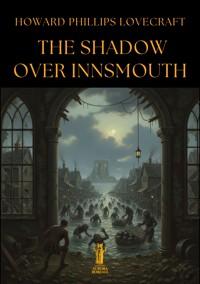
Written in 1931 and published in 1936, The Shadow Over Innsmouth is one of the most celebrated novellas by Howard Phillips Lovecraft. It is a fundamental pillar of the Cthulhu Mythos, blending elements of gothic horror, suspense, and the "cosmic dread" that defines Lovecraft’s literary legacy. Unlike many of his other stories which focus on scholarly research or distant stars, this tale brings the horror to a decaying, desolate town on the Massachusetts coast.
The story follows an unnamed protagonist (later identified as Robert Olmstead in Lovecraft’s notes) who is on a celebratory tour of New England. While looking for a cheaper way to reach Arkham, he hears of the shunned seaport of Innsmouth. Despite warnings from locals in neighboring towns about the "Innsmouth look" and the town’s sinister reputation, he decides to visit.
Once there, he finds a crumbling, foul-smelling ruins inhabited by people with strange physical deformities: bulging eyes, narrow heads, and scaly skin. Through a long, booze-fueled conversation with an old local named Zadok Allen, the protagonist learns the town’s dark secret: a pact made generations ago by Captain Obed Marsh with oceanic entities known as the Deep Ones. This pact traded human sacrifices for gold and plentiful fishing, eventually leading to the interbreeding of humans and monsters.
The novella culminates in a terrifying night-time escape as the protagonist is hunted through the streets of the town, followed by a shocking revelation regarding his own ancestry.
Das E-Book können Sie in Legimi-Apps oder einer beliebigen App lesen, die das folgende Format unterstützen:
Veröffentlichungsjahr: 2026
Ähnliche







SYMBOLS & MYTHS
HOWARD PHILLIPS LOVECRAFT
THE SHADOW OVER INNSMOUTH
Edizioni Aurora Boreale
Title:The Shadow Over Innsmouth
Author: Howard Phillips Lovecraft
Publishing series: Symbols & Myths
Editing, cover and illustrations by Nicola Bizzi
Edizioni Aurora Boreale
© 2025 Edizioni Aurora Boreale
Via del Fiordaliso 14 - 59100 Prato - Italia
www.auroraboreale-edizioni.com
INTRODUCTION BY THE PUBLISHER
Howard Phillips Lovecraft (1890-1937), often cited as H.P. Lovecraft, was an American writer, poet, literary critic and essayist, recognized as one of the greatest writers of horror literature together with Edgar Allan Poe and considered by many to be one of the precursors of Anglo-American science fiction. His works, a contamination between horror, soft science fiction, dark fantasy and low fantasy, have often been described, even by himself, with the term weird fiction (where weird stands for "strange"), being recognized among the main origins of the modern literary genre of the new weird.
Born in Providence, Rhode Island, on August 20, 1890, Lovecraft spent most of his life in New England. After his father's institutionalization in 1893, he lived affluently until his family's wealth dissipated after the death of his grandfather. Lovecraft then lived with his mother, in reduced financial security, until her institutionalization in 1919. He began to write essays for the United Amateur Press Association, and in 1913 wrote a critical letter to a pulp magazine that ultimately led to his involvement in pulp fiction. He became active in the speculative fiction community and was published in several pulp magazines.
Lovecraft moved to New York City, marrying Sonia Greene in 1924, and later became the center of a wider group of authors known as the "Lovecraft Circle". They introduced him to Weird Tales, which became his most prominent publisher.
Lovecraft's time in New York took a toll on his mental state and financial conditions. He returned to Providence in 1926 and produced some of his most popular works, including The Call of Cthulhu, At the Mountains of Madness, The Shadow over Innsmouth, and TheShadowOut ofTime. He remained active as a writer for 11 years until his death, on March 15, 1937, from intestinal cancer at the age of 46.
Lovecraft's literary corpus is rooted in cosmicism, which was simultaneously his personal philosophy and the main theme of his fiction. Cosmicism posits that humanity is an insignificant part of the cosmos and could be swept away at any moment. He incorporated fantasy and science fiction elements into his stories, representing the perceived fragility of anthropocentrism. This was tied to his ambivalent views on knowledge. His works were largely set in a fictionalized version of New England. Civilizational decline also plays a major role in his works, as he believed that the West was in decline during his lifetime. Lovecraft's early political views were conservative and traditionalist. Following the Great Depression, Lovecraft's political views became more socialist while still remaining elitist and aristocratic.
His interest in weird fiction began in his childhood when his grandfather, who preferred Gothic stories, told him stories of his own design. Lovecraft's childhood home on Angell Street had a large library that contained classical literature, scientific works, and early weird fiction. At the age of five, Lovecraft enjoyed reading One Thousand and One Nights, and was reading Nathaniel Hawthorne a year later. He was also influenced by the travel literature of John Mandeville and Marco Polo. This led to his discovery of gaps in then-contemporary science, which prevented Lovecraft from committing suicide in response to the death of his grandfather and his family's declining financial situation during his adolescence. These travelogues may have also influenced how Lovecraft's later works describe their characters and locations. For example, there is a resemblance between the powers of the Tibetan enchanters in The Travels of Marco Polo and the powers unleashed on Sentinel Hill in "The Dunwich Horror".
One of Lovecraft's most significant literary influences was Edgar Allan Poe, whom he described as his "God of Fiction". Poe's fiction was introduced to Lovecraft when the latter was eight years old. His earlier works were significantly influenced by Poe's prose and writing style. He also made extensive use of Poe's unity of effect in his fiction. Furthermore, At the Mountains of Madness directly quotes Poe and was influenced by The Narrative of Arthur Gordon Pym of Nantucket. One of the main themes of the two stories is to discuss the unreliable nature of language as a method of expressing meaning.
In 1919, Lovecraft's discovery of the stories of Lord Dunsany moved his writing in a new direction, resulting in a series of fantasies. Throughout his life, Lovecraft referred to Dunsany as the author who had the greatest impact on his literary career. The initial result of this influence was the Dream Cycle, a series of fantasies that originally take place in prehistory, but later shift to a dreamworld setting. By 1930, Lovecraft decided that he would no longer write Dunsanian fantasies, arguing that the style did not come naturally to him. Additionally, he also read and cited Arthur Machen and Algernon Blackwood as influences in the 1920s.
Aside from horror authors, Lovecraft was significantly influenced by the Decadents, the Puritans, and the Aesthetic movement. In his essay H. P. Lovecraft: New England Decadent, Barton Levi St. Armand, a professor emeritus of English and American studies at Brown University, has argued that these three influences combined to define Lovecraft as a writer. He traces this influence to both Lovecraft's stories and letters, noting that he actively cultivated the image of a New England gentleman in his letters. Meanwhile, his influence from the Decadents and the Aesthetic Movement stems from his readings of Edgar Allan Poe. Lovecraft's aesthetic worldview and fixation on decline stems from these readings.
The idea of cosmic decline is described as having been Lovecraft's response to both the Aesthetic Movement and the 19th century Decadents. St. Armand describes it as being a combination of non-theological Puritan thought and the Decadent worldview. This is used as a division in his stories, particularly in The Horror at Red Hook, Pickman's Model, and The Music of Erich Zann. The division between Puritanism and Decadence, St. Armand argues, represents a polarization between an artificial paradise and oneiriscopic visions of different worlds.
Throughout his adult life, Lovecraft was never able to support himself from his earnings as an author and editor. He was virtually unknown during his lifetime and was almost exclusively published in pulp magazines before his death. A scholarly revival of Lovecraft's work began in the 1970s, and he is now regarded as one of the most significant 20th-century authors of supernatural horror fiction. Many direct adaptations and spiritual successors followed. Works inspired by Lovecraft, adaptations or original works, began to form the basis of the Cthulhu Mythos, which utilizes Lovecraft's characters, setting, and themes.
* * * *
Written in 1931 and published in 1936, The Shadow Over Innsmouth is one of the most celebrated novellas by Howard Phillips Lovecraft. It is a fundamental pillar of the Cthulhu Mythos, blending elements of gothic horror, suspense, and the "cosmic dread" that defines Lovecraft’s literary legacy. Unlike many of his other stories which focus on scholarly research or distant stars, this tale brings the horror to a decaying, desolate town on the Massachusetts coast.
The story follows an unnamed protagonist (later identified as Robert Olmstead in Lovecraft’s notes) who is on a celebratory tour of New England. While looking for a cheaper way to reach Arkham, he hears of the shunned seaport of Innsmouth. Despite warnings from locals in neighboring towns about the "Innsmouth look" and the town’s sinister reputation, he decides to visit.
Once there, he finds a crumbling, foul-smelling ruins inhabited by people with strange physical deformities: bulging eyes, narrow heads, and scaly skin. Through a long, booze-fueled conversation with an old local named Zadok Allen, the protagonist learns the town’s dark secret: a pact made generations ago by Captain Obed Marsh with oceanic entities known as the Deep Ones. This pact traded human sacrifices for gold and plentiful fishing, eventually leading to the interbreeding of humans and monsters.
The novella culminates in a terrifying night-time escape as the protagonist is hunted through the streets of the town, followed by a shocking revelation regarding his own ancestry.
Key Themes:
Degeneration and Decay:
The physical rotting of the town mirrors the biological "corruption" of its inhabitants. Lovecraft explores the fear of hereditary taints and the loss of humanity.
Isolation:
Innsmouth is a closed society, cut off from the modern world, which allows its ancient, blasphemous traditions to thrive.
Cosmic Indifference:
The
Deep Ones
and their deities (Father Dagon and Mother Hydra) do not hate humanity; they simply view them as tools or vessels, highlighting the insignificance of man in the universe.
Fate and Inevitability:
The ending suggests that one cannot escape their bloodline, no matter how hard they try to run.




