


1,99 €
Mehr erfahren.
- Herausgeber: Quickie Classics
- Kategorie: Abenteuer, Thriller, Horror
- Sprache: Englisch
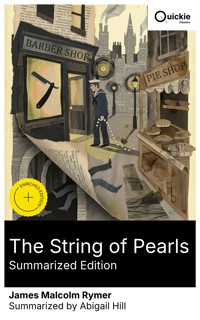
The String of Pearls inaugurates the legend of Sweeney Todd, the demon barber of Fleet Street, in a heady blend of urban Gothic, crime fiction, and sensational melodrama. Serialized in a penny weekly in 1846–47, the novel fuses labyrinthine London topography with a suspense engine of cliffhangers, shifting viewpoints, and theatrical set‑pieces. Its plot—pirated wealth condensed into the titular pearls, sailors vanished, customers dispatched through a barber's chair to become Mrs. Lovett's infamous pies—exposes anxieties about imperial plunder, class exploitation, and the mechanization of appetite and commerce. Stylistically brisk and lurid, yet thematically pointed, it stands at the crossroads of the Newgate novel and the Victorian city mystery, anticipating later urban Gothic by converting everyday trades into engines of terror. James Malcolm Rymer, a prolific master of the Victorian "penny dreadful," honed techniques of serial suspense within Edward Lloyd's publishing stable and elsewhere. His instinct for cliffhangers, vivid crowd scenes, and moral chiaroscuro—evident across his vast output, including Varney the Vampire—reflects an acute feel for working‑class readerships and for the press-fueled spectacle of metropolitan crime. The constraints and opportunities of serialization shaped his pacing, while the era's theatrical melodrama lent his prose its kinetic immediacy. Scholars of popular fiction, Gothic aficionados, and historians of media will find this a foundational text: a gripping, darkly comic anatomy of Victorian modernity whose influence, from stage to screen, still sharpens our taste for horror and social critique. Quickie Classics summarizes timeless works with precision, preserving the author's voice and keeping the prose clear, fast, and readable—distilled, never diluted. Enriched Edition extras: Introduction · Synopsis · Historical Context · Brief Analysis · 4 Reflection Q&As · Editorial Footnotes.
Das E-Book können Sie in Legimi-Apps oder einer beliebigen App lesen, die das folgende Format unterstützen:
Veröffentlichungsjahr: 2026
Ähnliche




















The String of Pearls (Summarized Edition)
Table of Contents
Introduction
In a city where appetites—financial, bodily, and moral—devour the unwary, trust becomes the most dangerous commodity. The String of Pearls, a Victorian sensation narrative set in London’s teeming streets around Fleet Street, first appeared as a mid-nineteenth-century penny dreadful and helped crystallize the enduring legend of a sinister barber. From its earliest installments, the story binds urban mystery to social unease, charting how expensive ornaments and everyday services intersect with secrecy, greed, and fear. This introduction presents the book’s milieu, premise, and themes without revealing its pivotal turns, inviting readers to experience its mounting dread and mordant wit as they were designed to unfold.
As a product of the cheap serial market that flourished in the 1840s, the tale embraces the penny dreadful’s speed, cliffhangers, and appetite for the grotesque while grounding its shocks in modern city life. Its London is a maze of barbers’ chairs, workshops, parlors, and cellars, where news travels fast and facts never quite catch up with rumor. Readers encounter crowded thoroughfares, fogs, and intimate interiors ruled by routine, all of which create a stage on which crime seems both exceptional and horribly ordinary. Often attributed to James Malcolm Rymer, the story also reflects the collaborative energy of the era’s bustling print culture.
The plot begins when a valuable necklace—the titular string of pearls—must be carried across the city and fails to reach its destination, raising questions that draw together a barber’s shop, a jeweler’s trade, and a circle of anxious acquaintances. From this straightforward errand, suspicion expands, and several determined figures pursue answers across streets, attics, and subterranean spaces. The narrative voice moves briskly and omnisciently, mixing taut suspense with sardonic asides to create an experience at once propulsive, theatrical, and keenly observant of daily habits. It is a labyrinthine pursuit that keeps consequences just ahead of certainty.
Written to be consumed in pieces, the story sustains momentum through reversals, confidences, and peril narrowly escaped, each episode sharpening a sense of invisible systems preying on the unwary. The prose delights in contrasts—public bustle and private terror, polished shopfronts and hidden mechanisms—while staging London as a character whose appetite for novelty masks an intimate acquaintance with vice. Humor surfaces even in grim moments, not to deflate horror but to implicate a curious public whose appetite mirrors our own. The effect is a rhythm of fascination and recoil that keeps readers both complicit and alert to the costs of looking.
At its core, The String of Pearls investigates how commerce organizes human relations, turning bodies, information, and even emotion into goods to be exchanged. It considers the ethics of service and the vulnerability of those who must submit themselves to the tools and schedules of others. Questions of justice run throughout: Who speaks for the missing, how does truth surface in a market of stories, and what forms of communal solidarity can resist predation in a city built on speed? The book’s villains and victims are legible types, yet their interactions expose enduring tensions between appetite, duty, and the fragile promise of trust.
For modern readers, these concerns feel strikingly current. The tale anticipates today’s fascination with true crime and the rumor mill, revealing how fear circulates as fast as news and how spectacle can numb compassion. Its portrait of precarious labor, extractive business models, and the blurred line between hospitality and exploitation resonates with service economies and urban inequality. Most enduringly, it asks how to recognize danger when it wears the reassuring costume of routine, a question that still haunts crowded streets, waiting rooms, and screens. The city’s churn may have changed, but the vulnerabilities it exploits are unsettlingly familiar.
Approached now, the book rewards historical curiosity and a visceral appetite for a scare, offering a blueprint of modern thriller craft wrapped in the cadences of Victorian prose. Read patiently or in swift gulps, it delivers escalating dread, vivid set pieces, and the satisfactions of ingenuity under pressure, while keeping a keen eye on social textures. Its legacy endures not only in the cultural figure it helped fix in the imagination but also in its reminder that civility without conscience is a razor’s edge. Enter the streets with care, and let the story show what barters beneath the surface.
Synopsis
The String of Pearls (1846–1847), a Victorian penny dreadful first serialized in The People's Periodical and Family Library and commonly attributed to James Malcolm Rymer, unfolds in a fog-choked London centered on Fleet Street. At its core stands a barber, Sweeney Todd, whose shop faces the busy thoroughfare and the bells of St. Dunstan's. The title refers to a valuable necklace whose sudden appearance and disappearance draw disparate lives into the same dark orbit. The narrative blends urban gothic menace with brisk serial pacing, establishing an atmosphere of commerce, anonymity, and hunger that frames the mysteries to come.
In the opening movements, a young messenger carrying the necklace seeks a shave on Fleet Street and vanishes soon afterward. His faithful dog's vigil hints at foul play, and rumors spread along coffeehouses and churchyards. The loss of the jewels, and the silence surrounding the courier's fate, send murmurs through London's mercantile and military circles. Questions accumulate: who owned the pearls, to whom were they bound, and why do the traces converge near a single barber's door? The serial format parcels out clues while sharpening the sense that a routine transaction has unlocked a deeper, more organized cruelty.
Parallel to this disappearance, the narrative follows Johanna Oakley, the daughter of a respectable craftsman, awaiting word of her betrothed, the sailor Mark Ingestrie. Reports of perilous voyages and whispered treasure suggest that a costly necklace may be bound up with Mark's absence. Determined and resourceful, Johanna presses beyond polite boundaries for news, finding unexpected allies among soldiers and tradesmen who sense that official inquiries will come too late. Her perspective grounds the story's domestic stakes, contrasting shop-counter light with the shadows of alleys, and it gives a human face to the question of how wealth, secrecy, and chance remake ordinary lives.
Across the street thrives Mrs. Lovett's pie shop, celebrated for its inexplicably abundant, inexpensive wares. Its success mirrors the barber's ceaseless custom, and passages beneath the neighborhood suggest traffic that the surface conceals. Todd's nervous apprentice, Tobias Ragg, notices patterns that respectable adults ignore and pays dearly for speaking up. The book dwells on locked doors, hidden routes, and institutional threats that can silence inconvenient witnesses, including the menace of private madhouses. As rumors congeal into suspicion, the proximity of a booming kitchen to a secretive barbershop begins to read less like coincidence and more like a grisly economy.
A widening circle of investigators, including a resolute military man, begins connecting testimonies from sailors, pie-shop workers, and parish officials. Maps of the old city, church vaults, and forgotten corridors become tools in assembling the truth behind vanished patrons and missing parcels. The String of Pearls relishes procedure as much as shock, alternating stakeouts and interviews with sudden perils that scatter the searchers. What unites these threads is a dawning recognition that London's prosperity can conceal predation, and that polite facades, when scaled up by ingenuity, can process human lives as efficiently as any factory.
Johanna's courage places her at the heart of the inquiry. She adopts a disguise to move unremarked between the pie shop and neighboring premises, gathering fragments others overlook. The necklace functions as both lure and ledger, tracing obligations between sailors, merchants, and households while pointing to a supply chain no one wants to name aloud. Glimpses behind counters and under grates reveal a system optimized for speed, profit, and secrecy, where witnesses disappear and wares never quite match their alleged origins. The serial escalates toward exposure, tightening the net around its central establishments without yet declaring how justice will fall.
Beyond its shocks, the tale endures for how it imagines the modern city: a place where appetite meets anonymity, and mechanical cleverness turns neighbors into resources. As a penny dreadful commonly attributed to James Malcolm Rymer, it exemplifies the form's cliffhangers, chorus of voices, and moral urgency, while introducing a figure—Sweeney Todd—who has since migrated into folklore and countless adaptations. The String of Pearls remains resonant for its questions about consumption, complicity, and the civility that hides violence. Even knowing a reckoning approaches, the work's power lies in the uneasy sense that the machinery enabling horror is stubbornly ordinary.
Historical Context
The String of Pearls (1846–1847) appeared as a penny dreadful in London, often attributed to James Malcolm Rymer (sometimes to Thomas Peckett Prest), and published by Edward Lloyd. Issued in inexpensive weekly numbers for a broad working- and lower-middle-class audience, it exploited advances in steam-powered printing and expanding literacy fostered by Sunday schools and Mechanics’ Institutes. Serial publication encouraged cliffhangers and rapid plotting, accompanied by woodcut illustrations. Lloyd’s publishing house had already popularized sensational crime tales and imitations of fashionable authors, contributing to a competitive, fast-moving print marketplace in the 1840s known for aggressive marketing, street hawkers, and vast circulation at the price of a penny.
Set in late eighteenth-century London, the narrative locates its menace among the workshops, courts, and taverns around Fleet Street and St. Dunstan-in-the-West, close to the Inns of Court and the city’s printing trade. The period evokes an urban fabric of narrow lanes and mixed occupations, where apprentices, journeymen, lawyers, and printers crossed paths daily. Britain’s maritime power under the East India Company linked London to distant ports, and sailors brought back luxury goods and prize money that circulated through the metropolis. This geography, compressed between commerce, law, and print, furnished a plausible stage for disappearances, rumors, and investigations in an era before systematic urban oversight.
In the story’s chosen timeframe, London relied on parish constables, night watchmen, and the Bow Street Runners, a small group of paid officers organized in the mid-eighteenth century under magistrates like Henry and John Fielding. Procedures were uneven, jurisdiction fragmented, and surveillance limited, decades before the Metropolitan Police were founded in 1829. Crime reporting circulated through broadsides, ballads, and the Newgate Calendar, shaping a popular appetite for lurid narratives and moral warnings. The novel draws on that milieu, presenting disappearances and clandestine enterprises as plausible within a city where detection depended on informants, magistrates’ offices, and ad hoc cooperation rather than standardized policing.
Although set earlier, The String of Pearls was written amid the “Hungry Forties,” when rapid urban growth, poverty, and disease troubled Victorian Britain. Edwin Chadwick’s 1842 report on sanitary conditions and the Public Health Act of 1848 reflected mounting concern over contaminated streets, tainted supplies, and unsafe trades. London’s meat provisioning, centered on markets such as Smithfield, had long drawn criticism for overcrowding and questionable practices, themes amplified by medical journals and reformers. Contemporary debates on food adulteration, flagged as early as Friedrich Accum’s 1820 exposé, fostered public suspicion. The novel’s fixation on shops, kitchens, and consumption echoes these anxieties about what city dwellers ingested.




