


1,99 €
Mehr erfahren.
- Herausgeber: DigiCat
- Kategorie: Für Kinder und Jugendliche
- Sprache: Englisch
In "The Tale of Peter Rabbit," Beatrix Potter weaves a charming narrative that combines whimsy with a subtle moral lesson about the consequences of disobedience. The story is enriched by Potter's exquisite original illustrations, which serve not just as visual companions but enhance the narrative's delicate balance of humor and adventure. Set in the picturesque English countryside, the book reflects the Victorian era's affection for nature while drawing upon folkloric traditions, encapsulating a timeless tale that resonates with both children and adults alike. Beatrix Potter, a pioneer of children's literature, drew on her own childhood experiences and deep love for nature while crafting this beloved story. Born into a well-to-do household in London, she spent her summers in the Lake District, which instilled in her an appreciation for the flora and fauna that would later populate her tales. Potter's background in art and her keen observational skills allowed her to breathe life into her characters, making them both relatable and enchanting for her young audience. "The Tale of Peter Rabbit" is a must-read for anyone seeking to revisit the innocence of childhood or introduce young readers to classic literature. Potter's masterful storytelling and enchanting illustrations create a delightful experience that emphasizes the joys and misadventures of curiosity, making this book a treasured addition to any library. In this enriched edition, we have carefully created added value for your reading experience: - A succinct Introduction situates the work's timeless appeal and themes. - The Synopsis outlines the central plot, highlighting key developments without spoiling critical twists. - A detailed Historical Context immerses you in the era's events and influences that shaped the writing. - An Author Biography reveals milestones in the author's life, illuminating the personal insights behind the text. - A thorough Analysis dissects symbols, motifs, and character arcs to unearth underlying meanings. - Reflection questions prompt you to engage personally with the work's messages, connecting them to modern life. - Hand‐picked Memorable Quotes shine a spotlight on moments of literary brilliance. - Interactive footnotes clarify unusual references, historical allusions, and archaic phrases for an effortless, more informed read.
Das E-Book können Sie in Legimi-Apps oder einer beliebigen App lesen, die das folgende Format unterstützen:
Veröffentlichungsjahr: 2023
Ähnliche





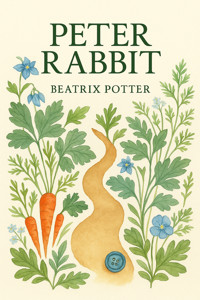



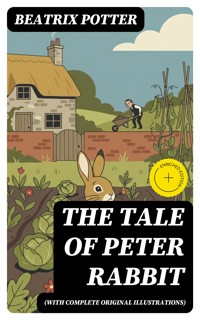
THE TALE OF PETER RABBIT (With Complete Original Illustrations)
Table of Contents
Introduction
A small rabbit, tugged between curiosity and caution, steps across a forbidden threshold and discovers that delight and danger can sprout from the same furrow of a well-tended garden.
First published in 1902, The Tale of Peter Rabbit endures as a classic because it distills childhood into its most recognizable impulses: boldness, appetite, and the testing of limits. Its concise language and clear, escalating action shaped expectations for the modern picture book, while its protagonist—at once spirited and vulnerable—has become a touchstone for generations of readers. The story’s balance of humor and genuine peril speaks across ages, inviting adults to remember and children to recognize themselves. Few works so gracefully unite narrative economy, visual charm, and psychological truth, which is why this slender tale continues to feel inexhaustibly fresh.
Beatrix Potter wrote and illustrated this work, first imagining the story in 1893 as a picture-letter for Noel Moore, the young son of a family friend. After privately printing it in 1901, she refined both text and images for its commercial publication by Frederick Warne & Co. in 1902. Emerging at the turn of the twentieth century, the book bridges late Victorian sensibilities and Edwardian publishing innovation. Potter’s dual role as author and illustrator gave her rare control over pacing, page turns, and visual emphasis, resulting in a unified design that set a model for later children’s literature.
At its core, the book presents a simple premise: a young rabbit, warned to avoid a certain garden, chooses otherwise and finds himself in a world where rules, risks, and appetites collide. The setting is intimate and legible to a child—hedges, rows of vegetables, tools, paths—yet it carries the weight of boundaries enforced by adults. This is a story of a brief adventure that feels momentous because it unfolds at child scale, where every gate is a threshold and every footstep can be a leap into consequence. The stakes are immediate without ever losing a playful tone.
Potter’s prose is notable for its restraint. She writes with clarity, rhythm, and measured understatement, allowing the smallest detail—a button, a leaf, a door—to carry narrative force. The sentences are crafted for reading aloud, moving briskly while leaving space for a listener’s breath. Humor arises naturally from action rather than commentary, and the narrator’s steady voice offers reassurance without dulling suspense. This economy of language respects young readers’ intelligence, guiding them through cause and effect with precision. The result is a story that teaches by showing, never resorting to heavy-handed moralizing or needless ornament.
The complete original illustrations are not mere decorations; they are the engine of the book’s momentum. Potter’s watercolors, grounded in close observation of animals and plants, give the tale a tangible world of texture and light. Perspective changes direct the eye, page turns function as cinematic cuts, and gestures of paws and ears convey emotion as eloquently as words. The sequence of images establishes timing—hesitation, dash, pause—that the text alone only suggests. Seen together, text and picture create a choreography of mischief and response that defined standards for visual storytelling in children’s books.
Part of the tale’s magic lies in how it blends realism with gentle anthropomorphism. Animals wear jackets and shoes, yet their movements, postures, and habitats feel recognizably natural. Gardens are drawn as working spaces with spades, pots, and labels; hedgerows are rendered with botanist’s care. This balance gives the story credibility a child can trust: the world looks right, so the adventure feels true. The human presence is mostly implied through tools and boundaries, an unseen order that contrasts with the rabbit’s impulsive energy and frames the action without overwhelming it.
The themes are elemental: curiosity, disobedience, and the swift arrival of consequences. Yet Potter treats these themes with nuance. The narrative does not scold curiosity; it acknowledges its allure and its costs. It recognizes parental guidance without erasing a child’s agency or resilience. The garden serves as both temptation and teacher—a place where appetite meets rule, and where learning is earned by experience rather than lecture. In this compact framework, Potter captures a timeless negotiation between safety and independence that every family knows and every child feels.
The book’s impact is visible in the evolution of the picture book itself. Its tightly integrated design—where words and images are inseparable—became a template for later creators. The character of Peter, lively yet fallible, helped popularize a mode of children’s storytelling that centers a childlike viewpoint without condescension. The tale has been translated widely and adapted in numerous media, testament to its flexibility and resonance. Its influence can be felt in works that value brevity, vivid imagery, and the meaningful calibration of suspense for young audiences.
Reading The Tale of Peter Rabbit aloud remains a small theatrical event. The rhythms invite participation, the pictures invite pointing and noticing, and the tension invites page-turning anticipation. Adults will appreciate the craft—the pacing of scenes, the deft escalation, the quiet humor—while children recognize the immediacy of the dilemma and the satisfactions of resolution. The story rewards repetition: details in foliage, posture, and background emerge anew with each visit. It is a primer in narrative structure as well as in empathy, offering a safe space to feel fear, delight, and relief.
This edition, with complete original illustrations, preserves the visual decisions that govern meaning: the placement of images, the progression of viewpoints, and the interplay of white space and color. Seeing the art as Potter arranged it restores the story’s full music—its pauses, crescendos, and rests. The watercolors’ delicate textures and precise linework communicate information at a glance that the text wisely leaves unsaid. For new readers, this provides an authoritative experience; for returning readers, it renews the quiet astonishment of a world minutely observed and perfectly scaled to the child’s eye.
More than a century after its debut, the tale speaks to contemporary concerns with surprising clarity. It honors children’s independence while acknowledging the responsibilities that shape it; it values the natural world as a place of wonder and boundary; it models consequences without cynicism. In an age crowded with noise, its simplicity feels radical—an invitation to attend, to notice, to learn by doing. That is why Peter’s brief adventure continues to feel alive: it mirrors the small, brave choices by which young readers test themselves, and it celebrates the care that welcomes them home.
Synopsis
Beatrix Potter’s The Tale of Peter Rabbit, first published in 1902, is a brief, vividly illustrated narrative that follows a young rabbit’s misadventure in a human garden. Written and illustrated by Potter, the story’s original watercolors accompany the text in editions that preserve her intended visual pacing and gentle humor. Set around a snug burrow and a nearby vegetable patch owned by Mr. McGregor, the tale introduces a small family of rabbits whose daily routines are shaped by caution and domestic order. Within this simple setting, Potter frames a childlike test of boundaries, curiosity, and consequence that unfolds with quiet, measured urgency.
The opening situates readers with a mother rabbit and her four children: three dutiful siblings and one more adventurous son, Peter. Before leaving them to their day, the mother establishes a clear rule concerning Mr. McGregor’s garden, a place associated with danger and a past family misfortune. The guidance is practical and protective, expressed as everyday wisdom rather than harsh command. This gentle warning sets the moral ground and defines the story’s central tension: the pull between obedience and impulse. With the home path outlined and safe alternatives offered, each youngster must choose how to spend the morning within or beyond prescribed limits.
Temptation quickly distinguishes Peter from his siblings. While the others keep to modest errands and simple fare, he slips under a boundary and into Mr. McGregor’s vegetable beds. The garden, richly planted and carefully tended, presents an overwhelming array of forbidden delights. Peter samples freely, moving from leaf to leaf with the heedless appetite of a child turned loose in abundance. Potter’s illustrations amplify the sensory pull: broad leaves, damp soil, and neatly labeled rows that make transgression feel both inviting and precarious. In this moment, pleasure masks risk, and Peter’s small act of defiance expands into a larger, consequential trespass.




